RBA should leave fiscal policy advice to the Treasury

RBA Governor Glenn Stevens gave an odd speech in Brisbane yesterday, in which he more-or-less suggested the federal Government should try to offset the demand shock from the end of the mining boom with expanded infrastructure investment, and that now is not the right time for fiscal tightening. The RBA apparently thinks it can’t reduce interest rates further to boost demand, given Sydney’s runaway housing market and also because, in its view, households have already borrowed enough and do not have capacity to go further into debt. So it is up to the Government to step in and boost demand, as business appears unwilling to invest. The Governor’s comments surprised financial markets, as you might expect, given the comments are inconsistent with the consensus view on the operation of monetary and fiscal policies in an open economy with a floating exchange rate, such as Australia’s.

As Tony Makin, among others, has argued vigorously in the past, fiscal policy is typically ineffective in an open economy with a floating exchange rate, and monetary policy is much more potent. According to the textbook model, this is because fiscal stimulus puts upward pressure on domestic interest rates and the exchange rate, crowding out exports (see New evidence stimulus worsened our competitiveness from Makin & Ratnasiri). This is widely recognised and is why macroeconomic stabilisation policy is seen as the role of the RBA. Prior to the floating of the Australian dollar in 1983, it was the Treasury’s responsibility, because, under a fixed exchange rate, it is fiscal policy that is effective, while monetary policy is ineffective.

Oddly, the RBA Governor has gone against this consensus and called for fiscal stimulus from the Federal Government through infrastructure spending. As the Governor himself may have hinted in his remarks, it is possibly too late to do so now, in the context of offsetting the shock from the end of the mining boom, given how long it would take to get projects designed, approved and built. And I don’t think it would be sensible anyway, due to the reason above, and also because it doesn’t seem wise to replace elevated levels of business investment, which were always likely and expected to be temporary, by high levels of government investment, particularly given some of the investment might be in projects of dubious merit. Further, as many commentators have noted, if the Federal Government doesn’t act to repair its Budget now, we run the risk of permanent deficits and, possibly, the loss of our AAA credit rating sometime in the future.

I would suggest Sydney’s overheated property market appears to be the reason for the RBA Governor’s odd remarks, and it is here that the RBA’s attention should be directed. Rather than giving odd and naive advice on fiscal policy, it should investigate the causes of the overheated Sydney market and advise on any regulatory or taxation policy changes that might be desirable.

Finally, I should note I attended the Governor’s speech yesterday as the Secretary of the Queensland branch of the Economic Society of Australia, which organised the lunch at which the Governor spoke. As a Management Committee member, I am very grateful that the Governor agreed to speak at our lunch, which was very well attended. Obviously, views expressed in this post are mine alone, and are not necessarily shared by my fellow Committee members.
Posted in Macroeconomy | Tagged , , , , , , | 4 Comments

QCA finds multiple policy failures associated with billions in industry assistance in Qld

industry_assistance

It appears that the QCA’s draft report on Industry Assistance in Queensland was released last Friday, a Friday before a long weekend, traditionally a good time to release reports that governments would rather be ignored and forgotten. But this report should not be ignored and forgotten, because it confirms ongoing, massive wastage of taxpayers’ money, on dubious schemes to assist industries such as tourism, film and racing, schemes that, as I’ve argued in the past, have no sound public policy rationale (see QCA review of Qld Govt industry assistance is great news). The report highlights poor policies in multiple areas, including drought assistance, the under-pricing of irrigation water, and subsidised electricity in regional areas, among many others.

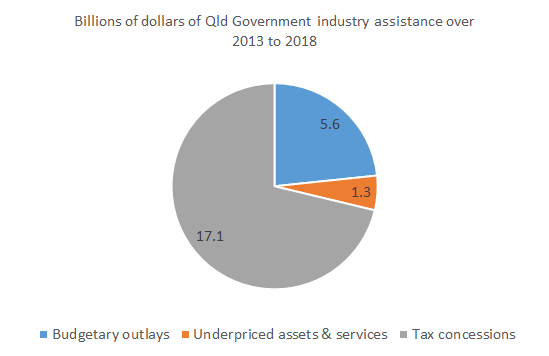
In total, the QCA estimates around $5.6 billion will be spent by the Queensland Government in budgetary outlays on industry assistance over 2013 to 2018, and additional assistance of $1.3 billion will be provided by underpriced assets and services (see chart above). There is also $17.1 billion in tax concessions, but, given this includes exemptions from bad taxes such as payroll tax, I’m less outraged by this revelation.

Regarding tourism, the report has an excellent section on assistance to the sector that I wish I’d read before writing my post on international visitors to Queensland earlier in the week, because it provides additional evidence regarding the failure of our tourism promotion efforts. On p. 102 the QCA notes:

While it could be the case that tourism in Queensland would have been worse without destination marketing, it is losing market share to other states and territories.

The Treasury should keep this in mind for the next time it sees a funding submission from Tourism and Events Queensland.

The Queensland Government could go a long way to getting out of the fiscal mess it is in if it closely reads this report and has the courage to stand up against the beneficiaries of industry assistance, who were no doubt happy this report was released in the lead up to the long weekend.

Posted in Industry policy | Tagged , , , , , , , , , , | 3 Comments

Qld Treasury’s forecasting record has improved in last few years, but big test to come

GSP_forecast_vs_actual

In the Mid-Year Fiscal and Economic Review at the end of 2014, Queensland Treasury downgraded its economic growth forecast for Queensland in 2014-15 from 3% to 2.5%, to reflect the weaker economic outlook. After Queensland’s technical recession in the last six months of 2014, in which gross state product (GSP) contracted by around 1 per cent (in seasonally adjusted terms), it appears that the GSP growth estimate for 2014-15 will probably need to be revised down even further at Budget time in July. And it is highly uncertain whether Queensland should still expect growth of around 5.75 per cent in 2015-16, although some of this growth appears guaranteed by LNG exports from Gladstone that are starting to boost Queensland’s export numbers.

As I’ve commented before, I have a lot of sympathy for Treasury in undertaking the challenging tasks of forecasting the economy and the Budget (see Brisbane ABC radio interview– why is budget forecasting so difficult?). At least Queensland Treasury appears to have improved its forecasting performance in the last few years relative to most of the years in the 2000s, in which the forecasting errors were much larger (see chart above). But, as I’ve tried to suggest above, there is a big test to come.

Posted in Budget, Macroeconomy | Tagged , , , , , , , , | 8 Comments

Victoria threatens to overtake Qld in international visitors

State_most_time_Jan15

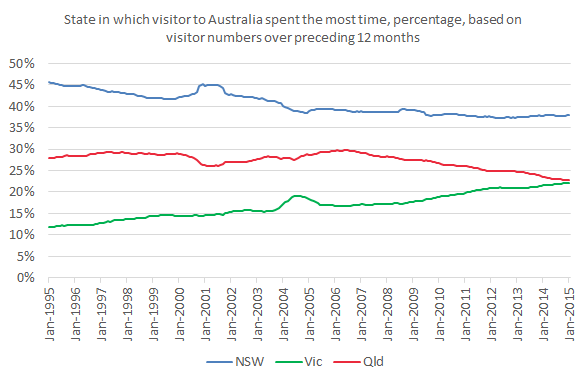
In a recent post, regarding new ABS data on the State or Territory in which short-term (i.e. for less than one year) international visitors to Australia spent the most time, Mark Beath asks: “Surely Victoria can’t really be about to overtake Queensland?” As Mark hints, this does appear to be likely, based on the historical trend (see chart above). The increase in Victoria’s share and decrease in Queensland’s share of international visitors is likely due to several factors:

  • the improved perception worldwide of Victoria as a tourist destination;
  • the trend increase in international student numbers over the last decade and Victoria capturing a larger share of international students than Queensland; and
  • members of the Australian diaspora who are now resident overseas returning home for a holiday to visit family and friends (as it would be expected a greater proportion of the diaspora would be from Victoria than Queensland due to the relative population sizes).

It would be useful for Tourism and Events Queensland to investigate the relative importance of these different factors to determine if there is something wrong with our tourism offerings or marketing. I’ve previously made critical comments on this issue: Qld should look to Victoria for tips on tourism promotion?

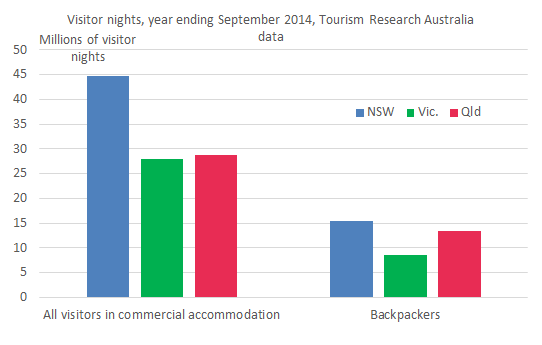
Queensland could learn from how Victoria has positioned itself as a sophisticated, cosmopolitan destination – e.g. the Play Melbourne campaign. While Queensland remains more popular than Victoria with backpackers (see chart below), I’m concerned it is losing its relative attractiveness to other tourists, as Queensland is only slightly ahead of Victoria in total visitor nights spent in commercial accommodation.

backpackers_Sep14

Posted in Education, Tourism | Tagged , , , , , , , , , | 2 Comments

Strategy is about asking the right questions

Seven_Strategy_Questions_Book_Cover-205x300

There is something alluring about the number seven. According to Miles Davis, there are seven steps to heaven, and, according to Harvard Business School Professor Robert Simons, there are seven important strategy questions for businesses to ask themselves. Professor Simons wrote my favourite book on business strategy, Seven Strategy Questions, and I’ve recently posted on it at the Effective Governance website:

Strategy is about asking the right questions

While recommending you read my post at the Effective Governance blog and seeking your views, I’d note that Pete Faulkner from Conus has already suggested to me that there should be an eighth question: “What value are you providing to your customer/s?” A fair comment, but it would unfortunately result in eight important strategy questions, and eight is nowhere near as nice a number as seven. Regardless, the important thing is that businesses should be asking themselves challenging questions, rather than relying on whatever is the latest fad in management consulting.

Posted in Uncategorized | Tagged , | Leave a comment

Qld economy enduring shock from end of mining boom as well as could be expected

SFD_Mar15

The March quarter National Accounts data released yesterday surprised on the upside with quarterly growth at 0.9 per cent, but as some commentators have noted there remains a downside risk over the next 12-24 months from much lower capital expenditure than once expected (see comments from Capital Economics’ Daniel Martin reported in Business Day). The new National Accounts data also give hope that Queensland’s technical recession may not extend into 2015 after all, with State Final Demand slightly growing in the March quarter, although at a much lower rate than in NSW and Victoria (see chart above). While the fall in resources sector capital expenditure is a big drag on the State economy, Queensland has benefited from a surge in residential dwelling investment, a good rate of consumption growth, and a big increase in investment by the State and local governments in March quarter.

Once Queensland’s recent strong export performance is considered, noting it is not including in the State Final Demand figures in the chart above, there is reason to be positive that Queensland is enduring the end of the mining boom as well as could be expected. On Queensland’s recent good news on exports, see the excellent National Accounts: State Details brief produced yesterday by Queensland Treasury’s Ryan Faulkner. On the March quarter National Accounts, I’d also recommend Pete Faulkner’s commentary GDP surprises on the upside. QLD returns to growth.

Note that, in the chart above, domestic final demand is shown as 0.0 per cent for Australia in March quarter. This can be reconciled with the reported GDP growth of 0.9 per cent by recognising that the domestic final demand figure does not take into account net exports or changes in inventories/stocks, which were both major contributors to Australia’s surprisingly good rate of economic growth in March quarter.

Posted in Macroeconomy, Mining | Tagged , , , , , | 2 Comments

Brisbane City Council made right decision on Toowong towers

Brisbane City Council deserves credit for ignoring its own City Plan and approving the development of three new high-rise apartment towers at the old ABC site at Toowong (see Toowong towers nine storeys too high: Labor lord mayoral candidate). I’ve commented previously on the need to boost the population density in inner city suburbs, and particularly in those well serviced by public transport, such as Toowong, which has bus stops, a train station, ferry terminal and access to the Bicentennial Bike-way. Also, regular readers will be familiar with Brad Rogers’s guest post from 2013 on Old Queenslanders in a New City, which discusses the economic costs associated with low population density and urban sprawl, which is more expensive to service with transport infrastructure.

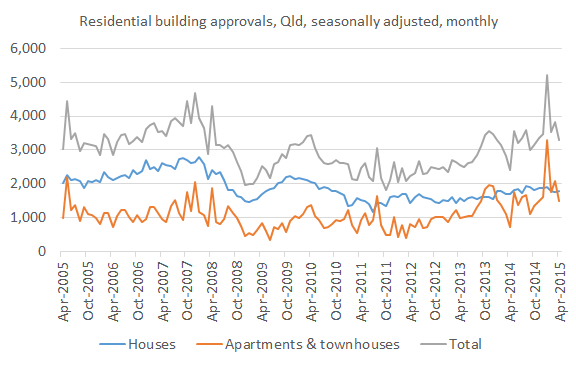
As well as the compelling micro-economic arguments for having a more liberal attitude to development, there is currently a good macro-economic argument, as residential building is essential in helping the economy adjust to the end of the mining boom (see Residential dwelling investment crucial to re-balancing of Queensland economy). Luckily we had a good start to 2015 with a surge in building approvals earlier in the year, but monthly approvals have fallen back a bit since then (see chart below based on ABS data released earlier this week and see Pete Faulkner’s post on the new data). It remains important, therefore, that councils have a liberal attitude to new developments, and I’m very happy the Brisbane City Council appears to have adopted such an attitude recently.

approvals_Apr15

Posted in Housing | Tagged , , , , , , , , | 8 Comments

Upcoming Young Economists Coffee Connections to discuss negative gearing & capital gains tax treatment

I await with interest the Hansard transcript of Treasury Secretary John Fraser’s testimony before Senate Estimates in Canberra yesterday, because in his reported comments he appears to be saying that any housing price bubble that may exist in Australia isn’t an issue for the Treasury, but rather for the RBA and APRA (see Brisbane Times coverage). However, the Treasury is responsible for policy settings relating to negative gearing and the (concessional) tax treatment of capital gains that have a large impact on the property market by encouraging households to take on “too much debt and risk”, according to the Henry tax review (see p. 73 of Part 2, Volume 1).

The Henry tax review was clear about the need to reform policy settings for taxing assets that yield capital gains, such as property and shares, and it’s odd that the current Treasury Secretary doesn’t appear to see any issues the Treasury needs to address regarding the property market.

Negative gearing and the tax treatment of capital gains are thus very topical issues and it’s fantastic that the Young Economists will be discussing these issues at its June Coffee Connections morning Friday next week at the Gresham Bar in Gresham Lane, Brisbane CBD:

Coffee Connections – Friday 12th June – Special Edition

I will start the Coffee Connections discussion off with a short presentation on the public finance and macroeconomic issues relating to negative gearing and capital gains taxation. I will consider impacts on the housing and rental markets, as one of the major objections to reforming the current system is that changes would affect the supply of rental housing, possibly increasing rents. Indeed, the Henry review (p. 74) acknowledges negative gearing “may place downward pressure on rents though it is poorly targeted to this purpose.”

I’m hoping for a lively discussion on these issues Friday week. While I don’t think there is anything wrong with negative gearing as a principle, it is becoming increasingly obvious that current tax policy settings are less than optimal and need reform. The exact nature of that reform is open to debate.

Posted in Housing, Tax | Tagged , , , , , , | 2 Comments

Business confidence in Queensland – the most reliable estimate (Westpac-CCIQ) is the most worrying

There is currently a large disparity among business confidence survey results for Queensland. The Sensis and Westpac Group-CCIQ reports for the March quarter suggest business confidence is relatively low, but the NAB report for the month of April, which the Queensland Treasurer frequently cites, is much more positive, with Queensland leading Australia on business confidence (see the Brisbane Times article Queensland businesses among most pessimistic in nation). But, as I’ll explain below, although the NAB survey might give reliable estimates of business confidence at a national level, there is very likely a large margin of error for its Queensland estimates, and, in my view, the Westpac Group-CCIQ estimates are likely to be most accurate for Queensland. The sample sizes for the State-level estimates in the NAB and Sensis surveys are so small that the resulting State-level estimates of business confidence have very high margins of error.

Let’s first consider the key findings of the different surveys:

  • According to NAB’s Monthly Business Survey, business confidence in Queensland was +7, which appears to mean that optimistic businesses outnumber pessimistic businesses by 7 percentage points (i.e. 53.5% of businesses optimistic 46.5% pessimistic), the highest level among Australia states;
  • The Sensis Small Business Index Survey for March found Queensland had an index score for the net balance of business confidence of +10, the second lowest in Australia, beating only SA which was at +6, and much lower than the national index of +27; and
  • The Westpac Group CCIQ Pulse Survey found business confidence in the Queensland economy was at its lowest level in six years in March quarter 2015 at an index level of 37.7, which a table at the back of the survey report suggests is a “poor” reading, and that 50 per cent of Queensland businesses expect the economy to get weaker, and only 14 per cent expect it to get stronger.

There are definitional differences for the indices, timing differences (March versus April 2015), and issues of coverage, with the Sensis and Westpac Group-CCIQ surveys focussing on small and medium enterprises, but my feeling is that the surveys cannot be reconciled according to these differences, given the NAB survey appears much more positive for Queensland than the others. For instance, I can’t think of any change in April that would have caused Queensland businesses to become more confident than they were in the previous month.

So I would look instead at the sample sizes of the different surveys. Sample size is very important because it has a very large impact on the reliability of survey estimates. The Westpac Group CCIQ Pulse survey has the largest sample size for Queensland businesses, typically 800+ each quarter. Sensis surveys only 183 Queensland businesses, while NAB reports surveying 410 businesses across Australia, which means it may have only surveyed around 80 to 100 Queensland businesses.

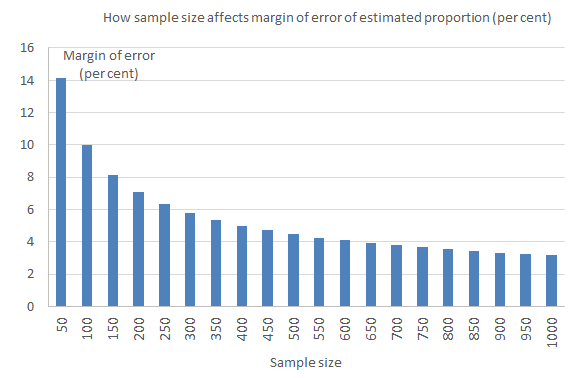
With such a relatively small number of respondents in Queensland, the margin of error associated with the NAB survey is likely to be larger than that for the Sensis survey and much, much larger than that for the Westpac Group CCIQ Pulse survey, which has the type of sample size you really need to have confidence in the results for Queensland. Consider how the margin of error (95% confidence interval) for a proportion varies with the survey size in the figure below (N.B. for the purpose of the figure I’ve assumed the true proportion in the population that the survey is trying to estimate is 50 per cent; also see the nice figure in the Wikipedia entry on margin of error).

error_margin

Finally, despite all the attention given to business confidence measures, it is possible that survey measures of business confidence don’t give us much of a guide to the future, or at least they don’t tell us anything we don’t already know based on looking at the most recent economic data. That was the conclusion of a very interesting RBA discussion paper from 2001 What do sentiment surveys measure? I highly doubt the survey techniques would have improved enough since then to doubt the currency of the paper’s findings.

Posted in Macroeconomy | Tagged , , , , , , , , , | 2 Comments

Mining leads fall in private sector capital expenditure – Qld technical recession may extend into 2015

privatecapex

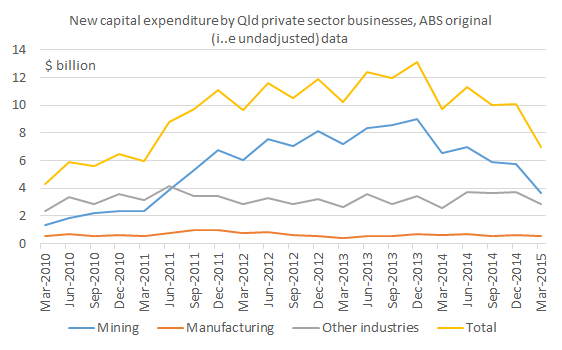
The technical recession Queensland experienced in late 2014 may extend into early 2015 based on new ABS data showing the large drop in mining investment from its extraordinarily high levels has continued into the March quarter of 2015 (see chart above).

The new capital expenditure data are for private sector businesses, so they do not include dwelling investments by households, which many economists are hoping will continue to record the increases they have recently and will hence provide some offset to the decline in investment being led by the resources sector.

On a positive note, private sector capital expenditure in Queensland outside of mining was up 5.6% through-the-year (noting that a quarterly comparison is unreliable given the data are not seasonally adjusted and investment is typically lower in the March quarter).

That said, based on what businesses nationally are telling the ABS about their future investment plans, the economic outlook now appears unfavorable, as leading economics commentator Peter Martin has observed (Economic outlook slips from ‘bleak to recessionary’).

Regarding the Federal Treasurer’s criticism of the Queensland Government reported in the Courier-Mail this morning (Treasurer Joe Hockey blames Queensland’s lack of asset sales for business doldrums), I’ve consistently made the point that the lack of privatisation proceeds implies lower than desirable infrastructure spending in Queensland in the next few years (see New Qld Govt faces big fiscal challenges). There is no doubt that the reduction in the pipeline of work has created considerable anxiety for construction and engineering businesses across the State.

Posted in Macroeconomy, Mining | Tagged , , , , , , | Leave a comment