There are growing calls to increase taxes on the wealthy in advanced economies such as the United States and Australia. For instance, US Congresswoman Alexandria Ocasio-Cortez controversially wore a white evening dress with the words Tax the Rich written in red across it to the 2021 Met Gala. To get an informed and objective view on taxing the wealthy, I invited Professor Miranda Stewart from the University of Melbourne Law School onto my Economics Explored podcast for Episode 112 Taxing the Rich – Billionaire and Inheritance Taxes. Miranda is the Director of the Tax Group at the Law School, and she is also a Fellow at the Tax and Transfer Policy Institute at the Crawford School of Public Policy, the Australian National University.
I reached out to Miranda after I read her comments in an Australian Nine media article titled Death duties: Why experts think this tax should be re-introduced. We haven’t had death duties in Australia since Sir Joh abolished them in Queensland in the seventies and other states followed his lead. I expect there will be growing pressure to re-introduce politically unpopular death duties in Australia over the coming decades, particularly given what John Quiggin has labelled The coming boom in inherited wealth. This is definitely an issue to watch.
Prof. Miranda Stewart, University of Melbourne Law School
Please feel free to comment below. Alternatively, you can email comments, questions, suggestions, or hot tips to contact@queenslandeconomywatch.com. I also post from time-to-time on my business website adepteconomics.com.au, so please consider subscribing to updates there (Get in touch). Also please check out my Economics Explored podcast, which has a new episode each week.
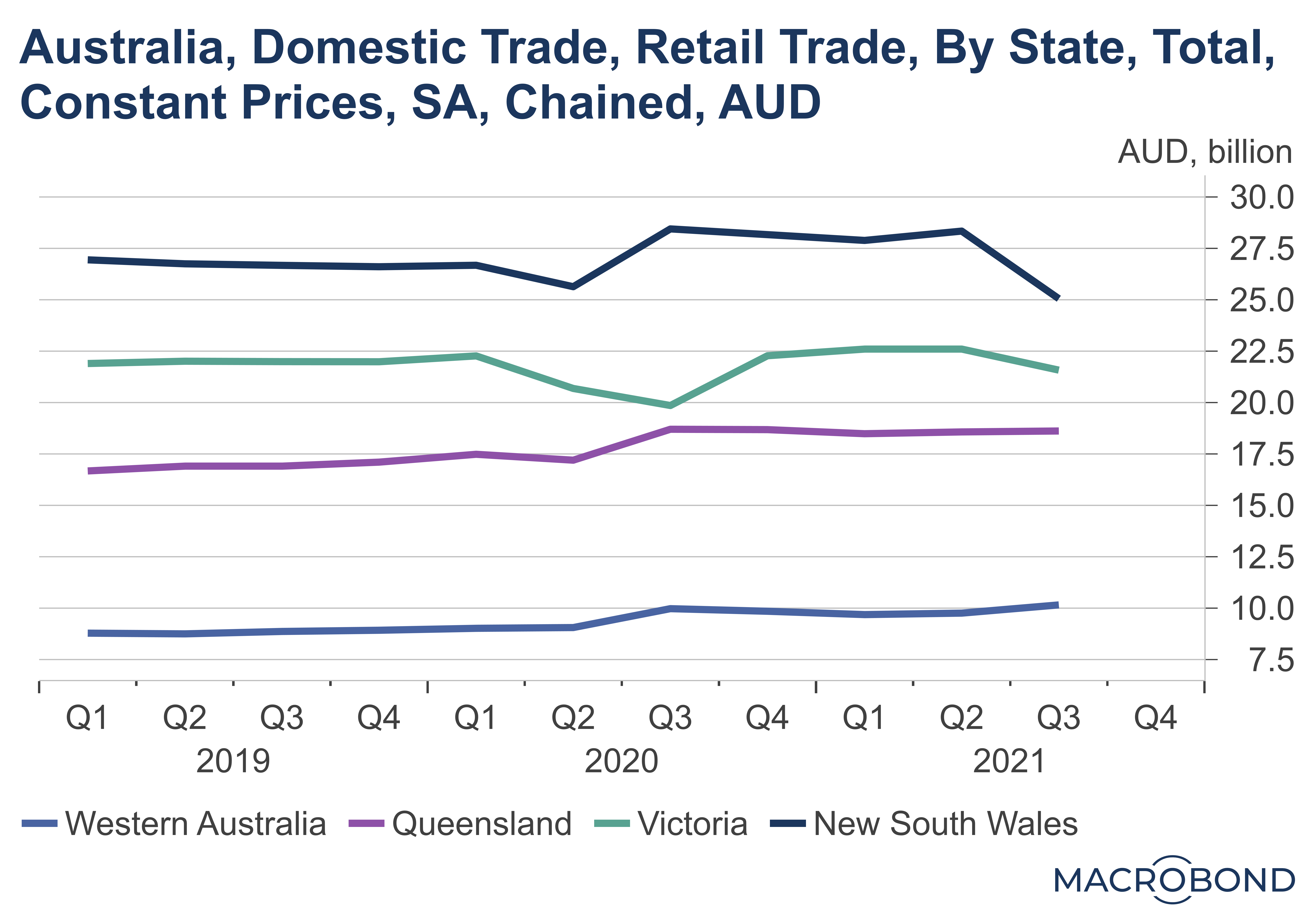
Let’s hope the Queensland Government doesn’t impose a lockdown in response to the new cases coming out of Goondiwindi, as the ABS’s estimates of retail turnover for September quarter show us once more the large adverse impact that lockdowns have on retail turnover (e.g. see Lockdowns see record 4.4% fall in quarterly retail sales and the chart below for the major states). As I’ve commented before, Queensland has been performing much better than the states which were locked down the longest. Queensland’s retail trade (in real terms) was up 0.2% in September quarter, which is probably consistent with state population growth running at under 1% per annum at the moment (see this ABS report). I suspect retail trade in Queensland would have grown much faster in September quarter if it weren’t for the short SEQ lockdowns we had in July and August and various interstate travel restrictions. Consider that WA was up 4.1%, SA was up 1.7%, and Tasmania was up 2.2%, in terms of retail trading volumes in September quarter.
I’m livestreaming my latest Economics Explored Live show later today, at 11.30am Brisbane time, and you can watch me via YouTube if you’d like to watch:
Please feel free to comment below. Alternatively, you can email comments, questions, suggestions, or hot tips to contact@queenslandeconomywatch.com. I also post from time-to-time on my business website adepteconomics.com.au, so please consider subscribing to updates there (Get in touch). Also please check out my Economics Explored podcast, which has a new episode each week.
As expected, the Queensland Government has brushed off One Nation MP Stephen Andrew’s e-petition to “Restore Democracy in Queensland”, citing the “enduring emergency” from COVID-19. The Government still claims the emergency powers it gave to the Chief Health Officer in early 2020 are “temporary”, although by the time they expire on 30 April 2022 they will have been in place for over two years, and who is to say they won’t be extended again? How’s that for “temporary”? For information, here is a link to the Health Minister’s response to the e-petition which was circulated to people who signed the petition:
I was a supporter of the petition (e.g. see my 21 July post), and I originally spoke out against the perpetual extension of “temporary emergency powers” back in January (e.g. see my 14 January post), because what the Government has done over the last 18-20 months has clearly breached traditional norms of parliamentary democracy. While our state government has been nowhere near as bad as Victoria’s, it has still enacted undemocratic measures and has treated people locked out of Queensland, including many Queenslanders, with cruelty. The Government claims it is all for the greater good, but I expect many more of us will come to doubt that as the years pass. Gigi Foster and Paul Frijters make a strong case that many countries, including Australia, were overcome by a wave of panic last March in their excellent book The Great COVID Panic, co-authored with Michael Baker.
We now await the inevitable spread of COVID in Queensland, particularly in our regions with low vaccination rates (e.g. Mackay, Rockhampton, parts of FNQ, and the Gold Coast relative to Brisbane). Will our stressed public hospital system cope? Will the Government impose regional lockdowns, threatening the viability of hospitality businesses if they can’t trade over the holiday period? I really don’t know, but I know senior people in industry are worried. I spoke at Capricorn Enterprise’s Major Projects Forum in Rockhampton last Thursday and QRC boss Ian Macfarlane gave an impassioned plea for people in regional Queensland to get vaccinated, as did Robert Sobyra from Construction Skills Queensland. Broadly speaking, Queensland’s economy has been recovering better than expected, but there’s always the chance of the Government imposing some new lockdowns as COVID spreads, setting us back again.
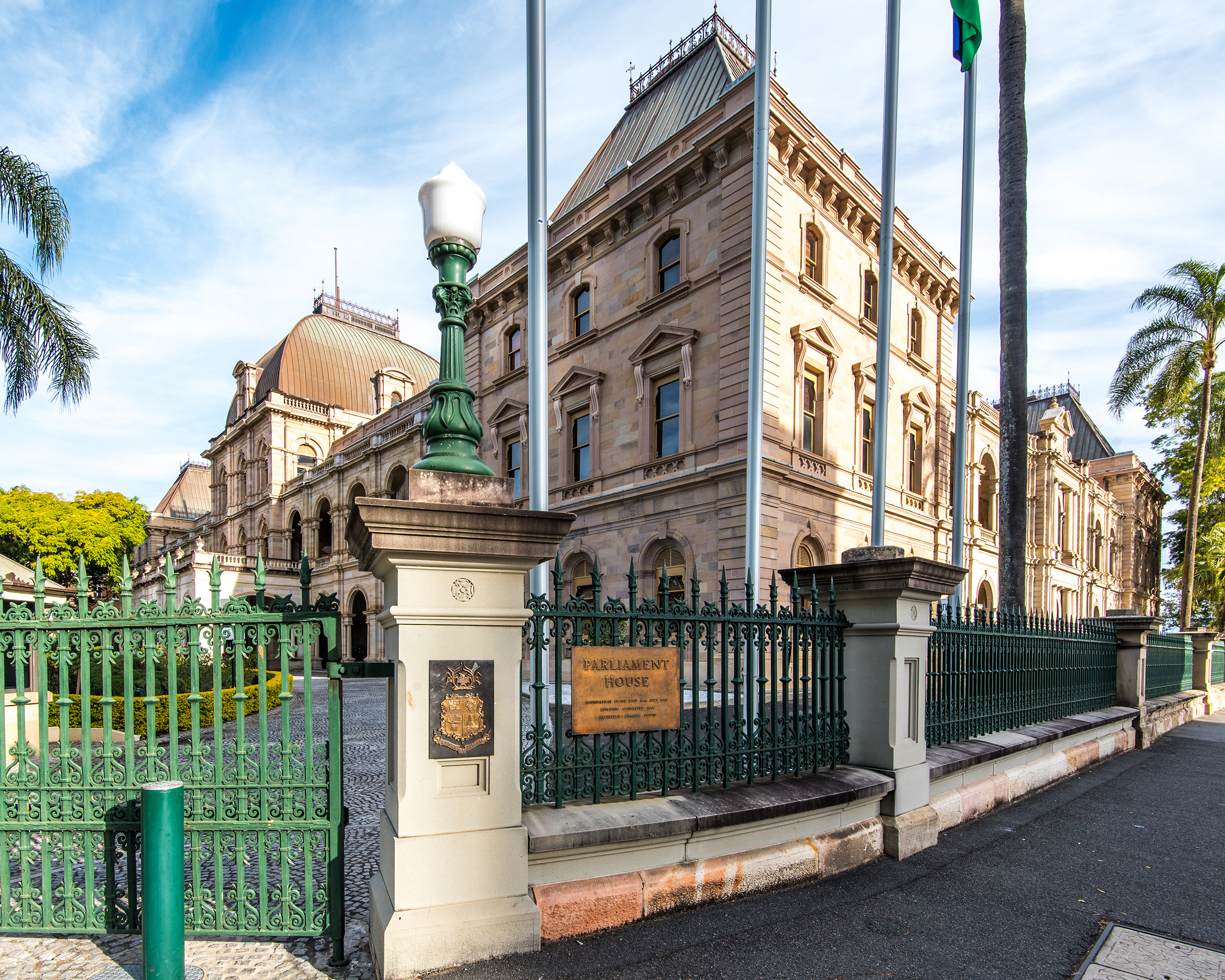
Qld Parliament House, corner of Alice and George Streets, Brisbane City.
Please feel free to comment below. Alternatively, you can email comments, questions, suggestions, or hot tips to contact@queenslandeconomywatch.com. I also post from time-to-time on my business website adepteconomics.com.au, so please consider subscribing to updates there (Get in touch). Also please check out my Economics Explored podcast, which has a new episode each week.
Decarbonising the economy to address climate change will disproportionately impact Queensland relative to the rest of Australia, particularly given the importance of coal mining to some of our regional economies and to our state Treasury through royalties. I’m holding a seminar on Decarbonising the Queensland Economy on Tuesday 9 November (from 4.30pm for 5pm commencement of presentation) at HopgoodGanim Lawyers, Waterfront Place, Brisbane.
The seminar will be held in conjunction with Effective Governance, HG’s corporate governance practice, and will include some words from the EG CEO Cate Jolley. Drinks and canapes will be provided. You can book via the Eventbrite page for the event:
The seminar presentation (by me) and following discussion will consider a range of complex issues, including:
Which Queensland industries and major companies will be most impacted by decarbonisation?
How should company boards be preparing for decarbonisation?
What is the future for coal mining and coal-fired power in Queensland and how will regions adapt to future structural change?
Will structural adjustment assistance be required for the most-affected regions (e.g. Biloela and Bowen Basin mining communities)?
What are the implications for agriculture in Queensland, particularly given cattle are a substantial source of greenhouse gas emissions?
How rapidly can renewables replace coal-fired power given their implications for the reliability of the electricity network? Will battery technology prove sufficient in conjunction with renewables to ensure reliable and cost-effective power? Or will we need to consider other technologies (e.g. pumped hydro or nuclear)?
What are the real prospects for Queensland developing a hydrogen economy?
Please come along if you’re interested and available. I’d love to see you there.
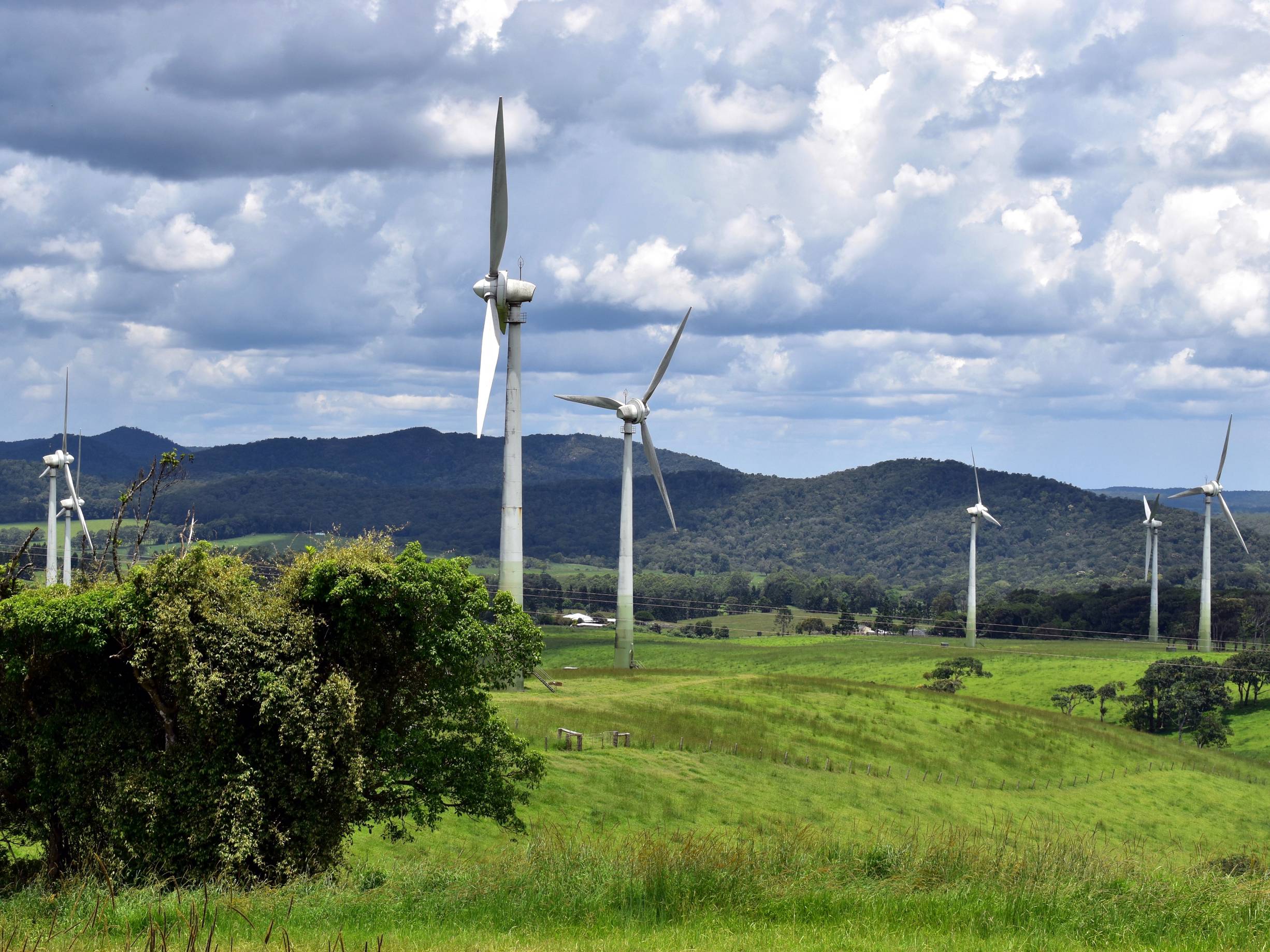
Wind farm, near Atherton, North Queensland.
Please feel free to comment below. Alternatively, you can email comments, questions, suggestions, or hot tips to contact@queenslandeconomywatch.com. I also post from time-to-time on my business website adepteconomics.com.au, so please consider subscribing to updates there (Get in touch). Also please check out my Economics Explored podcast, which has a new episode each week.
In Episode 111 of my Economics Explored podcast, Queensland Senator Matt Canavan explains why he opposes the Net Zero greenhouse gas emissions by 2050 objective. We have a wide-ranging conversation covering COP26, nuclear energy, hydrogen, China, the US political situation (particularly Joe Manchin) and what that means for US climate change policy, and the outlook for coal, among other issues. On hydrogen, Matt tells a great story about Queensland’s short-lived attempt to develop a hydrogen industry in the eighties, involving Sir Joh and a hydrogen-powered car which, according to Sir Joh, relied on a nuclear fusion reaction! I’ve included a link to the Seven News retrospective on that incident in the show notes which you can access via the link above.
On my business website, I’ve also published a transcript which was originally generated using the AI transcription service Otter and which has been edited to fix up transcription errors.
Please feel free to comment below. Alternatively, you can email comments, questions, suggestions, or hot tips to contact@queenslandeconomywatch.com. I also post from time-to-time on my business website adepteconomics.com.au, so please consider subscribing to updates there (Get in touch). Also please check out my Economics Explored podcast, which has a new episode each week.
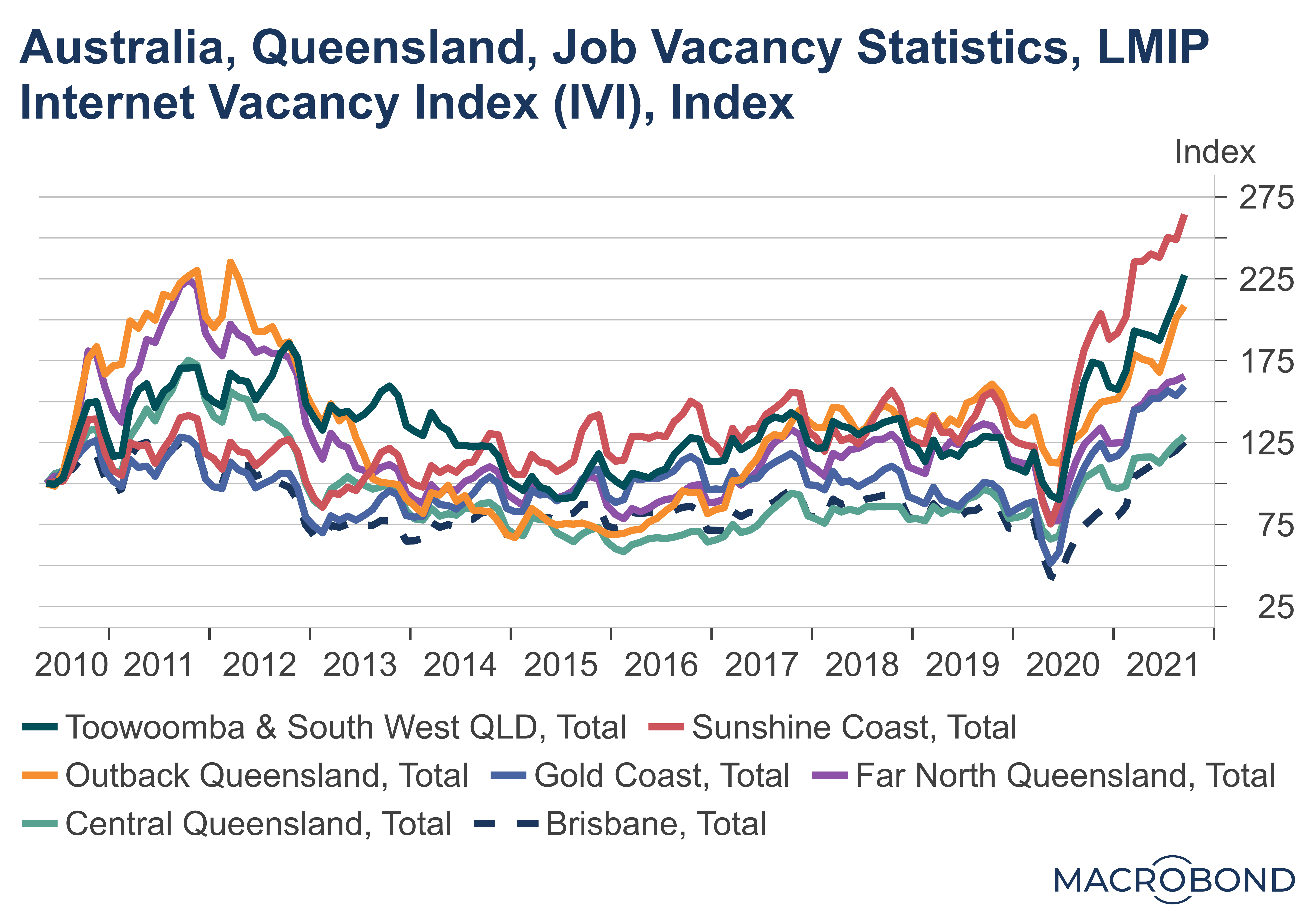
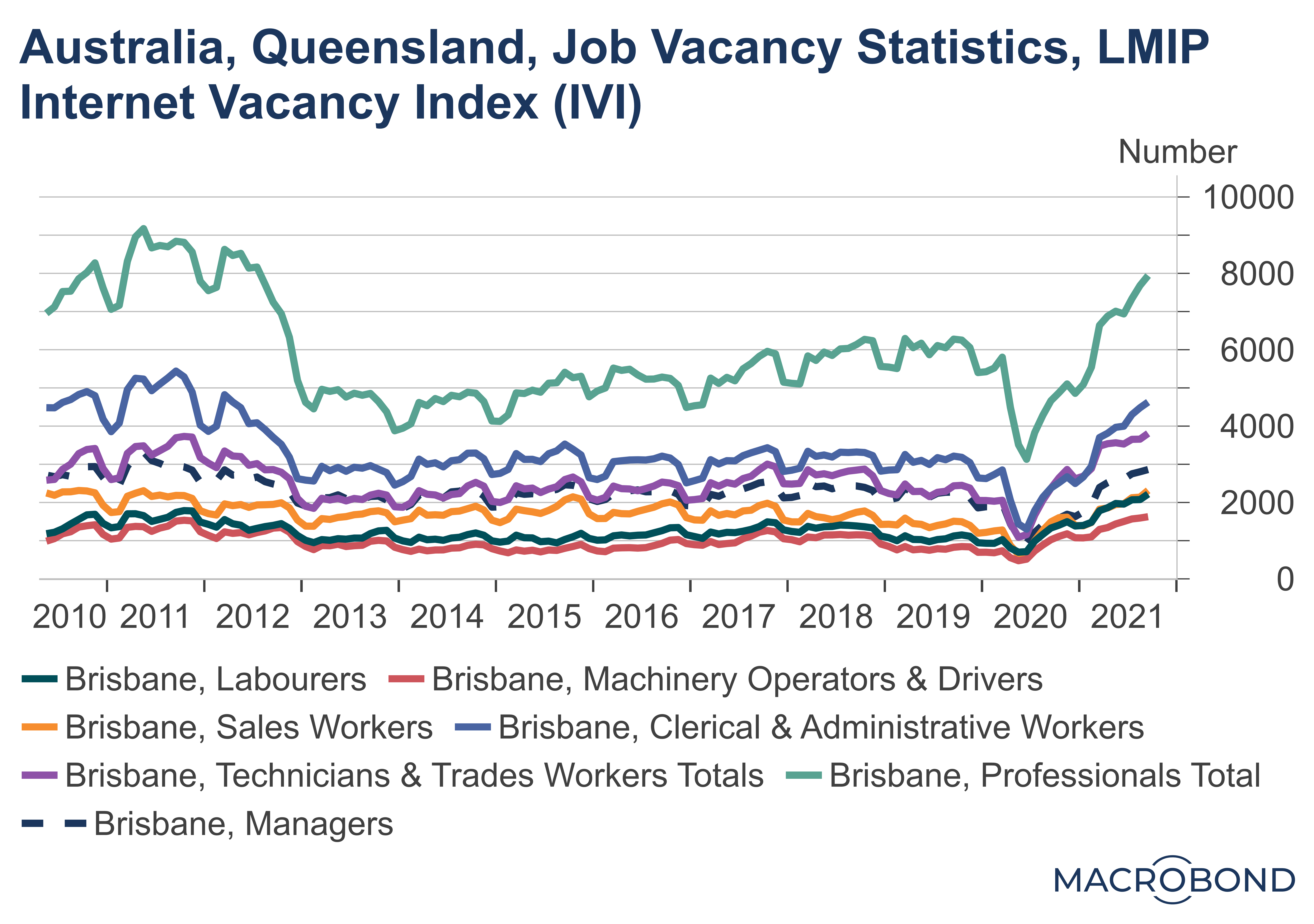
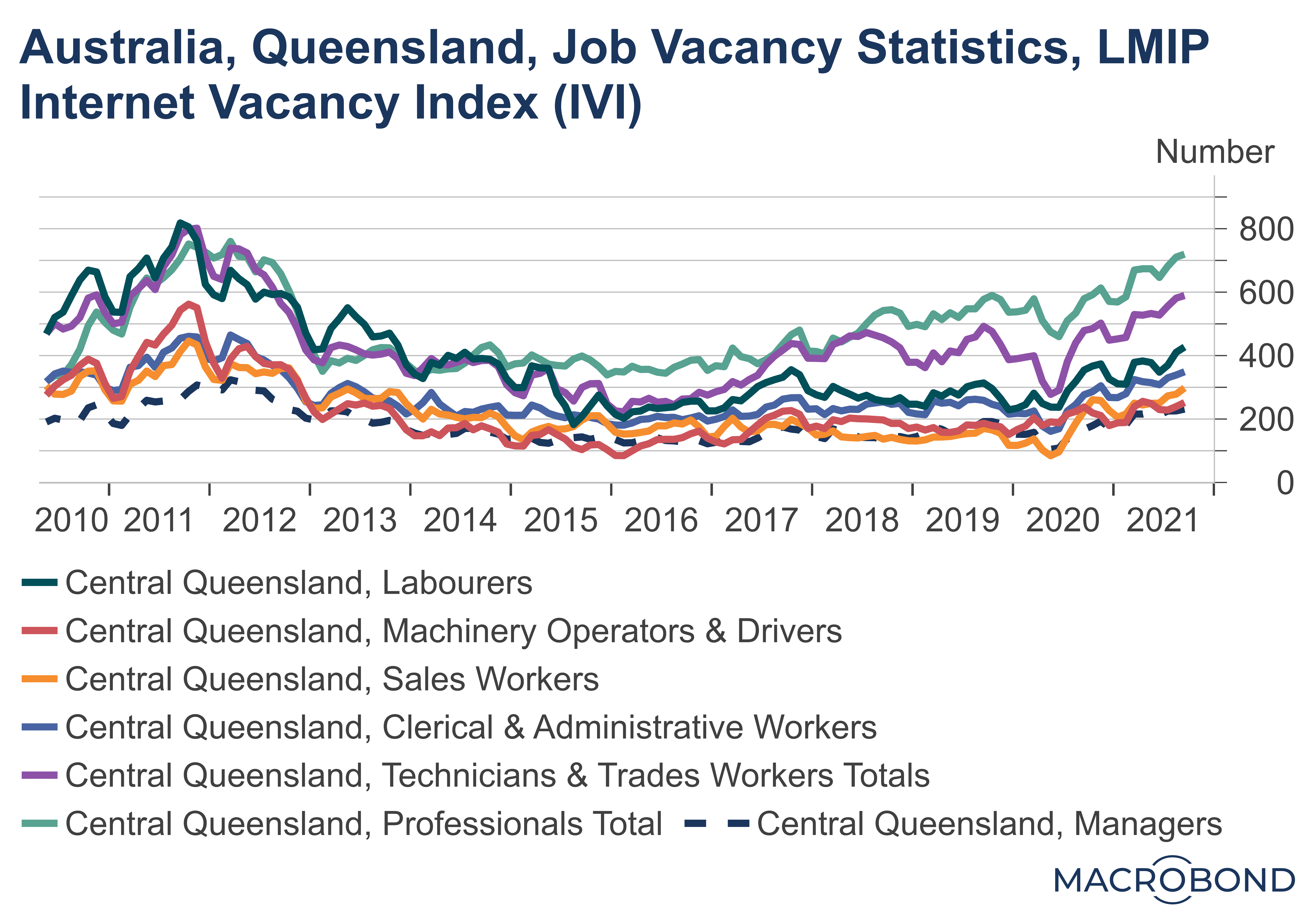
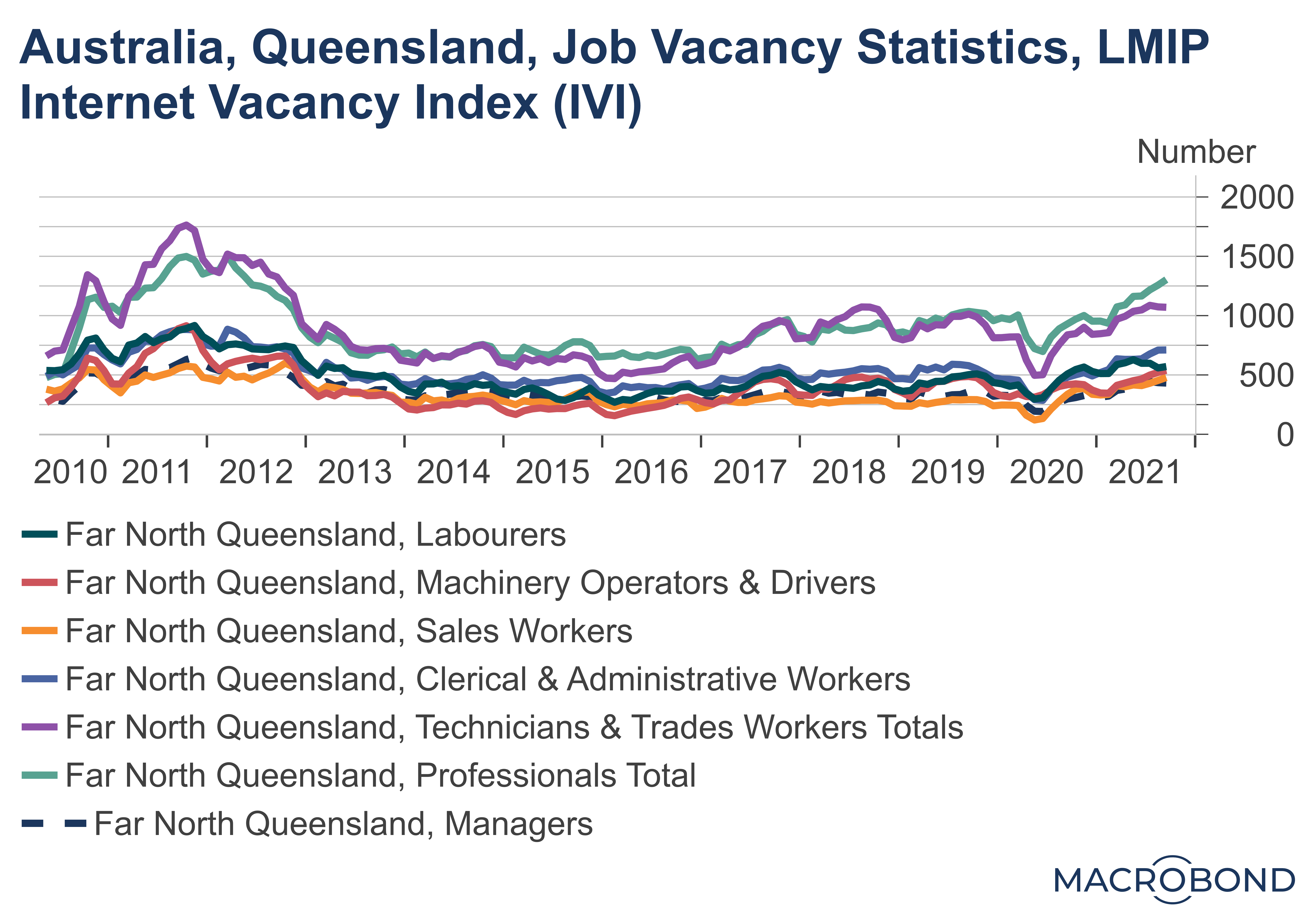
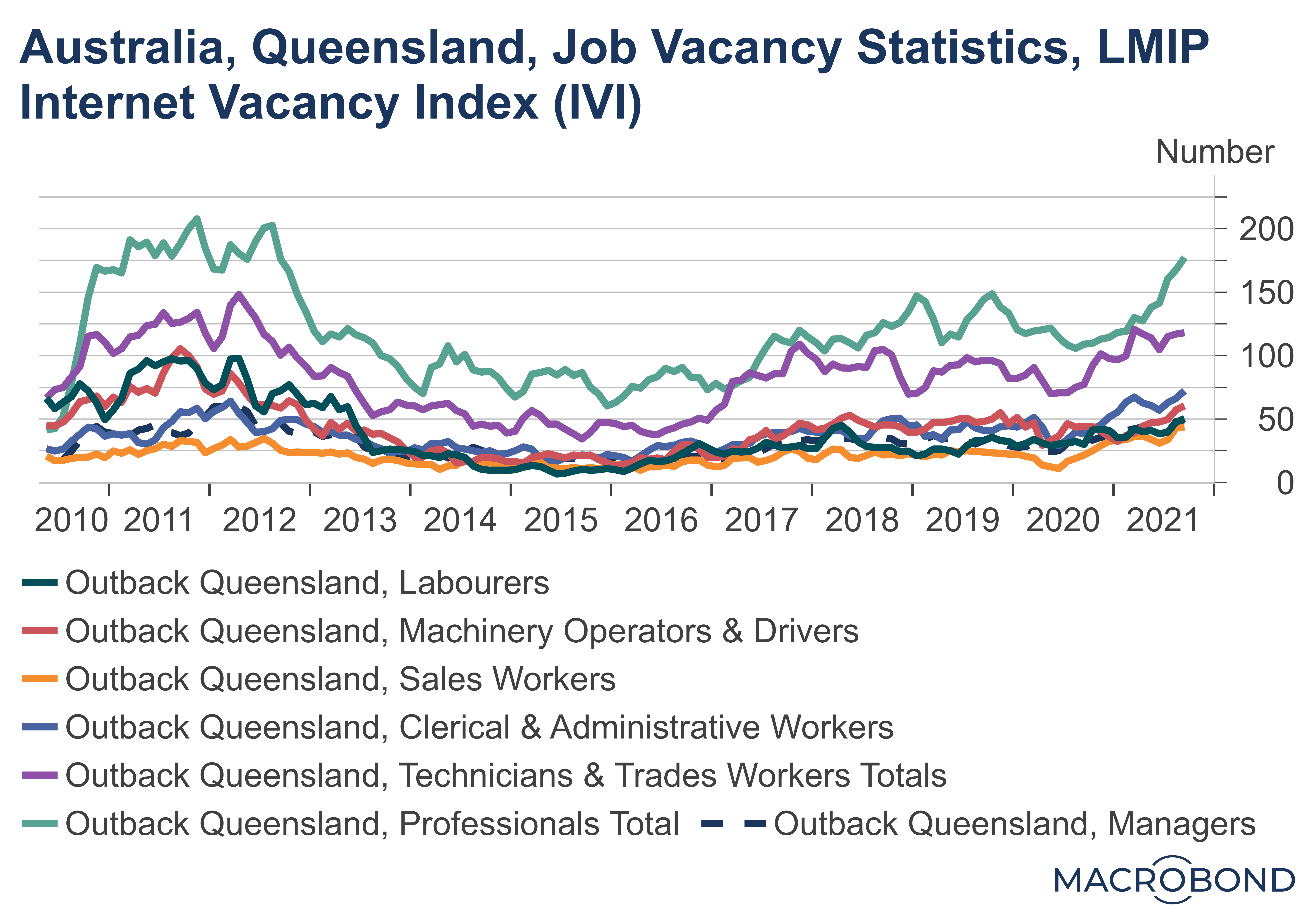
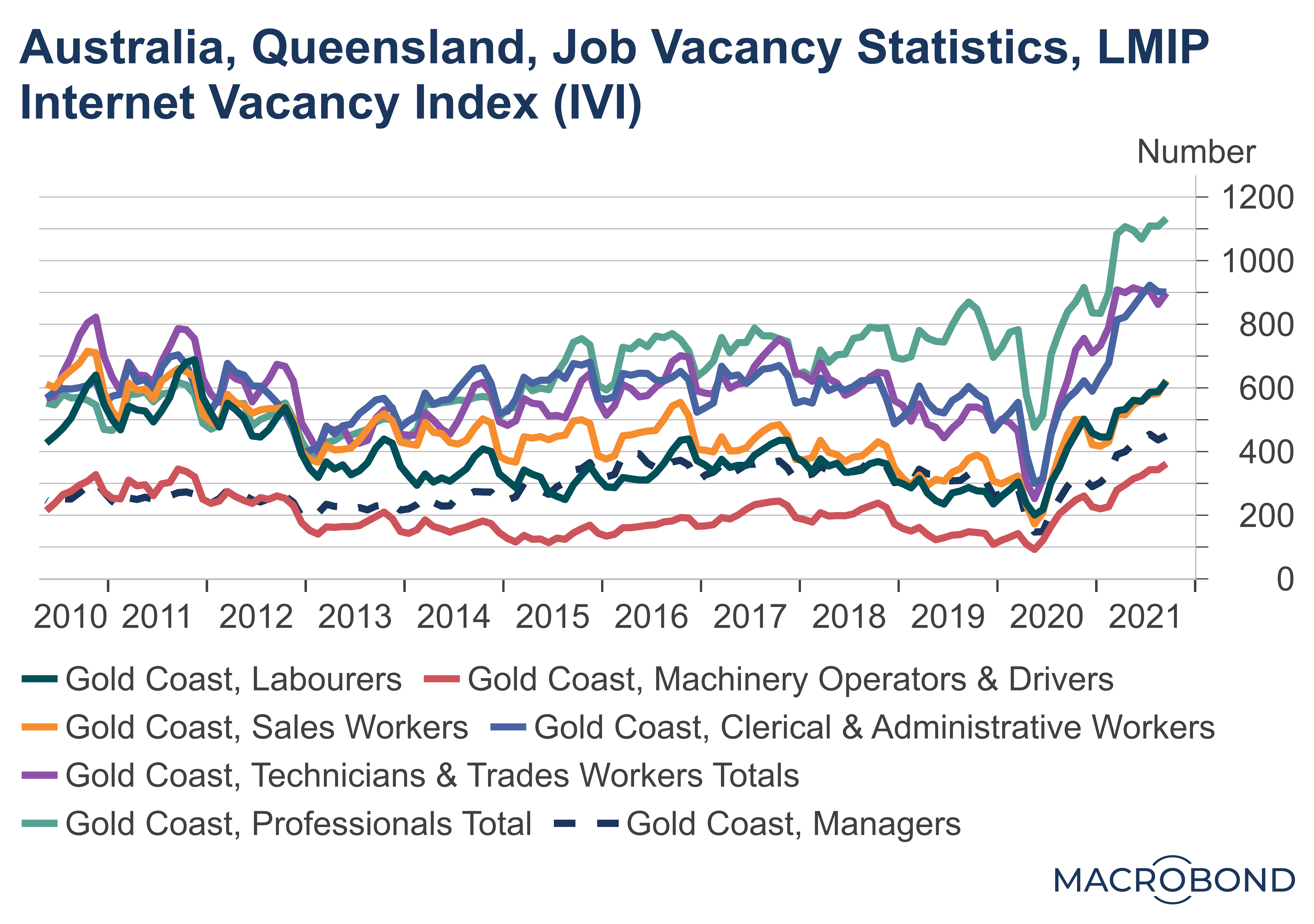
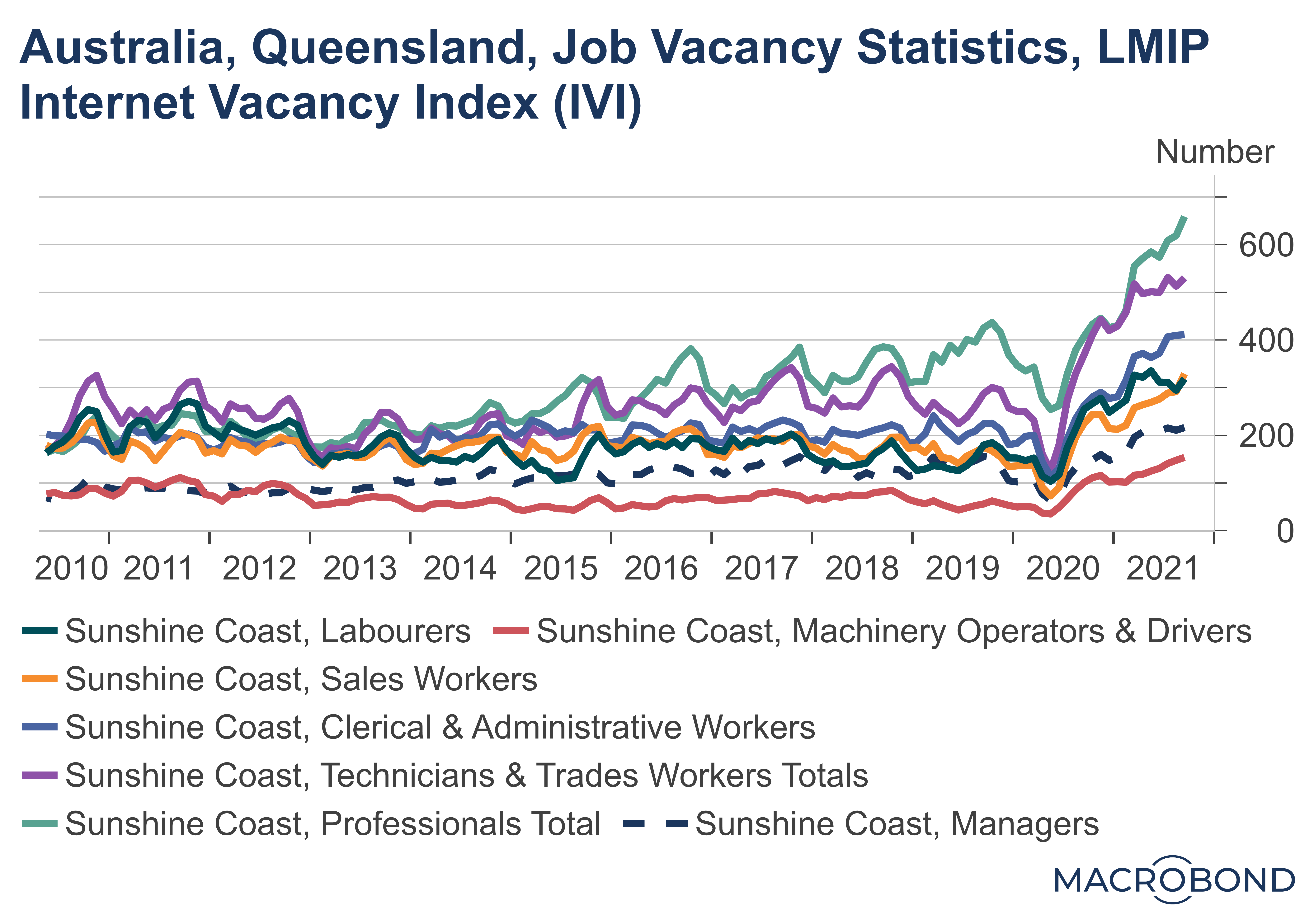
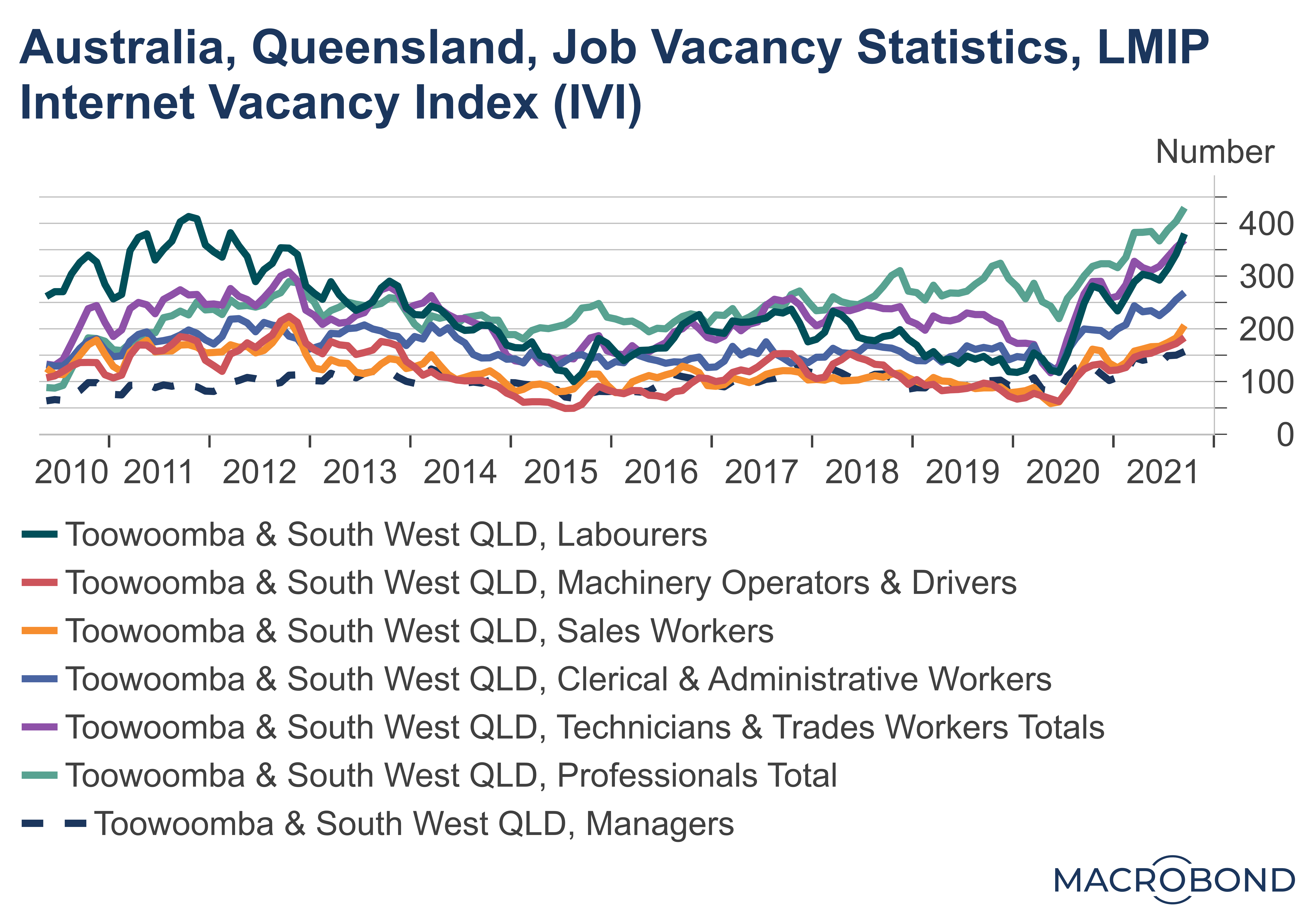
In my last Friday livestream, I mentioned surging job vacancies across Queensland (and in many parts of the rest of Australia, too). Vacancies are at record levels in four out of seven Queensland regions (see the chart below using National Skills Commission data) – Central Queensland, Far North Queensland, and the Outback being the exceptions.
Of course, job vacancies were most likely higher in the early part of last decade for Central Queensland and the Outback due to the resources boom, and FNQ would have benefited back then from an influx of foreign (largely Chinese) tourists. Those facts probably help explain why those regions are not currently at record levels of vacancies. It’s probable that vacancies would be much higher in FNQ if COVID-related border restrictions were removed. As for the Gold Coast, border restrictions are no doubt adversely affecting many local businesses, but thankfully the broadly-based regional economy appears to have proven highly resilient.
Below I present charts of the numbers of vacancies by major occupation groups by region. Professional jobs are dominating across all regions. Note that hospitality workers are included in the Technicians and Trades Worker category, along with construction workers and hairdressers, among other occupations, in the National Skills Commission data.
Brisbane
Central Queensland
Far North Queensland
Outback Queensland
Gold Coast
Sunshine Coast
Toowoomba and South West
Please feel free to comment below. Alternatively, you can email comments, questions, suggestions, or hot tips to contact@queenslandeconomywatch.com. I also post from time-to-time on my business website adepteconomics.com.au, so please consider subscribing to updates there (Get in touch). Also please check out my Economics Explored podcast, which has a new episode each week.
accelerating NZ inflation and the implications for interest rates of accelerating inflation in advanced economies more broadly;
the great Australian reopening and booming job vacancies (i.e. as noted by the National Skills Commission “Nationally job advertisements are up by 36.2% (or 60,800 job advertisements) compared to levels observed prior to the pandemic”); and
the extraordinary Bitcoin narrative which is being reinforced by the introduction of Bitcoin-exposed Exchange Traded Funds.
You can download Michael Knox’s excellent note on the oil price I mentioned in the livestream here:
Also, check out this great note (which I quoted in the livestream and which I’m guessing was written by Pete Wargent) in the BuyersBuyers newsletter from yesterday:
Please feel free to comment below. Alternatively, you can email comments, questions, suggestions, or hot tips to contact@queenslandeconomywatch.com. I also post from time-to-time on my business website adepteconomics.com.au, so please consider subscribing to updates there (Get in touch). Also please check out my Economics Explored podcast, which has a new episode each week.
The Queensland Parliament’s Education, Employment and Training Committee is undertaking an inquiry into retail trading hours which could lead to improved consumer choice and reduced inconsistencies, but will probably end up recommending minimal changes, I fear. Hopefully, it will at least support major retailers opening on Sundays in regional centres such as Mount Isa.
I don’t have a lot of hope the Parliamentary Committee will advocate removing all the silly inconsistencies which frustrate consumers and force people to travel further than they otherwise would. Why, for instance, do the closest supermarkets to me, Woolies at Spring Hill and Macarthur Central, close at 6pm on Sunday, but the Coles at Merthyr Rd is open to 9pm and Harris Farm Markets at West End is open to 10pm on a Sunday?
The Committee is not due to report until late January next year, but public submissions have now been published on its website. Industry bodies such as CCIQ, Commerce North West, and the National Retail Association are rightly supporting further deregulation. CCIQ has identified some major problems with current regulations in its submission. For instance, the side of a road your business is on can have major implications for your trading hours and turnover due to regulation-defined boundaries:
Several chambers consulted discussed irritation in trading hour discrepancies along boundaries of differing areas. This has improved a great deal as the number of areas has shrunk significantly since 2016 however, businesses are still experiencing difficulties. For example, shops on the side of a road may be considered a ‘tourist area’ and able to trade on a Sunday, whilst a shop on the other side may be categorised as ‘all other areas’ and not be able to open. This results in all foot traffic being diverted to areas that can open and creates market opportunities for shops nearby to trade.
Here’s another good point from CCIQ:
Frustrations surrounding retail trading hours in Queensland is common during the Christmas and New Year period. It is necessary that non-exempt stores are able to trade freely to leverage periods of peak economic demand as they see fit. This is also relevant to supporting the economy recovery of business in the present COVID-19 climate where many retailers are facing ongoing disruptions and trading turbulence as a result of forced closures, the end of stimulus support, and ongoing public health restrictions.
Certainly the state government has made things difficult for many retail businesses since March last year, with lockdowns and border closures, so it should arguably do all it can to reduce the regulatory burden from here on.
On the frustrations caused by major retailers not opening on Sundays in some regional centres such as Mount Isa, Commerce North West’s submission has some choice quotes from the organisation’s members:
“It’s not just residents who benefit but also our many travellers. So many tourists stay on weekends, lost trade because nothing is opened…”
“get out of the dark ages and catch up with rest of the world, tourists coming here are astonished that shops are closed Sundays.”
“Transient Aussie travellers are caught out when traveling through places like Mount Isa when shops are not open.”
Regular QEW reader Andrew Aschman has also made a great submission to the inquiry. Andrew wrote:
The suitability of permitted hours that currently stand does not reflect the need of the modern-day consumer, nor to the expansion of the retail sector. We live in a 7-day economy in which a progressive amount of industry operates 24 hours a day. Due these circumstances people that work in these industries have limited time to buy essential goods at competitive prices. Allowing retail to trade unrestricted to reflect the need of the consumer market, can help alleviate this current problem.
As well as providing better convenience and access to bricks and mortar stores, deregulation of retail can improve logistics in the online market. This can provide the ability for supermarkets and other retail to pack and deliver online orders for click and collect at lockers and pick up points, as well as for home delivery later into the evening 7 days a week.
Finally, one benefit of deregulating trading hours is that it would reduce, possibly eliminate, a major function of the generously remunerated Queensland Industrial Relations Commission (i.e. its role “setting permitted hours outside the prescribed hours” as the Parliamentary website describes it), hopefully leading to some budgetary savings.
Queensland Parliament House, corner of George and Alice Streets, Brisbane.
Please feel free to comment below. Alternatively, you can email comments, questions, suggestions, or hot tips to contact@queenslandeconomywatch.com. I also post from time-to-time on my business website adepteconomics.com.au, so please consider subscribing to updates there (Get in touch). Also please check out my Economics Explored podcast, which has a new episode each week.
Yesterday afternoon I did my first livestream, covering:
the growing concern internationally about accelerating inflation, prompted by the latest US CPI figures;
the September ABS Labour Force data revealing big drops in hours worked and workforce participation in the locked-down economies of NSW and Victoria; and
Queensland’s relatively low vaccination rate (72% for 1st dose vs 84% nationally) and what it could mean for the state’s reopening and the economy – it’s pretty obvious the Premier should set a date for re-opening ASAP to encourage people to get vaccinated promptly, as suggested by the Queensland AMA.
Here’s the video of the livestream, which was streamed to YouTube and LinkedIn Live:
Regarding inflationary pressures in advanced economies, I quoted leading market economist Stephen Roach from his recent Financial Times op-ed The sequencing trap that risks stagflation 2.0:
As brilliant and lucky as they have been, today’s generation of central bankers is afflicted with the same sense of denial that proved problematic in the 1970s. Due to a lack of experience and institutional memory of that tough period, the risk of another monetary policy blunder cannot be taken lightly.
Certainly, central banks have been running a massive monetary policy experiment with ultra-low interest rates and Quantitative Easing, which have been associated with double-digit growth rates in money stocks. I agree with Roach regarding the potential for a “monetary policy blunder”.
Please feel free to comment below. Alternatively, you can email comments, questions, suggestions, or hot tips to contact@queenslandeconomywatch.com. I also post from time-to-time on my business website adepteconomics.com.au, so please consider subscribing to updates there (Get in touch). Also please check out my Economics Explored podcast, which has a new episode each week.
A few weeks ago I observed that it took the NRL Grand Final for the Queensland Government to adopt a more rational approach to the pandemic, and now, thankfully, there are further signs of rationality from the Government, with the Courier-Mail reporting:
Premier Annastacia Palaszczuk, in a strong signal the state’s border with NSW could open within weeks, has also put the impetus on Queenslanders to get the Covid-19 jab saying “we cannot protect you if you won’t protect yourself”.
That’s good news. While some commentators have rationalised border restrictions as acceptable if they mean our politicians don’t impose lockdowns which bring huge economic costs, I think those commentators ignore a) that we probably shouldn’t lockdown even if COVID is spreading and b) the large human costs and the immorality, indeed cruelty, of those border restrictions. Queensland’s economy has no doubt been performing much better than the lockdown-afflicted NSW and Victorian economies, but thousands of Queenslanders have endured immense suffering because of the border restrictions, and interstate-tourism-reliant businesses have been severely financially stressed. For more of my thoughts on the economic impacts of pandemic policies and on the economic outlook, check out my interview with Damian Coory on his The Other Side YouTube/Facebook show:
The Other Side EP68 “Australia’s Economic Suicide” featuring an interview with me on the economic impacts of COVID policies
Finally, if you haven’t read it yet, I can without hesitation recommend you read The Great COVID Panic by Paul Frijters, Gigi Foster, and Michael Baker. The authors make a strong case that the majority of the world succumbed to a great panic over COVID in early 2020 and our governments enacted policies which, on balance, were irrational and harmful.
Please feel free to comment below. Alternatively, you can email comments, questions, suggestions, or hot tips to contact@queenslandeconomywatch.com. I also post from time-to-time on my business website adepteconomics.com.au, so please consider subscribing to updates there (Get in touch). Also please check out my Economics Explored podcast, which has a new episode each week.



 Queensland Economy Watch