Uber/Taxi Green Paper not too bad, but needs more economic analysis and evidence

In the Green Paper on Queensland’s Personalised Transport Industry released by the Queensland Government yesterday, I was hoping to see a cost-benefit analysis of the different reform options, an analysis which would reveal the large benefits to consumers coming from deregulation of the taxi industry and the legalisation of Uber, laying a clear path to necessary reform. But, alas, in the Green Paper we do not see the level of analysis that would be desirable to properly inform public consideration and debate. Instead, the Green Paper talks in general terms about the net benefits of the different reform options, with no attempt at quantifying those net benefits and how the magnitudes of net benefits differ among the options.

The Green Paper notes that its “scenarios have been informed by economic and social analysis of the personalised transport industry.” That may be so, but that analysis is not well demonstrated in the Paper. It would have been really good for the Green Paper to have estimated the net benefit to the community of scenario 4, which is pretty much full deregulation except for safety accreditation and a nominal annual administration fee, my preferred scenario. The Queensland Department of Premier and Cabinet has previously estimated that current restrictions on taxi licences cost Brisbane consumers $40 million per annum in higher fares (see this ABC News Report). But I cannot see evidence of this type cited in the Green Paper, which is very light on economic analysis.

Regarding its maximum deregulation Scenario 4, the Green Paper notes:

“The removal of entry restrictions creates a highly competitive environment with more diversity and choice for customers. Competition drives a reduction in wait times and fares as a result of market driven supply-demand matching and reduced regulatory burden on service providers.”

That this would be the case was obvious to many of us already. The important work to do is to quantify those gains and inject them into the public debate to help win the case for maximum deregulation, showing how much better this option is than partial deregulation options (e.g. maintaining the taxi industry’s control of the “rank and hail” market). For too long, Queensland consumers have been ripped off by the taxi industry which has been protected by a regulatory restriction on the number of taxi licences. The Green Paper should have made a stronger case for maximum deregulation, backed by solid economic analysis and evidence. So the Green Paper gets a C+ grade at best.

On the issue of whether taxi licence holders should be compensated, see Rod Bogaard’s excellent guest post from early February:

Should Qld taxi plate owners be compensated for the recent disruption to the taxi industry?

Rod’s guest post has apparently become a prescribed reading for an economics subject at QUT, based on traffic data for my blog, which is recording a high number of hits from the QUT Blackboard site. Well done, Rod!

Green_paper_cover

Green Paper not too bad, but needs some solid economic analysis

Posted in Transport, Uncategorized | Tagged , , , , | 2 Comments

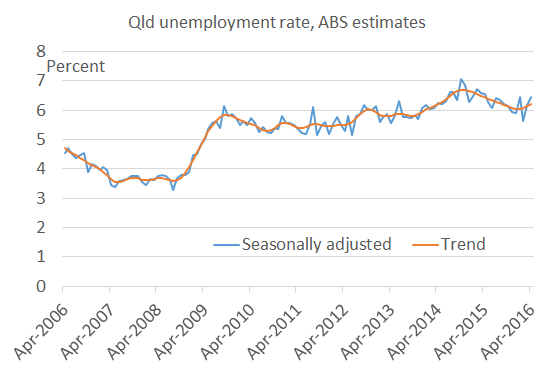
Qld unemployment rate trends up and jobs trend down

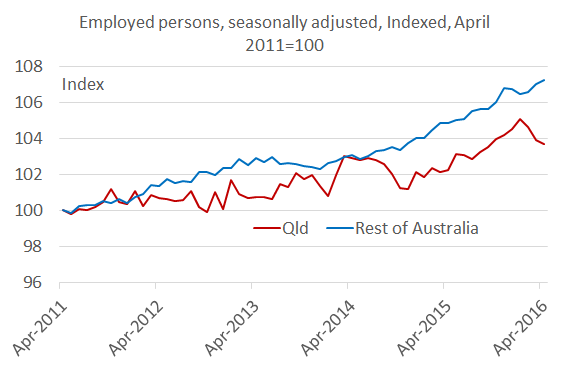
The April 2016 ABS jobs data confirm the view I have expressed for a while now that the Queensland economy is under-performing (see charts below and Treasury’s brief). While in South-East Queensland conditions appear reasonable, the regions are struggling with the impacts of the mining downturn and drought, and this translates into a lacklustre State economy in aggregate. The paper I prepared for last month’s Jobs Growth Summit is still relevant, and I would again urge the State Government to consider the recommendations I made within it for boosting employment, such as cutting payroll tax, deregulating retail trading hours, legalising Uber, and other reforms.

LF_Apr16_chart2

LF_Apr16_chart1

Posted in Labour market, Macroeconomy, Uncategorized | Tagged , , , , , , , , , | Leave a comment

Transparency and good governance essential for successful infrastructure projects

After my recent post on mega-projects, I came across this excellent presentation, by a Jacobs consultant and an Adelaide University academic, which was delivered to a conference in Adelaide last year:

Jacobs presentation on infrastructure risks and mega projects

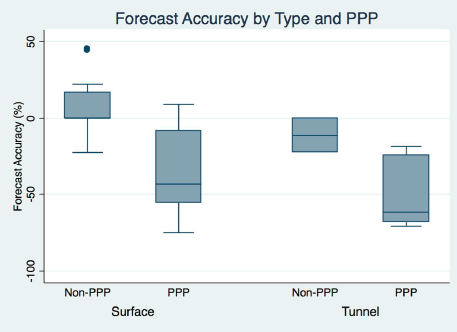
The Jacobs consultants highlight the risks of mega-projects and argue for transparency, good governance and the consideration of any cost-effective alternatives, such as smaller projects and transport demand management. The presentation includes analysis of a database of recent Australian mega-projects, and I particularly like this box plot showing the poor demand forecasting record for public-private partnership (PPP) projects:

forecast_chart

The presentation includes two points which readers of this blog will be familiar with, as I have made them in previous posts regarding the BaT Tunnel and Cross River Rail:

  • a mega-project should have a benefit-cost ratio of at least 1.5 to allow for cost and demand risks; and
  • “All business cases should be made public when funded.”

Building Queensland’s current policy of only releasing summaries of business cases should be reviewed, and the full business case for Cross River Rail should be released so it can be scrutinised by external experts and the broader public.

Posted in Infrastructure, Uncategorized | Tagged , , , , , , , , | 6 Comments

New motor vehicle sales lower in Qld than before financial crisis

New motor vehicle sales data for April released by the ABS yesterday support the RBA Board’s decision to cut the cash rate on Budget day earlier this month, with sales down 2.5% in April nationwide, and down 7.7% in Queensland, but I would note the data tend to be volatile (see the ABS Summary). In its Summary, the ABS noted:

The largest downward movement across all states and territories, on a trend basis, was in Queensland (-0.5%), continuing a downward trend which commenced in November 2015.

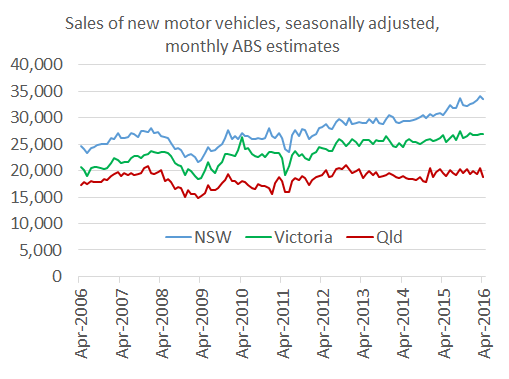
Time series data for new vehicle sales confirm Queensland’s under-performing economy relative to other States, with new vehicle sales lower in Queensland than before the financial crisis (e.g. over 9% lower than at the end of 2007) compared with much higher sales in NSW (+23%) and Victoria (+17%) (see chart below).

motor_vehicles_Apr_16

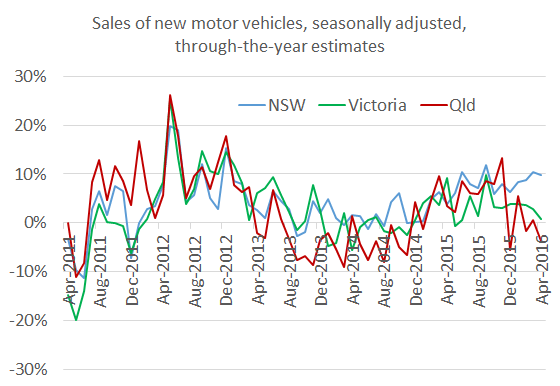
New vehicle sales have fallen 3.7% in Queensland through-the-year, compared with growth of 9.8% in NSW and 0.8% in Victoria (see chart below). It is very likely that the boom in property prices in Sydney had a flow-on impact on new vehicle purchases.

motor_vehicles_tty_Apr16

Posted in Macroeconomy, Uncategorized | Tagged , , , , , , , , , | 2 Comments

Cross River Rail equals mega-project equals mega-risk

Shadow Assistant Treasurer Andrew Leigh is a very good economist, so I hope he is encouraging his colleagues to wait for and fully scrutinise the Cross River Rail business case being delivered in June, before the Federal Opposition commits to the project. I am a little concerned that he hinted yesterday that the Opposition will support Cross River Rail as a matter of course (see the Brisbane Times report). Cross River Rail will be a mega-project, at least $5-10 billion in capital expenditure, possibly $10-15 billion ultimately. As a mega-project, it will have mega-risks, of huge cost blowouts and demand shortfalls, for example, a point I made last Friday to a seminar on cost-benefit analysis organised by Griffith’s Economic Policy and Analysis Program at Griffith’s Southbank campus. As is becoming ritualistic among economists and infrastructure experts, I referred to the classic Bent Flyvbjerg book Megaprojects and Risk:

“At the same time as many more and much larger infrastructure projects are being proposed and built around the world, it is becoming clear that many such projects have strikingly poor performance records in terms of economy, environment and public support. Cost overruns and lower-than-predicted revenues frequently place project viability at risk and redefine projects that were initially promoted as effective vehicles to economic growth as possible obstacles to such growth.”

I would hope that anyone involved in infrastructure decision making in Queensland has read this book, so they can read the Cross River Rail business case with a more critical eye. They need to think about whether the risks have been fully elaborated and whether the estimated benefit-cost ratio is credible and gives them comfort the project stacks up. As I noted at the seminar last Friday, the BaT tunnel business case should have given the previous government little comfort in the economics of the project, given the relatively low benefit-cost ratio of 1.16 (see my September 2014 post on this issue).

Also, infrastructure decision makers should consider whether cost-effective alternatives could be adopted. In the case of Cross River Rail, alternatives I would be exploring would include larger differences between peak and off-peak public transport fares, to encourage greater off-peak travel, and staggered starting times and more flexible working hours for Queensland public servants working in the Brisbane CBD, and possibly relocating many of them to areas outside the CBD. State Government public servants are undoubtedly a major contributor to the peak hour demands for public transport into the CBD.

Finally, I will reiterate my call for all business cases for publicly-supported projects to be made public. This is absolutely essential for transparency and better decision making. See my post:

Transparency essential in Building Qld cost-benefit studies of infrastructure projects

Megaprojects

A modern classic for infrastructure experts

Posted in Brisbane, Infrastructure, Uncategorized | Tagged , , , , , , , | Leave a comment

Targeting infrastructure spending as a % of GSP won’t work – Guest post by Joe Branigan

Again, I am delighted to publish a guest post from my good friend and former Treasury colleague Joe Branigan. The usual disclaimer applies, that the views expressed in this article are Joe’s and should not necessarily be attributed to me.

Targeting infrastructure spending as a % of GSP won’t work

Infrastructure spending is cyclical, and it’s productivity that matters to Queenslanders – not short-term engineering and construction jobs

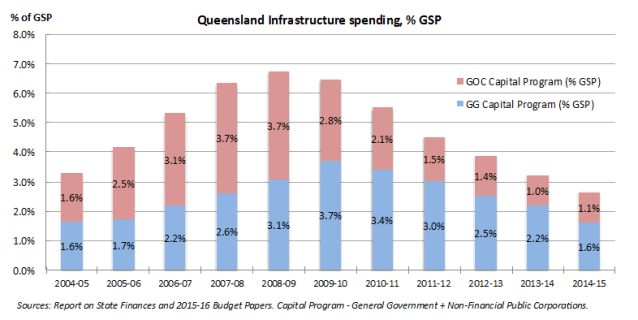
Infrastructure Partnerships Australia (IPA) has recommended that the Queensland Government set annual infrastructure spending as a percentage of Gross State Product (GSP). Specifically, IPA has recommended that Queensland should: “Restore the State Government’s infrastructure spend in the Budget to the 10-year average of 4.25% of GSP.”

This recommendation is fundamentally flawed for several reasons.

First, all public infrastructure investment should be assessed on a case-by-case basis to see whether each proposed project represents taxpayer value-for-money. Will the investment increase productivity, which would in turn increase incomes and create jobs in the future by increasing both labour supply (lowering the natural rate of unemployment via improved labour market ‘search and matching’) and labour demand (since higher incomes drives demand for jobs). As Tony Makin from Griffith University has shown (and Ken Henry said when Treasury Secretary), if you invest in bad public infrastructure you lower productivity, and you ultimately lower real incomes.

Second, we need to stop thinking about infrastructure in terms of inputs (i.e. “this is a $10 billion capital program (so it must be fantastic)”) and start focussing on outputs (i.e. “this investment in roads will mean less time stuck in traffic and the estimated benefits exceed the estimated costs to the Queensland taxpayer”). Spending billions of dollars just to hit some artificial spending target will not help us improve our living standards. We need to target our spending and be smart about where we invest in new productivity-enhancing infrastructure.

Third, taking the last 10-years average public investment as the target is not reflective of what’s ‘normal’ since we’ve had (i) the government’s spending response to the mining boom (i.e. the government needed to respond to the consequences of a strong increase in population growth and the consequent need for public infrastructure in the regions as well as in SEQ), and (ii) the massive borrowings to fund the ill-considered GFC response (remember the $17.8 billion capital program in 2008-09, followed by $17.3 billion in 2009-10 (real dollars)). This investment was ill-considered because we were never going into recession since the RBA cut interest rates hard and our exchange rate depreciated by 30% making our exports significantly more competitive – but that’s a story for another day.

Fourth, large infrastructure network investments are cyclical and spending levels should be left to the government-owned corporations (GOCs) to decide in the best interests of customers and shareholders (i.e. ‘us’). For instance, we had the massive electricity network rebuild in the mid-1980s and again in mid-2000s (some might say ‘overbuild’). The SEQ water grid investments in the late 2000s (in response to the fear about water security) is another example of the cyclical nature of public infrastructure investment.

Fifth, we will not create all the jobs we need by investing in public infrastructure. As I argued recently in the Courier-Mail and on this blog, infrastructure investment is about raising incomes, not creating jobs. IPA argues that: “Lifting it back to a decade average of 4.25 per cent would mean spending $12.9 billion in 2016-17 rather than the planned $8.8 billion. Based on analysis by Infrastructure Partnership Australia, that could create more than 10,600 additional jobs.” This kind of analysis is ignorant of how the labour market actually works. What we should be focussed on is reducing the natural rate of unemployment, which Queensland Treasury has estimated is not far below the current unemployment rate. This means, for instance, looking at the barriers to entry for the young and unskilled.

Sixth, the level of public investment must be constrained by the long-term sustainability of the State Budget and the overall fiscal strategy. Not doing so would be unsustainable and reckless. Here, targeting a structural fiscal balance across the Non-Financial Public Sector is a more prudent approach than targeting a net operating surplus in the General Government sector. Moreover, setting a budget constraint on infrastructure expenditure should force governments to prioritise, picking the best productivity-enhancing projects. Here, governance arrangements are vital – for instance, not having the ‘independent’ infrastructure advisor preparing business cases for government might be a good approach. Preparing demand forecasts independently of business case development and counting the deadweight loss from raising taxes (since borrowings are future taxes) as a cost are also important governance measures.

Seventh, it is wrong-headed to argue for increased infrastructure investment just because governments can borrow at lower interest rates than the private sector. The level of the interest rate doesn’t reflect the true risk of the project or the project’s potential costs and benefits – the borrowing rate is lower because of the coercive powers of governments to tax its citizens and pay its debts. Just because the Queensland Government can borrow at 2% rather than 8%, doesn’t make a bad infrastructure investment a good one.

Ultimately, we need to think about infrastructure in terms of productivity. It’s about more than just creating jobs in the short-term, it’s about lowering costs, improving efficiency, increasing incomes and ultimately creating sustainable high-paying jobs for the long-term. That’s what good infrastructure is about; it’s not about making sure the engineers and construction firms have a forward work program so they can sleep easy. China tried that and now they have vast shopping malls with no shoppers, wide roads with no cars, and large cities with no people.

In my view, the pressure applied from industry lobby groups for increased infrastructure spending does not come from a concern about the welfare of the Queensland people, particularly the unemployed, but rather from a concern solely for their own members who will receive contracts from government associated with additional infrastructure spending. Chamber of Commerce and Industry Queensland Advocacy GM Nick Behrens said to the Courier-Mail this week: “We need to be reinvesting in our future and supporting now our engineering and construction businesses that are currently shifting to other states as work dries up.” As I have argued, this is a fundamentally flawed view.

Joe Branigan is a Senior Research Fellow at the SMART Infrastructure Facility
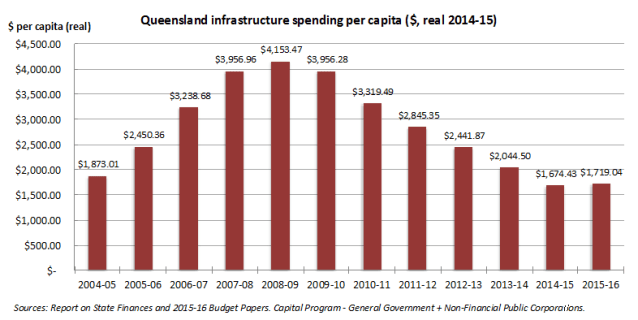
JB_infrastructure_chart1

JB_infrastructure_chart2

Posted in Infrastructure, Uncategorized | Tagged , , , , , , | Leave a comment

FACCI thriving in time of greater French-Australian economic cooperation

The recent awarding of the $50 billion submarine contract to French firm DCNS was greeted enthusiastically by members of the French-Australian Chamber of Commerce and Industry (FACCI), which is doing terrific things around town and running some excellent events. For example, the week before last, at a FACCI breakfast event at Deloitte’s offices, Australia Pacific LNG CEO Page Maxson, the quintessential oil and gas man from Oklahoma, spoke about issues affecting the LNG industry. Despite recent market conditions, Mr Maxson was very upbeat about the outlook for gas over the next five to ten years. Given expected global demand growth, analysis he has seen suggests there will be a shortage of capacity within six years, and he also noted that six years is about the full lead time needed to increase capacity.

Mr Maxson was realistic enough to recognise that, over the long-term, there will be (or has to be) a transition away from fossil fuels to other energy sources. He considered that the only realistic way to do this, and come anywhere near achieving the aspirations set at the Paris Climate Change Conference, would be to massively increase our reliance on nuclear energy. I fear Mr Maxson is right about this. A greater reliance on nuclear energy may bring large risks, but it may well be preferable to relying on very costly renewable energy.

In question time, Mr Maxson was asked whether Australia is a high-cost country and whether this is adversely impacting the industry. Mr Maxson noted that the problem is not high wages, but rather relatively low productivity for those wages. He compared us with Japan, which has high wages but also high productivity in its industrial sectors, which he considered is related to better organisational skills in Japan than he sees in Australia. Of course, it is well known that Japanese success in manufacturing is partly related to lean manufacturing/just-in-time methods that eliminate waste and excess capacity. Mr Maxson’s opinion seems reasonable, particularly given many Australians still possess the “she’ll be right, mate” view and may not pay enough attention to the details. This is certainly something for our educational professionals to ponder, as we may need to teach better organisational and planning skills in our schools.

Page_Maxson_2

Page Maxson, CEO of APLNG, addressing a FACCI seminar at Deloitte’s offices, Riverside Centre, Brisbane, on Thursday 28 April. I am in the front row.

Posted in Education, Mining, Uncategorized | Tagged , , , , , , , , , , , | 7 Comments

Don’t miss 16 June Brisbane speech by RBA Deputy Governor Philip Lowe, the Bank’s next Governor

At a lunchtime event at Tattersall’s Club in Brisbane yesterday, after he predicted another interest rate cut this year in either June or August, Dr Chris Caton, BT’s Chief Economist, noted that “Interest rate changes are like cockroaches.” That is, “There’s usually another one around somewhere.” This is a rule-of-thumb for Australian market economists, and AMP’s Shane Oliver said the same thing last week (see this ABC News Report). Queensland’s own Michael Knox, Chief Economist of Morgans, also predicted another rate cut this year at his ESA Qld lunchtime briefing last week, based on Australia’s unemployment rate (currently 5.7%) remaining above the natural rate of unemployment (which Michael must think is around 5% or lower).

So another rate cut is likely this year, possibly as early as next month, but more likely in August, after the June quarter CPI figures are out and the Bank can gauge whether inflation is remaining abnormally low and whether Australia is truly at risk of deflation, which I doubt, even though deflation has, surprisingly, become a new topic for discussion at dinner parties and social gatherings.

To gain insights into the economic outlook, so you might assess the prospects for future interest rate movements, there would undoubtedly be no one better to hear from than a senior official from the RBA. The Economic Society of Australia (Qld), of which I am the Secretary, is privileged to be hosting a business lunch on Thursday 16 June at the Hilton, Brisbane, featuring RBA Deputy Governor Philip Lowe, who will take over as Governor from Glenn Stevens on 18 September (see the Treasurer’s media release). In Brisbane, the Deputy Governor will speak on “Recent developments in the Australian and global economies”, which no doubt will be of interest to us all. You can find out further details and register for the lunch via the ESA Qld website:

ESA QLD 2016 Business Lunch – Philip Lowe, RBA

I hope to see you there.

Phil_Lowe

RBA Deputy Governor Philip Lowe, the Bank’s next Governor

Posted in Macroeconomy, Uncategorized | Tagged , , , , , , , , | Leave a comment

Government ownership of QIC becoming less appropriate every day

The Queensland Treasurer’s media release yesterday regarding QIC’s purchase of a large stake in a Northern Australian cattle business should have raised eyebrows:

Treasurer Curtis Pitt has welcomed today’s announcement that the Queensland Government’s investment manager, QIC, will acquire 80 per cent of one of Australian’s oldest and largest agricultural enterprises, North Australian Pastoral Company.

Mr Pitt said the investment was a strong vote of confidence in Queensland.

It may well be a strong vote of confidence in the prospects for the beef industry, possibly the broader economy, but how can we be sure when QIC is actually owned by the Queensland Government, and the Treasurer is one of the shareholding Ministers? While QIC remains Government owned, how can we be sure its investment decisions are entirely free from political influence and that they will maximise the return to the State’s funds under management (for an appropriate level of risk)?

I am very concerned about the risks being put on the State Government’s balance sheet through QIC’s operations, given its wide range of activities, including private funds management, and its interesting mix of investments, including shopping centres in regional Queensland towns such as Townsville and Toowoomba. In the interests of risk management, the State Government should sell its financial business, QIC, and adopt an arms-length approach to whomever it appoints as its fund manager.

Additionally, it is undesirable that QIC receives a competitive advantage from State Government ownership (e.g. an implicit government guarantee that makes investing with it attractive), which means it is competing unfairly against private sector fund managers. For this reason, as well as the issues of risk and whether it is appropriate for the State Government to own QIC after it has already sold banking and insurance businesses, the Queensland Commission of Audit in 2013 (in its Final Report, Volume 2, p. 173) rightly recommended the sale of QIC, which is unique in Australia as a government-owned funds management business:

There is no compelling public policy rationale for an agency of Government to provide these financial services. They can be accessed on a competitive basis from private investment managers.

Furthermore, it is highly questionable as to whether Government should bear the risk of managing investment funds for the private sector.

The continued participation of QIC in this activity creates a distortion in financial markets. By means of its status as a crown entity, QIC has a competitive advantage that is not available to its private sector competitors…

…This advantage is inconsistent with long-standing principles of competitive neutrality…

…In an era of open, competitive and dynamic financial markets, there is no strong rationale for government provision of investment funds management services.

We should listen to the Commission of Audit because it was well advised on QIC. One of the Audit Commission members was none other than Dr Doug McTaggart, former head of QIC and Under-Treasurer.

I have long advocated the sale of QIC (e.g. see Why is QIC Government owned anyway?). And other Queensland-based economists, such as John Quiggin, have identified problems with QIC being a government-owned fund manager: Bligh and Fraser sell Port of Brisbane…to themselves.

I am even more convinced of the desirability of selling QIC after the latest announcement from the Treasurer and from a recent inspection of the QIC website, which revealed QIC staff are pretending they are a privately-owned funds management business, with some of its key personnel calling themselves partners (see the QIC website).

But QIC is not yet a private business. As noted above, there are clear economic and public policy reasons for selling QIC, and a sale would be supported by a former CEO and likely by many of its current staff, who are obviously embarrassed by its government ownership. The case for selling QIC is compelling.

QCA_report

The Queensland Commission of Audit report will have a long shelf life

Posted in Agriculture, Uncategorized | Tagged , , , , , | 2 Comments

Could we cope with two Federal Budgets in one year?

GT_QRC_2

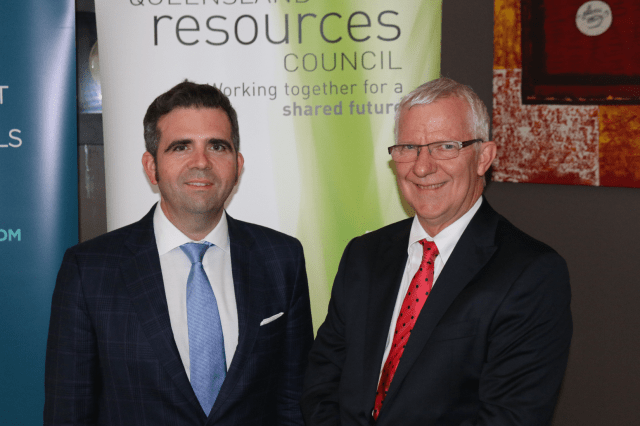
Michael Roche, QRC CEO, and I at Jade Buddha for the Resources Roundup

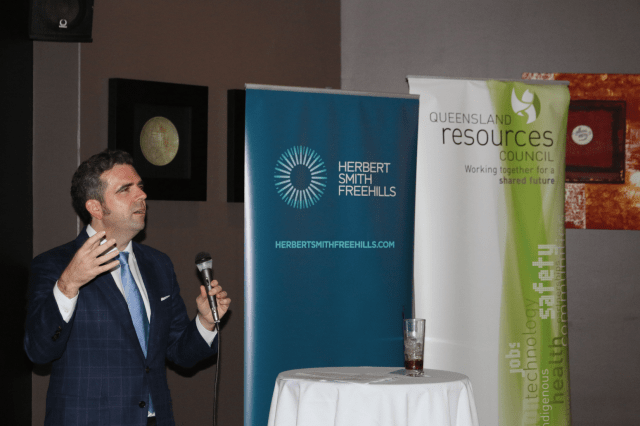
At the QRC Resources Roundup at Jade Buddha, Brisbane CBD on Wednesday afternoon, after I provided my thoughts on the 2016-17 Budget, I was asked whether there would be any serious issues if there were a change of Government at the upcoming election and we needed to have a second Budget in 2016? I answered that, while this would create much more work for the Treasury, it would not have dire consequences for the country, as the 2016-17 Budget measures would largely not have been implemented anyway. Also, I noted there is very little chance of a second Budget, because the Turnbull Government is almost guaranteed of re-election, given that it can run a very effective scare campaign on the Opposition’s negative gearing policy.

And I should have noted that, personally, I’d find two rounds of Budget functions in one year hard to cope with.  Over the last two days, I have been to three post-Budget functions, and while the discussion, food and beverages were excellent, I do not think I can cope with another round of it this year!

At the QRC Resources Roundup, I was also asked what I would do to repair the Budget. As a hard-headed, ex-Treasury man this was an easy one to answer: include the family home fully (or at least partially) in the assets test for the pension, which could save billions each year (see my post PC calls for partial inclusion of family home in pension means test).

During my talk, I reiterated to the QRC audience my concerns about the Budget that I noted in my previous post, and I also quoted the excellent BDO Budget summary which noted:

“This is very much a Budget for a government whose first, second and third priorities are to get re-elected.”

It certainly is, and it is all very disappointing.

Thankfully, the weekend is coming up soon, and I will have time to recover from this action-packed week, which is just as well because there are two more post-Budget functions next week:

‘Federal Budget’ an Audience with Dr Chris Caton at Tattersall’s Club on Monday 9 May

Young Economists Post-Budget drinks on Thursday 12 May

Both are highly recommended!

GT_QRC_1

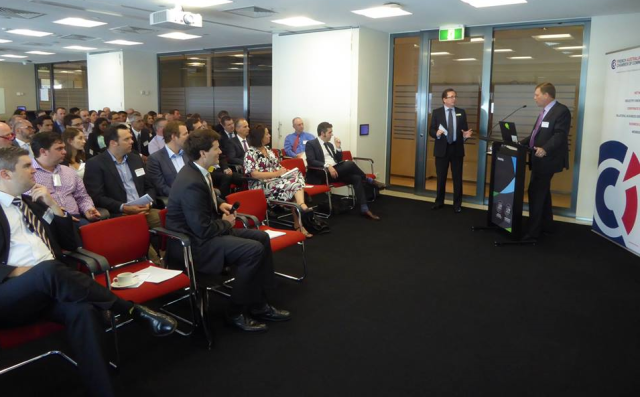
Addressing the multitude at the QRC Resources Roundup event


Posted in Budget, Mining, Uncategorized | Tagged , , , , , , , , , , , | 4 Comments