Another example of the high cost of free parking in Toowong

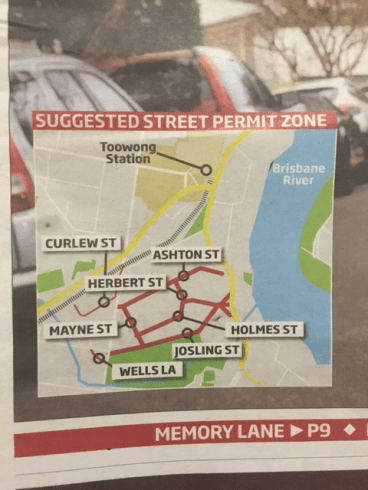
Poor economics is at the core of the latest parking dispute in the leafy Brisbane western suburb of Toowong, particularly a misunderstanding about property rights and the lack of a price mechanism for allocating the car parks (see Toowong commuters stopping residents from parking outside their own homes). Local residents are lobbying Brisbane City Council for the creation of a residential parking permit scheme (see image from the Westside News below), which would give local residents priority for parking, as they argue they are being “parked out of their own street by commuters” catching the train at Toowong station. However, the local residents do not own the streets; the Council does. It may seem unfair that local residents cannot park near their homes at all times, but it may also seem unfair if someone cannot find a park in a local street after they have searched in vain for a park at the Commuter Car Park. It is very difficult to judge fairness.

A market solution would be superior. If the Council metered the scarce car parks in the area around Toowong Village, it would be more likely that the car parks would go to those people placing the highest value on them. Alternatively, the Council could sell a limited number of daytime parking permits, which would be available for purchase by both residents and non-residents. The current situation is sub-optimal, and is a good illustration of what UCLA Professor Donald Shoup called The High Cost of Free Parking.

For further discussion of the economics of parking, see my February post:

On-street parking charges a better solution than Harding plan

toowong_parking

Toowong residents are lobbying for a residential parking permit zone

Posted in Transport, Uncategorized | Tagged , , , , , , , , , | 3 Comments

Comments on asset sales/privatisation in Saturday’s Courier-Mail

At the IAQ Infrastructure Summit in Brisbane on Thursday last week, several participants lamented that Queensland was missing out on the benefits of so-called asset recycling that NSW and Victoria were expecting. The privatisation issue will not die in Queensland, and the current state of the debate is nicely set out in an article by the Courier-Mail’s State Political Editor Steven Wardill in today’s paper  (pay-walled, sorry):

Privatisation of Queensland’s assets

The article quotes me towards the end (see the extract below). For the record, I am supportive of privatisation, largely due to the substantial efficiency gains that have been demonstrated by numerous privatisations around the world since the 1980s. To me, the main issue is who will run particular assets most efficiently and productively. For the Queensland assets that have been proposed for privatisation in the past, I expect that would be the private sector.

The Government may lose a revenue stream, but this would be partly offset by a reduction in interest payments on government debt (if the proceeds were used to pay down debt), and the public would benefit from more efficiently run assets and lower prices for their services than otherwise. If the Government were to use privatisation proceeds to fund new infrastructure, such as a new road or tunnel, the new asset would yield benefits to the community, such as a reduction in travel times.

Here is an extract from today’s Courier-Mail (p. 53) with my comments:

Economist Gene Tunny says while the income argument to keeping assets makes sense, what happens when they’re not profitable anymore?

“By owning those assets the Government is assuming the risk,” Tunney says. “However, in the future, these assets might not generate these returns and they’re left holding stranded assets.”

The whole argument – whether you’re for or against – comes down to the question of what you expect governments to do.

In Tunny’s view, whether to sell or not should be viewed through what is in the best interests of the broader economy rather than just the government’s balance sheet.

The assets are still part of the economy and potentially run more efficiently while the State could reduce debt and tackle other, sometimes more intangible, issues in its bailiwick.

“You could be saving money on the debt repayments or buying something else,” Tunny says.

“It may not show up as a revenue stream in the Budget but it could, for instance, improve travel times.”

Posted in Infrastructure, Uncategorized | Tagged , , , , , , , , | Leave a comment

Treasury dumps wellbeing framework & defines principal objectives around Budget, productivity and globalisation

Of the many outstanding contributions that former Treasury Secretary Ken Henry made to public policy in Australia, one of my favourites was the wellbeing framework. This framework established Treasury’s goal as improving the wellbeing of Australians, and identified five elements of wellbeing: the level of consumption possibilities, their distribution, the degree of risk borne by individuals and society, the degree of complexity we face in our choices, and the level of freedom and opportunity we enjoy. I liked the framework because it made it clear that Treasury should consider a range of factors, in addition to the impacts on the Budget and the economy, when assessing or developing policy proposals, including social and environmental impacts. This is good economics, as social and environmental impacts should ideally be considered in any cost-benefit analysis of policy measures or projects.

So it is somewhat of a shame that Treasury is abandoning the wellbeing framework according to an article by David Uren in today’s Australian:

Treasury has abandoned the “wellbeing framework” that ­guided its strategy under secretaries Ken Henry and Martin Parkinson, and which looked beyond managing the economy to envir­onmental and social sustainability, and is instead giving top priority to fixing the budget.

Current secretary John Fraser has released a four-year corporate plan that identifies the budget, lifting productivity and securing the benefits of globalisation as his department’s principal objectives. “I wanted to focus on the things where we can have an influence,’’ he told The Australian…

…The new plan, which is focused on the economic policy issues that Treasury directly controls, contrasts with the more expansive vision which Ken Henry introduced to the department he led from 2001 to 2011. Dr Henry described wellbeing as “a grassroots statement of our mission, encompassing market, non-market, material and intangible components”.

While it is unfortunate that the wellbeing framework has been dumped, at least the Treasury under John Fraser continues to focus on important objectives related to the Budget and productivity, and it is excellent that the Treasury Secretary has identified securing the benefits of globalisation as a principal objective.

It is becoming increasingly clear that many people in advanced economies are either missing out on or are unaware of the benefits of globalisation. While there have been job losses and business closures associated with globalisation, overwhelmingly there have been net benefits to Australians, through news jobs and business opportunities, and through lower prices in real terms for a wide range of products, including clothes, furniture, and cars. Alas, many people do not appreciate these gains and there is a growing backlash against free trade and globalisation, which is manifesting itself in support for political extremists and demagogues.

I was recently alerted to some interesting research by MIT economist David Autor and others regarding the relationship between trade exposure and political polarisation in the US. From the abstract of the working paper:

Has rising trade integration between the U.S. and China contributed to the polarization of U.S. politics? Analyzing outcomes from the 2002 and 2010 congressional elections, we detect an ideological realignment that is centered in trade-exposed local labor markets and that commences prior to the divisive 2016 U.S. presidential election. Exploiting the exogenous component of rising trade with China and classifying legislator ideologies by their congressional voting record, we find strong evidence that congressional districts exposed to larger increases in import competition disproportionately removed moderate representatives from office in the 2000s. Trade-exposed districts initially in Republican hands become substantially more likely to elect a conservative Republican, while trade-exposed districts initially in Democratic hands become more likely to elect either a liberal Democrat or a conservative Republican.

Like the US, Australia is at risk of rising polarisation and extremism. So it is good that the Treasury has a goal of securing the benefits of globalisation. It should re-litigate the case for free trade and globalisation, pointing out the many benefits that Australians have already enjoyed.

treasury_building

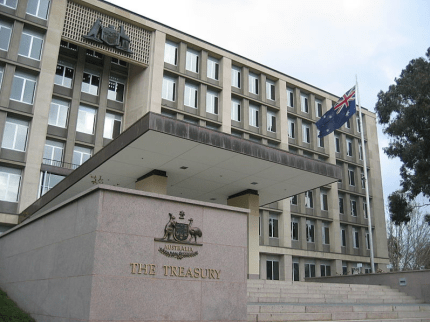
The Treasury Building, Langton Crescent, Canberra

Posted in Industry policy, Labour market, Macroeconomy, Uncategorized | Tagged , , , , , , , , , | 12 Comments

Many accounting & financial services businesses being held back by poor understanding of laws of success

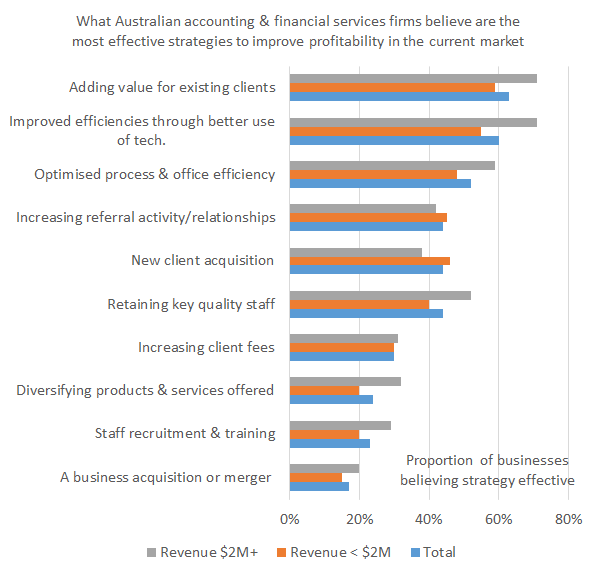
Last Wednesday, at the Brisbane offices of Macpherson Kelley Lawyers, I attended a presentation by Macquarie on its 2015-16 Accounting and Financial Services Benchmarking Report, which is based on survey data collected from 355 accounting and financial services firms across Australia. I was stunned that fewer than half of respondents considered that new client acquisition is an effective strategy to improve profitability in the current market (see chart below). Instead, most respondents favour adding value for existing clients and finding efficiencies, which are both admirable goals, but are unlikely to result in startling business growth and profits.

profitability_levers

Source: Macquarie, 2015-16 Accounting and Financial Services Benchmarking Report, p. 17.

I would suggest that many accountants and financial advisers would benefit from reading The 10X Rule by US sales guru Grant Cardone, in which he notes (in Chapter 19):

Customer satisfaction doesn’t concern me very much! Why? Because I know that we over-deliver to our clients and provide customer service that is well beyond “satisfactory”…

…I am most worried about noncustomer satisfaction; that is, the people who are dissatisfied because they do not have my product and may not even know that they are unhappy…

…It is impossible for a company to create success by just focussing on customer satisfaction. I believe that the trend of focusing on customer satisfaction has been detrimental to customer acquisition. Companies become so consumed about their current customers’ “satisfaction” that many are failing to aggressively acquire and expand their market share.

These are very wise words, and I hope to see an improvement in the proportion of accounting and financial services businesses that believe new client acquisition is an effective profitability lever in Macquarie’s next benchmarking report.

Posted in Productivity, Uncategorized | Tagged , , , , , , , | 4 Comments

Pets are good for your health, the Budget and the economy

Bondi Vet Dr Chris Brown has noted:

“…pets make us happy. They wash away our worries while showing us how life should be lived. And pets are proven to also make us healthier.”

Pets also have economic and budgetary impacts, as recent research by my fellow economist and friend Dr Stephen Thornton has demonstrated. Stephen’s research was presented to a recent forum at Queensland Parliament House which was arranged by Mars Petcare, owner of leading pet food brands such as Chum and Whiskas, as part of its Keep Australia Pet Friendly campaign.

Stephen spoke about his recent report Pet ownership in Queensland strata schemes: economic, financial and public health benefits. The report considered the economic, financial and public health impacts that would follow from allowing pets in properties under strata schemes without prohibitions (although a body corporate would be able to set reasonable conditions and have the power to ask for offensive pets to be removed after reasonable notices). Stephen reports that, if dogs and cats were not prohibited in any strata dwellings, likely impacts include:

  • approximately $90 – $180 million of increased expenditure and over 600 new jobs in the lucrative pet industry in the medium term (3 to 5 years);
  • approximately a $25,000 increase in value and $1,300/year increase in rental income for lot owners of an average $500,000 apartment/townhouse; and
  • budget savings for Queensland Health resulting from better public health outcomes.

Please consult Stephen’s report for his specific assumptions and sources.

The current review of Queensland property law being carried out by the Commercial and Property Law Research Centre at QUT provides an excellent opportunity to consider changes in property law to make it easier for people to own pets in properties in strata schemes.

thornton_qph

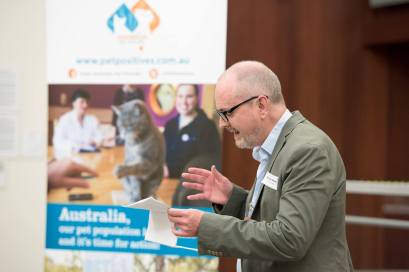
Dr Stephen Thornton speaking at the Qld Parliament House forum on keeping Australia pet friendly

Posted in Budget, Health, Housing, Uncategorized | Tagged , , , , , , , | Comments Off on Pets are good for your health, the Budget and the economy

Heavy criticism of Qld’s infrastructure deficit at IAQ Infrastructure Summit

Government ministers should accept speaking invitations at important conferences so they can communicate with industry and the public, and, also, so they can deny Opposition members 20 minute speaking slots in which they can criticise the Government’s performance. That is what happened yesterday at the Infrastructure Association of Queensland’s Infrastructure Summit held at the Brisbane Convention and Exhibition Centre, which featured Deputy Opposition Leader Deb Frecklington as keynote speaker.

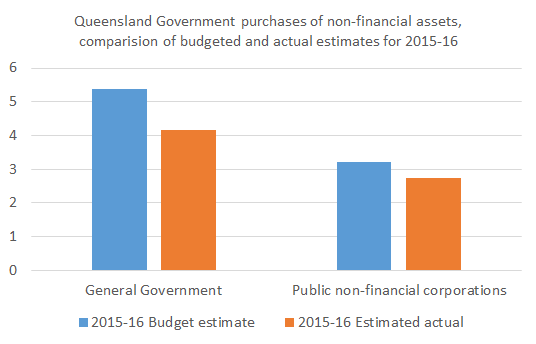
The Deputy Opposition Leader heavily criticised the Queensland Government’s record on infrastructure, noting that, at 1.3 percent of GSP, general government infrastructure spending was at a record low in 2015-16. She also criticised the Government for failing to fully deliver its infrastructure program in 2015-16, with a shortfall of some $2 billion. This appears to be based on a comparison of budgeted and estimated actual expenditure figures for non-financial asset purchases across the whole of Queensland Government for 2015-16, which reveals a shortfall of $1.7 billion (see chart below based on data from the 2016-17 Budget papers, specifically Tables 9.1 and 9.2 of Budget Paper no. 2).

infrastructure_1516

The Deputy Opposition Leader also said the Government has yet to make a convincing case for Cross River Rail, and called on the Government to release the full business case. She asked what “secret taxes” are being planned by the Government to pay for the project. This is obviously a reference to value capture proposals, which could include a betterment levy on property owners benefiting from increases in property values. An increase in car registration, which was apparently advanced as an option in the business case, has been ruled out by the Government. I hope the Opposition’s rhetoric about secret and sneaky taxes does not preclude it from using value capture to pay for future projects when in Government, as value capture can be a legitimate source of project funding and can promote a fairer sharing of the costs.

The Deputy Opposition Leader would have been very pleased if she had stayed at the Summit, because the next speaker, the Deputy Director-General of Queensland’s Infrastructure Department Darren Crombie, said he supported a lot of what the Deputy Opposition Leader said, and he noted she was correct about the infrastructure shortfall. It appears that public servants, too, and not just industry players, are disappointed with the relatively low level of infrastructure spending in Queensland. As I have noted on this blog, however, government infrastructure spending has started to increase recently, and it is very important to make sure we are spending money on projects that deliver net benefits to the community.

Posted in Infrastructure, Transport, Uncategorized | Tagged , , , | 2 Comments

Subsidiarity principle suggests Qld Government should let West Village proceed in current form

In today’s Courier-Mail, commenting on the Deputy Premier’s call in for State Government review of an $800 Million West End development, Steve Wardill observes that “WITH the case of the West Village development call-in, Jackie Trad was damned if she didn’t and damned if she did.” If she did not call it in, she would lose support in her electorate of South Brisbane, but, if she did, she ran the risk of appearing to be anti-development.

Political considerations will ultimately determine the conditions the Government places on the West Village development, because it is obvious on economic and policy grounds it should proceed in its current form, and that Brisbane City Council was right to ignore its own restrictive neighbourhood plan for the area when approving the development. Consider that higher inner-city population density, which this West End development would contribute to, would be consistent with State Government policy to increase active transport (cycling and walking) and to reduce greenhouse gas emissions.

Furthermore, there does not appear to be any reason for the State Government to get involved, because this is a purely local issue. It is not affecting the environment outside of the immediate local area as far as I can tell. A well-known principle governing the allocation of powers and responsibilities to different levels of a hierarchy, which apparently originated in the Catholic Church, is the subsidiarity principle. According to the Council for the Australian Federation:

Subsidiarity is the principle that powers and responsibilities should be left with the lowest level of government practicable. Such a devolved system means there is greater local input into decision-making and States and Territories can customise policies and services to suit local preferences.

Applying this principle would mean that local planning decisions with no State-wide significance are left to councils. This would appear applicable in the case of the West Village development.

Previous related posts include:

Heritage protection imposing high costs

Brad Rogers’s guest post – Old Queenslanders in a new city

Grattan book City Limits highlights problems with current planning and transport policies

Posted in Brisbane, Uncategorized | Tagged , , , , , , , , , | 6 Comments

Upcoming lecture on whether Australia should have a Royal Commission into banking

Last month in Perth, at the WA Local Government Association Convention, I was lucky enough to hear a speech by former Australian Chief of Army David Morrison, in which he asked what comes to mind when you hear the words “Australian banker”? He was implying that the impression would not be positive. While he only touched on banking in his speech on organisational culture, it cemented in my mind that there is a lot of community concern about the behaviour of our banks, particularly in light of scandals such as unscrupulous practices at CBA’s CommInsure (see this ABC News report) and manipulation of the Bank Bill Swap Rate (see this Conversation article).

Also, you may recall the Storm Financial scandal, in which over-leveraged clients of Storm Financial were wiped out when stock markets crashed during the financial crisis. Banks such as CBA, Macquarie and Bank of Queensland that had lent money to investors ended up making multi-million dollar settlements in the aftermath of Storm Financial’s collapse (see this Courier-Mail report). Many investors in Storm Financial are still suffering financially and are supportive of calls for a Royal Commission into banking, as reported recently in the Townsville Bulletin:

“THE thousands of victims of Townsville’s Storm Financial collapse “to a man” want a royal commission into the misconduct of banks, chairman of the Storm Investors Consumers Action Group Mark Weir said yesterday.

It comes as Mr Weir remains part of a small group of Storm investors who are still waiting for a resolution with their bank eight years after reckless advice and lending caused $3 billion in losses, and as politicians argue over the need for a royal commission or new consumer tribunal.”

While it may yield some good and would be tremendously entertaining, as we may expect some more sordid tales to be revealed, a banking Royal Commission would be expensive, at a cost over $50 million. There would also be the risk of an excessive regulatory response following on from a Royal Commission. I will provide my views on whether the likely benefits would outweigh these costs at an upcoming lecture to the University of the Third Age (U3A) Redlands on Monday morning, 10 October at Cleveland’s Donald Simpson Community Centre (172 Bloomfield St, Cleveland). Here are the details from the U3A website:

LIFE IN AUSTRALIA will return to the Donald Simpson Community Centre 9.30am for Term 4 on Monday 10 October 

Monday 10 October will be guest speaker, Gene Tunny Principal, ADEPT Economics speaking on “Should Australia Have a Royal Commission into Banking?”

Cost $4 including Morning Tea, all more than welcome.

Posted in Macroeconomy, Uncategorized | Tagged , , , , , , , | 2 Comments

Weekly highlights: BDO Economic & Political Update and ESA Qld-Nine Squared CBA seminar

It was a fantastic week to be an economist in Brisbane, with two excellent events, the BDO Economic & Political Update on Tuesday morning at BCEC and the ESA Qld-Nine Squared seminar on Cost-benefit analysis in contemporary project evaluation at QUT on Wednesday afternoon.

BDO Economic & Political Update 2016

The Economic and Political Update 2016 continued BDO’s track record of excellent breakfast functions, following on from a very informative and interesting Budget seminar in May. Treasurer Curtis Pitt gave a good account of the State’s economic outlook, and I was pleased he quoted my recent comments on the SEQ-regional Queensland divide that were reported by Paul Syvret in the Courier-Mail’s most recent Queensland Business Monthly. You can hear the relevant quote at just after 34 minutes into the video of the function (https://www.youtube.com/watch?v=YQBVeABh2y8).

The highlight of the function was an outstanding panel discussion moderated by ABC Senior State Political Reporter Chris O’Brien, which saw some sparks fly between the Treasurer and CCIQ Director of Advocacy Nick Behrens. The Courier-Mail has reported:

“We couldn’t help but notice that CCIQ advocacy director Nick Behrens and Treasurer Curtis Pitt were kept separated during a BDO breakfast panel discussion this week.

Behrens and Pitt have endured a rocky relationship in recent weeks, after the former made some particularly critical comments about the latter in a very public manner.

That was quickly followed by Behrens blowing the Government’s cover on plans to make Easter Sunday a public holiday under the cover of a review of trading hours.

Both were all smiles during the breakfast (though Behrens did correct the Treasurer about one particular issue during proceedings). It likely helped that there were two chairs between them.”

I recall two points Nick actually challenged the Treasurer on.

First, in response to the Treasurer’s reference to ACCC Chairman Rod Sims’ recent critical words on privatisation, Nick said that the ACCC Chairman did not really argue against privatisation. Instead, he just made the obvious point that there should be appropriate regulation of privatised monopoly businesses. Nick went on to give an outstanding monologue on the economic benefits of privatisation.

Second, after the Treasurer claimed the Government is reducing debt, Nick noted general government debt is actually increasing over the forward estimates. According to the 2016-17 State Budget papers (BP 2, Table 9.4, p. 183), general government borrowing is increasing from $35.7 billion in 2015-16 to $38.7 billion in 2019-20 (NB this is a stock measure not the annual flow).

CCIQ members are certainly getting good value from Nick in terms of frank and fearless advocacy on their behalf. Overall, both the Treasurer and Nick acquitted themselves well, and the audience very much enjoyed the robust exchange!

ESA Qld-Nine Squared CBA in contemporary project evaluation seminar

ESA Qld, of which I am the Secretary, and Nine Squared, a transport economics consultancy, teamed up on Wednesday afternoon to host an intellectually stimulating facilitated discussion between academic experts, public officials, and professional economists on the current use of cost-benefit analysis (CBA) in project evaluation.

UQ Associate Professor Richard Brown, who co-authored the leading international CBA textbook (see image below) made the excellent suggestion that we should engage in ex post reviews of CBAs. That is, we should check, for example, if infrastructure projects ended up delivering the benefits that were promised. Such an exercise would likely reveal the types of projects we should be skeptical about, such as large dams and irrigation schemes in regional areas. In fact, Jim Binney of Mainstream Economics and Policy appears to have already done just that for the Burdekin Falls Dam and Paradise Dam, finding that both dams failed to deliver projected net benefits (see Jim’s estimates quoted in this WWF submission in response to the Federal Government’s Agricultural Competitive Green Paper.) This type of exercise should be done more often.

Another excellent point made in the seminar came from Ben Ellis from Nine Squared, who noted that value capture (e.g. through a betterment levy) might improve the benefit-cost ratio of projects, by providing project funding that is associated with a lower efficiency loss than alternative funding through other taxes. We know from research by UQ’s Harry Campbell, for example, that one dollar of revenue costs more than one dollar to raise due to the efficiency losses from taxes; it can cost upwards of $1.30 according to some estimates.

I made the final comment from the floor regarding the need for transparency in CBA studies and business cases, and I called for the Cross River Rail business case to be released in full. Building Queensland has so far only released a pathetically thin summary, which is terrible from a transparency perspective. There appeared to be much support in the room for my position, which was very encouraging.

Well done to Nine Squared and ESA Qld Vice President Julian Pearce for organising such an excellent seminar.
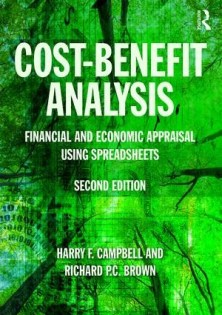
cba_book_cover

If you only read one book on cost-benefit analysis, make sure it’s this one.

Posted in Infrastructure, Uncategorized | Tagged , , , , , , , | Leave a comment

Good news for the economy as Qld businesses increase investment in machinery & equipment

Despite having some weak regional economies, particularly in the Townsville and Queensland outback regions, the State economy overall recorded reasonably healthy growth in State Final Demand in the June quarter of 0.7 percent in seasonally adjusted terms. This is very good news and is a testament to the robust economy of SEQ. Pete Faulkner has an excellent summary of the new data released by the ABS yesterday at his blog (GDP +0.5% q/q and +2.9% ann in line with expectations. QLD moves into positive territory):

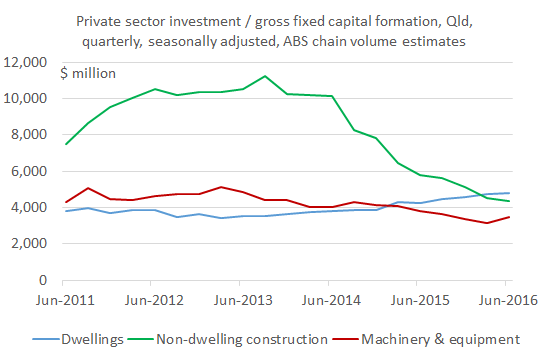
The story from Queensland is one of a recovery. State Final Demand (which does not account for the state’s massive exports) rose 0.7% q/q which is the best performance in 3 years. Interestingly, given the talk about the slowdown in Private Investment, this sector was up 0.9% for the quarter with investment in machinery and equipment (which accounts for 23% of Private Fixed Capital) jumping 10.4% q/q. Public sector Fixed Capital also grew strongly up 6.8% q/q which helped the Public sector grow 1.9% q/q. The net result from this renewed strength is that State Final Demand was down just 1.2% for the year 2015-16 and up 0.4% y/y; this is the best result since the end of 2014 although it still falls a little short of the 2016-17 Budget forecast of a 1.0% decline.

Pete is right to highlight the increased private sector investment in machinery and equipment as a good sign, as it suggests new businesses are opening up or existing ones are expanding, or at least they feel confident enough to replace old equipment (see my chart below). Let us hope this translates into a boost in employment soon. Along with greater dwelling construction, greater investment in machinery and equipment offset the adverse impact on State Final Demand coming from the continuing decline in non-residential construction, which is largely associated with the mining downturn and the completion of the Gladstone LNG processing facilities.

sfd_jun16_chart1

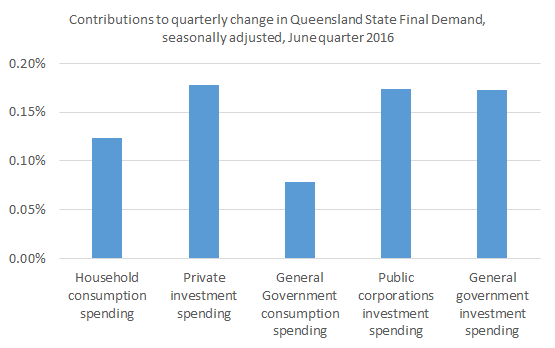
While private sector investment and household consumption made solid contributions to the growth in State Final Demand in June, the majority of the growth was due to increases in Government expenditure (see chart below, noting the columns represent percentage point contributions to the growth in State Final Demand of 0.7% in June quarter; i.e. the columns add up to 0.7%). Given the Federal and State budgetary positions, the desirability of public expenditure increases may be questioned by some economists. That said, these expenditures are supporting demand at a challenging time for Queensland’s economy as it adjusts to the mining downturn.

sfd_jun16_chart2

Posted in Macroeconomy, Mining, Uncategorized | Tagged , , , , , , , , | 4 Comments