ABC Regional Drive interview – dubious jobs data another sign ABS is struggling under a tight budget

In its September labour force report, which reported the Australian unemployment rate fell to 5.6% from 5.7% while employment fell by 9,800 (and full-time employment fell 53,000!), contrary to the jobs growth the market was expecting, the ABS more or less admitted it had to fudge the data so the numbers did not appear even more odd. The numbers might have shown an even greater reduction in employment, for example. Note that the unemployment rate fell even though employment fell due to a decline in the participation rate. On this point, see Pete Faulkner’s post:

Unemployment rate drops on fall in participation

Queensland actually turned out to be the reason the ABS had to fudge the data. The ABS notes on its website:

“The incoming rotation group in Queensland for September 2016 was considerably different to the rest of the Queensland sample and its influence has been temporarily reduced as part of the estimation process. The data will be further reviewed when October data are available.”

Annette Beacher from TD Securities went as far to say that the latest ABS data are “rubbish” (see this ABC News report), and I pretty much agree with her, as I mentioned to ABC Radio’s Loretta Ryan on the Regional Drive program yesterday afternoon. The information content of yesterday’s labour force data is very low. I am always careful not to read too much into any one month’s figures due to the volatility in month-to-month changes, but yesterday’s data were even more dubious than data in the past. Considering both the unreliability of the labour force data, which are essential to monetary policy formulation by the RBA, and the recent Census debacle, the Government may need to bring in new senior management and boost the budget of a clearly struggling ABS.

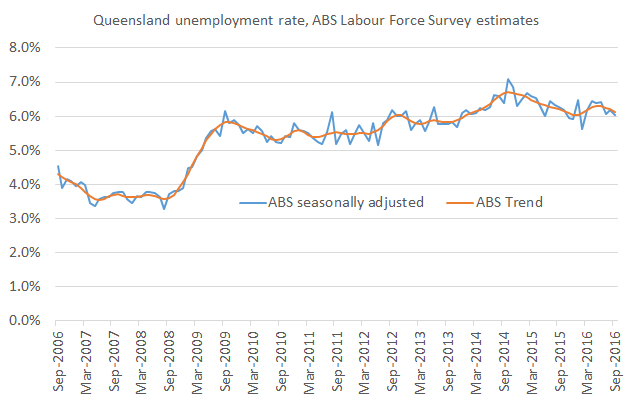
Finally, Queensland’s unemployment rate fell from 6.2% to 6.0% in seasonally adjusted terms (see chart below), which I would like to believe but am unsure of due to the unreliability of the data. That said, I told Loretta Ryan there are reasons to be confident Queensland’s economic conditions are improving, especially considering positive developments in mining, tourism, and agriculture.

unemployment_rate_sep16

Posted in Labour market, Uncategorized | Tagged , , , , , , , | 3 Comments

SUV sales over-taking passenger vehicle sales in Qld

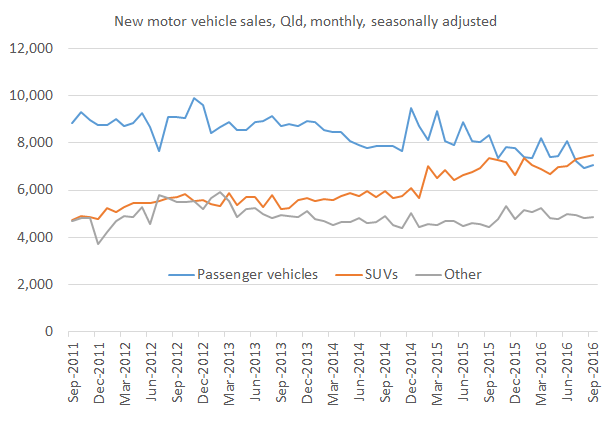
As SUVs have become the new family car, and many millennials are living in inner cities and relying on public transport, walking or cycling, SUVs have steadily increased their share of new motor vehicle sales, and now SUV sales exceed passenger vehicle sales in Queensland (see chart below based on new ABS data released yesterday). This is also the case in WA, NT and Tasmania, although not yet at a national level, as passenger vehicle sales still exceed SUV sales in NSW, Victoria, SA and ACT. Eventually, SUV sales may dominate nationally, especially given so many stylish new SUV models, including Jaguar’s new F-Pace. High-end SUVs are suburban status symbols, and I expect their popularity will continue to grow.

mv_sep16_chart1

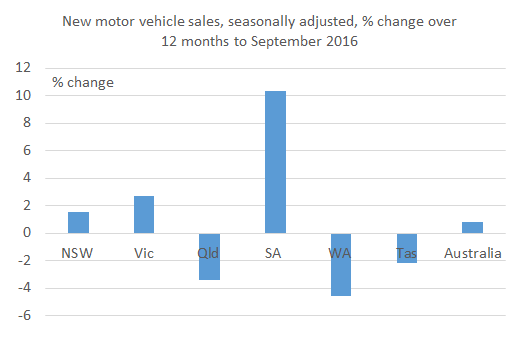
The latest new motor vehicle sales data from the ABS reflect the challenging conditions that have persisted in Queensland since the end of the mining boom, with new motor vehicle sales having fallen over the last twelve months (see chart below).

mv_sep16_chart2

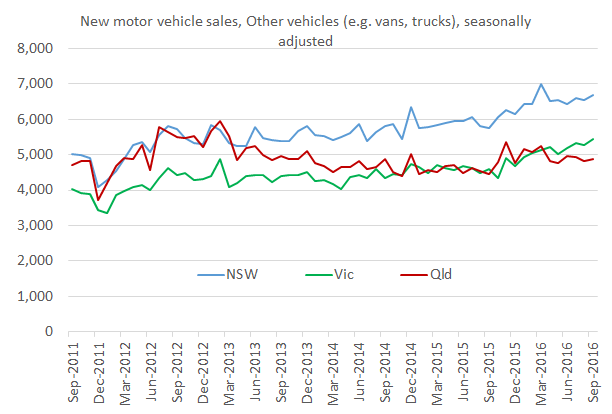
While business confidence in Queensland appears to be improving, this is still to be fully reflected in the sales of vans and trucks which fall into the “other” new motor vehicle category. This category appears to be picking up more strongly in other States (e.g. see chart below).

mv_sep16_chart3

Posted in Macroeconomy, Uncategorized | Tagged , , , , , , , , | 4 Comments

The future of the professions

Speaking with accountants at CPA Australia conferences earlier in the year, I was struck by the widely-shared anxiety that accountants have about the future of their profession. Australian accountants are concerned about a variety of trends that threaten them with redundancy, including out-sourcing of data processing to low-cost economies such as India, DIY book-keeping using cloud applications such as Xero and MYOB, and advances in artificial intelligence. Hence the interest of many accountants in moving into business advisory and management consulting services.

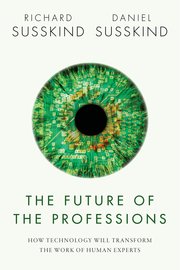
According to Richard and Daniel Susskind from Oxford University, in their recent book The Future of the Professions, it is not just accountants who should be worried, but all professionals. Technology is affecting all professions in a variety of ways, and the delivery of professional services will be radically different in two to three decades’ time. As noted on the flap of the book cover:

The Future of the Professions explains how ‘increasingly capable systems’—from telepresence to artificial intelligence—will bring fundamental change in the way that the ‘practical expertise’ of specialists is made available in society. The authors challenge the ‘grand bargain’—the arrangement that grants various monopolies to today’s professionals. They argue that our current professions are antiquated, opaque, and no longer affordable, and the expertise of the best is enjoyed only by a few. In their place, they propose six new models for producing and distributing expertise.

The six new models proposed by the Susskinds, which are designed to deliver existing services more economically and more widely through various organisational and technological changes, are referred to by the authors as:

  • networked experts model, in which professionals form virtual teams and are not burdened by the high overheads of traditional professional service businesses;
  • para-professional model, in which a non-expert who deals with a client uses procedures or systems that have been developed by experts;
  • knowledge engineering model, in which “practical expertise is represented in a system that is made available to users as an online service” (p. 221);
  • communities of experience model, in which expertise is crowd-sourced and a Wikipedia of professional knowledge and techniques is continually enhanced;
  • embedded knowledge model, in which professional expertise is embedded within machines, buildings, working practices or even into humans; and
  • machine-generated model, in which, in the most advanced model presented and one in which humans are effectively redundant, practical professional knowledge ends up being developed and delivered by machines.

The Susskinds consider it likely that the greater use of technology will result in unemployment for many current professionals, but the efficiency gains will yield long-term economic benefits. And technological change will result in the creation of new jobs that are required in the new modes of delivery of professional services. The Susskinds note that such jobs might have the labels of para-professionals, knowledge engineers, process analysts, data scientists or systems engineers, for example. That is, we will have fewer professional accountants or lawyers, for example, but more para-professionals to engage with clients on their issues, and more data scientists and systems engineers to make sure the expert systems that solve the clients’ problems are working properly.

The Susskinds rightly encourage current professionals to start preparing for the future now by developing delivery modes for their services that take advantage of the new technologies such as telepresence, robotics, and advances in data mining, AI and expert systems. The six new delivery models the Susskinds have presented provide an excellent starting point for professionals to think about what is possible for their professions.

The Susskinds are very convincing on the point that machines or expert systems can perform many professional tasks as well as or better than human professionals, citing an example that would be very disturbing to US residents who use a lot of pharmaceuticals (on p. 49):

The University of California at San Francisco has a pharmacy staffed by a single robot which has now completed more than 2 million prescriptions without error—on a conservative estimate, US pharmacists make a wrong prescription about 1 percent of the time (equivalent to 37 million mistakes each year).

This is an excellent book which encourages deep reflection by professionals on their current work practices and opportunities for improvement. I would highly recommend it to all professionals.

future_of_the_professions

 The Future of the Professions, by Richard Susskind and Daniel Susskind, is published by Oxford University Press. Copies are available at Dymocks Bookstore on Queen St Mall, Brisbane.

Posted in Uncategorized | Tagged , , , , , , , , , , | 4 Comments

Corporate whistleblowers need better protection

At the QUT Business Leaders’ Forum lunch at the Sofitel in Brisbane on Monday, NAB CEO Andrew Thorburn was subjected to a tough line of questioning from the forum moderator, veteran ABC journalist Kerry O’Brien. Thorburn generally performed well, although some of his claims were unconvincing. The Australian Financial Review’s Rear Window column observed yesterday:

Thorburn squirmed after a few questions, agreeing there had been a failure of leadership. There was even an audible gasp from the assembled when Thorburn said his bank did all it could to help whistleblowers.

I was one of the assembled making the audible gasp.

Kerry O’Brien had suggested to NAB’s CEO that, in Australia, anyone with knowledge of corporate wrongdoing would be very reluctant to report it, given that reporting it would be a career killer. This reflects the weak legal protection given to corporate whistleblowers in Australia. Sydney Morning Herald journalist Adele Ferguson, a strong advocate of a Royal Commission into the banks, has pointed to disturbing examples of whistleblowers, such as a whistleblower at IOOF, who have lost their jobs after courageous disclosures (see this SMH report). The limited protection for whistleblowers is appalling, given that whistleblowers have been essential to uncovering the scandals associated with the banking industry in recent years.

It is widely agreed that Australia’s whistleblower protection laws are weak, especially compared with those in the US and some other countries. In 2014, in its report on the performance of ASIC, the Australian Senate Economic References Committee recommended an overhaul of Australia’s corporate whistleblower laws, so corporate whistleblowers would receive protection similar to public sector whistleblowers, which would include the protection of anonymous disclosures, among other additional protections (see Recommendation 15 in Chapter 14 of the Report). Currently, under the Corporations Act, whistleblower protection does not extend to people making anonymous disclosures.

The Committee also recommended consideration of “reward-based incentives for corporate whistleblowers, including qui tam arrangements”. Qui tam is Latin for “who as well”, and under these arrangements whistleblowers could receive part of any fines or settlements against companies that have done the wrong thing. In a position paper published earlier this year, Transparency International suggested qui tam provisions may be desirable as they:

“…incentivise corporate employees to disclose fraud and wrongdoing by providing rewards of up to 25 per cent of recovered damages, such as in the US where US$6 billion was recovered in 2014 through the federal False Claims Act.”

Some commentators may be concerned about the possibility of vexatious claims arising from reward-based incentives, but, by linking the reward to recovered damages, a qui tam approach may avoid this issue.

Given the high level of community concern regarding the behaviour of our banks, which are just one more scandal away from a Royal Commission, the reform of whistleblower protection is long overdue and should be progressed by the Australian Government as a matter of urgency.

whistle

Posted in Uncategorized | Tagged , , , , , , , | 2 Comments

St Lucia property owners capturing value from Ironside State School

A story in the Courier-Mail this morning regarding Ironside State School in St Lucia, Brisbane reinforces Independent Schools Queensland head David Robertson’s argument for reforming school funding arrangements (see QEW post), as it appears parents are very willing to pay to send their children to high-performing State Schools such as Ironside. But this high willingness to pay does not provide the Education Department with additional funds; instead it benefits local property owners. The Courier-Mail reports:

Ironside State School is one of Brisbane’s most sought after primary schools.

Consistently ranked as one of the top performing academic facilities in the city, it is little wonder the school was forced to introduce a catchment zone around St Lucia in a bid to cap student numbers…

…DJ Arnold Real Estate owner David Arnold said Ironside State School was one of the biggest drawcards for families who moved into the area.

“We find people come here to rent to secure their children’s enrolment,” he said.

“That’s a big thing.”

The State Government is rightly interested in value capture regarding the benefits created by proposed new infrastructure investments such as Cross River Rail. It should also consider capturing part of the value created by existing infrastructure, including high-performing state schools such as Ironside State School and Brisbane State High, which drive up rents and hence property values in their catchment areas. Relevant policy measures would include the proposals advanced by David Robertson last week (e.g. a means-tested school voucher scheme) and the replacement of the inefficient stamp duty tax regime with land tax.

Ironically, parents can end up paying similar amounts to private school tuition fees, through higher rents or property prices, so they can live in high-performing school catchments, as demonstrated by Ian Davidoff and Andrew Leigh, then at the Treasury and ANU respectively, in an excellent 2007 paper regarding the impact of Canberra public schools on the local property market:

How Much Do Public Schools Really Cost? Estimating the Relationship Between House Prices and School Quality

Posted in Brisbane, Education, Uncategorized | Tagged , , , , , , , , | 4 Comments

Excellent proposal for school funding reform from ISQ head David Robertson

In today’s Courier-Mail, the head of Independent Schools Queensland has come out in support of reforming school funding arrangements, either through a levy on wealthy parents whose children attend state schools or a means-tested voucher scheme. ISQ head David Robertson writes:

DAVID Gillespie’s latest outcry against private schools totally misses the point that the parents of students at independent schools pay their taxes and are entitled to government support for the education of their children.

In fact, these parents in Queensland contribute $1 billion annually (from their after-tax income) to school education. Across Australia, fee-paying parents save governments $4.3 billion each year…

…Perhaps a more useful public policy debate might be whether or not affluent parents who choose a state school for the education of their child might make a contribution to the costs through a Medicare-type levy.

Alternatively, a school voucher system could be considered, with students allocated financial support according to their needs.

This would give all families the opportunity to choose the school, no matter which sector, that best suits their needs and aspirations.

Levies or means-tested vouchers make a lot of economic sense. There are many parents who would be willing to pay (and would be able to pay) to send their children to particular state schools, and this is a revenue source that the State Government could use to help meet the costs of schooling. In a way, many parents are already spending significant sums to send their children to favourable state schools through buying properties in the catchments of top schools such as Brisbane State High. Means-tested vouchers would have the added benefit of encouraging greater choice, as they may allow many parents to send their children to better schools by making small financial contributions in addition to the vouchers.

Obviously, a lot of work would need to go into designing a new funding model. The ideas advanced by ISQ, which have long been supported by economists, deserve further development and consideration by Government. The idea of co-payments for state schools was actually raised in the abandoned draft Economic Action Plan from the Queensland Department of Premier and Cabinet last year, and I have commented previously on the desirability of reforming school funding arrangements along the lines proposed by ISQ:

Qld private independent schools saving taxpayers $1 billion per annum

Catholic schools still benefiting from very favourable funding deal from Howard Govt days

Large savings for Qld Govt from shift to private schooling

Posted in Uncategorized | Tagged , , , , , , , , , | 4 Comments

Recommended reading: Empire of Things

In 2015-16, Australian households consumed $929 billion of goods and services. Consumption is central to our economy. In the Great Depression, John Maynard Keynes exhorted Britain’s “patriotic housewives” to spend money at the sales, lest they put a man out of work for a day by saving five shillings. In the most recent financial crisis, our former Prime Minister Kevin Rudd urged us to spend our stimulus payments, the so-called Rudd money, after his Treasury Secretary Ken Henry advised him to “Go hard, go early, and go to households.”

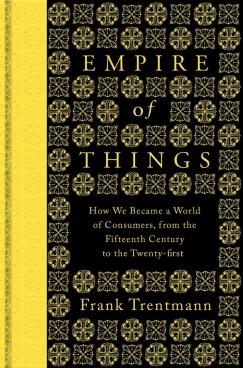
Consumption, now or in the future, is the ultimate purpose of economic activity. And the study of consumer behaviour is at the core of economics. So, as an economist, I was incredibly delighted to find a history of consumption was published earlier this year, titled Empire of Things: How We Became a World of Consumers, from the Fifteenth Century to the Twenty-First. It was written by Frank Trentmann, a History Professor at the University of London, and it is available at Dymocks’s Queen St Mall store, which has an excellent collection of economics and finance books.

empire_of_things

The book’s main thesis is that our modern materialistic lifestyles and consumer culture have deep historical roots, going back many centuries. In an excellent summary of his argument in the closing chapter, Trentmann observes:

“Almost all the forces driving up consumption were in place by the time Western states embraced sustained growth in the 1950s: the rise in domestic comfort, fashion and novelty; shopping for pleasure; a taste for articles from faraway lands; rising levels of water and energy use; the cult of domestic possessions and hobbies; urban entertainment and pleasure; credit and debt; and the notion of the ‘material self’, which recognized that things are an inextricable part of what makes us human.”

Trentmann surveys how these forces drove consumption over many centuries, reviewing the growing consumption of a range of goods including coffee, tea, sugar, cotton and porcelain, among others.

The book recalls the great controversies over consumption, include Marx’s critique of capitalism and “fetishism” regarding commodities, Veblen’s concerns about “conspicuous consumption”, and more recent concerns from environmentalists regarding the sustainability of western lifestyles. Trentmann echoes mainstream economists when he argues that resource scarcity is not something we need to worry about at the moment, particularly considering that prices will rise as resources become scarcer, encouraging more efficient use; but we may need to worry about un-priced external impacts (what economists call externalities) such as greenhouse gas emissions.

Trentmann is highly insightful when it comes to the deficiencies of the former socialist economies in the Soviet Union and Eastern Europe in meeting the needs of their consumers. Popular support for the socialist economic system was eroded by the clear superiority in range and quality of western consumer goods. Referring to shoddy and technologically deficient products, including cars such as the Tranbant, that were produced in economies such as East Germany, Trentmann notes many workers in socialist economies came to lose pride in their work, as they knew the goods were of poor quality relative to what was produced in western economies. This was ironic given that socialist economies were meant to exalt the worker.

I also found Trentmann insightful regarding the luxury goods market, which he divides into two markets: the traditional high-end luxury market, for “classic Porsches and Tiffany” and other ultra-expensive luxury goods, and a second market for accessories such as handbags and watches, which are relatively more affordable. The motivations for the consumption of luxury accessories are not necessarily what you expect, particularly among consumers in emerging market economies. Trentmann observes:

“The demand for luxury accessories is no longer primarily about emulating the very rich. It is about a sense of belonging to a global ‘modern’ middle class, about vertical inclusion rather than hierarchical distinction. This is one reason for the popularity of luxury brands in Asian markets, including China, with its stellar savings rate. For millions of urban secretaries, going off to work with the same handbag and sunglasses conveys the feeling of being part of the modern world.”

Luxury accessories are no longer necessarily about distinction and exclusivity, but about the experience the goods provide.

I highly recommend this book to economists and historians, and also to market researchers and sales people, who need to understand the factors that will motivate customers to choose particular products among a myriad of alternatives in this empire of things.

Posted in Uncategorized | Tagged , , , , , , , | 3 Comments

Qld should benefit from strong economic performance in NSW and Victoria

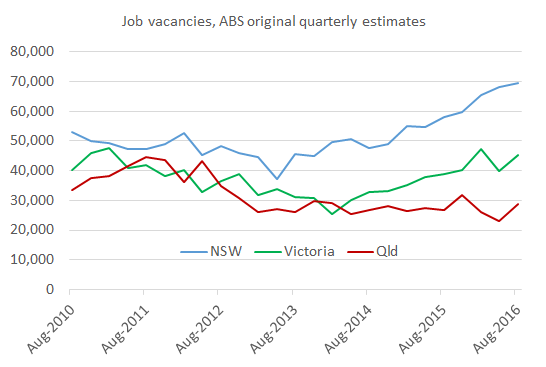
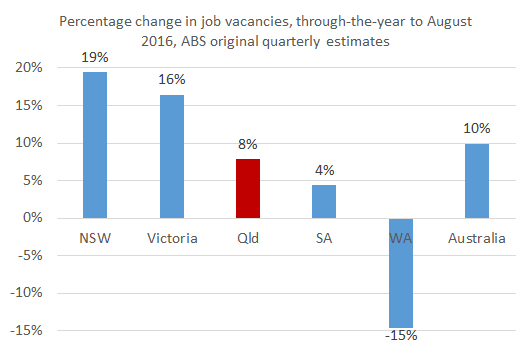
The August job vacancies data released by the ABS yesterday confirm the strong economic performance we are seeing in NSW and Victoria, and they also show encouraging signs for Queensland (see charts below).

vacancies_aug16_chart1

vacancies_aug16_chart2

Given national markets and the linkages between Queensland’s economy and that of other States, we can expect some of the strong economic performance in southern States to flow through to Queensland and to boost our economy. Let us hope some of the economic benefits flow to regional Queensland, particularly to regions such as Townsville, which has been suffering from a weak economy. For more on the economic challenges facing Townsville and North Queensland more broadly, see some of Pete Faulkner’s recent posts:

Regional jobs – improvement for Cairns but worse for Townsville

Pete Faulkner on ABC North Queensland

The Premier has made a sound political decision to spend next week in Townsville (see this Townsville Bulletin report).

Posted in Labour market, Macroeconomy, North Queensland, Townsville, Uncategorized | Tagged , , , , , , , , | Leave a comment

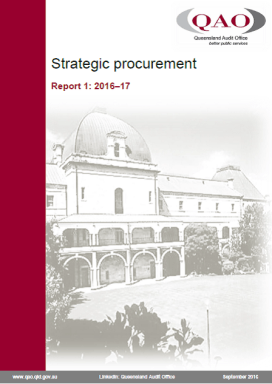
Qld Audit Office gives scathing assessment of Government procurement

The Queensland Audit Office’s first report for the 2016-17 financial year is a scathing assessment of Government procurement practices, an assessment which should spur the State Treasury into action. After all, it is proverbial that, if you look after the pennies, the pounds will look after themselves. Actually, it is more than pennies to look after, as the QAO reports (p. 9) that “In 2015-16, Queensland Government departments and Hospital and Health Services (HHSs) spent about $10 billion on services and supplies provided by the private sector (excluding capital spend).”

The QAO finds that a recent attempt to save money on procurement, the Procurement Transformation Program (PTP) led by the Procurement Transformation Division (PTD) in the Department of Housing and Public Works (DHPW), failed to achieve its targeted savings over 2013-14 and 2014-15 by a long way, by around $226 million (p. 20):

A whole-of-government review set an expectation for the PTP, led by DHPW, to achieve a minimum of $417 million in procurement benefits within two financial years across all categories. PTD reported only $190.5 million was achieved over its first two years.

The PTP, which was introduced under the Newman Government, was abandoned in 2015 by the current Government. The QAO reports (on p. 3):

…the government is no longer tracking or aiming for the benefits target set in the State Procurement Plan 2014–18, which was developed by the PTD in June 2014. This is because it believes that target focused too narrowly on achieving financial savings rather than value for money.

The Government does have a point that it is value for money, rather than the pure financial savings themselves, which should be the target. But it is worrying that the QAO appears to suggest in its report that Government agencies have essentially given up on chasing savings in procurement. Indeed, they have no real incentive to achieve them because they will just end up with money taken out of their departmental budgets by the Treasury. Spend it or lose it is the guiding principle.

The QAO is highly critical of the capabilities that exists within Queensland Government agencies to achieve value for money in procurement. It questions why almost half of the plane flights taken by public servants are booked within seven days of the travel date, and hence have higher fares. Even taking into account the urgent nature of much Government business, the QAO suggests (on p. 25) that staff “do not adequately plan their travel.”

qao_report

This report should prompt a Qld Treasury takeover of Government procurement

Part of the problem is that the wrong agency, DHPW, has oversight of procurement across Queensland Government. The QAO notes (on p. 19):

DHPW has been responsible historically for coordinating whole-of-government procurement in Queensland. However, in our view it is not best positioned to deliver this function. It does not have the authority to set policies for procurement processes, influence finance system designs, or monitor how effectively departments implement them.

The QAO suggests, although it does not formally recommend, that Treasury takes over responsibility for procurement from DHPW. It notes (on p. 33):

Queensland is the only Australian state where the responsibility for whole-of-government procurement does not sit with a treasury or finance department.

This is unfortunate, as saving money is core Treasury business. I hope the hard heads at the Treasury would relish the opportunity to take over procurement policy, and I hope, after it absorbs this QAO report, the Government gives the Treasury this responsibility.

The QAO report provides the Government with a huge opportunity to show it is serious about budget management and reducing Government waste. Let us hope the QAO report prompts some strong action, as there is the potential to save tens of millions (if not hundreds of millions) of dollars annually through more rigorous procurement practices.

Also see ARN coverage of the report:

Audit uncovers blind spots in Queensland’s IT procurement regime

Posted in Budget, Uncategorized | Tagged , , , , , , , , | 1 Comment

Edward St redevelopment: Exciting opportunities for Brisbane’s future

luxury

This post is co-authored by my friend Dr Parisa Mahyari, who is a Brisbane-based expert on luxury branding and a property market analyst.

For some time now, Edward St has been associated with luxury brands such as Hugo Boss and Ralph Lauren, and it is becoming known as the “Paris end” of Brisbane CBD. Over the last few years, other brands such as Cartier and Montblanc have boosted the street’s credentials as a luxury shopping destination. In fact, location can be an important part of the success of retail businesses, especially for luxury brands that are targeted at a particular market. The availability of a range of luxury brands in a central location makes the Edward St precinct highly attractive to luxury shoppers, both from Australia and overseas.

That said, Edward St still has some way to go as a luxury shopping destination. There are many luxury stores such as Prada that are not present on Edward St yet, but are in other precincts in Sydney’s Pitt St, Melbourne’s Collins St, and Perth’s King St, for example. And there is the potential for further development to enhance Edward St’s status as a luxury precinct.

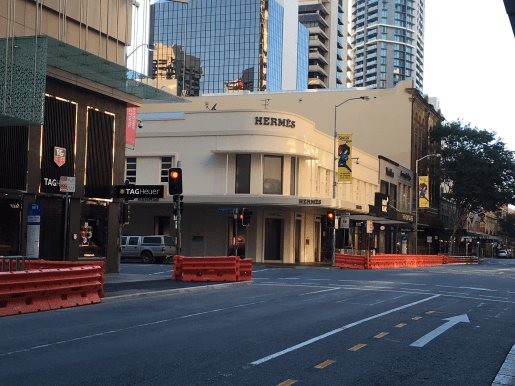
Hence it is welcome news that Brisbane City Council has commenced its $11 million upgrade of Edward St to create a world class luxury goods precinct (see image below and the Council website). The wider footpaths, granite paving and street trees will help create a boulevard atmosphere similar to that in European capitals such as Paris and Vienna. And the public art will add to the cosmopolitan atmosphere and attract well-heeled locals and visitors. The planned improvement in the Edward St streetscape appears to be consistent with the vision in the Brisbane Destination Tourism Plan to make Brisbane “Friendly, safe, engaging and accessible.” Additionally, the Council may wish to consider a re-branding exercise for Edward St to cement its status as a luxury goods precinct, similar to how London’s Lower Regent Street was re-labelled Regent Street St James’s (see Capital investment: the evolution of luxury London).
edward_st

The barriers are in place for the exciting new $11 million Edward St upgrade

The redevelopment has the potential to boost commercial opportunities, not only in luxury goods but also in hospitality, as the widening of Edward St should promote greater al fresco dining. Evidence from overseas, particularly from London developments, suggests food is an important part of the offering of luxury precincts. Primarily, the attraction of a luxury goods precinct is convenience. In one area, people have access to luxury shopping, luxury dining and luxury hotels.

The Edward St redevelopment is consistent with other new investments in Brisbane in luxury hotels and fine dining restaurants and high-end bars, such as OTTO at 480 Queen St, so it can be considered as building on what Brisbane already has.

Due to Brisbane’s superior weather and proximity to the Gold and Sunshine Coasts and the Reef, Brisbane can potentially leapfrog other East Coast cities with luxury precincts such as Sydney and Melbourne in attracting overseas visitors. Current offerings on Edward St have been especially successful with Chinese tourists, and, with the Chinese outbound tourism market growing from around 120 million per annum globally to 200-250 million in ten years’ time, there is obviously huge potential to attract more Chinese tourism (see this Goldman Sachs report). Additionally Brisbane can attract increasingly affluent travelers from across South-East Asia, including from Singapore, Malaysia and Indonesia. Australia offers a superior environment to many regional competitors, particularly Macau, which has seen a drop off in Chinese tourists and spending. However, the Chinese government is now taxing luxury goods purchased abroad, and this will restrain the growth in visitor numbers and spending to an extent (see this Business Insider article).

By helping Brisbane to attract more tourists, the further development of the Edward St luxury goods precinct would align with the current Brisbane City Council’s goals to position Brisbane as one of the most popular tourist destinations internationally and to make it Australia’s “new world city”. It will add to the contributions that will come from major upcoming projects including the $3 billion Queen’s Wharf Redevelopment, the Brisbane Airport New Parallel Runway Project as well as the Brisbane Quarter luxury mixed-use development on the site of the old Law Courts (see Queensland  News).

The Council should recover part of the cost of the Edward St upgrade through higher rates revenue, as the further development of the luxury goods precinct will likely result in higher rental incomes and property values. There will be benefits to other levels of government through higher tax revenues. While there is the loss of one lane of traffic on Edward St, the Council appears confident in traffic modelling suggesting this will not significantly add to congestion.

Overall, this appears to be a worthwhile investment given the large potential benefits flowing from additional economic activity and recreational benefits. It may very well attract further investment, as it makes Brisbane a more desirable location to live for high net worth individuals. Given the upcoming 2018 Gold Coast Commonwealth Games, it is a particularly well-timed investment, as there is the potential to attract visitors attending the Games to Brisbane for a spot of luxury shopping.

Dr Parisa Mahyari and Gene Tunny

Posted in Brisbane, Uncategorized | Tagged , , , , , , , , , , | 4 Comments