Get it right the first time: the Paradise Dam example

The Queensland Government’s rural water business Sunwater has released a great video about the restoration of Bundaberg region’s Paradise Dam to its full capacity, which the state government finally agreed to last Christmas Eve.* This came after more than two years of uncertainty about the dam’s future. In 2019, the state government revealed it had to lower the spillway by 5 metres to guarantee the dam wall wouldn’t collapse if it rained like it did in January 2013 again. The Christmas Eve announcement that the dam would be restored to its full capacity came as a great relief to many local growers, who have planted thirsty tree crops such as macadamias and avocados in expectation of a highly reliable water supply in the Bundaberg region.   

According to Sunwater, the Paradise Dam repair will require 370,000 cubic metres of concrete, more than 90% of the volume of concrete that was used in the dam’s construction in the mid-2000s. It will cost $1.2 billion (i.e. $1,200 million) to repair (see Federal government agrees to fund remaining $600 million cost of fixing Paradise Dam). 

The state government’s original budget for Paradise Dam in the mid-2000s was $240 million. If we convert that to current dollars using the price index for the construction of roads and bridges tracked by the ABS, the cost of construction would now be around $400-500 million, but the repair is going to cost $1.2 billion! Obviously, the cost of constructing dams has increased at a much faster rate than the cost of constructing basic infrastructure. 

Ultimately, the Paradise Dam debacle shows the importance of getting it right the first time. As carpenters say, measure twice, cut once. Something appears to have gone badly wrong in the design or construction of the Paradise Dam in the 2000s. Paradise Dam was the first dam in Australia to use roller-compacted concrete, and as ABC News reported in May 2020:

Concrete used in the construction of Paradise Dam near Bundaberg may have been “intrinsically incapable” of meeting design standards, an independent inquiry has determined.

It’s unclear exactly who stuffed up, but it was a very costly mistake, one which Queensland and Australian taxpayers now have to pay $1.2 billion to correct. 

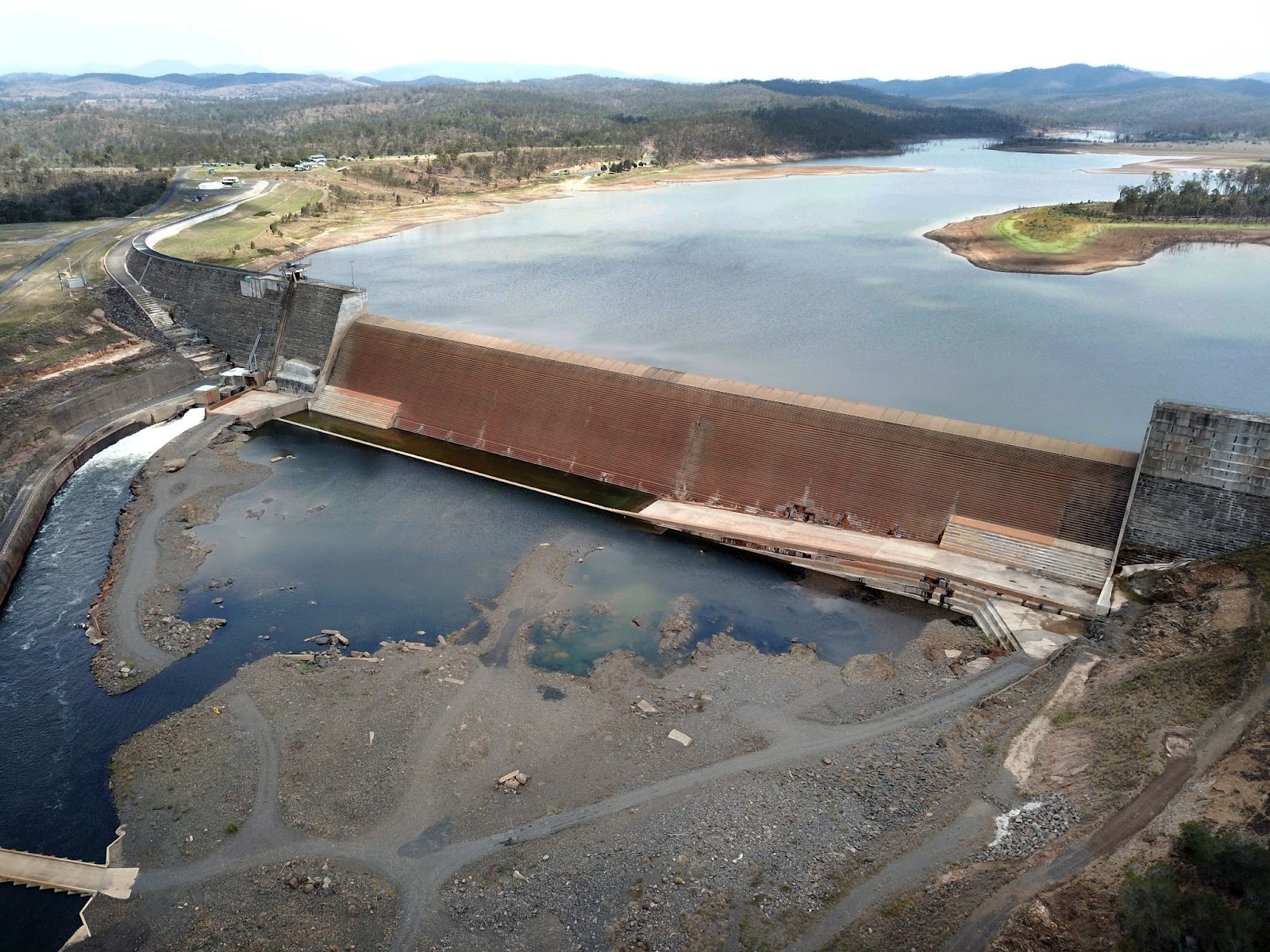
Paradise Dam, on the Burnett River, near Bundaberg, Queensland. 

*Disclosure: My consulting business Adept Economics was engaged by Bundaberg Regional Council and local grower groups to analyse the economic costs of inaction on Paradise Dam in early 2020 and I’ve participated in various working group meetings hosted by Sunwater since then. Full credit to Sunwater for the professionalism and responsiveness of its staff.  

Please feel free to comment below. Alternatively, you can email comments, questions, suggestions, or hot tips to contact@queenslandeconomywatch.com. Also please check out my Economics Explored podcast, which has a new episode each week.

Posted in Agriculture | Tagged , , , , | Leave a comment

Economic update and interest rate discussion at Brisbane Club next Wednesday

Australian Treasury Secretary Steven Kennedy nicely summarised the economic outlook in his Opening statement to the Parliament’s Economics Legislation Committee yesterday:

Nonetheless, while the disruption caused by Omicron has been significant, its overall economic impact is likely to be less than was foreshadowed in the downside scenario.

This is because we have also learnt that the underlying economy is stronger than we had recognised.

As I told the ABC’s Julius Dennis last weekend (As we begin to emerge from the Omicron wave, Queenslanders are spending more and returning to work), the economy is still being supported by the massive monetary expansion resulting from the RBA’s unconventional monetary policy (a.k.a. Quantitative Easing) and all the new credit associated with the latest housing boom. Consumer prices are yet to catch up, and households feel wealthier with their additional money balances, and are spending more. Queensland Treasurer Cameron Dick was quoted by the ABC as saying “Spending is up 27 per cent in early February, compared to pre-COVID.” That Australians haven’t been able to holiday overseas and have been spending more at home is another relevant factor I should note.

Partly as a result of all the additional money held by households and businesses, CPI inflation is accelerating, as I discussed with 4BC’s Scott Emerson last month (see When home owners can expect an interest rate rise), and that will push up interest rates. The outlook for interest rates is the topic of the Brisbane Club’s Economics in Conversation event at the Brisbane Club, on Post Office Square in the CBD, next Wednesday 23 February at 5pm. I’ll be speaking on the economic outlook and likely interest rate movements alongside my colleagues Brendan Markey-Towler and Nick Johnson. 

None of this is to deny the disruption and hardship caused by omicron in the very short-term. CCIQ’s most recent Pulse Survey, conducted over the heavily disrupted month of January, was reported by the Courier-Mail as finding confidence is As bad as lockdown: Business confidence at drastically low levels. I’m expecting that plunge in business confidence was only for a very short period. The CCIQ result may have been reasonable, but it was only applicable for a very short period of time and doesn’t tell us much about the outlook for the rest of the year. That said, as I mentioned to the ABC, it’s hard to know what will happen in Winter if we have simultaneous COVID and flu waves.   

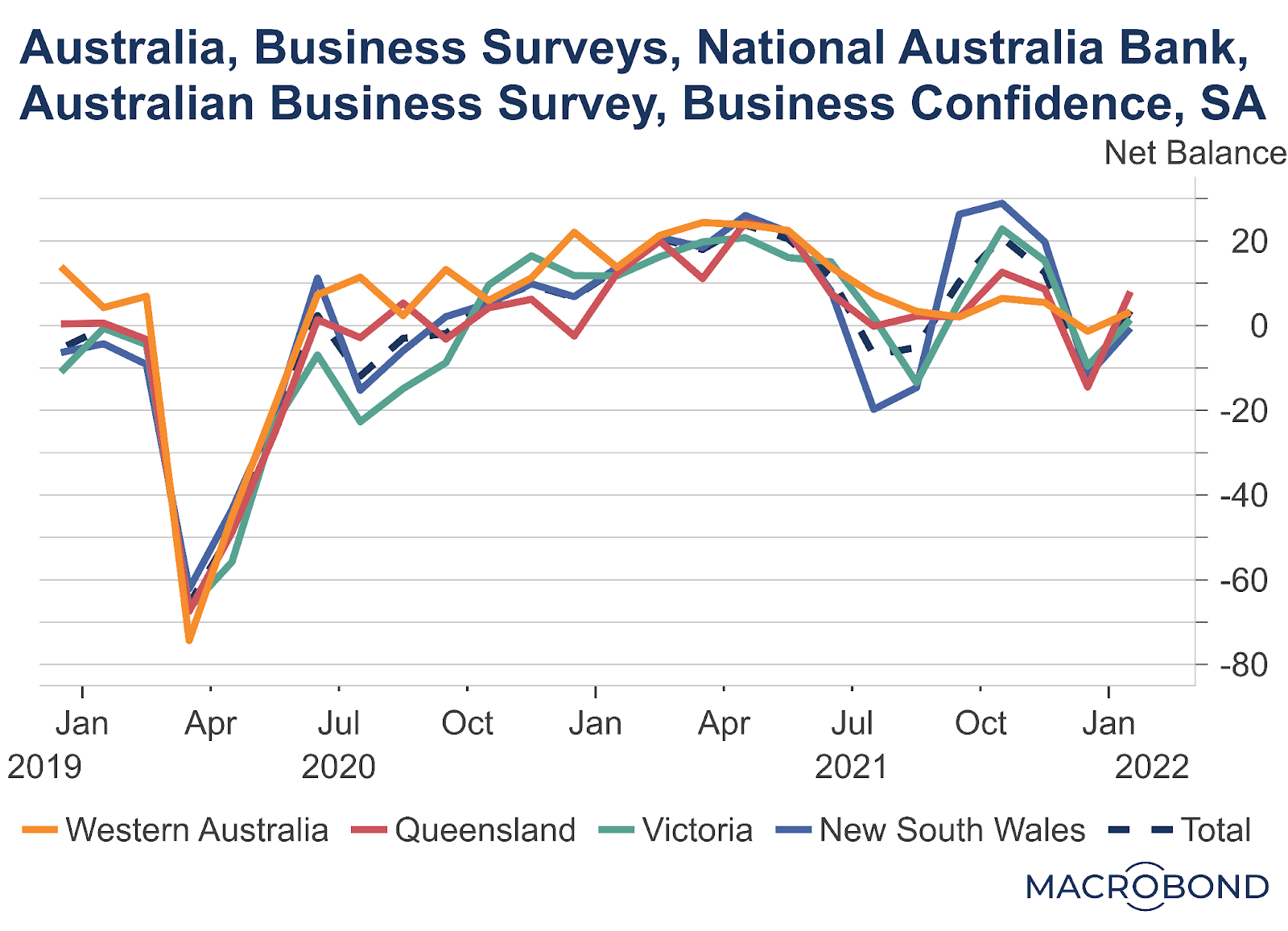
Other indicators are much more encouraging about the economic outlook than CCIQ’s Pulse indicator. For instance, NAB’s Monthly Business Survey reported that while omicron did reduce business activity in January, business confidence actually rebounded in January after it fell in December following the initial omicron outbreak (see chart below). NAB reported:

The confidence rebound signals that, despite the disruption, firms were optimistic that the outbreak would be short-lived, and consistent with this, forward orders remained steady.

NAB data show business confidence as above the neutral reading of 0 in January in Queensland and Australia (on a national-average basis). Also, I should note the Financial Review today reported CEOs ‘very optimistic’ about 2022.    

It’s difficult to know how to reconcile the NAB and CCIQ survey results. Possibly the discrepancy has to do with different compositions of businesses undertaking the surveys, with SMEs more affected by the omicron outbreak making up a larger share of the CCIQ survey sample. 

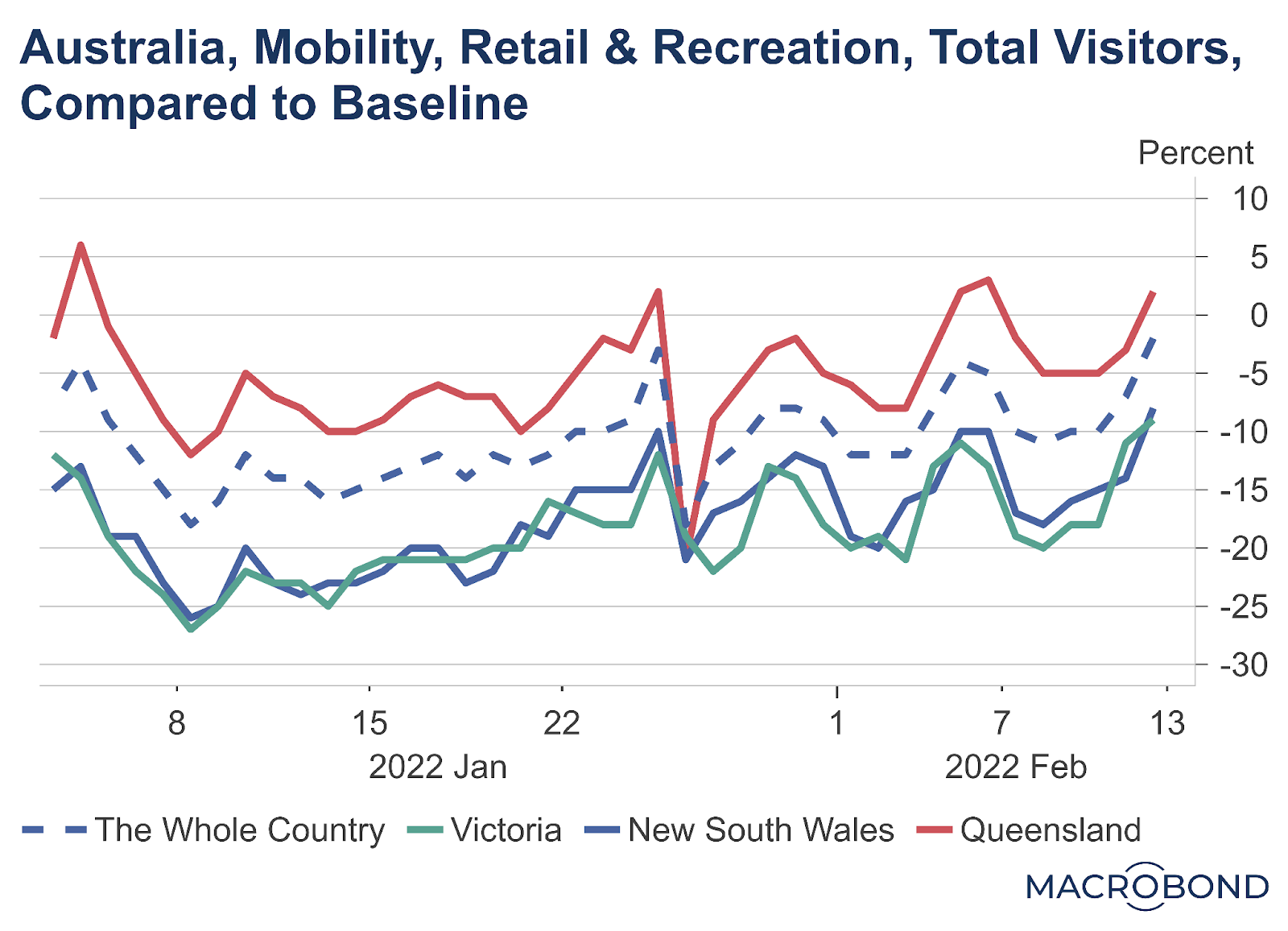
Finally, there’s been a big recovery in Queenslanders’ mobility (see the chart below). While many of us, including me, stopped going out as much for retail and recreation in early to mid January, we’ve now got back out there. Queensland is now above the baseline for retail-and-recreation-related movements, although Southern States are still significantly below it. Queensland appears to be leading Australia out of the latest COVID-induced disruption.      

Please feel free to comment below. Alternatively, you can email comments, questions, suggestions, or hot tips to contact@queenslandeconomywatch.com. Also please check out my Economics Explored podcast, which has a new episode each week.

Posted in Brisbane, Macroeconomy | Tagged , , , , , , , , | Leave a comment

UBI podcast chat w/ Ben Phillips, ANU Associate Professor and microsimulation modeller

My latest podcast episode features a conversation about the pros and cons of a Universal Basic Income (UBI) with my old UQ economics classmate Ben Phillips, now an Associate Professor at the ANU. Ben is one of Australia’s leading modellers of the impacts of tax and welfare policies on households, so he’s the perfect person to chat with about UBI. Here’s a video clip from the episode to give you a sense of the issues Ben and I discuss.

You can listen to the full audio episode using the podcast player in this post or via podcasting apps, including Apple Podcasts, Google Podcasts, Spotify, and Stitcher, among others.

Finally, if you’d like to learn more about what a UBI could look like and its implications for Australian households, check out this great paper Ben co-authored with David Ingles and Miranda Stewart: A basic income for Australia? Exploring rationale, design, distribution and cost.

Please feel free to comment below. Alternatively, you can email comments, questions, suggestions, or hot tips to contact@queenslandeconomywatch.com. Also please check out my Economics Explored podcast, which has a new episode each week.
Posted in Social policy, Tax | Tagged , , , , , , , | Leave a comment

Gigi Foster event on the Great COVID Panic + latest podcast episode on price controls & infrastructure

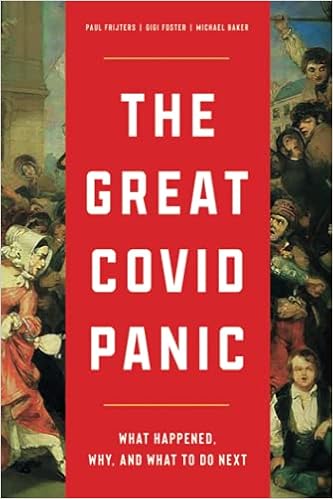
Thankfully, we’re getting much closer to a return to normality with the international border reopening. While we should focus on the brighter future, at the same time we should rigorously review what happened over the last two years, and ask whether, in our authoritarian ends-justify-the-means response, we succumbed to The Great COVID Panic, as Gigi Foster and her co-authors call it in their latest book. Gigi is currently in Brisbane to present her views to the Australian Institute for Progress on Friday evening, 11 February. You can pick up tickets via the Eventbrite page The Great COVID Panic: What Happened, Why, and What To Do.

I spoke briefly about Australia’s COVID experience with Larry Reed, the President Emeritus of the Foundation for Economic Education, toward the end of my latest podcast episode Price controls to fight inflation a bad idea + infrastructure lessons from POTUS 21. The bulk of our discussion was on price controls (i.e. regulating that businesses can only increase prices by x% over a period), which some commentators have suggested as a way to control accelerating inflation in advanced economies. As Larry explains in the episode, price controls would be a really bad idea, resulting in shortages, and wouldn’t solve the underlying problem. Inflation after all is a monetary phenomenon and, in my view, requires a monetary policy response. The big test this year for our Reserve Bank is how rapidly it responds to growing inflationary pressures. There is a risk it doesn’t act quickly enough and inflation accelerates even further.

In addition to COVID and price controls, Larry and I chatted about the recent controversial statements from US personal finance guru Dave Ramsey, who said he wouldn’t feel like a bad Christian if he increased the rent on an investment property to the market rate and doing so forced a poor tenant to move out. Check out a clip of Larry’s response in which he cites the parable of the vineyard workers:

Here’s another clip in which Larry explains why it would be good if he could put President Biden and the 21st President Chester A. Arthur in a room together to discuss infrastructure.

Finally, here’s another clip, this one focussing on what we can learn about economic prosperity from San Marino and Genoa.

Please feel free to comment below. Alternatively, you can email comments, questions, suggestions, or hot tips to contact@queenslandeconomywatch.com. Also please check out my Economics Explored podcast, which has a new episode each week.
Posted in Health, Infrastructure | Tagged , , | 1 Comment

Qld Titles Registry trickery should be investigated in integrity inquiry

There is growing pressure for a wide-ranging inquiry into the Queensland Government’s integrity, and, in my view, any such inquiry should explore the fake privatisation of the Titles Registry in mid-2021. This gave the Government political cover to take on billions in additional debt, while breaching fundamental principles of government budget reporting. The Titles Registry trickery raises big questions about the Government’s public financial management and whether Queensland Treasury has been politicised. Is the state Treasury offering the frank and fearless advice it should? 

Continue reading
Posted in Budget | Tagged , , , | Leave a comment

Women in economics podcast chat with Leonora Risse (RMIT, ex-Harvard Women and Public Policy program)

Earlier this week, I spoke with Australian Women in Economics Network (WEN) chair Dr Leonora Risse, of RMIT and formerly of Harvard’s Women and Public Policy program, about how WEN is promoting greater gender diversity in the economics profession. Leonora’s hypothesis, which we discuss in Episode 124 of my Economics Explored podcast, is that greater gender diversity will lead to a greater breadth and higher quality of economic research and analysis and better policy advice. Is this a legitimate assertion, or is the field of gender economics simply “self-serving identity politics” as some critics have alleged? Leonora and I have a frank and fearless discussion of the relevant issues in this episode.

Here’s a video clip of an excerpt of our conversation on the issue of whether there’s still a “boys club” in some businesses and organisations.

Please listen to the full conversation for my response to Leonora’s points in this clip and for more great conversation on gender issues in economics.

Please feel free to comment below. Alternatively, you can email comments, questions, suggestions, or hot tips to contact@queenslandeconomywatch.com. Also please check out my Economics Explored podcast, which has a new episode each week.
Posted in Uncategorized | Tagged , , , , | Leave a comment

Inflation & interest rates chat with 4BC’s Scott Emerson


The ABS yesterday revealed through-the-year CPI inflation of 3.5% (headline) and 2.6% (core/Trimmed Mean) in December quarter 2021. Note “c.o.p.” in the chart above stands for “change over period” and SA stands for seasonally adjusted.

Yesterday afternoon I had a quick chat with Scott Emerson on his 4BC Drive program about the accelerating CPI inflation revealed by the ABS yesterday (see chart above) and what it means for interest rates, with bank chief economists now predicting an August cash rate hike by the RBA. This is something we probably should have been expecting given that inflation is reaching the highest rates in decades in the US and UK, and Australia has also seen a large growth in the money supply, associated with Quantitative Easing and a housing credit boom. Of course, the implicit assumption in the speculation about future rate rises is that the omicron wave is short-lived, the economy rebounds sharply, and wages growth increases. Incidentally, Scott surprised me with a question about federal Opposition leader Anthony Albanese’s bold promise of higher wages growth under a government led by him. Check out my conversation with Scott via the 4BC website:

When home owners can expect an interest rate rise


Regarding inflation in other advanced economies, last week we learned the UK is experiencing its highest CPI inflation since the early nineties (see chart below).


And a week or so before we got the UK data we learned the US is experiencing its highest CPI inflation since the early eighties (see chart below).

Please feel free to comment below. Alternatively, you can email comments, questions, suggestions, or hot tips to contact@queenslandeconomywatch.com. Also please check out my Economics Explored podcast, which has a new episode each week.

Posted in Macroeconomy | Tagged , , , , , , , , | Leave a comment

UQ’s brilliant Critical Thinking Project explored in my latest podcast episode

In my latest podcast conversation with Philosophy Professor Deb Brown, I learned about the Critical Thinking Project run out of the University of Queensland. This is much needed in these confusing times, in which no one trusts politicians or traditional media sources, and there is intense polarisation and debate over even basic facts, augmented by social media filter bubbles. 

The Critical Thinking Project, led by Deb, has been working with state and private schools and organisations such as Brisbane City Council and the Australian Defence Force, to improve critical thinking skills. It all begins with actually thinking about how we think, how we know what we know, something referred to as metacognition. It’s a technique we’ve known about for centuries, indeed at least since Descartes developed his Method of Doubt in the first half of the 1600s, as Deb explains to me and my occasional co-host Tim Hughes in episode 123 of Economics Explored.  

We started our conversation with Deb by asking her about her comments in a December ABC News article Is telling the truth too much to ask of our politicians?:

…when public officials lie, that’s really high-stakes lying. because that undermines the fundamental relationship of authority between people and their elected officials, which is at the heart of the legitimacy of the state.

Very true. Unfortunately we live in an age of interminable BS. So it’s incredibly important to develop critical thinking skills so we can all cut through it. So I can highly recommend my latest podcast episode with Professor Deb Brown. If you listen to it, please let me know what you think. 

Looking through the cloister to the Great Court and the Forgan Smith building of the University of Queensland, St Lucia, Brisbane, Australia.

Please feel free to comment below. Alternatively, you can email comments, questions, suggestions, or hot tips to contact@queenslandeconomywatch.com. Also please check out my Economics Explored podcast, which has a new episode each week.
Posted in Uncategorized | Tagged , , , , , | Leave a comment

Shadow lockdown and supply-chain crisis – 9.30am Qld time livestream

I’m going live at 9.30am Queensland time this morning (Friday 21/1/22) to discuss the big economic issues of the week, particularly:

  • Australia’s strong pre-omicron labour force figures from the ABS for December, although they weren’t much comfort given the current “shadow lockdown” and supply-chain crisis, driven by a combination of fear and government regulations regarding isolation requirements for close contacts (a problem augmented by a lack of Rapid Antigen Tests, arguably reflective of poor planning by our governments)*;
  • UK CPI inflation at its highest rate since 1992; and
  • the German 10 year bond yield turning positive (at least for one day) for the first time since mid-2019 in expectation of higher inflation and interest rates.

Other news I should mention is that it looks increasingly likely Russia will invade the Ukraine with expectations this will send oil and gas prices even higher.

So please consider tuning in at 9.30am Queensland time for my latest thoughts on the economic outlook. You can watch via the YouTube player below.

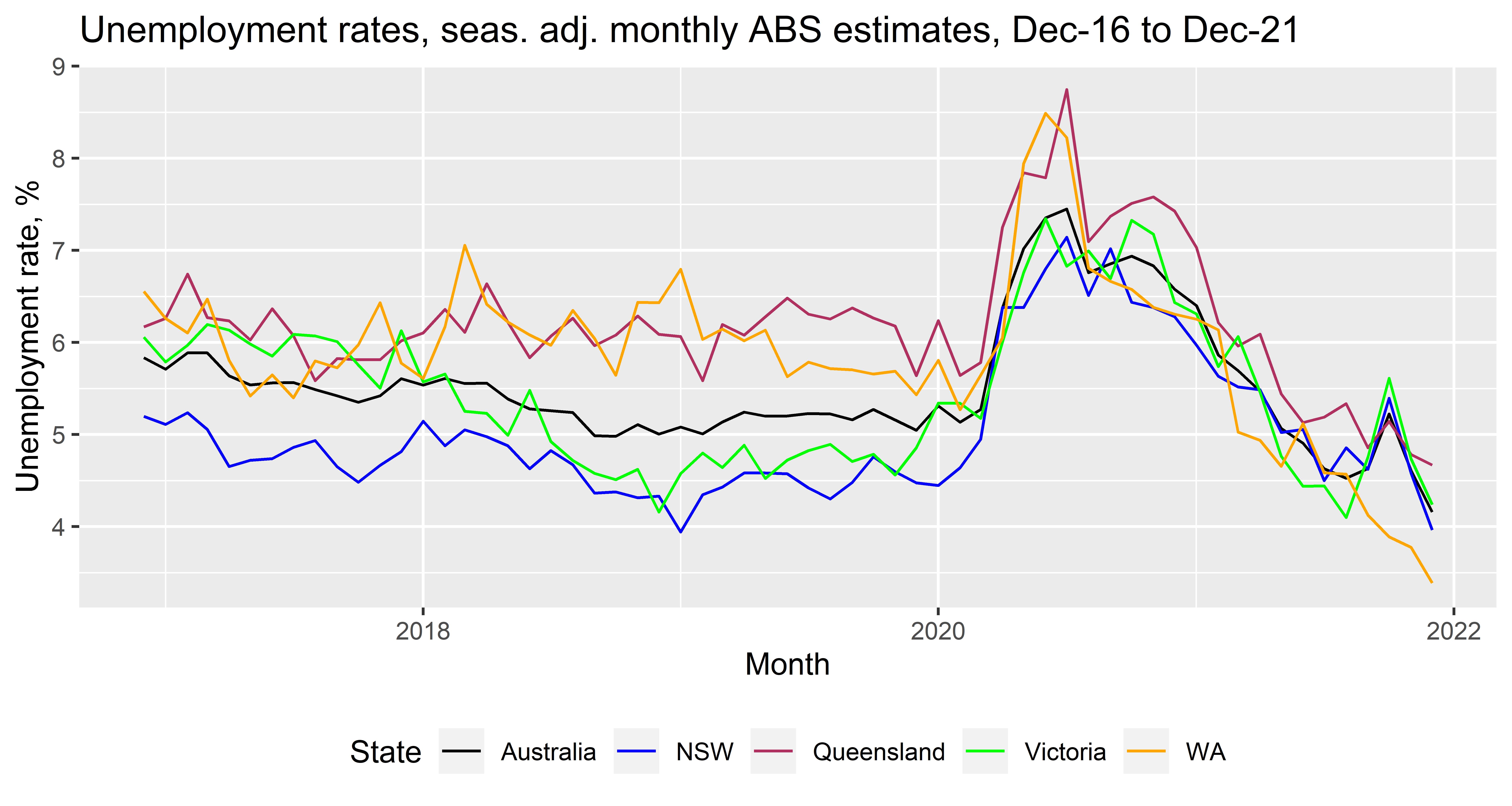
As a reminder of happier pre-omicron days, here’s a chart of the unemployment rates for the major states estimated by the ABS for December and published yesterday. Queensland’s unemployment rate of 4.7% is higher than the national average of 4.2% but it’s still a good result in terms of the historical data in recent decades, being the state’s lowest unemployment rate since early 2009. (We also need to recognise sampling error is a bigger deal at the state level, too.) The big question now, of course, is how long the omicron wave lasts and how much economic damage it does, as I’ll discuss in my livestream. The expectation or rather hope is that this wave is over in a few weeks and the economy bounces back strongly.

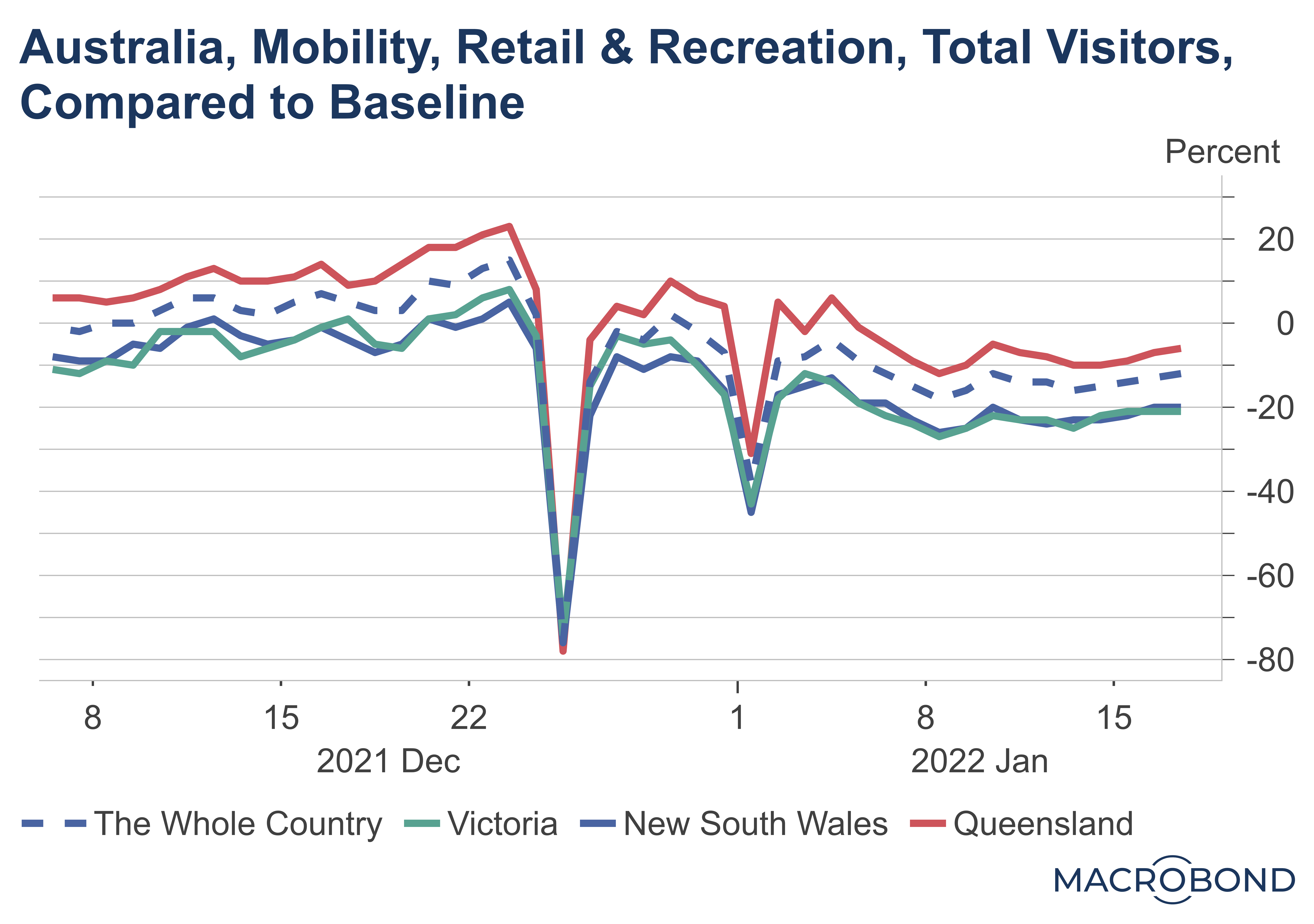
Regarding the shadow lockdown, that appears to be worse in southern states than in Queensland (see chart below including data up to Monday 17/1), based on Google Mobility data, although Brisbane City is certainly suffering worse than the state-wide data would suggest, as is clear from Google’s regional breakdown which I’ll discuss in the livestream.

*I should note there has been some relaxation of requirements for “critically essential workers” (see the Qld Health advice) in the last week and a bit.

Please feel free to comment below. Alternatively, you can email comments, questions, suggestions, or hot tips to contact@queenslandeconomywatch.com. Also please check out my Economics Explored podcast, which has a new episode each week.
Posted in Macroeconomy | Tagged , , , , , , , , , , , , , , , | Leave a comment

Fake privatisation of Titles Registry helping Qld Gov’t pretend it has debt management plan

This post is an early draft of an article I’m preparing for a public finance or public policy journal about the Queensland Government’s accounting trickery regarding the Titles Registry last year. The state government has violated some well-established principles for government financial reporting and risks being called out by the ABS when it publishes its annual Government Finances Statistics report in April.* The state government is defying logic by pretending the Titles Registry has a market value of nearly $8 billion, even though a large part of that value relates to a general government taxation power the government couldn’t possibly transfer, as comments at Estimates from Treasurer Cameron Dick confirmed. The state government has effectively capitalised the value of a general government taxation power as a financial asset on its balance sheet, something which it is not allowed to do, given that the offsetting liability to pay for future government services is not recognised on the balance sheet. 

Introduction

In a remarkable feat of creative accounting, the government of the Australian state of Queensland has recorded a financial benefit from privatising its land titles registry, without actually privatising it. It is using a dubious and logically-flawed valuation of the registry of $8 billion, compared with sale prices in the order of $3 billion achieved in NSW and Victoria, to claim billions of dollars of additional financial assets which reduce Queensland’s net debt. But the economic substance of the Titles Registry has remained the same, and the state government cannot legitimately count those additional assets. Indeed, the Queensland Government is in breach of the spirit and, in my view, the letter of well-established international principles for government financial accounting codified by the IMF and adopted by the Australian Bureau of Statistics (ABS).   

How was this valuation reached?

The Queensland Treasurer Cameron Dick explained the Titles Registry valuation to the Budget Estimates committee on 16 July 2021 like this:

To give some context as to why our Titles Registry is so valuable, it is important to note that our registry turns over approximately $350 million per year. This is higher than the revenue streams estimated by other jurisdictions which have privatised their registries. Because Queensland has retained the asset in public hands, we have included ad valorem fees in its valuation, which other states have not. Informed by several independent valuations and independent commercial advice, QIC has valued the registry on a multiple of 23 times earnings before interest, tax, depreciation and amortisation. That is quite a conservative multiple. Of the four titles registries that have traded in the last few years, only one traded at a lower earnings multiple, and that was the first one to be sold, when it was a novel asset in Australia. A concession period of 50 years was adopted, reflecting discussions with the Queensland Audit Office and agreed by the QIC steering committee. Having used a conservative earnings multiple and a 50-year horizon, QIC has arrived at the valuation of almost $8 billion. (from p. 51 of the Hansard, emphasis added)

The huge logical flaws in the Queensland Government’s accounting

Regardless of whether the 23x multiple is appropriate based on the discount rate and other assumptions, there is a huge logical flaw in the Titles Registry valuation which is clear from a close reading of what the Treasurer told Estimates. The Treasurer has basically admitted that, if the Titles Registry were privatised, the privatised entity could not charge ad valorem (i.e. according to value) fees (i.e. $37 for each $10,000 or part of $10,000 over $180,000 of consideration). This is because the ad valorem fees in question are characteristic of a general government taxation power, and the government would not allow a private monopoly to have this power. Ultimately, it means the Titles Registry could not be sold for nearly $8 billion. So how does the Queensland Government now have a financial asset worth $8 billion, which it is using to reduce its net debt, if it couldn’t sell the Titles Registry for $8 billion? It is a complete sham. 

The large value of the Titles Office is essentially related to its ability to levy what is effectively a tax rather than a fee-for-service. The ability to generate future taxation revenues is treated as an asset on the government balance sheet. If governments were allowed to do this, then the future liabilities to deliver government services would have to be, too. 

The Government has legally separated the Titles Registry, which records land transactions, from the general government Department of Resources, and made it a Pty Ltd company (i.e. to pretend it’s a private entity outside of the general government or public non-financial corporations sectors), owned by various state government investment funds. The tricky financial engineering is well documented in the Queensland Audit Office’s Establishing the Queensland Future Fund report published in early December 2021. In a telling passage of the report, on p. 7, the Queensland Audit Office observed:

While the indirect owners of the Queensland Titles Registry were all government entities as at 30 June 2021, there is no legislative protection under the Queensland Future Fund Act 2020 or the Queensland Future Fund (Titles Registry) Act 2021 to prevent some or all of the holdings in the Queensland Titles Registry from being sold to private entities.

I’m guessing the Government probably can’t provide that legislative protection because then it would be an open-and-shut case on the nature of the Titles Registry: that it remains a general government entity, subject to government direction and with employees effectively remaining public servants, regardless of whatever legal status the Government attempts to give it. Indeed, the Titles Registry appears to be operating out of the same offices as it previously did, including offices where it’s co-located with Resources department officers in the regions. 

Violation of well-established principles for government financial reporting

The ABS made it clear in a note on ABS public sector unit classification decisions in early July, a few weeks after the Queensland Government released its 2021-22 Budget including the Title Registry change, that:

When classifying a unit for official statistics, the ABS looks beyond legal status and focuses on the economic substance behind the nature of an entity.

I have no idea whether the ABS was sending a message to the Queensland Government (and to other governments watching the Queensland Government’s tricky play), but I hope the state government noticed it. It’s possible the ABS could refuse to recognise the state government’s hypothetical privatisation of the Titles Registry and, hence, won’t recognise the billions of dollars of additional financial assets. We’ll learn its decision next April when it publishes its annual Government Finance Statistics for the 2020-21 financial year. In my view, the ABS should recognise the Queensland Titles Registry is exercising a general government taxation power and hence it should remain as part of the general government sector.

The ABS is responsible for reporting Australia’s government finance statistics on a basis which is compatible with the IMF Government Finance Statistics (GFS) standards. This is to ensure statistics are as accurate and reliable as possible. My feeling is that the Queensland Government’s Titles Registry manoeuvre is contrary to the spirit, and probably the letter, of IMF rules. The Queensland Government is at risk of violating well-established IMF GFS rules, by not properly accounting for the scope of government activities, by pretending it has privatised an activity that it has not. After all, this is a government which opposes asset sales. 

While I’ve been critical of some previous Queensland Government budgetary manoeuvres, such as the 2015-16 debt switch, at least they were accounted for correctly. We know something fishy is going on here, because the state government won’t release full financial statements for the various funds which part own the Titles Registry (see InQld’s report Show me the money: Auditor-General demands answers on future fund fate). This is disgraceful in its lack of transparency. 

Conclusion

The fake privatisation of the Queensland Titles Registry is the most deceptive fiscal play I’ve seen from any government in Australia in recent decades, and we need to call it out so state governments don’t think they can get away with worse.

*Alas this did not occur and the ABS has simply taken on faith the Queensland Government’s estimates. I am presenting a paper on this issue at the Australian Conference of Economists in Hobart in July 2022 and will forward it to the ABS for its consideration.

Please feel free to comment below. Alternatively, you can email comments, questions, suggestions, or hot tips to contact@queenslandeconomywatch.com. Also please check out my Economics Explored podcast, which has a new episode each week.
Posted in Budget, Queensland Government | Tagged , , , , , , | 6 Comments