I’ve recorded a video covering the May US jobs data, which have been greeted very positively by the markets despite the data showing only a small rebound*, and the Australian Parliamentary Budget Office’s rather pessimistic projection of an additional $620 billion of debt by the end of the decade (check out the PBO Medium-term Fiscal Projections).
* i.e. relative to the fall from pre-coronavirus levels. With an additional 2.5M US jobs in May, it was the largest ever recorded monthly increase.
With the Queensland Government willing to invest $200 million in Virgin Australia to keep its HQ in Brisbane, I thought it would be timely to record a podcast interview on investment attraction and industry policy more broadly. On Tuesday, I spoke with Craig Lawrence, Managing Director of Lytton Advisory, about the pros and cons of interventionist industry policy, i.e. picking winners. Craig previously worked as an economist in Queensland’s Department of State Development and has advised on a variety of investment attraction packages over the years. I’ve now published our conversation as Economics Explained EP38: Picking winners.
The March quarter National Accounts released by the ABS today suggest Australia will have two consecutive quarters of negative economic growth in the first half of 2020, and hence the traditional definition of a recession will be satisfied. That said, it’s never been in doubt that we’re effectively in a recession as a result of COVID-19 mitigation measures.
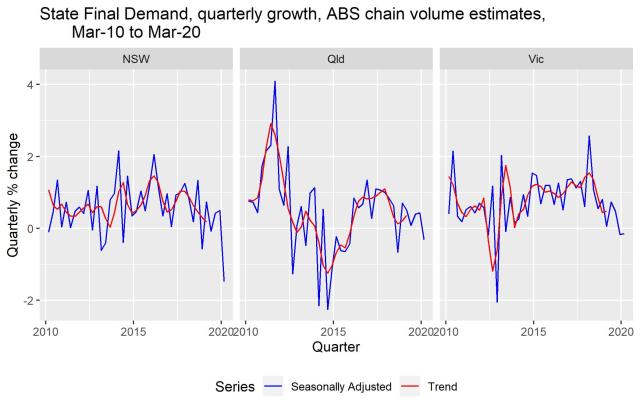
According to the ABS, national GDP contracted 0.3% in the March quarter. Queensland’s State Final Demand (i.e. demand from domestic sources and excluding exports) fell 0.3%, NSW’s fell 1.5%, and Victoria’s fell 0.1% (see chart below). The falls in June quarter will be much larger than these reported falls for March quarter.
Incidentally, on the west coast, an increase in mining capital investment boosted WA State Final Demand by 0.9%. ACT and Tasmania also saw increases in State Final Demand, so check out the ABS’s useful commentary on the SFD estimates if you’re interested in learning more.
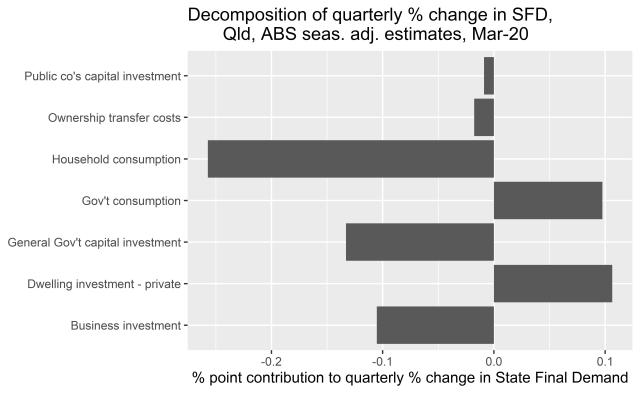
The March quarter GDP contraction was largely related to households cutting their consumption spending and businesses cutting their capital investment spending across Australia, although in Queensland, surprisingly, a decline in government capital spending contributed to the contraction in our State Final Demand (see figure below). The ABS observed for Queensland that: “Public gross fixed capital formation decreased 2.5%, driven by a: 3.1% decrease in general government investment in buildings and state and local investment in infrastructure”.
Time will tell how long and deep the recession will be. In Queensland, thankfully the state government has now relaxed many restrictions and we can now travel freely within Queensland. Ideally, we’d also open the border with NSW, given there no longer appears to be a compelling public health reason to keep it closed.
The video recording of a webinar on the economic impact of COVID-19 I participated in last Friday is now available. The other panellists were Danielle Wood from the Grattan Institute, Griffith Professor Tony Makin, and QUT Professor Pascalis Raimondos. My remarks start at around 32:20:
I emphasised that all Queensland regional economies have been severely affected, with the more tourism-dependent regional economies such as Far North Queensland and the Gold Coast the worst affected. I noted reopening the state border is crucial to reviving tourism spending and the hospitality sector in Queensland. And, in the Q&A at the end, I observed the public health and economic disaster unfolding in the United States is a major risk to the speed and strength of the eventual global economic recovery from COVID-19.
Currently, the big economic debate in Queensland concerns the border with NSW, which remains closed to interstate visitors. Earlier today I spoke with my old friend and former Treasury colleague Joe Branigan, Director of Tulipwood Economics, who thinks the border should never have been closed in the first place and should be reopened immediately. I highly recommend you listen to our conversation (link below) for some great commentary from Joe on the public policy approach to COVID-19.
For instance, check out Joe’s comments at around 18:00, where Joe notes:
…on the one hand, I agree with this staged approach [to relaxing restrictions], but, on the other hand, there are certain measures that I think never should have been in place in the first place, such as the border closure. And that, as I said, is indicative of this abandonment of this proper policy evaluation framework where you think about the costs and benefits of each policy and try to match them up such that the benefits exceed the cost…That went out the window in January, early February for justifiable reasons, because we didn’t know…we knew hardly anything about this virus.
Also, check out Joe’s thoughts at around 12:15:
…we can adjust policy to target protecting those people [at risk] without…crashing the economy into a brick wall, and I think the longer the social distancing measures are in place, the more people will start to question the costs of them…
At 15:00 I ask Joe whether Pauline Hanson and Clive Palmer’s High Court challenge to the border closure is simply political grandstanding.
Regarding Australia’s tourism services trade deficit (mentioned at around 21:00), which suggests increased domestic tourism could make up for lost international tourism as the Prime Minister has been saying, check out Tourism Research Australia’s National Tourism Satellite Account.
Finally, I’d recommend listening to Joe’s Chermside Shopping Centre story at around 25:00 illustrating the unintended consequences of restrictions.
Queensland-NSW border marker. Photo by Jennifer Tunny.
On 612 ABC Brisbane yesterday morning I mentioned to host Bec Levingston my first reaction to hearing the news about the $60 billion JobKeeper forecasting bungle was sympathy for my former Treasury colleagues. It’s hugely embarrassing, but actually good news the program is expected to cost so much less. I told Bec that mistakes can happen when things are done very quickly in a crisis. It looks like the JobKeeper policy was developed in a very short period of time and the Treasury forecasters may have had to deal with design changes along the way. You can listen to my interview with Bec from around 18 minutes into this recording:
There has been some criticism of the Government over its changing story regarding what happened. But, as I explained to Bec yesterday morning, there were two errors. Treasury’s forecast of the cost of the scheme in late March was way off, but, earlier this month, an estimate from the ATO appeared to roughly confirm Treasury’s forecast that around 6 million employees would be covered by JobKeeper. Unfortunately, the ATO added up a column of data on employees covered containing numbers incorrectly entered by employers. This error by the ATO lent support to the wildly inaccurate Treasury forecast and meant the Government initially confirmed rather than corrected Treasury’s inaccurate $130 billion JobKeeper cost forecast.
Again, it’s hugely embarrassing, but I think we should accept it as good news as it means less public debt to service in the years ahead. That said, there is a legitimate debate now occurring over whether the JobKeeper scheme had the right design and coverage in the first place, which I’ll try to cover in a future post.
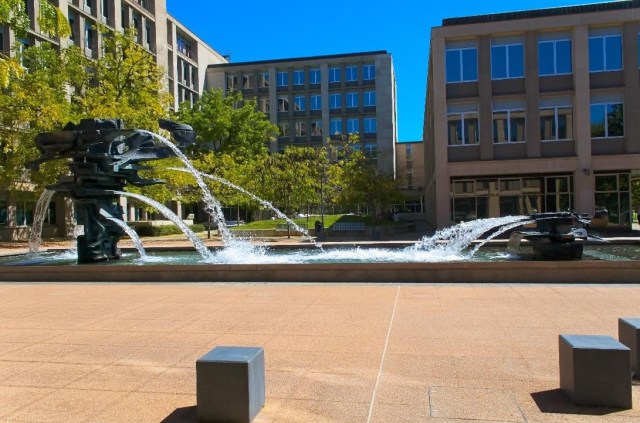
The extraordinary Norma Redpath fountain in the courtyard of the Treasury Building, Canberra
Darren is an Austrian school economist who serves as the chief economist at LibertyWorks, an Australian think tank, and as an associate scholar with the US Center for Freedom and Prosperity. He is also a policy advisor to the Heartland Institute. Darren has previously worked for NSW Treasury, various consulting firms, industry associations, a US Presidential campaign, and for an Australian Senator.
You can use these (approximate) timestamps as a guide to my conversation with Darren:
2:20 – Darren gives an overview of the US’s crumbling infrastructure
7:15 – Darren observes “the average US airport…looks like something out of the Soviet Union”
19:00 – Darren notes “the key is to actually open things up to competition as well, not just to privatise things or to recycle an asset”
20:00 – discussion of National Competition Policy in Australia and how the Australian economic reform process slowed down in the 2000s
28:10 – reference to the Productivity Commission’s finding of substantial economic gains from National Competition Policy in Australia (e.g. see the 2005 Inquiry Report – Review of National Competition Policy Arrangements) and Darren argues the US could easily replicate Australia’s very high ROI with a US National Competition Policy
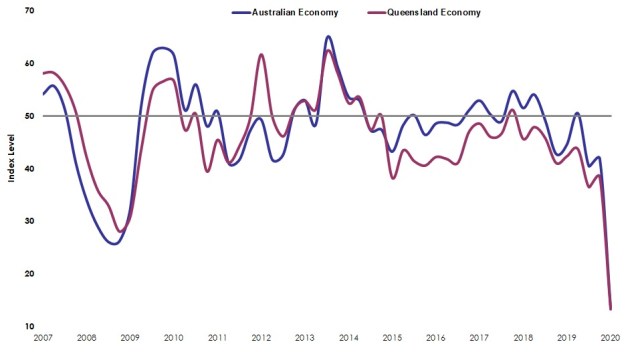
I spoke with CCIQ Economic and Policy Advisor Jack Baxter earlier today regarding the corona-crisis-induced collapse in business conditions and confidence reported in the March quarter Suncorp-CCIQ Pulse Survey report. Business conditions and confidence are at their worst levels in the history of the Pulse Survey, which began in 2007, and are much worse than during the global financial crisis (e.g. see the 12-month outlook chart below). You can listen to my conversation with Jack here:
Here are some timestamps so you can find some of the highlights:
1:30 – Jack gives an overview of the Pulse Survey findings for March quarter (NB the Pulse Survey period was from the 1st to the 15th of April; JobKeeper was announced 30 March)
4:00 – discussion of the “severe financial hardship” being felt by many businesses
10:00 – discussion of the huge adverse impacts of coronavirus on hospitality and tourism
13:20 – discussion of regional conditions and confidence, with Jack noting Cairns businesses were “very vocal” about how badly they’ve been impacted
14:45 – beginning of discussion about policy issues, and why tax policy changes (e.g. long-term payroll tax cut and a switch from stamp duty to land tax as NSW and Victoria are investigating) may be desirable
22:00 – discussion about how much depends on how soon our borders re-open, both to other states and the rest of the world, with reference to the importance of domestic tourism in reviving some of our regional economies
12-month outlook for the Australian and Queensland economies, Suncorp-CCIQ Pulse Survey estimates, courtesy of CCIQ
The current investigation of a potential investment in Virgin Australia will be a defining moment for the Queensland Investment Corporation (QIC). On ABC radio yesterday morning, I told host Bec Levingston that QIC needs to show it can act as a fund manager which only makes commercially-sound investments, and it is not unduly influenced by the desires of the Queensland Government. You can listen to my conversation with Bec while the audio stays on the ABC website here (from the beginning of the audio):
Without being involved in the discussions with potential private sector bidders for Virgin that QIC’s people are, it is difficult to judge whether it might be possible for QIC to make a sound investment in Virgin. I strongly suspect it isn’t, given Virgin’s financial troubles and high debt load (around $7 billion in total liabilities) even before the corona-crisis, but I have an open mind.
I recognise the Government is concerned about what a collapse of Virgin could mean for our regional communities and tourism industry. That said, it would be a poor start to the Queensland Future Fund which QIC is managing, and a bad result for Queensland taxpayers, if one of its major investments, of at least $200 million and very likely more, is in a struggling airline doomed to perpetual second place and continuing to lose money. QIC would need to have a very high level of confidence the airline can be turned around. Virgin Australia would be a very risky investment for QIC.
Finally, as I emphasised in my conversation with Bec yesterday, the debate over an investment in Virgin reinforces the need for the state government to provide a budget update in the near future, within the next month or two ideally, and certainly well before the state election on 31 October.
This afternoon I caught up with Ben Scott, who works as a Research Assistant in my business Adept Economics, to discuss the April Labour Force data published by the ABS today, as well as the possible shape of the eventual economic recovery (e.g. v-shaped, u-shaped, or Nike swoosh). I’ve uploaded our conversation, recorded using Zoom, to YouTube.
Pete Faulkner has a great summary of today’s data in his latest Conus blog post in which he notes:
…the real surprise came was in the unemployment rate. This had been forecast anywhere from about 8-9% (with some outliers even suggesting as high as 10%). The reality was a rather more pedestrian, and very surprising, lift to just 6.2%. The culprit for the wide miss was the fact that the Participation rate (the proportion of the working age population who are either in work or looking for work) fell a record 2.5 ppts to just 63.5. Had the PR remained at its previous level of 66 then the unemployment rate would have risen to 9.7%.
So, as I mentioned in my chat with Ben, the Australian unemployment rate is effectively nearly at 10%, if we count the people who gave up looking for work as effectively unemployed. Performing the same calculation Pete made for Australia using the Queensland data, the Queensland unemployment rate would be 10.6% instead of 6.8%, if we hadn’t had huge numbers of people give up the search for work and drop out of the labour force.



 Queensland Economy Watch