Premier’s border decision helps, but it’s still early days in any recovery from virus recession

The Queensland Premier’s decision to reopen the border to non-Victorian interstate travellers and to bring forward the relaxation of a range of restrictions will no doubt provide a bit of a boost to the economy (e.g. the Courier-Mail is reporting $520m a month, 50k jobs to flow from eased restrictions). But, at best, it’s still early days in the recovery from the virus recession, and there’s always the possibility the recovery could stall and the economy settles into an extended slump, particularly with all the financial damage being done to businesses.

There is legitimate concern about what happens when the JobKeeper lifeline is withdrawn from many businesses at the end of September. Fairfax economics correspondent Shane Wright wrote yesterday, in his article RBA warns ending stimulus will be ‘a problem’ as jobs recovery slows:

A sudden halt to government stimulus to support the economy through the coronavirus recession would be a problem, the Reserve Bank has conceded, with signs the jobs market is failing to bounce back from pandemic-related shutdowns.

It’s obvious the federal government will need to extend the stimulus in some way, such as via a more targeted JobKeeper and bumping up the standard rate of JobSeeker (i.e. excluding the coronavirus supplement). This is because the drop in government support to the economy at the end of September will be huge and may lead to any recovery stalling in December quarter, when we will likely see many of the so-called zombie firms shutting up for good.

On the ABC 730 program the other day, Grattan’s Danielle Wood said that federal support equal to 15% of GDP in quarterly terms will be “turned off at the end of September” (Gov’t will not reveal plan for future of JobKeeper for weeks). That’s an enormous adverse shock for the economy to adjust to over the rest of 2020.

Regarding “signs the jobs market is failing to bounce back”, Wright is referring to the latest payroll jobs data released by the ABS yesterday (see chart below).

payroll_national

With the possibility international travel won’t be back to normal until 2022, our economy, to which international tourism and international education made substantial contributions, certainly won’t be able to regain any semblance of normality for a while yet.

Posted in Labour market, Macroeconomy, Queensland Government, Uncategorized | Tagged , , , , , , , , , , , | Leave a comment

Qld Gov’t COVID-19 Adaption Grants program poorly designed

The Queensland Government’s $200 million COVID-19 Adaption Grants program for small businesses is poorly designed and pretty embarrassing, with the Employment Minister Shannon Fentiman today telling businesses “My strong advice is get in quick.” I was stunned when I read this in the Brisbane Times, as the Minister’s words pretty much acknowledge the program is a cash giveaway to those quick enough to lodge an application before the money runs out. It is not well targeted to those businesses most in need. The Brisbane Times reports Queensland bosses to scramble for money after first grants gone in days:

The grants open on July 1 and will be dished out until the $100 million funding pool runs out.

“I expect it to go very quickly,” Ms Fentiman said.

“The first round, $96 million, did go within 4½ days,” Ms Fentiman said.

The state government doesn’t lack public servants who can review grant applications – which should be allowed to come in over a reasonable application period (e.g. two weeks) – and rank them according to criteria, one of which should be financial need. It shouldn’t just set broad eligibility criteria and dole out money until it runs out. This is extremely poor policy and I suspect largely a waste of money that could be better spent in this time of twin economic and health crises.

Incidentally, earlier today I was invited to appear as an expert witness panel member for a public hearing on Monday 13 July of the Queensland Parliamentary Inquiry into the Queensland Government’s economic response to COVID-19. I’ll certainly mention my concern that standards of policy design have slipped substantially, as well as providing my thoughts on contentious issues such as the border closure and the Virgin bid.

59491038_2434373029920036_1178202300586393600_o

1 William St, a.k.a. the Tower of Power, is full of public servants who could assess grant applications.

Posted in Budget, Queensland Government, Uncategorized | Tagged , , , , , | Leave a comment

Aussie unemployment & underemployment video

In my latest video, I expand on my post from last Monday True Queensland unemployment rate around 12% and discuss just how bad the Australian labour market is at the moment. Thanks to those readers who commented on the post and raised some great points which I’ve endeavoured to respond to in this video.

Posted in Labour market, Macroeconomy, Uncategorized | Tagged , , , , , , , , , | 2 Comments

A Fiscal Vaccine for COVID-19 with Tony Makin – new podcast episode

In my latest podcast episode, I speak with Professor Tony Makin of Griffith University about his new CIS Policy Paper A Fiscal Vaccine for COVID-19. In Tony’s words:

“the paper considers the resurgence of crude Keynesianism before highlighting risks of the fiscal legacy.”

Tony is Professor of Economics at Griffith University and has previously taught at the University of Queensland, the Lee Kuan Yew School of Public Policy at the National University of Singapore and in the Australia and New Zealand School of Government (ANZSOG) program. His field of expertise is international macroeconomics and public finance and he has previously served as an economist with the International Monetary Fund and in the Australian federal departments of Finance, Foreign Affairs and Trade, The Treasury and Prime Minister and Cabinet. He has also been Director of the APEC Study Centre at Griffith University, and Australian convener of the structural issues group of the Pacific Economic Cooperation Council (PECC).

Tony’s previous papers on fiscal policy include:

The Effectiveness of Federal Fiscal Policy: A Review

Australia’s Competitiveness: Reversing the Slide by Tony Makin

Tony Makin’s Agenda paper on fiscal stimulus during the GFC


Posted in Budget | Tagged , , , , , , , , , , , , , , , , , | Leave a comment

True Qld unemployment rate around 12%

The true Queensland unemployment rate is around 12% rather than the official 7.9%. I’m not suggesting the ABS is being tricky. The ABS is accurately applying the internationally accepted Labour Force Statistics methodology. But we must look beyond the ABS data to understand what is happening in the labour market at the moment.

ABC business reporter Gareth Hutchens published a great article on Friday (JobSeeker has about 700,000 more claimants than there are ‘unemployed’ people on ABS data) attempting to reconcile the official estimate of the number of unemployed persons in May of around 928,000 nationally with the more than 1.6 million JobSeeker (or Youth Allowance-equivalent) recipients, around 380,000 of whom are in Queensland (see Pete Faulkner’s post JobSeeker data for May shows another 22% increase). In his article, Hutchens observed that currently you don’t need to be actively seeking work to qualify for JobSeeker but you do to be counted as unemployed by the ABS. The discrepancy between the JobSeeker and ABS unemployment estimates is largely due to over 600,000 people having left the labour force, meaning they are not actively looking for work. Hutchens observed:

The ABS noted that the official unemployment rate would be around 11.3 per cent if everyone who lost their job in the last two months was still part of the labour force.

Performing the same calculation for Queensland gives an estimated unemployment rate of 11.8%.* In the official ABS data, the highest unemployment rate recorded (technically since 1978, but realistically since the Great Depression) was 11.1% in Queensland and 11.2% nationwide during the early nineties recession.

Incidentally, John McCarthy at In Queensland has done his own investigations on this issue:

More than 116,000 ‘missing’ from Queensland jobless data

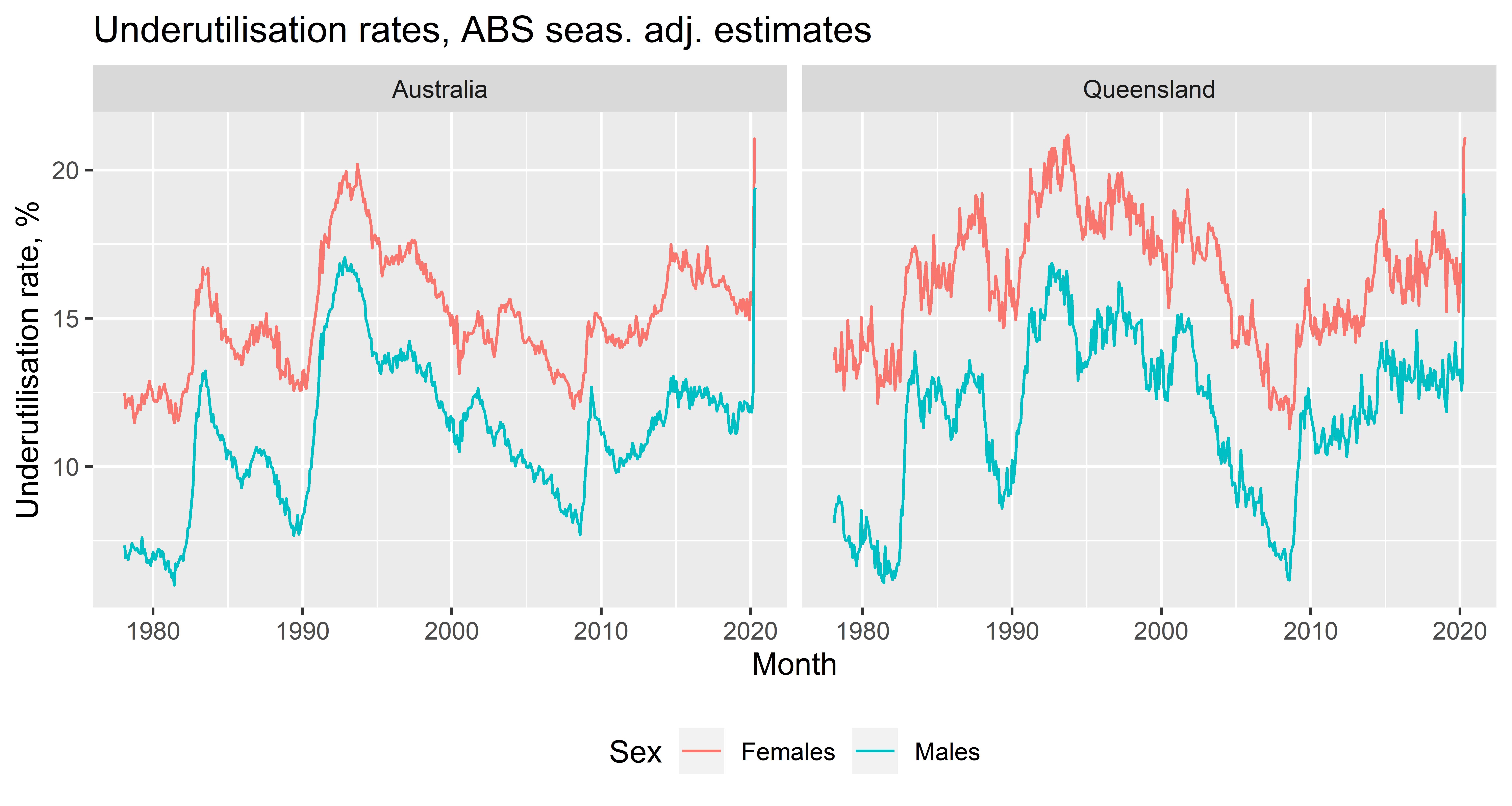
Taking underemployment into account, we see that one-in-five workers are under-utilised, and that women have been worse affected than men (see chart below). We really need the economy and our internal borders to fully open as soon as possible, but of course the news from Victoria over the weekend has been a huge setback.

underutil

*Using the alternative way of performing this calculation, holding the participation rate constant, which is the way I recall Queensland Treasury once did it, yields a true unemployment rate of 12.0% in Queensland. 

Posted in Labour market, Macroeconomy | Tagged , , , , , , , , , | 6 Comments

Official Qld unemployment rate of 7.9% doesn’t tell the full story

urates

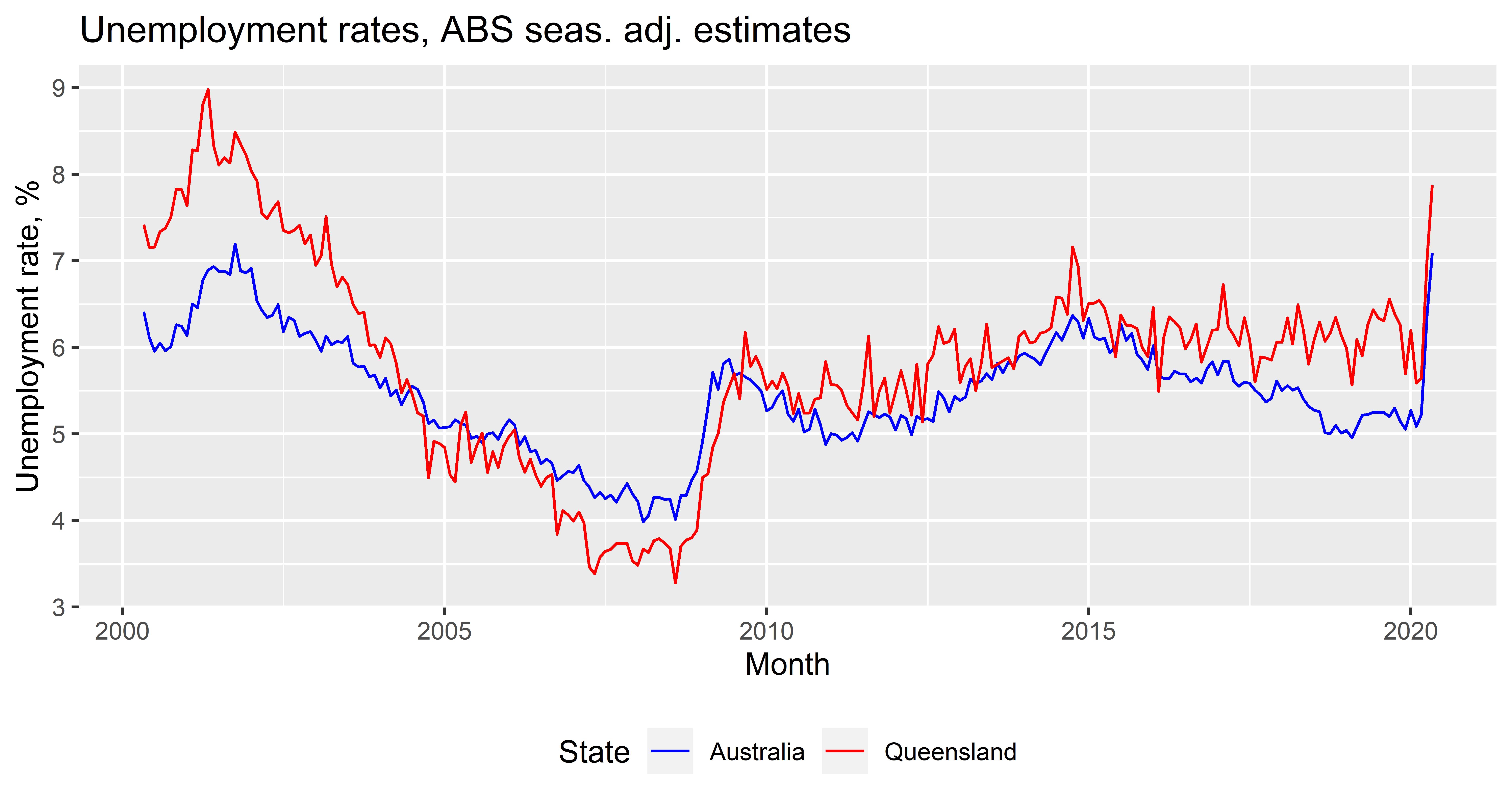
It’s obvious the official unemployment rate figures from the ABS are understating the true unemployment rate due to large numbers of people having left the labour force, evidenced by the collapse in the workforce participation rate. The official estimates for May were 7.9% for Queensland and 7.1% for Australia (see chart above). We know from JobSeeker statistics (i.e. over 1.6 million people having been on the payment) and ABS labour under-utilisation and hours worked estimates that the economic situation is much worse than the unemployment rate estimates suggest. For instance, the Queensland Treasury in its excellent brief on the latest figures noted:

With persons not working but receiving JobKeeper payments from their employers classified as ’employed’ by the ABS, the reduction in hours worked is probably the clearest example of the full impact of COVID-19 social distancing measures on labour market activity.

There were 321.0 million hours worked in Queensland in May 2020, down 0.1% from April and down 7.6% over the year…

So forecasts I’ve seen of a June quarter GDP/GSP contraction of around 8% are looking reasonable.  Also, check out the state Treasury’s chart illustrating the big reduction in the workforce participation rate to 62.6%, compared with 65.9% in May 2019. As I noted regarding last month’s data (Qld jobless rate at 6.8%, but effectively over 10%), if the participation rate hadn’t collapsed the unemployment rate would be in double digits.

Also, check out Pete Faulkner’s commentary Another big drop in employment and another decline in participation.

Finally, regarding whether the May labour force estimates are at odds with the ABS/ATO payroll data showing a pick up in employment at the end of May (see my Wednesday post), note the May ABS Labour Force estimates are based on activity in the “reference week” in early to mid-May. In its Explanatory Notes, the ABS writes:

The interviews are generally conducted during the two weeks beginning on the Sunday between the 5th and 11th of each month. The information obtained relates to the week before the interview (i.e. the reference week).

So it’s very possible that, with some relaxation of restrictions in the second half of May, some jobs came back online. Of course, it’s early days, and the payroll data have issues as Pete Faulkner has commented on (see this tweet from Pete), but we live in hope.

Posted in Labour market, Macroeconomy, Uncategorized | Tagged , , , , , , , , , , | Leave a comment

Gender pay gap recap – latest podcast episode

Andrew Leigh MP’s Inequality Bites video Underpaid & Over It prompted me to have another look at the gender pay gap in my latest Economics Explained podcast episode.

Resources mentioned in the episode include:

Blau and Kahn JEL article on the gender wage gap

Ross Guest on the Real Gender Pay Gap

KPMG She’s Price(d)less report

Leonora Risse on the gender pay gap interview

Australian Government Workplace Gender Equality Agency on the gender pay gap

Thanks to Andrew for letting me use the audio from his video in the episode and to Ben Scott, Research Officer at my business Adept Economics, for participating in the discussion.

Economics Explained Logo

Posted in Labour market | Tagged , , , , , , , , , , , , | Leave a comment

Jobs coming back as economy reopens

payroll

The AFR’s Matthew Cranston has nicely summarised the latest payroll data published by the ABS yesterday in his article Job market crawls off floor as recovery begins:

The worst appears to be over in the job market with Tax Office payroll data showing about 124,000 jobs were added in May, in the first tentative signs of economic recovery.

But economists warn that with more people searching for work the unemployment rate is likely to rise when official figures are released on Thursday.


Generally, signs are positive across the country, except arguably in Victoria, where total wages fell 0.8% in the last week of May (see charts above).

It’s still early days in the reopening of the economy, so let’s not read too much into these figures. We still need to assess how much lasting financial damage has been done to households and businesses and how the economy will cope as emergency support is withdrawn in September.

Posted in Labour market, Macroeconomy, Uncategorized | Tagged , , , , , , , , , , | 2 Comments

Qld-NSW border & Qld Chief Economist comments

I’ve recorded a new video commenting on:

  • the cost to the Queensland economy of the interstate border closure and other coronavirus measures (thanks to CCIQ for putting some estimates out there, which I’ve provided links to below),
  • what’s been happening in the financial markets, and
  • the controversy over the state government being unable to fill the Chief Economist position.

You can watch it on YouTube:

Here are some links relating to my comments:

CCIQ on the cost of Queensland’s closed border

It’s time to get serious and ease restrictions: CCIQ

A third quarter correction for the S&P 500

Australian article: Qld Chief Economist role a hard sell for Labor

Posted in Macroeconomy, Uncategorized | Tagged , , , , , , , , | Leave a comment

Seven Habits podcast discussion

In the latest episode of my podcast, I discuss one of my all-time favourite books, Stephen Covey’s 7 Habits of Highly Effective People, with regular podcast guest Tim Hughes. I focus on the relevance of the 7 Habits to economists.

A 30th anniversary edition of the 7 Habits was published this year.

Links related to the discussion include:

Art of Manliness episode on 30th anniversary of the 7 Habits

Paul Frijters on coronavirus

Who pays Trump’s tariffs, China or U.S. customers and companies?

Ralph Turvey on how to estimate marginal costs

Brian Tracy’s Eat that Frog

The 7 habits of highly effective economists – Part 1: Habits 1 to 3 for private victory

The 7 habits of highly effective economists Part 2 – Habits 4 to 7: Public victory & renewal habits

Economics Explained Logo

Posted in Productivity, Uncategorized | Tagged , , , , , , , , , , | Leave a comment