Recent studies show potentially large savings in power bills

Prime Minister Julia Gillard is right to draw attention to rising electricity prices and ask whether we can improve the regulation of our electricity networks, with a view to promoting cheaper ways of guaranteeing reliable power supplies.

The Queensland Independent Review Panel on Network Costs presented its interim report to the Government last month, and it identified potential savings of $5 billion in network costs over the period to 2020 if its recommendations are adopted (see p. 38). The recommendations include giving Powerlink, Energex and Ergon more flexibility in how they provide a reliable power supply. Currently they are required by regulation to build a lot of redundancy (e.g. by having lots of backup transformers available, I imagine) into the system, which some commentators refer to as “gold plating”.  The Independent Review Panel has also recommended privatisation of Energex and Ergon but I expect that is less important than getting the regulations right.

Another recent report highlighting potential savings from better regulation was released by the Grattan Institute on the weekend:
Putting the customer back in front

Posted in Infrastructure | Tagged , , , , , , , , , | 1 Comment

Farmers struggling to understand reams of vegetation management regulation

Given that Queensland has seen some egregious examples of land clearing in the past – recall George Quaid in the 1980s – there is clearly a role for Government in regulating activities affecting native vegetation. However, it is possible Government has now gone too far. In its new report on Queensland’s Agriculture and Resource Industries, the Queensland Parliament’s Agriculture, Resources and Environment Committee observed that nine separate pieces of legislation and policy deal with vegetation management (see p. 36).

Clearly there is a need for a review of these regulations that, at the very least, will tidy them up, reducing the amount of material landholders need to read and understand. This would significant reduce compliance costs and would mean that landholders, farmers especially, might identify some land for development that they are currently wary of developing in case they breach vegetation management regulations they don’t understand. Whether there needs to be a change in the balance struck between the economy and environment is a more challenging question.

Posted in Agriculture, Environment | Tagged , , , , | Leave a comment

Government commits to much needed reform of training system

I’m very pleased the Newman Government has embraced the recommendations of the Skills and Training Taskforce to rationalise the TAFE system and introduce much greater contestability of funding (Government response to Skills and Training Taskforce final report):

The Government response identifies four key objectives for reforming the State’s vocational education and training sector:

  1. An industry engaged vocational education and training sector that has a direct line to government
  2. Demand driven, fully contestable funding for the delivery of skills and training to grow the capacity of Queensland’s training market and increase access to training across the state
  3. A new era and a strong future for TAFE Queensland
  4. Strengthening Queensland’s apprenticeship system to increase flexibility for users and increase completion rates.

The Government will release a detailed five year action plan for skills and training in the first half of 2013. The action plan will map out how the reforms are to be achieved.

While we need to see the detailed five year action plan to make a final judgment, this is a great start. I’m especially pleased to see the Government appears to have resisted the push to create a powerful industry-led Skills Commission that might get captured by particular industry players and inhibit the reallocation of training funding to areas where demand is going. Instead the Government has committed to “rejuvenate industry engagement arrangements”, which is much less risky.

I’ve previously posted on the Taskforce’s report:

Better late than never for TAFE rationalisation

Posted in Education | Tagged , , | Leave a comment

Holden chief’s weird call for independent review of car industry

I was stunned when I read that Holden boss Mike Devereux has called for an independent review of the car industry, presumably in relation to Government assistance (see ‘Deadline looms’ for car industry). The Australian car industry should be extremely grateful it didn’t get an independent review by the Productivity Commission in 2008 and instead got a weak, economically illiterate review from former Victorian Premier Steve Bracks, which recommended a substantial increase and extension of assistance. I’ve previously discussed this woeful piece of public policy making in my Policy article from last year: Carr’s car cash and Australia’s reform malaise.

Australian Governments must be reaching the point where they are fed up with more calls for assistance to the car industry. Given the budgetary challenges arising from slower growth, as forecast by the OECD today (see OECD report warns of weakening global economy), I expect there will be vigorous debate within the Federal Government around whether it should commit more funding or cut its losses.

Posted in Industry policy | Tagged , , , , , , , | Leave a comment

Pollies should be careful with jobs promises

Former Premier Peter Beattie was fortunate that the mining boom came along and helped bring Queensland’s unemployment rate below the 5% he promised, but his successor Anna Bligh wasn’t so fortunate – the Queensland economy still hasn’t generated the 100,000 jobs the former Premier promised at the 2009 election.

Forecasting future employment growth is challenging because much depends on the state of the economy, the migration rate, and the aggregate rate of workforce participation, which might be affected by a variety of factors including changes to the population age structure and childcare costs.

Hence I was surprised the Opposition Leader Tony Abbott has made a promise to deliver 1 million new jobs in his first five years. As the Unconventional Economist at Macro Business points out, based on historical experience this would actually be a promise of “low jobs growth”, but I’m less confident that this promise is easy to deliver. The Australian economy will see a lot of baby boomers retiring in the next few years and this will act as a drag on employment growth.

The current Queensland Government also faces a challenging labour market target. I’ve previously posted on how the current Queensland Government’s 4% unemployment rate target is technically achievable, but may not be sustainable:

The 4% unemployment rate target – achievability vs sustainability

Posted in Labour market, Macroeconomy | Tagged , , , , , , , | Leave a comment

Insurance Council admits ignorance on strata insurance hikes and funds JCU research

In a post last month, I observed that the Australian Government Actuary found insurers were struggling to understand the risks they face from natural disasters such as cyclones, and hence it is possible that huge increases in insurance premiums for North and Far North Queensland apartment blocks were an over-reaction. I’m pleased to see the Insurance Council of Australia is willing to admit it can’t explain the magnitude of recent premium increases and is willing to fund research at James Cook University in Townsville to better understand risks to apartment buildings. As the Townsville Bulletin reported yesterday:

AUSTRALIA’S major insurance body will fund research at James Cook University in a bid to drive down spiralling insurance costs for North Queenslanders.

The Insurance Council of Australia yesterday announced they would work with experts to determine why the cost of insuring unit or strata-properties has skyrocketed by up to 800 per cent.

Researchers at Townsville’s JCU cyclone testing station will commence their investigation next month, in a bid to bring much needed relief to thousands of property owners.

It is hoped the outcome may also alleviate the hip-pocket pain experienced by stand-alone home owners.

The research aims to identify the “key exposures” of strata-titled property that may be causing insurable losses.

The announcement follows hikes in premiums on residential unit properties in North Queensland, particularly in the wake of Cyclone Yasi and the southeast Queensland floods.

Posted in Cairns, Cyclones, North Queensland | Tagged , , , , , | Leave a comment

40,000 jobs from Caloundra South development?

The report in the Courier-Mail this morning Caloundra South Estate to bring 40,000 jobs to Sunshine Coast appears so over-the-top you know something must be wrong with it. Based on the public environment report Urbis has prepared for Stockland (the developer), the commercial and industrial activities in Caloundra South would employ 19,515 people. This appears to have some scientific basis, as Urbis has considered the expected land use and employees per square metre of gross floor area for different activity types. Of course, a similar development elsewhere might provide commercial/industrial space to employ similar numbers of people, so it’s unclear whether there’s anything special about the Caloundra South development.

The 40,000 jobs estimate was obtained through the magic of multipliers (a phrase I’ve borrowed from KS at Loose Change), with Urbis estimating another 19,500 jobs would be created outside of Caloundra South through impacts on supply chains and additional spending resulting from the jobs in the area. But multipliers are only meaningful when you’re analysing the short-term impacts of spending in a depressed economy. Otherwise they’re pretty meaningless and create confusion.

Sure, the commercial activities and spending associated with the 19,515 jobs at Caloundra South will support businesses and jobs elsewhere in the Sunshine Coast and Queensland, but likewise economic activity elsewhere is supporting businesses and jobs in Caloundra South. The economy is a massive web of inter-connected businesses and workers. There would be nothing special about the economic contribution of Caloundra South.

Posted in Housing, Labour market | Tagged , , , , | Leave a comment

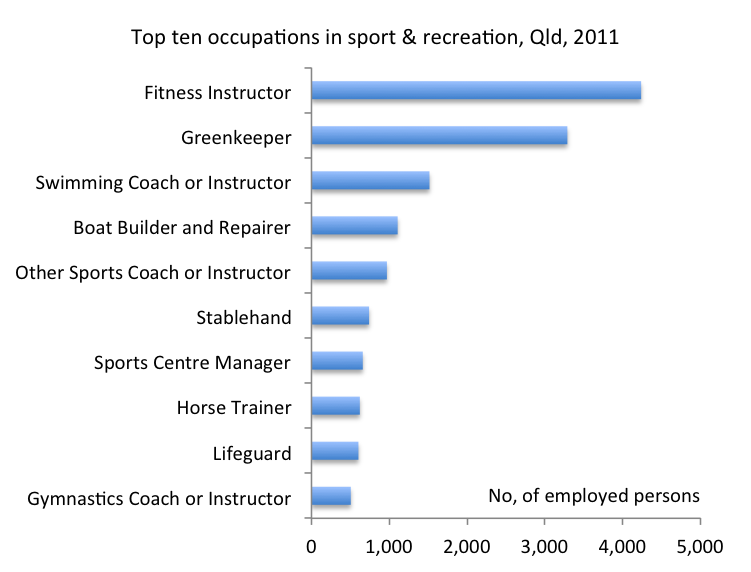
Top ten occupations in sport and recreation

The ABS released (or repackaged) some interesting 2011 Census data yesterday on employment in sport and recreation, showing the dominance of gyms and the significance of the heavily subsidised racing industry as an employer. John Quiggin wrote a great post earlier this year on the ongoing, difficult to justify Government support for the racing industry: Horses versus nurses.

Some interesting and exotic occupations such as bungy jump master and trekking guide don’t make the top ten list and employ only a handful of people (3 & 4 respectively) at the moment. Given the abundance of beautiful outdoor locations in Queensland, I expect occupations such as these will grow significantly in the future, however.

Posted in Labour market | Tagged , , , , , | Leave a comment

Storms and floods reveal need for public education campaign on disasters

After South-East Queensland’s wild weekend of storms, the Queensland Government should consider a public education campaign on how to stay safe during storms and floods, as the Bureau of Meteorology obviously doesn’t see that as its role. While the Bureau has received criticism over not issuing strong warnings (see the Courier-Mail this morning), I agree with its judgment that:

“The Bureau of Meteorology doesn’t aim to issue warnings for every thunderstorm, but uses thresholds to ensure there isn’t complacency in the community due to over-warning.”

There remains the problem, however, that younger generations, including many of my own generation X, don’t take sufficient precautions for disasters. This was obvious in my Toowong apartment building during the 2011 flood when many of the younger residents didn’t have a torch, candles or matches. Also, the many people who went out yesterday afternoon would have realised it was unwise to have done so after the storm arrived.

The weekend storms could have done much greater damage to property and lives and we are thankful they didn’t. The Government now has the opportunity to educate the public about how to prepare for storms and floods and to keep themselves out of harms way.

Posted in Brisbane, Floods | Tagged , , , , , | Leave a comment

Brisbane hearing of inquiry into two pillars (ag and resources) today

The public hearing for the Inquiry into Queensland’s Agriculture and Resource Industries in Brisbane today looks very interesting, and I will try to get along to one or two of the sessions, particularly the sessions with the Resources Council and the Environment Department. It will be interesting to see if there is any common ground between them, especially given the potential gains from reforms to environmental regulations affecting mining are large. As noted by the Office of Best Practice Regulation in its recent Interim Report on the Burden of Regulation:

The minerals industry considers that mining and environmental approvals are complex, inconsistent and poorly administered. Approval delays and obligations have grown substantially in recent years…

CIE estimates that the net present value of gains to Queensland would be approximately $2 billion or $125 million per year.

Posted in Agriculture, Mining | Tagged , , , , , , , | Leave a comment