Qld economy’s growth rate reduced by business CAPEX fall

Queensland had the second lowest rate of State Final Demand (SFD) growth in the first quarter of 2021, according to the March quarter National Accounts published by the ABS yesterday. Queensland’s SFD grew at 0.4% compared with a national average of 1.6%. All states and territories saw increases in SFD except for NT where it fell 1.9% (because there was a huge temporary boost to CAPEX in the December quarter in the NT). As discussed in recent QEW posts, Queensland’s economic growth performance is being compromised by declining business capital investment (see the chart below illustrating the impact of this decline on SFD growth).
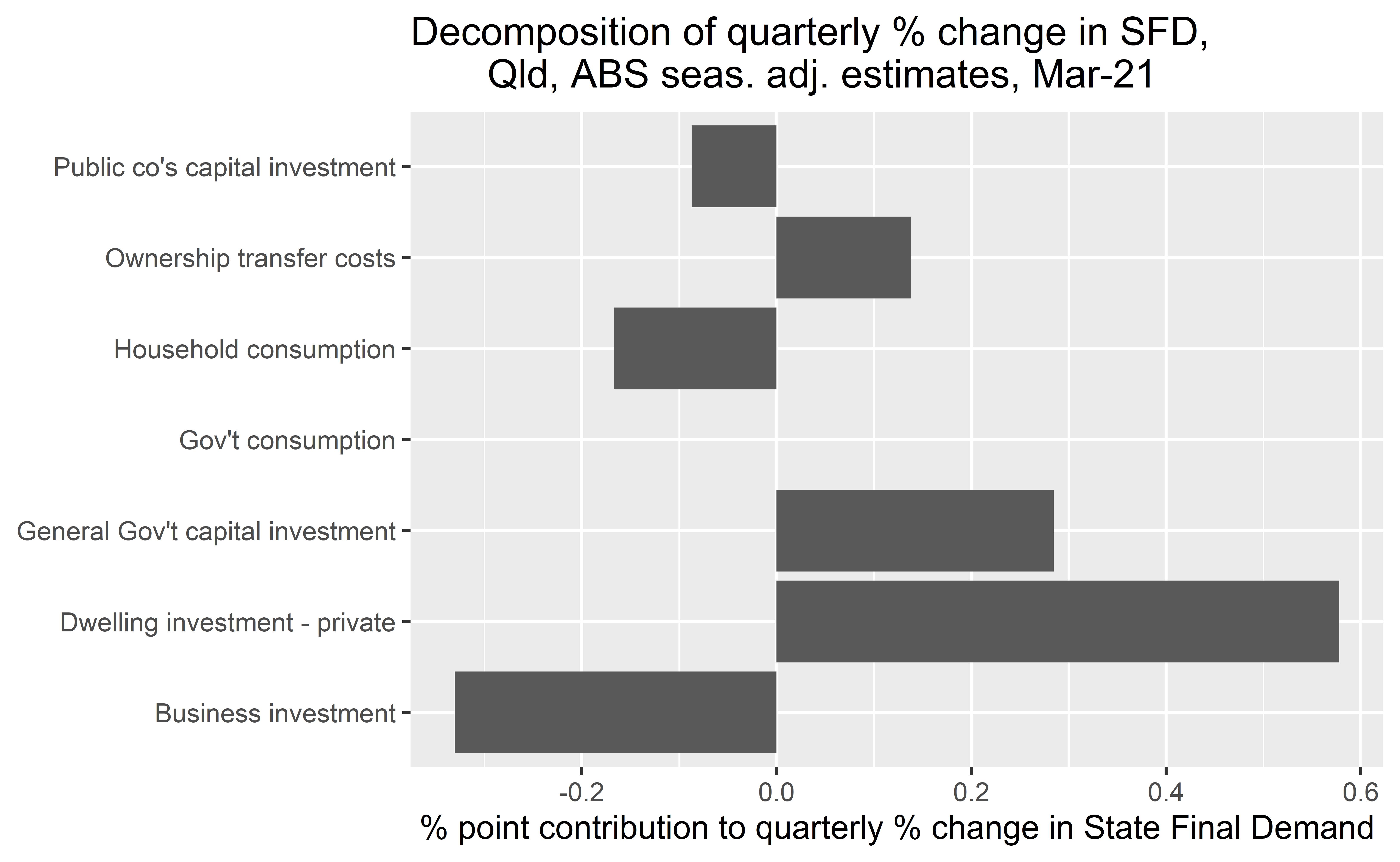
A chart showing that falling business investment is lowering the growth rate of State Final Demand in Queensland.

Specifically, non-dwelling building investment and heavy/engineering construction investment have been falling (see chart below). Of course, the booming property market is making positive contributions to SFD, with dwelling investments and ownership transfer costs (i.e. real estate commissions and stamp duty) surging.
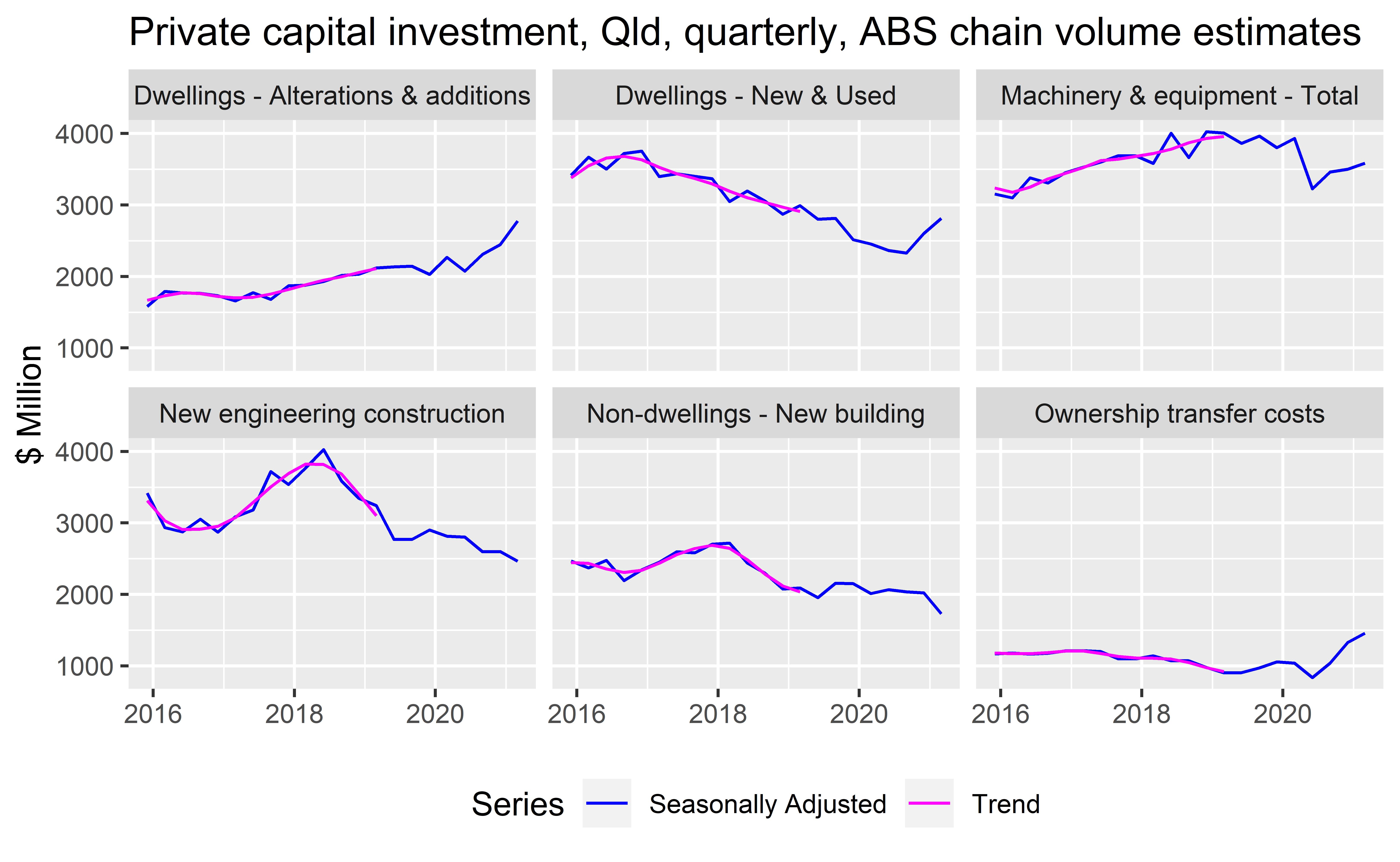
A chart showing private business investment is falling while investment in residential dwellings is surging.

For a closer look at the March quarter National Accounts, check out Pete Faulkner’s Conus Quarterly. Pete has a nice summary of the state of play in international-tourism-dependent Far North Queensland:

…with the international border still closed, and with the recent Federal Budget making it clear that the Government is not expecting it to open in any meaningful way to international tourism until the middle of next year, the tourism sector in the Far North will continue to struggle to make up the slack left by the absence of international visitors.

The recent shut-down in Victoria will obviously not help with domestic tourism certain to take another backward step. Not only will people be forced to reconsider immediate travel plans but this might also make travellers be more cautious about future travel plans.

The Victorian COVID outbreak is obviously a huge risk to the economic outlook from here. We await news of what new assistance the federal government will offer and whether that will be made available more broadly, including to struggling regional tourism businesses in Queensland.

Please feel free to comment below. Alternatively, you can email comments, questions, suggestions, or hot tips to contact@queenslandeconomywatch.com.
Posted in Uncategorized | Tagged , , , , , , , , | 1 Comment

Housing approvals at record high nationwide, but Qld’s historic high was in mid-1990s

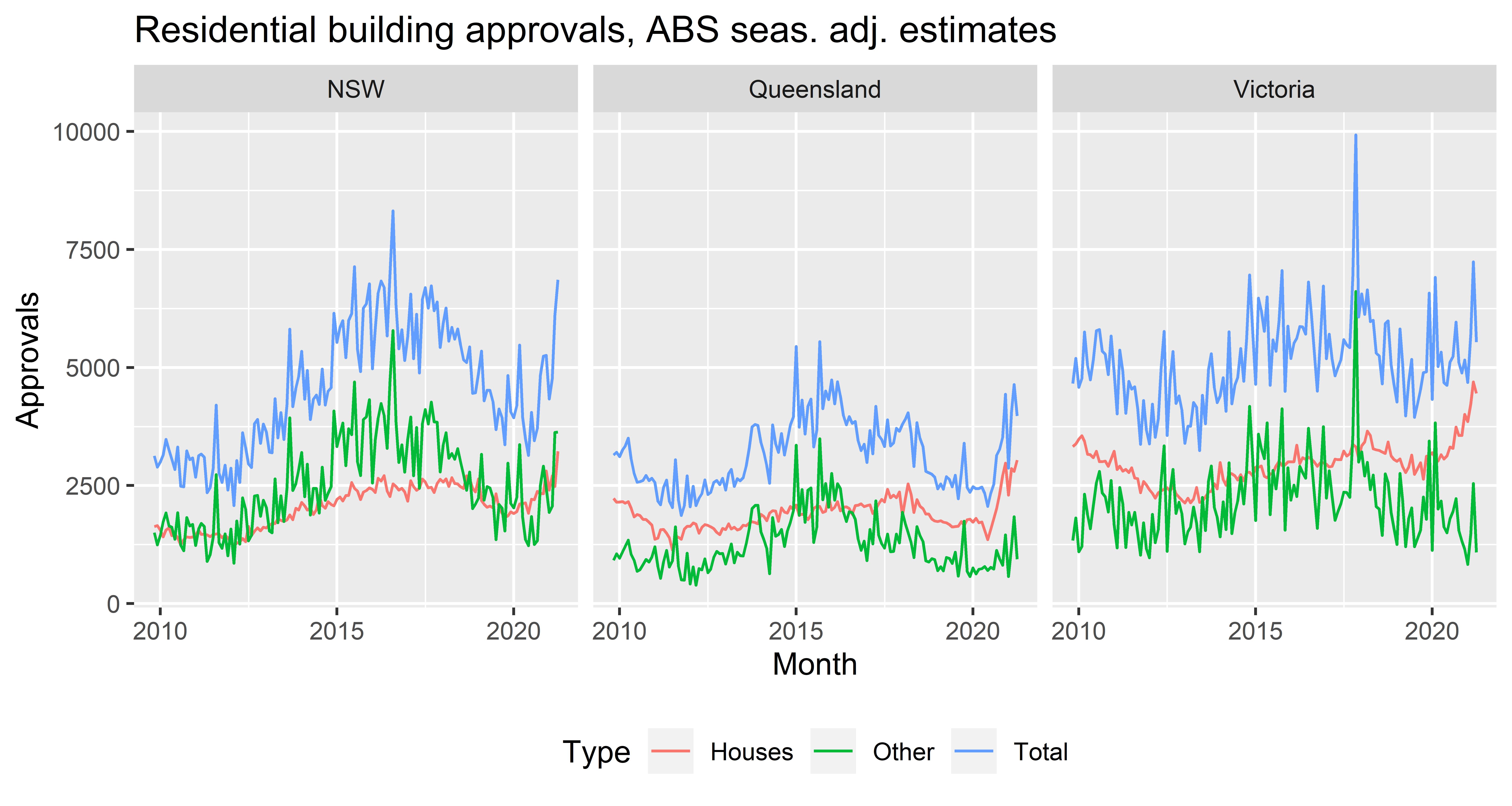
Soaring property prices and surging building approvals highlight a residential property market super-charged by record-low interest rates, returning expatriates, and a Fear Of Missing Out (FOMO). CoreLogic has estimated property prices were up 2.2% nationwide in May and up 2.0% in Brisbane. Obviously, such growth rates can’t last forever and one reason is that the supply-side will respond. The April 2021 ABS building approvals estimates published yesterday revealed record levels of approvals for detached houses nationwide (e.g. see charts below showing the surge in detached housing approvals in the major states). Approvals of apartments and townhouses were much higher during the apartment building boom of several years ago, however.

Chart showing approvals of detached houses are surging across Australia.

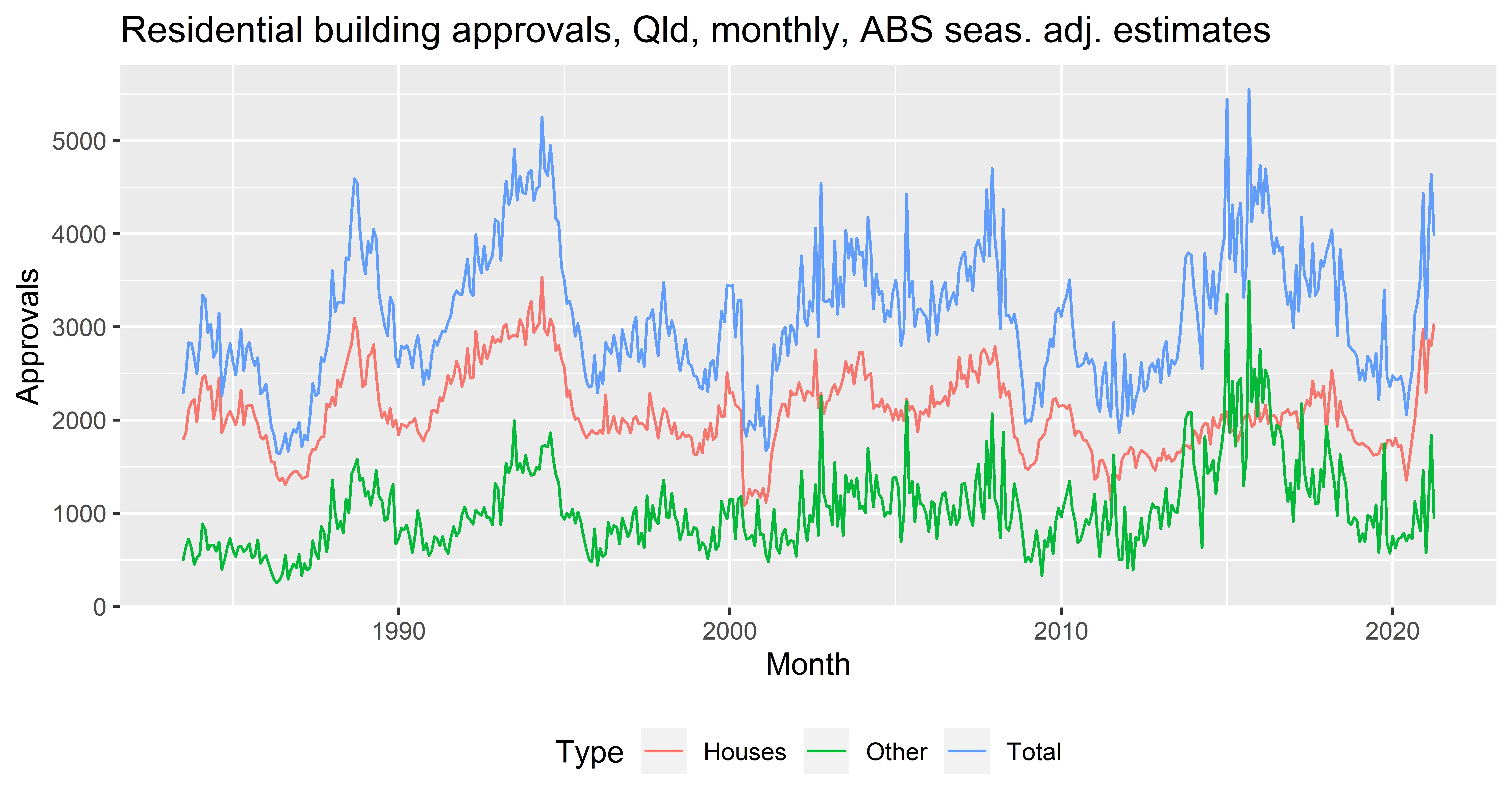
In Queensland, monthly approvals of detached houses are at their highest level (approx. 3,000) since the mid-1990s, but are still less than the peak (approx. 3,500) of that period of high interstate migration (see chart below). That was the time when you’d often hear Premier Goss or Treasurer De Lacy on the TV or radio talking about the 1,000 southerners crossing the border every week, and how that meant Queensland should receive more federal funding.

Chart showing approvals of detached houses are at the highest level they have been in Queensland since the mid-1990s when the historical peak was recorded.

Finally, the ABS is releasing the March quarter National Accounts this morning. Nationally, growth is expected to have been strongly positive in the March quarter (January to March), with forecasts ranging from 1.5% to 2% (see today’s AFR coverage Surge of confidence as iron ore, retail boost GDP).

Please feel free to comment below. Alternatively, you can email comments, questions, suggestions, or hot tips to contact@queenslandeconomywatch.com.
Posted in Housing | Tagged , , , , , | Leave a comment

QCA warned against bidding wars (e.g. on Origin games) back in 2015

As a Townsvillian by birth, I am happy that Townsville will host the first 2021 State of Origin game, but I’m also appalled that Queensland taxpayers have to pay (reportedly) up to $8 million to the NRL so Townsville can host the game (see this Brisbane Times report). This provides another excellent example of Queensland Government financial mismanagement for me to discuss at the Australasian Study of Parliament Group seminar at Parliament House, Brisbane on Monday 14th of June. The NSW Government was right not to pay “silly money” to host the Origin game, as reported by the Courier-Mail today.

Here’s what the Queensland Government’s independent economic adviser the Queensland Competition Authority had to say about interstate bidding wars for major events such as Origin games in its 2015 Industry Assistance Review (p. 107):

…interstate bidding wars for major events are highly likely to be zero sum games. Major events, secured at significant taxpayer expense, primarily expand a state’s tourism sector at the cost of other industries within the state and the rest of Australia.

When a government overbids and overinvests to secure the right for a major event to be hosted in its jurisdiction, it may largely dissipate any potential benefits from the event. Therefore, increased cooperation between state and territory governments in attracting major events may be beneficial for the community, especially if it reduces the likelihood of governments entering expensive bidding wars to secure major events.

The high costs of bidding wars have been previously recognised by most state and territory governments. In 2003, the Interstate Investment Cooperation Agreement was signed by all state and territory governments (except Queensland), whereby the governments agreed to end unnecessary bidding wars to attract investment, including major events. However, this agreement lapsed in 2011…Another cross-jurisdictional agreement between all state and territory governments is worthy of further consideration to increase cooperation and end costly bidding wars.

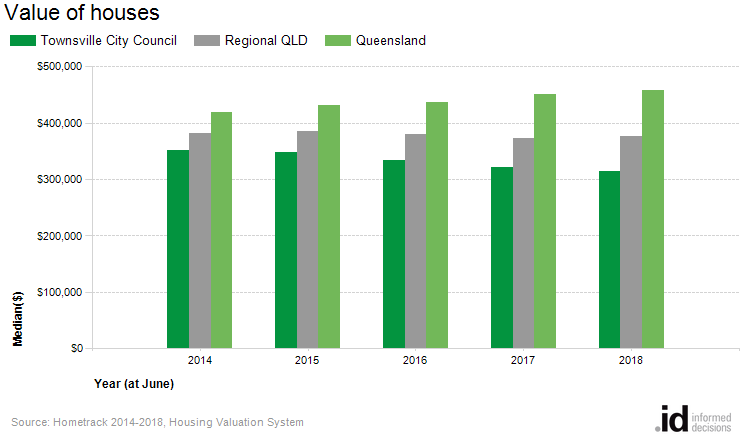
Instead of spending $8 million on a one-night Origin game, wouldn’t it have been better for the Queensland Government to have spent that money on local schools or tackling what appears to be out-of-control youth crime in Townsville? Certainly there are many areas of need in Townsville as the local economy has struggled for years, as evidenced by declining property prices (Hat tip to Marcus Smith for highlighting this).* The $8 million paid to the NRL to attract the Origin game could be much better spent on areas of genuine need.

A chart showing declining house prices in Townsville over 2014 to 2018.

*On Townsville house prices, Pete Faulkner has made me aware that Townsville house prices have recovered since 2018 (when the .id data in the chart above finish) and are now higher than they were in 2014. I’ll aim to have a closer look at these figures in a future post.

Please feel free to comment below. Alternatively, you can email comments, questions, suggestions, or hot tips to contact@queenslandeconomywatch.com.
Posted in Townsville | Tagged , , , , | 5 Comments

Growing concerns that stimulus and money printing are fuelling inflation

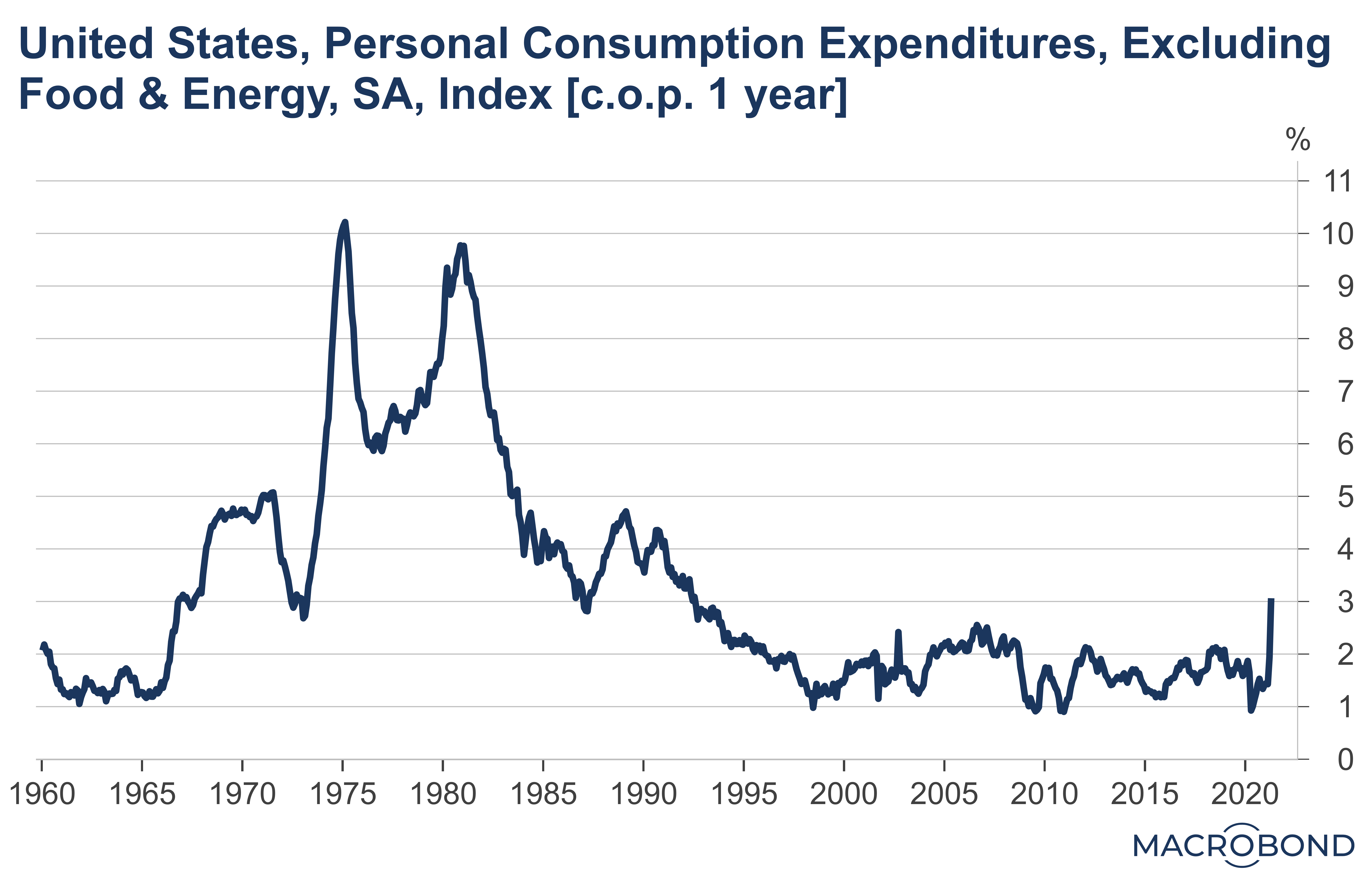
Setting off an inflationary spiral is one of the big risks with the mega-stimulus measures and Quantitative Easing or money printing we’ve seen in the responses of governments and central banks to the pandemic. This month, we’ve seen some higher-than-expected readings of inflation in the US, with the latest being the core Personal Consumption Expenditures (PCE) Index, which was up 3.1 percent through-the-year to April 2021, the biggest increase since the early nineties (see chart below).

The closely watched US Personal Consumption Expenditure (PCE) Index showed 3.1 percent inflation through-they-year to April 2021.

There is a lot of disagreement about whether we should be worried about inflation. For instance, Harvard Professor and former US Treasury Secretary Larry Summers is concerned President Biden’s budget could overheat the US economy (check out this Bloomberg interview). That said, as the Financial Times Coronavirus Business Update email noted today:

Investors were relatively sanguine about the inflation data, which merely confirmed their belief that the recovery was stoking a rise in prices. Global government bonds, sensitive to rises in inflation that could diminish their returns, remained steady.

That is, the markets reacted to the latest inflation data with a collective “whatever”. Time will tell whether that’s a sensible reaction.

Last week, for my Economics Explored podcast, I spoke with someone who is concerned about the potential for spiralling inflation, my regular guest Darren Brady Nelson. You can now listen to our conversation which I’ve published as EP89 CPI inflation concerns with Darren Brady Nelson.

Regarding the outlook for inflation in Australia, let’s see how this current COVID outbreak develops and whether lockdowns over Winter will suppress the economy and any inflationary pressures.

Please feel free to comment below. Alternatively, you can email comments, questions, suggestions, or hot tips to contact@queenslandeconomywatch.com.
Posted in Macroeconomy | Tagged , , , , , , , , | Leave a comment

Mining CAPEX has been growing in WA, falling in Qld

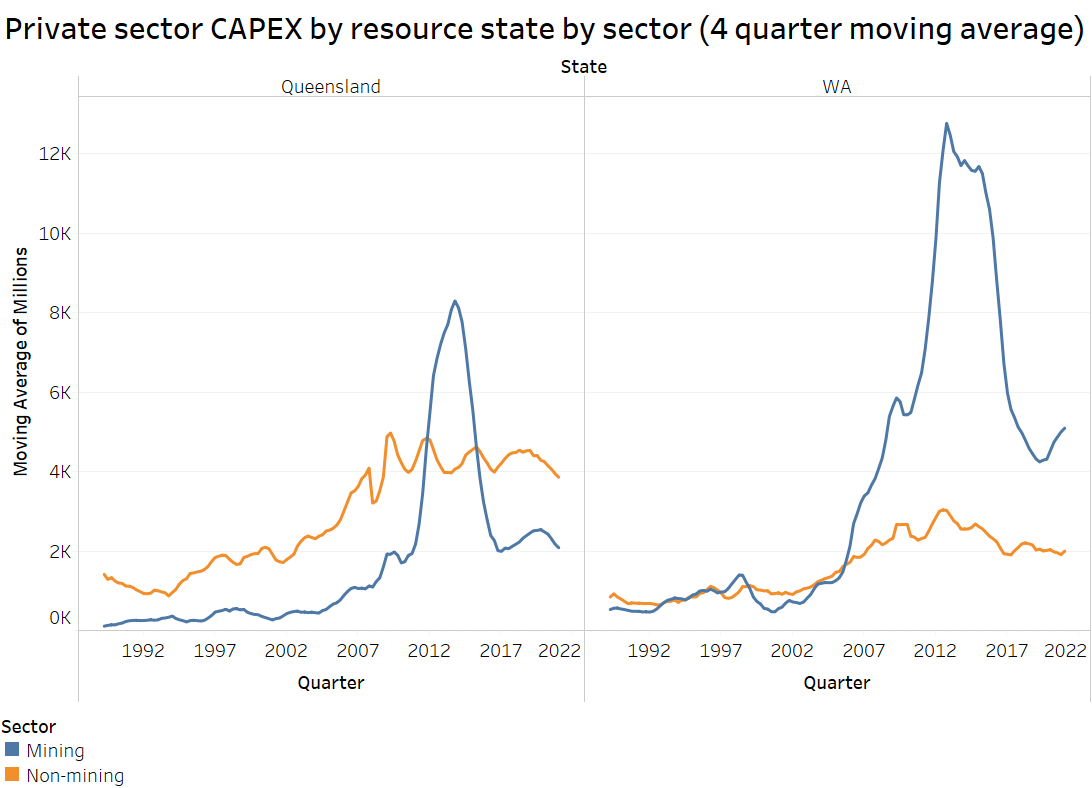
Mining sector CAPEX is falling in Queensland, but increasing in WA

Mining sector capital investment has been increasing in WA but falling in Queensland, according to March quarter capital expenditure data published by the ABS yesterday (see chart above). This would reflect a combination of the following factors:

  • the stronger demand and higher prices we’ve seen for iron ore which is mined in WA;
  • the weaker demand and lower prices for coal which we mine a lot of in Queensland; and
  • a Queensland state government which is internally divided on the desirability of coal mining and hasn’t made it easy to get new mining projects up and running.

Overall, the private sector capital expenditure data are discouraging for Queensland. Nationwide CAPEX was up 6.3% in March quarter but it was down 0.4% in Queensland. While Queensland has so far had a superior recovery to the rest of Australia from the COVID recession, there is now a risk we’ll fall behind other states.

Of course, the COVID outbreak and lockdown in Victoria should mean we’ll continue to outperform Victoria at least. What an absolute debacle. We needed to get as many Australians vaccinated by Winter as possible and we failed miserably. Our federal and state governments have really let us down. They have failed to grasp the magnitude of the challenge and to act with the necessary urgency and vigour. The result is that Victorians are once again locked down, interstate travel is restricted, and people in other states must now be worried about lockdowns being imposed upon them. It’s looking like it could be a dreadful Winter.

Please feel free to comment below. Alternatively, you can email comments, questions, suggestions, or hot tips to contact@queenslandeconomywatch.com.
Posted in Mining | Tagged , , , , , , , | Leave a comment

Surge in new houses and reno’s offset by slump in non-residential construction in Qld

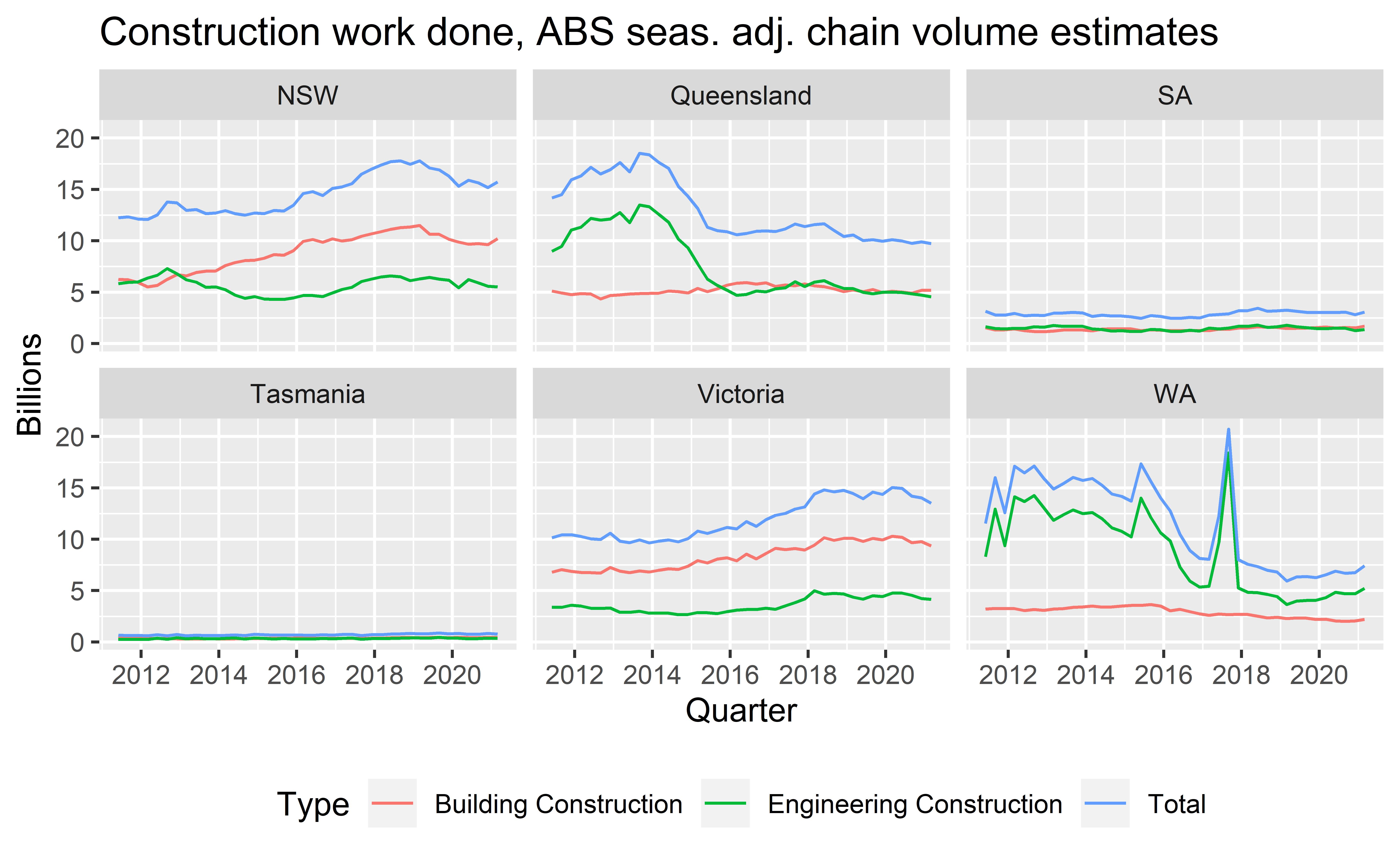
The ABS’s preliminary estimates of construction activity for March quarter are discouraging for Queensland, with an overall fall of 1.7% since December quarter in seasonally adjusted terms (see chart below). In contrast, construction work done increased by 2.4% nationwide. NSW was up by 3.6%, WA by 9.8%, SA by 9.0%, while Victoria fell 3.7%. In Queensland, building construction activity was basically unchanged (only up 0.1%) in March quarter as the surge in residential construction was offset by a fall in non-residential building activity (e.g. offices and shops), and the overall construction work done figure was pushed to -1.7% by a 3.7% fall in engineering/heavy construction activity (e.g. roads, bridges, etc.).*

A chart showing construction work done fell 1.7% in March quarter in Qld, while it increased by 3.6% in NSW, 9.8% in WA, and 9.0% in SA.

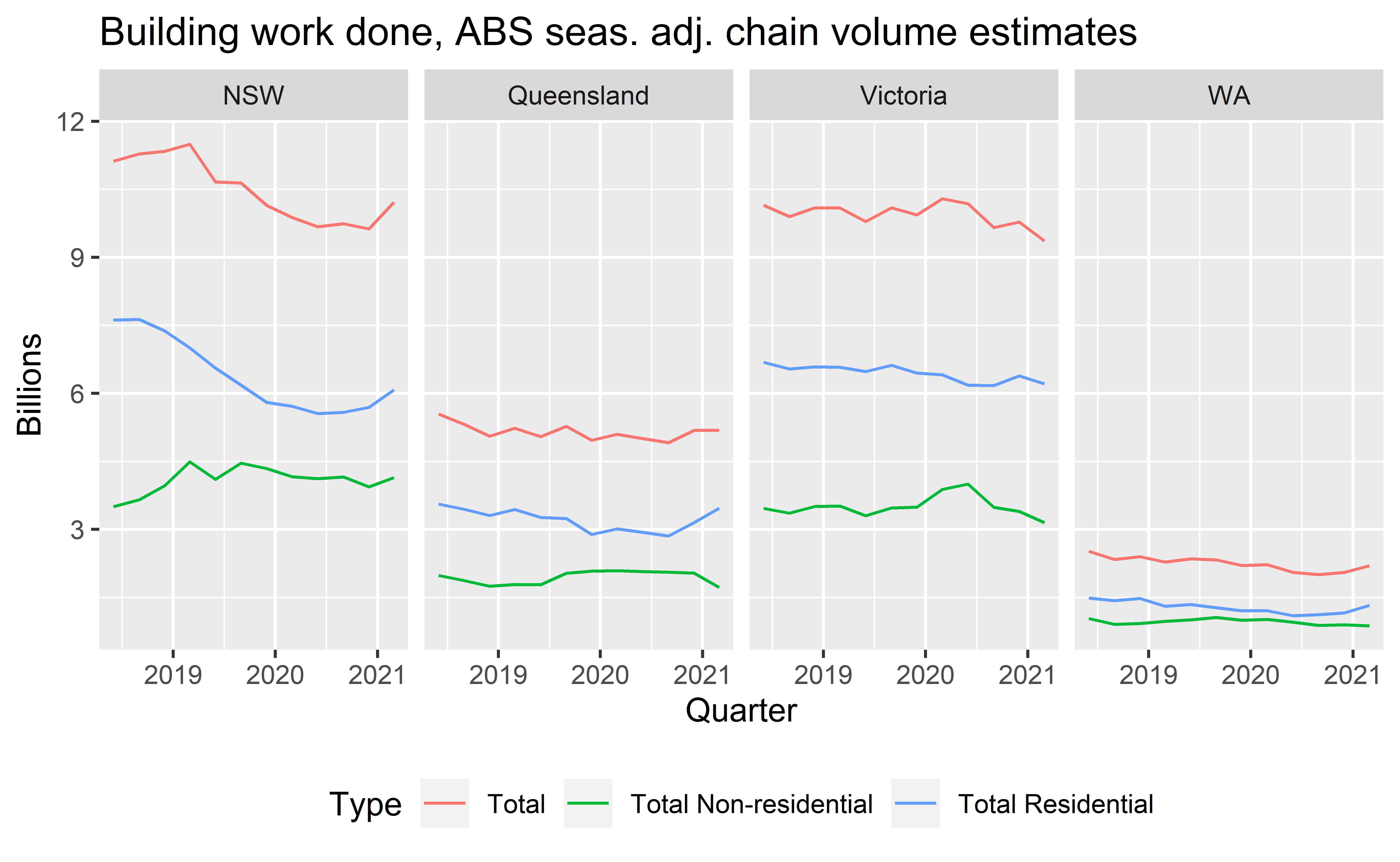
In Queensland, while building work on new housing construction and renovations increased by 10% in March quarter, non-residential building work was down by over 15% (see chart below, noting this is building work done only, and excludes engineering construction activity). Business leaders across Queensland have been talking up the economic benefits of a range of new projects, but we are yet to see an impact on the construction work done data.

A chart showing building work on residential housing is surging in Queensland, but that has been offset by a fall in non-residential building work (e.g. on offices and shopping centres).

The construction work done figures are important inputs into the National Accounts. The March quarter National Accounts will be released by the ABS on Wednesday next week. With total construction activity detracting from growth in March quarter, Queensland will be relying on household and government consumption spending to bring about positive growth in State Final Demand. Hopefully the recovery in interstate tourism will have helped deliver that. We’ll see next Wednesday.

*Total construction work done comprises residential building work, non-residential building work, and engineering construction work.

Please feel free to comment below. Alternatively, you can email comments, questions, suggestions, or hot tips to contact@queenslandeconomywatch.com.
Posted in Uncategorized | Tagged , , , , , , , , , | Leave a comment

Evolutionary Economics with Brendan Markey-Towler

Harvard Economics Professor Joseph Schumpeter (1883-1950) was arguably the most perceptive and prophetic economist of all time. Schumpeter wrote about the importance of the entrepreneur for innovation and so-called “creative destruction” in capitalism, but he also recognised the inexorable tendency toward welfare-state socialism in democracy, the latest manifestation of which in Australia is the NDIS. Recently I spoke with fellow Queensland economist Dr Brendan Markey-Towler about Schumpeter’s theory of economic growth and its influence on the sub-field of Evolutionary Economics, which sees the economy as a constantly evolving system. Our conversation has been published as Episode 88 of my Economics Explored podcast.

Brendan and I had a wide-ranging conversation on the insights of Evolutionary Economics, the importance of the entrepreneur to economic growth, and the interaction of private and public sectors in the innovation process (e.g. we owe the US Government for GPS but the fundamental, life-altering innovations using it have come from the private sector).

On the perspective of Evolutionary Economics, Brendan notes in the first ten minutes of our conversation:

…you constantly need to be introducing novelty, you constantly need to be introducing new ways of doing things, new ways of producing, new ways of finding the best cost structure, new ways of serving your customers, new ways of treating your employees, new ways of organising your production structures, in order to out compete each other, and that is the health of markets. That’s what is evolutionary economics’ big difference from neoclassical economics, as it emphasises the importance of differentiation and variety to the health of markets.

Brendan has a PhD in economics from the University of Queensland and is the co-author with Nicholas Johnson of the 2020 book Economics of the Fourth Industrial Revolution Internet, Artificial Intelligence and Blockchain, published by Routledge. Brendan has written a popular Medium article on Evolutionary Economics: What is evolutionary economics.

Joseph Schumpeter (1883-1950). Source: Volkswirtschaftliches Institut, Universität Freiburg.

Please feel free to comment below. Alternatively, you can email comments, questions, suggestions, or hot tips to contact@queenslandeconomywatch.com.
Posted in Industry policy | Tagged , , , , , , | Leave a comment

Role of Qld Parliament in public finance – upcoming ASPG event on 14 June 21

Thanks to the Queensland chapter of the Australasian Study of Parliament Group (ASPG) for inviting me to be a panel member at its upcoming event The role of Parliament in public finance on 14 June at Parliament House, Brisbane. My fellow panel members will be former state transport and finance minister (in the Bligh government) Rachel Nolan and UQ Economics Associate Professor Begona Dominguez. The topic of discussion for the evening will be:

…the role of the Queensland Parliament in overseeing government financial performance. Is scrutiny of the state budget a process of careful consideration, or a rubber stamp?

Regular QEW readers will be unsurprised that I’m leaning toward the rubber stamp view. The government always just does what it wants as it has the numbers in the Queensland Legislative Assembly and there’s no upper house which could act as a genuine house of review. There’s also little point members of the public sending submissions into parliamentary inquiries because the government has usually decided what it wants to do, and at best you’ll get a weak response back from the relevant department with dull talking points, similar to Queensland Treasury’s response to my critique of the government’s pointless Queensland Future Fund last year (see my submission).

I really welcome the invitation from the ASPG as it will allow me to reiterate and expand on the points I made in my 2018 book Beautiful One Day, Broke the Next regarding Queensland’s woeful parliamentary committee process. Assuming you’re not a member of the ASPG, it would cost you $10 to attend the event at Parliament House on 14 June, and you can book via Eventbrite.

Finally, today I was alerted to the fact that Queensland Treasurer Cameron Dick directed a few barbs my way in Parliament back in March (hat tip to Joe Branigan), and hopefully I’ll get the chance to address his comments on 14 June. While quoting me approvingly on one issue, the Treasurer thought it emphasised his point to depict me (incorrectly, I should note) as an LNP adviser. The Hansard for Tuesday 9 March 2021 on page 319 quotes the state Treasurer as saying:

…the LNP’s chief economist, Gene Tunny—the man who literally wrote the book on asset sales…

The first part of the Queensland Treasurer’s statement is total BS, as I’m not an LNP member, nor do I work for the Opposition, and I try my best to be non-partisan and objective. Regarding the second part of the Treasurer’s statement, assuming he’s talking about Beautiful One Day, Broke the Next, I’ll take it as a compliment, and indeed may even consider it as a testimonial to include on the back cover of a second edition of the book I’ll need to get around to writing one day. Since 2018, enough has certainly happened in Queensland to warrant a second edition!

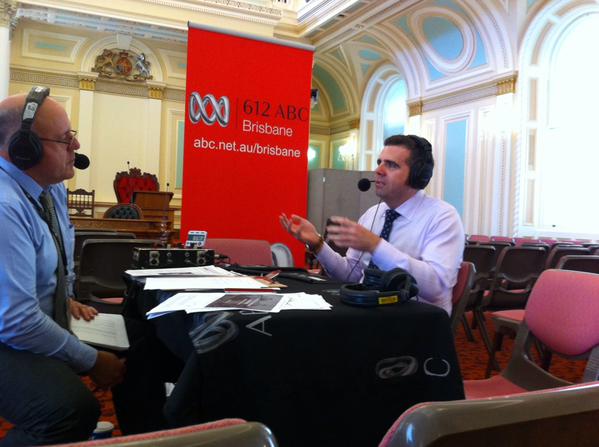
Here I am speaking with 612 ABC Brisbane’s Steve Austin on the first day of Parliament for the newly elected Palaszczuk Government in early 2015. The temporary broadcast studio was set up in the chamber of Queensland’s defunct upper house, the Legislative Council. The ASPG event on 14 June 2021 will be held in this chamber.

Please feel free to comment below. Alternatively, you can email comments, questions, suggestions, or hot tips to contact@queenslandeconomywatch.com.

Posted in Queensland Government | Tagged , , , , , | Leave a comment

Interview with 4BC’s Scott Emerson on the federal budget

This afternoon, on his 4BC Drive program, former Queensland Government Transport Minister Scott Emerson and I shared our astonishment regarding the Morrison Government’s Go for Growth, Keynesian federal budget which Treasurer Josh Frydenberg handed down last night. You can listen to our conversation via this link:

Drive with Scott Emerson, 12 May 21, from 48:30

Former PM John Howard and former Treasurer Peter Costello, responsible for ten Australian Government budget surpluses, must also be astonished that a Liberal Government would deliver a budget that no Labor Government ever could, because it would be pilloried all across Australia for its fiscal profligacy. This is another Nixon-goes-to-China-type Budget.

I remember clearly, largely because it made things difficult for some of us in Treasury, how then Opposition Leader Malcolm Turnbull and his colleagues opposed the Rudd Government’s proposed increase in the debt limit to $200 billion in February 2009 following the release of the Nation Building and Jobs Plan, the second stimulus package during the GFC. To some of us, this seemed akin to blocking supply, something which has been considered forbidden since the contentious dismissal of the Whitlam Government in 1975. But Turnbull could at least argue he was standing up for principles of sound public finance. From now on, it will be extremely difficult for the conservative side of politics to criticise Labor for debt and deficits. This could be very costly to the conservatives’ political appeal in future years.

Finally, the Treasury’s medium-term budget projections (pages 97-98) suggest a baked-in structural federal deficit of at least 1 percent of GDP out to which a future Government will need to address, particularly if and when interest rates escalate in the future and the interest bill weighs heavily on the budget. The pandemic will continue to cost us long after it’s over.

Please feel free to comment below. Alternatively, you can email comments, questions, suggestions, or hot tips to contact@queenslandeconomywatch.com.
Posted in Budget | Tagged , , , , | Leave a comment

Qld and WA leading Australia in business conditions, based on NAB Survey

It’s federal budget day and, at this stage, I’m due to appear on Steve Austin’s 612 ABC Brisbane Drive program after 6pm to talk about how the federal budget is developed, so please tune in if you’re interested.

Tonight we’ll learn just how much Australia’s extraordinary economic recovery has improved the budget bottom line from previous forecasts. The Australian is reporting:

The Australian understands the budget deficit for 2020-21 to be unveiled on Tuesday night will be $161bn compared with the $213.7bn forecast in the October 6 budget. This is a $52.7bn improvement and also accounts for a third stage stimulus spending program ahead of the next election.

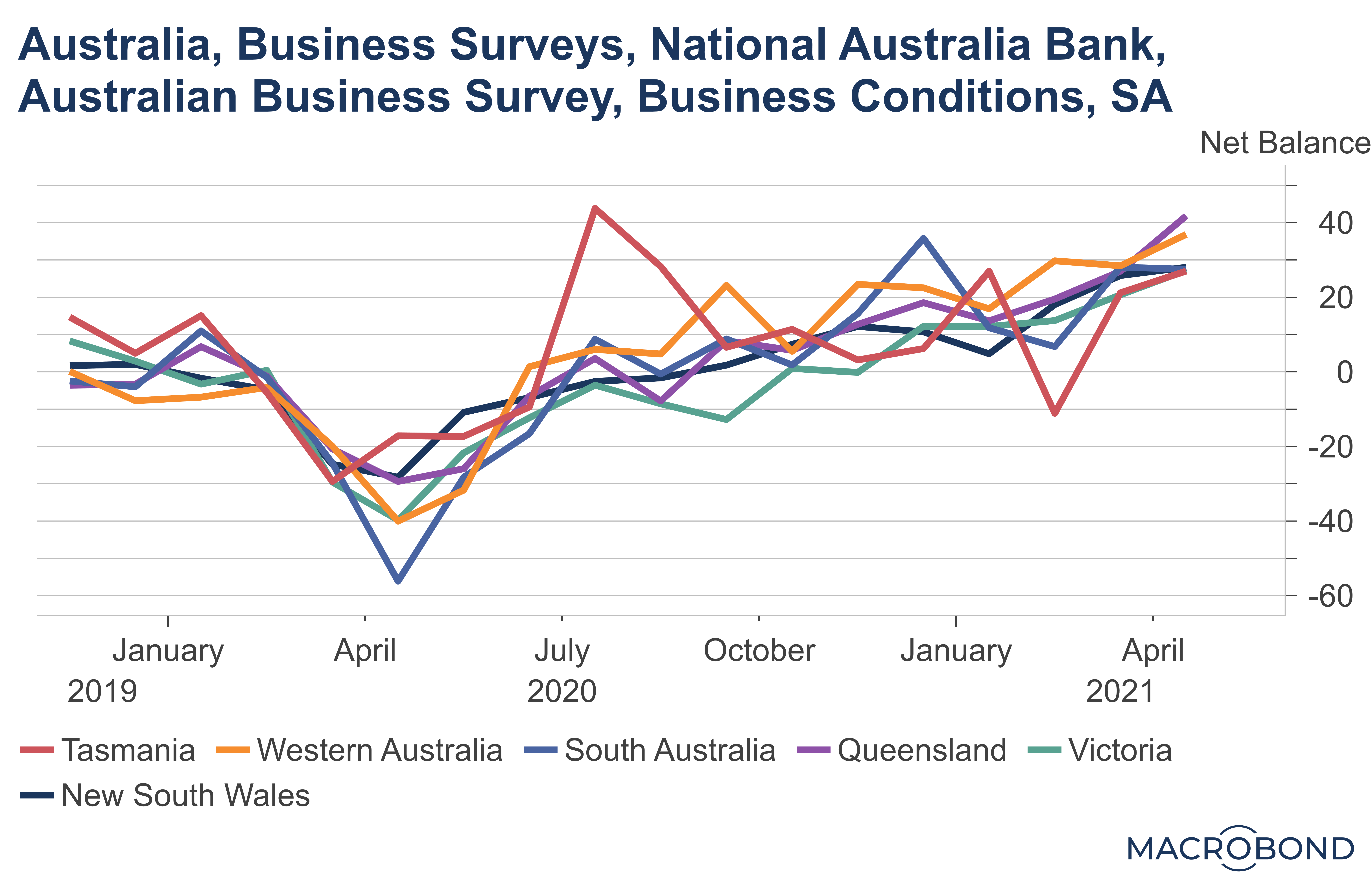
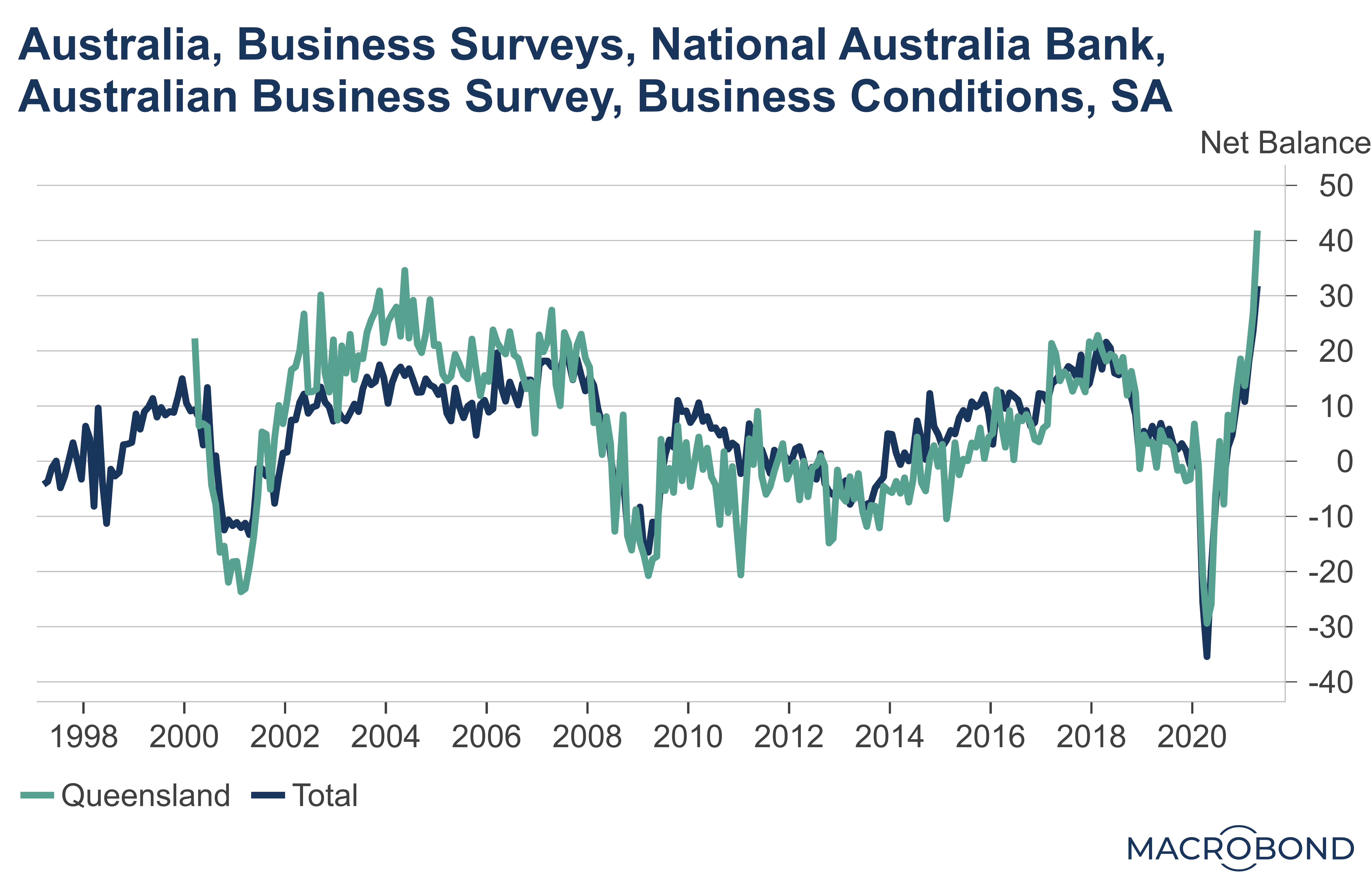
The economy is doing much better than anyone expected (see chart below). NAB Chief Economist Alan Oster was right to describe the latest business survey data for April from his bank as “simply stunning”, as reported by Matthew Cranston in today’s Financial Review (Business conditions ‘simply stunning’ as confidence hits record high).

In terms of business conditions, which are at historical highs, Queensland is leading Australia in the NAB’s seasonally adjusted estimates (see chart below), but is a little below WA on the NAB’s trend estimates (see the NAB Monthly Business Survey April 2021). Are Queensland and WA doing so well because they’re the mining states, (noting the record high iron ore price which is of great relevance to WA)? Possibly. Here, I should note the high degree of sampling error at the state level in the NAB data. Also, I wonder whether COVID has so disrupted our sense of what is normal that we’re over-estimating just how good current conditions are. It’s implausible to me that business conditions are at record highs, although I do acknowledge there is a lot of positivity out there. Certainly the residential building industry, a big employer, is booming and households are spending money decking out new houses and apartments.

In the data, we may be seeing the lagged impacts of JobKeeper and the Coronavirus Supplement still operating on the economy (i.e. as households and businesses spend money they saved in previous months), but these programs have now been turned off. I also remain concerned about the potential for a COVID outbreak in Winter, sending capitals into lockdowns. Time will tell.

Please feel free to comment below. Alternatively, you can email comments, questions, suggestions, or hot tips to contact@queenslandeconomywatch.com. QEW is supported by Adept Economics.
Posted in Budget | Tagged , , , , , , , , , | Leave a comment