People marginally attached to the labour force behind participation rate movements

In the early 2000s, when Queensland’s unemployment rate seemed permanently stuck around 1-2 percentage points above the national average, it was common for Premier Beattie and Employment Minister Braddy to note that our relatively higher participation rate placed us at a disadvantage. This was because the Queensland economy needed to produce many more jobs than if workforce participation weren’t so high. Adjusting for our higher participation rate, Queensland’s unemployment rate would have been much closer to the national average.

There is certainly an arithmetic link between the unemployment rate and the participation rate. The unemployment rate is the ratio of the number of unemployed people to the size of the labour force. The size of the labour force is the sum of employed and unemployed persons, and by definition is equal to the participation rate (%) multiplied by the civilian population aged 15 or over. Given these relationships, you can work out what the unemployment rate would be if the participation rate were a different value.

This is relevant to the discussion of more recent labour force data. For example, Queensland’s December 2012 unemployment rate of 6.2% could have been much worse if the participation rate hadn’t fallen from 66.6% to 66.0%. Assuming the December participation rate were instead steady at 66.6%, the unemployment rate would have been 7.1%. Given the volatility in the monthly data, I wouldn’t want to make too much out of this. However, over the last year or so, there has been a downward trend in participation as labour market conditions have worsened, and it appears that lower labour force participation has indeed prevented the unemployment rate from increasing more than it has.

This is not unexpected, as it has been observed for many decades and across many countries that the participation rate will vary with labour market conditions. To a large extent, this is because of the existence of many people (tens of thousands in Queensland I expect) who are marginally attached to the workforce – e.g. students and parents who have left the workforce to raise children. People who are marginally attached might take a job if an attractive one comes along, but they don’t necessarily need to work. When employment growth is strong, the better labour market conditions encourage people who are marginally attached to the workforce to look for work, hence increasing the participation rate. This is the so-called encouraged worker effect. There is also a discouraged worker effect, because when labour force conditions worsen, the marginally attached (and the newly unemployed) can get discouraged from looking for work and hence drop out of the labour force.

Given the encouraged and discouraged worker effects, the participation rate will tend to move in a way that dampens movements in the unemployment rate. This is evident in the Queensland data (see chart below), with the participation rate dropping in periods of weak labour market conditions (i.e. last year and the early 1990s recession) and increasing when labour market conditions were better (i.e. in the years prior to the 2008 financial crisis). Hence there is nothing unexpected or odd about the moderating impact of the recent decline in Queensland’s participation rate on the unemployment rate.

lfdata

Posted in Labour market, Macroeconomy | Tagged , , , , , | 1 Comment

Brisbane metro labour market in bad shape

According to ABS regional labour force data, the latest batch of which was released today, the rise in Queensland’s unemployment rate over 2012 was driven by a weakening labour market in the Brisbane metro area – a deterioration which was only slightly offset by an improving labour market in the rest of Queensland (see chart below). This was possibly because the public sector job cuts have been largely confined to administrative jobs in the Brisbane metro area – a sensible strategy given this is where the inefficiencies are likely to exist.

unempPete Faulkner has coverage of the Far North Queensland data: FNQ unemployment rate edges higher but the news is positive. However, I’m much less confident than Pete that we can read much into the highly volatile data at the statistical region level. KS at Loose Change also has coverage of today’s FNQ data (FNQ employment at a new monthly high).


Posted in Labour market | Tagged , , , , , , | 5 Comments

Weird OECD create your own economy competition

In principle, I think it’s a good idea that the OECD is reaching out to young people to get them interested in economic policy issues, but this video competition strikes me as weird:

Think differently: How would you shape tomorrow’s global economy?

The worst financial, economic and social crisis of our lifetime led to widespread condemnation of “business as usual” and calls to revisit, rethink and test new approaches to economic and societal challenges.

Are today’s economic models sufficient? What needs to be done to build a sustainable future?

If you’re between 18-25, make a three-minute video laying out your vision on future economic models and how would you shape tomorrow’s global economy.

The winners will gain a trip to Paris during OECD Week in May 2013.

We don’t need radical ideas to reform our economies. We just need to get the basics like free trade and financial market regulation right. The OECD shouldn’t waste time on silly competitions like this and should instead spend time improving its arguments and evidence base for policies such as cutting European farm subsidies and tightening up the regulation of financial derivatives.

Finally, in public policy debates, there is no substitute for clear logic supported by compelling data. Thankfully the ABS is doing a great job in disseminating data to Australians, and I applaud its new iPhone app:

ABS Mobile

Posted in Macroeconomy | Tagged , , , , , , | Leave a comment

Qld’s sluggish labour market persists – unemployment at 6.2% (compared with 5.4% nationally)

The Queensland unemployment rate was recorded at 6.2% (seasonally adjusted) in December 2012, up slightly from 6.1% in the previous month. The number of unemployed persons has increased to nearly 154,000, compared with 130,000 twelve months previously. The result is not a surprise given the poor job vacancies data we saw recently:

Disappointing vacancies data support Treasury’s very low employment growth forecast for 2012-13

Pete Faulkner has good coverage of today’s figures:

Unemp rate rises as jobs fall; but it’s all coming from QLD

Posted in Labour market | Tagged , , , , , , | Leave a comment

Townsville Super Stadium-land sales link would only be indirect

Rugby league has a massive following in Townsville, and I remember there was a betting comp on the Winfield Cup among students at Kirwan High in the late eighties, back when the Broncos were the only Queensland team in the national competition. Hence I expect a Super Stadium, so Townsville could host finals games and major international events, would be extremely popular and is likely to be built (unless the project appears completely infeasible when the cost estimates come in).

The Super Stadium is creating a lot of excitement in Townsville and the local paper has picked up on a suggestion that sales of surplus State Government land around Townsville could be used to finance it (Premier flags property sell-off to help fund super stadium). However, I think the Bulletin is making too much of the obvious point that, if the Government sells assets (e.g. surplus land), that will provide it with cash that it can spend on other things (e.g. a Super Stadium). But it would be inefficient and unnecessary to earmark the money for expenditure on a Super Stadium.

Money, after all, is fungible. One dollar from one source (e.g. land sales in Townsville) is identical with one dollar from another source (e.g. land sales in Brisbane or speeding fines).  Abstracting from accounting issues, either dollar could be used to build a Super Stadium or pay down debt, which is a major priority of the Government given it is aiming to restore our AAA credit rating. Hence the availability of surplus land in Townsville is not a major consideration in whether to build a Super Stadium. The Government needs to decide whether it is preferable to spend possibly several hundred millions of dollars building a Super Stadium or to instead reduce State debt by an equivalent amount of money.

Posted in Budget, Townsville | Tagged , , , , , , , | Leave a comment

Debt ceiling is an important constraint on government expenditure

I’m somewhat surprised that the Economist in its latest issue argues the US debt ceiling “serves no useful purpose and should be abolished” (From cliff to ceiling). A debt ceiling is important because it forces the Government to consider the aggregate level of government debt and the sustainability of fiscal policy over the long-term. It is not necessarily doing this every time a new spending or taxation measure is passed.

The Economist makes the incorrect assertion that “The debt ceiling is a peculiarly American anachronism.” This is not the case, as Australia also has a debt ceiling, set by section 5 of the Commonwealth Inscribed Stock Act, which limits the Australian Government to having no more than $300 billion of Treasury bonds on issue. As a Treasury officer in 2009, I well recall the huge debate in February 2009 when this limit was raised from $75 billion to $200 billion, and it no doubt created some anxiety in the Government. But it was an important debate to have because it focussed attention on the medium and long-term implications of fiscal policy.

Also, once a debt ceiling is in place, it makes Governments more carefully consider future spending increases because they realise they may have to apply for a debt ceiling increase if expenditure grows too much. Given that Governments of all persuasions typically develop a number of wasteful and inefficient programs, forcing Governments to exercise more care is a very good thing.

Finally, it is important to decouple decision making on government expenditure and taxation from decision making on the financing of Government policy measures, because Governments do not necessarily have to borrow all the money required to finance deficits. Governments could draw down on existing sources of funds, for example. The Future Fund may have provided this possibility in Australia, if it weren’t a “locked box” to use Peter Costello’s memorable phrase.  I would recommend that future Australian Governments invest future surpluses (maybe 2-3 years away) in unlocked boxes, rather than the Future Fund or Nation Building Funds, as that would provide the Government with added budgetary flexibility.

Posted in Budget | Tagged , , , , , , , , , , , | 2 Comments

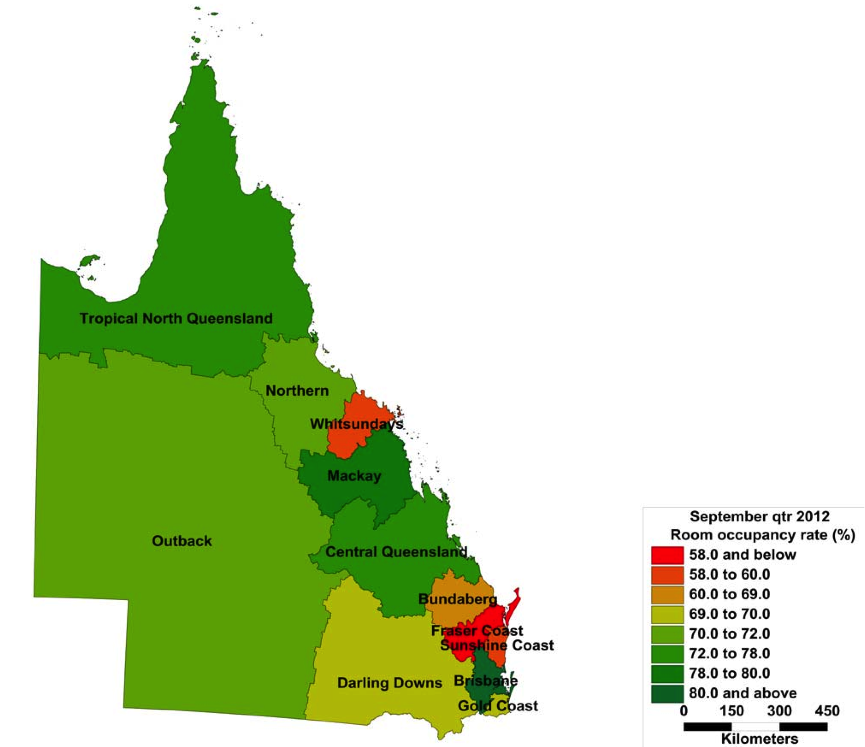
Awful September qtr tourism data for Whitsundays, Fraser Coast and Sunshine Coast

The ABS released its September quarter 2012 small area data for tourism accommodation today, and it shows the Whitsundays, Fraser Coast and Sunshine Coast had a really bad quarter (see map below). This is not to say other regions performed wonderfully, as occupancy rates are still lower than pre-financial crisis levels (see the chart for Queensland as a whole in my post from earlier this week). I’ll aim to compare current and historical small area data in a future post.

ror


Posted in Tourism | Tagged , , , , , , , , | Leave a comment

Qld building industry recovery postponed

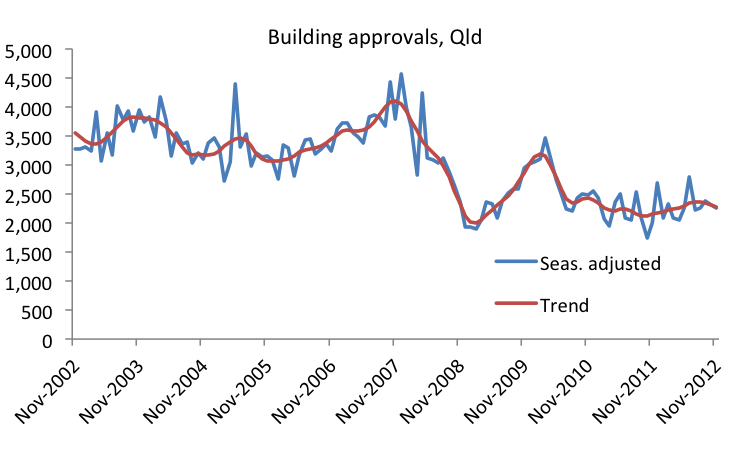
In a post last month I observed that of the so-called four pillars of the Queensland economy – agriculture, construction, resources and tourism –  the resources sector has been the only one with employment growth in recent years. Unfortunately, new ABS data on building approvals today suggests the construction industry isn’t likely to start generating new jobs anytime soon, with approvals appearing to stabilise at a relatively low level:

buildingapprovalsNationally the data aren’t encouraging either, except in Victoria. The HIA’s media release has a good summary of the data:

“Today’s positive headline result, a 2.9 per cent improvement in the dwelling approvals nationally, somewhat overshadows what is a rather poor update for most jurisdictions,” said HIA Economist, Geordan Murray…

…In November 2012, total seasonally adjusted building approvals increased in only one jurisdiction, Victoria – up by 8.7 per cent. Approvals fell in South Australia (-13.8 per cent), Tasmania (-7.6 per cent), New South Wales (-4.0 per cent), Queensland (-1.5 per cent) and Western Australia (-1.0 per cent). In trend terms building approvals in November fell in both the Australian Capital Territory (-0.8 per cent) and the Northern Territory (-3.6 per cent).

Other coverage of today’s building approvals data includes:


Posted in Housing | Tagged , , , , , , | Leave a comment

Disappointing vacancies data support Treasury’s very low employment growth forecast for 2012-13

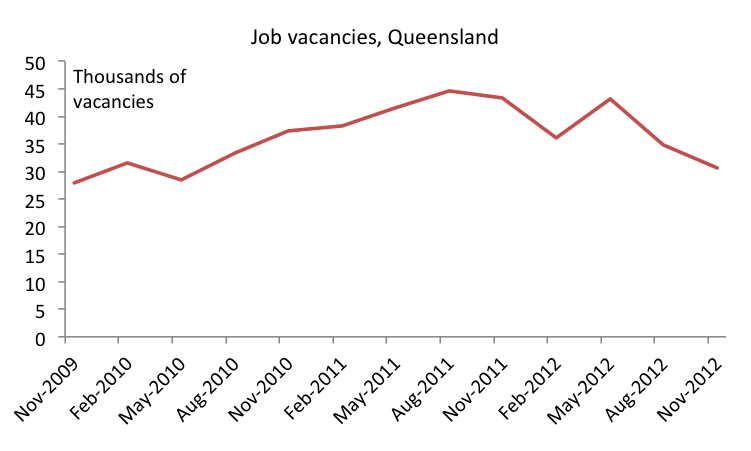
In the Mid Year Fiscal and Economic Review 2012-13 released last month, Queensland Treasury revised down its forecast of 2012-13 employment growth from a weak 0.75% to a very weak 0.25%. The ABS job vacancies data released today lend support to Treasury’s new forecast, and suggest it will be some months yet before the labour market recovers (see chart below).

vacanciesI’ve previously posted on how the labour market sluggishness is likely to be only temporary (Temporary weakness due to public sector restraint continues), as recent State Government job cuts and spending restraint are significant contributors to the sluggishness, and I expect the fiscal restraint is only temporary. The Government, of course, will eventually need to boost spending on its own priorities to maximise its re-election chances.


Posted in Labour market | Tagged , , , , , | 2 Comments

Top ten countries for imports to Qld and exports from Qld

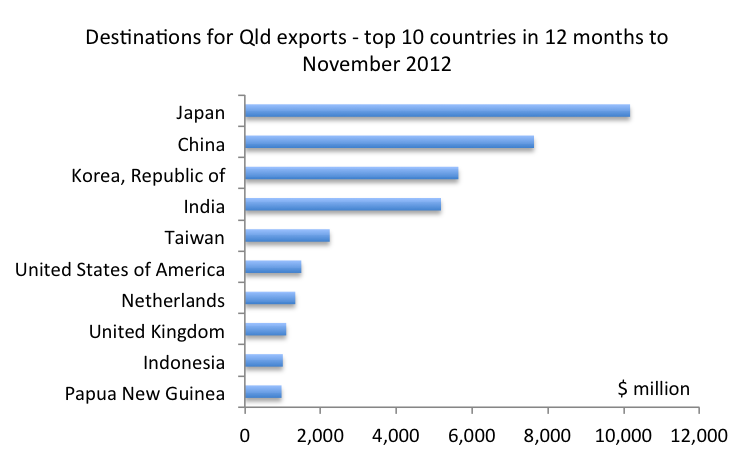
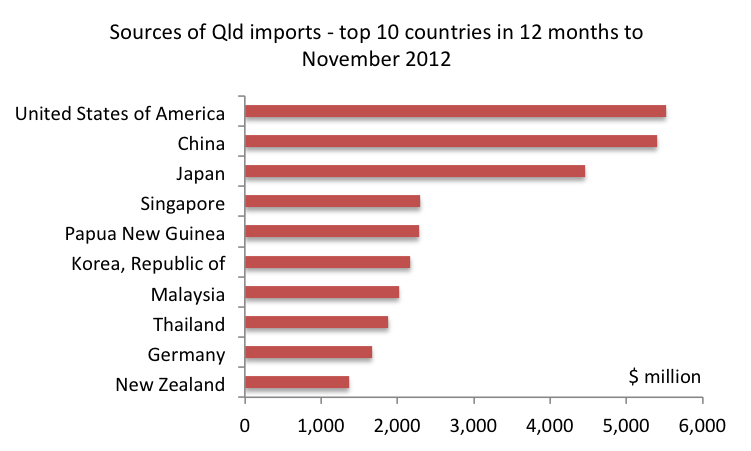
Based on today’s new ABS international trade statistics, I prepared the charts below, which show Japan and China are our top two export destinations and the US and China are our top two sources of imports:

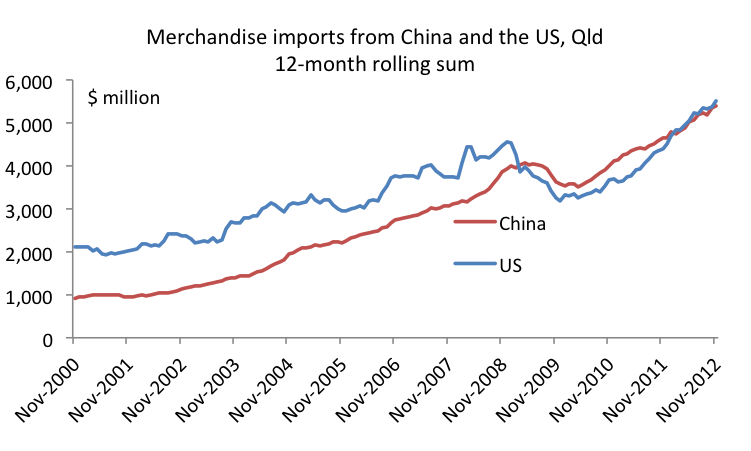
Exports ImportsI was initially surprised by the US being number one as a source of imports, albeit not very far ahead of China, but it makes sense when one considers online purchases from US websites and large amounts of mining equipment that would be imported from the US.

Imports from both the US and China are growing strongly (see chart below).

China and the US


Posted in Exports, Macroeconomy, Uncategorized | Tagged , , , , , , , | Leave a comment