Nine News interview on Paddington seven-storey development

Tessa Scott from Nine News Brisbane interviewed me yesterday morning regarding the proposed re-development of the Brisbane Workers’ Community Centre and associated shops on the corner of Given and Latrobe Terraces, Paddington. I was supportive of the proposed mixed-used (i.e. commercial and residential) development, arguing higher density brings many economic and social benefits, including reduced transport costs, lower greenhouse gas emissions, and greater opportunities for business and social interactions. Here’s a link to the Nine News story in which I’m interviewed:

Paddington residents rally against development

Let’s hope this doesn’t become another missed opportunity, like the missed opportunity to develop the old Milton Tennis Centre site, which is now being turned into a park. The development should proceed.

Posted in Brisbane, Housing | Tagged , , | 2 Comments

Heritage protection imposing high costs

sp-so-150514-graph3

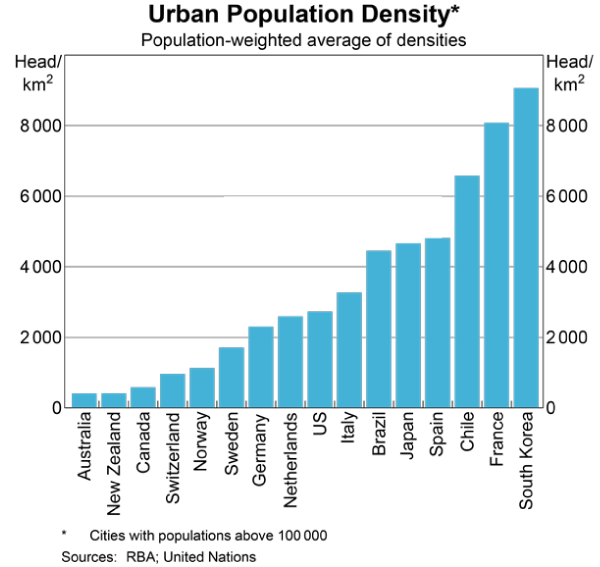
The head of the Financial Stability Department at the Reserve Bank of Australia, Luci Ellis, delivered an excellent speech last week on Space and Stability: Some reflections on the Housing-Finance System. In the speech she observed:

The cumulation of individual decisions and government policies over many years has given us comparatively low-density cities that create large price premiums for the most convenient districts in those cities.

Australia’s low urban population density is clearly seen in the chart above copied and pasted from Luci Ellis’s speech.

One relevant government policy is the protection of heritage houses, such as old Queenslanders. While the excessive protection of heritage houses has only occurred in the last few decades, and urban sprawl had commenced before the restrictions came into place, there is no doubt heritage protection now plays some role in constraining supply and raising prices in older suburbs. My friend and colleague Brad Rogers has previously written on this topic and has just posted a fuller exposition of his views:

House prices, Council monopoly and a historic village

I’m sure the RBA would welcome a relaxation of heritage protection by our Councils. As Luci Ellis noted:

I am hopeful that, over time, Australia’s urban structure can evolve to offer better choices and greater financial stability. This might require some changes to the way we plan, build, and live, as well as ongoing prudence in how we borrow.

Currently, heritage protection is a major impediment to the provision of better choices in our older suburbs.

Posted in Housing | Tagged , , , , , , | 6 Comments

QCA should investigate V8 Supercars funding in industry assistance review

The Townsville V8 Supercars event appears not to have delivered the huge visitor numbers and economic benefits that were once forecast by its organisers, given the announcement of a new joint marketing campaign with other V8 races. The Townsville Bulletin reports (V8 plan to draw tourists):

A UNIFIED Queensland marketing campaign could result in a boom of interstate spectators heading north to Townsville for the 500 V8 Supercars event in July.

The Queensland Government signed a three-year deal in 2013 to ensure the Townsville event, the Ipswich 360 and the Gold Coast 600 would all continue until 2016.

And all three Queensland V8 events will be marketed as a package for the first time this year in a bid to breathe new life into all three races…

…All three events have faced their own challenges in recent years, with Townsville posting its worst attendance in its five year existence in 2013. The Gold Coast lost the crowd-drawing Indy cars in 2008 and Ipswich recorded its lowest ever attendance following a crash into spectators during the Mini Challenge series at the 2010 V8 event.

Clearly the races have not achieved the stellar forecasts of visitor numbers and economic benefits that were once made. For example, in 2007, Townsville Enterprise Chair Geoff Plante said: “the Townsville V8 Supercars…will have a huge economic impact for the city bringing visitors in from around the country”, as reported in the Sydney Morning Herald. It now appears the race hasn’t had the huge economic benefit expected.

It is well known by economists that claims made about the economic benefits of major events – particularly regarding flow-on or multiplier benefits – rarely stack up, as posted on a couple of years ago by Mark Beath at Loose Change: Events extravaganza expose. For further discussion of the limitations of the typical claims about the benefits of major events, I’d recommend the excellent 2007 report from the Victorian Auditor-General’s Office State Investment in Major Events, which questioned the purported economic benefits of the Melbourne Grand Prix. A cost-benefit analysis undertaken for VAGO by Applied Economics found a net loss to the State from the 2005 Grand Prix of almost $7 million.

Given doubts about the economic merits of government support for major events, the Queensland Competition Authority should investigate Government support of V8 Supercars as part of its current review of industry assistance. It should push vigorously for the Queensland Government to reveal the full details of funding agreements for these races, to help determine if the claims of net benefits to the State are justified. Unfortunately the Government has been reluctant to disclose the level of funding – reported to be $7-8 million p.a. (see V8 Supercars secured until 2016)– due to commercial-in-confidence considerations.

Governments obviously worry that the public might question the scale of subsidies to commercial events, but they are also, somewhat justifiably, worried that if other States find out what they’re paying, the other States might out-bid them. Ironically, given that many major events are a net loss to the State holding them, it would be in the State’s best interest to be out-bid.

Posted in Gold Coast, Industry policy, Ipswich, Townsville | Tagged , , , , , , | 3 Comments

Calls for holistic tax and super reform at BDO Budget Breakfast

Accounting and professional services firm BDO has prepared an excellent guide to the 2014-15 Federal Budget Time to Pull on the Reins, which notes “The budget measures continue to tinker around the edges of real tax reform.” This was a major theme at BDO’s Budget Breakfast at the Brisbane Convention Centre which I attended yesterday morning. In answering a question about the GST I asked from the floor, BDO Tax partner and one of Australia’s leading taxation experts Mark Molesworth answered that GST exemptions (e.g. fresh food and some health and education items) should be examined as part of a holistic review of the tax system. I’ve previously commented that the GST base should be broadened (see Dr Parkinson right that the GST should be broadened). Of course, as noted by one panelist at the Breakfast yesterday, any changes to the GST would need to be accompanied by compensation to low-income earners to compensate for the GST’s regressive impact. 

In his presentation, Mark made several insightful points, including:

  • super contribution limits appear even less desirable now that there will be a large gap between the age you can access super and the pension age; and
  • the Government’s stated justification for trimming the R&D tax incentive (i.e. the company tax rate is being reduced as well) is inconsistent with the rationale for the current version of the R&D tax incentive, which was designed to deliver an incentive to companies that is independent of the rate of company tax. This is a pretty technical point, but demonstrates Treasury is struggling to maintain its corporate knowledge.

Well done to BDO for an excellent and informative Budget Breakfast, and thanks in particular to Paul Rafton for inviting me along.

As a final comment, I’d note that this has been an excellent year so far for business breakfasts in Brisbane. Indeed, next Monday morning, the Queensland branch of the Economic Society (of which I’m Deputy Secretary) is hosting the head of the RBA’s Economic Analysis Department Jonathan Kearns at a breakfast at the Polo Club where Jonathan will discuss Current Economic Conditions. It’s probably not too late to book a place if you get in touch with the Society today.

Posted in Tax | Tagged , , , , , | 7 Comments

PwC Breakfast on the Blackadder Budget – a cunning plan is afoot

At the PwC Federal Budget breakfast this morning at the Brisbane RNA Showgrounds convention centre, popular finance commentator Peter Switzer gave an entertaining and informative address on last night’s Federal Budget, which he labelled the Blackadder Budget, because a cunning plan is afoot. In Switzer’s view, it is a cunning plan that is designed to make Joe Hockey appear like a fiscal genius. Switzer was very persuasive in his view that the Budget forecasts on economic growth are conservative and the Government could actually achieve much better budget outcomes, including an earlier return to surplus. Let’s hope so.

Also notable were presentations by:

  • Queensland Treasurer Tim Nicholls, who wasn’t happy about the future reductions in health and education funding relative to the previous baselines, and noted he would take up the fight to Canberra for additional funding; and
  • former PM John Howard, who agreed with the PwC CEO and Tax Partner that Australia needs fundamental tax reform (e.g. raising more revenue from the GST), and who memorably noted that “context is everything” when explaining his decision in the early 2000s to remove fuel excise indexation, a decision reversed in last night’s budget (N.B. the context Howard was referring to was the Government having just implemented the GST and community concern that people were then being unfairly taxed at the bowser).

PwC has made the slides for its Budget Breakfast available on its website.

A big thank you to Denise Morton from Effective Governance for having invited me along to the breakfast.

Finally, 4BC today made my interview on the Federal Budget with Ben Davis from yesterday afternoon available on its website (you’ll have to scroll down the page a bit to find it, however):

Abbott Budget 2014

Posted in Budget | Tagged , , , , , , | 4 Comments

Good Budget strategy, but a mix of good and bad policy measures

I told Ben Davis on 4BC’s Drive program this afternoon that this would be the Federal Budget we needed to have – while we’re not facing an emergency/crisis, if we don’t repair the Budget now, we probably never will. The economy isn’t spectacular, but neither is it weak, and I asked, if we’re running an almost $50 billion deficit now, what would it be if we really faced a downturn?

My impression is that the Budget strategy is good, but there is a wide variance in the desirability of the budget measures contained in it.

The following measures, among others, are good policy:

  • tightening of eligibility for Family Tax Benefit B – reducing middle class welfare is a good objective;
  • fuel excise indexation – it should go up in line with inflation to maintain the Government’s real revenue from fuel excise;
  • $7 co-payment for GP visits – a good demand management measure which is really needed to constrain rapidly growing health care costs;
  • cuts to industry assistance/corporate welfare – Treasury’s Industry Policy Unit, in which I once worked, has had a big win here; and
  • deregulation of university fees – a brilliant move which will hopefully end the mediocrity that has been enforced upon our public universities by years of strong reliance on the Commonwealth.

The following measures, among others, are, alas, bad policy:

  • the inequitable and expensive Paid Parental Leave scheme – see my previous post ABC radio interview on the debt levy and paid parental leave; and
  • the temporary budget repair levy – this is mainly for the optics, so wealthy people are seen to be contributing to the budget repair task, and it doesn’t fix the structural deficit.

I’m also worried about the six month waiting period for NewStart for people under 30, which appears designed to encourage people into education and training but seems unduly harsh and runs the risk of encouraging a lot of dodgy training courses being funded to absorb all the young people who would otherwise be denied Government support.

I’m unsure what to think about the cuts to funding in the forward estimates to the States for the purposes of health and education. It could be a good move if it ends up forcing a re-think of the GST, particularly a broadening of the base (see Dr Parkinson right that the GST should be broadened), to raise revenue to make up the lost funding.

These are my initial reactions based largely on the Budget speech and I may reconsider them after a closer read of the Budget papers.

Posted in Budget | Tagged , | 7 Comments

Huge disparity in qualification levels across regions, even in SEQ – e.g. Bris West vs Ipswich & Logan

A new ABS publication, Perspectives on Regional Australia:  Changes in Regional Educational Attainment, reveals huge differences in the percentage of people aged 20-64 with post-school qualifications (Certificate III and above) across Australian regions (see map below based on 2011 Census data).

Australia_postschool

While South East Queensland appears fine, the low percentage of people in the rest of the State with post-school qualifications is possibly a concern, although it could just reflect the pattern of economic and employment opportunities. No doubt there is some brain drain of young people from the regions who obtain qualifications in SEQ and don’t return back home because opportunities are greater in SEQ or Sydney or Melbourne. Within SEQ, unsurprisingly qualification levels are highest in Brisbane’s inner city and western suburbs (see map below). I’ve previously posted on how West is best. Ipswich and Logan appear to be having some trouble in attracting or retaining highly skilled residents.

SEQ postschool


Posted in Brisbane, Education | Tagged , , , , , , | 4 Comments

Teenagers have had tough time in labour market since financial crisis

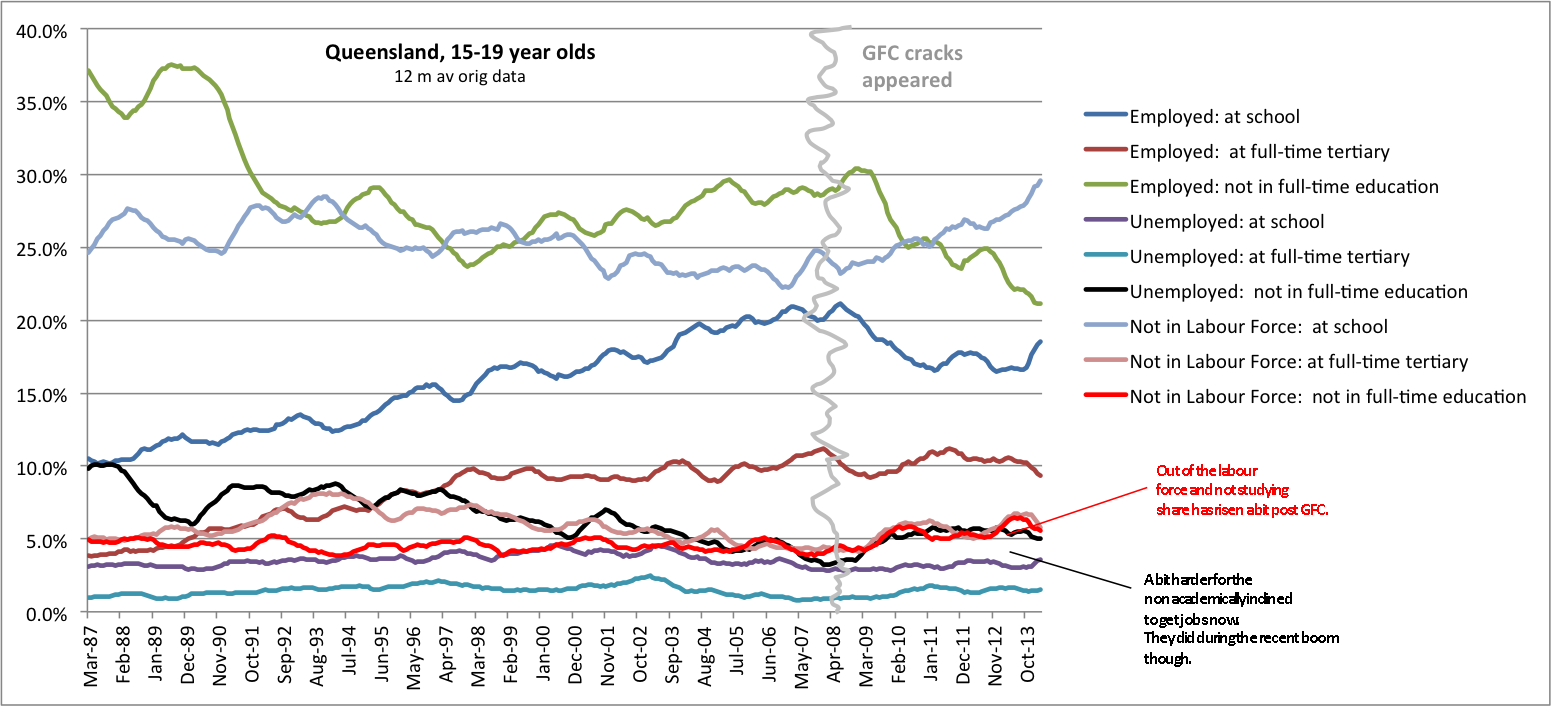
A creative reader and former colleague of mine, who goes by the nickname Toad, today sent me an interesting chart, presented below, that he has prepared on teenage labour force data for Queensland (you may need to open it in another window to read some of the text). It shows just how tough Queensland teenagers have been finding it in the labour market since the global financial crisis (GFC). Teenagers not in full-time education have been hit particularly hard, with a steep decline in the percentage employed. Also notable is a large increase in the percentage of teenagers at school who are not in the labour force – i.e. neither employed nor looking for work. Obviously, many teenagers have been discouraged by lacklustre labour market conditions in recent years.

youth

Posted in Labour market | Tagged , , , , , , | Leave a comment

Failure of Strong Choices now obvious – missed chance to persuade on asset sales

The Queensland Government should have directly made the case for asset sales, rather than hoping people would conclude they’re necessary after playing the choose-your-own-budget game on the Strong Choices website, a point I’ve made a few times over the last few weeks (see e.g. Brisbane Times article on asset sales). This must be all too obvious now to the Government which has received inconvenient results from the Strong Choices game, as reported by the Courier-Mail this morning:

Queenslanders would rather see taxes raised than assets sold to tackle state debt

The Treasurer, rightly, more-or-less responded that higher taxes are probably undesirable because they’d harm the State economy and hence aren’t really an option. This confirms the point I made to Steve Austin on 612 ABC Brisbane a few weeks back: Strong Choices is just a game. It’s no substitute for the real economic analysis that should be done around budget measures.

The Government needs to boot out whichever PR firm came up with the Strong Choices nonsense and bring in some serious economic advisers. It’s not too late to win the debate on asset sales, but the Government needs to start scoring points soon.

Regarding other news, on yesterday’s rather ambiguous labour force data for Queensland, Pete Faulkner has a good discussion of what the data mean (see Unspinning the QLD job numbers and Once again..strong jobs data; but QLD still lags). The Queensland economy still appears like it is struggling to recover, based on the labour market data. While employment is growing at a good pace, it isn’t growing fast enough to provide jobs for all the people now coming back into the labour market as conditions appear to be improving. Hence we’ve seen an increase in unemployment to 6.3% from 6.1% the previous month as the participation rate has risen. Finally, I’d note employers appear worried about the economic outlook, as reflected in the Pulse Business Survey results released Wednesday by CCIQ (see Pulse Survey points to downturn in business confidence).

Posted in Budget, Labour market | Tagged , , , , , , , , | 6 Comments

Recent vacancies data suggest we shouldn’t get too excited about jobs market just yet

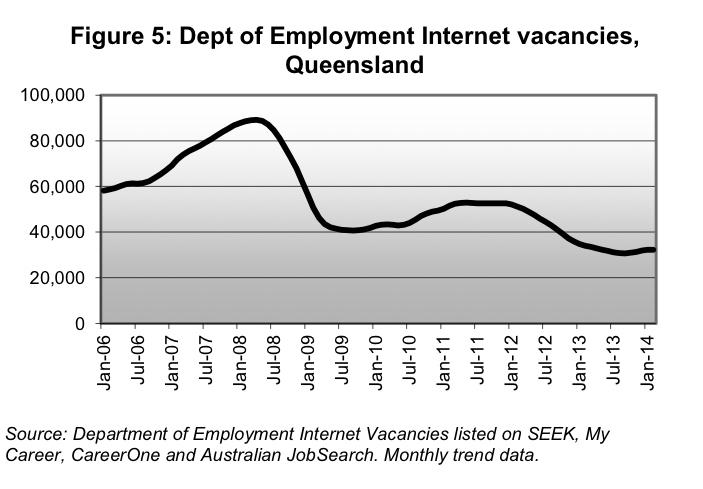
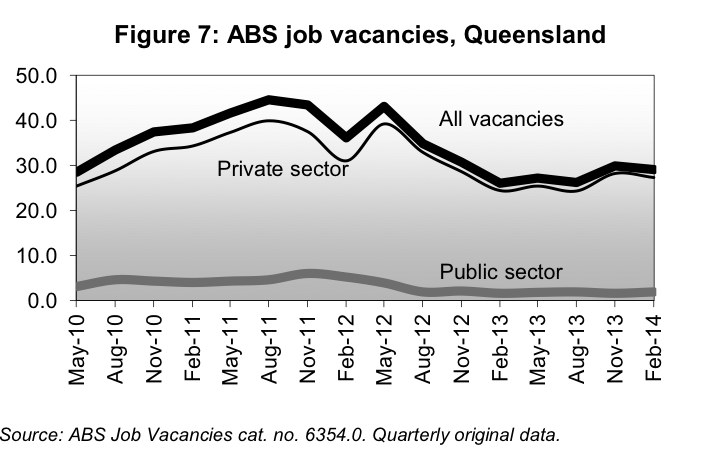
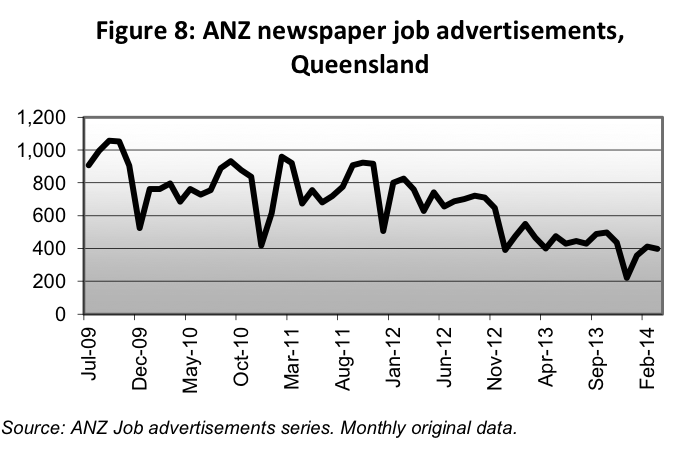
Tomorrow’s release of April labour force data from the ABS will hopefully confirm a recovery in the job market in Queensland, continuing the positive trend from last month (see my post from last month: Qld unemployment rate falls slightly to 6.1% – rising participation a good sign). But data on job vacancies presented in the Queensland Training Department’s latest quarterly Labour Market and Training Review suggest any recovery may be slow, given vacancies remain at low levels and aren’t surging back (see the charts I’ve copied from the Review and pasted below). Another reason not to get too excited about the labour market just yet is the Federal Employment Department’s leading indicator of employment, which has declined for the seventh consecutive month, as reported by MacroBusiness today (DEEWR leading jobs index falls again).

internetvac

absvac

anzvac

The Training Department’s Labour Market and Training Review contains a useful collection of labour market data, but I’d really like to see the Department’s considered assessment of the current state of the labour market and the short-term outlook. Currently, the Review is full of labour market facts, but it could do with more analysis and interpretation. That said, I’m really glad to see the Department has re-commenced producing this Review, as a number of the charts and tables are very interesting and informative.

Posted in Labour market | Tagged , , , , , , | Leave a comment