Uber confusion – Premier was right to back Uber and support deregulated taxi industry

I’m a bit confused about the Queensland Government’s position on the Uber ridesharing service, which has the potential to massively disrupt the highly regulated taxi industry. Taxi industry regulations, particularly the restricted number of licences, result in economic rents (i.e. super profits) for licence owners. It appeared that earlier today the Premier supported Uber users competing with the taxi industry, but a later news report clarified that Uber users would still need to comply with taxi regulations (i.e. they’d need to buy an expensive licence) if they’re to compete with taxis. AAP reports (Qld cracks down on Uber taxi service):

Transport Minister Scott Emerson says the company needs to meet existing taxi service laws, such as driver accreditation and vehicle standards.

“The department is working with Uber to outline what safety regulations it needs to meet in order to operate in Queensland, including driver authorisation, which includes detailed criminal history checks, vehicle standards and taxi licences,” he said.

Premier Campbell Newman expressed concern that the service might not be as safe as traditional taxis, and said he wouldn’t want his daughters to use it…

…Mr Newman had earlier said the government didn’t believe in red tape and regulation unless it was absolutely necessary, but later updated his advice following advice from Mr Emerson’s office.

Taxi Council Queensland CEO Benjamin Wash said it was only fair Uber complied with existing regulation.

The Taxi Council CEO is protecting the economic rents accruing to his members. The current regime of taxi regulation is blatant industry protection, and the Queensland Competition Authority should investigate it as part of its current industry assistance review.

My friend and colleague Brad Rogers has written a great piece pushing for taxi industry deregulation:

Queensland taxi licences and drunken violence

I’ve also commented on the desirability of deregulation:

Reduce youth unemployment through improved regulation – e.g. of penalty rates, taxis
Posted in Industry policy, Transport | Tagged , , , , , , , | 1 Comment

Qld Budget needs to reflect challenging conditions – asset sales good option to cut debt

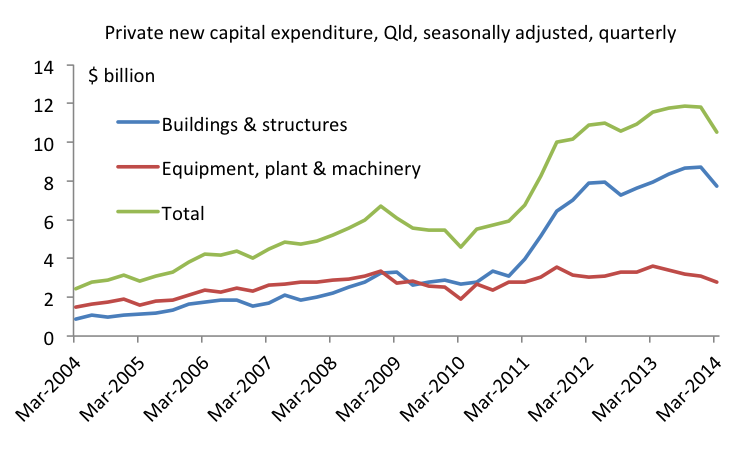
The March quarter private capital spending figures released today by the ABS confirm that Treasury was right to make conservative, sub-par growth forecasts in developing the Federal Budget. Queensland Treasury will have to do the same in the Queensland Budget, which is being released next Tuesday 4 June. The economy will clearly be impacted by declining private capital spending, which fell 11.1% in the State in the March quarter – compared with a fall of 4.2% nationally – largely related to declining mining sector investment (see chart below). The Queensland Budget delivered next Tuesday will have been developed in a challenging environment, and hence it’s even more important to rely on asset sales to pay down debt, rather than cutting spending or raising taxes, which would adversely impact an already sub-par economy. We will need to wait and see whether the recovery in non-mining building activity reported yesterday will be sufficient to offset the contractionary effect coming from the decline in mining investment.

capexFor other coverage of today’s capital expenditure figures, see:

CAPEX falls again but it’s not all bad

Actual capital expenditures fall sharply on mining


Posted in Budget, Macroeconomy, Mining | Tagged , , , , , , , , , , , , , , | Leave a comment

Qld residential building recovery due to new apartments and townhouses

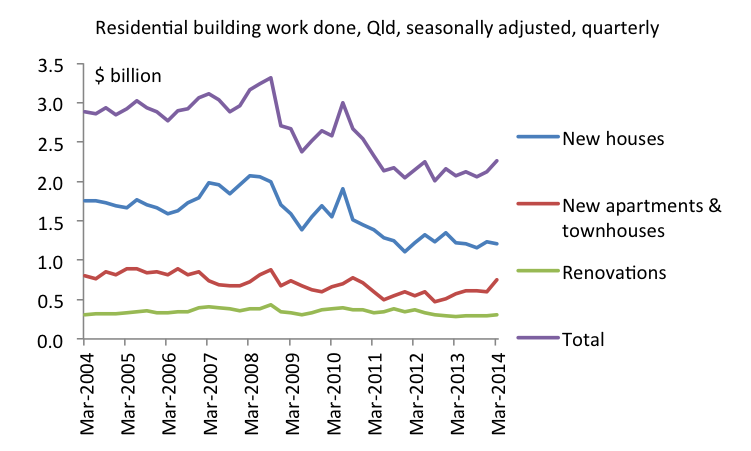
After the bad news about the recent slump in consumer confidence – which hopefully is just a short-term post-budget reaction – it’s good to see a recovery in residential building, which the Treasury and RBA are hoping will help drive the economy as mining investment declines. The pick up in building approvals since last year (see Good news for Qld building industry as new apartment approvals surge) has translated into continued growth in building work done, particularly of new apartments and townhouses, in the March quarter (see chart below). This confirms anecdotal reports I’ve heard from people in the residential building industry that business is improving markedly. This is great news for the outlook for the Queensland economy, given the building industry is such a large employer and a bit of a bellwether for the state of the economy.

buildingworkdone

For additional coverage, see MacroBusiness’s article Housing drives construction rebound. MacroBusiness notes that total construction activity, which also includes heavy engineering and non-residential construction activity, fell in Queensland in the March quarter and that this “may be related to the three large Gladstone LNG projects, which are nearing the final stages of construction.” 

Posted in Housing | Tagged , , , , , | Leave a comment

Trams unlikely to be cost-effective – buses generally much cheaper

This morning on 612 ABC Brisbane, Steve Austin interviewed Queensland Tourism Industry Council CEO Daniel Gschwind, who would like to see trams return to the streets of Brisbane (Should trams return to Brisbane?). Mr Gschwind was honest enough to admit it’s a thought bubble and I suspect he’d realise it wouldn’t be sensible if he was shown cost comparisons for trams and buses.

Busways are generally much cheaper to build than tramways/light railways. For example, see the interesting chart below I’ve copied and pasted from a presentation (Merits of light rail versus bus) at a Canberra transport conference by Monash Professor Graham Currie (N.B. BRT stands for Bus Rapid Transit and HOV stands for high occupancy vehicle). 

capitalcostThat’s a large difference in capital costs between light rail and busways. While operating costs per person moved can be lower for trams/light rail compared with buses on busy corridors (see p. 46 of Affordable Mass Transit Guidance), you’d want to be very confident a tram system would be well patronised before committing to it. You’d want to crunch the numbers for a range of demand scenarios – including a low passenger numbers scenario – to check if any savings in operating costs are sufficient to pay for the large up-front capital expenditure that would be needed to build the tram system. My guess is that, for the case of Brisbane, it wouldn’t be.

It’s important to remember that Clem Jones replaced the trams with buses in the late 1960s even though the tramways were already in place – i.e. the expensive capital investment had already been made and was a “sunk cost.” The operating and maintenance costs of the trams were obviously signficantly higher than those associated with buses from the Council’s perspective. Given Brisbane still has a relatively low urban density, I doubt trams would be economically viable for Brisbane, particularly once the capital expenditure to re-establish the tramways is taken into account.

A big hat tip to my friend and colleague Brad Rogers, who first alerted me to what cost comparisons between light rail and buses typically show. Brad blogs at BJREconomics


Posted in Transport | Tagged , , , , , | Leave a comment

How Seqwater learned to stop worrying and love Ipswich

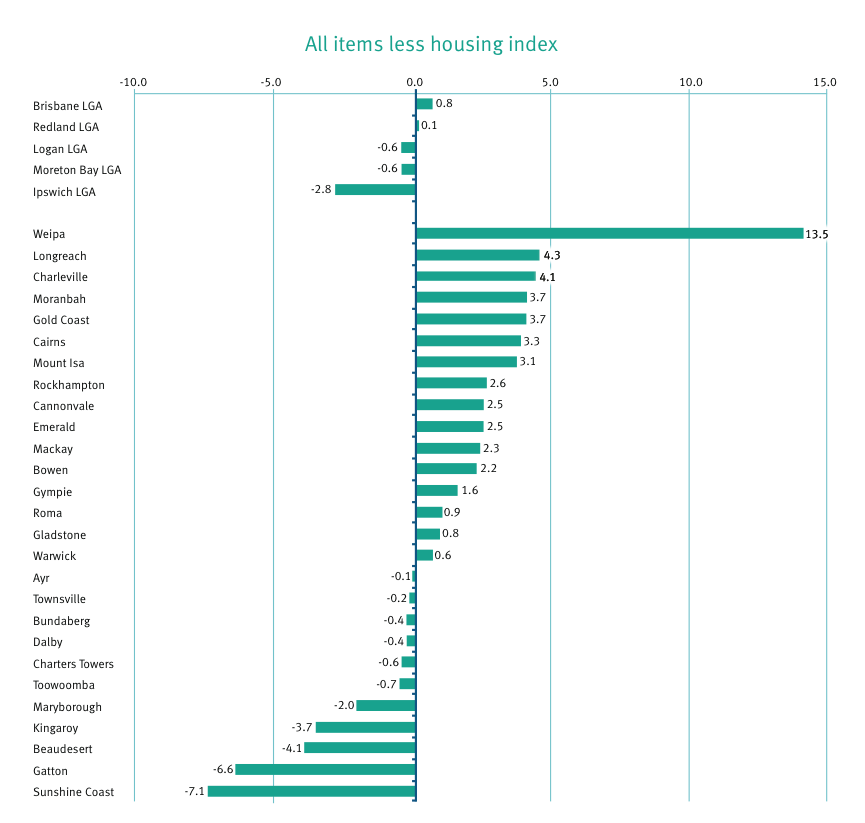
Despite initial fears about their relocation to Ipswich, it appears many staff of Seqwater, which runs South-East Queensland’s dams such as Wivenhoe and Somerset, have come to embrace the city. The local paper, the Queensland Times, which of course may show some bias toward its home town, has just run a story about how great things are for the relocated public servants (Workers enjoying the ‘Switch). Seqwater workers will certainly benefit from lower retail prices, particularly for food items, in Ipswich compared with Brisbane, as a recent Queensland Government Statistician report Prices across Queensland shows (see the chart I’ve copied and pasted below, which shows the percentage deviation from average Brisbane metro retail prices in each local government area). And the local community is benefitting, too. For example, Seqwater workers, who apparently enjoy their coffee, have signficantly boosted turnover at local cafes (Coffee gives workers and CBD financial hit).

pricesI still question whether relocating public servants to the region is a good idea. I’ve previously commented on this issue:

Move public servants to regions only if cost-effective

Whether it was a sensible move or not, Seqwater is now at home in Ipswich and has added to the momentum of a region that is growing strongly, as I’ve previously posted on:

Coles backs Ipswich – good investment given strong population growth


Posted in Ipswich, Retail trade | Tagged , , , , , , , , | 2 Comments

Dogs in cafes debate highlights over-regulation by local governments

Australians generally have much more conservative attitudes to pets in public places than people in other countries. I remember vividly one bus trip in Prague in the late nineties when I was the subject of a lot of attention from two playful German Shepherds, appropriately muzzled, luckily. We generally don’t allow dogs and other pets on public transport or at cafes or restaurants in Australia, arguably due to concerns about public health and safety. But attitudes are changing, with many people now seeing their pets almost as substitute children, and Government regulation has changed as well, with the Queensland Government now allowing pets in outdoor eating areas. This has prompted local governments to reconsider their own regulations, as ultimately they have final say over the rules. The Sunshine Coast Daily reported yesterday (Have your say on a bone of contention):

DOGGIE do, or doggie don’t?

That is the question on everyone’s lips as Sunshine Coast Council reaches out for community feedback on a proposed law to allow dogs in eating establishments.

Council officers will start visiting restaurants and cafes across the Coast to help owners understand the new proposed laws to allow dogs in outdoor dining areas.

The council is looking to change the local law to mirror the Queensland Government’s Food Act 2006 and allow dogs in designated outdoor dining areas where permitted by the business owner.

This strikes me as a clear case of over-regulation with two levels of Government involved in setting rules on the simple question of whether pets should be allowed in cafes and restaurants. The Queensland Government law appears reasonably clear – it makes a lot of sense for the business owner to decide – so I can’t really understand why local governments then have to impose their own by-law. If people are worried about pets going to cafes, I’m sure they’ll be able to find a cafe somewhere nearby that doesn’t allow pets.

There is potentially a great deal of silly regulation at the local government level that is constraining businesses and should be removed. Indeed, the Queensland Competition Authority recommended last year, in it Final Report on Reducing the Burden of Regulation, that “the OBPR [Office of Best Practice Regulation] prepare a separate paper, in conjunction with the Department of Local Government, regarding local government red tape reduction.”  This was supposed to be prepared to inform planned Government consultations with local governments in late 2013. I can’t find a copy of this recommended paper on the QCA website so I’m unclear if it was followed through with. If it wasn’t, it should be prepared as a matter of priority, as I suspect there are many silly local government regulations burdening Queensland businesses and consumers.

Posted in Retail trade | Tagged , , , , , , , , , , , | 6 Comments

Coles backs Ipswich – good investment given strong population growth

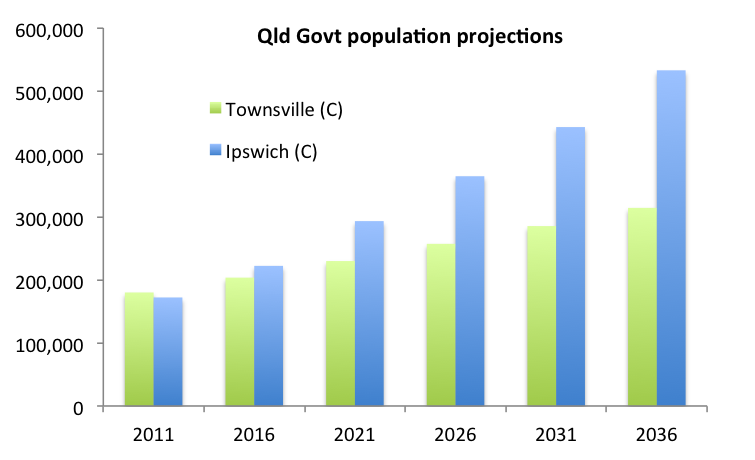
Coles has announced it is building three new stores in Ipswich, obviously recognising the strong current and projected population growth in the region (Coles project to bring new stores and 700 jobs to Ipswich). While Ipswich is currently around the same population as Townsville (172,000 vs 180,000), for example, it is expected to rapidly surpass Townsville in the coming years, growing to over half a million people by 2036 (see chart below).

populationI’ve previously commented on the strong growth potential in Ipswich (Ipswich will play important role in eventual recovery of Qld building industry) and was interviewed by Katherine Feeney, then at Brisbane Times, on the issue last year:

Ipswich key to Queensland’s building sector recovery

Posted in Ipswich | Tagged , , , | 4 Comments

TAFEs cutting costs as training market gets much more competitive

It’s good to see that Queensland TAFEs are preparing for the more competitive training market expected in the next few years and are considering cutting courses that are not economically viable. For example, as reported on in the Fraser Coast Chronicle yesterday, TAFE’s Hervey Bay Arts Department is under review. And, as I noted in a post from earlier this year (Further TAFE job cuts likely in new contestable training market), a number of TAFEs have already started cutting costs through redundancies.

The next few years will be tough for TAFE colleges across Queensland as the training market is opened up further to private providers such as Sarina Russo under the Government’s Great Skills Real Opportunities reforms. If the Victorian experience is any guide, there will be a huge shift to private training providers as the market is made more contestable, as shown in a recent NCVER paper: Early impacts of the Victorian Training Guarantee on VET enrolments and graduate outcomes. There will be big opportunities to make money for anyone with a training background who has the patience to deal with the bureaucratic requirements for setting up a registered training organisation. Of course, there will also be big opportunities for rorting by offering low-cost, low-value training courses which the Government will have to be on the lookout for.

I expect training reforms will be a major topic of discussion at the upcoming NCVER National Vocational Education and Training Research Conference in July in Melbourne. I’m currently scheduled to present a paper on setting public subsidies for VET courses on the morning of Thursday, 10 July. Anyone with an interest in VET policy should think about attending the conference, which is usually very informative and a good opportunity to meet prominent people in the VET sector.


Posted in Education | Tagged , , , , , , , | 2 Comments

Consumers and businesses lacking confidence – growth may be even more sub-par

Yesterday’s ANZ-Roy Morgan Consumer Confidence figures show a slump in consumer sentiment, possibly caused by last week’s Federal Budget (see MacroBusiness’s story The epic crash in consumer confidence). The ANZ-Roy Morgan media release notes:

ANZ-Roy Morgan Consumer Confidence fell a further 3.2% to 100.4 in the week ending 18 May, after the 2014-15 Commonwealth Budget was handed down. Consumer confidence began weakening noticeably four weeks ago when some significant policies were leaked ahead of the Federal Budget’s release and is down a sharp 14% since then; the sharpest decline over a four week period since the series became weekly in October 2008.

This means both consumers and businesses are worried about the state of the economy, as we know from the CCIQ-Pulse survey that business confidence has deteriorated both in Queensland and nationally (see Pulse survey points to downturn in business confidence).

This deterioration in consumer and business confidence could just be an over-reaction to the Federal Budget and I don’t think there’s any point worrying too much about it yet. Consumer confidence is still above the depths it reached during the financial crisis in 2008-09, and is far above the level experienced in the early nineties recession. I’d wait a month or two and see whether consumer and business confidence bounce strongly back as consumers and businesses realise the Budget really won’t kill the economy.

Also, I’d note that consumer confidence appears pretty volatile and would only have a weak correlation with economic activity. Consumer confidence will certainly fluctuate a lot more than actual consumer spending will, because a large part of consumer spending is on items such as basic groceries that will be consumed almost regardless of consumer confidence.

International evidence appears to support the view that consumer confidence is not a great indicator of future activity. A 1996 OECD Working Paper Confidence indicators and their relationship to changes in economic activity concluded:

…consumer confidence indicators are much less useful than business confidence indicators for economic analysis due to their much looser relationship with output movements.

That said, there is some Australian evidence that consumer confidence significantly affects the housing sector, particularly house prices and sales volumes (see MacroBusiness’s story: RP Data: Confidence and house prices). This is somewhat concerning given that the RBA and Treasury are ultimately hoping a strong rebound in housing construction will offset the decline in mining investment and weak public demand (i.e. government spending) growth. If consumers become reluctant to purchase new dwellings or to renovate, then housing construction may not be the economic saviour it is expected to be.

Overall, while I think there’s no point being too pessimistic yet, the consumer confidence figures suggest the Treasury and RBA are right to expect below trend (i.e. below 3%) growth, and there are significant risks on the downside.

Posted in Macroeconomy | Tagged , , , , , , | Leave a comment

Sub-par growth to continue as mining investment falls and govts restrain spending

The Reserve Bank of Australia’s Head of Economic Analysis, Dr Jonathan Kearns, gave an informative presentation this morning on current economic conditions at an Economic Society of Australia (Qld branch) breakfast at the Brisbane Polo Club. The outlook for at least the next twelve months is for below-trend (i.e. less than 3%) economic growth to continue. Unemployment is likely to (slowly) drift upward while growth remains sub-par. Jonathan’s presentation was based on the RBA’s latest Statement on Monetary Policy. Key points from Jonathan’s presentation that I jotted down include the following.

  • Mining is starting to subtract from growth through the decline in capital investment, though this is offset somewhat by mining exports picking up.
  • The other major issue for the economy is that public demand (i.e. government spending) growth is very weak – the weakest period of growth in fifty years – and is expected to remain weak over the next couple of years.
  • The combination of declining mining investment and weak public demand growth will lead to below average growth in GDP (below 3%) in the next couple of years.
  • But highly stimulatory monetary policy (lowest cash rate ever) should boost the economy in other sectors, particularly housing.
  • The growth of our major trading partners is expected to remain around the long-term average over the next few years, meaning we don’t have to fear a decline in exports.
  • While services and manufacturing exports have been going nowhere recently, there are some signs of improvement in education and tourism exports.
  • There have been improvements in forward indicators – e.g. job ads, which have picked up but remain at low levels. Hence any employment growth will be moderate.
  • Because of higher unemployment, wages growth is down – 1% below average – which should result in lower inflation.
  • We should see economic growth picking up in late 2015 and into 2016.
  • Inflation is expected to remain within the target range (2-3%) over the next couple of years.


Posted in Macroeconomy | Tagged , , , , , , | Leave a comment