Neither party gets a high distinction in fiscal policy

In their proposed fiscal strategies, neither the Government nor the Opposition gets a high distinction. The Government gets marked down because it is not allocating all asset lease proceeds to reducing debt and (thus) interest payments, which means there is an adverse impact on the Budget in the order of $1 billion per annum in the next few years, according to John Quiggin’s estimates. And the Opposition gets marked down because it has committed to a very slow path of debt reduction that is unlikely to restore our AAA credit rating. Also, there are no details yet of how it intends to maintain the tight expenditure control implied by its planned debt reduction, which largely occurs beyond 2017-18 (the final year of the State Budget forward estimates).

The Government is right to prioritise reducing the $80 billion debt and getting our AAA credit rating back. Leasing out assets is a good way to do this, and will yield wider benefits, such as more efficiently run assets, lower power prices than otherwise, and less risk on the Government’s balance sheet. However, the Government has potentially opened up a hole in the Budget by using some of the lease proceeds for infrastructure that will not directly return money to the Budget, as pointed out by John Quiggin earlier in the week. Initially, I was sceptical of John’s estimates, but after an explanatory comment from John on my Monday post Better off allocating all lease proceeds to debt reduction, I now mostly accept his estimates. I would note, however, that John has not included the potential budgetary benefits of getting our AAA credit rating back, which would reduce but not eliminate the budgetary loss John has estimated.

The Opposition’s fiscal strategy is not great either. It is proposing a very slow path of debt repayment that offers little hope of getting our AAA credit rating back over the next decade. It also has yet to provide full details of its future expenditure and revenue raising plans, meaning it is open to criticism from the Government that it has a hole in its budget estimates—the $1.3 billion black hole referred to on the front page of today’s Courier-Mail. This is a bit of a beat up, but the Opposition left itself open to it. Technically, the Opposition didn’t propose allocating money to debt reduction that was already allocated to funding services, because it wasn’t earmarking income from Government-owned businesses to debt reduction until 2018-19 – i.e. outside of the forward estimate years for which the State Budget currently plans (2014-15 to 2017-18). However, it is not yet clear how it will fund debt reduction of the proposed scale from 2018-19.

The Opposition is essentially committing itself to very tightly managing government expenditure, which I think is commendable, but won’t be popular with Labor voters. As I mentioned to Ben Davis on 4BC on Friday afternoon, the Debt Reduction Trust is a gimmick. To pay back debt, the Opposition, if it wins government, would still have to do the hard work of creating surpluses, by keeping expenditures below revenues. Treasurer Tim Nicholls was correct to point out the Opposition’s plan to earmark money from the earnings of government-owned businesses doesn’t create any new money.

That said, the Treasurer is still vulnerable to the Quiggin critique—that the Government has its own $1-2 billion budget hole, largely created by allocating lease proceeds not to debt reduction, but to non-commercial infrastructure investments and its cost of living fund. Frankly, much of the money not allocated to debt reduction is simply being allocated to chasing votes in marginal seats—for example, the Government’s $150 million commitment to the Townsville Super Stadium, to which, alas, the Opposition has also committed money.

My regular reader Jim nicely summed up the problem with the Townsville Super Stadium in a brilliant comment on the post I referred to above last week:

The white elephant for today is $150 million for a new stadium in Townsville (subject to privatisation of course). The existing stadium has a capacity of about 27,000 and is rarely full even when the NQ Cowboys make the finals. OK. The existing stadium doesn’t have a roof. But the use of the stadium is almost exclusively in the dry season anyway. There is no way in the world that this project stacks up.

The ALP have also promised $100 million for this white elephant. Townsville needs a new mega-stadium like a hole in the head. I’m sure there are other infrastructure projects and services that would provide a much greater benefit to the region.

This demonstrates poor economic thinking by both parties. We deserve better.

Absolutely, Jim. Neither major party is covering itself in economic glory.

Posted in Budget | Tagged , | 2 Comments

Economic Policy Issues in the 2015 Qld Election – Griffith-ESA Qld event on 28 January

I’m looking forward to participating in an upcoming panel discussion on Economic Policy Issues in the 2015 Queensland Election, to be held on Wednesday, 28 January at 6.30pm at Griffith University’s Southbank campus. I’m certain Professors Fabrizio Carmignani and Tony Makin and I will have plenty to discuss, given the huge debate over the Government’s plan to lease assets, and I expect Dr Alex Robson will live up to the claim of him being “chief provocateur”. The Griffith Economic Policy Analysis Program (EPAP) event is being supported by the Economic Society of Australia’s Queensland branch, of which I’m Deputy Secretary. You can find further details at the ESA Qld website and on Griffith’s flyer for the event. Please come along if you’re in Brisbane and available that night.

Posted in Budget, Macroeconomy, Queensland Government | Tagged , , , , , , , , | 2 Comments

Qld Govt benefits from volatile jobs data – still vulnerable over bulk of jobs growth being part-time over first term

The volatile labour force data yielded a nice surprise for the Queensland Government today, with the seasonally adjusted rate falling from 6.8% to 6.1% between November and December last year, and the trend rate falling marginally, too, though staying the same rounded to one decimal place at 6.6% (see chart below).

urate_Dec14

While today’s numbers are good news for the Government, it is still vulnerable to the criticism that the growth in employment during its first term was all part-time, and full-time employment (in trend terms) appears to have fallen (see chart below). While the seasonally adjusted data showed an unbelievably large growth in full-time employment in December, the seasonally adjusted data nonetheless showed the bulk of jobs growth over the Government’s first term was part-time – around 6,000 additional full-time jobs and 52,000 additional part-time jobs since March 2012.

Change_since_election_chart_Dec14

Pete Faulkner has a very good post on the surprising labour force data:

Very strong labour force data; Qld too good to be true?

Posted in Labour market | Tagged , , , , , , , | 4 Comments

New jobs figures will be important to election debate

Today the ABS will release its December 2014 labour force estimates of employment and unemployment and the figures will be important to the ongoing election debate about employment. At 6.9%, Queensland’s unemployment rate is significantly higher than the rate of 5.5% when the Government was elected. The Government will be hoping that the slight fall that was seen in Queensland’s seasonally adjusted unemployment rate in November continues, and wasn’t just noise in the data, and that there is meaningful employment growth. As I’ve noted in previous posts, due to factors largely out of the Government’s control, employment growth has been weak over the term of the current Government, and there has been a loss of full-time jobs according to ABS statistics. For example, see:

Employment and unemployment can both increase because labour force grows with population

Qld Govt’s new jobs target much more achievable than previous 4% unemployment rate target

The November job vacancies data released by the ABS yesterday provide a glimmer of hope for the Government, with vacancies having increased nearly 5% between August and November, although they still remain below levels of a few years ago (see chart below).

vacancies_Nov14

Posted in Uncategorized | Leave a comment

ABC radio interview on outlook for Qld economy

Steve Austin from 612 ABC Brisbane interviewed me yesterday morning regarding the economic outlook, and I gave my current view that the economy is relatively weak at the moment, but there are reasons for optimism for later in the year (e.g. due to the lower Australian dollar, low interest rates and expected infrastructure spending):

Finance with Gene Tunny

In his interview with Treasurer Tim Nicholls this morning, Steve recalled one of the points I made yesterday morning about the royalties associated with each boat full of LNG leaving Gladstone harbour, and he asked the Treasurer if it’s about $1 million per boat, which is what I heard from an informed source but unfortunately can’t verify. The Treasurer noted that it won’t be a certain amount per boat because it will depend on the value of the gas coming out of the wellhead – i.e. the royalty is paid when it’s extracted from the ground rather than shipped on the boat. That’s correct, but a rough estimate of royalties associated with each LNG tanker leaving Gladstone harbour would be one of those interesting facts the Treasury should be able to estimate pretty easily.

Posted in Macroeconomy, Mining | Tagged , , , , , , , , | Leave a comment

Better off allocating all lease proceeds to debt reduction

John Quiggin’s interesting new paper on the budgetary impact of asset leases, reported in the Brisbane Times today (Strong Choices will have ‘adverse impact’), correctly points out the adverse budgetary impact of the Queensland Government allocating around one-third of asset lease proceeds to infrastructure projects and the Cost of Living Fund. It means the Government doesn’t receive the interest savings it would from an equivalent amount of repaid debt – interest savings it could have used to partly offset the loss of forgone dividend (and tax equivalent) payments from government-owned businesses whose assets are leased out. For this reason, and because I also want to maximise our chances of regaining our AAA credit rating, I would use all the lease proceeds to pay down debt, as I’ve noted in previous posts (e.g. Reforming solar cross-subsidy is good policy, but unclear why $3.4 billion should be locked up in Cost of Living Fund).

While I agree with several of the points Professor Quiggin makes in his new paper, I have a couple of criticisms.

First, I don’t agree that interest savings from the repaid debt of government-owned corporations should be excluded from the analysis (see p. 6 of Professor Quiggin’s paper), because ultimately that debt is owed by the Government and thus taxpayers, who will benefit if the debt is repaid. By excluding these savings, the paper over-estimates the negative impact of the proposed asset leases (and uses of the proceeds) on the State’s finances.

Second, the paper focuses too much on the budgetary impacts of asset leases to the neglect of productivity and efficiency impacts-i.e. whether the assets would be more efficiently run by the private sector, which I suspect they would be (see my previous post Productivity and Privatisation). A comprehensive cost-benefit analysis of asset leases would consider the full range of economic impacts, and would look further than the budgetary impacts. For example, lower costs of electricity supply (and hence lower electricity prices) under private management than would otherwise occur may be important benefits flowing from asset leases that would need to be considered in a cost-benefit analysis.

Posted in Budget, Infrastructure, Queensland Government | Tagged , , , , , , | 10 Comments

Qld Govt’s new jobs target much more achievable than previous 4% unemployment rate target

The Premier today announced a relatively conservative employment growth target of 209,000 new jobs over six years, which he based on Treasury advice (see LNP unveils plan for the Jobs of Tomorrow). So long as the economy doesn’t remain in its current weak state for the next six years – an unlikely prospect – this target should be achievable. In six-year periods in the past, the Queensland economy has generated many more than 209,000 jobs (see the chart below).

Six_years_employment_growth

The new jobs target requires just under 35,000 new jobs each year and an employment growth rate of 1.4-1.5% per annum, on average. Current Queensland Treasury forecasts and projections have employment growing at 1.5% in 2014-15, 1.75% in 2015-16, and at 2.5% per annum beyond that, so the Government’s commitment appears slightly more conservative than Treasury forecasts would suggest it needs to be. Of course, with uncertainty over the economic outlook and the ageing of the population, which will gradually reduce economic and employment growth rates, it’s good to be conservative in projecting future employment growth.

The new jobs target is much more sensible and achievable than the previous 4% unemployment rate target, which I’ve previously commented on:

4% unemployment rate target looking much less achievable now

ABC radio interview on unemployment, the 4% target and the four pillars plan

Posted in Labour market, Macroeconomy | Tagged , , , , , | 5 Comments

Retail turnover has been declining in real terms in Qld, possibly due to lack of fulfilment centres

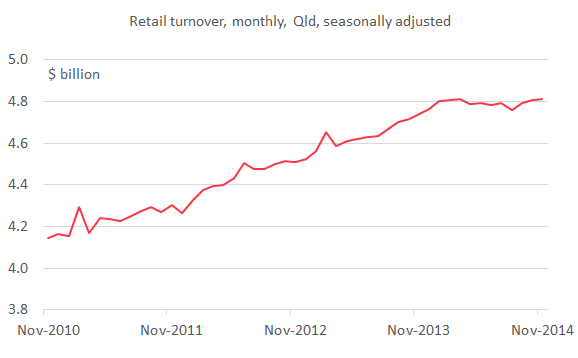
ABS data released Friday confirmed that Queensland’s retail trade sector remained relatively weak in the lead up to the Christmas period, with nominal retail turnover only increasing slightly by o.1 per cent in November (see chart below).

Retail_turnover_monthly_Nov14

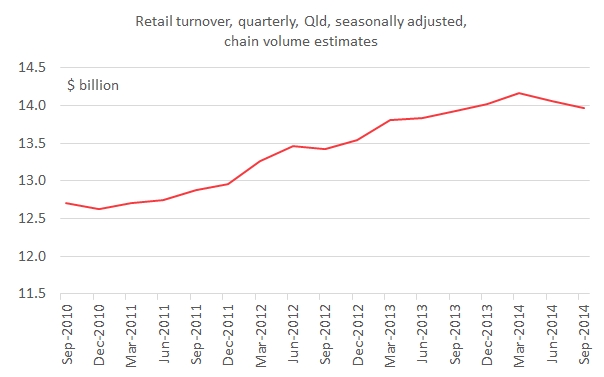
Recent weak results in nominal turnover mean that it’s unlikely that the recent decline in real retail turnover (i.e. after removing the impact of inflation) will be dramatically reversed in the near future. As Pete Faulkner has noted at his Conus blog, retail turnover has been falling in real terms in Queensland (see chart below).

retail_turnover_quarterly_Sep14

We still don’t have official data on December sales, but I doubt December sales would do much to turn this around (particularly when you consider the figures in the chart above are seasonally adjusted). Ultimately, population and economic growth should push real retail turnover back upwards, but the shift to online sales will no doubt continue to have an adverse impact on real retail turnover recorded in Queensland.

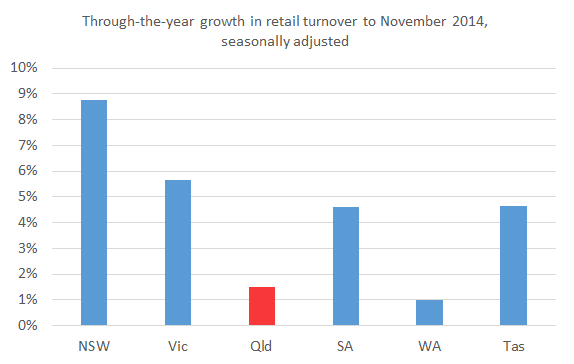
NSW and Victoria don’t appear to have been as adversely affected by the growth of online retailing as Queensland (see chart below). This is possibly because the distribution centres (a.k.a. fulfilment centres) for Australian retailers with an online presence (e.g. David Jones, Myer) are typically located in Sydney or Melbourne. While international online sales aren’t recorded by the ABS, domestic online sales are, and I suspect the ABS is recording these sales as occurring in the State where the relevant fulfilment centre is, which makes sense because that is where the jobs will be located. If this is the case, then online sales for David Jones and Myer, for example, improve retail turnover in NSW and Victoria, but not for Queensland (any may actually subtract from turnover in Queensland if these goods would otherwise have been purchased in a bricks-and-mortar store in Queensland).

Interstate_comparison_retail_turnover_Nov14

As ABS experimental estimates reported in its latest retail trade publication show, domestic online sales in Australia are becoming increasingly important, having grown from $417 million in the month of March 2013 to $745 million in the month of November 2014.

Posted in Retail trade | Tagged , , , , , , , , , , | 2 Comments

Up-tick in Queensland building approvals, while Victoria surges

Building_approvals_Nov14

There was a welcome 5.6% increase in building approvals in November last year according to ABS data released yesterday (see chart above), largely due to approvals of new apartments and townhouses. Of course, the volatility of approvals from month-to-month means that this gain could be wiped out in the December data, and also approvals still remain below pre-financial crisis highs.

Finally, yesterday’s data confirm there is something pretty extraordinary going on in Victoria, which Queensland policy advisers should investigate. In part, the surge in Victorian building approvals at the end of 2014 may be due to the introduction of changes to residential zones in Victoria, which were designed to give greater protection to heritage and character housing. It’s possible there was a surge in development applications earlier in the year, before the reforms were introduced, and these applications have just been approved. So we’ll have to wait and see if there’s a correction in Victoria in coming months. In any case, Victoria deserves close attention from Queensland policy advisers because, as I’ve noted before, one of the reasons interstate migration and population growth have fallen in Queensland is because we are no longer attracting people (in net terms) from Victoria. Victoria has obviously done something right to improve the livability of the State and the economic opportunities available.

See my previous post:

Victoria beating Qld in budget management and other policy areas

Posted in Housing, Macroeconomy | Tagged , , , , | 2 Comments

Employment and unemployment can both increase because labour force grows with population

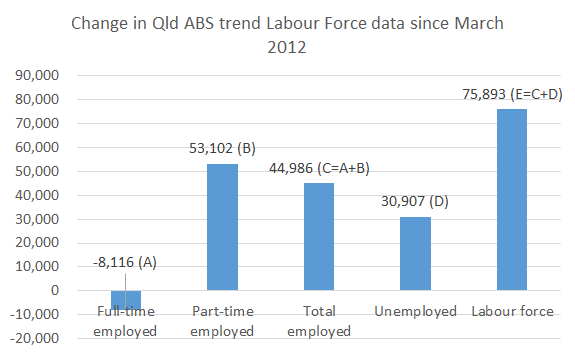
I’ve noticed there is a bit of confusion around regarding how the Queensland Government can claim employment has grown while at the same time unemployment has increased and the unemployment rate has risen to 6.9 per cent. Employment and unemployment can both increase over a particular period because the pool of people in the labour market – those employed or actively looking for work (i.e. unemployed) – is not static, but growing, as the population increases. New jobs need to be created not just for those currently unemployed but for future workforce entrants such as school leavers and parents re-entering the workforce. When employment grows at a slower rate than the labour force, unemployment is increasing faster than employment, and the unemployment rate will increase. This is what has happened in Queensland since the last election (see chart below, which was inspired by today’s article in the Brisbane Times Employment grows but jobs are part-time).

Labour_force_since_election

I’ve been reluctant to make too much out of the loss of full-time jobs because of the high degree of imprecision in the labour force data and because I think there is still value in part-time employment, even though a full-time job would obviously be preferable for many people.

Posted in Labour market | Tagged , , , , , | Leave a comment