612 ABC Brisbane radio interview on Qld economy and infrastructure

Yesterday I was interviewed by Steve Austin of 612 ABC Brisbane regarding the current state of the Queensland economy, and the interview aired this morning. You can find the audio recording of my interview here (just scroll down below Jackie Trad’s and Tim Nicholls’ interviews):

The future of Qld’s economy and infrastructure

The main points I made were that we don’t yet see the signs of a broad-based (big “R”) recession in Queensland, the ongoing (albeit not strong) growth in household consumption spending is encouraging, and the private sector is eagerly awaiting the Queensland Government’s infrastructure plan. The previous Government was planning to spend $8 billion from privatisation proceeds on new infrastructure, money the current Government will not have. The Government needs to set out what its funding plans are and whether and how it intends to partner with private sector companies to deliver new infrastructure.
Posted in Uncategorized | Leave a comment

Qld consumers resilient at the end of the mining boom

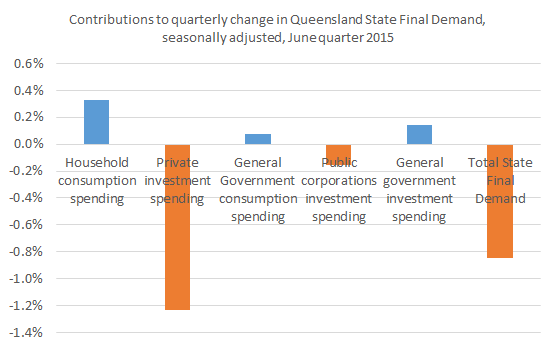
SFD_Qld_Jun15

At the end of the mining boom, as resources sector investment has plummeted, Queensland consumers are nonetheless resilient, and their growing consumption spending has partly offset the adverse impact of the fall in investment on aggregate demand (see chart above based on yesterday’s ABS National Accounts data). As others have noted, the state final demand numbers reported yesterday do not include exports, and we know that LNG is starting to boost Queensland exports. However, my feeling is that the 0.8 per cent contraction in State Final Demand Queensland has seen in June quarter is too large to be reversed by a boost to exports. That said, we should wait for Queensland Treasury to update its State Accounts estimates to conclude whether the Queensland economy contracted in June quarter. Even if it has contracted, it is a contraction associated with a fall in business investment from elevated heights that only ever could have been temporary. And it would be a contraction that, for now at least, Queensland consumers largely appear to be shrugging off.

See also Pete Faulkner’s commentary Q2 GDP disappoints.

Posted in Macroeconomy | Tagged , , , , , | 2 Comments

A longer-term perspective on the CAPEX plunge

capex_%_gsp

In a comment on my post from last Friday, regular Queensland Economy Watch reader Jim pointed out that the plunge in capital expenditure (CAPEX) is simply returning Queensland to more normal rates of investment, as was completely expected. Jim suggested I could present a longer time series to demonstrate this, as I’ve done above (N.B. the chart is based on ABS and Qld Treasury data, with June 2015 GSP estimated by extrapolation from December 2014 and March 2015 estimates). Here is what Jim had to say in his comment:

It would be interesting to look at your time series graph over a longer period. 2005 (the start of your series) is actually well within the construction phase for the Queensland mining and energy boom. I suspect even the lowest point of the “building and structures” category you have shown is above long term averages (particularly if you separated out the housing construction). Like I’ve said before, what we are experiencing was 100% expected by any economist with a time horizon longer than a goldfish.

We seem to have a construction and engineering sector that was more than happy to privatise the gains of the upswing in the boom, that are now pushing to have the downside cushioned by State expenditure (particularly for dubious projects that don’t pass a basic benefit-cost test – think dams, stadiums and roads to nowhere).

Besides, the downturn in activity will actually have a few positive spin offs as the price of construction and the associated labour used should actually become more affordable to other sectors as the two-speed economy returns to more of a one-speed economy.

Everyone is getting overly gloomy about “the recession we are not even having”. But some of us are old enough to remember the “recession we had to have”. It is time we all had a bit of long-term perspective.

I agree largely with Jim on this, but I would note there is still the prospect of the CAPEX plunge continuing over the next twelve months across Australia, and the impact being broader than the resources sector. So there is still some justification for a level of gloominess.

Posted in Macroeconomy, Mining | Tagged , , , , , , | 3 Comments

Health, aged care & tourism will generate jobs in Qld at the end of the mining boom

newcapex

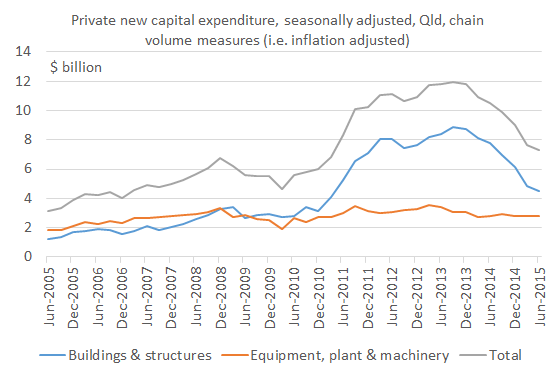
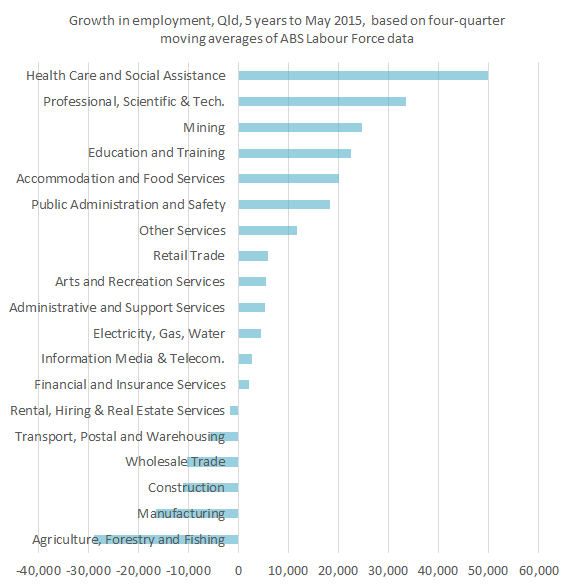
At the end of the mining boom, as capital expenditure plummets (chart above) from an elevated level, and ten thousand new jobs expected in the Galilee basin now appear unlikely, it is probably not surprising that some commentators are getting hysterical and calling for the Queensland Government to stimulate the economy (see today’s Courier-Mail report). But, considering the pattern of employment growth over the last five years (see chart below), the Government is right to note the economy is broader than mining, even if one of its examples of where future jobs may come from, i.e. movies, is weak. Major areas of expected jobs growth in Queensland certainly include health, disability and aged care, and tourism, even prior to the Commonwealth Games on the Gold Coast in 2018. I’ve noted in a previous post that tourism (which has received a boost from the depreciating dollar) and our cafe culture are helping us endure the end of the mining boom.

I am even more confident about the prospects for tourism after listening to Justin Fung from Aquis at the recent Futures Summit in Brisbane. While he is not a disinterested observer, the points he made about the massive expected growth in Chinese tourism yet to come were very powerful. The Great Barrier Reef is on the bucket list for many people and Far North Queensland is the major gateway. It is great news that international passenger numbers at Cairns airport are trending upward (see That airport data again).

emplgrowth_five_years

Posted in Labour market, Macroeconomy, Mining | Tagged , , , , , , , , , | 6 Comments

Unsurprising Townsville running out of water when Council is charging so little for it

Townsville City Council desperately needs some hard-headed economic advice, not just on the unwise Super Stadium project, but on water pricing, too. It is reported in today’s Townsville Bulletin that “TOWNSVILLE residents must dramatically reduce their water use if the city is to avoid hefty costs to pump water from the Burdekin Dam.” Townsville is again facing the prospect of strict water restrictions, not just because of a lack of rainfall, but also because the Council has failed to manage the demand for water through appropriate water pricing. As the Council notes on its website:

Townsville residents consume approximately 4 times more water per person than in most major cities.

The Council blames the climate, which certainly would be part of the explanation for the extremely high water use, but low water prices are another obvious contributor. In Townsville, the standard water plan is 772kL of water for $739 per year (see water billing). This is a huge quantity of water for a very low price. A Brisbane family is typically assumed to consume 155kL per year. Based on Queensland Urban Utilities’ water charges, a Brisbane family that consumed 772kL of water per year would have to pay over $3,000 per year. It seems obvious that Townsville City Council should seriously review its water prices and investigate whether it can manage demand through a better pricing system rather than by imposing water restrictions on a recurring basis.

Finally, I’d note that the failure to manage demand through appropriate pricing is responsible for another major policy challenge faced by the community: traffic congestion (see today’s Courier-Mail report Brisbane traffic: Worst roads in city for commuter congestion).  It is time for Councils to inject some basic economic logic into their policies.

Posted in Environment, Townsville | Tagged , , , , , | 14 Comments

Upcoming ESA Qld event on family-based taxation featuring Senator Matt Canavan & Alex Robson

Equity is important for the design of tax systems. Equity involves treating similar people the same (i.e. horizontal equity), but also adjusting taxes to allow for differences in the ability to pay taxes and in the benefits that people receive from government (i.e. vertical equity). Obviously there are large value judgements involved, and there is scope for heated debate about what is equitable. First-term Queensland Senator Matt Canavan has injected himself into this debate with a thought-provoking submission to the Australian Government’s tax review, calling for a second tax-free threshold for families where only one parent works. This is not full income splitting for taxation purposes, which was once advocated by John Howard, but a pragmatic and less costly alternative.

Senator Canavan’s proposal could provide single-income families up to $2,000 extra each year (at a total cost of $1.5 billion per annum). The Senator argues this would be much more equitable than the current system “because families with similar incomes can pay vastly different amounts of net tax.” For example, as noted in the submission:

A double income family could earn up to $172,000 a year before they pay the same average tax rate as a single income family on just $86,000 a year.

Senator Canavan is an ex-Productivity Commission economist, so you would expect a high quality and well-argued submission. The Senator will present his case at an upcoming Economic Society of Australia (Qld) event on Thursday 24 September, which, as the Secretary of ESA (Qld), I would encourage you to attend if you can make it. At the event, Dr Alex Robson from Griffith University will also provide some views on the Senator’s submission and presentation. Details are available on the ESA Qld website.

Posted in Tax | Tagged , , , , , , , | 5 Comments

More than half of Australian large businesses receiving government financial assistance of some type

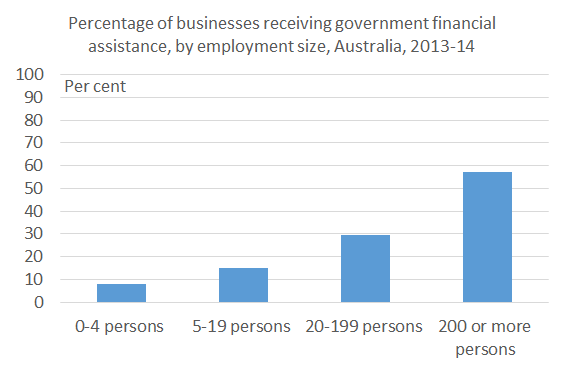
Australian large businesses have proven themselves much better than smaller businesses at securing government financial assistance such as grants and tax concessions. Around 57 per cent of large businesses (i.e. 200+ employees) received some type of government financial assistance in 2013-14, compared with much lower percentages for small and medium-sized businesses (see chart below based on the ABS’s Selected Characteristics of Australian Businesses data). This huge disparity strikes me as very odd, and suggests our governments are providing industry assistance too liberally. It is very likely that too much assistance is directed at the big end of town, which has much less need for it than smaller businesses.

businesses_receiving_assistance

Posted in Industry policy | Tagged , , , , , , , , | 5 Comments

Independent schools right to be worried about GST broadening – parents already fee sensitive

Independent Schools Queensland (ISQ), which represents non-Catholic private schools, released an excellent discussion paper earlier this week prepared by Mikayla Novak on the impacts of broadening the GST to include education. The paper notes that, if GST were applied to school fees, the consequent fee increases would lead to a switch of enrolments from private to State schools. This would come at a high cost to the Queensland Government, at around $360 million per annum, as the Government would now have to cover the bulk of the costs of educating the nearly 23,000 students who would switch to the State system. This point was previously made by Michael Willis in a guest post on this blog earlier this year (see Time for a sensible debate on broadening the GST net).

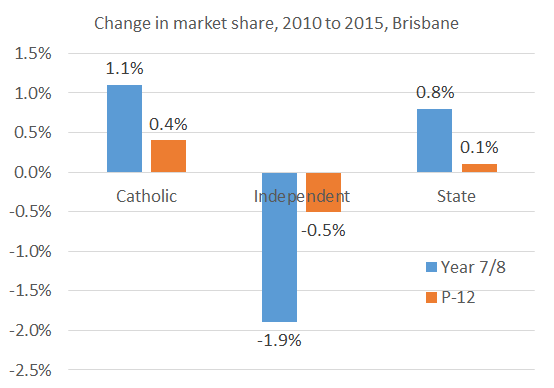
It is very plausible that there would be many students shifting from private to State schools if the GST were imposed on school fees. It is clear that parents are very sensitive to school fees. Increases in school fees in recent years have seen both a movement from private schools to State schools and from higher-fee private schools to lower-fee private schools, including a shift from higher-fee independent to lower-fee Catholic schools (see this 2013 Courier-Mail report). This is confirmed by recent data from ISQ (see chart below). As I noted in a post last year, one reason Catholic schools can charge lower fees than independent schools is the very favourable funding deal that the Catholic sector secured from the Howard Government (see Catholic schools still benefiting from very favourable funding deal from Howard Govt days).

marketshare

Posted in Education | Tagged , , , , , , , , | 2 Comments

Is the Queensland economy at a standstill?

I’m unsure if the Queensland economy is at a standstill, as suggested by the federal Treasurer Joe Hockey (see today’s Courier-Mail report), but, at best, it is moving slowly and sluggishly. This has meant the Queensland unemployment rate has remained stuck above 6 per cent, but so has the national unemployment rate, which is only slightly lower than Queensland’s. The Queensland economy is currently enduring a major shock from the end of the mining boom. As I’ve commented in a previous post, the economy is enduring the shock as well as can be expected.

The economy is currently being propped up by recoveries in residential construction, particularly associated with the boom in approvals and construction of apartment towers (see Qld economy propped up by residential building as business investment slumps), and tourism (see the International Tourism Snapshot). And measures of confidence are improving, particularly in the building industry (see Gold, Sunshine coasts drive construction confidence: Master Builders).

That said, business is legitimately concerned about future levels of infrastructure investment, and is eagerly awaiting the State Government’s draft State Infrastructure Plan, to be released later this year. There is no doubt the business sector was looking forward to the $8 billion of infrastructure spending that was to be funded from privatisation proceeds by the previous government. This funding is no longer available for new infrastructure, so the business community is anxiously awaiting the current Government’s plans to be set out later this year.

Posted in Housing, Macroeconomy, Tourism | Tagged , , , , | 2 Comments

Very high youth unemployment in North Qld and Wide Bay region

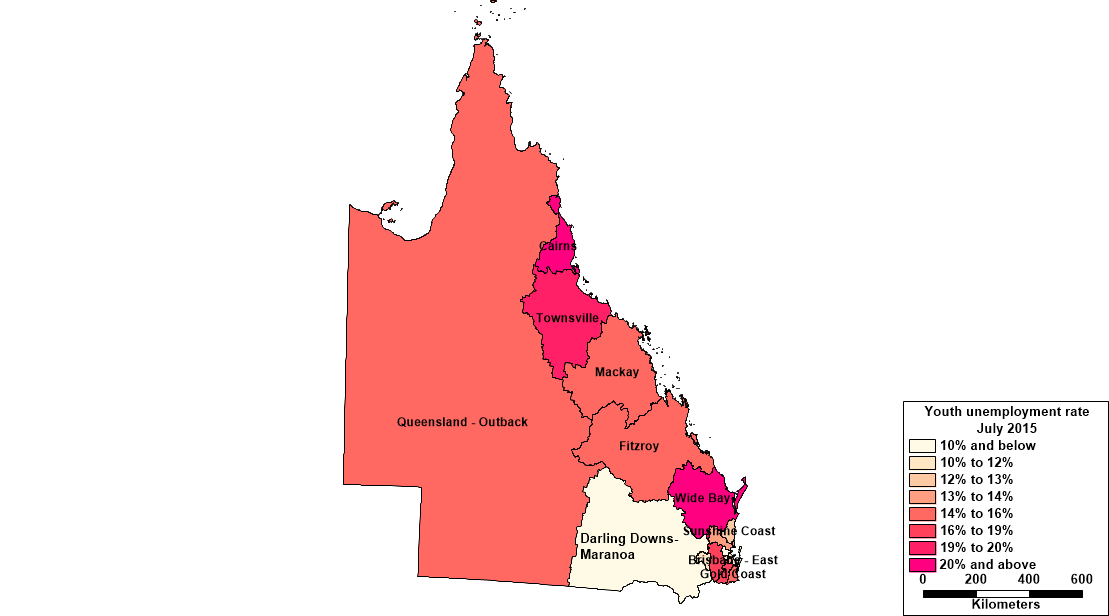
Young people, many of who may be trying to enter the workforce for the first time, are usually disproportionately affected when the economy slows down. Relatively weak conditions in regional Queensland, which I discussed in my last post, have contributed to some very high rates of youth unemployment in particular regions, including Cairns, Townsville and Wide Bay. Both Cairns and Wide Bay have a youth unemployment rate (among 15-24 year olds) of over 20 per cent, compared with a State average of around 14 per cent, according to Queensland Treasury’s smoothed estimates of the regional ABS Labour Force data released last week (see Regional Youth Unemployment). I produced the map below of youth unemployment rates across Queensland using the Queensland Treasury estimates.

Youth_unemployment_Qld_map_July_15

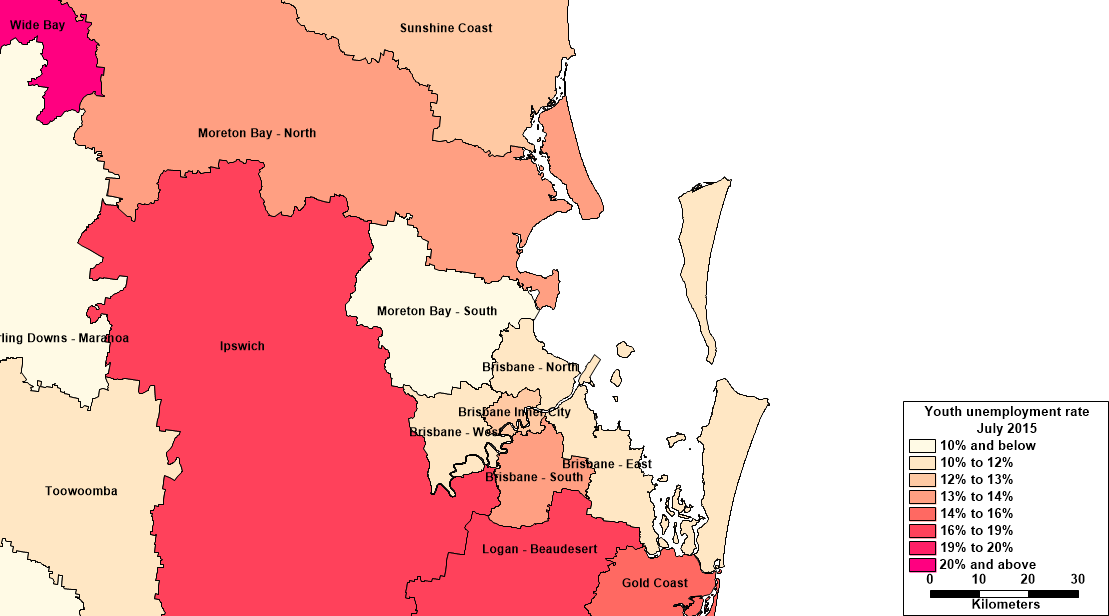
And here’s the close up for SEQ:

Youth_unemployment_Qld_map_July_15_SEQ_closeup

High rates of youth unemployment should mean that we seriously consider removing regulations that unnecessarily constrain job creation (e.g. trading hours and taxi regulations). And they also mean we should consider at least the modest reforms to penalty rates proposed recently by the Productivity Commission.

Posted in Labour market | Tagged , , , , , , | 2 Comments