Doubts about capabilities of public servants in contract management worldwide

The Economist last week reported on British Chancellor George Osborne’s ambitious plan to remake the British Government, and it observed (in U-turns and new turns):

“By 2020 departments will be too cash-strapped to run things; public administration will be far more about awarding and overseeing contracts. That is a sensible shift, but it is not clear that bureaucrats are up to the job.”

The Economist rightly pointed out the London Olympics security contract debacle, and it could have also noted the Queensland Health payroll debacle. In the Brisbane Times coverage of the news that the Queensland Government cannot sue IBM over the health payroll debacle, it was noted that “the debacle has been described as possibly the worst public administration failure in Australia.”

The health payroll debacle demonstrated a lack of capability in the Queensland public service to oversee the implementation of major projects being delivered by contractors. This was disturbing because, regardless of the political party holding power, there is a clear trend toward greater outsourcing or contracting out, which, as I have noted previously, has been demonstrated to yield efficiency gains, typically in the range of 10-20 per cent. Of course, those gains only occur when the outsourcing is properly managed, and that was certainly not the case in the Queensland Health payroll debacle. And that is why there is an urgent need to review the capabilities of Queensland public servants and to determine their training needs in project and contract management.

Posted in Productivity, Queensland Government, Uncategorized | Tagged , , , , , , , , , | 4 Comments

More transparency, but KSD upgrade still looks like a dud

Jim Binney, Principal of Mainstream Economics and Policy, has undertaken further analysis of the proposed Kingsford Smith Drive upgrade, following up his guest post from yesterday, and I am very happy to publish his critique of the business case below. I have been very lucky this week to have had three high quality guest posts, two from Jim and one from Rod Bogaards on competition policy I published last night.

More transparency, but KSD upgrade still looks like a dud

Last night, a copy of Brisbane City Council’s business case for the KSD upgrade landed on my desk. While it is incredibly short on detail, it is clearly based on a lot of previous work (BCC has expended about $18.46 million to date on the project). To BCC’s credit, they did do a lot of the right things such as sensitivity analysis of some basic parameters (different discount rates, changes to capital costs, with and without the wider economic benefits, etc.). But the business case is still way short of a reasonable benchmark for such a major investment. For example:

  • Shortlisted options were not assessed against a ‘do nothing more’ option. Doing nothing more should always be an option, particularly if ‘doing something’ might be questionable or risky.
  • The costs of additional congestion during the construction phase seem to have been ignored. Anyone who has endured a major road upgrade for years understands the reality of such a cost.
  • The benefits assessed are vehicle operating benefits. Typically this includes time savings and reduced vehicle operating costs to motorists (but it is never actually clearly articulated). In addition, road safety benefits (less crashes) are also included. Details of how these benefits were estimated are not provided despite the fact they are the primary justification for the project in the first place. Fortunately these benefits can be estimated based on information from the business case and elsewhere.
  • Non-monetised benefits and costs (e.g. amenity, pedestrian safety) are not included. They should be for a major project.
  • The wider economic benefits (agglomeration economies, labour supply impacts, and changes to imperfectly competitive markets) are simply assumed to be 20% of the direct benefits without any real justification.

I expanded the scope and improved the input data for the back-of-the-envelope model I used yesterday. Specifically:

  • A 30-year period is still used (like BCC).
  • A 7% discount rate is used (like BCC).
  • Costs are based on cash flow for the four-year construction period (direct from business case).
  • Benefits start immediately after construction is finished and grow in line with increases in road usage and the increasing marginal costs of congestion (presumably like BCC).
  • Time savings are based on the data in the business case and grow in line with BCC’s estimates.
  • Vehicle operating savings are based on the length of the upgrade, the changes in average speeds and the AUSTROADS estimates of changes in vehicle operating costs in Brisbane at different congestion conditions.
  • Road safety benefits were derived from the historical costs in the business case. I‘ve unitised them (expected cost per trip) and then assumed they will reduce by 80% from business as usual as most crashes on roads like KSD occur at congested intersections.

Surely my results should be in the same ballpark as the BCC figures now that I’ve broadened the scope and used better input data? Unfortunately not. The benefit-cost ratio has barely changed (it is now 0.62). While the scope of benefits included has broadened to include road safety and vehicle operating costs, the present value is actually lower because they don’t start until the upgrade is finished (i.e. in year five). The decrease in the present value of the benefits is almost identical to the decrease in the present value of construction costs (which are now spread over four years).

And when I did sensitivity analysis I still struggled get to a benefit-cost ratio of 1.13 unless I assume a very low discount rate and benefits are the same even on the weekends (they aren’t).

The fundamental issue is that I cannot see how BCC got such high estimates of vehicle operating benefits using the accepted methods and data typically used for analysing road projects. Unfortunately, the business case does not really enhance transparency at all in this area. Benefit-cost analysis is the primary tool of my trade and I’ve worked as the Chief Transport Economist, Director of Transport Planning and Manager of Road Safety interstate, so I’m pretty sure I’ve got the basics right.

The last line of the economic assessment section of the business case says…. “Overall, under the assumptions that have been adopted, the results present a robust economic justification to proceed with the Project.” The problem is that the business case doesn’t appear to be terribly robust, some assumptions are questionable, and it certainly isn’t transparent. So how does it provide a robust economic justification to spend $650 million of our money? Simple. It doesn’t.

Jim Binney is Principal of Mainstream Economics and Policy.

Posted in Transport, Uncategorized | Tagged , , , , , , , , , , | 2 Comments

Harper Competition Policy Review – guest post by Rod Bogaards

The Queensland Parliament’s passage of the retrograde sugar bill that was put forward by Katter’s Australian Party is a strong sign that we should not hold much hope for sensible economic policy coming out of this hung parliament (see Brisbane Times coverage).  It means we are very unlikely to see any action at a State level to adopt the Harper Competition Policy Review reforms. This is very disappointing because these reforms would yield substantial economic benefits, as Rod Bogaards, a former director at the Productivity Commission, discusses in his guest post below.

Australian Government response to Harper Competition Policy Review — learning lessons from past reform processes

Last week the Commonwealth Treasurer released the Government’s long awaited response to the Harper Review, accepting over three quarters of the recommendations. With much of the public debate centred on the review’s proposed changes to competition law, the recommendations to reinvigorate competition policy have received less attention.

Competition policy is aimed at exposing previously protected activities to competition — in recognition of the fact that, in most cases, competitive markets deliver better outcomes than regulated markets. This is because they effectively align the interests of suppliers and consumers. In seeking to maximise profits, suppliers have a strong incentive to produce at least cost, to provide the mix and quality of products and services consumers want and to innovate to gain an edge over their competitors. In other words, consumers are better off when businesses compete vigorously to deliver new and better products and services at lower prices.

Many recommendations in the Harper Review are not new but relate to ‘unfinished business’ from National Competition Policy (NCP), which was agreed between the Australian, state and territory governments in 1995. These include restrictions on:

  • retail trading hours
  • pharmacy ownership and location rules
  • taxi licences
  • parallel imports of books and second-hand cars
  • planning and zoning
  • water trading
  • coastal shipping and aviation
  • retail prices of electricity and gas.

In many cases, properly constituted legislation reviews found that benefits of such restrictions to the community as a whole are outweighed by the costs. For example, numerous reviews of retail trading hours restrictions over the last two decades have found that deregulating trading hours would benefit consumers through greater convenience and choice of products and services and potentially lower retail prices and higher retail employment.

Businesses benefiting from the retail trading restrictions often point to small business participation to maintain the restrictions. But this is not supported by the evidence. The Productivity Commission found consistently high small business participation rates of around 90 per cent in both regulated and deregulated Australian states and territories, suggesting that trading hours have little influence over the level of market participation by small retail businesses.

However, recommendations from such reviews were not ultimately implemented by governments. This was largely because those who stood to lose from a policy change were concentrated, organised and vocal in their lobbying and those who stood to gain were often widely dispersed.

This suggests that the quality of the agreements that will be negotiated between the Australian Government and the state and territory governments and the institutional structure that is developed over the coming months will be crucial to delivering reform.

The Queensland community may be best served through an agreement that commits to implement the set of outstanding reforms, and concentrates future review and policy efforts on anti-competitive restrictions where the costs and benefits of removing restrictions are more finely balanced, or where benefits are heavily dependent on implementation and design of any new arrangements.

The complex nature of human services (health and education) is, for example, one area where jurisdictions should focus their policy analysis. This is because the prevalence of market failures in many facets of health services markets means that unfettered competition will often not deliver the best outcomes. In addition, while competition may deliver lower cost outcomes, it does not guarantee equity of access to basic health services. Other areas where governments could focus their attention include government procurement, road transport and intellectual property.

To ensure that all jurisdictions deliver on reform, the institutional framework will be important. The National Competition Council (NCC) played an effective role in monitoring and assessing progress of jurisdictions against their reform commitments under NCP. While the Commonwealth Treasurer had the final say, whether particular jurisdictions received their competition payments depended largely on the advice of the NCC.

To this end, the Commonwealth Treasurer’s press release stated:

“To support the new competition policy agenda, the Government has supported the recommendation to put in place a new institutional structure with the states and territories, including the potential for productivity payments for delivery of reforms.”

The lesson of past reform programs is that any reward payments for jurisdictions should be tied to the outcomes achieved rather than the processes undertaken. The 2009 National Partnership Agreement to Deliver a Seamless National Economy and to a lesser extent the 1995 NCP agreement were too focused on rewarding jurisdictions for their achievement of process milestones rather than reform outcomes, particularly in the early years of these agreements.

Rod Bogaards is an economic consultant and former Director of the Productivity Commission.

Posted in Industry policy, Retail trade, Transport, Uncategorized | Tagged , , , , , , , , | 3 Comments

Guest post on KSD upgrade by Jim Binney

I am very grateful to Jim Binney, Principal of Mainstream Economics and Policy, for preparing the guest post below on the economics of the Kingsford Smith Drive upgrade.  I share Jim’s suspicion that the project is an “economic dud.”

Brisbane ratepayers, taxpayers and investors (often unknowingly via superannuation) have not done particularly well out of major transport infrastructure projects in Brisbane in the past decade. As investors, we would have lost less by putting a few lazy billion on black at the roulette table (when you expect to get about 95c back for each $1 gambled).

So we should reasonably expect Brisbane City Council (BCC) to be more risk averse and transparent when it comes to the next major transport project. Remember, it is our money they are investing (or gambling).

After reading the articles in the Courier Mail and Brisbane Times about the project, I began to suspect that the project looked like an economic dud. How did they possibly come up with those numbers, even the modest benefit-cost ratio of 1.13? Remember a project needs a benefit-cost ratio of at least 1 to be viable.

The major benefits of the project are the value of time savings for commuters. There will also be some fuel savings (less stopping and starting), and perhaps some road safety benefits. The costs are the $650 million capital cost plus the (probably) higher future maintenance costs (bigger roads = higher maintenance costs).

We only have the commuter numbers and time savings to calculate the benefits and the capital costs to work with, but that should be enough to get a result within the same ballpark as the figures in the press (assuming the analysis was over the typical 30-year period used for project benefit-cost analysis).

Based on the estimated traffic volumes, time savings (including the increase in benefits over time), and the value of time (based on average weekly earnings data from the ABS), I estimated the annual economic value of the time savings. They would currently be around $10.8 million, increasing to around $29.7 million after 15 years. In the absence of any more information, I have assumed the growth rate in traffic numbers and benefits is the same throughout a 30 year period (to around $49 million after 30 years providing the new road doesn’t start to get congested!).

So a back-of-the-envelope benefit-cost analysis using those numbers and a 5% discount rate indicates a benefit-cost ratio of 0.61 (net present value of -$239 million). That is a long way short of the 1.13 in the press. I doubt the fuel savings, road safety benefits, or any defensible changes in assumptions during the sensitivity analysis process would make up the shortfall in benefits. The project is looking a lot like a dud based on the information at hand.

Christmas is a time for giving. The gift I’d like to see from BCC is more transparency when it comes to investment decisions. Unfortunately, the gift from BCC to Brisbane’s residents this Christmas could be a poor road investment with a net cost to the community of about $200 million. To put that into perspective, that equates to about $320 for every Brisbane household.

Posted in Brisbane, Transport | Tagged , , , , | Leave a comment

What does the sensitivity analysis for KSD upgrade show?

Governments and local councils would be much better off making business cases for public projects such as the $650 million Kingsford Smith Drive upgrade public before they commit to them, so they are tested by the critics and the politicians are sure they are not exposed to later criticism. Brisbane City Council has just learned this lesson, as it appears the business case for the KSD upgrade provides only modest support for the project, with travel time savings of only one minute per trip and a benefit-cost ratio of only 1.36, taking into account the full range of possible economic benefits (see Brisbane Times coverage). Given the uncertainty around cost and benefit estimates for public projects, this benefit-cost ratio does not provide a lot of comfort that the project stacks up.

What we really need to see is the full sensitivity analysis for the project, which tests how robust the benefit-cost ratio is to variations in key assumptions (e.g. capital expenditure, travel time savings). Is the benefit-cost ratio less than one in some scenarios? It possibly would be. We really need to see the sensitivity analysis to know how comfortable we can be with the project going ahead.

It would be a cause for concern if the business case did not contain a sensitivity analysis. The Queensland Government’s Project Assessment Framework guidelines on cost-benefit analysis are instructive on the importance of sensitivity analysis (p. 7):

A range of factors can lead to significant variations in costs
and benefits of a project from the levels assumed in the
financial and economic analysis of a project option.

Project analysts can address this uncertainty by
undertaking a sensitivity analysis, which enables an
examination of how sensitive the financial and economic
outcomes are to specific assumptions in the evaluation.
The analysis would be focused on the key variable or else
those that are so uncertain that their variation could upset
the project’s outcome.

Posted in Transport, Uncategorized | Tagged , , , , , , , | 4 Comments

PC calls for partial inclusion of family home in pension means test

Last week, Treasurer Scott Morrison warned young Australians not to expect they can rely on the age pension in the future. This was good advice, because the budgetary pressures facing the Commonwealth Government, emphasised again this week in grim forecasts of permanent deficits from Deloitte Access Economics, mean that the sustainability of current policy settings for the age pension is in doubt. Of course, one way the Commonwealth could improve the sustainability of the age pension is by limiting eligibility through including the family home in the means test. This would discourage retirees from tying up so much of their capital in housing, and would encourage them to draw down this capital to support their retirement.

There is partial support for this proposition from the Productivity Commission, which has today released an interesting research paper entitled Housing decisions of older Australians, in which it notes (p. 117):

In principle, including the full value of the principal residence in the Age Pension assets test would improve efficiency and equity.

However…removing the exemption entirely in the immediate future is intractable.

At a minimum, there is a strong case on equity grounds for setting limits on the value of the principal residence that is exempt from the Age Pension means test.

The thresholds beyond which the family home would be included in the means test could be $750,000 for couples and $500,000 for singles, as recommended by the National Commission of Audit, for example.

Also, in the interests of economic efficiency through encouraging labour mobility, the Productivity Commission recommended removing State Government stamp duty on housing transactions. This is another excellent policy recommendation. I hope this latest report from the Commission is widely read by policy advisers and their political masters.

Posted in Budget, Uncategorized | Tagged , , , , , , , , | 4 Comments

Governments find a gentle nudge can get results

Australians should be prepared for more nudges from government agencies encouraging us to do the right thing, similar to recent examples such as letters from the ATO urging us to pay our taxes to support our way of life, and their friendly SMS reminders to lodge our tax returns on time. For the Australian Government has established its very own behavioural economics unit, otherwise known as a nudge unit, to figure out how it can shake us citizens out of our typical inertia and do the right thing, whether that be paying our taxes on time, eating the right food or not drinking or gambling too much (see Peter Martin’s excellent recent article Just a nudge). The new nudge unit was launched by US behavioural economics expert, Harvard Professor and White House adviser Cass Sunstein, who was in Australia last week, and indeed made his way to Brisbane to deliver a presentation at QUT. Alas, I was unable to attend his presentation but I did get a copy of the slides which you can download at the link below.

Sunstein presentation on Nudging Citizens

Posted in Social policy, Tax, Uncategorized | Tagged , , , , , | 2 Comments

Building construction rebounded in September quarter, but still below previous highs

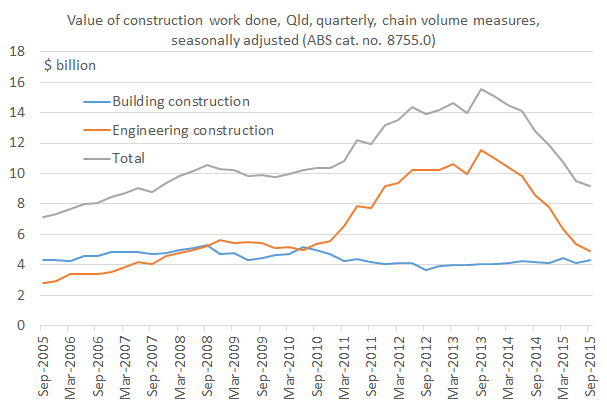
All the cranes on the Brisbane skyline, from the Valley and Newstead, to West End, Milton and Toowong, might suggest there is a building boom underway. Certainly activity is increasing in the building industry. Building construction work done in Queensland rebounded 4.0 per cent in the September quarter, after a 6.8 per cent fall in June quarter, and is now 2.7 per cent up through the year (see chart below based on ABS estimates released yesterday). This is not an extraordinary growth rate, however, and so we cannot say the sector is booming just yet. Furthermore, building construction activity is still below levels seen prior to the 2008 financial crisis and (temporarily) during 2010 when the sector was building a lot of new school halls funded by Rudd-Gillard’s Building the Education Revolution.

Construction_Sep15

Additional perspective is provided by comparing building construction activity with engineering construction activity, which continues to fall from the extraordinary highs it experienced during the mining boom.

Regarding recent economic trends, there is an excellent new post from Pete Faulkner comparing ABS and Queensland Treasury economic growth estimates for Queensland:

Queensland growth confusions…an attempt to explain

Posted in Housing, Mining, Uncategorized | Tagged , , , , , , | 2 Comments

Courier-Mail’s Paul Syvret on my “coldly commercial prism”

Thanks to the Courier-Mail’s Paul Syvret for quoting my last post in his Saturday opinion piece on the proposed new 1,500 seat theatre for Brisbane (see Opinion: New inner-city theatre would be a boost for Brisbane, which may be behind the paywall):

Already the move has attracted some criticism. Economist Gene Tunny, for example, describes the project as “a complete waste of taxpayers’ money” and questions whether such a facility is needed in the first place, and if so, then surely there is a business case for the private sector to develop it, not the taxpayer.

Viewing such a project through a coldly commercial prism, Tunny is right, in that in a very narrow sense it is in effect a government subsidy of the arts sector.

This ignores however both the capacity constraints of our existing facilities, and the multiplier effects of investing in such infrastructure.

Responding to Paul’s piece, first, I do not think I have ignored the capacity constraints. I just cannot see any justification here for the Government increasing capacity, rather than the private sector doing it when there is sufficient demand to justify it.

Second, I would not deny the existence of multiplier effects. However, multiplier effects, which may be estimated using input-output or computable general equilibrium models, are typically irrelevant to the cost-benefit analysis of public projects. And it is the cost-benefit analysis that determines whether the project delivers net benefits to the community (i.e. whether it stacks up), and which should be the focus of any business case.

The Queensland Government’s Project Assessment Framework supplementary guidance material on cost-benefit analysis from July 2015 is instructive (p. 16):

Benefits identified in economic impact analysis using an input-output approach should not be included in cost-benefit analysis for several reasons including:

  • although any project will generate economic activity, directly and indirectly, these effects could also be generated by an alternative use of the resources…

I trust the $1.3 million business case that is being prepared for the new theatre will contain the correct treatment of any multiplier impacts.

Posted in Arts, Uncategorized | Tagged , , , , , , , , , , , , , , | 6 Comments

New 1,500 seat theatre would likely be a waste of taxpayers’ money

The Queensland Government is commissioning a relatively large business case, at a cost of $1.3 million, for a new 1,500 seat theatre for Brisbane, but it is likely there can be no plausible business case, because the theatre would be a complete waste of taxpayers’ money. It appears the construction of a new theatre would be funded from the Government’s proceeds from the Queen’s Wharf development (see this media statement from Monday). There would certainly be better public uses, such as in health and education, for any government funding for a new theatre, which would cost many tens of millions of dollars.

Queensland already has a large theatre. The Lyric Theatre at QPAC has 2,000 seats. Presumably there is a push for a new 1,500 seat theatre because the Lyric Theatre is relatively well utilised by touring musicals. Any business case would need to clearly set out why exactly a new theatre is needed and why it deserves government funding. It would need to establish why, if there is sufficient demand for a new theatre, the private sector will not build it. And why should government funding be provided?

The Queensland Government already owns a venue, QPAC, which appears more than sufficient to host a large number of edifying cultural productions from our theatre, ballet and opera companies. Is the problem that touring musicals and cultural productions are competing for slots at the Lyric Theatre? If so, then let us wait until the unmet demand from touring musicals is sufficient to make the construction of a new theatre by the private sector commercially viable. I cannot see the need for the Government investing in a new theatre.

I would note the Government already spends significant money on the arts in Queensland ($9.3M for the Queensland Performing Arts Trust and $2.6M for the Queensland Theatre Company in 2015-16). This involves a government subsidy to the mostly well off people who attend the ballet, symphony, theatre and opera. There is not a compelling case for greater public support for the arts.

The Queensland arts community itself does not appear totally convinced there is a need for a new 1,500 seat theatre, as some in the community are arguing what we really need is a 500 seat theatre with better facilities than the Powerhouse Theatre which is around this size (see this Brisbane Times article). This makes me even more sceptical of the need for a new 1,500 seat theatre.

Posted in Arts, Uncategorized | Tagged , , , , , , , | 2 Comments