Qld Audit Office identifies risks to energy businesses from State debt reshuffle

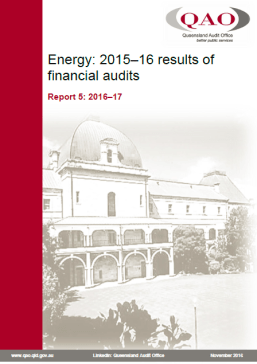
In a report published today on Queensland’s government-owned energy businesses, the Queensland Audit Office has flagged risks associated with the Government’s debt reshuffle (on the debt reshuffle, see this QEW post from December last year). Here is the relevant extract from p.3 of the QAO report with emphasis added:

“The state government continues its position of 100 per cent of net profits after tax from government owned corporations (GOC) being returned as dividends, except for CS Energy which returns 80 per cent. GOC fund these dividends through cash and borrowings, and out of realised and unrealised reserves.

Over the last two years, $1.7 billion in cash has been taken out of energy entities and $3.7 billion in new borrowings has been drawn to fund the payment of dividends.

The energy sector will meet the increased interest expense caused by the 4 per cent increase in debt position this year. In the longer term, if dividends continue to be funded through borrowings and unrealised reserves there is a risk that reserves will be depleted. This may result in a reduced ability to fund future dividends and service the increased debt levels.

Additionally, if expenses continue to grow at a rate greater than revenue, there will be less profit to pay for asset replacement and repayment of debt, and ultimately lower returns to shareholders through dividends.”

The Government has artificially improved its budget bottom line by shifting debt on to the GOCs and forcing them to pay interest expenses that otherwise would directly impact the budget balance. And it is requiring the GOCs to pay a high rate of dividends based solely on their accounting profits, without regard to the actual cash they have available (noting that cash might be needed to fund CAPEX or repay debt), meaning the GOCs have had to borrow to pay dividends to the Government. As the QAO has suggested, this is not a sustainable long-run strategy.

qao_energy_report

The QAO has flagged risks with the Government’s debt reshuffle

Posted in Budget, Queensland Government, Uncategorized | Tagged , , , , , | 2 Comments

Should Queensland ban plastic shopping bags?

Last week, the Queensland Government Environment Department issued a discussion paper to consult with the community on its proposed ban of lightweight plastic bags (i.e. the type you get at Coles and Woolworths). However, the scope for public consultation is minimal given the paper basically says the ban is coming and the consultation is just on the parameters of the ban, such as whether biodegradable bags are included. From a public policy process perspective, this is woeful, particularly given the discussion paper does not present a cost-benefit analysis (CBA) comparing different options before deciding on a ban as the preferred option.

It would have been good to see at least a CBA comparing an outright ban, a small charge on plastic bags, and no policy action at all, for example. An outright ban would create substantial inconvenience (particularly for those of us who use public transport and would have to regularly carry a reusable bag around) and additional costs for consumers (i.e. purchasing reusable bags). A small charge (e.g. 10 cents per lightweight plastic bag) would be less heavy-handed and a more efficient response to the environmental costs of plastic bags than a ban, and would still likely achieve a large reduction in plastic bag usage. Indeed, a plastic bag levy has proven to be very successful in England (see the Guardian report England’s plastic bag usage drops 85% since 5p charge introduced). Alas, the Government has prematurely ruled out a charge because, according to the discussion paper (p. 14):

“If regulation is introduced, the retail sector favours a ban on the supply of lightweight plastic bags, rather than a charge.”

This is possibly because shoppers would then be forced to buy the heavier reusable shopping bags, on which the retailers would be earning a margin, while any minimum charge on lightweight bags might only provide a tiny margin over their cost.

To an extent, the savings that retailers make by not having to supply lightweight bags may be passed on to consumers, but I doubt these savings would offset the additional costs to consumers from a ban on the lightweight bags. Of course, I remain open to the evidence, but the discussion paper does not attempt to weight up the costs and benefits of different options.

I am not denying that lightweight plastic bags can cause environmental damage, but I am not convinced an outright ban is the answer, and neither were the Productivity Commission and other experts who have examined this issue in the past. Regarding previous studies, and for an overview of the issues in banning plastic bags, see Rod Bogaards’s excellent guest post from earlier this year, a guest post which foreshadowed the coming plastic bag ban:

Is banning plastic bags the best option to tackle litter and reduce waste?

plastic_bag_discussion_paper

Submissions are due on the plastic bag ban discussion paper by 27 February.

Posted in Environment, Queensland Government, Uncategorized | Tagged , , , , , , | Leave a comment

Upcoming ESA Qld event: How economics improved the world in 2016

2016 has not been a good year for economics. Brexit and the US Presidential election result both implied a rejection of free trade and free markets by large numbers of people in the UK and US. Economists have learned that free trade and free markets need to be continuously defended and justified. The Economist magazine has certainly absorbed this lesson, and you may recall its recent Why they’re wrong cover story regarding the new nationalist movements across the world. They certainly are wrong, as they ignore the large benefits of globalisation that have accrued to people all over the world, including western consumers benefiting from cheaper goods and people being lifted out of poverty in emerging economies in the hundreds of millions. But The Economist and economists arguably should have seen the signs of discontent earlier and have been better prepared for what has transpired.

As Secretary of the Economic Society of Australia (Qld) I would naturally suggest that an ESA Qld function would be a good place to reflect on the events of 2016. So it is timely that we are having our Christmas function next Tuesday night (29 November) in the Gibson room at QUT, Gardens Point campus, Brisbane:

How Economics Improved the World in 2016

Join us for the Economic Society’s final event for the year. The function will feature an update from Professor Flavio Menezes on the activities of the Society for the year. This will be followed by a light-hearted look at how economics improved the world in 2016 with commentary from Professor Flavio Menezes and Professor Lionel Page of QUT and end-of-year drinks and savouries.

I will be very interested in Flavio’s and Lionel’s views on just how economics has improved the world in 2016. I would suggest that our knowledge of the economy and our understanding of the impacts  of fiscal and monetary policies have yielded ongoing benefits. Improvements in economic knowledge since the 1930s meant we avoided a second great depression which could have been prompted by the financial crisis of 2008. Economic conditions may have been even worse today were it not for the actions of economists. That said, the weak performance of advanced economies since 2008 should restrain triumphalism, and of course economists have to acknowledge that very few saw the financial crisis coming.

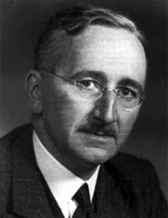
Finally, I should note I remain hopeful that the ideals of free trade and free markets will endure the current challenges, and I am inspired by the growing number of Australians who believe in free institutions. For example, consider the Liberty Works submission to the current Queensland trading hours review, authored by my friend Justin Campbell. The submission cites Friedrich Hayek, whom no doubt would support trading hours deregulation. I am hopeful that economic arguments in favour of deregulation will prevail, and Queensland will soon have much more liberal trading hours and the ability to buy liquor in supermarkets.

Friedrich_Hayek_portrait.jpg

Friedrich Hayek wouldn’t object to you picking up a bottle of wine at your local supermarket, which would be allowed to open much later than 9pm.

Posted in qut, Retail trade, Uncategorized | Tagged , , , , , , , , , , , | 4 Comments

ABS data confirm Qld economy under-performed in 2015-16

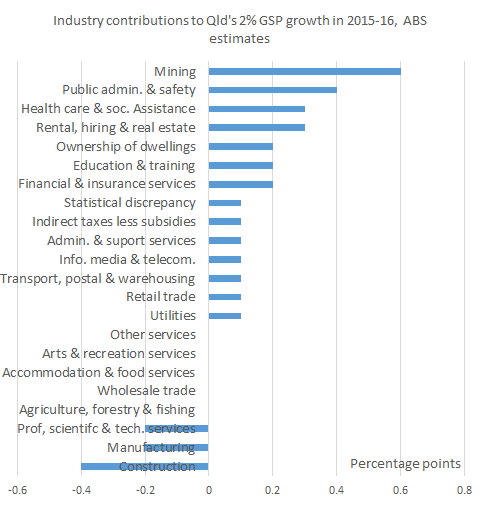
The annual gross state product (GSP) data the ABS published on Friday revealed Queensland’s lacklustre economic growth of 2% in 2015-16 (compared with 2.8% nationally) was heavily influenced by the transition at the end of the mining boom. The data revealed the mining sector technically made the largest contribution of any sector to the 2% growth rate, with a 0.6 percentage point contribution associated largely with new LNG exports (see chart below). However, industries badly affected by the decline in mining construction and exploration activity, particularly construction, manufacturing and professional, scientific and technical services, all subtracted from GSP in 2015-16.

industry_contributions_gsp201516

Other key points to note regarding the 2015-16 GSP data are:

  • The ABS’s Queensland GSP growth estimate of 2% in 2015-16 is noticeably lower than the Queensland Treasury’s Budget time forecast of 3½%; and
  • The resurgence of the public sector in 2015-16 was also a significant contributor to the GSP growth we did see (with a 0.4 percentage point contribution from public administration and safety).

On the 2015-16 GSP data, also see Pete Faulkner’s post:

ABS estimate QLD Gross State Product +2.0% in 2015/16

Pete notes Queensland Treasury may have a better understanding of Queensland’s exports than the ABS, and that the ABS may be under-estimating our GSP growth. I would suggest Queensland Treasury should publish an explanation for the discrepancy between its GSP estimates and the ABS’s.

Posted in Uncategorized | Tagged , , , , , , | 6 Comments

Ironic that Trump may just be the shock financial markets needed

The election of Donald Trump as US President is undoubtedly a huge shock to global financial markets. Even though it is highly uncertain what policies he will ultimately adopt and can get passed by Congress, it is highly probable he will blow out the US budget deficit and that this will increase interest rates globally, a prospect which has prompted a bond market rout (noting that the price of a bond and its yield vary inversely), as the Financial Times reports:

“A global bond market rout intensified on Monday while the dollar strengthened as investors bet that US president-elect Donald Trump’s commitment to economic stimulus will herald faster growth and the return of inflation.

Since Mr Trump’s surprise win in last week’s election, investors have begun to question their long-held consensus forecasts for subdued inflation and mediocre growth that underpinned a rally in bonds over the summer…

…The 30-year US Treasury yield jumped on Monday above 3 per cent for the first time since January before paring its losses while 10-year yields rose 4 basis points to 2.19 per cent, the highest level since January. Ten-year UK gilt yields regained pre-Brexit vote levels, while the yield on the German 30-year bond briefly moved above 1 per cent for the first time since early May. Yields rise as bond prices fall.”

Bond yields in Australia are also rising, with the Australian Government ten year bond rate now at 2.65% (see data reported by Bloomberg) compared with 2.31% the day before the US election.

Hence, even though Trump arguably represents a threat to global political and economic stability, his election, ironically, may help end the extraordinary new age of depression economics that advanced western economies have been living in since the 2008 financial crisis. The ultra-low interest rates we have seen have been a reflection of both extraordinary actions by central banks such as quantitative easing and the prevailing level of anxiety among financial market players. They are incompatible with any sensible long-run model of the economy and with historical experience. I have long been expecting a return to normality, as my question to the RBA Governor Glenn Stevens last year suggested (see this QEW post), but so far it has eluded us. It is extraordinary that President Trump may bring it about.

Posted in Macroeconomy, Uncategorized | Tagged , , , , , , , | 2 Comments

PC ennui?

Based on its discussion paper for its five year productivity review, the Productivity Commission appears to be suffering from ennui or world weariness. Consider this passage, which the PC has published in bold italics (on p. 17):

“The Commission is particularly interested in new and novel ideas because there is already a strong awareness of many reform options that parties would like to see implemented. More of the same is not likely to be helpful.”

The PC obviously does not want to hear from economists or business groups regarding the need for reforms to the labour market or the tax system, as it has heard it all before; and it has argued for such reforms itself and has been ignored by the Government. Indeed, just last week, PC Chairman Peter Harris expressed his frustration at the Government’s lack of response to the PC’s workplace relations review, which recommended changes to penalty rates and the breaking up of the Fair Work Commission, among other things. In a speech in Melbourne, the PC Chairman commented:

“It is almost twelve months since the Productivity Commission completed its Inquiry Report into Workplace Relations.

The Government has yet to formally respond and given the nature of the topic, that is probably understandable.

We can all hope that the time is being spent wisely.”

The sarcasm in the last sentence is obvious. Rightly, the PC does not have high expectations of the current Government on workplace relations. The Government has only committed to responding to the PC’s report “in due course”, and most likely not this year (see this AFR report).

Alas, I think the PC may have learned the wrong lesson. In showing interest only in “new and novel ideas”, it appears to have given up prosecuting the case for reforms to the labour market and tax system, for example. But the PC is very well resourced with high calibre economists and should be redoubling its efforts to make the case for reforms.

If the PC is uninterested in re-litigating the case for workplace relations and other policy reforms, it could perhaps focus on advocating for minimal regulation of new technologies—e.g. driverless cars, drones, robots, and collaborative economy platforms such as Uber and Airbnb. Incidentally, I have spent the last week and a half in Indonesia, which has one of the best collaborative economy apps I have seen, GO-JEK. Check out all the wonderful options in the screen shot below, including Go-Ride, Go-Food and even Go-Massage.

go-jek-screenshot

The Indonesian GO-JEK company is a leader in the collaborative economy

New technologies such as those mentioned will boost our living standards, and they may soon enough solve the current productivity malaise, by eliminating the need for humans for many work tasks. However, it is most likely the process of substitution will occur in fits and starts over several decades, and the labour market will have time to adjust. I expect much of the displaced labour will be absorbed by the services sector, particularly in recreational, health, disability and aged and child care jobs.

In addition to promoting minimal regulation of new technologies, the PC should also push strongly for open data, whereby as much government data is made publicly available as possible, as this data can inform business decisions and be used to create useful apps. Publicly available spatial and topographical datasets have been found to add significant value to the economy. In 2008, ACIL Tasman estimated that the spatial information industry, which is reliant upon publicly available data sets, contributed around $700 million to the Australian economy (see the Lateral Economics report Open for Business, p. 20).

However, as the PC finds in its recent draft report on Data Availability and Use (on p. 25):

“Australia’s provision of open access to data is below comparable countries with similar governance structures — including the United States and the United Kingdom. There remains considerable scope to improve the range of datasets published (and, correspondingly, the diversity of agencies and research bodies publicly releasing data) and the usability of open data portals.”

The PC has referred to its data availability and use project in its productivity discussion paper, and I trust it will further promote its findings in the interests of better utilising our publicly funded data sets and improving productivity.

Finally, I should note I have refrained from commenting on the US election because I have always expected a business-as-usual scenario in which Hillary Clinton takes over from President Obama and follows largely similar policies. Of course, one point of difference between Clinton and Obama is the Trans-Pacific Partnership, but it is unclear whether the President will be able to get this ratified by the Congress before Clinton takes power.

Posted in IR, Labour market, Productivity, Uncategorized | Tagged , , , , , , , , | 1 Comment

“Luxury”: A New Way of Marketing Overpriced Apartments

I have previously posted on the massive increase in the supply of apartments in Brisbane that we are seeing. In a market with a glut of apartment stock, developers and sales agents are trying to differentiate their own offerings as best they can, and many are labeling their apartments as “luxury.” While for many this is a sales gimmick, there are several developments that represent a relatively new level of luxury for Brisbane. This post considers what distinguishes a true luxury apartment from the rest. It is co-authored by my friend Dr Parisa Mahyari, who is a Brisbane-based expert on luxury branding and a property market analyst. GT

“Luxury”: A New Way of Marketing Overpriced Apartments

by Dr Parisa Mahyari and Gene Tunny

If you drive around Brisbane’s inner city suburbs, you will notice signs promoting so-called luxury apartment developments. Luxury seems to be an over-used term, and only a handful of the properties labelled as such would meet a true definition of luxury. Luxury is often confused with high price only, and there seems not to be a unified definition of it, especially when it comes to the property market. Newstead/Teneriffe is one of the areas that is known as an upmarket suburb in Brisbane with a high number of units where most buildings are associated with luxury; however, the number of actual luxury apartments are limited. While a suburb with the right up-market lifestyle is a suitable place to build a luxury property in, the suburb by itself does not make a property luxury. This seems to have been the case in some areas, which has led to the overpricing of apartments without offering any luxury features.
luxury_post_image

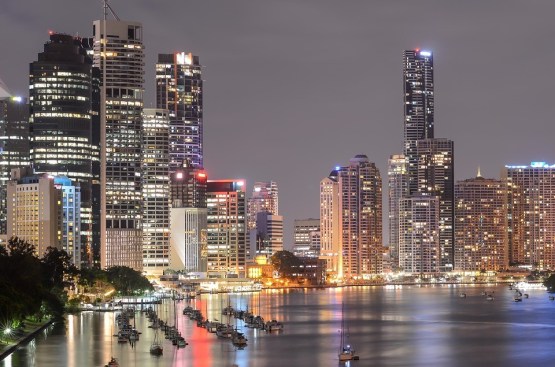
A prime location can be an important factor distinguishing a true luxury apartment.

The way individuals define a luxury apartment seems to be subjective. It can have different meanings to various people, depending on where and how they have been brought up. For instance, if you were raised in a Beverly Hills’ mansion, the first few words that you might associate a luxury building with, can be size, craftsmanship and quality, whereas for someone who grew up in a small suburb in Queensland it might be the location, price, and something that is out of reach. However, the inseparable part of luxury is perfection – impeccable finishes with no fault.

Luxury is ‘timeless’ and is not necessarily complicated or traditional. It can be a simple classy impressive design with a high-end superb contemporary style and great utilisation of space. Luxury is a combination of factors, and there is no single factor defining luxury. Some of the aspects that you need to look for in a luxury apartment are as follows.

EXCLUSIVITY:

A property needs to be rare or scarce to be considered as exclusive. For example, it could be positioned in a unique waterfront location with boatyard and one unit on each level that can hardly be found anywhere else. It could contain very high ceilings and custom designed handcrafted pieces that can only be found in a particular building. For instance, O-14, in Dubai has one-metre wide spaces between the glass windows and the facade that allows the building to cool down in the desert heat.

WOW FACTOR:

The moment that something enjoyably surprises or impresses you, and makes you pay the premium price to secure a property, is when you have experienced a wow factor. It can be the spaciousness of an apartment, the view, the shape of the building or rooms, unique architecture and design, extra features such as a big beautiful butler’s pantry or a high-end wine cellar, and even the innovation and the technologies used in the apartment (e.g. being able to control everything through your phone from the air-conditioning temperature to the lights’ brightness) which makes your life more pleasurable and comfortable. These are features that are increasingly being seen in Brisbane luxury apartments.

PRIME LOCATION:

Location plays a significant role in making a property a luxury one. Prime locations may be in areas long-known as prestige and upmarket, with beautiful natural surroundings, and which have a short proximity to fine dining, luxury shopping, galleries, museums, entertainment, leisure and parks, for example. Or they may be places where you can get panoramic view of the ocean, river or city in an unrivaled location. A prime location, typically with an excellent view, is something a luxury apartment must have.

REPUTATION:

It is important that the developer and the architect of the building have a rich heritage and fine reputation, and are well-recognised in delivering the best projects in the market.  A good example is an eleven-storey luxury building designed by Zaha Hadid in NYC, with the asking price of $50M for penthouses.

QUALITY:

The material that is used in the building from interior to exterior needs to be of top quality (i.e. everlasting). As the kitchen is usually the main part of each property, its design (e.g. luxurious high quality bench top and bench top rangehood) and quality of appliances as well as their functionality matter the most. Miele and Gaggenau appliances are found in most of the luxury apartments.

 AESTHETIC:

A property’s aesthetic features can distinguish a property as luxury. That is, the beauty of the design and features of the property that stimulates your senses and enhances your mood. It can be the lighting of the property (whether it is artificial or natural) that makes you feel welcomed and relaxed or having pleasing colours used in ceilings, floors, wardrobes, kitchen cabinets and appliances.

SIZE AND SPACIOUSNESS:

Luxury apartments have to be more spacious than typical apartments, to provide their owners with the level of comfort they desire. This applies to outdoor areas, too, and balconies have to be generously sized, for example, to entertain friends and to accommodate a large high-end barbeque and even a wine fridge in some instances.

AMENITIES:

In luxury buildings some of the amenities can include outstanding facilities such as  a rooftop garden and “infinity pool”, which gives you the illusion that the pool is ending in the river or ocean, a unique spa with a spectacular view of the city, private barbeque and rooftop sanctuary, a leading edge gym or a cinema with the best audio and visual appliances and design.

EXCEPTIONAL SERVICES:

The types of services that needs to be considered in luxury apartments are: 24/7 onsite management, secured residents lobby and parking, function rooms, on-site spa, and personalised services for owners through the concierge.

SAFETY AND PRIVACY:

Given that luxury apartment buyers will likely be wealthy people (e.g. doctors, lawyers, business people), and some may be in the public eye, they will demand a high level of safety and privacy. Restricted private lobbies for some floors may be attractive to some buyers, for example.

THE MARKET FOR LUXURY APARTMENTS

Ultimately, an apartment is luxury when people have strong desire and dream for it, when it is aspiring. This means they will be willing to pay a premium price for the apartment. Depending on the number of bedrooms, bathrooms, carparks and storage size, price will vary. Though, based on a consideration of properties in the Greater Brisbane area, and assessing them on the basis of the above factors, the starting price for a true luxury property is around $1 million.

The luxury apartment market appears to have several market segments. Arguably, Brisbane does not yet have an ultra-luxury market segment (e.g. Trump Tower in NYC and One Hyde Park in London where apartments sell for tens of millions of dollars). But Brisbane does appear to have a reasonably strong market for apartments in the $1-5M range, which may feature penthouse-style apartments, including half or full floors of exclusive apartment buildings, such as Riparian Plaza in the City, or the yet to be built Banyan Tree apartments at Kangaroo Point, Banc at Toowong, or Walan at Kangaroo Point developments.

Individuals who buy opulent properties are people who not only look for opportunities to show their social status, but also search for a pleasant experience that they cannot get anywhere else. Luxury apartment buyers would include affluent Chinese, baby boomers looking to downsize without compromising their lifestyles, as well as high-income earner young professionals, among other demographic groups. Different types of luxury apartments may appeal to these different groups. For example, younger buyers may be more attracted to luxury apartments with high quality on-site gyms or barbeque areas.

CONCLUSION

Brisbane currently has many apartments that are being marketed as “luxury” apartments, but arguably the number of true luxury apartments is much smaller. To develop true luxury apartments that will attract a premium price and meet an ever growing demand, developers should consider the range of factors we have identified above, particularly the need for a “wow factor”, prime location, exceptional services, and privacy and security among other factors.

Posted in Brisbane, Housing, Uncategorized | Tagged , , , , , , | 4 Comments

Guest post – Where is NSW getting the money to fund its massive infrastructure spending?

I am delighted to publish another guest post from my friend and fellow economist Dr Alistair Robson. Views expressed in this article are Alistair’s, and should not necessarily be attributed to me.

Where is NSW getting the money to fund its massive infrastructure spending?

by Dr Alistair Robson

The NSW Government will spend about $20 billion on infrastructure through its Rebuilding NSW plan. Where is it getting the money from to do this?

There are two major reasons NSW can fund this level of infrastructure spending.  The first is NSW’s strong fiscal position and low debt, and the second is use of ‘Asset Recycling’.  NSW’s strong fiscal position will be examined first along with a comparison to Queensland before a look at ‘Asset Recycling’.

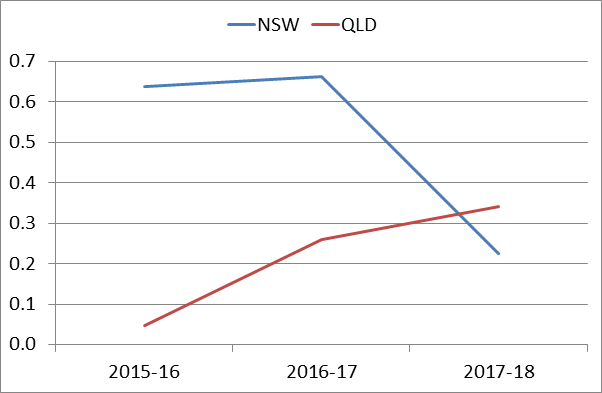
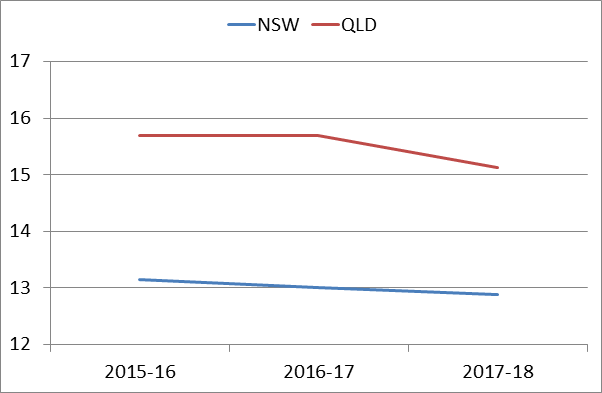
The NSW state general government budget forecasts an operating surplus of $3.7 billion in 2016-17 and operating surpluses averaging $2.0 billion over the budget year and forward estimates. An operating surplus is where revenues exceed operating expenses (i.e. excluding net capital expenditures).  As a proportion of GSP, NSW’s operating surplus is estimated to be 0.6% in 2015-16 and forecast to be 0.7% in 2016-17 before dropping to 0.2% in 2017-18.  Comparatively, in Queensland, the general government’s operating (or recurrent) budget is estimated to be balanced in 2015-16 and an operating surplus of 0.3% of GSP is forecast in 2016-17 and increasing again in 2017-18.

Figure 1: General Government Budget Balance—% of GSP

ar_figure1

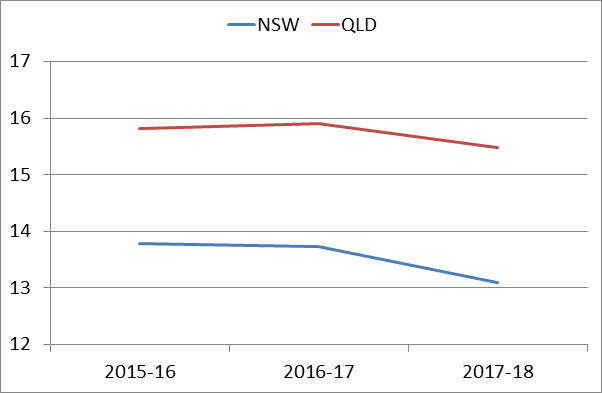
General Government revenue as a proportion of GSP is forecast to be higher in Queensland than in New South Wales in 2015-16 through to 2017-18. In Queensland it is anticipated to increase in 2016-17 but fall slightly in 2017-18 in NSW. In 2017-18 it will fall in both NSW and Queensland.

Figure 2: General Government Revenue—% of GSP

ar_figure2

General Government expenditure is forecast to be higher in Queensland than in New South Wales in 2015-16 through to 2017-18.  Over the forward estimates period it will fall as a proportion of GSP in both states. Queensland typically spends more as a proportion of its GSP due to many reasons, such as a larger state area and provision of new infrastructure for a usually faster growing population.

Figure 3: General Government Expenditure—% of GSP

ar_figure3

Both the NSW and Queensland state governments forecast operating surpluses in the coming four years.  These sets of forecasts are based on questionable sets of assumptions.  The NSW budget surplus partly depends on relatively low interest rates propping up house prices, as stamp duty revenues are highly sensitive to house prices, while the Queensland budget surplus partly depends on overseas demand for LNG.

In the NSW budget, of interest to Queensland is the continual upgrade of the Pacific Highway which should mean lower travel times for trucks delivering intra‑state exports from Queensland to Southern states.  Also the southern suburbs of the Gold Coast will benefit from the major upgrade of the Tweed Heads Hospital.

Looking forward, budgetary pressures from health services will continue in NSW. This is particularly so in the fast growing Western Sydney area and exemplified by the recent media coverage of pressures at the Nepean Hospital. Over the long-term, according to the NSW Intergenerational Report, health expenses are expected to grow at 6 percent per annum.  The construction of Badgery’s Creek airport will also require a lot of infrastructure such as rail and roads which will add to budgetary pressures in coming years, as it is not currently factored into the budget forward estimates.

This strong fiscal position will help the NSW Government spend about $20 billion through its Rebuilding NSW plan.  Deloitte Access economics estimates the plan will produce $300 billion in benefits for the NSW economy and 100,000 extra jobs over 20 years to 2035/36.  Much of this is spending is due to ‘asset recycling’.  Asset recycling is where the proceeds from the long term leases of existing assets are used to fund the building of new infrastructure.  That is, asset recycling is effectively using privatisation proceeds to fund new infrastructure. Asset recycling allows the Government to invest in new infrastructure without increasing borrowing and it can also improve the budget bottom line by funding capital expenditure that may otherwise have had to be funded by the Government budget.

The impetus for the asset recycling scheme was a report on Public Infrastructure released by the Productivity Commission in 2014.  The report said there was an urgent need to comprehensively overhaul processes for assessing and developing public infrastructure projects. Asset recycling was further advanced by the ex-Treasurer Joe Hockey with a $5 billion fund to provide a 15% top-up from the proceeds of any asset sales/long term leases. NSW has been the largest recipient of funds to date with the $10.3 billion for electricity wholesaler Transgrid, and presumed money from the long term lease of 50.4% of both Ausgrid and Endeavour Energy to make a total for all three at an expected $20 billion. After a knock back by the Federal Treasurer for a Chinese led consortium of China’s State Grid and Hong Kong based Cheung Kong Infrastructure due to security concerns to buy Ausgrid, it will now be sold for $16.189 billion to a consortium of IFM Investors and superannuation fund AustralianSuper .

The money will be spent on numerous infrastructure projects including the Sydney Metro and other urban public transport projects ($8.9 billion), Light rail projects (Parramatta light rail, CBD and South East Light Rail, and Newcastle Light Rail), and regional freight corridors and other regional roads such as the Newell highway, Princes Highway and New England Highway $3.7 billion).

The largest urban road infrastructure projects will be the several motorways under construction or expansion — specifically the $11 billion Westconnex project and the $3 billion Northconnex project. Both should ease congestion and increase productivity in some of Australia’s most economically important and highly congested transport routes.  As a side effect the Westconnex project allows for fewer trucks along Parramatta road and enhanced urban renewal and corresponding commercial land development opportunities (as has the Newcastle light rail project). The NSW Government anticipates $20 billion in economic benefits from Westconnex as well as 10,000 jobs in the construction phase.

While NSW net debt is also increasing to partly pay for this infrastructure, it will be producing a valuable asset and remains low as a proportion of GSP and revenue.  The Queensland Government could consider, assuming quality business cases by an independent infrastructure body, following suit and use relative low interest rates to spend more money on infrastructure such as widening the M1, M7 and extending the Gold Coast heavy rail line.  These investments would boost economic efficiency in future years at a historically low cost of debt.

As with any government process there will be winners and losers.  One solution is better communication as Dr Matthew Beck of the University of Sydney suggests (http://sydney.edu.au/business/itls/thinking/opinion/asset_recycling). He writes that voters are willing to accept asset privatisations if the communication message (and style) is clear there will be benefits.

Dr Alistair Robson is a Sydney-based economist. He has a PhD in Economic Geography from the University of Queensland.

Posted in Infrastructure, Transport, Uncategorized | Tagged , , , , | 2 Comments

Better Living through Economics – upcoming presentation at UQ

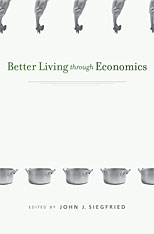
Economists have made immense contributions to people’s wellbeing over the last fifty years. An Australian example that comes to mind is the instrumental role economists played in advocating for and designing microeconomic reforms, including tariff reductions, privatisations and the deregulation of industries. Such reforms have resulted in a higher standard of living, including through cheaper cars, clothes and plane flights, for example. Also, economists at the Treasury (of which I was one) and the RBA were critical in developing effective policy responses to the financial crisis. So economists have much to celebrate and to be proud of.

Hence, I welcome an upcoming presentation by Vanderbilt University Emeritus Professor John Siegfried on “Better Living through Economics”, at the University of Queensland, Brisbane on the evening of Thursday 17 November. Professor Siegfried will speak on case studies in a 2012 book he edited regarding the positive contributions that economics has made to our daily lives over the last half century. You can register to attend via this event registration website:

Better Living through Economics

The presentation will occur in the exclusive Terrace Room in the Sir Llew Edwards Building, which offers a terrific view of Brisbane’s leafy western suburbs. You might even consider having dinner at UQ’s world renowned Pizza Caffe afterwards.

The presentation is being sponsored by the Economic Society of Australia (Qld) of which I am the Secretary, Griffith University, QUT and the University of Queensland.

better_living_through_economics

Undeniably, the secret to better living is economics.

Posted in Macroeconomy, Trade, Uncategorized | Tagged , , , , , , , , , | 3 Comments

Inquiry should consider contestability and privatisation of QR services

One of the alleged benefits of public provision of services is that levels of service and reliability are higher than for private provision, but the crisis engulfing Queensland Rail at the moment suggests we should question that purported benefit. It should now be obvious to us all that QR is a sclerotic, inefficient Government bureaucracy that needs shaking up. A good way to do this would be to be privatise the rail services QR provides, and this should be an issue for consideration in the inquiry into the “timetable meltdown” (See today’s Courier-Mail). Indeed, the Queensland Commission of Audit advocated such privatisation in 2013, recommending that (on p 1-29 of the Executive Summary):

“City passenger rail services and network infrastructure be opened up to contestability, like bus services, to allow different providers, including private providers, to bid to operate services and maintain below-rail assets in a particular franchised area under franchise and lease arrangements.”

While rail privatisations have had a mixed record around the world—they have had much better results in Victoria than in the UK, for example—the failure at QR is so bad that it is hard to see how we could make matters worse through privatisation, and there is a very strong likelihood we would improve both efficiency and reliability, and the Government would get the benefit of substantial savings in the provision of rail services.

As I predicted at the time of its release in 2013, the Queensland Commission of Audit report is having a very long shelf life (see Commission of Audit report an impressive guide to reform of Qld Government). Regrettably, that in part reflects inertia in public sector reform and the survival of bureaucratic dinosaurs like QR. It is time for a new approach.

QCA_report

The Queensland Commission of Audit report will have a very long shelf life.

Update: I have amended the last sentence of the second last paragraph to remove reference to “privatisation proceeds” and refer instead to savings in the provision of rail services that would occur if rail services were made contestable.

Posted in Queensland Rail, Transport, Uncategorized | Tagged , , , , , , , , | 6 Comments