The Sydney property boom and interstate migration to Qld

Regular QEW blog reader and occasional contributor Mike Willis asked some good questions in response to my post yesterday on Five million Queenslanders by EOFY 2017-18, which noted interstate migration to Queensland is trending up.

“Gene, this data is reflected in other anecdotal trends of demand in SE Qld. It looks like the post-GFC and post-mining boom hangovers may be over? Or is this just the traditional ripple effect in SE Qld from the Sydney property boom?”

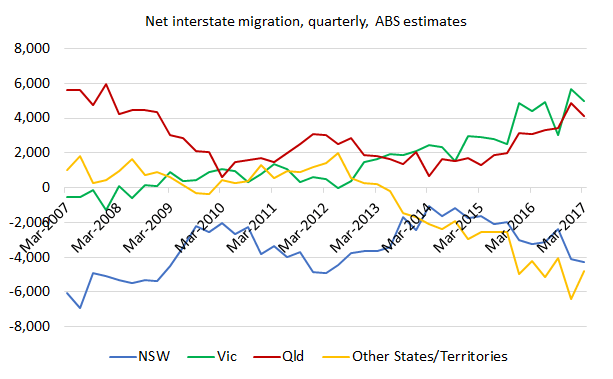
The answer to the first question is yes, as the Queensland economy has been recovering nicely over the last year or so. The answer to the second question is very likely yes as well, and the pick up in interstate migration is a result of both factors. Mike had actually predicted the “ripple effect” from the Sydney property boom and had forecast a pick up in interstate migration to Queensland in a QEW post back in June 2015. Certainly a pick up in interstate migration from NSW has been responsible for much of the recovery in interstate migration to Queensland in recent years (see chart below).

NIM_by_States

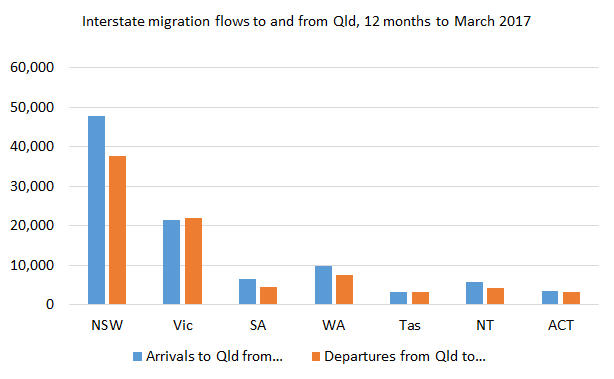
And the increase in net interstate migration from NSW has been due to an increase in arrivals to Queensland from NSW rather than a fall in departures to NSW from Queensland (chart below).

Arrivals and departures

No doubt some Sydneysiders have decided to take advantage of the large house price differential between Sydney and Brisbane (or the GC or elsewhere), selling their houses in Sydney and moving up here to buy a comparable or superior property, and still having money left over (see chart below).

median house prices

REIQ Chairman Rob Honeycombe and Propertyology’s Simon Pressley have also made some interesting observations on this issue. See this Domain report from earlier this year:

House price disparity between Sydney and Brisbane set to spur northern migration

Posted in Housing, Migration, Uncategorized | Tagged , , , , , , , | Leave a comment

Five million Queenslanders by EOFY 2017-18

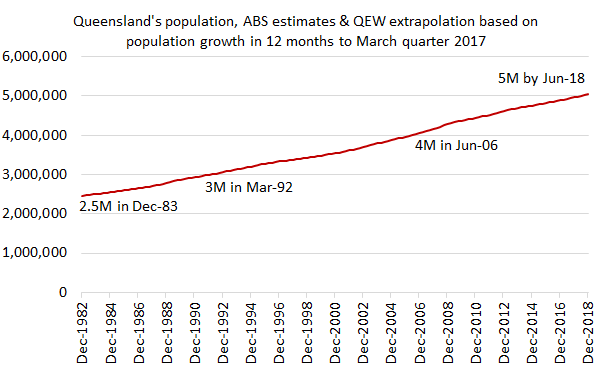
Sometime around the middle of June next year, Queensland is expected to have 5 million residents (see chart below). This is based on an extrapolation of the Queensland Government Statistician’s Office’s population counter estimate, currently at around 4.95 million, which itself is extrapolated from ABS population estimates, the latest of which were released last week. When it is achieved, the milestone of 5 million Queenslanders will prompt us to reflect on how we have gone at managing our population growth, particularly in SEQ. A frequent example of the challenge of managing our ever increasing population is the heavy congestion on the M1 motorway between Brisbane and the Gold Coast. This will no doubt be a major issue at the upcoming State election, especially in marginal GC seats, as the Opposition has proposed a “second M1” (see this news.com.au report), although it has not actually committed to building it if it wins the next election, which is a very likely prospect according to today’s Sunday Mail.

Pop_post_Mar17_Chart1

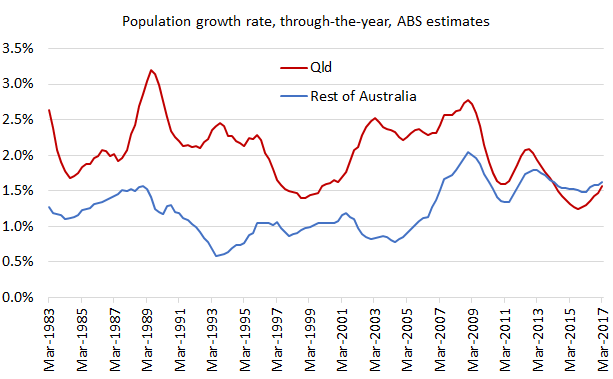
The March quarter demographic data revealed Queensland’s population growth rate is continuing to move back towards the growth rate of the rest of Australia (see chart below).

Pop_post_Mar17_Chart2

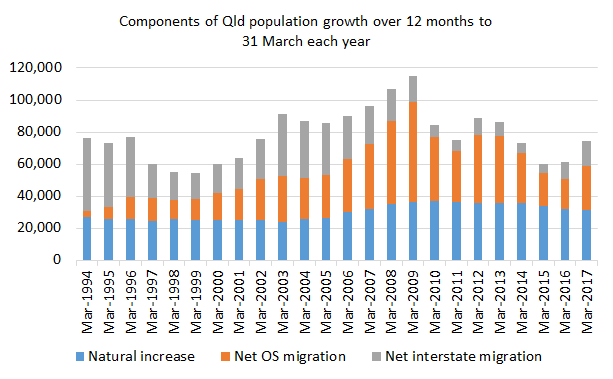
This recovery in Queensland’s population growth rate has been driven by an increase in net interstate and net overseas migration (see chart below). A pick up in population growth is likely associated with improving labour market conditions in Queensland over the last year or so. However, as Nick Behrens noted at his QEAS blog:

“Population flows towards employment opportunity but it will take more full-time jobs to really ramp up interstate migration.”

Pop_post_Mar17_Chart2b

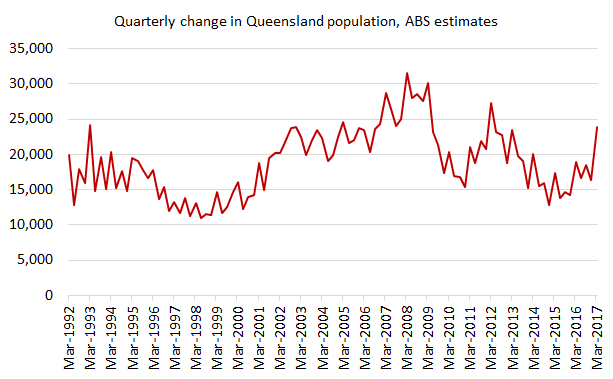
March quarter saw a sharp increase in the quarterly change in population (see chart below), suggesting the through-the-year population growth rate is on an upward trend. So we may see a sustained recovery in the population growth rate to around 1.75%, meaning Queensland Treasury’s forecasts and projections in the Budget of 1.5% p.a. population growth for the next few years may turn out to be a bit conservative.

Pop_post_Mar17_Chart3

Finally, even though net interstate migration to Queensland appears to be on an increasing trend, Victoria is still beating us in the interstate migration stakes (see chart below).

Pop_post_Mar17_Chart4

And there is still a very small leakage of people (in net terms) to Victoria (see chart below). That is, the number of Queenslanders departing to Victoria to live still slightly exceeds the number of Victorians arriving in Queensland to live.

Pop_post_Mar17_Chart4b

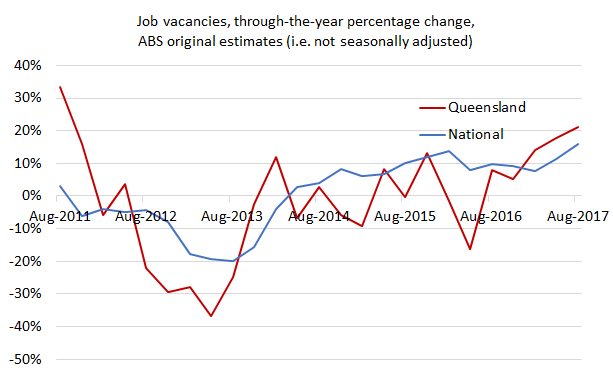
Finally, regarding Queensland’s improving labour market, note that job vacancies continue to grow strongly according to the latest ABS estimates released last Thursday (see chart below), suggesting employment will continue to grow strongly over the remainder of 2017.

Pop_post_Mar17_Chart5

Posted in Labour market, Population, Uncategorized | Tagged , , , , , , , , , | 2 Comments

UQ student’s Treasury prize winning essay highlights benefits of competition & free trade

The Australian Treasury yesterday announced the winner of its inaugural essay competition, and the award went to University of Queensland Economics student Elizabeth Baldwin, who incidentally also won the RBA/Economic Society of Australia essay prize last year. The essay question was:

What do you believe will be most important for ensuring Australia’s future economic prosperity, and why?

As is now well known, productivity growth is the most important contributor to long-run improvements in living standards. So Ms Baldwin focused on factors influencing the productivity of firms in the economy, particularly how readily they adopt new technology and knowledge. Ms Baldwin’s well-researched essay stressed the importance of competitive markets and free trade in promoting the diffusion and adoption of new technology, which is critical to productivity growth. She also noted competition is important in eliminating what is called X-inefficiency, where firms shielded from competition get complacent and have a high degree of slack in their operations.  Incidentally, I would note this is why protectionist measures such as Buy Queensland are such poor policy.

Well done to Ms Baldwin for winning two prestigious national essay competitions (you can find her RBA prize winning essay at the RBA website). And well done to UQ Economics for continuing to encourage excellence in economic analysis and research.

Treasury

The extraordinary Norma Redpath fountain in the forecourt of the Treasury Building, King Edward Terrace, Canberra

Posted in Productivity, Trade, Uncategorized | Tagged , , , , , , , , , , | Leave a comment

My comments on possible NRL Grand Final at Suncorp in today’s Courier-Mail

I am quoted in today’s Courier-Mail story Queensland in talks to host NRL Grand Final at Suncorp in $10 million boost to the economy:

MORE than $10 million could be injected into the Queensland economy if the state hosted an NRL grand final, according to economists.

Sports Minister Mick de Brenni said the State Government was in talks with the NRL to bring a grand final to Suncorp Stadium as early as next year…

Economist Gene Tunny said a grand final game in Brisbane would pour millions of dollars into the economy.

“You’re looking at over a $10 million impact, so it would be significant and it’d definitely help the hospitality and accommodation industry,” Mr Tunny said.

“It would definitely be a boon to the economy but we just need to be judicious about any financial support from the Government.

“It would be terrific.”

CCIQ economist Steven Gosarevski was also interviewed for the story and provided a similar estimate of the likely economic impact.

As I noted to the Courier-Mail, I would not approve of the State Government providing financial support to the NRL for a Brisbane Grand Final. There are better things to spend taxpayers’ dollars on. My previous comments on industry assistance include an August 2015 ABC News interview on industry assistance.

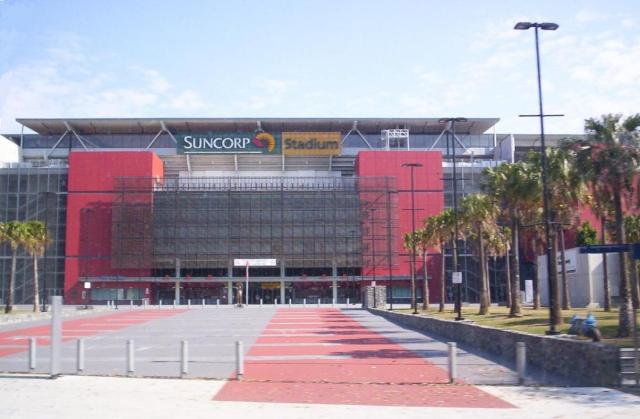
Suncorp-Stadium-Milton-Queensland

Suncorp Stadium, a.k.a. Lang Park and the Cauldron

Posted in Brisbane, Industry policy, Uncategorized | Tagged , , , , , | 2 Comments

Courier-Mail & 612 ABC Brisbane media this week regarding jobs growth & small business

Today’s Courier-Mail features a short piece (on p. 29) “Employment growth best since the GFC” from Daryl Passmore quoting FNQ-based economist Pete Faulkner and me on Queensland’s recent strong employment growth. The Queensland economy has been recovering strongly over the last year or so, after it experienced some sluggishness at the end of the mining investment boom. I also chatted with Trevor Jackson from 612 ABC Brisbane about employment and economic growth in Queensland last Tuesday evening. The interview starts at 8’46”:

612 ABC Brisbane Evenings with Trevor Jackson, Tuesday 19 September 2017

I made the point to Trevor that, while the aggregate data are very good, we need to keep in mind that part-time positions appear to be growing much more strongly than full-time positions, and also that the State public service has made a disproportionate contribution to jobs growth.

My other media mention this week followed on from my small business employment trends post, published on Wednesday. The Courier-Mail ran an article yesterday including a quote from me. CCIQ’s GM of Advocacy Kate Whittle has included a snapshot of the article on her twitter feed (see below).

https://twitter.com/katewhittle01/status/911001914061418497

Incidentally, CCIQ is generally doing a great job informing and participating in the public policy debate. I can highly recommend the twitter feed of CCIQ’s economist Steven Gosarevski. Follow him @sgosarevski for very timely updates on the latest economic data relevant to Queensland. I have especially enjoyed his most excellent charts. Keep up the good work!

Posted in Labour market, Macroeconomy, Uncategorized | Tagged , , , , , , , | Leave a comment

Bigger is better – small businesses once employed over half of private sector workers but no longer

Ten years ago, small businesses, those with fewer than 20 employees, employed over half of private sector workers in Queensland, but that is no longer the case. This was revealed in an excellent note, Small Business in Queensland, published yesterday by the Queensland Government Statistician’s Office, part of the Queensland Treasury:

“While small business makes a significant contribution to total employment in Queensland, its share has fallen from 55.9% in June 2007 to 44.2% in 2016.”

The trend decline occurred across Australia, although the fall was greater in Queensland than the rest of Australia, on average.

While small business employment declined, employment in medium-sized businesses (20-199 employees) increased. The Government Statistician’s Office reports:

“Between June 2007 and June 2016, the number of persons employed in a small business in Queensland decreased by 166,000 (down 15.4%)…Conversely, the number of persons employed in a medium or large business increased by 128,000 (38.0%) and 172,000 (33.5%) respectively.”

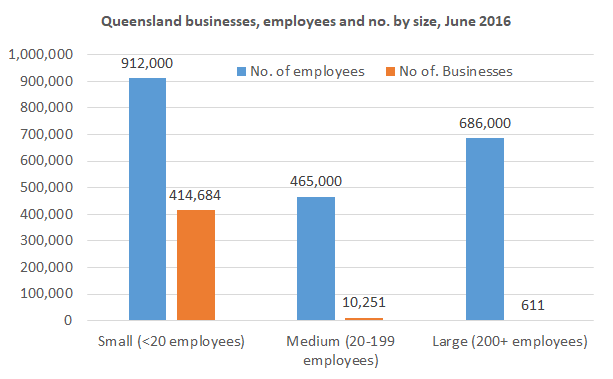
Incidentally, medium-sized businesses and large businesses (200+ employees) make up only 2.6 percent of total businesses, but account for 56% of employees (see chart below).

Why have small businesses declined in relative importance? Many factors have probably contributed to the downward trend, including, among others:

  • Consumer preferences, with consumers preferring to shop at bigger stores with more variety and lower prices (as the bigger stores benefit from economies of scale);
  • Information and communications technology improvements which have made it easier for successful businesses to extend their business models into new regions;
  • Government regulations, particularly in workplace relations, which impose costs that massively eat into the margins of small businesses and can more readily be absorbed by larger businesses; and
  • Deregulation (e.g. of retail trading hours), which has gradually been eliminating many of the small corner stores that were once prevalent in Australia.

Of course, technology is now allowing many people to set up micro-businesses, such as consultancies or Uber driving businesses, so there may be a reversal in the longer-term trend to some extent. But the longer-term trend away from traditional small businesses, such as a corner store or newsagent employing half a dozen people, appears unstoppable.

Qld_businesses_2016

Posted in Uncategorized | Tagged , , , | 2 Comments

Unmissable upcoming Lowy Institute Choosing Openness paper launch with Andrew Leigh

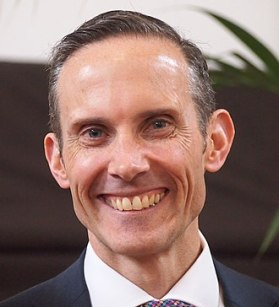
Australian Shadow Assistant Treasurer Dr Andrew Leigh will be speaking at the Brisbane launch of his Lowy Institute paper Choosing Openness on the evening of Wednesday 4 October, at the Queensland College of Art in South Brisbane. This looks absolutely unmissable for anyone interested in economics and politics. Here is the summary from the website:

In-conversation with Andrew Leigh and Sam Roggeveen, Senior Fellow of the Lowy Institute, followed by a Q&A.

In the early part of the twentieth century, the world turned inwards as fear shut down flows of people and goods across national borders. A century later, can we make a better choice?

Please join us for the launch of Choosing Openness, a new Lowy Institute Paper by the Hon Dr Andrew Leigh MP and published by Penguin Random House Australia.

Across the developed world, global engagement has become a major political fault line. Some say that trade, investment, and immigration are threats rather than opportunities. Global uncertainty, rising inequality, and populism present real challenges to globalists. Choosing Openness argues that Australia’s past prosperity has flowed from engaging with the world. An open Australia requires stronger advocacy and smarter policies.

Such a discussion is especially needed in Queensland at the moment, given the recent adoption of the Buy Queensland procurement policy, one of the most illogical and misguided pieces of policy implemented in recent times in this State. Recall this is the policy that massively favours local firms in procurement processes, risks a blowout in government expenses, and has upset the New Zealand Government, causing a trade policy headache for the federal government. I strongly suspect Buy Queensland is inconsistent with the views that will be advanced by Dr Leigh in his Choosing Openness paper. I hope that the policy is discussed in either the conversation or Q&A component of the evening.

My previous posts on the new Buy Queensland procurement policy include:

Comments to Radio NZ on Buy Qld policy

Protectionist Buy Qld policy unlikely to survive in current form

Interview on Buy Qld with Dave Pellowe

330px-Andrew_Leigh_2017

Dr Andrew Leigh, Australian Shadow Assistant Treasurer

Posted in Trade, Uncategorized | Tagged , , , , , | 3 Comments

With One Nation as likely power brokers, expect greater share of Qld Gov’t CAPEX in regions

If I were the Managing Director of an engineering firm, I’d start investigating the availability of office space in Queensland’s regional centres, including Maroochydore, Rockhampton, Toowoomba, and Townsville. I would want the firm well-positioned to win new work from a State Government that will undoubtedly spend more on regional capital works, to satisfy the likely new power brokers  from One Nation, which is expected to win several regional seats. And I wouldn’t count on Cross River Rail going ahead.

Today’s Sunday-Mail is reporting One Nation Queensland leader Steve Dickson is anti-Cross River Rail, and instead wants some major regional projects funded, including a duplicated Sunshine Coast rail line and an expansion of the Borumba dam (to rival Wivenhoe in capacity) in the Gympie region (see this Gympie Times report). After the Traveston dam debacle, I suspect the likelihood of getting environmental approval for expanding the Borumba dam is pretty close to zero, but no doubt One Nation will find many other regional projects to fund.

The betting odds reported by Centrebet currently suggest Tim Nicholls is favourite to become Premier after the upcoming State election (see screenshot below). This is plausible, given Queensland currently has a minority government, One Nation is expected to win several seats, and Labor has ruled out a deal with One Nation. Election punters have obviously heavily discounted polling results suggesting Labor is well in the lead, as these are based on an assumed 55-45 preference flow from One Nation to the LNP and Labor, respectively. Many poll watchers expect the preference flow will more heavily favour the LNP than is currently assumed by Newspoll, so the election will be closer than Newspoll suggests.

Qld_election_odds

Despite the betting markets currently favouring an LNP victory, I still expect Premier Palaszczuk to call an election this year. The Government is already in campaign mode and won’t want to lose momentum over the Christmas-New Year period. Also, it can point to an improvement in economic conditions over the last year or so (see my previous post). And consider that, by holding the election this year, the current Government would shorten the term of the next Government, possibly by over half a year. This may be attractive to Labor if it thinks it will lose the upcoming election. As explained in the Brisbane Times earlier this year, due to the transitional arrangements for four-year fixed terms:

…if an election is held before December 31, 2017, the next election will be held on October 31, 2020. If it is held between January 1, 2018 and May 5, 2018, the next election will be held on October 30, 2021.

Betting markets can be wrong, of course, as they were in the 2016 US Presidential election. Labor is exceptionally good at campaigning in marginal seats and can generally rely on more manpower and dollars, much of them coming from the union movement, than the LNP. So it would be unwise to discount Labor’s chances. It is certain to be a bitter and hard-fought election battle.

Even if Labor ends up winning in its own right, I suspect One Nation will remain influential and may force the Government into boosting its regional capital expenditure. Expect to hear a lot about so-called “good debt” being used to finance Queensland infrastructure in future years.

As I have noted in previous posts (e.g. see Townsville Bulletin report on funding feud), capital works spending per capita in Queensland has been higher in regional Queensland than SEQ (partly because of economies of scale and the need to spend so much on disaster recovery). I expect the regions will continue to receive a generous share of State Government capital spending after the next election regardless of who wins, and that the share going to the regions would increase sharply if an LNP minority government assumes power with One Nation support.

Posted in Infrastructure, Queensland Government, Uncategorized | Tagged , , , , , , , , , , , | 4 Comments

Strong jobs figures for Qld, although much of recent increase was in part-time employment

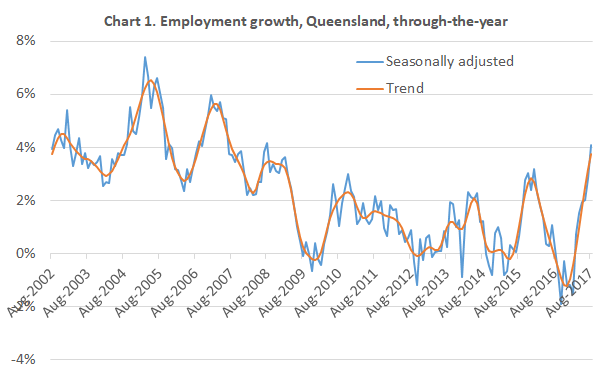
The August jobs figures released yesterday by the ABS confirmed the Queensland economy is clearly on an upswing and jobs growth is currently strong, with through-the-year growth in employment at 3.7% compared with a national rate of 2.6% (chart 1). The unemployment rate is trending downwards, and is now at 6.0% compared with the national average of 5.6%. My feeling is the upswing is fairly broad-based, but with tourism and health, aged and disability care services being stand-out sectors.

Chart1_LF_Aug17

A large fall in the seasonally-adjusted Queensland unemployment rate in August to 5.7% (from 6.2%) suggests the trend unemployment rate will continue to fall in September. This would be welcome news for the Government when the next set of figures are released in mid-October, as I expect the Government will then be in an election campaign. The Premier won’t waste much time before she calls an election after footy season has finished. Note the NRL Grand Final is on Sunday 1 October, and an early November election is highly likely.

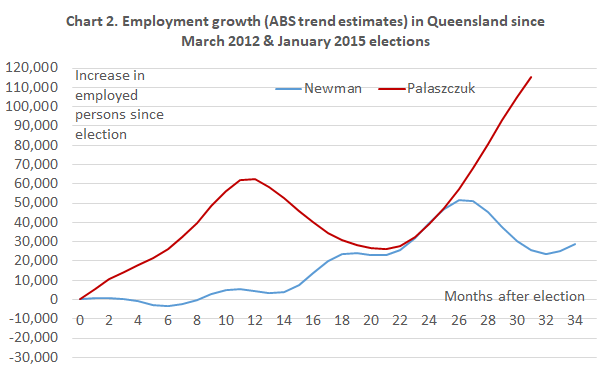
So far, the Government can point to over 115,000 additional jobs since the last election (Chart 2).

Chart2_LF_Aug17

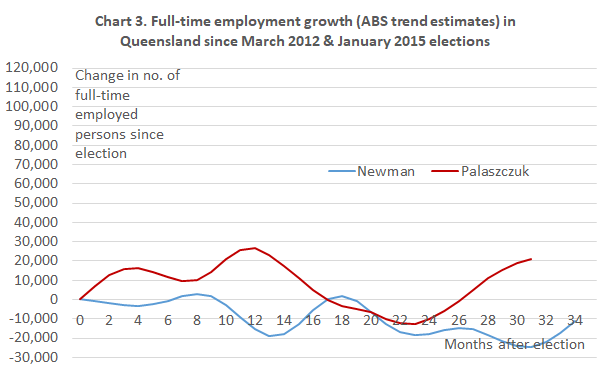
However, the Opposition is correct to highlight the bulk of additional employed persons have been in part-time positions, with only around 21,000 additional full-time employed persons since the last election (Chart 3).

Chart3_LF_Aug17

Also see Pete Faulkner’s coverage:

Strong jobs growth. Qld strongest jobs growth since GFC

Posted in Labour market, Uncategorized | Tagged , , , , , , , , , | Leave a comment

BWF session considers fake news & economic viability of quality journalism

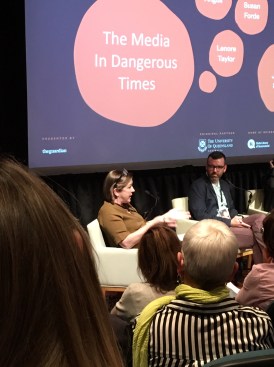
Yesterday afternoon, Saturday 9 September, I attended a Brisbane Writers Festival panel discussion “The Media in Dangerous Times” at the State Library of Queensland. The topic was “how news organisations are responding to the threat of Fake News and the formation of filter bubbles through social media algorithms and knowledge curation.” Griffith Review editor Julianne Schultz chaired the panel, which comprised Guardian Australia Editor Lenore Taylor, UQ academic Daniel Angus, and Griffith academic Susan Forde.
Writers_Festival_2017

Guardian Australia editor Lenore Taylor providing great insight into media trends at the Brisbane Writers Festival

Based on the discussion in the session, in my view it will be difficult to reverse the trend of fake news and filter bubbles, of people getting a highly curated news feed consistent with their existing world views. Also, for me, the session reinforced the dismal economic outlook for many traditional media providers. Even though established news providers, such as the Guardian and the Australian, have a very large readership online, there is such competition for online advertising revenue that such revenue is insufficient for news organisations to be profitable, given the high cost of gathering and reporting the news.

It is well known that both Fairfax and News Corporation are struggling. News Corporation recently reported a yearly loss of over $800 million, after having written down the value of its UK and Australian newspapers by $1 billion (see this ABC News report). Both Fairfax and News Corporation’s Australian division are highly dependent on their online real estate advertising arms, domain.com.au and real.estate.com.au, meaning both companies would be vulnerable to a future property market slump.

Unfortunately for the traditional media providers, online ad revenue is increasingly being lost to Google and Facebook, which benefit from the news articles generated by the media providers, as people either search for them via Google or view them via Facebook. Also, click bait and fake news are taking away readers and ad revenue from quality journalism. So many media providers, including News Corporation, the New York Times and Financial Times (FT) among others, have embraced paywalls.

In the panel discussion, Guardian editor Lenore Taylor said she does not favour a paywall model, as there is a public benefit in news being publicly available. The Guardian has instead opted for a voluntary supporter model, with contributions of $10 per month, and it also encourages donations. Guardian Australia desperately needs this new model to work. In late 2015, the Australian reported that the Guardian Australia had two years to prove its worth. Ms Taylor mentioned the need to grow the Guardian’s revenue often kept her awake at night. Of course, the need to grow revenue is a concern for many businesses. But it appears especially difficult in the media industry, given the trends that were discussed by the panel.

Best of luck to Ms Taylor in making the Guardian Australia financially viable, but I fear it may be in trouble. Its voluntary supporter model runs up against the classic free rider problem. It appears unlikely sufficient people would sign up as supporters, paying $10 per month, when the vast majority of people can continue to read the site’s contents for free. For this reason, I also suspect Jimmy Wales’s new crowd-sourced news organisation, Wiki Tribune, which will also rely on a voluntary supporter model, will struggle.

In my view, although we all hate being blocked from reading articles on pay-walled news sites, such as the Courier-Mail or New York Times, the pay wall may ultimately be the best model for traditional journalism. But, as noted above, many media organisations are still struggling even though they have adopted this model. The problem is, of course, they are competing with (a) a whole lot of free content, including content from public broadcasters such as the ABC, and (b) the tendency for basic news to spread quickly via many channels, so, if media companies are not offering deep insights and analysis, few people will be willing to sign up.

Media organisations also may have to expand their geographic reach, meaning the better known brands such as the New York Times may end up in dominant positions, but those which focus on specific geographic regions may continue to struggle and fail. Griffith’s Susan Forde noted that the key to the New York Times’s recent success in signing up international readers has been to focus more on international issues, and much less on NYC-specific issues.

So across the world we may see less reporting by traditional media of local issues, and we may be more reliant on bloggers and citizen journalists such as David Marler in Queensland. Lenore Taylor has noted that the Guardian Australia has only one Brisbane-based reporter, and we know economic necessity has forced the Courier-Mail to cut its workforce over the years.

Clearly, the trend is toward fewer major news organisations and fewer journalists employed in traditional roles, and that is even before considering the potential impact of artificial intelligence. If they wish to remain in the media game, redundant journalists will either have to work as media advisers in government or industry, work as contractors for digital media agencies such as Newsmodo, or establish their own niche online media businesses (e.g. Gavin King’s Tropic Now).

As suggested above, those media organisations that survive will be those offering deep insights and valuable information, and charging for it via paywall subscription models. To illustrate, my two favourite publications, the Economist and the FT, are thriving. The Economist has recently moved out of its brutalist office building in St James’s, London to new headquarters in the Adelphi Building on Victoria Embankment by the Thames. And the FT has reported “sustained healthy profits” in 2016 (see this FT announcement). Its subscription numbers were certainly boosted by Brexit and Trump, but I expect very high quality news organisations such as the Economist and FT will continue to thrive. Of course, both these newspapers are focused on business, economics and finance, and publications in some other fields may struggle to prove their value to readers.

“The Media in Dangerous Times” panel discussion was the best panel discussion I have ever attended at the Brisbane Writers Festival over the years. Well done to the Chair and the panelists, and to the Writers Festival for organising such an excellent panel.

Posted in Brisbane, Uncategorized | Tagged , , , , , , , , , , , , , , , , , | Leave a comment