In the 56th Parliament the main fiscal battle line will be between SEQ and Regional Qld – Joe Branigan guest post

I am delighted to publish another guest post from Joe Branigan on the upcoming Queensland election. Views expressed are Joe’s, and are not necessarily shared by me. GT

In the 56th Parliament the main fiscal battle line will be between SEQ and Regional Qld

Guest post by Joe Branigan

The People’s Forum. Who would be a politician? The ability to say five different things to three different groups of people in the same sentence using exactly the same words, facial expressions and body language without for a nanosecond questioning your own sanity. How are those skills even developed?

Which brings me to regional Queensland.

There are seemingly sharp differences between the wants and needs of SEQ residents vis-à-vis Regional Queenslanders. But perhaps those differences simply reflect different means to achieve the same ends – a comfortable life with secure employment in the community where your family lives. Nothing wrong with that aspiration. The question is: what role should the Queensland Government play in supporting that aspiration, against technological, cultural and economic tides?

In my recent submission to the House of Representatives Regional Development and Decentralisation Inquiry – The Contribution of Our Cities to our Enduring Prosperity ( Sub 154 SMART Infrastructure Facility), I presented the arguments in defence of Australia’s great capital cities. Compared to the regions, cities have lower unemployment rates, higher productivity, higher wages, deeper employment markets, and vastly more private and public goods and services. Public infrastructure services are cheaper to deliver per person. City dwellers have greater life expectancy in part because they are closer to emergency health services. Harvard economist Ed Glaeser has written that cities foster innovation, spur competition and entrepreneurship, and allow for social and economic mobility. In short, cities are a triumph of human civilization.

There’s a trade-off between investing public money in SEQ and Regional Queensland. Simply, within a budget constraint, a dollar invested in SEQ is a dollar not invested in Regional Queensland and vice versa. My friend and colleague Gene Tunny has written previously busting the myths around Regional Queenslanders not getting their fair share of taxpayer funds in relation to infrastructure investment (e.g. see GT’s 16 July post). Regional Queensland also benefits from other policies, like the annual payment made to Energy Queensland to meet the Uniform Tariff Policy commitment (whereby the actual per capita Ergon distribution cost is artificially set at the lower Energex per capita distribution cost in order to equalise electricity costs between SEQ and Regional Queensland). The Uniform Tariff Policy cost the Queensland taxpayer $564 million in 2016-17.

A famous (if you’re into that kind of thing) Productivity Commission study: Can Australia Match US Productivity Performance? led by the brilliant and unassuming Dean Parham, found that part of the reason why Australia did not match the United States in productivity performance was linked to “fundamental factors of history and geography, including Australia’s remoteness from large markets and its pattern of settlement”. By “pattern of settlement”, the authors (Parham and Ben Dolman) were referring to the decentralised nature of a significant minority of Australia’s population as well as the relatively great distances between our capital cities.

The authors suggest that Australia’s productivity levels in some industry sectors, like wholesale and retail trade and transport, would be higher under a more concentrated pattern of settlement. The authors conclude that:

“Three factors could limit overall productivity performance in sparsely settled countries:

  • Greater infrastructure requirements per head of population;
  • Fewer gains from economies of scale and competitive pressure on producers; and
  • Less ability to access other agglomeration economies.”

Of course, our current pattern of settlement is an unavoidable fact and the immediate policy question is: what do we do about stubbornly high unemployment (especially youth unemployment) in Regional Queensland post mining boom?

Between September 1999 and September 2017, the average unemployment rate for Greater Brisbane was 6.5%. The corresponding figure for the ‘Rest of Qld’ was 7.3%. Since 2010, the figures are 5.6% in Greater Brisbane and 6.3% in ‘Rest of Qld’. Regional Queensland consistently exhibits higher minimum unemployment rates and higher maximum unemployment rates reflecting the smaller labour markets where matching workers to jobs is more difficult: i.e. higher levels of frictional unemployment (being between jobs), and structural unemployment (mis-matched skill sets in the presence of technological change).

Townsville’s very high unemployment rate, which is currently 9.6% but below the peak of 14.8% reached in mid-2016, is a case in point of it taking much longer for the unemployment rate in small labour markets to return to long-run average levels following economic downturns.

In response to high unemployment in Regional Queensland, Pauline Hanson’s One Nation Party and Katter’s Australian Party are demanding even more taxpayer money for Regional Queensland, not to mention a regional development bank to subsidise private businesses with taxpayers bearing the risk on commercial projects. The massive Adani coal project is strongly supported in regional Queensland as an antidote to high unemployment. A new coal-fired power station is supported by the LNP and One Nation to add reliable baseload power into the NEM.

Obviously Regional Queensland deserves its fair share of government expenditure and infrastructure investment. And there is room for debate about exactly what a ‘fair share’ means. But the truth is that nobody can stop structural change in Regional Queensland and trying to would undermine the strengths of SEQ. ‘Throwing the kitchen sink’ at Townsville (in terms of government support) may have actually deterred some unemployed people and their families moving to other regions with greater long-term opportunities. And this ‘migration-inertia’ may not be beneficial for anybody.

The next Queensland Government will need to think carefully about how to deal with the increasing demands from Regional Queensland, understandably driven by the fallout from unstoppable technological change, more transparent public financial management, drought, severe tropical cyclones and its impact on tourism, the collapse in spending and investment following the resources boom and its aftermath of stubbornly high regional unemployment rates, and a collapsed nickel refinery.

The best policies should be Queensland-wide – remove taxes on labour mobility*, lower taxes on business, control spending, seek independent transparent advice on the highest priority infrastructure needs, target the fiscal balance and slowly but surely lower the debt.

But no government should try to actively discourage the free flow of people into larger towns and cities in search of more opportunity, greater choice and job security.

Joe

Joe Branigan is Senior Research Fellow at the SMART Infrastructure Facility at the University of Wollongong and is an independent consultant based in Brisbane.

*i.e. Stamp duty. GT
Posted in Uncategorized | Tagged , , , , , , , , | 4 Comments

Frustrated Qld industry peak bodies (e.g. AgForce, QRC) want greater consultation post-election

Last Sunday, five prominent Queensland industry peak bodies—AgForce, the Property Council, QRC, QTIC and Timber Queensland—issued a joint election platform Driving Queensland’s Economic Growth. It was extraordinary that such a diverse collection of peak bodies were motivated enough and could find sufficient common ground to issue this joint platform. Partly, it was motivated by the frustration that senior staff in industry bodies have felt with the way the State Government has consulted industry to date. Industry groups have been disappointed they were inadequately consulted on a range of policy developments in recent times including, among others:

  • Reintroduction of third party objection rights to resources projects;
  • Chain of Responsibility Bill;
  • The calling in or cancellation of projects such as the Gold Coast integrated resort and casino;
  • Imposition of a 3% transfer duty surcharge for foreign buyers of residential property in Queensland; and
  • Creation of an additional public holiday.

I wouldn’t go so far as to say that we would have automatically had better policy on each and every one of these issues if the industry groups’ views were accommodated, but policy development processes where industry groups are inadequately consulted will no doubt lead to poorer outcomes overall.

What I really like about the joint election platform from the five peak bodies is the strong commitment to evidence-based policy. The platform notes:

Investors are looking for predictable and enduring policies anchored in evidence based research. Industry is seeking a regulatory system which is globally attractive and internationally competitive and look to Government to:

  • Ensure our unicameral Parliament has an effective and transparent review mechanism.
  • Guarantee evidence-based planning decisions.
  • Commit to a genuine regulatory impact process for all major legislative changes.

Industry groups want rigorous cost-benefit analysis of policy proposals presented in Regulatory Impact Statements for consultation and scrutiny. It is fantastic that the peak bodies are pushing for evidence-based policy. As an economist who spent nearly a decade in the State and Federal public services, I have a deep commitment to evidence-based policy development, and I have seen that effective and genuine consultation with industry is a vital part of that process.

Finally, I should stress that instances of inadequate consultation and rushed legislation and regulation have occurred for many years in Queensland, and not just during the most recent term of government (see e.g. this SMH report from the time of the Newman Government). But the extraordinary joint election platform from the five peak bodies, partly motivated by their frustrations over a lack of genuine consultation, is an important development in the 2017 Queensland election.

Joint_election_platform

Posted in Environment, Mining, Queensland Government, Uncategorized | Tagged , , , , , , , , , | Leave a comment

Qld’s real gross state income surged in 2016-17 as coal prices recovered strongly

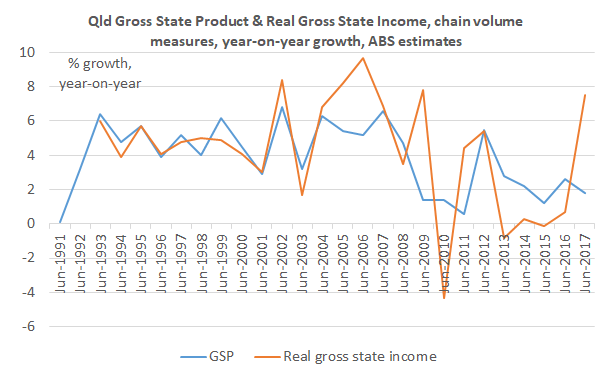
According to ABS State Accounts data released today, Queensland’s real gross state income surged 7.5% in 2016-17, the highest growth rate among States and Territories, owing to the strong recovery in coal prices during that financial year (see chart below).* Growth in real gross state income incorporates improvements in the terms-of-trade, while real gross state product (GSP) growth does not, and the latter measure was a much less impressive 1.8 percent. Now much of the gains in the terms-of-trade accrue to mining companies that are majority foreign-owned, but the Queensland Government does capture some of the gains through higher royalties, particularly on coal. To illustrate, coal royalties in 2016-17 ended up being an estimated $3.4 billion compared with $1.7 billion in 2015-16.

Coal prices higher than those forecast by Queensland Treasury have continued into the new financial year, and this will provide a nice little windfall for the incoming Queensland Government after next Saturday’s election. Former Queensland Resources Council chief Michael Roche commented on a LinkedIn post of mine earlier this week that he “would guess there is a $1 billion coal royalty windfall in 2017-18 awaiting the next government”, and I think that’s a reasonable estimate based on recent coal prices compared with budget assumptions.

Real_GSI

*Hat tip to the Courier-Mail‘s John McCarthy for first alerting me to the strong real gross state income growth estimate earlier today.

Posted in Macroeconomy, Uncategorized | Tagged , , , , , , , | Leave a comment

Interview with Steve Austin on Qld election issues incl. LNP’s fiscal principles & Greens’ promises

Yesterday, on Steve Austin’s 612 ABC Brisbane Mornings radio show, I had another enjoyable chat with Steve and some of his listeners regarding a range of state election issues. These included John Quiggin’s critique of the LNP’s fiscal principles, the Greens’ election promises, and infrastructure spending, among others. We began the discussion by returning to an issue raised in a previous interview, the controversial development of the new public service “tower of power”, 1 William St. You can listen to the interview from 1:37:49 at:

Steve Austin’s 612 ABC Brisbane wireless program Mornings, Mon 13 Nov 2017

I was grateful that one listener asked me for one example of a government program I would cut to save money. The first one that came to my mind was Tourism and Events Queensland (TEQ), which is an unnecessary agency, given we have a national tourism body, Tourism Australia. Also, both TEQ and Tourism Australia are less relevant in the age of social media, as our attractions, such as the Reef, rainforests, and beaches, are constantly advertised all around the world via Facebook and Instagram. I would note that, in its 2015 Industry Assistance Review, the Queensland Competition Authority also questioned the effectiveness of Tourism and Events Queensland, which receives over $100 million in funding annually. My previous posts referring to the Queensland Government’s tourism promotion efforts via TEQ include:

QCA finds multiple policy failures associated with billions in industry assistance in Qld

Tourism & Events Qld deserved funding cut – no turnaround in share of international visitors

I mentioned on air yesterday that I have no doubt the Queensland Treasury has a hit list of ineffective programs that it will propose cutting to a new incoming government. I am pretty sure TEQ would be on that list.

ABC Brisbane

Posted in Budget, Tourism, Uncategorized | Tagged , , , , , , , , , , | Leave a comment

Pets, Airbnb and Management Rights: Strata policy challenges for the incoming Queensland Government

I am grateful for another guest post, this time from Dr Stephen Thornton of BG Economics. Views expressed are Stephen’s, and should not necessarily be attributed to me. GT

Pets, Airbnb and Management Rights: Strata policy challenges for the incoming Queensland Government

by Dr Stephen Thornton

The apartment construction boom in Queensland in the last few years has been astonishing and unprecedented. The number of strata lots is now quickly approaching 500,000, mostly apartments and townhouses (465K, October 2017). By 2020 around one million people in the state will call them home.

A strata review is being finalised by the QUT Commercial and Property Law Research Centre as part of a wider Queensland property law review commissioned by the former Newman government, with a number of recommendations recently made. Some of these recommendations go to procedural matters like the calling of AGMs, electronic communications and the like, while others are around by-laws and, importantly, scheme termination.

Given jobs and health budget savings are always high priorities, the incoming government should give serious consideration to one of the Centre’s recommendations around the keeping of pets. The recommendation would make it much less likely that pets would be banned in strata complexes, as it would limit the prohibition of pets to new buildings where the developer sets it as a by-law or if a body corporate adopts it by way of a resolution without dissent.

In my submission to the review (in which I argued that giving developers and bodies corporate the power to adopt ‘no pet by-laws’ is contrary to Queensland’s economic interests), I calculated that allowing pets in strata properties is likely to result in 1,000 new jobs in the longer term in Queensland’s $1B – $2B pet industry (currently estimated at 10,000+ jobs). Importantly, these new jobs would be in both high-skilled employment areas (e.g. vets, pathologists, radiologists) and lower skilled employment areas (e.g. retail stores, pet grooming, dog walking), and would be right across the state including high youth unemployment places like Townsville and Cairns.

In more recent work for the Mars Keep Australia Pet Friendly campaign, I have estimated the recurrent public healthcare savings due to pets for the Queensland budget to be $172 million annually (total Qld/federal public saving of $435M; total all state/federal public saving of $2B). More pets in strata properties would increase these savings.

However, there are a number of major issues not covered by the Law Centre which were outside the scope of the review but are important in terms of the cost of living for strata owners. I’ll briefly discuss two that government might turn its mind to in 2018: ‘management rights’ and peer-to-peer short-term accommodation.

Management Rights

Simply put, management rights are the contractual rights to manage medium to large apartment complexes and to provide exclusive onsite letting and ancillary services. These are sold by the developer to caretaking companies (some as large as JLL), often for millions of dollars, with a maximum 25-year contract locked in for bodies corporate from the get-go. The MRs are periodically ‘topped up’ to the original maximum contract term at AGMs by uninformed lot owners as the contract runs down, and they are on-sold every three to five years via industry brokers.

The fixed ‘salary’ for caretaking and management duties, often over $300,000 in the large strata complexes (with mandatory annual CPI increases), typically comprises 20% – 30% of lot owners’ strata levies, making it the single largest expense item by bodies corporate.

There is little doubt that larger complexes require onsite management and the current model has many positive aspects. Still, after a few decades in operation, a new comprehensive review is required to bring about much needed reform in this space. An article by a Gold Coast law firm Is it Time to Change the Management Rights Model? makes some interesting observations and suggestions.

Peer-to-Peer Short-Term Accommodation

Most people have heard of Airbnb. In a similar way to how Uber disrupted the traditional taxi industry, it and similar companies allow potential tenants to directly deal with dwelling owners by cutting out the ‘middleman’, which in strata is the local real estate agent or onsite resident manager (see above). State governments have struggled over the appropriate public policy response to ride-sharing disruptors like Uber given the investments in taxi plates. This is also an issue for owners of management rights in Queensland, who have similarly invested in an asset at risk from technological disruption and regulatory change.

NSW is currently finalising a review of Short-term Holiday Letting with their July 2017 options paper outlining three broad policy response options to amend strata legislation, being:

  • By-laws to manage visitor behaviour
  • By-laws to receive compensation for adverse effects
  • By-laws to prohibit short-term holiday letting (STHL)

(see pp.15-17 for more detail & p.27 for a chart summary)

The benefits of providing a legislative green light to strata owners in this space, however, must also be appreciated. Deloitte Access Economics this year released a report Economic effects of Airbnb in Australia: Queensland in which they estimated that ‘Airbnb guest expenditure is associated with $217.4 million in value add to the Queensland economy, and supports 2,115 FTE jobs across the state’ (see p.22).

Strata living is no longer simply a stepping stone to owning a house in the suburbs. Given Queensland’s increasing urbanisation, smaller families and ageing population, we can expect a greater proportion of the population living in this type of housing in the future. In this respect, the Body Corporate and Community Management Act 1997 should increasingly be viewed by government as an important piece of legislation to be regularly reviewed to keep pace with changing technologies, demographics and public expectations.

Dr. Stephen Thornton is a social economist and principal of BG Economics. Disclosure: Stephen owns a strata investment property in Brisbane.

Woolworths_site_development

Proposed mixed-use development on the old Woolworths site in central Toowong. Includes 533 apartments (594 resident carparks), 1,728m2 gross retail area (73 retail carparks). Source: BCC planning & development online portal, accessed 11.11.2017

Posted in Uncategorized | Tagged , , , , , , , , | 8 Comments

Qld Greens policies would increase State Gov’t spending by $8-9BN p.a.

Queensland’s Deputy Premier Jackie Trad is under threat of losing her seat of South Brisbane to the Greens candidate Amy MacMahon, who is benefiting politically from a range of utopian policies disconnected from economic reality (see Friday’s Courier-Mail on the political situation in South Brisbane). I first heard about the Greens’ proposed $1 public transport fares policy while waiting in the green room of ABC Studios at the same time Ms MacMahon was on air discussing the policy with Steve Austin, who would interview me later that morning. Obviously this would be a very costly policy and one without economic merit, especially given the large subsidies already provided to public transport by the Queensland Government. But the $1 public transport fares policy would represent just a fraction of the total cost that Greens policies would impose on Queensland taxpayers.

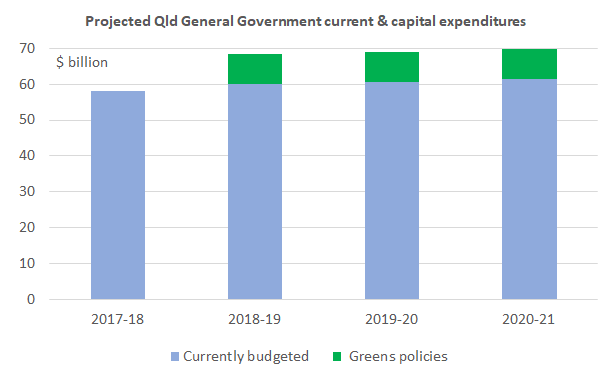
Based on my interpretation of the policies currently presented, Greens policies could increase total annual Queensland Government expenditure by an incredible $8-9 billion or 13-14% (see chart below). Of course, this is unlikely to ever happen, given the Greens couldn’t possibly win government in their own right, but it is interesting to consider what a Greens budget would look like.

Qld_Greens_spending

The most egregious Greens policy is the Queensland Housing Trust:

A new Queensland Housing Trust will be established to finance the construction of one million homes over the next thirty years. In the first ten years, the Queensland Housing Trust would invest $60 billion to finance the construction of 200,000 affordable homes. The revenue raised from the rent on these 200,000 homes would then be invested into the construction of 40,000 homes each year for the next twenty years.

This policy suggests a Greens Queensland Government would increase the stock of public housing in Queensland by over 300% in ten years. It would mean dwelling construction in Queensland would have to increase by over 40% per annum, with massive implications for the demand-supply balance in the building industry and likely resulting in construction cost spikes. The Greens’ policy would massively increase the supply of rental properties which have already been boosted by the apartment building boom. It would suppress market rents and increase vacancy rates for properties. Unsurprisingly, the Property Council and REIQ are highly critical of the proposed Queensland Housing Trust (see today’s Sunday Mail article Greens’ social housing plan slammed).

Another large part of the increased spending that would result under Greens policies is due to the so-called Queensland Public Infrastructure Bank. This would not really be a bank, but a fund that would invest in non-commercial infrastructure. The Greens’ media release on Friday noted:

Under the Greens the State government will establish a Queensland Public Infrastructure Bank to invest $10 billion in public infrastructure over five years.

Queensland Greens lead spokesperson and candidate for South Brisbane Amy MacMahon said:

“Queensland is facing a critical shortage of public infrastructure, so the Greens will create a $10 billion Public Infrastructure Bank funded primarily by making sure mining corporations and property developers pay their fair share.

“The Queensland Public Infrastructure Bank will invest in the schools, hospitals, green space and public transport our State desperately needs…”

The Greens claim they would pay for their additional spending through “a series of major revenue raising measures which target the billionaires and big corporations”, particularly miners and property developers (see https://greens.org.au/qld/powerpeople). But the Commonwealth controls income taxes, so it is unclear exactly how the Greens would raise the huge amount of additional revenue required (noting the rent from the new social housing properties would only provide a very small fraction of the additional revenue required). The Greens could only increase mining royalty rates so far before higher royalty payments had a deleterious effect on the industry. If sufficient revenue could not be raised from the proposed sources, a hypothetical Greens Government would have to sharply increase taxes and charges on all Queensland households and businesses, or we would see total Queensland Government debt grow to over $100 billion.

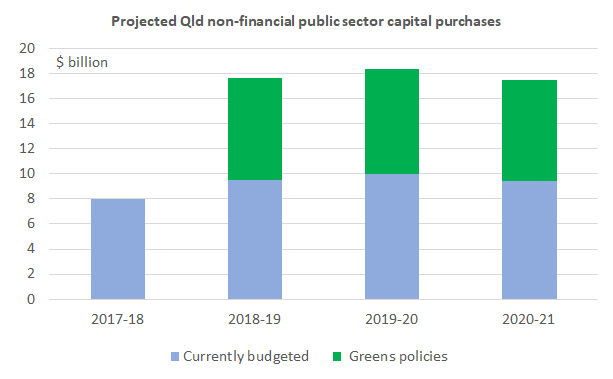
Note that, in the chart above, I have assumed all the new Greens capital expenditure would occur in the general government sector, based on the descriptions of the type of non-commercial infrastructure the Greens would fund. While the Greens would deliver its housing policy via a Queensland Housing Trust, this would probably be part of the general government sector because it would not earn a commercial rate of return on its investments. Regardless of whether the new Greens infrastructure spending is classified as occurring in the general government or public non-financial corporations sectors, it would still represent a massive increase in total government capital spending (see chart below), and one which would very likely lead to crowding out, skills shortages and sharp cost increases in construction projects across Queensland.

Greens_capital

I should note that I find some of the Greens’ proposed policies attractive, such as building a green bridge from Toowong to West End and investing in cycling infrastructure, but we should always be mindful of budget constraints, and any major expenditure proposals should be subject to a cost-benefit analysis. The Greens have presented a utopian policy platform that can only be paid for by much higher taxes and charges on all Queenslanders (and not just on billionaires and big corporations). Otherwise it would result in total Queensland Government debt rising to $100 billion or more. The Greens’ utopian policies warrant much greater scrutiny from commentators and the electorate.

Posted in Budget, Uncategorized | Tagged , , , , | 8 Comments

Queensland State Election 2017: Week 2 review from Joe Branigan

I am again very grateful for Joe Branigan’s review of the previous week in the Queensland election. The views expressed in the guest post are Joe’s, and they should not necessarily be attributed to me. GT

Winner must target the fiscal balance, buy global and avoid mega-projects – Week 2 Queensland election highlights from Joe Branigan

There was Tim Nicholls hurtling down the Movie World rollercoaster at terminal velocity – coincidentally a speed soon to be seen on the M1 thanks to the political battle being fought from Logan to the NSW border. And there was the One Nation candidate cornered by a junior Channel 7 reporter and his quest for a stunning scoop. But the image of the week was surely Pauline and the Battler’s Bus broken down on the Bruce Highway barely out of Rocky.

Beneath the bluster and non-verbal communication stunts so vital to election campaigns in a place where life is long and concentration spans are short, there are a number of important policy issues that will affect whether or not the good times continue to roll on.

The first and most important is that we need to live within our means, and that means targeting the fiscal balance not the net operating balance. The difference between the two measures is that the fiscal balance includes net infrastructure investment but the net operating balance does not. It is a public finance accounting identity that if you have a fiscal deficit your debt is rising, even if you have a net operating surplus.

My colleague John Quiggin made this point last week*, although I think he overstated what that would mean for LNP spending policies, in part because he has assumed that the LNP’s M1 duplication policy (and therefore its cost) is the same as Labor’s when it is not: LNP’s $500 million 4-lane arterial versus Labor’s $2.5 billion 6-lane highway. Based on work I’ve previously done for the Queensland Government (with my SMART Infrastructure Facility hat on), my Saturday night ‘back of the envelope’ calculation for the LNP’s M1 duplication (based on the SEQ Council of Mayors specifications) is [36.5 km * $14.7 million per km =] $536.6 million. However, the per km cost might be lower in the post mining boom economy, as the cost of engineering, design and construction services have fallen relative to the ‘mining boom’ data set I used to produce a median cost of $14.7 million per km. Therefore, I don’t think the $500 million LNP estimate is unreasonable.

In any case (back to Quiggin’s point), a man is innocent until proven guilty, so let’s see what the LNP costings say (yes, released way too late).

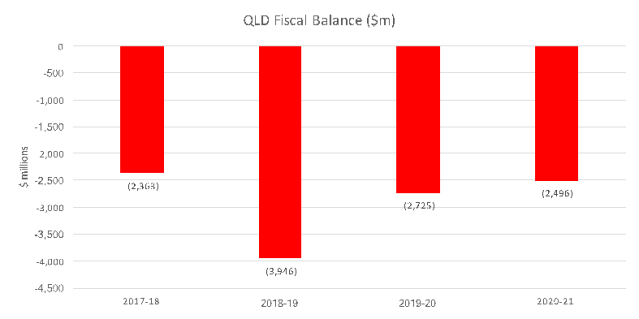
Labor have convinced themselves that targeting a net operating surplus is ok and they have demonstrated that commitment by bequeathing to the LNP (if it wins government) what can only be described as a kale and quinoa sandwich of $11.5 billion in fiscal deficits in the General Government sector over the forward estimates (see chart below).

FB_Qld

It will be a long road back, but better financial management is the first task of the next government because, without it, Queensland will be unable to effectively respond to natural disasters and adverse economic shocks without help (and therefore control) from the Federal Government. In simple terms, if you control your debt you control your destiny. If Labor scrapes back in, it should take a very serious look at its own fiscal principles and tighten them up in the interests of best-practice public financial management.

Given the lessons of the Newman Government, the LNP Opposition has promised not to make large cuts to public service employment to levels that might be considered by some (including me) more efficient, better for the Queensland economy and financially sustainable. A long road back indeed, but I suspect the modern democratic principle of real-time public support has been learned or perhaps burned into the political and policy minds at the LNP.

The two necessary conditions to slowly and gently stabilise the debt and eventually achieve fiscal balance are to: (i) keep overall annual spending growth below the long-run average annual growth in revenue (which is highly volatile and therefore impossible to predict year-on-year); and (ii) avoid committing to mega-infrastructure projects (think Cross River Rail), but rather commit to sensible incremental improvements in our roads, passenger rail, hospital and school networks that provide the most community benefit at the lowest cost.

This is not to say the infrastructure projects being proposed by all sides in this election campaign wouldn’t be popular and beneficial to those who would use them. Who wouldn’t like a 12-lane highway to the Gold Coast, a 4-lane minimum dual carriageway along the full length of the Bruce Highway, not to mention a world-class underground metro for Brisbane and an international airport at Airlie beach, but (unlike the unconstrained demands made by the RACQ, CCIQ and others this week), budgets are limited and projects must be prioritised based on greatest potential benefit.

On this, governments need good independent advice based on evidence. In my view, this required independence is not being provided by Building Queensland, which is conflicted and will need to be reformed. The LNP’s policy to set up advisory bodies (aka ‘Planning Commissions’) to recommend the most beneficial projects has merit so long as they are truly independent of the government and are sufficiently resourced to do the job.

Unlike the regulated electricity sector where Government Owned Corporations can confidently borrow billions to fund new capital investment knowing that they’ll get the money back via regulated electricity charges, Queensland roads (apart from the odd toll road) don’t generate any revenue for the government (rego revenue is not currently hypothecated to road investment). Therefore, roads, hospital and school infrastructure spending must be funded almost entirely from recurrent revenue with borrowings kept to a minimum so that interest payments are kept to a manageable level and General Government debt is stabilised.

An infrastructure investment budget that uses 80% from net operating surpluses and 20% from borrowings is generally considered to be appropriate when the debt in the General Government sector is sustainable. However, when the debt is unsustainable and/or increasing, a better target is to fund 100% of infrastructure spending from the operating budget so that debt can be reduced with fiscal surpluses. It is a mathematical certainty that fiscal deficits lead to higher debt and only fiscal surpluses can lead to lower debt.

We all need to live within our means. Targeting the fiscal balance over the economic cycle will stabilise the debt, ensure only the most beneficial spending and infrastructure investments proceed and put Queensland on a path to regaining its AAA credit rating. Buying global (not local) and avoiding mega-projects will make it a lot easier to eventually achieve fiscal balances, but that won’t happen until well into next decade.

Policy of the week

It has to be ‘Buy Local’. In my own region of Albany Creek there is plenty of surplus land in the Aldi carpark to set up our local coal-fired power station and car manufacturing plant. We can build the new trains at Bunnings up at Brendale (ok we’ll need an FTA with Brendale), and the Queensland Submarine Corporation can set up on that vacant lot beside the Albany Creek Cemetery and Crematorium.

Joe Branigan is a Senior Research Fellow at the SMART Infrastructure Facility UOW and an independent economist based in Brisbane.

* Joe is referring to John Quiggin’s widely reported analysis demonstrating that the LNP’s currently stated fiscal principles imply large cuts in government spending and public service jobs (e.g. see this Guardian article). Given the LNP have probably learned that large public service job cuts are politically toxic, they will no doubt have to moderate the very strict fiscal principles in their economic plan if they win government. GT

Posted in Budget, Uncategorized | Tagged , , , , , , , , , , , | Leave a comment

Guest post: 2018 State Election – week 1 highlights from Joe Branigan

I am delighted to publish this guest post regarding the first week of the Queensland election campaign from my old friend and former Treasury colleague Joe Branigan. GT

2018 State Election – week 1 highlights from Joe Branigan

Letterboxes stuffed with glossy blue, red and burnt orange policies, matte-grey images of Campbell Newman haunting a matte-grey Tim Nicholls, a ban on 15-yr old kids in Townsville seeing the 8.30pm movie at Event Cinemas on a Friday night, 4 dams, 2 Planning Commissions, 2 M1s, 1 Report on State Finances, 1 red helicopter with a 5-million watt halogen searchlight (to find the stray 15-yr old kids), several outbreaks of coal panic syndrome (CPS) most notably from the Premier, and an LNP electricity policy to gazump all electricity policies.

That was week 1 of the Queensland State Election campaign.

On a more serious note, perhaps the most revealing (and surely the most bizarre) event of week 1 was the Premier walking away from supporting Adani’s NAIF concessional loan application to the Commonwealth Government, to underwrite the building of a rail line that connects the Galilee Basin’s thermal coal reserves to Adani’s Abbot Point Terminal near Bowen in North Queensland. The Adani loan debacle has left the Government appearing confused, incoherent and indecisive, and has added to the perceived sovereign risk involved in investing in Queensland.

Given that this has happened in the middle of the State Election campaign, I doubt the Adani issue is about the economic and broader public policy principles around whether to offer a concessional federal loan to a foreign (or domestic for that matter) private company, or about the need to avoid a conflict of interest. The only logical explanation for the Premier’s decision to veto a NAIF loan to Adani, rejecting the advice of her own Integrity Commissioner, who said all she needed to do was recuse herself from relevant CBRC meetings, is that Labor thinks its best path to victory is to trade regional seats for SEQ seats. Could the Premier be as cunning as a fox who’s just been appointed Professor of cunning at Oxford University (thank you, Blackadder)? Perhaps too cunning by half, but we will see. Labor will need to regroup fast, unless it thinks it can get away with narrow-casting one message into regional Queensland and the opposite message into SEQ.

Despite the recent surge in revenues, it has been difficult for the Government to gain any traction on economic management. Again, being too cunning by half has exposed Labor to criticism in its public financial management. Pretending that the overall state debt doesn’t matter, and that money can be transferred from funds outside of the general government sector (such as from GOCs and public servant’s superannuation and leave funds) indefinitely and without consequence, has left Labor wide open to criticism from policy experts, commentators and the LNP. I have described Labor’s fiscal policy, whereby there are multiple uses for the GOC dividends, as utilising the latest advances in quantum entanglement theory, such that the Treasurer can make the same public dollar appear in two places at once.

Controlling the growth in employee expenses (i.e. number of public servants * wages) is critical. Unless expenses growth is at or below the long-run average growth in revenue, things will go backwards quickly. The 8-year moving average for revenue growth reported in the 2017-18 State Budget is 5.6% per year, with a low of -8.8% in 2012-13 and a high of 11.9% in 2013-14. Revenue growth in Queensland is highly volatile and extremely hard to predict. Whoever wins this election would be well advised to request detailed analysis and advice from Treasury about how to deal with these fluctuations in revenue.

Reviewing the 60-odd policies on the LNP website, a number of things stand out. First, they’ve clearly done their homework and it’s hard to find a policy that hasn’t successfully weathered the 24-hour news cycle. Second, the LNP’s overall philosophical direction is clear: economic development in both SEQ and the regions, address high unemployment in the regions, fix the electricity debacle, and be tougher on crime than Labor. And third, there is a strong focus on things that matter right now, such as reducing electricity prices asap, reducing road congestion and reducing high unemployment in regional Queensland. Still, much of the Opposition’s economic credibility will come down to whether its policy costings statement withstands external scrutiny (presumably in the last week of the campaign), and aligns with its stated objective to target the fiscal balance (rather than the ‘looser’ net operating balance target).

Of course, there is the odd disproven, ineffective or unworkable policy lurking among the LNP policy manifesto, but in the scheme of things they are pretty harmless and hopefully short-lived. These include tracking 15-yr olds with a red helicopter, banning plastic bags, and the container deposit scheme. Incidentally, Labor also supports banning plastic bags and the container deposit scheme, so what’s the difference?

So that was Week 1. The LNP appears to have done their homework, while Labor looks off balance and deeply confused on its policy toward the Adani mega mine, but perhaps it’s all a cunning plan. Meanwhile, Pauline Hanson is back in town and the latest Galaxy poll looks ominous for Labor and the LNP.

Policy of the week

It’s a tough call between the red helicopter and the 4 public holidays…but who doesn’t enjoy a public holiday, so I’ve given the Week 1 policy award to the Greens.

Bring on week 2.

Joe

Joe Branigan is a Brisbane-based economist, Senior Research Fellow at the SMART Infrastructure Facility UOW and independent consultant. He is not a member of any political party.

Posted in Queensland Government, Uncategorized | Tagged , , , , , , , | 1 Comment

Qld state debt debate is challenging for both sides

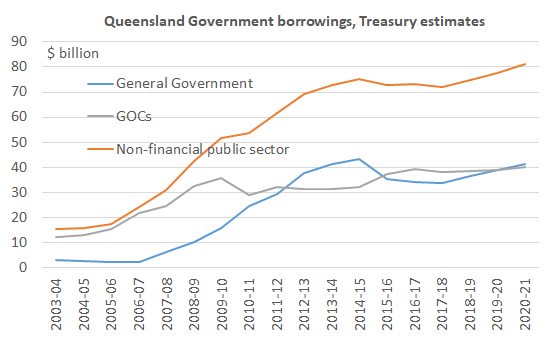
What an exciting first week of the election campaign! I am very pleased that state government debt is a prominent issue in the campaign, and I must say I’m surprised by the Queensland Treasurer’s recent description of the total state government borrowing figure projected by the Treasury at $81 billion in 2020-21 as “magical or mythical” (see today’s Courier-Mail). The Treasurer argues it is only general government debt we should worry about. The argument is that the debt owed by GOCs is serviced by the GOCs themselves rather than by taxpayers, and it is offset by revenue-generating assets that the borrowings have been used to purchase. In a perfect world, where the GOCs were well-functioning commercial businesses fully separated from government, this would be correct, but, as I told Steve Austin on his wireless show on 612 ABC Brisbane on Wednesday morning, this is not the case and we really do need to be concerned about the total debt.

Total government debt is not “magical or mythical”, and we do need to keep an eye on it, as there are blurred lines between the general government sector and the GOCs in Queensland. The current Queensland Government effectively treats its GOCs as extensions of the general government and not as independent entities. It has engaged in clever accounting practices such as shifting $3-4 billion of debt on to the GOCs to help reduce debt in the general government sector. This debt shift gave the electricity GOCs extra debt without extra assets to help pay the extra debt off. It was effectively an attempt to hide general government debt in the books of the GOCs. The ratings agencies (i.e. S&P and Moody’s) are aware of the blurred lines that exist worldwide between governments and their businesses, and hence they keep a close eye on the total debt-to-revenue ratio.

You can listen to my Wednesday morning interview with Steve Austin at this link (from around 38’30””):

http://www.abc.net.au/radio/brisbane/programs/mornings/mornings/9086734

Also, on Steve’s show, I gave listeners an update on the current level and forecasts of state debt, and Steve and I discussed the huge challenge of reducing debt in the current political environment, when a government cannot cut spending, raise tax rates or sell assets. Unless the economy starts going gangbusters, there is no way a Queensland Government can pay down debt without cutting spending, raising taxes or selling assets.

So the Opposition may be considered courageous for having committed, in its economic plan Getting Qld Back in Business, to targeting the fiscal balance, rather than the less strict operating balance, which only includes recurrent revenues and expenses, not capital spending. The Together union, which represents public servants, argues in a media release published yesterday that the Opposition’s plan would involve significant expenditure cuts:

Nicholl’s radical plan involves massive job cuts – union

Certainly, if the Opposition has ruled out asset sales and tax increases, then given current economic forecasts they would need to massively cut spending if they were to achieve at least a fiscal balance next financial year. But I suspect that, if the Opposition wins the election, the incoming government would specify a very gradual return to fiscal balance, avoiding the large spending cuts that did so much political damage to the Newman Government.

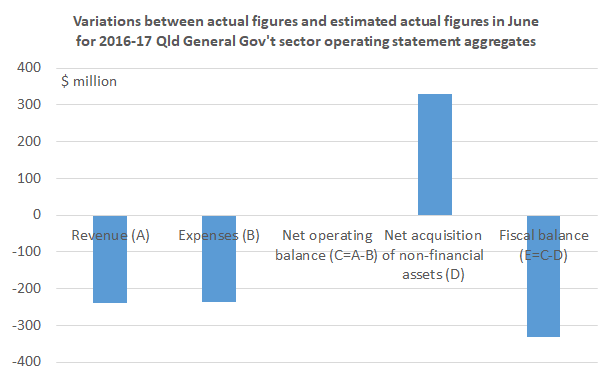
Also released yesterday was the 2016-17 Report on State Finances, which revealed general government debt at the end of 2016-17 at $33.3 billion was slightly lower (by around $677 million) than it was expected to be a few weeks earlier when the budget was published on 13 June. Before the end of financial year, the Queensland Treasury engaged in some clever cash management to bring about this reduction in borrowing. The reduction in borrowing was not due to any improvement in the underlying budget situation. Indeed, the net operating surplus was more-or-less constant and the fiscal surplus for 2016-17 actually turned out to be lower than expected (see chart below).

variations

What appears to have happened is the Government has received more money in advance from its government-owned corporations such as Energy Queensland than it was previously expecting. It has again taken advantage of the blurred lines between government agencies and the GOCs I mentioned to Steve Austin on Wednesday morning. The advances received item in the general government balance sheet turned out to be $1.831 billion in 2016-17 compared with the $1.328 billion expected 2-3 weeks earlier at budget time. I expect this increase of $503 million explains a large part of the lower state general government debt amount reported as at 30 June. So it appears the government has engineered this slightly lower debt figure by extracting more money out of its electricity GOCs. This obviously isn’t sustainable, and it means less can be extracted in future years, so I still expect government debt to remain on its previous upward trajectory to $41 billion for the general government and $81 billion in total by 2020-21.

The Report on State Finances also confirmed the large revenue surprise and high expenses growth in 2016-17. My old friend and former Treasury colleague Joe Branigan, now a Senior Research Fellow at SMART and an economic consultant, texted me the following insightful commentary on the Report:

Employee expenses growth is running at 6%, which is plainly not sustainable. The general government books look good thanks to a massive $5.4 billion increase in revenue, due to above-average growth in Commonwealth Grants and royalties, and that’s not sustainable either. Eventually, governments run out of accounting tricks or luck or both…The non-financial public sector debt is plainly too high to withstand a sustained economic downturn.

Joe’s last point is consistent with my comments in the Courier-Mail on Tuesday. Let’s hope the budget and debt debate continues into week 2!

Posted in Budget, Uncategorized | Tagged , , , , , | 4 Comments

Comments on Qld state debt to the Courier-Mail

I am quoted in today’s Courier-Mail in an article on Queensland state debt, which for the whole Queensland Government (incl. government-owned businesses) is on its way to over $80 billion (see chart below). The paper reports on the Premier’s failure to answer a tricky question regarding how much dividends from government-owned corporations have contributed to debt reduction:

Qld election 2017: Palaszczuk draws a blank on state debt

The Courier-Mail reported my comments as follows:

Economist Gene Tunny, principal of Adept Economics, said the state was at risk during future downturns and could face a fiscal crisis if government failed to adopt a disciplined approach to debt reduction. Debt was approaching $80 billion and needed to be below $50 billion to win back a AAA credit rating, he said.

“That’s a direct saving in interest costs and that could be used to pay for education or health services or it could be used to further reduce debt.”

He said there had been a loss of financial discipline since the mid-2000s that had allowed debt to balloon.

The point I was trying to make was that if we do not get our debt under control, then it will keep creeping up and will compromise our ability to respond to future economic downturns and crises. As a former Australian Treasury official, I will always remember the financial crisis in 2008-09, during which the Australian Treasury had to temporarily provide a guarantee of state borrowings, largely to support the huge financing task faced by a nervous Queensland Treasury. I would like the Queensland Government to get its budget and debt under control so the state does not end up in that unfortunate situation again.

If the Queensland Government could reduce total borrowings to $50 billion or less, the aspiration I suggested to the Courier-Mail, then the state would certainly get its AAA credit rating back. I should have been clearer in my comments to the Courier-Mail and noted we may even be able to get a AAA rating back if we can reduce debt to around $60-65 billion. The critical ratio the ratings agencies (e.g. S&P, Moody’s) appear to look at is the debt-to-revenue ratio, and they get worried when it is over 100 percent. Currently, total revenue for the state non-financial public sector is around $63 billion. So if we could reduce total borrowings to $50 billion or less, we would definitely get back the AAA rating and provide a buffer that could help us absorb future shocks.

borrowings

Finally, I should mention the Courier-Mail got in touch with me after it noticed I was a co-signatory to a letter organised by Graham Young at the Australian Institute for Progress regarding critical issues for the Queensland election, one of which obviously was state debt:

Queensland election issues: open letter from 7 public policy professionals

Posted in Budget, Uncategorized | Tagged , , , , | 6 Comments