CIS Ideas post on government size & economic growth paper by Makin et al.

I spent an enjoyable week visiting the Centre for Independent Studies in Sydney, and while there I was roped into drafting a short post for their regular Friday Ideas email. My post was on a recent conference paper by Griffith Economics Professor Tony Makin, my ESA Qld management committee colleague Julian Pearce, and Griffith econometrician Shyama Ratnasiri on the optimal size of government in Australia:

Cut government share of the economy

Here’s an extract from the post:

Prior to the Whitlam government of 1972-75, total Commonwealth, state and territory government spending in Australia was around 25% of GDP. In the four decades since the Whitlam government, it has been around 35%.

There is no question it would be good for the economy and taxpayers to reduce this burden.

The CIS has previously set a realistic target of reducing government spending to 30% of GDP, as part of its TARGET30 campaign. A new economic research paper presented at the recent 2018 Conference of Economists provides fresh support for this objective.

In The Optimal Size of Government in Australia, Makin, Pearce and Ratnasiri estimated the optimal size of government in Australia is around 31%. This represents the level that maximises economic growth.

The 2018 Australian Conference of Economists paper by Makin and co-authors (still to be peer reviewed and containing only preliminary results I should note) can be downloaded at this link:

The Optimal Size of Government in Australia

Note that local government spending (which I forgot to mention in my summary) is included in the figures referred to above.

Posted in Budget, Uncategorized | Tagged , , , , , , | 6 Comments

The Andrew Leigh-Sinclair Davidson company tax debate

In March, there was extensive media coverage (e.g. in the Guardian Australia) of shadow assistant treasurer Andrew Leigh’s company tax research which found companies paying lower effective company tax rates (i.e. actual tax paid/profits) did not create more jobs than those paying higher effective tax rates, and may actually create fewer jobs. The research paper was published in Economic Analysis and Policy (EAP), the online journal of the Economic Society of Australia (QLD) of which I’m Vice President, although this is a personal comment on my part, and I am not on the editorial committee of EAP.

I am very pleased that RMIT’s Sinclair Davidson has converted his critique of Andrew Leigh’s paper, originally published at Catallaxy Files, into a submission to EAP. Davidson’s paper has been published along with a reply by Andrew Leigh, which in my view doesn’t effectively counter the major criticism Davidson makes, that Leigh has used a mis-specified econometric model. The abstract of Sinclair Davidson’s comment is:

The paper presents a critique of the recent paper published in this Journal by Dr Andrew Leigh (Do firms that pay less company tax create more jobs? Volume 59, September 2018, Pages 25–28). Besides the model misspecification, omitted results and data availability bias of the regression used to inform the overall results, there are no controls for confounding factors that influence the effective marginal tax rate. These omissions are detrimental to the validity of the paper. This paper seeks to illuminate the sources of those errors and argues that the paper is sufficiently flawed that no weight should be given to its analysis when considering the potential consequences of a company tax rate cut.

I agree with Davidson’s conclusion. Indeed, as Judith Sloan pointed out in the Australian, it does not make sense to relate jobs created to the effective tax rate paid by companies in the way Andrew Leigh did, because the effective tax rate can differ from the statutory rate (i.e. 30% for large companies) for a variety of reasons, some of which would affect employment growth. So it would not be possible to say there was a one-way causal relationship going from the effective tax rate to jobs growth. A firm could have a low effective tax rate and low or negative employment growth for the same underlying reason (e.g. a previously poor financial position which means it can now take advantage of previous tax losses, but which would still make it reluctant to hire workers). In her Australian article, Judith Sloan was alluding to the fact the effective company tax rate is endogenous, which makes it perilous to estimate a relationship between the effective tax rate and employment growth. Judith Sloan noted in her Australian article:

What Leigh doesn’t seem to understand is that there is a variety of reasons why companies pay an effective tax rate below the statutory one.

Take mining companies that have made large investments. These companies will bring the cost of these investments to book over a long period of time, bringing down the rate of company tax they pay. You would also expect the number of jobs in those companies to be lower after the investment has been completed.

Andrew Leigh attempted to respond to one of Sinclair Davidson’s criticisms in his reply by including average profits in the regression equation. But econometric theory tells us this alone would not deal with the fundamental endogeneity problem that has probably given Andrew Leigh a biased and meaningless equation.

Andrew Leigh knows well the challenge of estimating causal relationships based on historical data from uncontrolled experiments, and it’s why he rightly advocates the analysis of natural experiments (e.g. in his work on the impact of the baby bonus on the timing of births) or the use of randomised controlled trials for policy evaluation. His EAP article should have been clearer about its limitations. In summary, Andrew Leigh’s findings are of questionable value to the policy debate over cutting the company tax rate.

Posted in Tax, Uncategorized | Tagged , , , , | 5 Comments

Economics of second best in energy policy

Australia’s energy policy is such a confusing mess that the Australian’s economics editor Judith Sloan actually supports the ACCC’s dubious call (in its Electricity Pricing Inquiry Final Report) for the Australian Government to act as a buyer of last resort for electricity, to help energy companies secure finance for new generation capacity. In her latest opinion piece, Sloan observes:

The one interesting recommendation of the ACCC’s report is that the government should operate a program to contract for low fixed-price generation capacity — around $45 to $50 per MWh — for the later years of new projects. These projects would in effect be sponsored by large industrial and commercial users but would be underwritten by the government.

Now, as reported in today’s Australian, the federal government is considering this proposal. Influential ministers, such as Queensland’s own Matt Canavan, see it as a way to support the construction of new high efficiency, low emission (HELE) coal-fired power stations.

Such industry assistance could only be justified as the economics of second best: using one market distortion to correct the economic problems caused by other distortions. To me, it looks like bad policy. We would be better off fixing the distortions which caused the mess in the first place, including public ownership of generation capacity and costly environmental schemes such as the premium solar feed-in tariff (44c/kWh in Queensland) and Small-scale Renewable Energy Scheme (SRES).

Much of the policy action needs to occur at the state level, in Queensland in particular. For example, we need to break up our price gouging power generators CS Energy and Stanwell and ideally privatise them, as recommended by the ACCC.

I would prefer we fix our current energy policy settings before the Australian Government commits to underwriting new generation capacity, taking a significant contingent liability on its balance sheet, the risk it will have to prop up unviable HELE coal-fired power plants in the future. This contingent liability would crystalise if substantial global action to reduce greenhouse gas emissions were agreed and followed through with in future decades.

I should say the ACCC deserves a high distinction for producing such a comprehensive analysis of electricity pricing in Australia and for generally sensible recommendations. But its proposal for government underwriting of new energy generation is not one of them. The ACCC is trying to correct one set of distortions by introducing a new one. This seems like folly to me.

accc_electricity_report

Posted in Energy, Uncategorized | Tagged , , , , , , , , | 2 Comments

A question you could ask RBA Deputy Governor Guy Debelle at ESA Qld business lunch on 22 August

Ten years after the 2008 financial crisis, economists are still debating whether the policy response at the time was excessive or insufficient (e.g. the excellent recent Macro Musings podcast with Larry Ball on the Lehman collapse) and whether banking needs further reform. In the UK and continental Europe, radical reforms to finance are being contemplated, including by veteran Financial Times columnist Martin Wolf, who last month wrote in support of the radical Vollgeld proposal put to a referendum in Switzerland (see Why the Swiss should vote for “Vollgeld”, which is behind a paywall, sorry).

Vollgeld would have prevented banks from lending out money acquired from depositors on a long-term basis to households or businesses. Instead, the banks would need to hold all the depositors’ money in reserve, in case depositors all wanted to withdraw all their money at once. This would certainly make the system safer, and would prevent banking panics and bank runs, but it would sharply increase the cost of borrowing, unless say the central bank stepped in as a lender to households and businesses, which appears to have been part of the Vollgeld plan. In my view, the Swiss were eminently sensible in rejecting this radical proposal, with 76 percent voting against it at the referendum last month.

That said, I acknowledge the 2008 financial crisis highlighted the too-big-to-fail problem with major financial institutions, which means government bailouts appear inevitable in times of financial crisis, and it is widely agreed this problem has not yet been fixed. So I’m pleased there is extensive debate about banking regulations, even if I disagree with many of the radical proposals.

Incidentally, one of the most interesting proposals for large-scale reform of banking has come from Australian economist Nicholas Gruen, who I work with from time-to-time on consulting projects. Gruen would have the RBA take deposits from households just as it takes deposits from banks. The RBA would also lend money to households against safe collateral (e.g. a home, but only up to 60 percent of its value). The justification advanced appears to be that the provision of bank accounts and payment services could soon solely be done electronically, and could be a natural monopoly which may be best placed in a central bank. As Martin Wolf, who referred to Nicholas Gruen’s proposal in his FT article on Vollgeld, noted:

“The technological reasons for branch banking are, after all, perishing quickly.”

Note that Gruen has posted a letter he wrote to the FT on his proposal at Club Troppo:

My letter to the Financial Times: All finance requires is an upgrade for the internet age

It would be good to know what the RBA thinks about proposals to reform the financial system along the lines of Vollgeld or the Gruen proposal. Fortuitously, for those of us in Brisbane, there is the opportunity to ask a very senior RBA official about these proposals at an upcoming lunch.

The Economic Society of Australia (QLD), of which I’m one of the Vice Presidents, is privileged to be hosting a lunch at the Hilton Hotel, Brisbane on 22 August featuring RBA Deputy Governor Guy Debelle:

ESA Qld Business Lunch – Guy Debelle, Deputy Governor of the Reserve Bank of Australia

There are still tickets available, and I would encourage you to attend if you can. The RBA typically does not announce the topics of its upcoming speeches, but there is no doubt the Deputy Governor’s address will be on an important economic issue and will attract much media and market interest.

guy-debelle

RBA Deputy Governor Guy Debelle
Posted in Macroeconomy, Uncategorized | Tagged , , , , , , , | 6 Comments

My comments in Morningstar article on Australia’s “27-year economic winning streak”

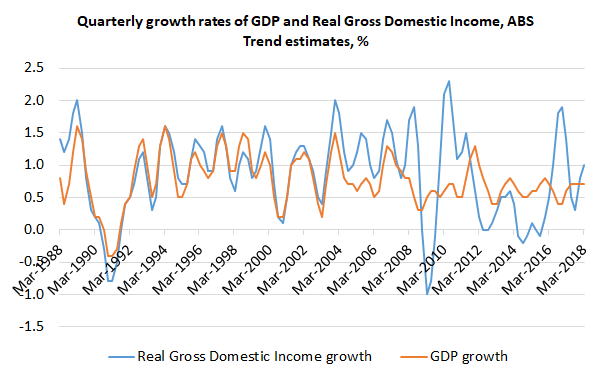
One frequently quoted economic fact I think is a bit dubious is that Australia has had a record breaking expansion of 27 years. Although Australia avoided a technical recession (by not having two successive quarters of declining real GDP) during the financial crisis, we nonetheless had a significant downturn which saw the unemployment rate climb from a low of 4.0% in August 2008, the month before the Lehman Brothers collapse in September, to 5.9% in June 2009. Furthermore, Australia had a significant contraction in Real Gross Domestic Income in the first half of 2009 (see chart below), due in part to falls in commodity prices during the financial crisis.*

Given my concerns about the robustness of the 27-year economic expansion claim for Australia, I’m grateful to Brisbane-based freelance journalist Anthony Fensom for quoting me in his latest article for Morningstar on Australia’s economic record: Australia’s economic record outscoring rivals but for how long?** Here are some relevant quotes from the article:

…economist Gene Tunny warns that Australia’s economic sunshine will not last forever.

“Eventually there will be a downturn; it’s just the nature of the business cycle. We’ve learned that you can’t fine tune your economy to never have a downturn – that’s impossible,” he says.

Tunny, principal of Adept Economics, notes the impact of population growth on supporting Australia’s economy, unlike other advanced economies. He also notes the nation suffered an “income recession” during the GFC.

“Based on the data, we’ve grown every year, but it’s not as if we haven’t had any downturns – we haven’t completely eliminated the business cycle,” he says.

While Tunny notes the concerns around Australia’s high level of household debt and the risk of a global trade war or other geopolitical shock, he says conditions remain generally positive amid synchronised global growth.

Incidentally, I had an enjoyable chat with 612 ABC Brisbane’s Steve Austin last year on my experience in the Treasury during the worst days of the financial crisis in late 2008 and early 2009:

Interview with ABC Radio’s Steve Austin on “The time Australia’s Treasury almost ran out of money”

realgdigrowth

*Given the major impact changes in commodity prices now have on business conditions and government budgets in Australia, in my view we need to supplement GDP, which effectively measures the volume of production, with measures such as Real Gross Domestic Income which measures “the purchasing power of the total incomes generated by domestic production”, according to the ABS definition.

**Unfortunately, the link I originally had to this article no longer works. I’m trying to obtain a new one, but the article may be behind a paywall.

Posted in Macroeconomy, Uncategorized | Tagged , , , , , | Leave a comment

Inner Brisbane Cross River Rail CAPEX comparable to statewide education CAPEX

Just before I appeared on 612 ABC Brisbane’s Breakfast program last week, one of the presenters Bec Levingston asked Deputy Premier Treasurer Jackie Trad what it would cost to air condition every classroom in Queensland, a question she obviously couldn’t answer without notice. Having spent the bulk of my schooling in un-air-conditioned classrooms in tropical Townsville, it struck me as a peculiar question, and I though air conditioning every classroom in the state would be a massive extravagance. That said, it did prompt me to look at what the state government currently spends on education capital works and compare it to what it spends on other priorities.

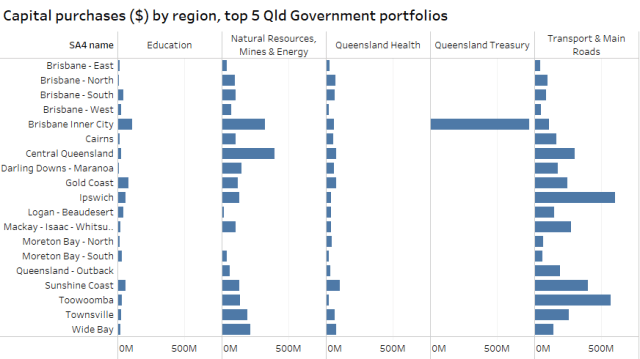
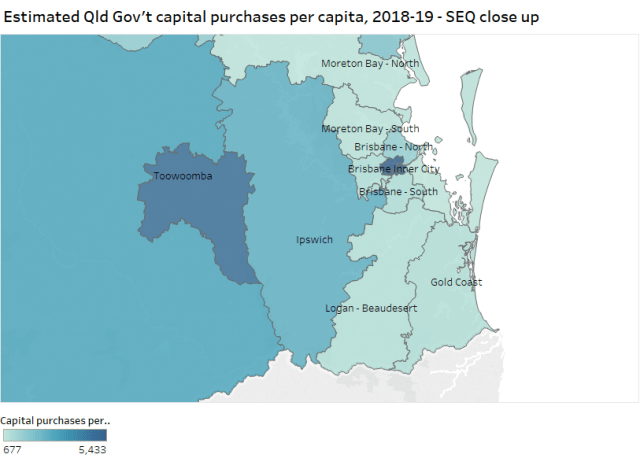
In state budget paper 3, the Capital Statement, we are starting to see the huge cost of the number one extravagance in the state at the moment, Cross River Rail. Total spending on property, plant and equipment for Cross River Rail, which is part of the Treasury portfolio, is estimated to be $733 million in 2018-19. This $733 million spent in inner city Brisbane on Cross River Rail is greater than total property, plant and equipment purchases for the Education portfolio of $674 million across the whole of Queensland! To be fair, I should note that if you add in $99 million of capital grants to other entities (which I suspect includes private schools and universities), total estimated education capital spending comes to $773 million in 2018-19. Still, the fact Cross River Rail’s total capital spending is of the same scale as education capital spending across the whole state should raise eyebrows. Incidentally, the region benefiting the most from education CAPEX is inner city Brisbane (see chart below). Political commentators would observe the government is worried about a Greens takeover of inner city seats.

Capital spend by region for top 5 portfolios

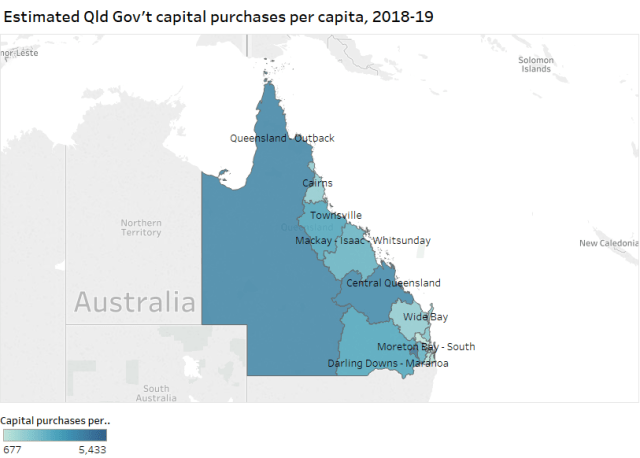
In per capita terms, regions other than inner city Brisbane doing very well out of the state government’s capital budget include Toowoomba, the Queensland outback, and Central Queensland (see maps below). Toowoomba, of course, is benefiting from the Second Range Crossing, on which an estimated $534 million is allocated to be spent by Transport and Main Roads in 2018-19.

Qld per capita

SEQ per capita

Posted in Infrastructure, Uncategorized | Tagged , , , , , , , , , | 3 Comments

My ABC radio interviews on the Qld state budget for 2018-19

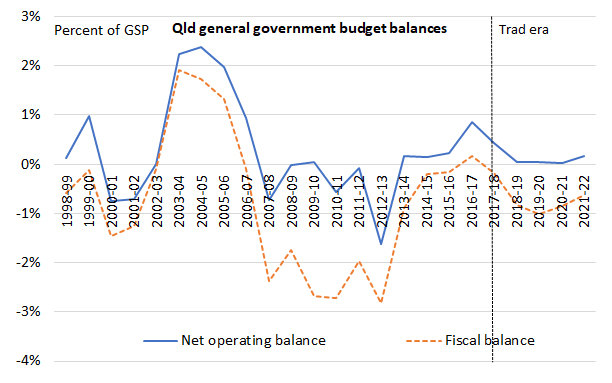
Budget balances

I made two trips to ABC’s South Brisbane studios yesterday. On the Breakfast program, hosts Bec Levingston and Craig Zonca and I chatted about Queensland’s growing state debt, the distinction between good and bad debt, and the state’s credit rating. I spoke after the Deputy Premier-Treasurer had chatted with Bec and Craig, and you can hear me from around 2 hours, 34 minutes into the recording:

http://www.abc.net.au/radio/brisbane/programs/breakfast/breakfast/9839236

On Steve Austin’s Drive show in the afternoon, Steve and I chatted about my impressions of the budget, released just three hours earlier. I told him I thought the projected operating surpluses were too thin and actually negligible when compared with gross state product (see chart above based on data published in the budget as well as ABS data). I also noted that, even according to the metrics the government prefers, the budget projects a deterioration in Queensland’s fiscal position. For example, on p. 48 of Budget Paper 2 we discover:

  • the general government debt to revenue ratio is projected to increase from 54 percent in 2017-18 to 68 percent in 2021-22, meaning the government is not expected to comply with the fiscal principle to “Target ongoing reductions in Queensland’s relative debt burden…”; and
  • the proportion of general government net investments in non-financial assets financed by net operating cash flows will fall below 50 percent to 40 percent in 2019-20 and 44 percent in 2020-21, meaning the government is not expected to comply with the fiscal principle that it will “ensure any new capital investment in the General Government Sector is funded primarily through recurrent revenues rather than borrowing.”

You can hear Steve and me chatting from around 1 hour, 1 minute and 50 seconds into the recording:

http://www.abc.net.au/radio/brisbane/programs/drive/drive/9839250

Posted in Budget, Uncategorized | Tagged , , , , , | 2 Comments

What I’m expecting from the 2018-19 Qld state budget

This coming Tuesday, 12 June, Queensland Deputy Premier-Treasurer Jackie Trad will deliver her first state budget. It is her best chance to establish her economic credibility. Trad is fortunate the state economy is performing reasonably well, albeit not strongly across all sectors and still too reliant on the public sector, as suggested by the March quarter national accounts data released by the ABS last Wednesday (see chart below). Another favourable circumstance for Trad is that coal prices remain high, with coking coal at around $US200 per tonne, boosting royalty revenues. As my colleague Nick Behrens commented in his Qld state budget preview, the revenue gods are smiling for Queensland.

On the other hand, Trad has to deal with an ever growing public service and insatiable demands for public expenditures from her ministerial colleagues, industry peak bodies, and community groups. Alas, Trad appears to have given in to some of these demands. The Government has already announced a $45 billion infrastructure budget, and the Courier-Mail’s Steven Wardill reports today that total state debt is now projected to reach $83 billion in 2021-22 (Infrastructure spree will see debt explode to $83 billion in four years). This is no doubt an example of a government getting the bad news out early, so the budget day reporting focuses on the positive surprises. Incidentally, regular readers will know I am very concerned about the level of state debt and the government’s interest bill, and I was quoted on this issue by Steven Wardill in one of his previous articles this week:

Car registration cost could be cut for same price of interest on Queensland debt

Despite today’s bad news regarding state debt, I remain hopeful there will be some positives in the upcoming budget. The 2018-19 state budget undoubtedly offers the Deputy Premier-Treasurer her best chance to check the ever expanding public service and to impose restraint on operating expenses, both to fund additional infrastructure and to demonstrate a path back to a AAA credit rating over the longer-term. So here are a few things I’m expecting (or rather hoping for) from the 2018-19 state budget.

  1. Public service efficiency measures. I expect Trad to impose efficiency measures such as a freeze on senior appointments or efficiency dividends (e.g. a 1% reduction per annum in operating budgets) on many public service agencies, in recognition of the fact public service numbers have over shot their optimal levels. I have previously commented on the excessive growth in senior public service positions (My comments on excessive growth in senior public service jobs in today’s Courier-Mail).
  2. A path back to the AAA credit rating. At the very least, I would like the budget to show a 5-10 year projection of the state’s debt-to-revenue ratio back to around 100% (and preferably to a much lower level), at which time Queensland would have a good case for regaining its AAA credit rating. To achieve this will require ongoing fiscal restraint on the part of the government, obviously, and an efficiency dividend may be one way of demonstrating this. Last December, the Treasury was projecting the critical debt-to-revenue metric was on its way to around 120% (see my post Critical Qld Gov’t debt metric still projected to worsen). With total state debt now projected to continue growing, the debt-to-revenue ratio will no doubt remain on a path to 120% or more.
  3. Conservative economic and fiscal forecasts. I will be checking the Treasury has not veered too far from the relatively conservative economic forecasts it made last December at the time of the Mid Year Fiscal and Economic Review (e.g. 3% GSP growth and 2.5% wages growth in 2018-19). It’s best to be conservative, lest governments start spending money they will never realistically ever have.

I am very much looking forward to the release of the state budget on Tuesday, and I am lucky enough to have been invited to the lunchtime stakeholder briefing at the Parliamentary Annexe, which occurs prior to the Deputy Premier-Treasurer handing down the budget in the Parliament. The 2018-19 state budget is a great test of the Deputy Premier-Treasurer’s economic credibility, and I will be paying very close attention to her justification, reportedly based on Queensland’s growing population, for letting state debt continue to accumulate, on its way to $83 billion in 2021-22.

sfd_Mar18

Posted in Budget, Uncategorized | Tagged , , , , , , , | 2 Comments

Better to let the private sector risk money on a new Brisbane theatre

In a November 2015 post New 1,500 seat theatre would likely be a waste of taxpayers’ money, I questioned the desirability of a state government-funded $1.3M business case to investigate a new 1,500 seat theatre for Brisbane. At the time, I was criticised by the Courier-Mail’s Paul Syvret for seeing things through a “coldly commercial prism” (see this post). But based on today’s news, I feel even more strongly that my comments at the time were justified. Following Premier Palaszczuk’s announcement yesterday of a new $150M theatre being tacked on to QPAC, today’s Courier-Mail reports:

A market-led proposal by Sydney-based Foundation Theatres for a $100 million theatre on the old State Library site adjacent to Queen’s Wharf has been with the State Government since last year. Foundation Theatres, which runs the hugely successful Capitol and Sydney Lyric Theatres in Sydney, would have required only $25 million from the Government.

Yesterday the Premier insisted that proposal was “still in play”.

“If they still want to pursue that they can,” she said.

But by announcing the new theatre as an extension of QPAC she has effectively killed off that proposal.

This is another good example of government activity crowding out private sector activity. Government activity is generally only justified where there is market failure or equity concerns (in which case transfer payments are typically more efficient than public provision of a good or service). Given the market-led proposal from Foundation Theatres, where is the market failure in this case?

The private sector appears willing to have met the bulk of the cost of the new theatre. The private sector proponent Foundation Theatres isn’t totally pure, as it was asking for a $25M contribution from the state government, but this would have been a much smaller outlay than the $150M the government will now spend building the theatre itself. Of course, one would need to consider what exactly the state government would have received for its $25M investment in the Foundation Theatres venture. That said, based on the limited information in the public domain, it is difficult to understand the logic behind the Government’s $150M investment in a new theatre at QPAC.

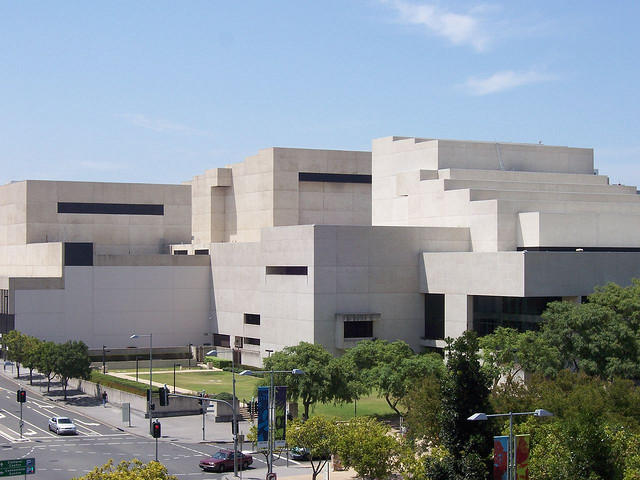
QPAC_Exterior

By Joe Gatling from Ho Chi Minh City, Vietnam – Queensland Performing Arts Complex, CC BY 2.0, https://commons.wikimedia.org/w/index.php?curid=11983514

Posted in Arts, Uncategorized | Tagged , , , , , , | 7 Comments

Upcoming AIIA talk on Asian tiger & tiger cub economies and impacts on Qld and Australia

When I first started studying economics in the early nineties, the international economies that mattered most to Australia were Japan, then beginning its lost decade, and the US, the winner of the cold war and the undisputed global economic and political leader. We learned that China was emerging from decades of failed communism to embrace the market—or rather its so-called socialism with Chinese characteristics—and progress was good, although I didn’t appreciate then just how pivotal to the world economy China would become. Recall that earlier this week the global macroeconomic risk posed by China’s debt-ridden economy was the most reported part of RBA Governor Philip Lowe’s latest speech (see this SMH report).

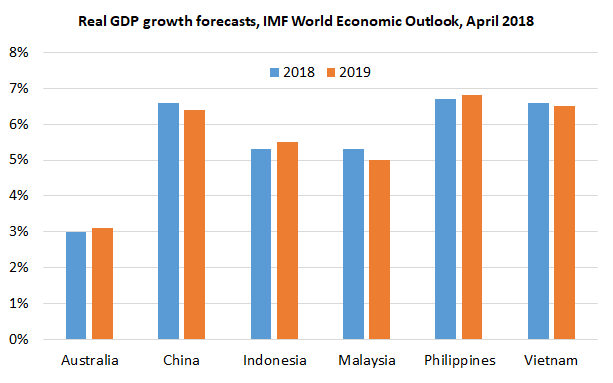
IMF_WEO_GROWTH

Regarding South East Asia, while Singapore was a beacon of economic progress, the most populous economies of Indonesia, the Philippines and Vietnam were still largely desperately poor in the early nineties and had very little macroeconomic impact on Australia. Strong economic growth in these economies since then (e.g. see the latest forecasts in the chart above), with the exception of the Asian financial crisis period in the late nineties, has lifted many millions in these economies and throughout Asia out of poverty.

So now a broad range of Asian economies, the North East Asian economies of China, Japan, Korea and Taiwan, and increasingly South East Asian economies such as Indonesia and Vietnam, are developing strong economic and social linkages with Australia. The most visible example to me is international education, which dominates the local economy around my office on Boundary St, Spring Hill. Hence, I was delighted and felt I was well positioned to accept an offer to address the Australian Institute of International Affairs—Queensland on the linkages between Asia’s tiger and tiger cub economies and the Queensland and national economies:

Surf the wave or crash on the rocks

What are the opportunities and threats from booming Asian Tigers and are the Australian and Queensland economies geared to secure the benefits?

Presented by Gene Tunny

In this presentation, Gene will highlight the extraordinary growth coming out of Asian economies – particularly the three “tigers” of China, Indonesia and Vietnam. Are the Australian and Queensland economies adequately equipped to take advantage of this boom? Are we selling what they want or are we competing with them? In what sectors will that demand grow? Are we doing better than our competitors in Canada, New Zealand, the USA and Europe?  Are we sufficiently diversified to protect ourselves against inevitable cycles in, say, China? Gene’s presentation will include a case study of the opportunities and challenges arising from international education.

The presentation in on Tuesday 12 June from 6:00 to 7:30pm at ACU Leadership Centre, Level 3, Cathedral House, 229 Elizabeth St, Brisbane CBD. It is free for AIIA members, $15 for non-members, and $10 for student non-members.

Many thanks to Paul Lucas, who is a member of the state council of AIIA and a UQ International Development colleague of mine, for suggesting me as a speaker and for also suggesting the topic.

Posted in China, Uncategorized | Tagged , , , , , , , , , | 4 Comments