Quiggin’s Economics in Two Lessons should be on ECON101 reading lists for decades to come

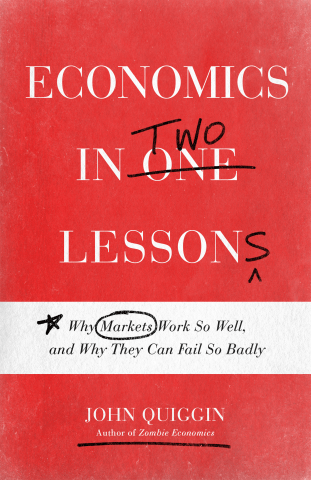
John Quiggin, the UQ Vice Chancellor’s Senior Fellow in Economics, has a new book out, Economics in Two Lessons: Why Markets Work so Well, and Why They Can Fail so Badly, which I can highly recommend. I’ve enjoyed dipping in and out of it over the last couple of weeks and discussing it with friends and colleagues. The consensus appears to be that, while the book isn’t as original and provocative as his previous books (e.g. Great Expectations, Zombie Economics), it is nonetheless a great introduction to economics for the general reader. Furthermore, it is a useful refresher of key concepts for experienced economists, and it does contain several stimulating insights.

My favourite section of the book is Quiggin’s discussion of the economics of Bitcoin, in which he notes (on p. 233) “The Bitcoin bubble rests on no plausible premise.” Quiggin rightly observes:

Whatever happens to Bitcoin, we must not lose sight of a more fundamental, and worrisome development. A financial product with a purely arbitrary value has been successfully introduced in the world’s most sophisticated financial markets.

If the 2008-09 financial crisis wasn’t enough to convince you that financial markets occasionally go haywire, and the efficient markets hypothesis is nonsense, the bubble in Bitcoin certainly should.

The blurb on the back cover nicely explains why Quiggin’s book is called Economics in Two Lessons:

Since 1946, Henry Hazlitt’s bestselling Economics in One Lesson has popularized the belief that economics can be boiled down to one simple lesson: market prices represent the true cost of everything. But one-lesson economics tells only half the story. It can explain why markets often work so well, but it can’t explain why they often fail so badly—or what we should do when they stumble. As Nobel Prize–winning economist Paul Samuelson quipped, “When someone preaches ‘Economics in one lesson,’ I advise: Go back for the second lesson.” In Economics in Two Lessons, John Quiggin teaches both lessons, offering a masterful introduction to the key ideas behind the successes—and failures—of free markets.

It certainly is “a masterful introduction”. I was impressed by Quiggin’s very clear explanation of the concept of opportunity cost, and his presentation of a brain teaser on opportunity cost involving Eric Clapton and Bob Dylan concerts on the same night. You have a free ticket to see Clapton. Dylan costs $40 to see, but you’d be willing to pay $50 to see him, so what is the opportunity cost of going to the Clapton concert instead of the Dylan concert? Embarrassingly, a very high proportion of economists at an American Economic Association conference answered incorrectly when this question was posed to them. You can read the full story and find out the correct answer in Quiggin’s book on pp. 69-70.

Notwithstanding Quiggin’s extraordinary contributions to economic theory and the policy debate on a huge range of issues – including climate change, the Murray Darling Basin, privatisation, and toll roads among others – this book may well end up being his most enduring contribution to economics. I expect it will be enthusiastically recommended to students by first-year economics lecturers for decades to come.

Despite the fact I disagree with a number of Quiggin’s policy suggestions, particularly the vague and Utopian “Job Guarantee” (p. 300), I have no hesitation in recommending this book to readers. You can pick up a copy at Dymocks on Albert St, Brisbane CBD, which had dozens of copies last time I checked.

Quiggin_cover

Posted in Uncategorized | Tagged , , , , , , , , | 2 Comments

No wonder TSBE is mad – Toowoomba businesses missing out on generous payroll tax discounts

Toowoomba & Surat Basin Enterprise, a chamber of commerce, has been annoyed by the Queensland Government’s decision to exclude Toowoomba from its 1% regional payroll tax discount, announced in the 2019-20 state budget. A recent email from TSBE, directing its contacts to its Payroll Tax Regional Discount Survey, announced:

TSBE believes that Toowoomba deserves the same discount in payroll tax that other regional areas will receive. We have the same challenges that other regional areas have in doing business including attracting staff, paying increased energy costs and internet connectivity and we believe that in this instance the Queensland Government is not applying public policy equitably and fairly across the regions.

The exclusion is a big deal for Toowoomba businesses, because its means the difference between a payroll tax rate of say 4.75% or a discounted 3.75% (for payroll up to
$6.5 million and over the $1.3 million threshold). This mean a business with a $5 million payroll would pay $37,000 less in payroll tax per year if it received the discount. Toowoomba businesses will be annoyed their competitors in other parts of regional Queensland, including in Townsville, Wide Bay, Cairns and the Outback, will receive the discount.

Toowoomba residents must be confused about whether they are considered part of regional Queensland or not. There do not appear to be any consistent definitions of South East Queensland or regional Queensland. Indeed, the Queensland Government is inconsistent in its classification of Toowoomba. For example, although Toowoomba has been excluded from regional Queensland in defining eligibility for the payroll tax discount, it was considered regional enough to be eligible for funding from the Regional Capital Fund in 2016:

Building our Regions: Current Fund Areas

Also, it appears Toowoomba is considered part of regional Queensland, and not as part of SEQ, in determining retail trading hours:

Allowable trading hours – Easter period and ANZAC Day 2019

For the record, I’m not necessarily supportive of regional tax discounts. I’d rather governments avoid complexity in the tax system and work on lowering rates in general, for all businesses across Queensland.

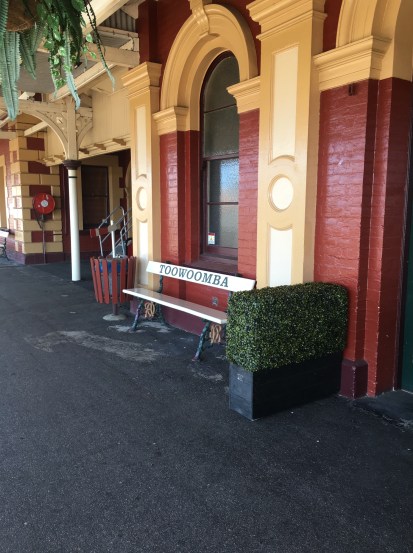
Toowoomba Railway Station

Posted in Tax, Uncategorized | Tagged , , , , , | 6 Comments

Meat disruption: it’s here and now – guest post by Stephen Thornton

Billions of dollars have been invested in Australia’s beef value chain in recent years, inspired partly by a rapidly growing Asian middle class with an increasing demand for protein. But, as in other industries, there is the potential for disruption from new technologies. My friend and colleague Dr Stephen Thornton of BG Economics offers an interesting perspective on the potential for disruption to the Australian livestock industry and abattoirs. The views contained in this guest post are Stephen’s, and should not necessarily be attributed to me. GT

An AT Kearney report into how ‘cultured’ meat (a Cellular Agriculture or ‘Cell-Ag’ technique where an animal cell is grown in a controlled environment) and meat alternatives are disrupting the agricultural and food industries recently made news headlines. Although somewhat speculative, given its qualitative forecasting methodology, the AT Kearney report does provide a useful economic framework for understanding the future global meat industry, currently estimated to be $US 1,000 billion and growing.

The world’s population is expected to be nearly 10 billion by 2050, thereby increasing the demand for food protein. However, the AT Kearney report forecasts cultured meat and new meat replacement products will result in conventional animal-slaughtered meat consumption decreasing from 90 per cent of total meat consumption in 2025 to just
40 per cent in 2040.

I expect the acceptance of these new meat technologies will be greater and possibly faster in Australia than globally, given our relatively high household disposable incomes, our propensity to adopt new technologies and that 12.1 per cent of the population already have diets that are vegetarian or almost all vegetarian.

This raises obvious questions for Queensland livestock farmers and owners of feedlots, abattoirs and butcher stores around their continued profitability in regard to domestic sales, especially after 2030 as the shelf-price of cultured meat becomes more competitive due to scientific processes becoming more sophisticated. To provide some context, the size of the Queensland beef industry alone in 2014-15 was 11.2 million head (45.4% of the nation’s herd) with over 17,300 specialist beef enterprises and beef production at the farm gate valued at $5.07 billion, although the continuing drought and devastating floods earlier this year will impact on these figures to some degree.

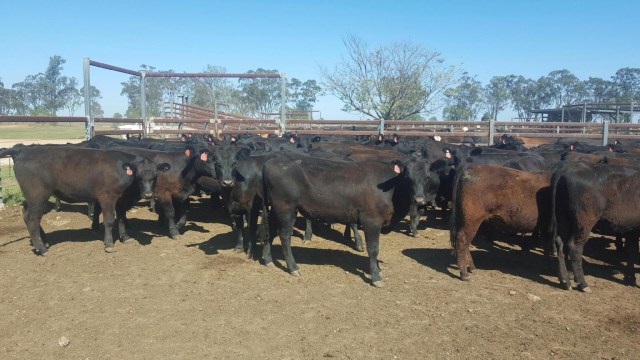
Wagu_cattle

Is the beef industry ripe for disruption?

There is now a proliferation of small vegan cafes and restaurants in Brisbane and elsewhere (see examples here) as well as plant-based patties now on the menu at medium size Australian burger chains such as Burger Urge and Grill’d, which aims to have half the menu in its 138 stores plant-based by the end of next year. McDonalds is trialling a new McVeggie burger and the supermarket majors, Coles and Woolworths, have added a wide range of plant-based meat alternative products to their shelves with Woolies seeing a double-digit increase in demand for vegan products in the past year.

While the focus is currently on plant-based meat replacements, the biggest disruptor in the longer term will be cultured meat, given most people will likely want to continue with their current food preferences of eating beef, lamb, pork, poultry, and seafood. The impact on the Queensland meat export industry is probably a little more difficult to determine at this stage, but it’s not hard to appreciate that some or all of our current export markets may eventually simply grow their own meat. No more beef and lamb price hikes due to flood and drought.

So, is lab grown meat just a passing fad for the top end of town? Probably not. While companies like Memphis Meats in California have seen Bill Gates and Richard Branson invest in this new technology, it’s not only capturing the attention of a few high net worth individuals. Tyson Foods, which produces 20 per cent of the chicken, beef, and pork in the US, with $US 40 billion of sales last year, has also diversified into this area. This is one to watch.

Dr. Stephen Thornton is principal economist at BG Economics.

Posted in Agriculture | Tagged , , , , , , , , , | 6 Comments

Qld Budget & Beyond event with Tony Makin, Judith Sloan & me on 18 July

I’m looking forward to participating in the Australian Institute for Progress’s upcoming Queensland Budget and Beyond event at Jones Lang LaSalle in Central Plaza One in Brisbane CBD on Thursday 18 July:

Come to this analysis and networking event and join our panel of Professor Tony Makin (Griffith University), Professor Judith Sloan (University of Melbourne), Gene Tunny (Adept Economics) and Natasha Doherty (Deloitte Access Economics), to discuss the recent state budget and alternative ways forward…

…The last state budget saw Queensland increasing debt and expenditure, with a heavy reliance on coal royalties to maintain surpluses. The government stressed its expenditure on job creating infrastructure, while the opposition stressed the need for financial prudence.

Who is right? Could they both be right?

That’s a nice summary of the issues from the AiP. As with all things in life, the challenge is achieving the right balance. I’m a great believer in fiscal prudence from governments, but, at the same time, I recognise the need to take the business cycle into account, so fiscal policy isn’t perverse. Austerity can be counter-productive in weak economies. That said, we should be forensically examining all our state government activities to identify savings we can make over the medium to longer-term, as I discussed in my 2018 book Beautiful One Day, Broke the Next.

If you’re in Brisbane on the 18th of July, please consider attending the AiP panel discussion. I’m sure it will be a lot of fun.

59491038_2434373029920036_1178202300586393600_o

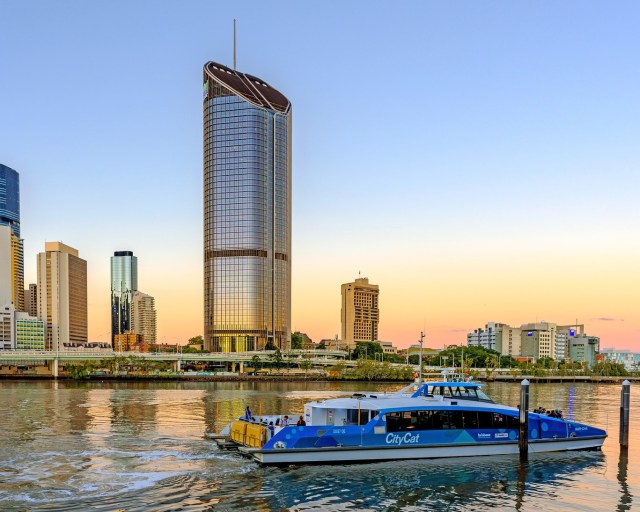
The Qld Government “Tower of Power” dominates the skyline of the southern end of Brisbane CBD.

Posted in Budget, Uncategorized | Tagged , , , , , | 2 Comments

Brisbane Club presentation on Qld economy & latest Value of the Census post at the Mandarin

Last Friday, I presented my thoughts on the economic outlook and the recent Queensland state budget at the Brisbane Club. I highlighted the positives (e.g. resource exports, international education) and negatives (e.g. low business confidence and subdued business investment across many sectors) in the Queensland economy, which are combining to deliver only modest growth. You can download my slides via this link:

Qld Economic update 21 June 19

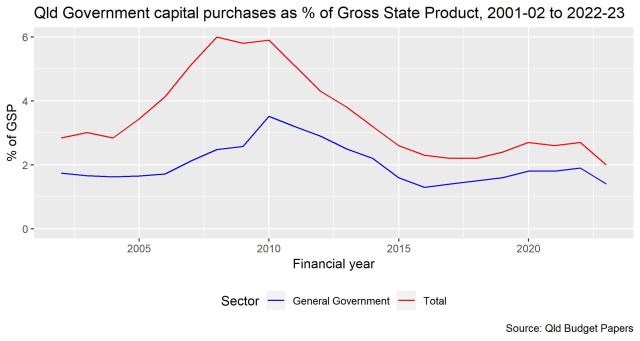
I also noted the state government’s capital works program was expected to contribute to economic growth, as well as to Queensland’s ever-growing state debt. Queensland government capital purchases are  increasing substantially in 2019-20, from $8.9 billion in 2018-19 to a budgeted $10.2 billion (a 15.4% increase). Relative to the size of the state economy, this will be the Palaszczuk government’s highest level of capital works yet, at 2.7% of GSP (see figure below). Note, on current budget projections, it is expected to drop significantly in 2022-23 to 2.0% of GSP, but I expect the government will have found many new projects to invest in by then, so that may not occur. Of course, that probably means total state debt will increase beyond the currently projected $90 billion for 2022-23.

Qld_govt_capital_purchases_19_20

Readers may also be interested in the latest post relating to the Value of the Census project I’m working on with Nicholas Gruen and Matt Balmford from Lateral Economics:

Comparing the Census to alternative data or information: What is the right counterfactual?

Posted in Budget, Labour market, Macroeconomy, Uncategorized | Tagged , , , , | Leave a comment

Qld Gov’t CAPEX – Brisbane’s inner city the big winner

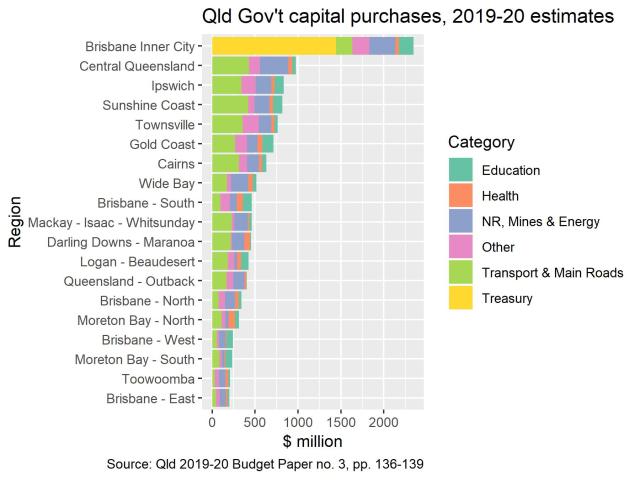
Brisbane inner city workers and residents should start expecting some heavy construction activity around them soon as Cross River Rail capital expenditures are expected to amount to around $1.48 billion in 2019-20, according to the Capital Statement in the Queensland Government 2019-20 Budget Papers published last week. Cross River Rail means the Brisbane Inner City ABS Statistical Area level 4 (SA4) region has the highest level of Queensland Government capital purchases among SA4s (see chart below, noting the Cross River Rail Delivery Authority is part of the Treasury portfolio, presumably so Deputy Premier-Treasurer Jackie Trad can keep a close eye on it). Brisbane Inner City SA4 is also receiving the largest amount of capital works expenditures by the Education department, as the state government builds new (arguably unnecessary) inner city high schools (see my post Is the Dutton Park high-rise high school really necessary?).

capex_region_category

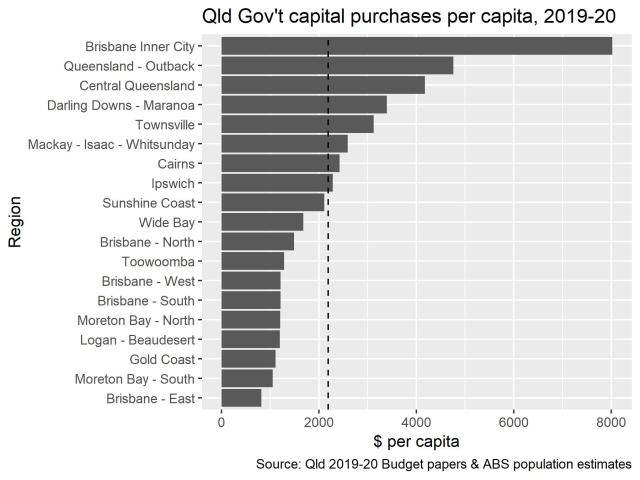
The capital spending in Brisbane Inner City looks extremely disproportionate when considered in per capita terms (see chart below, noting the dotted line is the state-wide average).

capex_per_capita_1

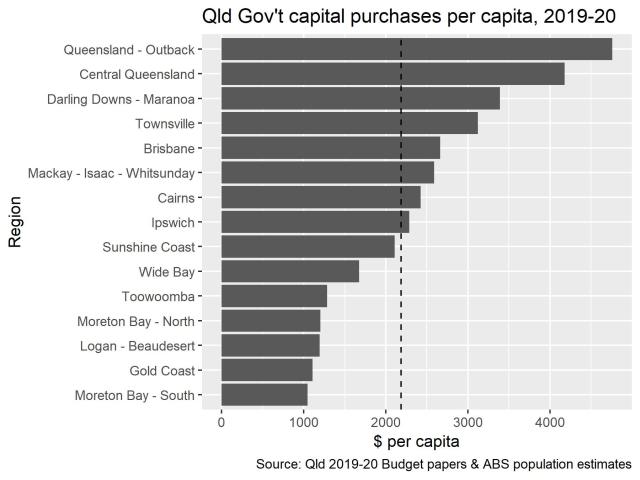
Sure, Cross River Rail will benefit more people than just inner city residents, so to be fair I’ve aggregated the Brisbane SA4s into one Brisbane grouping (see figure below). This reduces the disparity a lot, but it would still annoy many regional Queenslanders to see Brisbane getting above average state government capital spending per capita as a result of Cross River Rail.

capex_per_capita_2

Given the state government’s political need to improve its standing in regional Queensland, some ministers may now be regretting such a high level of capital expenditures in Brisbane’s inner city.

For a handy summary of what’s in the latest Queensland Budget for business, see Nick Behrens’s post:

Queensland Budget 2019-20 Business Update

Posted in Infrastructure, Uncategorized | Tagged , , , , , , , , , | 2 Comments

Valuing the Australian Census – cross-posted at Club Troppo

One of the exciting projects I’m working on is a valuation of the Australian Census for the ABS with my Lateral Economics’ colleagues Nicholas Gruen and Matt Balmford. Our first project-related post is below. Here’s an introductory message from Nicholas:

Lateral Economics has been commissioned by the Australian Bureau of Statistics (ABS) to estimate the value of the Australian Census to the Australian community. As part of that exercise we’ve got the go-ahead from ABS to do something that, it seems to me, all public inquiries, and most independent public agencies, should do as a matter of course. Run a blog a little like the blog we ran when I chaired the Government 2.0 Taskforce.

Ten years on from the Taskforce, it’s amazing how slow the practice has been to catch on. It seems to me the kind of thing that the Productivity Commission should do, and the Reserve Bank. Anyway, as far as I know, there’s no such blog on offer there or anywhere else much. One exception is the Bank of England which runs a lively blog in which staff explore all manner of questions relating to their research. It greatly enhances both its work and their staff’s morale and willingness for some of the best to stay at the Bank rather than moving off into academia or consultant land.

Anyway, this exercise gives us an opportunity to trial it again. Accordingly we will post from time to time outlining the progress of our investigations, particularly highlighting issues we are trying to understand to improve the quality of our review.

Comment will be post-moderated with a back-up plan to provide pre-moderation in the unlikely event of commentary which is judged to lack bona fides in a disruptive way. We’ll be consulting ABS with draft blog posts before posting them to give the ABS an opportunity to provide input. We nevertheless remain responsible for the exercise, and for the content of each post, not the ABS.

Finally, if you do have anything to offer, please do so to show how productive this kind of exercise can be. I know myself how productive it is from my own experiences blogging myself not least as part of the Government 2.0 Taskforce, but as I’ve grown older it’s struck me how much adoption relies on, well, adoption. If no-one’s doing it, no one does it. Then a few people do it and the obviousness of doing it seems to become accessible to others, even as they keep their in-tray reasonably cleared.

Valuing the Australian Census

Gene Tunny, Nicholas Gruen, and Matt Balmford, Lateral Economics

The five-yearly Australian Census provides a wealth of data on Australian households. Those data are used extensively by all levels of governments, industry, and non-profits in decision making and planning. The Census provides important information on household composition, journey-to-work flows, Indigenous status, and languages spoken at home, among other data. It is also used extensively to ‘ground-truth’ and so assess and improve the representativeness of a wide variety of data sets. The ABS understands that all this information is of substantial value, but no careful estimate of its total value has yet been made. The ABS has engaged Lateral Economics to provide such an estimate.

In recent years, a combination of factors has led to renewed scrutiny of the value of the census, including burgeoning administrative data which could be tapped by national statistical agencies, as well as advances in computing power and data science. Statistical agencies worldwide have come under pressure from ministers to provide greater justification for the hundreds of millions of dollars of costs of a national census. For instance, in 2001, the UK House of Commons Treasury Select Committee called for the national census to be justified in cost-benefit terms. Since then, the UK Office of National Statistics (ONS) has produced a Census Benefits Evaluation Report for the 2011 Census. It was reported that the UK census yields annual benefits in the order of £500 million.

In 2013, Statistics New Zealand followed the example of the ONS and commissioned a valuation of the NZ census, which reported a return on investment (ROI) of around $5 of net benefits for every $1 of expenditure on the census.

In Australia, too, the issue of the cost of the census has come under scrutiny. For example, in 1993, a Federal government interdepartmental committee investigated cost reduction opportunities for the census. However, it recommended maintaining the current census format. Indeed, comprehensive five-yearly censuses are seen as necessary to ensure fair electoral representation given substantial population growth in newly-developed areas, such as Springfield and Yarrabilba in South East Queensland. The requirement for a five-yearly Census was inserted into the Census and Statistics Act 1905 in 1977 (section 8(1)), following a 1976 High Court decision suggesting the need for more a more frequent Census to ensure fair electoral representation.

A critical question for Lateral Economics’ research project is the extent to which the Census is essential for developing high quality estimates of populations at various levels, national, state, regional and for small areas, and for various groups in the population, including Indigenous and culturally and linguistically diverse people. Such estimates are important for electoral representation, but they are also important for the allocation of:

  • GST revenues across state and territories;
  • resources in health, education, and other social services; and
  • capital expenditures, both for social infrastructure and transport infrastructure, and in the private sector, too (e.g. shopping centres, retirement villages, etc.).

Such decisions may depend critically on information such as accurate estimates of Indigenous people in a region, or journey-to-work flows between regions, and the Census is a critical source of information to such estimates and for which there are not obvious substitutes.

Lateral Economics will attempt to quantify the benefits to the Australian community of more accurate decision making regarding the allocation of funds across regions for different purposes. We will be guided, but not limited, by the methodologies employed in previous studies. These methodologies rely largely on estimates of the inaccuracies of resource allocation and capital investment that would be occur in the absence of Census data. We will also draw on methodologies developed in these studies for estimating the dollar benefits of, among other things:

  • improved public policy development in social policy areas where Census data are important, such as in policies for disadvantaged groups[1]; and
  • higher-quality academic and market research.

Even after the most stringent of efforts, considerable uncertainties will remain in parameterising these questions. However this underlines the importance of consulting as widely as possible – with the Australian Electoral Commission, Commonwealth Grants Commission, other federal and state agencies, local governments, and the private sector and NGOs – to develop defensible assumptions to underpin our estimates (guesstimates?). It is likely we will provide reasonable lower and upper-bound estimates of this ROI.

In undertaking this project, Lateral Economics is not necessarily presuming that there will net benefits to the community from running the Australian Census in its current format and frequency. We are doing our best to follow the evidence – something that the ABS has stressed its support for. We note that, based on a cost-benefit analysis, South Africa decided not to run a census in 2016, so the question of whether a national census is valuable is an open one.  But wherever the evidence takes us, it’s critical we get the best evidence we can regarding users’ specific uses of Census data, the benefits they derive from that use, and any reflections they have on what the next best source of data would be in the absence of the Census, and the potential costs of any reduction in data quality.

In future articles, Lateral Economics will discuss our progress and seek feedback on our thinking and analysis to date regarding the different Census benefit values we will be estimating. In the meantime, if you have any ideas or information that you think would help us, please get in touch via mail@lateraleconomics.com.au.

[1] This could be estimated by assuming a percentage improvement in the quality of related government services and applying that to total spending on those services. The assumption would be informed by consultations with stakeholders.

Posted in Uncategorized | Tagged , , , , , , | 6 Comments

Qld Budget interviews with ABC’s Steve Austin & 4BC’s Ross Greenwood

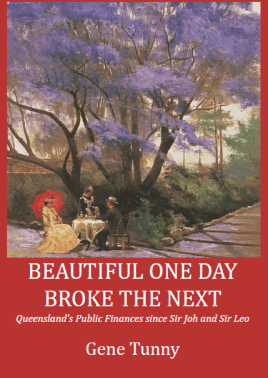
While chatting with 612 ABC Brisbane’s Steve Austin and fellow interviewee Nick Behrens this afternoon, I almost chuckled when Steve asked me whether this Queensland state budget, in which total debt is projected to head toward $90 billion by 2022-23, meant the state government had abandoned the task of fixing up the budget and paying down the debt, or words to that effect.* As I argued in my book Beautiful One Day, Broke the Next, the state government did that several budgets ago, arguably in former Treasurer Curtis Pitt’s first budget with the notorious debt shuffle. This budget simply continues in the tradition of highly political budgets aimed at improving the government’s political prospects.

After federal Labor’s disastrous performance in regional Queensland, partly due to the state government’s alleged “go slow” on the Adani mega mine, this state budget had to be aimed at regional Queensland and as we’ve seen with various announcements regarding the new Gatton prison, AC in schools in hot regions, and the latest regional pork barreling fund, the government has tried to improve its prospects in the regions, as I discussed with Steve and Nick. You can hear the discussion, which I enjoyed immensely, from 1:03:17 at this link (which will self-destruct after about one week so the ABC can save its server storage space):

https://www.abc.net.au/radio/brisbane/programs/drive/drive/11179680

I was also interviewed by Ross Greenwood on 4BC and among other things we discussed the Adani mega mine:

https://omny.fm/shows/money-news-with-ross-greenwood/gene-tunny-on-rising-debt-in-qld?in_playlist=money-news-with-ross-greenwood!podcast

*In the ABC radio interview I noted the new accounting treatment of leases makes comparisons with previous debt estimates a little tricky.

cover

My book on how Queensland ended up with so much debt, available from the link above and at Folio bookstore on Edward St, Brisbane CBD.

Posted in Budget, Queensland Government, Uncategorized | Tagged , , , , , , | 2 Comments

Qld’s exports to China doubled in less than 2½ years

There was some excellent commentary on the US’s and Australia’s relationships with China on ABC Radio National over the weekend which I can highly recommend:

FT’s Martin Wolf interview: Is the US wrong on the trade war? on Saturday Extra with Geraldine Doouge, and

30 years after the Tiananmen Square massacre, how strong is Australia’s relationship with China? on Between the Lines with Tom Switzer.

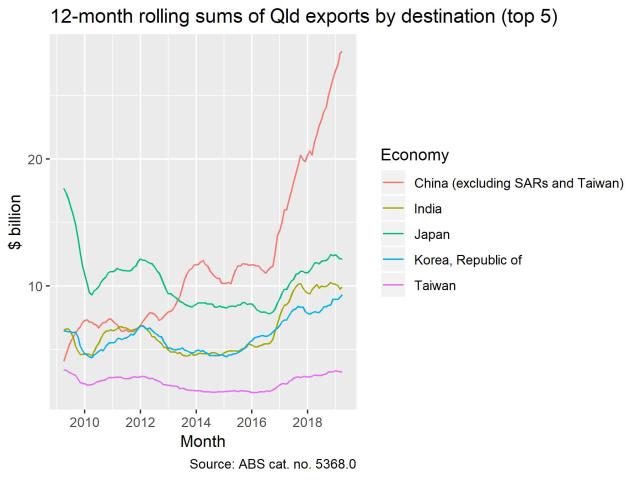
Some remarks from Tom Switzer in particular made me think about the risks of future economic or political crises in China, and what they might mean for the Australian and Queensland economies. Obviously, we are particularly vulnerable. China is our largest trading partner. Consider that, as shown in the chart below, Queensland’s exports to China have doubled over the 28 months to April 2019.

exports_destination_12m

Much of that surge was due to a strong recovery in coal prices over the last few years, although they now appeared to have peaked. As the CCIQ noted in its media release accompanying the new exports data from the ABS last week, there has been “some moderation in coal prices”. CCIQ Head of Media and Industry Dan Petrie observed:

The April data shows a softening in coal and natural gas exports…

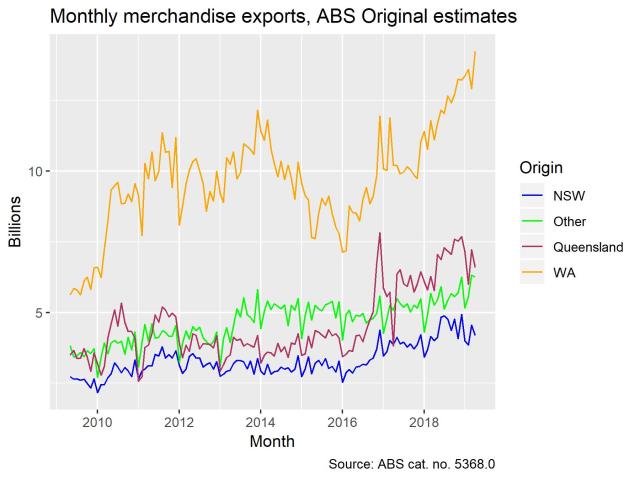
As the Queensland Treasury briefing on exports demonstrates, Queensland’s major export is coal, with an export value of $36.5 billion in the twelve months to the end of April 2019. Coal accounts for around 43% of Queensland’s total goods exports of $85.2 billion over the same period.

You can see how Queensland’ monthly merchandise exports are down from their most recent peak at the end of 2018 in the chart below.

exports_monthly

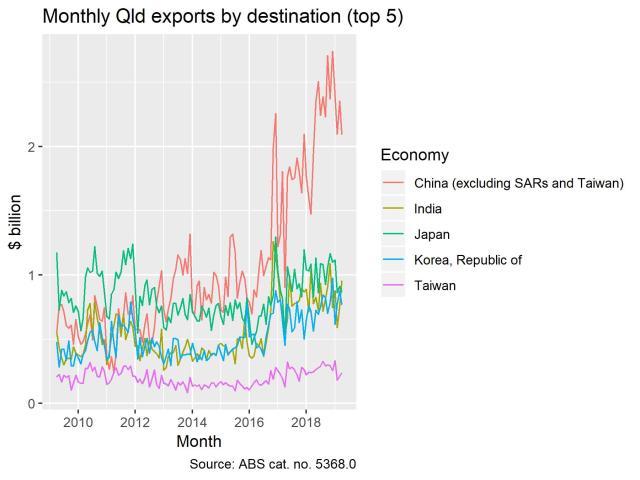
Here’s a plot of monthly exports to Queensland’s major trading partners showing how the value of exports to China has fallen from the late 2018 peak, although they are still double what they were a few years ago. Also note these data are not seasonally adjusted, and it is possible there is some seasonal variation.

exports_destination

In summary, Queensland’s export performance over the last few years has been extraordinary, although we are now much more dependent on China than we ever were in the past, with all the associated risks that involves.

Posted in China, Exports, Uncategorized | Tagged , , , , , , , , , | 2 Comments

International education boom – new ABS estimates

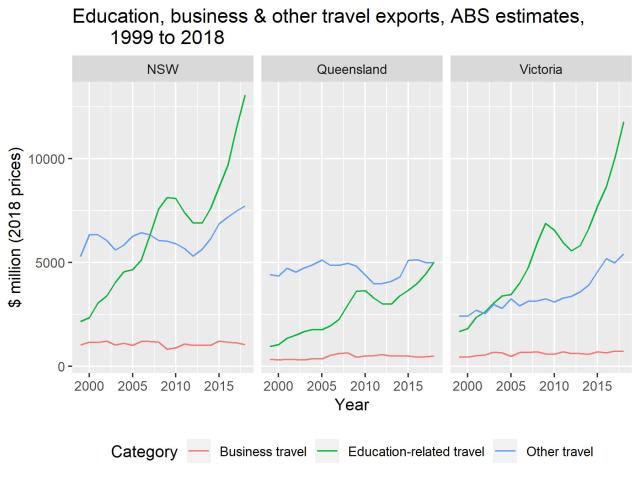
My office is in the Johnson Hotel, in the middle of the international education precinct around Boundary St, Spring Hill, so I’m very conscious of the international education boom we are experiencing. Even so, I was stunned by newly released ABS estimates of international education export earnings, comprising what international students spend on fees and on goods and services while in Australia. Education-related travel spending in Queensland amounted to $5 billion in 2018 (see chart below). In real terms, it has grown at an average annual rate of 10.9% since 2013. It has grown at even faster rates in southern states, at 13.6% p.a. in NSW and at 15.1% p.a. in Victoria.

ed_exports

Notice how education-related travel has really been the outstanding performer among the different international travel categories in Queensland. Otherwise, it appears international tourism has been flat for the last few years after its rebound in 2014 and 2015. Tourism and Events Queensland should be asking what is going wrong with its marketing, given it really can’t take credit for the growth of international education.

A strong critic of Queensland’s failure to reach its tourism potential is Simon Pressley of Propertyology, a real estate investment adviser. Last month, in his post Queensland has double-digit growth potential, but what’s missing?, Simon wrote:

The Sunshine State scores an ‘epic fail’ for not capitalising on enormous economic opportunities from a worldwide tourism boom which commenced way back in 2012.

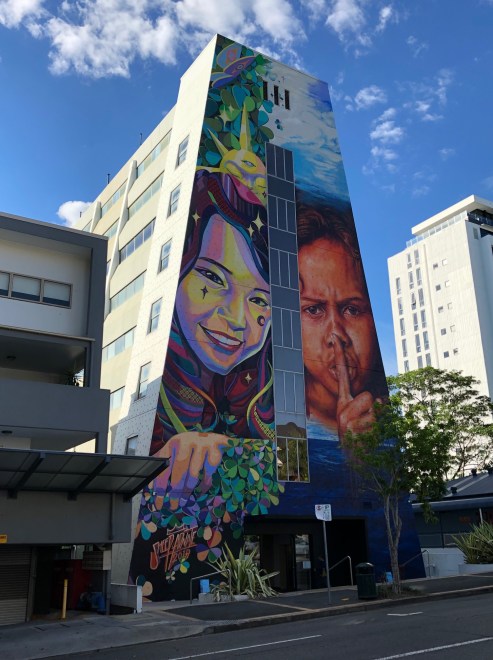
Finally, regarding the Spring Hill international education precinct, a fascinating mural has been painted recently on the triangle building on Boundary St which is part of the International Education Services empire (see image below). The young Asian person painted in the mural represents all the international students passing through IES, while the image of the young Indigenous persons acknowledges Boundary St’s history, as an actual boundary in the early days of British settlement of Brisbane, when Indigenous people had to remain outside the boundary after curfew.

IES

The International Education Services building on Boundary St, Spring Hill, Brisbane

Posted in Education, Uncategorized | Tagged , , , , , , , | 2 Comments