The Gig Economy – Economics Explained episode with Darren Brady Nelson

The topic of my latest Economics Explained episode is the so-called gig economy. Across the world, we’ve seen a surge in freelancing and contract work, facilitated by the proliferation of laptops and smartphones, and by web platforms such as Uber and Upwork.

The gig economy benefits consumers through lower prices and greater choice. Check out how many local restaurants are participating in Uber Eats for example. And obviously the gig economy benefits the platform businesses which have multi-billion-dollar valuations. But does the gig economy benefit the workers, the people working gig-by-gig?

This question and others were considered in the conversation I had on 12 October with my good friend Darren Brady Nelson, a professional economist who has worked for many years as a freelancer and contractor. Darren’s professional career began in the NSW Treasury in the 1990s. In addition to his economic consulting work, Darren has contributed regularly to a variety of publications, including the Cayman Financial Review. He has also served as an adviser to politicians. For instance, in 2017, Darren was economic adviser to Queensland Senator Malcolm Roberts.

Darren joined us via Skype from co-working space Work Lofts in Milwaukee, Wisconsin, which has a range of features designed to make freelancers and entrepreneurs comfortable, including beer and sparkling water on tap and coffee (see image below).

Beer on tap at Work Lofts

The following articles were mentioned in the interview:

OECD Working Paper – Gig Economy Platforms: Boon or Bane?

Mises Institute article – Is the Sharing Economy Exploitative?

In the episode, I alluded to the regulators taking a dim view of Uber in London. The latest news is that Uber is effectively on probation in London:

Uber gets two-month operating license in London. It wanted five years
Posted in Labour market, Uncategorized | Tagged , , , , , , , , , , | Leave a comment

Government Budget Analysis Training Day on 22 November at the Johnson, Spring Hill, Brisbane

I’m excited to announce my old friend and colleague Joe Branigan and I will be holding a training day on government budget analysis on Friday 22 November at the Johnson Hotel, Spring Hill, Brisbane. Tickets are available via Eventbrite:

Government Budget Analysis Training

We think there is a real need for a training day like this, given all the debate we see in the media on budget/fiscal policy and the large number of different budget metrics, such as the net operating balance and fiscal balance, which are mentioned.

Topics to be covered at the training day include:

  • Public finance 101 – what governments do; how they tax, spend, manage cash, and borrow money
  • Operating and cash flow statements
  • Balance sheets
  • Pros and cons of different metrics (e.g. gross vs net measures, cash vs accrual, general government vs government-owned corporations)
  • Optimal budget policy
    • – golden rule / debt dynamics
    • – debt brake, etc.
    • – privatisation and so-called asset recycling
  • Debt dynamics modelling in Excel
  • Role models and cautionary tales – i.e. good and bad budget policies through history

Morning tea, lunch, and afternoon tea will be provided. Please join us if you’re interested, and please alert anyone who may be interested in our upcoming training day.

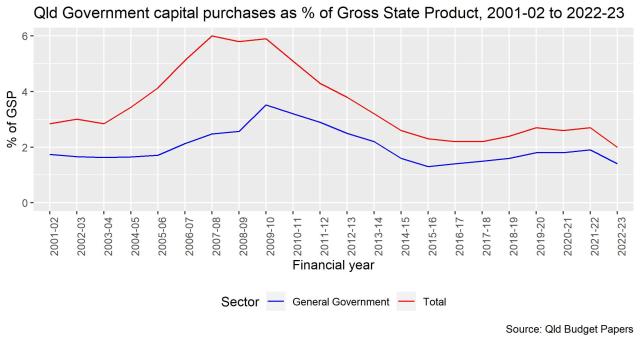
Qld_govt_capital_purchases_19_20_v2

Posted in Budget, Uncategorized | Tagged , , , , , , , | Leave a comment

Economics of Infrastructure with Craig Lawrence podcast discussion – Part 2

I’ve just published part 2 of my Economics Explained podcast discussion on the economics of infrastructure with Craig Lawrence, Managing Director of Brisbane-based Lytton Advisory:

Economics of Infrastructure – Part 2

Craig Lawrence has three decades of experience as a professional economist and has advised on a wide range of infrastructure projects in Australia, the Pacific, and the Middle East. Part 2 of our conversation covers, among other things:

  • public private partnerships or PPPs, their pros and their cons;
  • challenges in infrastructure provision in emerging economies;
  • the merits of quasi-independent infrastructure advisory bodies such as Infrastructure Australia and Building Queensland; and
  • the geopolitics of infrastructure (e.g. Chinese takeover of a Sri Lankan port, Australia blocking Huawei’s involvement in 5G infrastructure, and the 99-year leasing out of Darwin port to a Chinese company).

My new Economics Explained podcast is also available via iTunes/Apple Podcasts and Spotify.

On PPPs, you might be interested in an article written by Adept Economics Research Assistant Ben Scott and me:

Demystifying Brisbane’s Cross-River Rail: a PPP, an alliance, and a traditional procurement

Economics Explained Logo

Posted in Infrastructure, Uncategorized | Tagged , , , , , , , , , | 1 Comment

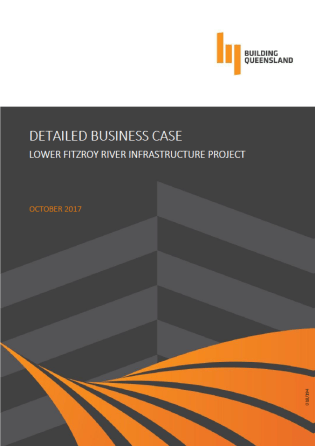
Rookwood Weir business case should be re-worked – first one suggested it’s a poor project, though

Building a downsized 54,000 ML Rookwood Weir in Central Queensland, as the state government is now proposing following an estimated cost blowout, doesn’t appear sensible to me, as agricultural use of the water is critical to the project’s viability, and the project will now offer little water for agriculture (see the ABC News article Weir reduction plan condemned by central Qld farmers worried about water loss). This is not to say that the full-sized 76,000 ML dam should be built instead. Building Queensland’s Rookwood Weir Business Case suggested the full-sized project probably wouldn’t stack up anyway.

In Building Queensland’s central case ‘best estimate’ scenario, Rookwood Weir’s benefit-cost ratio was estimated at 0.6-0.8 (see Figure 1-2 on p. 16 of the Business Case). That is, the benefits from the weir were estimated to be only 60-80% of its costs. It doesn’t stack up. The project does stack up in the most optimistic “full demand” scenario, but it wouldn’t be wise to spend $352 million on a project you expect will only be worthwhile in the most optimistic scenario.

The business case for the Rookwood Weir should be re-worked, using the latest cost estimates, and the state government should give itself the option of not going ahead with the project, which doesn’t stack up in the central scenario of Building Queensland’s business case anyway. According to the Courier-Mail, the state government has already spent $66 million on the project, but the preliminary construction works start next month. These should be deferred until the government re-works the business case and is confident the project actually stacks up.

Rookwood Weir business case

Posted in Agriculture, Uncategorized, Water | Tagged , , , , , | 5 Comments

Economics of apartment living podcast discussion with Dr Stephen Thornton

I’ve just published a new Economics Explained episode in which I interview regular QEW contributor Dr Stephen Thornton on the economics of apartment living:

Economics Explained episode 2 – Economics of apartment living

Issues discussed include:

You can subscribe to the Economics Explained podcast via iTunes:

Economics Explained via iTunes

Apartment tower under construction at Milton

Posted in Housing, Uncategorized | Tagged , , , , , , , , , , | Leave a comment

QPAC/QTIX to trial Uber-style surge pricing to boost revenue

While trawling through the dozens of documents tabled online by the state government yesterday, I noticed the Queensland Performing Arts Centre (QPAC) is investigating airline/Uber-style dynamic or “surge” pricing to boost revenue and presumably to make it less dependent on the $10.6 million subsidy it receives from the state government.* In its 2018-19 Annual Report on p. 66 QPAC describes dynamic pricing as “The practice of varying the price for a product or service to reflect changing market conditions, in particular in times of greater demand.” It’s a pity they didn’t have it in place when Lion King and Phantom of the Opera were showing in the past as they would have cleaned up.

On p. 18 of the QPAC 2018-19 Annual Report it is noted:

A review of the QTIX pricing model has resulted in changes such as a fee for development work specific to individual clients’ needs and an introduction of a QTIX transaction fee negotiated as contracts are renewed. A system to apply dynamic pricing to improve yield for specific events is currently being developed and will be trialled in coming months in consultation with producers.

I was very pleased to read this, and it should benefit both producers and QPAC, as QTIX (QPAC’s “ticketing arm” as they call it) receives higher transaction fees. It will benefit consumers, too, as people who really want to attend a popular show and are willing to pay to attend will be more likely to secure tickets. Also, consumers may find they can buy heavily discounted tickets for shows which haven’t attracted a lot of attention yet.

South Bank 15a

The Playhouse at QPAC, South Bank, Brisbane. Photo by Jennifer Tunny.

While I was generally pleased with the level of disclosure in QPAC’s Annual Report, I would like to see more information on utilisation rates for specific venues with QPAC (e.g. Lyric Theatre, Concert Hall, Playhouse, and Cremorne Theatre) rather than just aggregate data (see p. 11). The Lyric Theatre appears to do well, with all those cash cow jukebox musicals that are always showing there, but I wonder about the profitability of the other venues.

*Hat tip to Nick Behrens for alerting me to the state government’s pre-Riverfire weekend document dump.

Posted in Uncategorized | Leave a comment

Lowest confidence in six years – not a happy Friday in Qld

Earlier this year I encountered some resistance at various presentations I gave on the gloomy outlook for the Queensland economy, but I suspect I wouldn’t get much push back now. Today, the Courier-Mail is reporting on its latest YouGov poll results:

CONFIDENCE in Queensland’s outlook is at its lowest point in at least six years, with almost half of people surveyed saying the state is headed in the wrong direction.

The August Courier-Mail/YouGov Galaxy poll, published in today’s Queensland Business Monthly, revealed just 34 per cent of people thought the state was on the right trajectory.

Nationally, confidence is lacking, too. NAB’s Monthly Business Survey for August, published earlier this month, revealed:

Both business confidence and conditions declined in the month, with both now at +1 index point – well below long-run averages.

This is all unsurprising to me, as I’ve been concerned about the leading indicators of activity for a while now (e.g. see Qld: Hot or not? Presentation at the Brisbane Club).

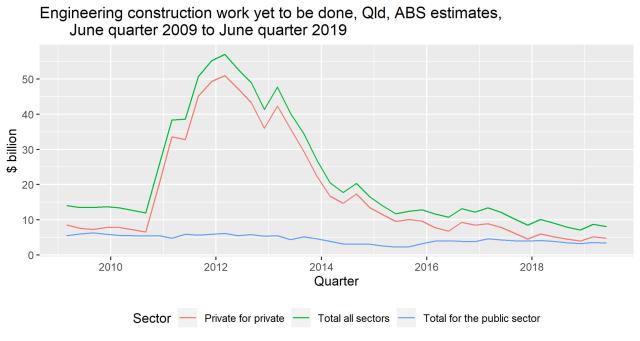
On Wednesday, the ABS published its engineering construction (i.e. heavy/civil construction) estimates for June quarter 2019. Engineering construction work yet to be done (the so-called pipeline of activity) in Queensland in June quarter was 10% below its level in June 2018 (see chart below). It must be very depressing for construction contractors who can remember the mining investment boom days. In March quarter 2012, when the massive Gladstone LNG projects were underway, the pipeline of work to be done was seven times the size it is now.

work_ytbd_qld

For more on the economic outlook for Queensland, see my post from late August:

Qld private sector CAPEX is disappointing

Posted in Infrastructure, Macroeconomy, Uncategorized | Tagged , , , , , , , | Leave a comment

Qld Gov’t public service bonus demonstrates ongoing relevance of Beautiful One Day, Broke the Next

The Queensland Government’s $1,250 bonus for public servants, estimated to cost $250 million in total, is being poorly received outside of the public service. Many people consider that public servants are already well remunerated and that the state government still needs to get its debt under control. The cash splash demonstrates the ongoing relevance of my 2018 book Beautiful One Day, Broke the Next: Queensland’s public finances since Sir Joh and Sir Leo.

For instance, in my book, I discussed the importance of the public service voting bloc in Queensland:

Given there are over 250,000 people employed in the Queensland public service, the public service vote can be a decisive factor in state elections. Arguably, by increasing the public service to such a large extent during its first term in government…the Palaszczuk government has realised the importance of the public service vote for its own political survival.

The public service bonus is a vote buying exercise, rather than a genuine fiscal stimulus, as I suggested to Sarah Vogler, State Political Editor of the Courier-Mail, when I spoke with her yesterday. In her article Economists cast doubt on claims public service cash bonus will boost economy, Sarah writes:

Adept Economics and former federal Treasury economist Gene Tunny described the stimulus excuse as a “weak” one.

“It is certainly going to be a significant addition to the income of those public servants and they will spend a fraction of it,’ he said.

“But if they are worried about a downturn then that is not really going to stop it happening. “That’s going to be quite minor in the scale of things.

“It really wouldn’t do much to stop a deteriorating economy in my view.”

Note that I’m not advocating for a larger fiscal stimulus or any fiscal stimulus at all. Generally, fiscal stimulus is ineffective in smoothing out the business cycle.

Nick Behrens from QEAS and Dan Petrie from CCIQ also have some great comments in today’s Courier-Mail criticising the public service bonus.

I concluded Beautiful One Day, Broke the Next with the words:

I live in hope of an eventual return to fiscal discipline in Queensland, but it may be a long time coming.

Those words remain appropriate.

cover

Posted in Uncategorized | Tagged , , , , , | 4 Comments

Let’s have Brisbane Festival retail trading hours all year round

Accustomed as I am to Queensland’s over-regulated economy, I was surprised the other week when shopping at the Spring Hill Woolworths to find out it has extended trading hours during the current Brisbane Festival season, which culminates in the River Fire spectacular next Saturday night. If I recall correctly, the Spring Hill Woolworths is trading to 10pm weekdays instead of being forced to close at 9pm and it is trading until 8 or 9pm Sunday instead of 6pm.

In a normal market economy, shops would have no problem opening longer if they can make enough revenue to cover costs and earn a profit, but in Queensland an application to the Queensland Industrial Relations Commission is required. Thankfully, the National Retail Association was successful in having the Brisbane Festival declared a “special event”, being significant for “cultural, economic and tourism reasons”, so many supermarkets in inner city Brisbane can trade for longer, as reported in the QIRC decision of 3 September. This is a victory for common sense and hopefully is a good sign that we will see further relaxation of our anachronistic retail trading hour restrictions in the future.

Regular readers will know I’ve long been critical of trading hour restrictions. For instance, in my post from last month Priorities for boosting tourism in Queensland I recommended the Queensland Government:

Remove regulations which make us look boring to international visitors—e.g. anachronistic retail trading hours regulations, which mean most supermarkets can’t stay open after 9pm Monday to Saturday or after 6pm on Sunday, and none can sell alcohol.

We shouldn’t just relax trading hours restrictions during the Brisbane Festival. They should be relaxed all year round.

Incidentally, check out the winning Treasury Brisbane #BrisbaneAnyDay photo taken by my mother Jennifer Tunny. The photo was reproduced in a Treasury Brisbane Instagram post. 1823 was the year it was decided that the worst convicts in Sydney should be sent a long way away, and NSW Surveyor-General John Oxley sailed off to find a suitable location to dump them.

Riv 6a

Treasury Brisbane #BrisbaneAnyDay competition winning photo by Jennifer Tunny

Posted in Retail trade, Uncategorized | Tagged , , , , , | 2 Comments

Economics of infrastructure interview with Craig Lawrence of Lytton Advisory

I spend much of my spare time listening to podcasts, including EconTalk, Planet Money, and the Tim Ferriss Show among others, and I’ve often thought it’s about time I start my own podcast. Over the last month or so, I’ve taken the Podcasting Fellowship course delivered by Alex DiPalma, a prominent US podcast producer, notably of Seth Godin’s Akimbo podcast. As part of the course, you need to interview people and edit the audio. I am very grateful to my colleague Craig Lawrence, Managing Director of Lytton Advisory, for agreeing to be my first interviewee. Craig has had a lot of experience advising on infrastructure projects in Australia and overseas, including in PNG, the Solomon Islands, and in the Middle East. I’ve been fortunate to work with Craig on a few projects over the last couple of years. You can listen to our discussion on the economics of infrastructure below.

Thanks to the BBC for providing the supermarket scanner sounds which I obtained via the BBC Sound Effects Archive.

Posted in Infrastructure, Uncategorized | Tagged , , , | 3 Comments