Cannabis with Dr Stephen Thornton – latest Economics Explained episode

Several jurisdictions around the world, such as the US states of California and Colorado, have legalised cannabis, also known as marijuana. In Australia, the Australian Capital Territory will become the first Australian jurisdiction to legalise recreational cannabis use on the last day of January 2020. What are the pros and cons of cannabis legalisation? To help us answer this question, we’re joined in the latest Economics Explained episode on cannabis by Dr Stephen Thornton of BG Economics, a Brisbane-based economic consulting firm specialising in the economics of social issues.

Use these timestamps to jump right to the highlights:

This episode was recorded on 6 January at the Adept Economics office, Spring Hill, Brisbane. Australia.

Economics Explained Logo

Posted in Social policy, Tax | Tagged , , , , , , , , , , , , , , , | Leave a comment

The Fight on the Right – latest International Liberty post features my interview with Dr Dan Mitchell

Well known US economist and pundit Dr Dan Mitchell has featured my Economics Explained interview with him in the latest instalment of his Fight on the Right series of posts on his International Liberty blog:

Fight on the Right part III: State Capacity Libertarianism

Dan’s Fight on the Right series considers major policy disagreements within the US Right. These disagreements have been over tax cuts, with fiscal conservatives fighting with supply-siders, and over the concept of “compassionate conservatism”, associated with President G.W. Bush. In his latest post, Dan critiques the emerging philosophy of State Capacity Libertarianism, as described by Tyler Cowen. State Capacity Libertarianism is essentially a mixed economy model with highly efficient public service delivery. As Dan notes, high taxing and high spending Denmark may well fit in this definition.

Check out Dan’s post as it’s highly thought provoking, but here’s Dan’s summary of his critique:

For what it’s worth, my view of state capacity libertarianism is the same as my view of national conservatism. And compassionate conservatismkinder-and-gentler conservatismcommon-good capitalism, and reform conservatism as well.

I will be highly skeptical until someone shows me the tiniest shred of evidence that further reducing economic liberty can lead to more prosperity.

Thanks again to Dan for appearing on my Economics Explained podcast and for sharing the interview on his blog.

Daniel_Mitchell_by_Gage_Skidmore

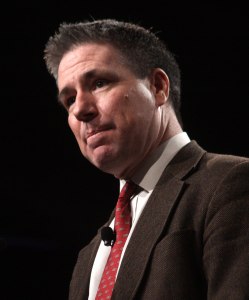
Dr Dan Mitchell, Founder of the Center for Freedom and Prosperity and former Senior Fellow of the Cato Institute.
Attribution: Gage Skidmore [CC BY-SA (https://creativecommons.org/licenses/by-sa/3.0)%5D

Posted in Tax, Uncategorized | Tagged , , , , , , , , | 6 Comments

China’s demographic future could be even worse than currently projected

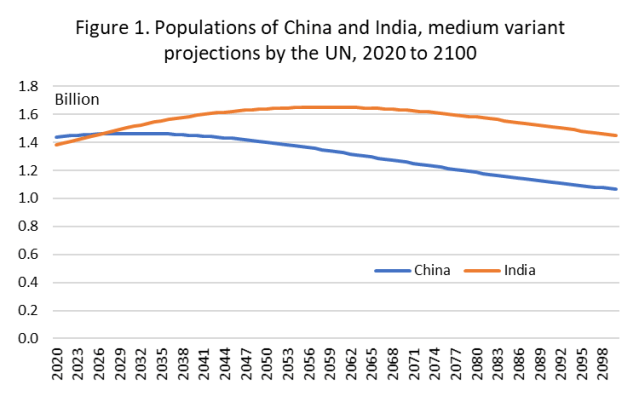
China is a major influence on the Queensland economy given the large value of our coal exports, so we should be paying close attention to how China’s poor demographics will affect its future economic growth. China’s unbalanced population, with lots of old people and not enough young people, is largely due to the persistent impact of the One Child Policy which was once in place. But it now appears that, increasingly, Chinese women are freely choosing to have only one child and hence China’s future demographic profile may be even worse than currently projected. Yesterday, the Financial Times article China’s falling birth rate threatens economic growth (pay-walled) reported:

Fewer than one in four women of child-bearing age in Shanghai is willing to have a second baby, exposing another threat to a Chinese economy that is already growing at its slowest pace in 29 years.

China’s demographic challenge, and the fact it will lose its title as the most populous country in the world to India this decade (Figure 1), was discussed in my Global Population Growth Economics Explained episode published earlier this year.

On the rising importance of India and opportunities for Australian businesses, check out this post from last September on my business website written by my Adept Economics research assistant Ben Scott and me:

Huge opportunities for Australian businesses in India

China_vs_India

Posted in China, India, Population, Uncategorized | Tagged , , , , , , | Leave a comment

Dan Mitchell interviewed on Economics Explained regarding government spending & economic growth

Last week, I interviewed prominent US economist and commentator Dan Mitchell regarding government spending and economic growth for the latest episode of my Economics Explained podcast. Dan is co-founder of the Center for Freedom and Prosperity, and he is a former Senior Fellow at the Cato Institute. He regularly appears in the media, including on programs on Fox, CNBC, and other channels. Here’s a link to Dan’s excellent International Liberty blog.

In the interview, we discussed the long-run impact of government spending on growth, rather than the debate over short-run multiplier impacts, and we considered recent OECD research as well as Adam Smith’s timeless wisdom from the eighteenth century.

Use these timestamps to jump right to the highlights:

  • 1:40 – Gene mentions the Optimal size of government in Australia paper co-authored by Griffith University Professor Tony Makin and Economic Society of Australia (QLD) President Julian Pearce
  • 3:00 – Dan notes empirical literature suggests optimal size of government around 20% of GDP
  • 10:20 – discussion of OECD research on government spending and growth (see this OECD working paper and Dan’s blog plot)
  • 17:10 – Dan notes the 1930s and 1960s were the two periods where the size of government really stepped up
  • 20:05 – how a value-added tax (VAT) promotes growth of government
  • 30:55 – discussion of Adam Smith’s dictum “Little else is requisite to carry a state to the highest degree of opulence from the lowest barbarism but peace, easy taxes, and tolerable administration of justice…” (see this Online Library of Liberty post)
  • 32:45 – using foreign judges to import the rule of law

Thanks to Darren Brady Nelson for helping to arrange my conversation with Dan.

Posted in Uncategorized | Tagged , , , , , , , , , , , , , , , | Leave a comment

Australia’s (and Qld’s) climate change policy predicament

Yesterday, the Financial Times published a blistering op-ed by its Chief Foreign Affairs Commentator Gideon Rachman: Australia is no longer the lucky country (NB pay-walled). It is one of the best summaries of Australia’s current predicament over climate change I’ve read. Rachman concluded his piece with the observation:

…Australian climate activists and their opponents are indulging in forms of wishful thinking. Conservatives argue that the facts around climate change are still contested and that nothing much needs to change. Those on the left argue that if the country summons up the will to take drastic action, it can make the future less threatening. But this Australian summer suggests that the future may already have arrived. And it looks frightening.

As Rachman notes, even if Australia shut down its coal mining industry, climate change would not be averted, as Australia’s contribution to global greenhouse gas emissions, including the contribution from Australian coal, is only 4%. But we need to show our willingness to do more than we have been doing. And we need to work hard to encourage the major economies, particular the US, China, Japan, and the EU, to enact policies that will bring about the large cuts in emissions globally that are increasingly appearing necessary to avert even worse outcomes.

The Australian Government has announced it will release a Technology Investment Roadmap as part of its revised response to climate change (see this Australian article). Australia’s Energy and Emissions Reduction Minister Angus Taylor has commented that:

The best way to deliver on and beat our international commitments is through new, productive technologies and practices that reduce emissions while maintaining or strengthening economic growth.

This may well be true, but it’s unclear why the Government needs to release a Technology Investment Roadmap, which has a whiff of central planning about it.

As Warwick McKibbin and Ken Henry note in their comments to The Australian, the most efficient, least cost way to achieve the necessary emissions reductions is through a market signal, a carbon price, whether via an emissions trading scheme or a carbon tax. Let private enterprise work out the best way to reduce emissions. On this point, have a listen to the excerpt from my interview with John Quiggin in my Economics Explained highlights episode. The Technology Investment Roadmap’s policy prescriptions could end up costing Australia more per tonne of reduced emissions than if we implemented a carbon price. We could end up heavily subsidising uneconomic Carbon Capture and Storage plants, for example.

Ross Garnaut also made an important contribution to the national discussion on bushfires and climate change yesterday. Among other points, Garnaut suggested Queensland needs to start preparing its coal-mining-dependent communities for a future in which we mine less coal as a result of the future global response to climate change (listen to Ross Garnaut’s 12-year old climate change prediction is coming true). There will have to be some rigorous thinking done on how we should best prepare for the structural change that is likely to occur in the next few decades. My Adept Economics Research Assistant Ben Scott and I recently published an article on structural change policies in which we summarise our understanding of what economic theory and evidence suggest is the best approach:

Structural adjustment policies becoming increasingly important

Also, I make some observations on climate change and structural change in my Economics Explained episode:

Big economic issues for the 2020s

Posted in Climate change, Mining, Uncategorized | Tagged , , , , , , , , , | 7 Comments

Global population trends on Economics Explained podcast

There are currently around 7.7 billion people in the world. The UN is projecting global population will increase to 9.7 billion by 2050 and to nearly 11 billion by 2100. Obviously, this projected growth raises a range of economic, social, and environmental challenges. In my latest Economics Explained podcast episode, I answer questions on global population growth from my good friend Tim Hughes from Urban Ergo, a Brisbane-based business specialising in ergonomic office equipment. In my responses, I relied extensively on the UN’s World Population Prospects 2019 projections.

Use these timestamps to jump right to the highlights:

  • 0:14 – intro to global population trends – e.g. declining global population growth with growth concentrated in developing economies, a projected decline in population in the most developed economies over the century, and India to overtake China as the most populous country this decade
  • 5:18 – declining fertility rates in richer countries
  • 10:18 – Reverend Malthus’s dire prediction
  • 11:58 – why global population growth is declining and global population may eventually peak and start falling by 2100
  • 15:53 – huge projected population growth in sub-Saharan Africa – e.g. in Nigeria
  • 20:30 – why is a fertility rate greater than 2 necessary to replace the population? And more on declining fertility rates – e.g. birth control pill, increasing opportunity cost of having children
  • 28:35 – sources of Australia’s population growth (NB more recent ABS demographic data than what I recalled off the top of my head suggest three-fifths of the growth is due to immigration, and two-fifths is due to natural increase (births minus deaths)

This episode was recorded on Thursday 19 February 2019 at the Adept Economics office in the Johnson Hotel, Spring Hill, Brisbane.

Economics Explained Logo

Posted in Uncategorized | Tagged , , , , , , , , , , , , , , , , , | Leave a comment

Big economic issues for the 2020s

In my latest Economics Explained episode Big economic issues for the 2020s, I discuss the major economic issues I’ve been thinking about lately: the secular stagnation hypothesis, digital disruption and surveillance capitalism, and climate change.

Use these timestamps to jump right into the episode:

Economics Explained Logo

Posted in Climate change, Macroeconomy, Productivity, Uncategorized | Tagged , , , , , , , , , , , , , , , , | Leave a comment

My top ten posts of the 2010s

Since I started Queensland Economy Watch in June 2010, I’ve attempted to cover the changing fortunes of the Queensland economy and state budget as accurately and objectively as possible. It’s been a great experience. I’ve learned a lot and met a lot of interesting people I never would have if I hadn’t started blogging. Without further ado, these are my top ten posts by views since 2010, from first to tenth:

Top twenty largest cities and towns in Qld

Heat map of Brisbane property prices – big opportunities in the Western corridor?

Qld’s economic outlook in 2018

Is Townsville or Cairns the capital of North Qld?

Pros and cons of a $300M royalties holiday for the Adani mega mine

Qld construction industry outlook for 2019 discouraging despite #BNE2025 projects

Where do Qld’s super rich live?

Michael Porter on Cairns’s tourism cluster

Did the financial crisis lead to an increase in Qld’s crime rate?

Which suburbs of Brisbane had the largest increases in unemployment?

My post on the twenty largest cities and towns in Queensland is number one, no doubt due to people googling for the largest cities and towns in Queensland and finding my site. The Queensland Government Statistician’s Office should set up a dedicated page on this topic given the general interest in it. Other top ten posts covered topics of wide interest or controversy, such as those on the property market, the economic outlook, whether Cairns or Townsville is the capital of North Queensland, and the Adani mega mine. Regrettably, link rot has set in on some of the posts.

Finally, a hat tip to Darren Nelson for the idea for this post.

Posted in Uncategorized | Tagged , , , , , , , , , , , , | Leave a comment

Higher long-term unemployment a marker of Qld’s under-performance relative to rest of Australia

In its 2019-20 Mid-Year Fiscal and Economic Review released in mid-December, the Queensland Government revised down the state economic outlook, with economic growth revised to 2.5%, down from 3%, and the unemployment rate revised upwards to 6.25% from 6% for 2019-20. These revisions were sensible, in my view. Regular readers will know I’ve been concerned about the strength of the Queensland economy for a while now.

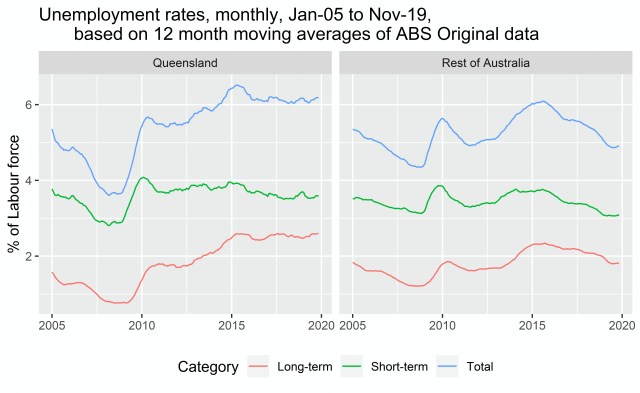
One of the consequences of our under-performing economy is that long-term unemployment in Queensland has not fallen as it has in the rest of Australia over the last few years. Using the latest ABS estimates up to November 2019, see how the long-term unemployment rate increased over 2013 to 2015 and has remained much higher than in the rest of Australia since then (see chart below).

ltu_plot_Nov19_upscaled_image_custom

I am defining long-term unemployment as the situation where a job-seeker has been unemployed for six months or longer. In November 2019, Queensland’s long-term unemployment rate was 2.6% compared with 1.8% in the rest of Australia. I should note these rates are much lower than the historical highs following the early-nineties recession of 4.7% for Queensland and 5.8% for the rest of Australia.*

The persistence of a long-term unemployment rate of around 2½% in Queensland, in contrast to the fall in the rate in the rest of Australia, is consistent with my view that Queensland has been under-performing the rest of Australia for a while now. The Queensland Government urgently needs to review the full range of policy and regulatory settings which could be constraining business investment and job creation.

One of the policy areas which should be investigated is vocational education and training. Despite Queensland being a fair way away from full employment overall, we are seeing an increasing reliance on temporary skilled migration to fill those positions for which shortages of skilled labour are emerging. The Courier-Mail today reports:

FOREIGN tradies are flooding into Queensland as the number of skilled worker visas skyrockets and the nation faces an apprenticeship crisis.

Mechanics, chefs, welders, carpenters and electricians were all trades which saw a noticeable increase for temporary skilled worker visas granted from 2017-18 to 2018-19.

It has been reported that apprenticeship numbers have been falling and the federal government is being criticised by the federal opposition over its cuts to TAFE funding. But isn’t TAFE a state government responsibility?

This is a good example of our dysfunctional federation, brought about by the so-called Vertical Fiscal Imbalance, which I discuss in my book Beautiful One Day, Broke the Next. Each level of government blames the other for policy and program failures. The federal government blames the states for poor administration and the states blame the federal government for not providing enough funding. We’ve known about this problem for many decades. Regrettably, we’re about to enter another decade with no resolution in sight.

*Based on the Labour Force Survey data which are available since February 1978. We don’t have comparable data for the 1930s or 1890s depressions.

Posted in Labour market, Uncategorized | Tagged , , , , , , , , , , | 3 Comments

Podcast highlights – Quiggin on climate change, Gruen on digital public goods, and others

My latest Economics Explained episode presents highlights from the podcast in 2019, including UQ’s John Quiggin on climate change, Lateral Economics’s Nicholas Gruen on digital public goods, and RMIT’s Leonora Risse (currently a fellow at the Harvard Kennedy School) on the gender pay gap, among other highlights.

Use these timestamps to jump right to the highlights:

  • 3:55 – John Quiggin on the relevance of his two lessons in economics for responding to climate change (i.e. introduce a carbon price, a more cost-effective way to reduce greenhouse gas emissions than so-called direct action measures);
  • 8:55 – Craig Lawrence on cost-benefit analysis;
  • 12:20 – Di Johnson on personal finance, particularly buying a house or unit;
  • 15:05 – Brendan Markey-Towler on behavioural economics;
  • 17:50 – Nicholas Gruen on digital public goods illustrated with 23andMe example;
  • 21:45 – Andreas Chai on Randomised Controlled Trials in poverty alleviation;
  • 25:23 – Rebecca Archer on the media in this age of digital disruption;
  • 26:54 – Darren Brady Nelson on the gig economy;
  • 28:44 – Pascalis Raimondos on multinational tax avoidance; and
  • 31:02 – Leonora Risse on the gender pay gap.

You can find all the episodes at Economics Explained.

Economics Explained Logo

Posted in Climate change, Industry policy, Uncategorized | Tagged , , , , , , , , , , , , , , , , | Leave a comment