Bailouts in this time of coronavirus with Dr Dan Mitchell – podcast interview

Industry bailouts by governments have been subject to intense debate in this time of coronavirus, including in Australia where the airline Virgin Australia is in voluntary administration and seeking additional financial support from government. Last weekend, I discussed industry bailouts with renowned US economist and commentator Dr Dan Mitchell, Founder of the Center for Freedom and Prosperity and former Senior Fellow at the Cato Institute. Dan regularly appears on Fox News and CNBC and is regularly quoted in the Wall Street Journal and other publications. I am grateful he agreed to appear again on my podcast (Bailouts in this time of coronavirus).

Use these (approximate) timestamps to jump right to the highlights:

Economics Explained Logo

Posted in Macroeconomy, Uncategorized | Tagged , , , , , , , , , , , | Leave a comment

Catch up on COVID-19 with CCIQ Chief Economist Dr Marcus Smith – Qld budget impact

I caught up with CCIQ Chief Economist Dr Marcus Smith earlier today to chat about the latest economic news and the expected impact of the coronavirus shock on the Queensland state budget. You can listen our conversation here:

Highlights of the discussion include:

  • 1:00 – discussion of the March ABS Labour Force estimates which don’t reflect the full coronavirus-shock yet
  • 4:00 – a problem with the implementation of the JobKeeper payment
  • 9:30 – discussion of how we’re heading for double-digit unemployment rate (10-12% or more) and how economy probably won’t quickly recover once restrictions are lifted, and why JobKeeper may not save as many jobs as hoped, as business owners will foresee weak conditions persisting even after restrictions are lifted
  • 13:00 – beginning of discussion of large impact of coronavirus shock on Queensland Budget
  • 17:30 – “fair to say” Queensland Government is on trajectory to $100 billion of total debt
  • 20:30 – discussion of whether it’s possible the Commonwealth will have to help out the states with their borrowing task, e.g. via a guarantee, as occurred during the 2008-09 financial crisis (see my book Beautiful One Day, Broke the Next which tells the full story)
  • 22:00 – reference to encouraging news from QTC that it was well ahead on its borrowing task prior to coronavirus shock (see the QTC Quarterly Update)
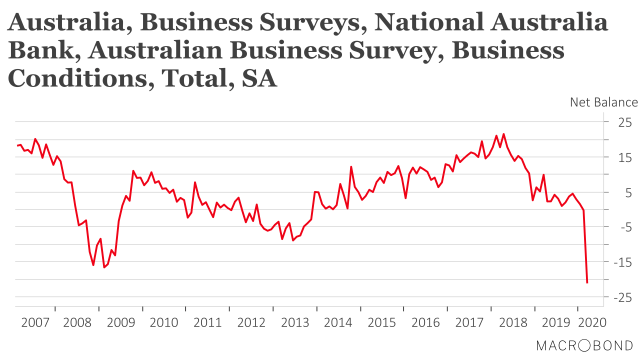
  • 27:10 – Marcus mentions the latest CCIQ Pulse Survey is closing soon, and we discuss how it’s likely to show a huge drop in business conditions and confidence, as the NAB survey has shown (see chart below)

NAB_business_conditions

Posted in Macroeconomy, Uncategorized | Tagged , , , , , , , , , , , , , , | Leave a comment

Paying for the coronavirus rescue measures – Economics Explained EP31 with Joe Branigan

I recorded another Economics Explained podcast episode on coronavirus with my good friend and former Treasury colleague Joe Branigan last night, this time exploring how governments will finance the rescue packages and make up for lost revenue. Here’s a link to Episode 31 Paying for the coronavirus rescue measures with Joe Branigan.

Use these timestamps to help you jump right to the highlights:

  • 5:45 – I recall my time in the Australian Treasury’s Budget Policy Division where I dealt with debt policy and cash management issues
  • 7:15 – discussion of how governments borrow money by selling bonds
  • 12:20 – discussion of bond auctions/tenders by the Australian Office of Financial Management (AOFM)
  • 17:30 – who buys bonds? (for Australian info, check out the excellent AOFM article The Australian Government Securities investor base)
  • 20:00 – discussion of Bank of England direct financing of UK Gov’t spending (discussed in a pay-walled article in the Financial Times, Bank of England to directly finance UK government’s extra spending), monetisation of deficits, and Modern Monetary Theory
  • 29:20 – repaying versus refinancing/refunding the debt
  • 31:10 – long-term problems/risks with government debt
  • 37:30 – overview of Joe’s research on costs and benefits of coronavirus policy measures

Economics Explained Logo

Posted in Macroeconomy, Uncategorized | Tagged , , , , , , , , , , , , | Leave a comment

Certified Corona-Immunity as a Resource with Prof. Benno Torgler, QUT – Economics Explained ep.30

Yesterday I interviewed QUT’s Professor Benno Torgler for my latest Economics Explained episode about a new paper he has co-authored: Certified Corona-Immunity as a Resource and Strategy to Cope with Pandemic Costs.

Professor Benno Torgler is Professor of Economics in the School of Economics and Finance and Centre for Behavioural Economics, Society and Technology (BEST), QUT. He was also Adjunct Professor at the EBS Universität für Wirtschaft und Recht, Germany (2012-2015) and an ARC Future Fellow (2011-2015).

Use these (approximate) timestamps to jump right to the highlights:

  • 1:20 – abstract/overview of Benno’s paper – immune people must be identified and re-integrated into normal activities as soon as possible
  • 5:15 – reference to my recent interview with CCIQ Chief Economist Marcus Smith on the economic impacts of coronavirus
  • 5:40 – concept of Immunity Certificates
  • 8:50 – what does Benno mean by actively producing the resource of corona-immunity?
  • 11:55 – importance of widespread testing and the need to discuss trade-offs (e.g. public health and economy), prompting discussion of final sentence of abstract, “There is a risk that the impacts of the secondary crisis could outweigh that of the biological event from a health and societal perspective.”
  • 13:40 – discussion of Frank Snowden’s book Epidemics and Society: From the Black Death to the Present
  • 16:40 – reference to post-September 11 study which showed driving deaths increased following terrorist attack which led to less air travel by Gerd Gigerenzer, Out of the Frying Pan into the Fire: Behavioral Reactions to Terrorist Attacks
  • 21:00 – reference to Paul Frijters’ Club Troppo articles on the virus – e.g. The Corona Dilemma
  • 23:45 – Benno mentions Rizio and Skali paper on How often do dictators have positive economic effects?

Economics Explained Logo

Posted in Health, Macroeconomy, Uncategorized | Tagged , , , , , , , , , , , , , | 1 Comment

612 ABC Brisbane follow-up interview on AOFM bond auctions/gov’t borrowing

As I told 612 ABC Brisbane Drive program host Steve Austin earlier this evening, the Australian Office of Financial Management (AOFM) had a good day today, running a successful $2 billion bond auction, selling $2 billion of bonds at a price which implied a borrowing rate of 0.245%. The AOFM is the Australian Treasury portfolio agency which borrows money (by selling bonds) on behalf of the Australian Government. You can listen to my conversation with Steve from 2:37:15:

612 ABC Brisbane Drive program, Monday 6 April 2020

Today’s bond auction was substantially over-subscribed, with $9.5 billion worth of bids having been made (check out the auction/tender results). This would have pleased the AOFM, which announced last Friday it now has to borrow $5 billion per week on behalf of the Government, rather than the $1.2-1.6 billion per week it was previously borrowing (See the AOFM’s Issuance Program Update). This is so the Government can fund its coronavirus rescue packages and to make up for lost revenue as a result of the social-distancing-induced recession.

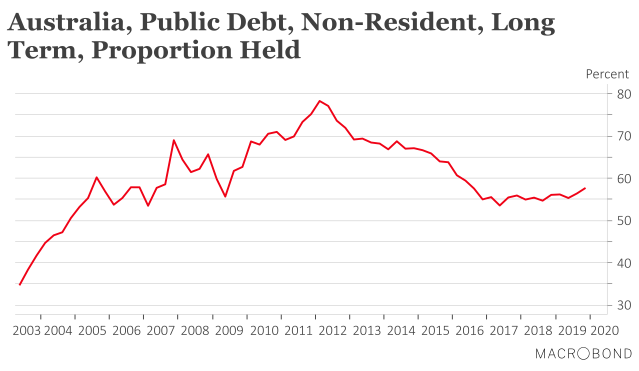
In my conversation with Steve, I answered a question a listener asked Steve last week following my first conversation with him on this topic: who is the Australian Government borrowing from – i.e. who is buying the bonds? I referred to the AOFM’s excellent summary of the Australian Government Securities investor base on its website, which identifies fund managers, hedge funds, banks, and central banks as the major categories of investors. Among other things, I noted around 60% of Australian Government bonds are ultimately owned by foreigners (see chart below). Fortunately, the debt is denominated in Australian dollars so that’s not as bad as it first sounds.

Bonds_foreignowned There are currently around $560 billion of Australian Government bonds (excluding short-term Treasury Notes) on issue. In a few years’ time, that figure will very likely be in the order of $1 trillion – i.e. $1,000 billion (see this Australian article).

Posted in Budget, Macroeconomy, Uncategorized | Tagged , , , , , , , , , , | 2 Comments

Catch up on COVID-19 with CCIQ Chief Economist Dr Marcus Smith

I spoke yesterday afternoon with CCIQ Chief Economist Dr Marcus Smith about the latest COVID-19 news:

You can use these timestamps to find the highlights:

  • 3:00 – Marcus’s recent commentary on coronavirus impact on Qld exports (e.g. COVID-19’s billion-dollar hit to Queensland exports as volumes sink)
  • 6:10 – economic impact of social distancing measures; CCIQ members are “still in shock”; commercial rent issue yet to be formally resolved
  • 10:00 – we’ll have  a “very different commercial landscape” post-coronavirus; whether many businesses will survive is an open question
  • 11:45 – discussion of macroeconomic impacts (reference to OECD estimates, which have been nicely summarised by Brendan Coates at the Grattan Institute in his article COVID-19: New OECD estimates suggest a 22% hit to Australia’s economy)
  • 14:00 – limited scope for both fiscal and monetary stimulus measures in current crisis
  • 15:25 – discussion of federal Opposition’s concerns re. original design of JobKeeper wage subsidy
  • 18:20 – discussion of how complexity in IR system is a challenge (NB the Government, unions, and industry associations appear to be working on this issue; e.g. see Award Flexibility during coronavirus)
  • 20:30 – discussion of the need to reopen the hospitality sector as soon as we can (without damaging public health) to avoid further structural economic damage; mention of encouraging news Qld appears to be “flattening the curve”
  • 22:30 – discussion of Adam Creighton’s Australian article advocating public sector wage cuts (see my previous QEW post Paradox of Thrift in recessions and depressions)
  • 27:15 – big shout out to Queensland Health which appears to be doing a great job “flattening the curve” in Queensland

Jimmys

Pre-coronavirus social distancing measures, Jimmy’s on the Mall, Brisbane would have been heaving on a Friday afternoon. No longer.

Posted in Macroeconomy, Uncategorized | Tagged , , , , , , , , , , , , , | 1 Comment

Paradox of Thrift in recessions and depressions

The Australian’s economics editor Adam Creighton is today advocating for public sector wage cuts by Australian governments, a policy which may be morally virtuous but would be economically damaging in this time of economic contraction, in my view (see Coronavirus pay cuts: This may make you very, very angry). Creighton writes:

Perhaps a temporary higher rate of income tax cutting [public service wages] is the cleanest solution.

During the Depression, the Scullin government cut public sector pay by 20 per cent.

Regular readers will know I’m in favour of public sector wage restraint, but what Creighton is advocating makes no sense in an economic contraction, where it would make things worse. Indeed, policies such as the Scullin government’s public sector wages cut are widely regarded by economic historians as having exacerbated the Great Depression.

In recessions and depressions, the Paradox of Thrift identified by John Maynard Keynes applies. This Paradox is generally described with reference to households but the logic applies to government spending, too. What may be beneficial for households acting alone is not beneficial for the whole economy, as the impact of everyone saving and reducing spending is to reduce output and income across the economy. It is a fallacy of composition to suppose that what is beneficial at the household level is beneficial at the economy-wide level. This is a first-year economics lesson we need to remember in this time of economic contraction.

Adam Creighton is recommending a perverse fiscal policy. Cutting public service wages during this time of contraction would reduce household incomes and aggregate spending and inflict further pain across the economy.

Posted in Macroeconomy, Uncategorized | Tagged , , , , , , | 6 Comments

The Fast Depression – 10 million newly jobless Americans in just two weeks

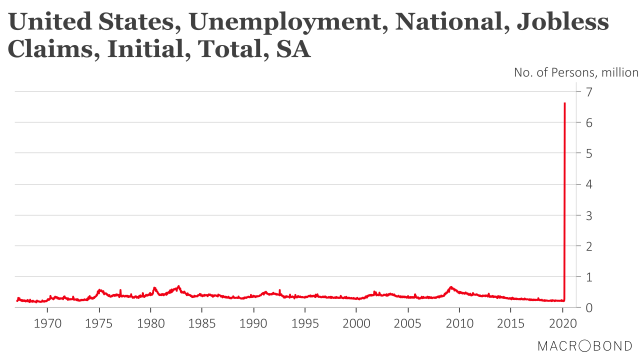
It is hard to overstate how rapidly economic conditions are deteriorating in economies affected by coronavirus, most particularly in the United States, which is seeing hitherto unbelievable numbers of people filing for unemployment benefits (see chart below). The 6.6 million claims last week was twice the previous record of 3.3 million, which was set the week before, and which was already an unbelievably high number, 10X the number from the week before that one. So that’s around 10 million additional Americans unemployed in two weeks, although it’s unclear how many jobs are gone for good and how many workers have just been furloughed or stood down for a temporary period, as Jason Furman has noted (Obama economist: Lessons from the 2008 crash). It’s been observed by US commentators that the increase in US unemployment over the last two weeks is broadly equivalent to the increase which took six months to occur during the Great Recession in the late 2000s.

Jobless_claims

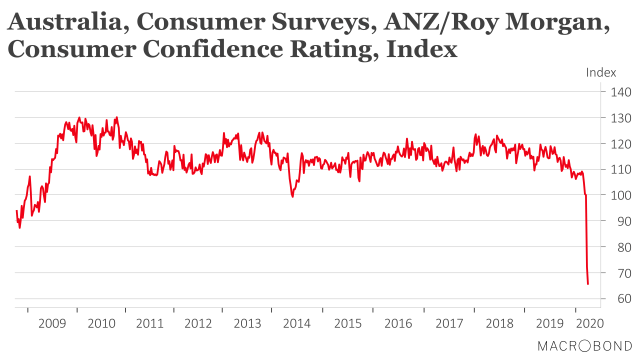
We are seeing a rapid real-time demonstration of the Keynesian multiplier, as the initial direct shock from coronavirus ripples through the economy, with reductions in aggregate output and income leading to lower spending, leading in turn to lower output and income, further reducing spending, and so on, in a cumulative process. The huge amounts of government support being provided to both the US and Australian economies will mean they should soon find a floor and we should avert a re-run of the Great Depression, but the US unemployment rate is widely expected to now be at least 10% and will probably get even higher still before this is over. There’s little doubt we’ll end up with a 10%+ unemployment rate in Australia. Certainly, consumer confidence has plummeted (see chart below).

ANZRMCC

It looks like we may learn today just how much money the Australian Office of Financial Management (AOFM) will need to borrow each week to pay for the coronavirus rescue measures and to make up for lower revenues, based on an article (Can the bond market pass the $300b test?) in the Financial Review:

Soon, the government’s debt management agency, the Australian Office of Financial Management, will reveal just how much it intends to borrow to fund the coronavirus response. The estimate is that an additional $300 billion of bonds will have to be sold over 15 months.

That is, the AOFM will need to increase its weekly bond sales from $1.2-1.6 billion to $4-5 billion. Will this mean Australia loses its AAA credit rating? Possibly, although even with this additional debt we’ll still be in a better position than many other OECD economies. The big problem with debt is the interest bill, which, while manageable at the low interest rates we’ve seen, could become hugely problematic in future years if the AOFM ends up having to refinance large amounts of debt at higher interest rates in the future.

I chatted about how the AOFM borrows money on behalf of the Australian Government with Steve Austin on 612 ABC Brisbane on Tuesday afternoon (from 2:41:00). Incidentally, I expect the Queensland Government is also facing a huge funding challenge, and I wouldn’t be surprised if it has been lobbying the Australian Government for assistance with its borrowing program, as it did during the financial crisis, a story I tell in my 2018 book Beautiful One Day, Broke the Next.

Posted in Macroeconomy, Uncategorized | Tagged , , , , , , , | 2 Comments

Coronavirus policy responses with Joe Branigan – latest Economics Explained episode

Last night I recorded an Economics Explained podcast interview with my good friend and former Treasury colleague Joe Branigan of Tulipwood Economics on the economic impact of coronavirus and the economic cost of responding to it.

Use these timestamps to help you jump to the highlights:

  • 1:50 – Joe reviews international data on coronavirus cases as at 1 April
  • 5:00 – how case fatality rates depend on the testing regime
  • 7:30 – why Italy has been so badly affected compared with Australia
  • 11:05 – what is a Disability Adjusted Life Year (DALY)?
  • 13:00 – discussion of whether cost-benefit analysis is relevant in assessing coronavirus responses
  • 20:50 – Sweden identified as a country which appears willing to tolerate a worse public health outcome to avoid enacting draconian measures
  • 23:20 – discussion of pros and cons of a full lock-down strategy, following a replay of an excerpt from my interview with Nicholas Gruen last week
  • 30:20 – “No one knows what the right answer is” – recognition we have much to learn from the variety of responses and experiences around the world
  • 32:00 – major takeaway is that each country is on its own trajectory and policy responses need to be specific to each country

Economics Explained Logo

Posted in Macroeconomy, Uncategorized | Tagged , , , , , , , | Leave a comment

Gov’t faces huge funding challenge as it puts economy on life support

The federal government’s latest rescue measure, the JobKeeper Payment, estimated to cost $130 billion, may well be justifiable, given social distancing measures have shut down large parts of the economy for an indeterminate period, and I recognise the need to act fast, but the government needs to provide further information to assure the public it is in control of the situation. One area of concern is how the government is going to pay for all these measures and how much public debt we’ll ultimately end up with. I expect it will be challenging for the Australian Office of Financial Management (AOFM), the government’s debt management office, to fund the government’s $194 billion of rescue measures (and to make up for a huge fall in revenue) and to ensure the money is available when it is required.

Until recently, the AOFM would promptly update the market on its borrowing program following major government announcements. It is no longer doing so, as it appears it’s all too hard given the rapid pace of policy development. The AOFM last provided an Issuance Program Update on 12 March, the day of the first $17.6 billion rescue package. It hasn’t provided an update on what measures since then mean for the amount it has to borrow each week, which now must be at least $3 billion per week for the foreseeable future, rather than the $1.2 to 1.6 billion per week it contemplated on 12 March. In its weekly Forthcoming Transactions update published last Friday, the AOFM acknowledged it needs to provide further information:

The Australian Office of Financial Management (AOFM) understands the need to provide updates on its funding program and will do this to the best of its ability. Further details on projected issuance rates and related operations will be released in the coming week.

In other words, the AOFM is scrambling to figure out how it’s going to fund the government’s commitments and the revenue shortfall. Let’s hope the AOFM does release those further details on projected issuance (i.e. bond sales / borrowing) this week. We need to have confidence the Government can borrow the money it needs to fund its commitments as they fall due.

In the worst case, the government could always ignore the RBA’s independence and instruct it to monetise the deficit, with all the long-term risks that involves. In the last two weeks, hitherto unthinkable policy measures have been introduced, so we probably shouldn’t be surprised if we ultimately end up with an experiment in so-called Modern Monetary Theory. As the PM said the other day, we are in “uncharted territory.”

Posted in Budget, Macroeconomy, Uncategorized | Tagged , , , , , , , | 6 Comments