Qld economy in big trouble if China follows through with trade threat

Australian investors appear remarkably optimistic about the prospects for patching up our relationship with China given that, as the Financial Review reported yesterday, ASX up 4.4pc in US election, QE week. I can understand why a new round of Quantitative Easing would be a positive for the market, but I’m surprised there’s not more concern about the huge potential cost of Chinese trade restrictions. Our PM Scott Morrison and Trade Minister Simon Birmingham are correct that the new restrictions being talked about are being denied by the Chinese administration. But they are being reported in one of the major state-aligned news outlets, China Daily, so it’s a legitimate threat. We will learn more over the remainder of 2020 as we find out whether orders for our coal, beef, wine, and other commodities fall further, and whether additional Australian goods are rejected at Chinese ports.

Queensland is obviously heavily exposed to trade restrictions from China (see the chart below and also check out Qld Treasury exports briefing, September 2020). Queensland’s annual goods exports to China of circa $25 billion amount to around 7% of our Gross State Product. Ongoing trade restrictions from China would cause major economic damage, especially in our regional economies such as Central Queensland and Mackay which are highly dependent on resources and agriculture. And, in the lead up to the 2020-21 Queensland Budget which Treasurer Dick will hand down on 1 December, I should note that Chinese trade restrictions would be a big blow to our budget via impacts on royalties and other revenues such as payroll tax and stamp duty which would be lower due to the economic shock. Sure, our exporters may be able to find alternative markets in which to sell, but that will take time, and they may have to heavily discount their products to find non-Chinese buyers.
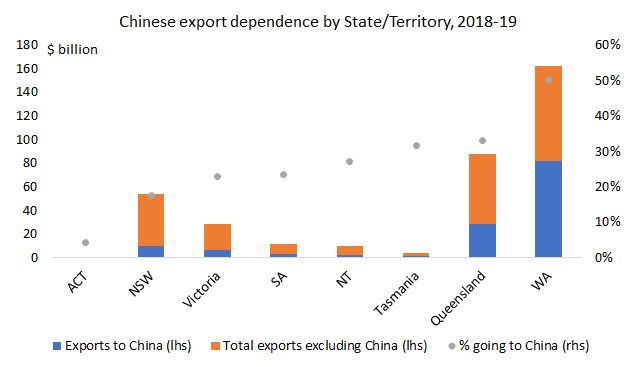
Source: DFAT compilation of ABS data. Note: Thanks to Adept Economics Research Officer Ben Scott for this chart.  

As if 2020 hasn’t been bad enough with the COVID-shock and recession, trade restrictions from China could make it much worse. Ultimately, this will require a diplomatic solution, one which respects both our economic and broader national interests and values. I’m reasonably confident this can be resolved diplomatically, but there’s enough of a chance it won’t be to cause me and industry players anxiety. I’ll keep a close eye on developments and provide updates as we learn more over the coming weeks.
Posted in Budget, Exports, Macroeconomy | Tagged , , , , , , , , , , | Leave a comment

RBA Governor Lowe does Treasurer Dick a favour in lead up to 1 December Qld Budget

Queensland Treasurer Cameron Dick is facing a tough challenge developing the COVID-recession-ravaged state budget, but the Reserve Bank of Australia will make his task a little bit easier with its new round of Quantitative Easing, by which it purchases Australian and state and territory government bonds with newly created money, driving up bond prices and lowering yields/interest rates (see Governor Phil Lowe’s Melbourne Cup day statement).

Along with the cut in the cash rate to 0.1%, the new round of QE will enable the Queensland Government to borrow at lower interest rates and should lead to the state government’s interest payments on its borrowings (an annual cost of around $1.7 billion) increasing less than they otherwise would with the state’s ever-growing debt. We may be lucky and interest payments won’t end up exceeding $2 billion in a few years’ time. Queensland Treasury Corporation is in the best position to forecast that, and I’m keen to see the forecast interest payments in the state budget.

The new round of QE will help the Queensland Government a little in its budget formulation task, but the Government will still run large deficits and general government debt will rise to around $75 billion by 2023-24, and total government debt will rise to around $115 billion, and possibly more. We will find out the Queensland Treasury’s estimates when Treasurer Dick hands down the state budget on 1 December.

Based on the RBA Governor’s statement, it appears the RBA could end up purchasing at least an additional $4 billion of Queensland Government bonds/debt. It’s extraordinary how times have changed. This is the sort of thing then Queensland Treasurer Andrew Fraser and his Treasury would have appreciated back during the 2008-09 financial crisis, when they were desperate for Commonwealth support (a tale I tell in my 2018 book Beautiful One Day, Broke the Next). The Australian Government eventually guaranteed state government borrowings but state governments had to pay a fee to get the guarantee. This time, the economic situation is even more precarious, and the RBA is doing all it can to stimulate the economy, including via its radical new experiment with QE, one beneficiary of which is the Queensland Government.

For more on QE, see my previous posts and podcast episodes:

Michael Knox on Quantitative Easing as a long-term strategy

Paying for the coronavirus rescue measures – with Joe Branigan

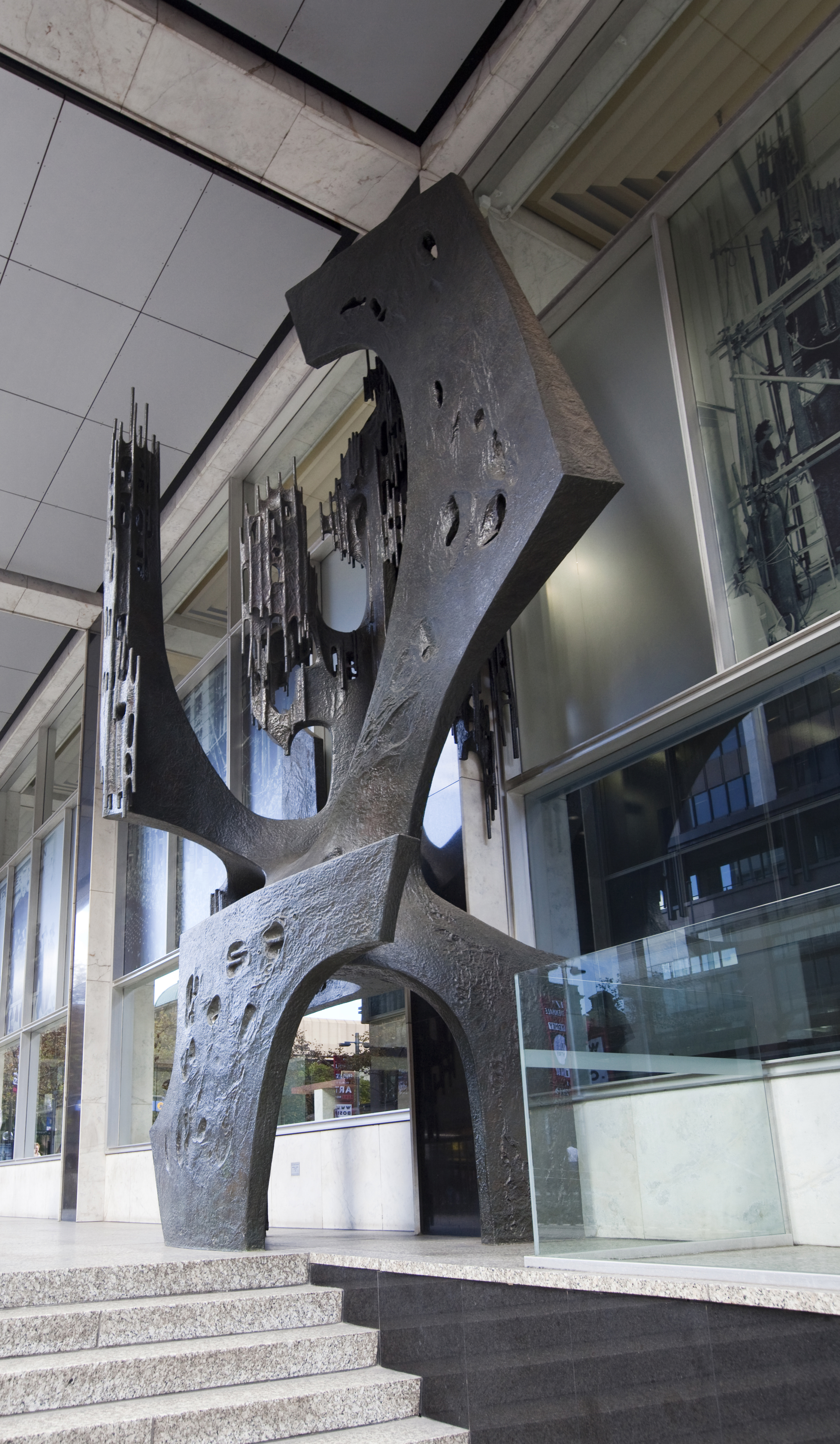
Sculpture at the RBA Building, Martin Place, Sydney
Posted in Macroeconomy | Tagged , , , , , , | Leave a comment

ABC PM comment on border closure cost – Qld tourism worried about loss of interstate visitors over Christmas season

I spoke with the ABC’s Rachel Mealey yesterday afternoon about Queensland’s increasingly difficult-to-justify border restrictions, particularly about the ongoing cost to Queensland’s tourism sector, which is concerned it will miss out on interstate visitor spending it desperately needs over the Christmas season. My comment is after 3:07 in this ABC PM story which was broadcast nationwide last night:

ABC PM story – Deb Frecklington announcing she won’t seek to remain as leader

The importance of interstate travel to the viability of many Queensland tourism operators was emphasised by Queensland Tourism Industry Council CEO Daniel Gschwind in a Nine Media radio interview last week: Tourism industry ‘bitterly disappointed’ after QLD border announcement.

Overall, I expect that the lower levels of interstate tourism over the Christmas season will have an adverse impact on the Queensland tourism industry (relative to last year), but I should note there will be some (partially) offsetting effects, such as Queenslanders being more likely to holiday in Queensland destinations. And Queensland’s most popular destinations such as Noosa Heads will probably still be full of people during the peak of the Christmas season, regardless (e.g. see Australian holiday hot-spots are booking out as travel is allowed again). So we need to wait and see the ultimate adverse impact of border restrictions.

NSW residents now welcome in Qld, unless you’re one of the two-in-three who live in Greater Sydney

Posted in Tourism | Tagged , , , , , , , , | 2 Comments

NSW border policy still lacks solid justification

The Palaszczuk Government’s simple and appealing message of Keeping Queenslanders Safe has helped it win an increased majority, and there is no doubt Queensland has done well to control coronavirus and our state economy has coped with the COVID-shock better than most. But we shouldn’t give up scrutinising state government policy decisions in the wake of the Government’s massive election victory. The Government still needs to do more to justify its decisions, including the decision the day before the election to continue to exclude people from Greater Sydney from Queensland – i.e. almost two-in-three people living in NSW.

Once again, on Friday, the Premier said she’s following the health advice. But as I’ve noted before, the health advice on its own is insufficient to justify the border decision. What weight is given to the adverse economic impacts of the NSW border restrictions, recognising that the risk to Queenslanders of opening up to Sydney is surely very small? The Chief Health Officer (CHO) and the Government need to be clear on the value judgements they are making in their decision-making process. They need to tell us how they are avoiding David Hume’s Is-Ought Problem, that you need to be careful making statements about what ought to be done based on facts alone (i.e. what is). Disturbingly, the CHO has been all over the place in trying to articulate her decision making framework (e.g. see my post Big questions about Qld Chief Health Officer’s judgment – Premier needs to show leadership and Qld’s harsh border policy – a conversation with Joe Branigan).

The Government should publish the advice it has received from the CHO so the advice is open to public discussion and debate. The long delay in responding to Graham Turner’s Right-To-Information request on the health advice regarding the border restrictions is disgraceful (see this Travel Weekly article).

Also, the remaining border restrictions should be reviewed at least weekly, not monthly, given the large adverse impact on industry. The Government’s most recent decision is difficult to comprehend, given what appears to be a very low risk associated with opening up to Sydney, and, extraordinarily, the decision has bemused not only industry players such as Qantas’s Alan Joyce but even Queensland’s former Premier Peter Beattie, who wrote the excellent opinion piece Winning was easy for Palaszczuk – but now there is nowhere to hide.

Finally, I’m very concerned the state government doesn’t fully understand how much the tourism-dependent hospitality sector continues to suffer, and how beneficial loosening the border restrictions further would be. Deputy Premier and Health Minister Steven Miles annoyed many in the industry last week when he observed, as reported by the Brisbane Times:

“Our hospitality sector is running as close to normal as anywhere else in the world, in fact better than anywhere else in the world, and that is because we don’t currently have cases.”

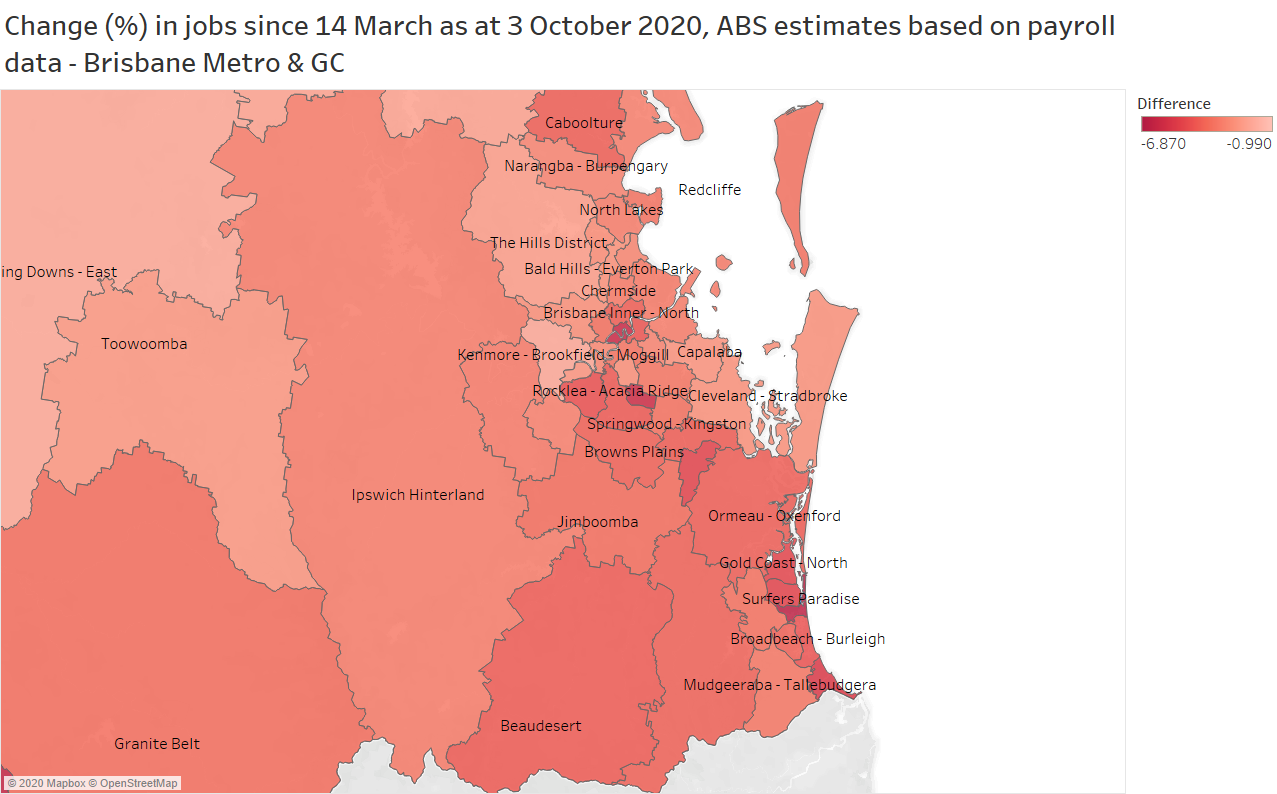
Arguably, it was just a poor choice of words by the Deputy Premier to say “close to normal” but it understandably annoyed many people in the industry. In early October, there were still over 10% fewer jobs in the Queensland Accommodation and Food Services (i.e. hospitality) industry than in mid-March, according to the Single Touch Payroll data reported by the ABS. Queensland has recovered more than NSW (down 18%) and Victoria (down 29%) but you can’t say we’re “close to normal”. Obviously, regions with a large economic contribution from hospitality have fared worse than others. For instance, in Surfers Paradise in early October, total payroll employment (across all industries) was still 6.5% below the level pre-COVID (see map below). We are far from “close to normal”.

Posted in Macroeconomy | Tagged , , , , , , | 2 Comments

LNP costings interview with Scott Emerson on 4BC

The Queensland LNP Opposition released its election costings yesterday, and I spoke with Scott Emerson on his 4BC Drive program about them later that day. You can listen to our conversation from around 54:00 via:

The Scott Emerson Drive Show, 29 October

The LNP costings, which you can download below, are well presented with handy summaries of the proposed measures, and they get a tick of approval for citing the report Joe Branigan and I wrote for the Australian Institute for Progress on the Queensland budget outlook (see p. 4 of the costings).

The LNP commitments feature a heavy emphasis on cracking down on crime, including one of my favourite measures, $1.75 million for the LNP’s plan to crack down on hooning:

The LNP will put the brakes on Queensland’s hooning problem with new cameras, new laws and new technology which will literally shred the tyres of dangerous drivers.

Let’s hope they have a reasonable and fair way of identifying dangerous drivers if they win government!

Finally, I should note, as I told Scott Emerson yesterday, like Labor’s election costings, the LNP costings appear to make a few bold assumptions, particularly around being able to fund a range of measures through finding savings in the public service and in government-owned corporations such as SunWater. If the LNP has committed to these savings on top of the savings program the current Queensland Government committed to in July, then they have set themselves a challenging task should they win government on Saturday.

Posted in Budget | Tagged , , , , , , , , , , , , | Leave a comment

Amusing costings of Qld election commitments – $4bn of Gov’t election commitments reported to have zero “Net Impact”

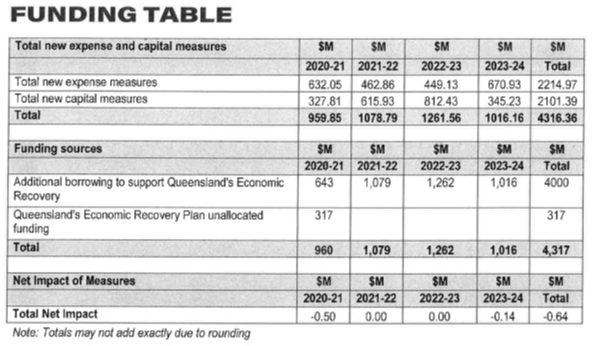
Extract from Queensland Labor, 2020, Working Together for Queensland, 2020 Election Financial Statement

I laughed out loud when I opened up a copy of the costings of the current Queensland Government’s election commitments and it reported that its $4 billion plus of commitments have practically zero “Net Impact” because it will be borrowing an additional $4 billion of money to pay for them, as well as tapping into unallocated funding it hasn’t used yet (see snapshot above). Here’s what my good friend and former Australian Treasury colleague Joe Branigan has to say about the costings:

Labor’s costings document doesn’t meet basic standards of public financial management. It simply says that ‘we borrowed X, and spent X’. But the point of publishing your costings is to show the impact on those important public finance metrics – the net operating balance and the fiscal balance, and net debt and gross debt, in the general government sector and non-financial public sector. Those eight very critical indicators tell us whether the public finances are being managed well (i.e. soberly, efficiently and transparently) and in the best interests of Queenslanders. What Labor has produced is almost meaningless, especially the headline figures that mix up recurrent expenditure and capital investment.

The other thing the so-called policy costings has missed in terms of their impact on the headline budget indicators is accounting for foreseeable parameter changes over the next four years. This is the fundamental problem with Labor not releasing a budget – we simply don’t know the expected increase in public service employees, the wage bill, capital spending etc. But we can be sure that those numbers will increase over time in nominal terms. That’s why an accurate accounting would identify both the policy changes and parameter changes over the budget period. In other words, you would be able to add your policy costings to your existing budget to see the bottom-line impact. Without a budget, these costings are essentially meaningless.

The best case the Government can make for its absurd near-zero “Net Impact” is that the $4 billion of additional borrowing for election commitments was announced in the COVID-19 Fiscal and Economic Review it released in early September and the spending was accounted for in the Government’s full budget forward estimates which the Treasury would have prepared, but which were not published in the update. Recall the Government only published a forward estimate for 2020-21 and not for the financial years out to 2023-24 which the costings go out to. Perhaps that is how the Government would justify its near-zero net impact measure, but on its face it looks absurd. Yes, budget deficits and additional borrowings are defensible given the COVID-crisis, but the Government can’t pretend borrowing an additional $4 billion to fund its election commitments has practically zero “Net Impact”. Perhaps I’m being pedantic, but the line item should at least read “Difference” (i.e. between additional spending and funding/borrowing) rather than “Net Impact”.

Finally, as has been widely reported, the election costings also incorporate some wishful thinking about $1 billion plus of efficiency/productivity gains in Queensland Health. I told Bill McDonald on 4BC earlier today that it’s a bit unclear how these productivity gains will be achieved. Based on the Treasurer’s interview on Bec Levington’s ABC Mornings show this morning, the Treasurer appears to want our hospitals to work its existing resources harder so it can get more procedures done and get more activity-based funding from the Commonwealth. I told Bill he should speak with the heads of the Health and Hospital Services and doctors and nurses to get their thoughts regarding how much capacity they have to work harder. Let’s hope we get some further information from the Government regarding how the efficiency dividend to be applied to Queensland Health will be achieved.

Update: you can now download a full copy of the costings:

Posted in Budget | Tagged , , , , , , , | 4 Comments

NQ State feasibility should be explored in lead up to Katter-proposed referendum

I’m pleased that Katter’s Australian Party (KAP) leader Robbie Katter will push for a referendum on North Queensland statehood in the first half of 2021, as reported on news.com.au. It appears there is widespread disappointment in the North with the Queensland Government over alleged, persistent under-funding of the North, even though that is open to debate (e.g. see my post Is NQ under-funded by the State Government relative to the South East?). That said, the $5 billion plus Cross River Rail project in inner city Brisbane annoys many people in the North, who can see more pressing needs for infrastructure funding in their own region. Incidentally, I still need to update that earlier analysis of mine on per capita funding by region to reflect Cross River Rail, which I’ll do as soon as I can.

As I’ve commented previously, creating a new state of North Queensland would be a major endeavour and it should not be rushed into. It deserves a proper investigation, possibly via a commission of eminent Queenslanders supported by the state Treasury to assess the financial viability of a new state and whether North Queenslanders would be better off. Possibly they would be, in the long-run, if they can include all the Bowen Basin coal mines in their state (through pushing the borderline as far south as they can) and if they are compensated for their remoteness and disadvantages by GST redistribution, but in the short-run they will face large transition costs and challenges in setting up a new state administration.

The most challenging issues for developing a workable NQ state include:

  • whether the capital is located in Townsville or Cairns;
  • the borderline – the fact that more recent proposals have the borderline south of Rockhampton and possibly south of Bundaberg has raised many eyebrows, given that traditionally North Queensland begins at Mackay, while Rockhampton is better thought of as being in Central Queensland; and
  • how the state’s assets and liabilities/debt are divided up between SEQ and NQ.

These are not easy questions to answer, and they require a full analysis before committing to an NQ state.

Robbie Katter thinks that only North Queenslanders should vote in a referendum on whether to create a new state, but that presupposes it’s clear who exactly is a North Queenslander, and I’m unsure that issue has been resolved. Given the Queensland Parliament has to vote on the creation of an NQ state, and that the development of NQ has been partly funded over the decades by taxpayers in SEQ, I think all Queenslanders should vote in a referendum on an NQ state.

Previous posts of mine on the idea of an NQ state include:

My comments on NQ exit in ABC online story

Townsville Bulletin report on funding feud: Brisbane economist “under fire”

Senator Canavan’s ambitious plan for a State of North Queensland

Yes to a North Qld State podcast

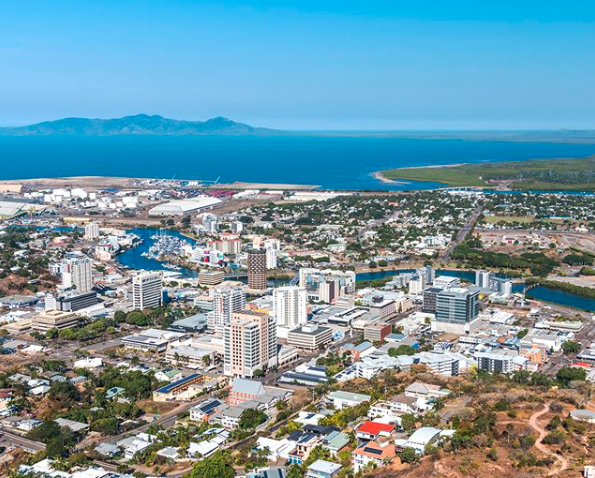
Townsville CBD from Castle Hill.
Posted in North Queensland | Tagged , , , , , , , , , , , | 2 Comments

Upcoming QPC Productivity Reform livestream on 24 November

The Queensland Productivity Commission (QPC) has arranged an upcoming livestream on Productivity Reform in Australia and NZ, scheduled for 24 November, with some well known Australian and NZ economists, econo-crats, and pundits. According to the program we’ll hear from, among others, Gary Banks on “Not wasting a crisis” and from Bob Gregory on “Key policy adjustments in a post COVID-19 world”. I’ve already registered and am looking forward to the discussion. It will be tough for the QPC to keep people engaged for a seven hour livestream, but it looks like they have some great presenters and it’s an important topic.

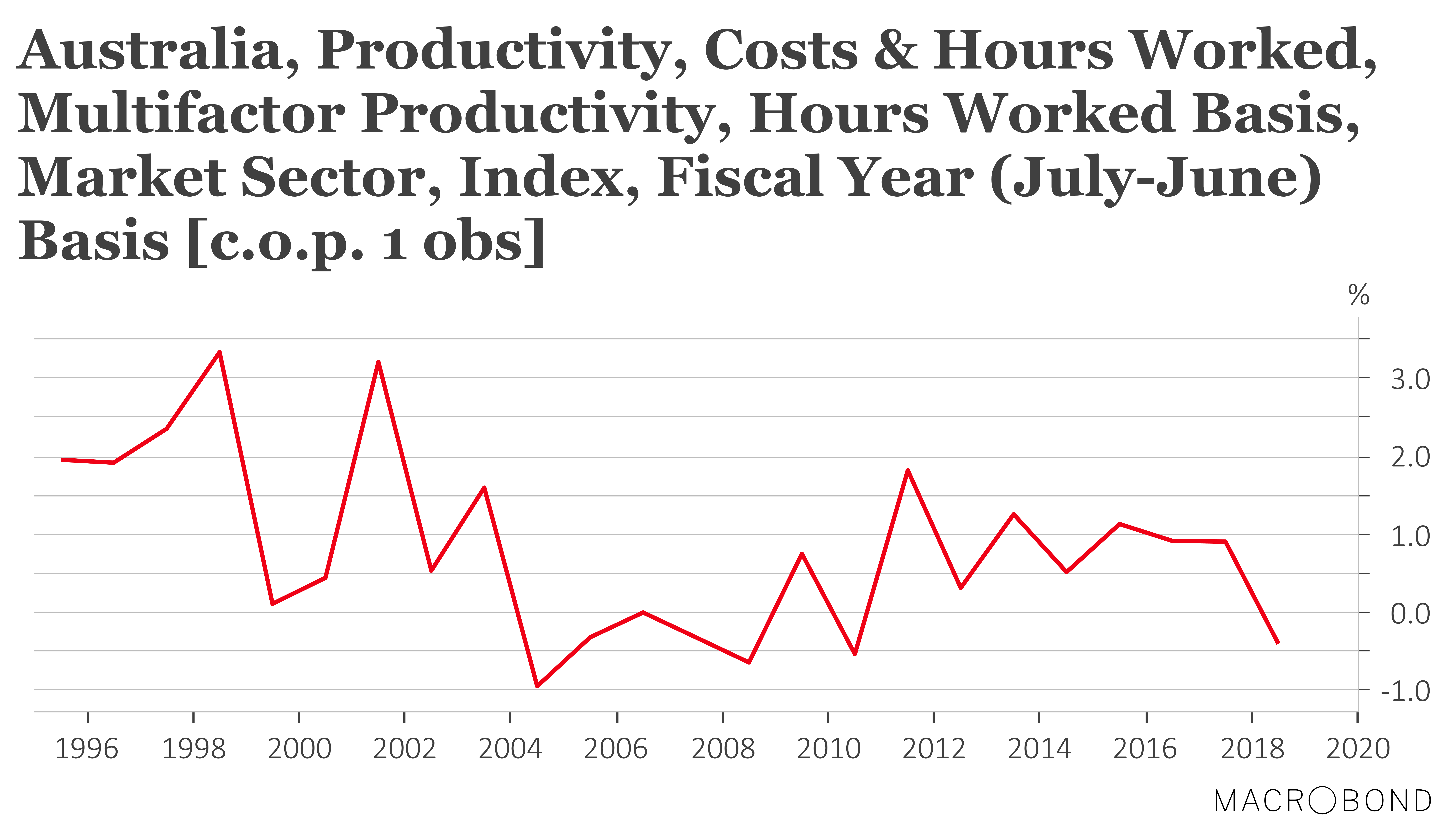
Many economists have seen the desirability of policy changes to improve productivity for some time. Recall that productivity is one of the three Ps, along with workforce participation and population, that determine GDP. Australia had a burst of productivity in the 1990s – due to widespread ICT adoption and to National Competition Policy measures and corporatisation or privatisation of public enterprises – but since then Australia’s productivity performance has been generally considered as disappointing (see chart below).

Posted in Macroeconomy, Productivity | Tagged , , , , , , | Leave a comment

Tech Giants vs legacy media and governments – latest podcast episode

One of the biggest pieces of international news this week was the announcement that the US Department of Justice is suing Google over its alleged monopoly in search (see US justice department sues Google over accusation of illegal monopoly). The market power of the tech giants has been questioned for some time now, and you may recall the Australian Government has proposed a regulation which would give traditional media companies like News Corp and Nine-Fairfax greater bargaining power relative to tech giants such as Google and Facebook.

Earlier this week, I spoke with my Adept Economics colleagues Taylor-Rose Hull and Ben Scott about recent developments in the battle between the tech giants, on the one side, and governments and traditional media, on the other side. Our conversation has been published as my latest Economics Explored podcast episode. Among other things, we discuss whether it would be better to allow Schumpeterian creative destruction to occur rather than regulating in favour of legacy media.

The discussion is based on the following article published on the Adept Economics website:

Australian Government takes on digital giants Google and Facebook

Posted in Uncategorized | Tagged , , , , , , , , , , , , , | Leave a comment

Chat with 4BC’s Neil Breen on Qld Economic Recovery Plan, travel restrictions, deficits, and debt

Yesterday morning, I spoke with 4BC Breakfast presenter Neil Breen about the Queensland Government’s Economic Recovery Plan, travel restrictions, deficits, and debt. The recording has been published on the 4BC website:

What’s in the book?

Neil began by asking me what is the Economic Recovery Plan document the Premier and Treasurer are always clutching during their press conferences? The 4BC website summarises my response as:

Former Treasury Official Gene Tunny says it’s just a prop and he’d rather see a full budget book.

The glossy does summarise a range of government initiatives designed to stimulate the economy, but I’d rather the Government have produced a full budget, or the Treasury to have released a Pre-Election Fiscal Outlook, a PEFO, as is standard practise at the federal level.

Voting is already underway to determine who rules Qld Parliament House (George St, Brisbane) for the next four years.
Posted in Budget | Tagged , , , , , , , , , , , , | Leave a comment