More signs of slowing growth in resources sector – bad news for Qld budget

Queensland Treasury already made a big downward revision of $1.4 billion over four years in mining royalties in the 2012-13 Mid-Year Fiscal and Economic Review last December, and it may need to shave some more off given the bad news from the resources sector continues.  The Rockhampton Morning Bulletin reports that the Dumping of Balaclava Island port casts doubt over Wandoan:

THE newly-merged Glencore-Xstrata has been forced to again deny it would dump its $7 billion Wandoan coal mine planned for south-west Queensland after killing off its $1 billion port slated for near Gladstone.

The Balaclava Island port was to create 800 jobs during construction with a further 100 needed once it began operating.

Despite cancelling its Balaclava Island port project – a decision understood to have been made before Xstrata’s merger with Glencore – the mining giant has denied it meant anything for the slated coal mine, which is currently the subject of a Land Court battle.

Balaclava Island was to become an export point for the Wandoan’s coal, after it outgrew the capacity it needed from Gladstone’s Wiggins Island coal terminal.

A spokesman for Glencore-Xstrata said the future of Wandoan still relied on the outcome for a Land Court battle over landowner compensation and a final investment decision.

He said that decision would take into account market conditions at the time.

It is those world market conditions that do not currently sit on the side of the Wandoan project, with Glencore-Xstrata’s statement on Balaclava saying as much in its announcement on Monday.

Residential vacancies data from REIQ are also consistent with a slowing resources sector, with the super-heated rental markets in Rockhampton, Gladstone and Mackay cooling somewhat due to lower demand from the resources sector, as also reported by the Morning Bulletin.

Unfortunately there aren’t many signs the construction sector will pick up in the near future and balance any loss of economic activity from the resources sector. MacroBusiness has a useful chart in its post on today’s new ABS housing finance data showing “new home finance in Queensland…has flatlined over the past six months.”

We already know the Commonwealth Budget tomorrow night will be a horror story, and I expect the Queensland Budget next month won’t be much fun either.
Posted in Budget, Housing, Macroeconomy, Mining | Tagged , , , , , , , , , , , , , , | 3 Comments

Despite cost disease, Government can boost public sector productivity

There are several fundamental differences between the public and private sectors, one of which was noted in Sir Peter Gershon’s review of Commonwealth Government ICT use in 2008. On Commonwealth agencies, and I assume the same would apply to State Government agencies, the  review noted on p. 2:

…they are funded by the taxpayer, they cannot go bankrupt, they have very little or nothing of the ‘time=money’ dynamic of the private sector, and they have no simple bottom line outcomes against which their success or failure can be measured.

The time equals money equation is critical and obvious to anyone in the private sector who has to meet sales or earnings targets. It drives people to work extremely hard and efficiently in the hours they spend at work, and occasionally, of course, it leads to people working outside of standard office hours. This is one of the reasons there are large potential gains from further out-sourcing of public services. Private sector operators have a strong incentive to reduce costs and to work as efficiently as possible.

Hence I’m more optimistic than Professor John Quiggin (see Paul Svyret’s article in today’s Courier-Mail) on the potential for productivity gains in Government services, which was identified as an important aspiration by the Queensland Commission of Audit. Professor Quiggin rightly refers to Baumol’s cost disease hypothesis, that the real cost of public services increases over time because the public sector has limited opportunities for productivity growth relative to the private sector. Indeed, I commented on the significance of the cost disease in a post last year on schooling (Cost of schooling will keep increasing under current model). But I also noted the potential for productivity gains in education through e-learning, and I think the same potential for gains exists in health through e-health initiatives. I also think there are large cost savings and productivity gains available in the administration of public services through further out-sourcing.

Recent relevant posts of mine on the Commission of Audit include:

Cost savings from contracting out public services

Link to my interview on Commission of Audit on ABC Brisbane radio this morning

Commission of Audit report an impressive guide to reform of Qld Government

Posted in Budget, Queensland Government | Tagged , , , , , , , , , | 2 Comments

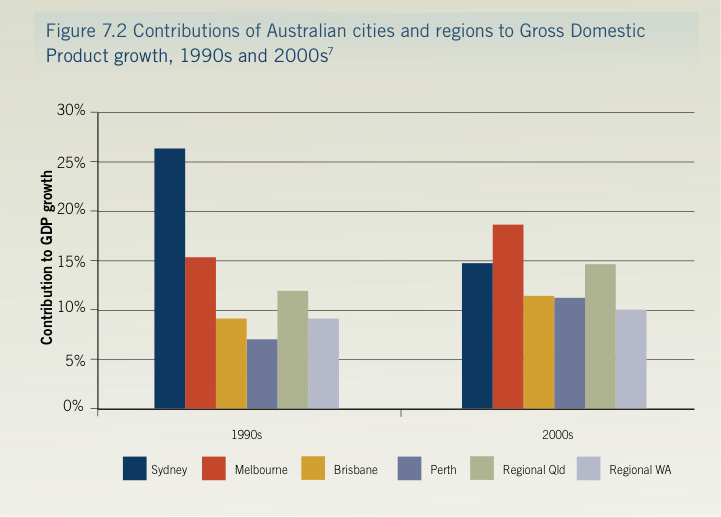
Regional Qld made impressive contribution to national economic growth over 2000s

I’m very impressed by the just released Sustainable Australia Report 2013: Conversations with the Future, which was produced by the National Sustainability Council for Sustainability and Environment Minister Tony Burke. The report covers a wide range of environmental sustainability issues facing urban and regional Australia, and has an impressive collection of charts. I especially like this one showing the strong contribution that growth in regional Queensland – particularly Townsville, the Gold Coast and our mining regions, I expect – made to national GDP growth over the 2000s:

gdpcontributionOn the major economic news of the day, the volatile labour force numbers, I recommend this post by Pete Faulkner:

Strong jobs data adds to questions about RBA decision


Posted in Gold Coast, Macroeconomy, Townsville | Tagged , , , , , , | 3 Comments

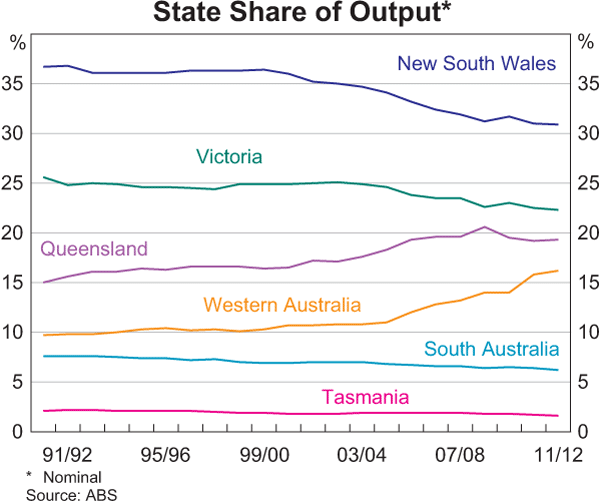
Qld and WA were on similar growth paths, but Qld got knocked off by GFC

This month’s RBA chart pack contains a nice, informative chart depicting State shares of Australia’s GDP (see below). It shows that, up until the financial crisis in 2008, Queensland, like WA, was increasing its share of national GDP, but stalled as the financial crisis hit the Queensland construction sector hard (particularly when people realised the extent of over-investment in the boom years) and also suppressed domestic tourism. And it got worse as the dollar went back above parity with the US dollar, killing any chance of a recovery in international tourism. Relative to Queensland, WA has benefited from a much larger resources boom and from being less dependent on tourism and hence less exposed to the adverse impact of a high exchange rate.

12tl-stateou

Posted in Housing, Macroeconomy, Tourism | Tagged , , , , , , , | Leave a comment

Barcaldine set to boom with big increase in FIFO workers

Queensland Treasury’s non-resident population projections for the Bowen and Galilee Basins show Barcaldine in Central Queensland is the next regional town that will boom due to an influx of fly-in, fly-out (FIFO) and drive-in, drive-out (DIDO) workers (see chart below I’ve copied from Treasury’s note). I think Series C in green gives the best indication of likely FIFO workers, because it includes projects for which an Environmental Impact Statement (EIS) has been lodged. While they haven’t been approved yet, the projects probably have a reasonably high likelihood of proceeding. These projects have the potential to bring over 3,000 FIFO/DIDO workers into a Regional Council area with only around 3,300 residents currently.

BarcaldineBy the way, I’ve noticed that a Central Queensland plane-spotting blogger is on top of the growing number of FIFO workers coming through Barcaldine:

More Fly-in Fly-out (FIFO) Charter Flights to Barcaldine Aerodrome

Regarding the big economic news of the day, I’m surprised the RBA has cut the cash rate to such a low level. It must be very worried about the manufacturing sector in southern States, and it may be attempting to bring the exchange rate down. Given the Australian dollar is still trading above parity with the US dollar, the RBA will need to cut interest rates much further if it would like the currency to get back down to a level that will make manufacturers happy – i.e. a level much less than parity and probably in the 70-80 US cents range.


Posted in Mining, Population | Tagged , , , , , , , , , , , , | 4 Comments

Retail sector adapting to new frugality – big box shopping & affordable luxuries

Australia’s retail sector has had to adapt to the new frugality as a result of the financial crisis, and it appears that, among bricks-and-mortar retailers, only big box stores such as Bunnings have thrived. Yesterday saw the site launch of the new Bunnings at West Ipswich (Bunnings brings hundreds of jobs to Ipswich) and last week brought news of the approval of Costco’s new store at North Lakes. Masters has also expanded in Queensland, and the new store at Springfield appears very popular, although Masters is at least a couple of years away from profitability (Masters ‘a couple of years’ away from profit).

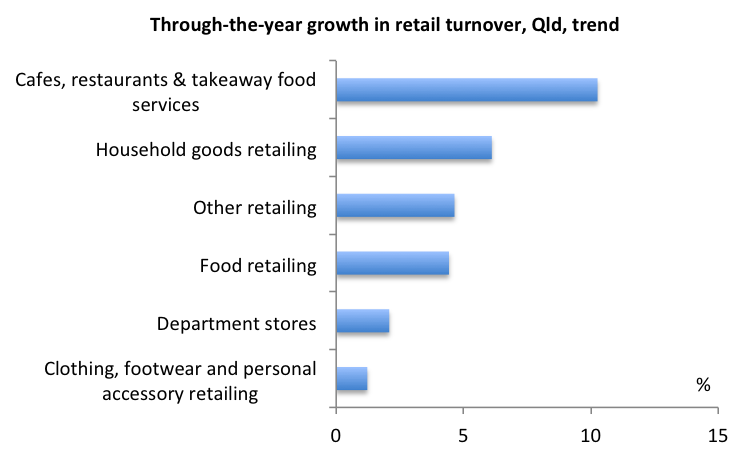
Cafes also appear to be performing well and proliferating at the moment, and are part of the leading sub-sector in through-the-year growth to March (see chart below). I expect this reflects both lifestyle changes (i.e. the popularity of brunch out at a cafe on weekends) and a desire for the affordable luxuries of coffee and cake at a cosy little cafe, which can be a cost-effective way of boosting spirits.

retailOverall, the Queensland retail trade data from yesterday were quite encouraging, with through-the-year growth not too bad at all (see the Treasury brief). But Victoria, whose manufacturing sector is suffering under the high Australian dollar, is a major drag on activity nationally.

Regarding today’s RBA Board meeting, I expect the Board will wait another couple of months before it decides to cut rates again. It would be best for the Board to wait for the March quarter GDP figures in early June, meaning they shouldn’t move until July. For more discussion of the RBA Board meeting today, see Pete Faulkner’s commentary at Conus Economics Blog.


Posted in Macroeconomy, Retail trade | Tagged , , , , , , , , | Leave a comment

Cost savings from contracting out public services

One of the issues of debate inspired by the Queensland Commission of Audit is the potential cost savings from outsourcing or contracting out public services. While there are risks to service quality if contract terms are not well specified and managed, the evidence is reasonably clear there can be signficant cost savings from contracting out. This has been well known to economists for a couple of decades now. The best analysis of the issues and summary of the evidence up to that point was made by Simon Domberger and Paul Jensen in a 1997 article in the Oxford Review of Economic Policy, Contracting out by the public sector: Theory, evidence, prospects, which unfortunately is pay-walled but is well worth reading in full if you can get your hands on it. The authors note international evidence on contracting out suggests:

…savings in the order of 20 per cent are achievable, without sacrificing the quality of service provided. In the UK, savings of between £240m and £280m have been estimated for contracts let at the central government level. Substantial savings have also been generated by contracting at the local government level.

Hence it’s certainly worth examining the contestability of Queensland public services and the potential for contracting out non-core services to the private sector. The savings that could be made on behalf of taxpayers are substantial. 

Posted in Budget, Queensland Government | Tagged , , , , | Leave a comment

How much cheaper is it to fly from Cairns to Brisbane today than in the mid-Thirties?

While in Cairns yesterday for a meeting, I found a little bit of time to pop into the Cairns Museum, in the grand old School of Arts Building in the centre of town, where I found this very interesting poster for North Queensland Airways:

photo-4It appears North Queensland Airways operated between 1936 to 1938, based on a Cairns Post report from 1938 on the company’s sale to Australian National Airways. Assuming the poster is from 1937, I’ve worked out that the price of a Cairns to Brisbane flight (10 pounds, 10 shillings in the old money) would equate to around $850 in today’s dollars. This would be expensive, but a Cairns-Brisbane flight would have been even less affordable than this figure suggests, because real wages were lower back then, and this flight would have cost nearly two-and-a-half times the average weekly wage. In today’s dollars, two-and-a-half times the average weekly wage is around $3,000.

Compare these figure with the cost of a Cairns-Brisbane flight today of around $150-170. Plus it only takes 2.25 hours to fly today, compared with 8.5 hours back in the Thirties based on that poster. Taking into account both the price reduction and the reduction in flying time, this represents more than an order-of-magnitude (i.e. 10x) improvement in the productivity of aviation since the 1930s.

For those interested in data sources, my calculations are based on statistics taken from Wray Vamplew’s 1987 Australians: Historical Statistics, vol. 11.

Posted in Cairns | Tagged , , , , , , , | 2 Comments

Link to my interview on Commission of Audit on ABC Brisbane radio this morning

Steve Austin from 612 ABC Brisbane radio interviewed me this morning on the Commission of Audit report. I elaborated on my view that it’s a good report because:

  • it offers a framework for the role of Government that can guide reform over at least the next decade, and
  • it contains solid analysis of policy issues across a wide range of topics, including public transport, social services, education and health, among others.

Here’s a link to a recording of the interview:

Commission of Audit from an economist’s point of view

Thanks to John Craig for helping Steve get in touch with me to arrange the interview.

My previous posts on the Commission of Audit report include:

Commission of Audit report an impressive guide to reform of Qld Government

Govt should embrace Costello Commission of Audit privatisation recommendations

Posted in Budget, Queensland Government | Tagged , , , , , , , | Leave a comment

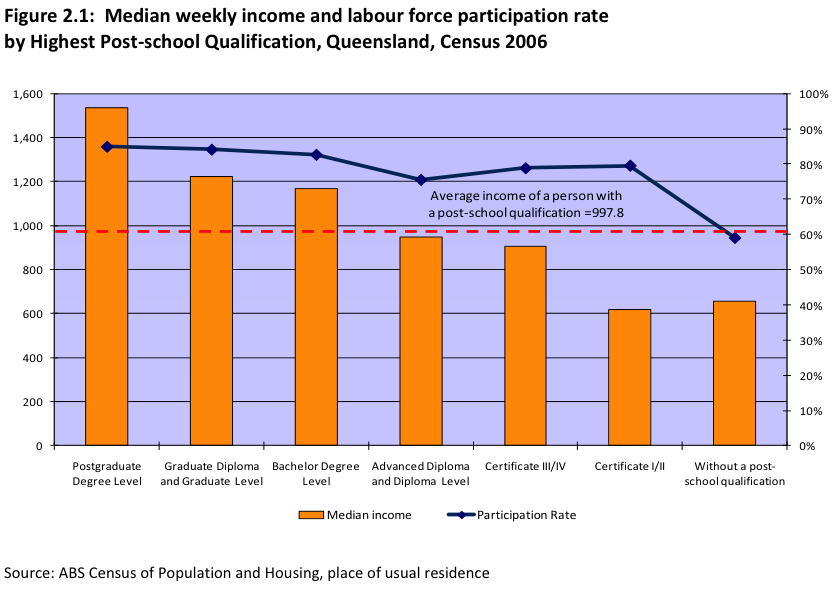
Uni not essential for success, but on average uni graduates do better

I’m disappointed news.com.au tonight features the really silly headline “Four reasons you should bypass uni”, under photos of Mark Zuckerberg, Steven Spielberg, Ellen DeGeneres and Richard Branson. Sure, you can be hugely successful without going to university, if you work incredibly hard and/or get lucky, but I don’t think it follows that you’re better off not going to university. After all, most people who don’t go to uni don’t end up hugely successful, and, of course, neither do most people who go to uni. But suggesting people may as well skip uni is really silly, given uni graduates on average earn higher incomes than non-graduates (see the chart below from the 2010 Skills for Jobs and Growth report). And it’s the averages that should matter in terms of providing advice at the population level.aveearnings

Posted in Education, Uncategorized | Tagged , , , , , | 2 Comments