Government has to rely on inefficient taxes to fix budget – GST reform needed

Among other 2013-14 Queensland Budget decisions, Treasurer Tim Nicholls today announced that the Government would be:

  • Increasing the insurance duty on general insurance products from 7 to 9 per cent to assist the state in funding the NDIS (Disability Care Australia). On a policy for a $300,000 home with $75,000 contents the increase will be $25 per year.
  • Deferring for two years the planned increases in the payroll tax threshold.  This will save the government $235 million.

While these measures may be necessary, given our State’s fiscal challenges, they are rather undesirable measures because both insurance duty and payroll tax are inefficient taxes in that they discourage much more economic activity per dollar raised than more efficient taxes such as the GST (see my previous post Inefficient State taxes which reproduces a nice KPMG-Econtech chart ranking different taxes by their economic costs).

Higher insurance duty is undesirable because it may discourage some people from taking out house and contents insurance, denying them the benefits of an insurance policy. The economic cost of payroll tax is a bit trickier to understand; it is not really a tax on jobs as often claimed. Instead, payroll tax affects the economy in two ways, which were nicely explained in a 1996 NSW Treasury paper by Matt Crowe:

  • To the extent that payroll tax can be passed forward to consumers through higher output prices, the net effect of the tax is comparable to a consumption tax.
  • To the extent that payroll tax can be passed backwards to employees as lower wages, decreasing disposable income, the impact of the tax is similar to personal income tax.

Given the complexity of its impacts, it’s unsurprising that payroll tax is a bad tax, and much less desirable than raising an equivalent amount of money through the GST alone.

Unfortunately, State Governments will keep using inefficient tax measures in the future because they really don’t have much choice. Instead, taking a broader federal perspective, it may be desirable to raise more money through the GST, which would reduce the need for relying on less efficient taxes such as insurance duties and payroll tax, as discussed in a post of mine last week:

GST changes should be considered as part of wide-ranging tax and expenditure review
Posted in Tax | Tagged , , , , | 2 Comments

Could Victorian manufacturing job losses lead to an increase in interstate migration to Qld?

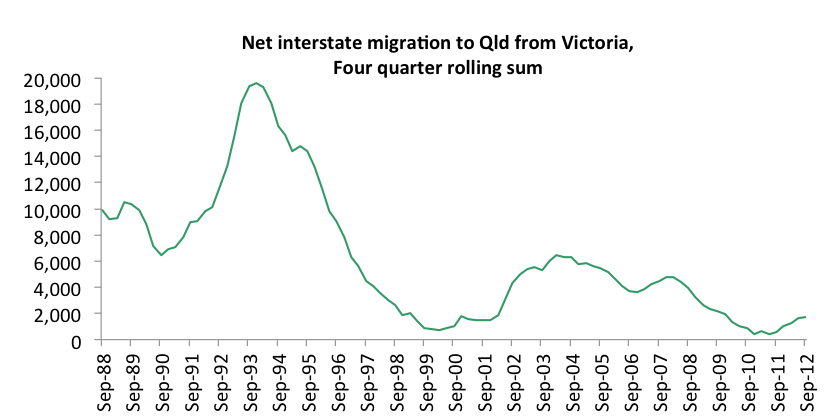
In a post last Thursday in response to the announced Ford plant closures, Mark Beath at Loose Change (Car crash!) wondered whether job losses in Victoria could lead to a revival of interstate migration to Queensland from Victoria, which is currently at low levels (see chart below).

interstate_migration_from_vic

Mark observed:

My recollection of the 1991 recession which hit hardest in Victoria, and particularly Geelong, was that it induced interstate migration to Queensland. Could it happen again?

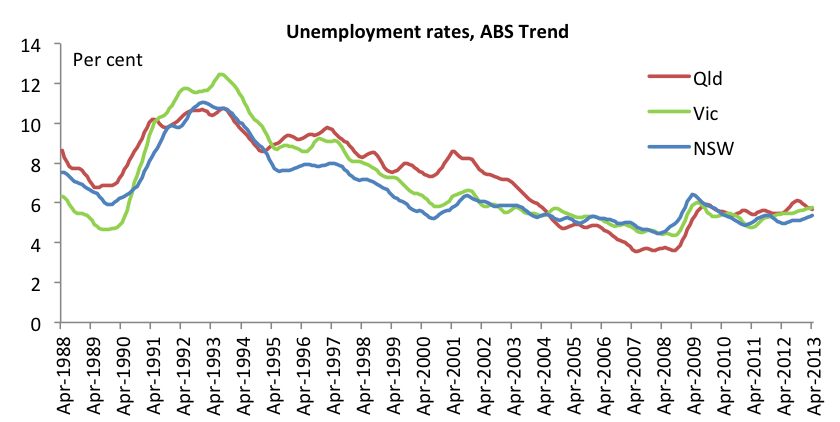
It certainly could, but I think we’d only see the massive interstate movements we saw in the 1990s if there was a downturn in Victoria that drove its unemployment rate 1-2 percentage points above Queensland’s, as occurred in the early 1990s (see chart below). Otherwise I don’t think the relative economic advantage of Queensland over Victoria would be enough to induce large numbers of people to move. Given Victoria has a labour force of around 3 million people, the possible 2,000 to 3,000 job losses associated with the Ford plant closures (and impacts on parts suppliers) would increase the Victorian unemployment rate by no more than 0.1 percentage points. Hence we may not see a revival in interstate migration to Queensland from Victoria just yet. But, as I observed in a post earlier this year (When will interstate migration to Qld recover?), I expect we will see a revival of interstate migration in the medium-term.

urates

Posted in Migration, Uncategorized | Tagged , , , , , | Leave a comment

Potential impact on Ford sales of plant closures

Jeff Waters of ABC News Victoria interviewed me today regarding the potential impact on Ford sales of “badwill” and anxiety over servicing and parts availability created by the announced plant closures:

Buyers cautious after Ford’s announced closures

I told Jeff I expect there will be a significant drop in Ford sales, although I did note I think this would be somewhat of an over-reaction and unwarranted, as Ford has indicated it remains committed to the Australian market, even though it won’t produce cars here. I have no reason to doubt Ford’s commitment. As a high-income OECD country, and a G20 economy (i.e. one of the 20 biggest in the world), Australia will remain an important market for Ford in the future.

For the record, to avoid any confusion over me being labelled an industry consultant in the news story, I’ve never consulted to the car industry. I have experience in car industry policy, of course, through the time I spent as an officer in Treasury’s Industry Policy Unit,  a unit which has always held the Treasury line against unjustifiable industry subsidies.

Posted in Industry policy, Retail trade | Tagged , , , , | Leave a comment

Future of Australian car industry depends a lot on the exchange rate

It’s been clear for a long time – well, all the time since Mitsubishi shut down in early 2008 – that Ford was the next Mitsubishi, so today’s plant closures aren’t that unexpected. Once again, as I more-or-less observed in a brief grab on ABC News tonight, it seems obvious there isn’t much point assisting an industry that is fundamentally unviable in Australia. Just how long the remaining manufacturers survive depends a lot on what happens to the exchange rate. If it falls down to, say, the 70-80 US cents range in the next few years, they might be able to survive into the 2020s, although they’d still need Government assistance, I expect.

I’ve previously presented my views on car industry assistance policy in a number of posts and in an article in Policy magazine. For example, see:

Holden chief’s weird call for independent review of car industry

Farmers miss out when Govt gives $275M handout to Holden

Carr’s car cash and Australia’s reform malaise

Coincidentally, I’ve just had a new article published in Policy magazine, this time on Government assistance to the film industry. The article isn’t available online, so I encourage you to buy a copy of Policy at the newsagent.

Posted in Industry policy | Tagged , , , , , , | 2 Comments

Resources sector investment has peaked, but likely to remain strong for a few years yet

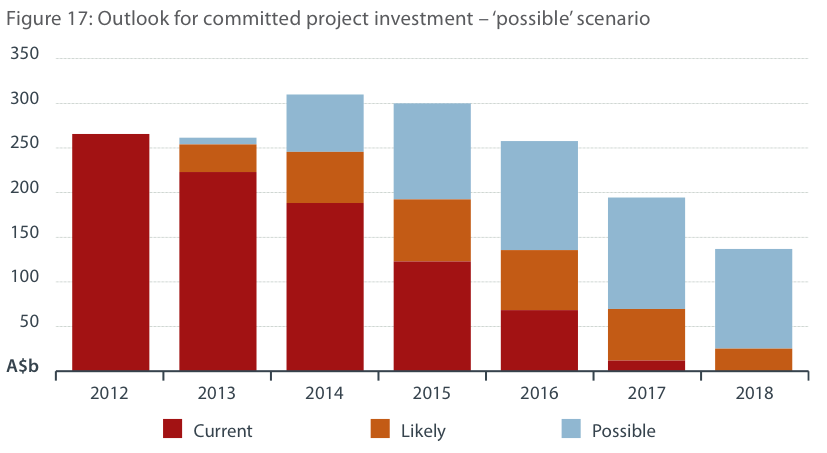
The Australian Bureau of Resources and Energy Economics released its latest review of Resources and Energy Projects today (see Committed investment in resources and energy major projects at peak). It shows that although resources sector capital expenditure has peaked, it should remain strong for a few years yet, and indeed could exceed the current peak if some possible (though not likely) projects get up (see the chart I’ve copied from the report below). 

resourcesinvestment


Queensland features prominently in BREE’s report, second only to WA:

Queensland has the second highest number of projects at the Committed Stage with 21 projects that have a total value of about $81 billion. Like Western Australia, this is primarily due to investment in mega LNG projects which account for 78 per cent, or $63 billion, of this total…

…There are nine coal projects at the Committed Stage in Queensland. These have a total value of $10 billion and are a mix of thermal and coking coal mines.  

So the resources sector will feature prominently in Queensland’s economic development for a few years yet. 

Posted in Mining | Tagged , , , , , , , , | Leave a comment

Surat Basin FIFO/DIDO workers to peak this year

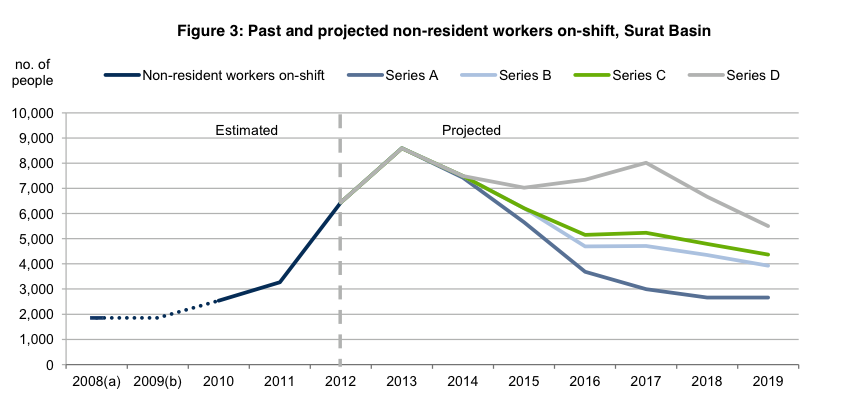
Queensland Treasury released its non-resident population projections for the Surat Basin today. They show that fly-in, fly-out (FIFO) and drive-in, drive-out (DIDO) worker numbers will peak this year at around 8,600 and decline over the next few years as the construction phase of the coal seam gas boom winds down (see chart I’ve copied from the publication below).

SuratAs discussed in a recent post (Barcaldine set to boom with a big increase in FIFO workers), I think Series C is the best projection because it includes projects for which an Environmental Impact Statement has been lodged – i.e. projects that probably have a fairly high likelihood of proceeding.

To a signficant extent, the large projected increase in FIFO/DIDO numbers in the Galilee Basin will provide opportunities for former Surat Basin FIFO/DIDO workers (see the Treasury projections), but I expect many of these workers will also look at opportunities in WA and some may even look overseas.


Posted in Mining | Tagged , , , , , , | Leave a comment

GST changes should be considered as part of wide-ranging tax and expenditure review
Pat Hession from the Drive program on 630 ABC North Queensland interviewed me this afternoon on the merits of increasing the GST rate and broadening its base to include exempt items such as fresh food. I noted that, from an economic point of view, having a broader GST base is better because it is less distortionary than a GST with exemptions. Also, you could raise more revenue that would allow you to reduce other taxes that are less efficient than the GST (see my previous post Inefficient State taxes which reproduces a nice Treasury chart showing how inefficient different taxes are).

By broadening the base, we could probably increase the GST take by around 20% or $10bn per annum, which, because the GST flows to the States, would massively help Queensland’s budget, assuming we got around $2 billion of the increased revenue. If we increased the GST rate as well, we could raise a lot more money.

Of course, one major problem with the GST is that it disproportionately affects low-income earners who spend a higher proportion of their incomes, in general, and spend a higher proportion of their incomes on food, in particular. So a GST base-broadening and/or rate increase would be inequitable, so we’d probably need to increase the tax-free threshold and boost pensions and unemployment benefits to compensate people.

Obviously the GST is a difficult political issue, but, given the large potential economic and fiscal benefits from GST reform, it should certainly be considered as a possible policy option for the incoming Federal Government after the September election. That said, it should only be considered as part of a thorough review of all tax and expenditure items to ensure that we’re only being taxed for necessary and desirable expenditures, and that we raise tax revenue in the most efficient way possible. Given the GST is a relatively efficient tax compared with income tax and company tax, consideration should certainly be given to changes to the GST.

For anyone interested in reading further on the GST debate, I recommend this excellent piece at the Conversation by my former colleague and co-author Professor John Mangan:

The GST debate: is reform necessary?

Posted in Tax | Tagged , , , | 2 Comments

Flood-proofing levy has merit, but funds should go into Consolidated Revenue

Given Queensland’s budgetary challenges, there is merit in the Government’s plan to raise additional money to pay for flood-proofing projects through a special levy, as reported in the Courier-Mail this morning. I would, however, advise against having the money paid into a special fund, where it is ear-marked for flood proofing, which appears to be the Local Government Minister’s intention. The Courier-Mail reports:

Mr Crisafulli said the levy would have its own fund away from consolidated revenue and an end date.

“I am not talking about something that goes into consolidated revenue or lasts in perpetuity,” he said.

“I am talking about a levy that goes into a separate fund for disaster recovery, disaster betterment as part of that recovery and resilience to reduce your future payouts.

“To me it is something we should look at doing over a five-year period and collect about $1 billion. I think that would make a good start.”

I agree with the Minister that the levy should have an end date, but I’m concerned that allocating it to a special fund will limit the Government’s budgetary flexibility. It will mean that the Government may well end up having to pay $1 billion for flood-proofing projects, when it isn’t clear yet that this is the right amount of money to spend on flood proofing. Sure, local governments have identified $950 million of flood-proofing works, but are we really sure these are all necessary (and better value for money than spending additional money on education or health)? It would be better for the Government to have the $1 billion paid into Consolidated Revenue and only funding worthwhile projects that stack up economically. It should dedicate a small fraction of the levy money raised to assessing the feasibility and merits of funding applications.

Posted in Budget, Floods, Tax | Tagged , , , , | Leave a comment

What’s really happening with Commonwealth payments to Qld for health?

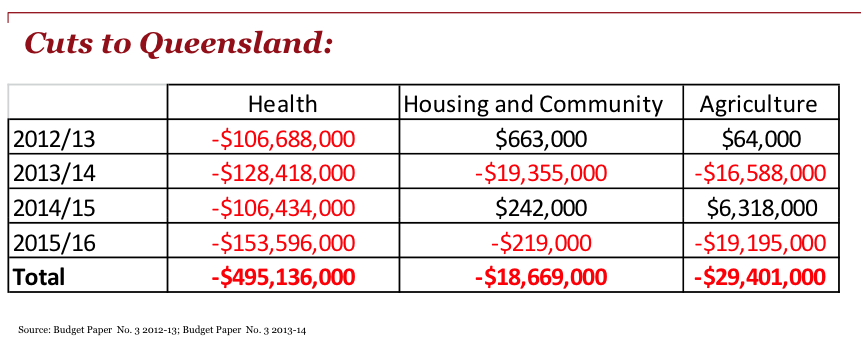
While Commonwealth Health Minister Tanya Plibersek has claimed the Budget gives $1bn extra for Queensland hospitals, Queensland Treasurer Tim Nicholls is criticising the Commonwealth for cuts to health and other areas of Government. For example, Mr Nicholls presented this table at the PwC Federal Budget Breakfast yesterday:

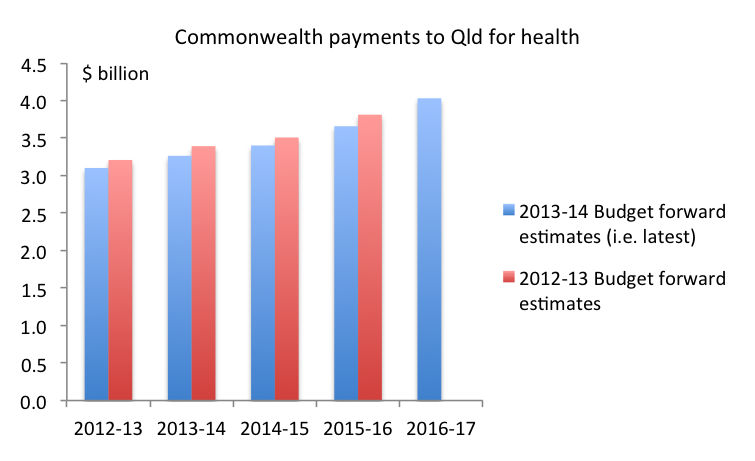
TNChartSo who is right? Well, they both are, depending on what point of comparison you assume. Ms Plibersek is right that the Commonwealth is increasing health funding for Queensland each year over 2013-14 to 2016-17, but Mr Nicholls is right that the increase is less than what Queensland originally expected based on last year’s Commonwealth Budget. (We’re getting less than we originally thought we would largely due to a downward revision in Queensland’s estimated population.) See the chart below comparing what Queensland is getting now compared with what we thought we’d be getting this time last year. Note there is no comparative figure for 2016-17 from last year’s Budget because it was outside the forecast period.

healthfunding

By the way, I chatted with Steve Austin on 612 ABC Brisbane Radio yesterday morning about the Budget:

What is in the Budget for Qld?

We started off with a nice chat about my CityCat ride to ABC Studios at Southbank before moving on to my concern Australia could end up in a state of permanent deficit.


Posted in Budget, Health | Tagged , , , , , , , | Leave a comment

Long-term education target unlikely to be met – haven’t we learned from previous unachievable targets?

The National Plan for School Improvement released with the 2013-14 Commonwealth Budget has the potential to signficantly lift educational outcomes across Australia and is therefore one of the positives of this Budget. But I’m skeptical of the Government’s stated ambition for:

Australia to be placed in the top five countries internationally in reading, mathematics and science by 2025

No matter how much extra funding we direct to the school system, I have no confidence that this ambition will be achieved by 2025. We are simply too far behind leading countries, as discussed in this insightful article at the Conversation last year:

Latest tests show PM’s 2025 education goal is in doubt

It is odd that the Commonwealth would commit to a highly ambitious target in an area in which State Governments play a much greater role than the Commonwealth. Also, the Commonwealth should be well aware of the failure to reach a previous ambitious education policy target – the so-called Finn target from 1991 that, by 2001, 95% of 19 year olds would have either finished year 12, completed a post-school qualification or be enrolled in education and training. Regrettably, Australia missed this target by nearly 10 percentage points (see this University of Tasmania paper on Youth Participation in Education).

I don’t know what else to say about the 2013-14 Budget other than that the $4.1 billion for the Bruce Highway is good news for Queensland. Unfortunately the Budget overall is a depressing document. It reveals that our medium-term fiscal strategy has failed and that we may end up like many of our OECD peers in a permanent state of deficit. Given the Government failed to meet its previous firm commitment to a surplus in 2012-13, it is difficult to believe any new commitment to future surpluses.

Posted in Budget, Education | Tagged , , , , , , | Leave a comment