Billions of benefits from selling Gladstone and Townsville ports

My colleague and friend Brad Rogers, who is also Secretary of the Queensland branch of the Economic Society of Australia, has written a nice post arguing for privatisation of Queensland’s Government-owned ports at his new blog:

Queensland Ports For Sale

Brad neatly explains how the State of Queensland would benefit from selling both the highly profitable Gladstone port and the unprofitable, heavily subsidised Townsville port.

I’ve previously commented on the desirability of privatising government assets in a number of posts, including:

Govt should embrace Costello Commission of Audit privatisation recommendations

On other matters, for coverage of today’s new building approvals data from the ABS, see these posts from fellow Queensland bloggers Pete Faulkner and Mark Beath:

Bldg Approvals weaker than expected but the Trend is still positive

Building momentum slows for the wet season

Posted in Budget, Housing, Transport | Tagged , , , , , , | 7 Comments

Why is training in oil & gas drilling fee-free?

The Queensland Government’s blueprint for reform of vocational education and training (VET), Great Skills Real Opportunities, which was released in June last year, goes a long way toward creating a more efficient and responsive VET sector, but falls short in some areas. The reform program is right to make training funding contestable and to corporatize TAFE, but it falls short of what would be ideal regarding the setting of public subsidies for training courses.

Queensland’s VET system still lacks a clear, rigorous methodology for setting the public subsidy for training courses – that is, is the level of contribution from the Government to help cover course costs, in addition to what is provided by students in course fees. This was apparent last week when the Education and Training Minister announced this year’s list of apprenticeship and traineeships that would be fee-free and fully publicly subsidised (see the Ministerial press release).

I was rather surprised to see that training in oil & gas drilling would be fee-free. This is a bit odd given the high level of private benefits, in the form of higher earnings, that would accrue to people completing the course. It’s unclear what degree of analysis was undertaken in identifying the priority courses listed in the press release. I would expect that any rigorous subsidy-setting methodology would dial down the subsidy level where there were large expected private benefits through higher earnings.

If the Government is concerned that course fees might discourage people from training, then, instead of making courses it identifies as priorities fee-free, it should instead work with the Commonwealth to introduce income-contingent loans, similar to HECS-HELP in the higher education sector, for all VET courses. This way a student could defer upfront fees that might discourage him or her from studying, and pay back the loan when they’re in the workforce and earning a reasonable amount of money.

Posted in Education, Labour market, Mining | Tagged , , , , , | 4 Comments

Rent auctions linked to constraints on inner city development

A story in mX yesterday afternoon highlighted an unnecessary law against so-called rent auctions:

Brisbane’s rental squeeze is forcing prospective tenants to offer landlords extra cash to secure a place to live.

As competition for properties in the inner city heats up, Tenants’ Union of Queensland co-ordinator Penny Carr said many renters were “up-bidding” above the advertised rental price in order to nab a home.

The practice becomes illegal in Queensland when potential tenants are asked to take part in an informal auction to see how much they are prepared to pay to have their application approved.

“People do it quite often, whether they are baited into doing it or feel like it’s the best way to get the property they want,” Carr said…

…Under laws introduced in 2009, agents must advertise a fixed rental price, can’t ask for offers or put a property up for rent auction.

This law is silly and should be repealed. It will result in inefficient outcomes because some people will miss out on rental properties they really like and are willing to pay a higher rent than other people for. If there is a problem with rents being too high in the inner city, it is not due to rent auctions, but limited supply of rental properties relative to demand, possibly due to constraints on development in the inner city. Rent auctions are merely a symptom of relative under supply, and are obviously not the cause of the under supply and consequent high rents.

A good start to addressing any rental supply shortfall would be for Brisbane City Council to review its heritage protection to determine the extent to which it is constraining development in the inner city – development which could boost the supply of rental accommodation and put downward pressure on rents.

The impacts of heritage protection on inner city development were previously discussed in a guest post by my colleague and friend Brad Rogers:

Guest post – Old Queenslanders in a New City

I’ve also discussed constraints on inner city development previously:

Where is residential development occurring in the Brisbane metro area?

Posted in Housing | Tagged , , , , , , , | 8 Comments

Regional infrastructure plan should be based on updated population projections

Having spent the first fifteen years of my life in Townsville, I’m a great supporter of regional Queensland, but as an economist I think the Government needs to do some further analysis before it commits large amounts of money to regional infrastructure under plans announced by the Local Government Minister last week (Regions set for boost):

LOCAL Government Minister David Crisafulli announced further plans to create infrastructure for regional communities.

“There is a prospect of growing regional centres and I think it’s something we should embrace on one condition – the infrastructure has got to be delivered ahead of the game,” Mr Crisafulli said last Monday.

The regional infrastructure plan appears consistent with the Queensland Plan aspiration to have half the population living outside South-East Queensland in thirty years’ time. But it’s unclear how the Queensland Plan aspiration can be achieved – assuming realistic policy settings – given that the Queensland Government population projections show SEQ’s share of Queensland’s population at 66.6 per cent in 2031, up slightly from 66.1 per cent in 2006. The Queensland Plan’s aspiration means around 1 million people more would have to live in regional Queensland than currently expected (based on the 2031 projected population; the number would be even higher if based on a projection of the 2044 population). I’m skeptical about whether this can be achieved.

The Queensland Plan is still only in draft form. Before the Government finalises it, and commits large amounts of money to regional infrastructure, it should seek updated official population projections from Queensland Treasury to see if its expectations of regional population growth are achievable. The whole point of official population projections is to inform infrastructure and service delivery decisions, and hence it’s important to update these projections which were last reviewed in 2011.

Posted in Population, Queensland Government, Townsville | Tagged , , , , , , , | 7 Comments

Chinese tourism boom for Cairns?

Cairns business leaders have been pinning their hopes on a surge in Chinese tourism for a while now, and they remain confident according to a Cairns Post report from yesterday (Could Cairns be on the cusp of a Chinese tourism boom?):

Cairns Airport chief executive Kevin Brown said Cairns had only “begun to scratch the surface in developing and servicing the Chinese tourism and business market.”

“There is huge potential for our region,” Mr Brown will tell the January 29 Cairns Airport Chinese New Year Yum Cha Business Event.

“We had direct China Eastern flights from Shanghai in place for most of 2013 and even without direct flights the Chinese visitor market shows strong growth trends with people willing to reach our destination via domestic services from other parts of Australia.

“Chinese New Year looks set to attract around 20,000 visitors into the region with many arriving on the China Eastern services as well as China Southern and Cathay Pacific charters.”

It may be that Chinese New Year gives a temporary boost to tourism, but I’m unsure if it will have any long-term impact. Chinese tourism in Australia has certainly grown impressively in recent years, but has started to decline in recent months, as covered by Pete Faulkner:

Chinese visitor numbers fall again

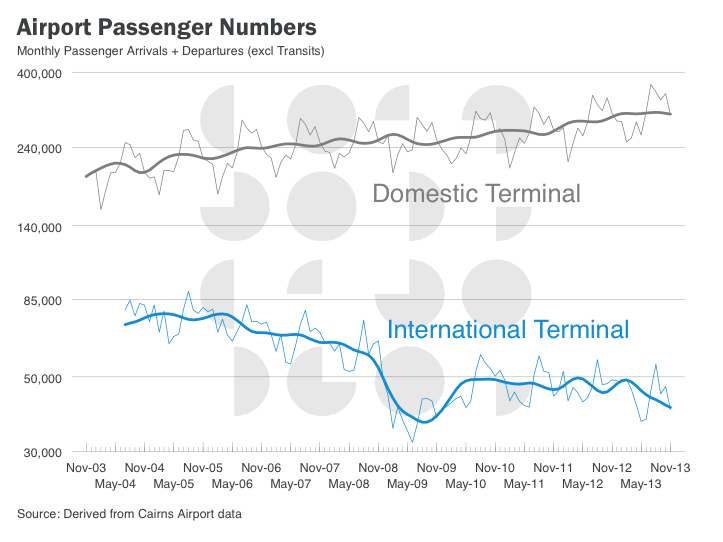
Furthermore, airport passenger numbers at Cairns airport don’t appear to suggest a tourism boom is in the making in Cairns. Here’s a nice chart from the latest CairnsWatch publication produced by Rick Carr of Herron Todd White Cairns, showing a decline in international terminal passenger numbers and reasonable but unspectacular growth in domestic terminal passenger numbers at Cairns Airport:

Cairnsairport

Mark Beath at Loose Change is also keeping an eye on Cairns airport passenger numbers:

Eclipse stalls airport growth

So it may be overly optimistic to expect a Chinese tourism boom for Cairns, given recent data haven’t been very encouraging.

Posted in Cairns, Tourism | Tagged , , , , | 3 Comments

Qld Govt should implement cycling inquiry recommendation on helmets

This afternoon’s Brisbane mX newspaper ran a front page story on the struggling CityCycle bike hire scheme:

Brisbane’s bike hire scheme has become a “gimmick” for visitors, with only one in four regular riders taking a subscription for longer than a week.

Brisbane City Council figures show only 1,800 of the 4,800 active users each month had a long-term subscription.

This may not be so surprising, as anyone who did start using CityCycle regularly would figure out they would be better off buying their own bike. However, there is no denying that CityCycle is in trouble, with very low usage. Part of the problem is Queensland’s compulsory helmet law, which discourages cycling on CityCycle and also in general. While some CityCycle bikes come with helmets, I’m sure many people would worry about wearing a helmet that has been worn by many people before them, especially in sub-tropical Brisbane in which it’s easy to work up a sweat while riding.

Given helmets massively discourage cycling and hence are bad from a public health perspective, the Government should seriously consider implementing recommendation 16 of the Parliamentary cycling inquiry’s November 2013 report:

The Committee recommends that the Minister for Transport and Main Roads introduce an exemption from Queensland road rule 256 for all cyclists age 16 years and over using a bicycle from a public or commercial bicycle hire scheme.

Road rule 256 is the compulsory helmet law. Exempting CityCycle from the helmet law would be a great idea, and I expect it would increase usage. Indeed, getting rid of the helmet law entirely would be even better, as I’ve discussed before:

Government should fully repeal compulsory bike helmet law

Should we repeal the compulsory bike helmet law?

In case you haven’t seen a CityCycle bike yet, here’s a picture of one outside my apartment building:

photo-8

Posted in Uncategorized | 1 Comment

Qld jobs market remains sluggish – unlikely trend unemployment rate fell last month

Unemployment_rate

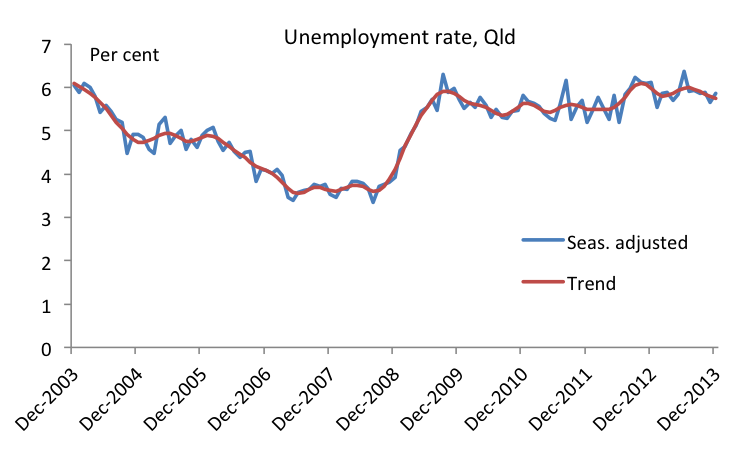
Today’s labour force data from the ABS confirmed that the jobs market remains sluggish, with Queensland’s unemployment rate at 5.9 per cent in seasonally adjusted terms. Unfortunately, the ABS data aren’t very precise for Queensland and it’s hard to have a great deal of confidence in either the seasonally adjusted data, which are highly volatile as I’ve discussed before (Don’t read too much into one month’s unemployment figures – Qld data pretty volatile), or the trend data, which are based on a backward-looking data smoothing procedure that yields some weird results from time-to-time.

For example, the reported drop in Queensland’s trend unemployment rate to 5.7 per cent in December from 5.8 per cent in November is weird. Given the seasonally adjusted unemployment rate has been 5.9 per cent for the last six months, except for November when it dropped to 5.7 per cent before returning to 5.9 per cent last month, my best guess would be the trend unemployment rate is around 5.9 per cent. It’s probably been around 5.9 per cent for the last six months and the lower November figure simply reflects the volatility in the data series.

My guess is that the trend unemployment rate fell in December because the ABS’s data smoothing procedure is now giving less weight to the rogue June 2013 seasonally adjusted unemployment rate of 6.4 per cent than it did in previous months.  That is, I suspect the weird drop in the trend unemployment rate in December is due to the data smoothing procedure being compromised by the bad data point from June – another bad data point due to a too small sample of households from Queensland in the Labour Force Survey and consequently a high degree of sampling error and volatility in the data. It would be desirable for the ABS or Queensland Treasury to investigate whether this is the case. Also, it would be desirable for Queensland Treasury to delve a bit deeper into the ABS data it reports on in its information briefs, and to question whether the data it’s reporting on make sense or not.

Finally, while the jobs market remains sluggish, it’s still pretty reasonable by historical standards, particularly if you can recall the much higher unemployment rates in the 1980s and 1990s, as I’ve discussed in an earlier post:

Qld jobless rate not “historically high”

Other commentary on Queensland’s labour market can be found at:

Weak jobs data but QLD bucks the Trend

Oh No Victoria!

Posted in Labour market, Macroeconomy | Tagged , , , , , , , , , | 2 Comments

Good pick up in home loans in Qld over 2013

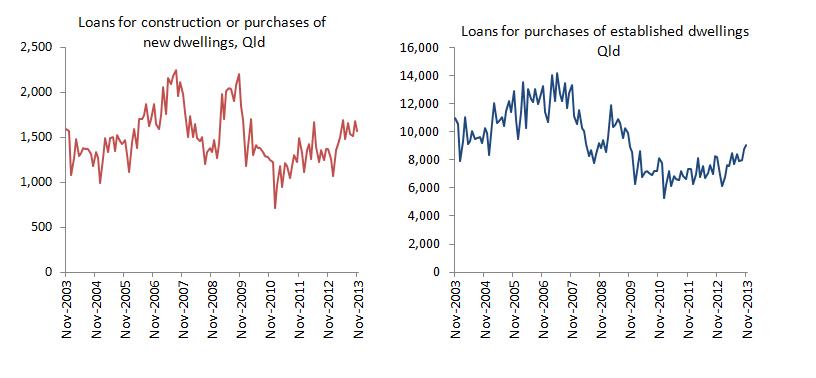
I agree with MacroBusiness’s assessment (New home finance takes a breather) that the number of loans for the construction or purchase of new houses, which is linked closely with the health of the building industry, picked up in Queensland over the last twelve months, although it remains below levels seen in the mid-2000s (see chart below). Loans for the purchase of established dwellings also increased over the last twelve months, although not to a level that would overly excite the property market. I expect 2014 will also see good growth in home loans in Queensland as confidence in the economy continues to recover.

housingfinanceN.B. the data in the charts above are not seasonally adjusted. Typically there is a sharp drop in home loans in January, which is apparent in the charts above.

Posted in Housing | Tagged , , , , , , | 3 Comments

Where is residential development occurring in the Brisbane metro area?

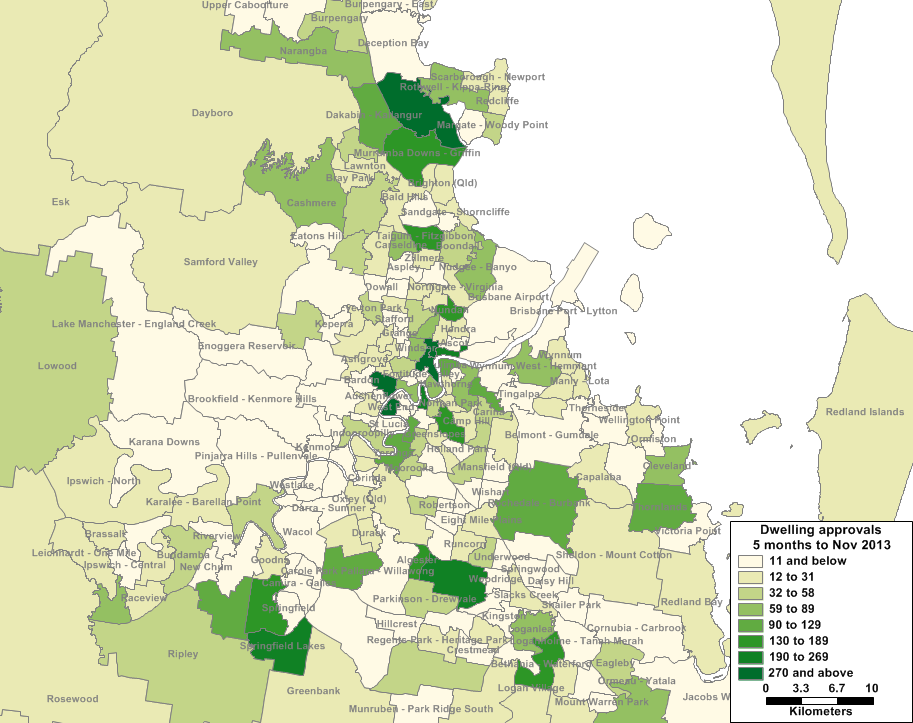
Every month the ABS releases new data on residential building approvals for Level 2 Statistical Areas (SA2s), which broadly correspond to suburbs, at least in the major cities. I’ve mapped the number of approvals for suburbs in the Brisbane metropolitan area over the five months to November 2013 below (i.e. the financial year to date).

Brisbane_metro_map

The highest numbers of approvals are in pockets of the inner city (e.g. Newstead and Milton) that, broadly speaking, were industrial/commercial areas unaffected by heritage protection, which is arguably limiting development in other inner city areas (see Old Queenslanders in a New City). Other than these small pockets in the inner city, where development typically comprises new apartment buildings, the other areas with high approvals are outer-lying suburbs, such as Springfield Lakes and Calamvale, where development typically comprises houses and townhouses.


Posted in Housing | Tagged , , , , | Leave a comment

Good news for Qld building industry as new apartment approvals surge

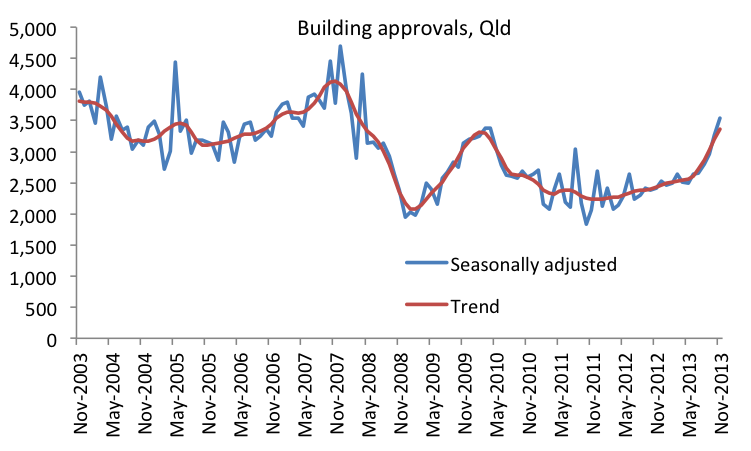
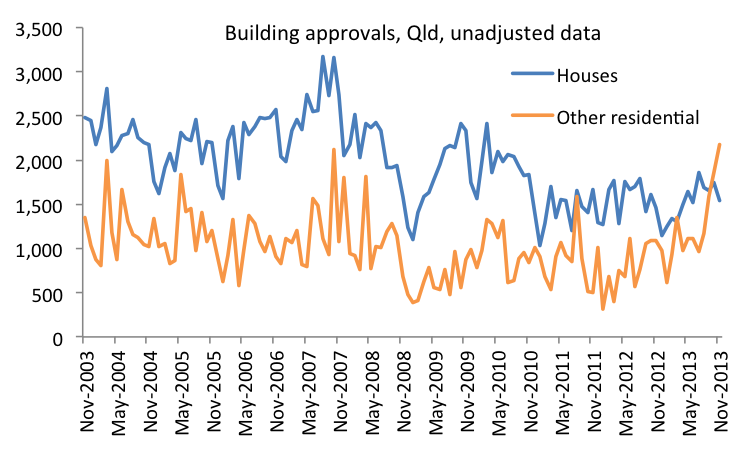
Conditions will certainly improve in the Queensland building industry over 2014 as residential building approvals continue to recover (see first chart below based on the new ABS data), although we shouldn’t get too excited yet because the recovery appears to be driven by the volatile other residential sector, which includes apartments and townhouses (see second chart below). This was also observed by Pete Faulkner in his post from yesterday (Units skew building approvals). Also, given total approvals are still below pre-financial crisis levels, I think it’s premature to talk of “boom-like approvals,” which is how a UBS economist quoted in Paul Syvret’s article in today’s Courier-Mail describes the approval figures.

ba

ba_split

Posted in Housing | Tagged , , , , , , , , | 5 Comments