Long-term trend in average working hours – big drop over last 100 years

A comment from a reader on my Friday post on robotics and automation got me thinking about long-term trends in average working hours. Historical data on standard male working hours (from Glenn Withers’s chapter in Vamplew’s Australians: Historical Statistics), which I’ve combined with recent ABS data, show a large drop in average hours worked in the last 100 years. While there was a period in the eighties and nineties when average full-time hours started to increase, this appears to have been unwound in the 2000s (see this ABS article on Trends in hours worked, which shows that average working hours across all workers have fallen over the last few decades as the proportion of people working part-time has increased).
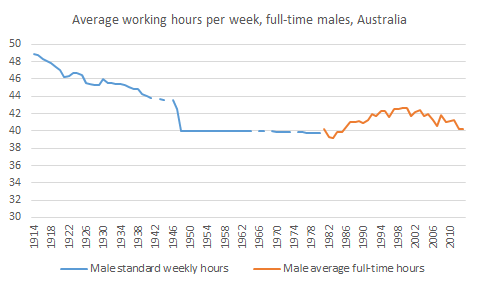
averagehoursPartly the drop in average hours would have been driven by technological progress, which has improved productivity and incomes. As we became more productive, we bought ourselves more leisure time as well as additional goods and services. As robotics and automation become more prevalent, I expect we’ll be able to buy ourselves more leisure time, and average hours will continue to fall, as more people can then afford to work fewer hours. Of course, with improving communications technology, including video calls, we can probably expect more work-related interruptions at home. The blurring of work and personal lives will continue to be a major issue in workplace and business relations.

N.B. Comparable historical figures back to 1914 for women don’t appear to exist, but I expect the average hours trend has been similar for women working full-time. Of course, the major labour market trend for women over the last 100 years has been rising participation in the workforce due to social and economic factors – a trend which I’ll aim to discuss in a future post.

Posted in Labour market, Uncategorized | Tagged , , , , | 6 Comments

Economic implications of robotics and automation

RobotThere is increasingly serious discussion about the implications of major advances in robotics and automation and what these advances mean for the future economy, particularly whether robots will replace humans in many jobs. For example, the OECD has observed that the robots are coming, and MIT economist Erik Brynjolfsson has forecast that robots will replace humans in many basic occupations:

Why AI could destroy more jobs than it creates, and how to save them

I touched on these issues in my speech a couple of weeks ago to the University of the Third Age, Redlands. I expect a gradual economic adjustment to a growing reliance on robots in future decades. Robots will make the economy more productive and mean that we could afford to enjoy more leisure time. While we will enjoy more leisure time, I don’t expect mass unemployment. Robots won’t be able to replace humans in all jobs and I expect we will see even greater numbers of people employed in services occupations, particularly in those involving a human touch – e.g. personal training, yoga instruction, aged care, etc. As one attendee at my Redlands talk commented, the Luddites thought the industrial revolution would cause mass unemployment and they were proven wrong. It’s likely that current fears about robots are equally misplaced.

Posted in Labour market | Tagged , , , | 4 Comments

Mining investment decline has driven recent economic weakness

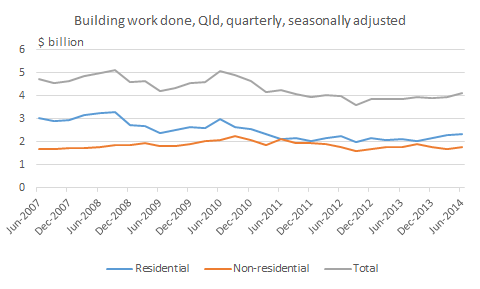
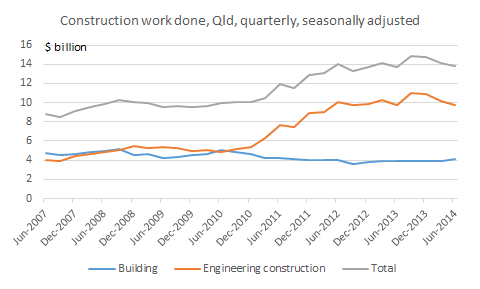
New data from the ABS show that although residential and commercial building activity is picking up nicely, the pick up is in no way large enough to offset the decline in heavy/engineering construction, which has largely occurred in the resources sector (see charts below). The decline in engineering construction will have had both direct and indirect, flow-on impacts, affecting not only people employed in mining construction but engineers, environmental scientists, and others who rely on work associated with mining construction projects. I expect the drop in engineering construction will contribute to weak conditions in the Queensland economy over the remainder of the year at least. As I’ve discussed before, I’m more positive about the medium and long-term outlooks due to the coming commencement of LNG exports and expected demands for workers in health and aged care and other services industries.

Construction_June_14Buildind_June_14

Posted in Housing, Macroeconomy, Mining | Leave a comment

Builders much more optimistic than current conditions would warrant

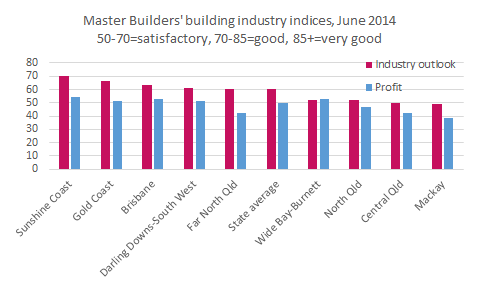
Broadly speaking, humans are biased towards being optimistic, and the Master Builders Survey of Industry Conditions for June 2014 is a good example of the optimism bias. Builders across Queensland, and especially in the South-East, are much more optimistic about the future outlook than you may expect based on current profitability (see chart below). Let’s hope the building industry has a good sense of future work in the pipeline, because the recent increase in the unemployment rate suggests a weak short-term outlook for the Queensland economy (see Unemployment keeps rising). Also, building approvals, while higher than a year ago, are still significantly below levels seen before the financial crisis.

MasterBuildersJune14

Posted in Housing, Macroeconomy | Tagged , , , , , , | Leave a comment

Privatisation proceeds should be spent wisely

I have an opinion piece in today’s Courier-Mail on asset sales/privatisation:

Corporatisation has brought efficiency gains but there is still room for more gains through privatisation

It’s based largely on my speech from a few weeks ago: Productivity and privatisation.

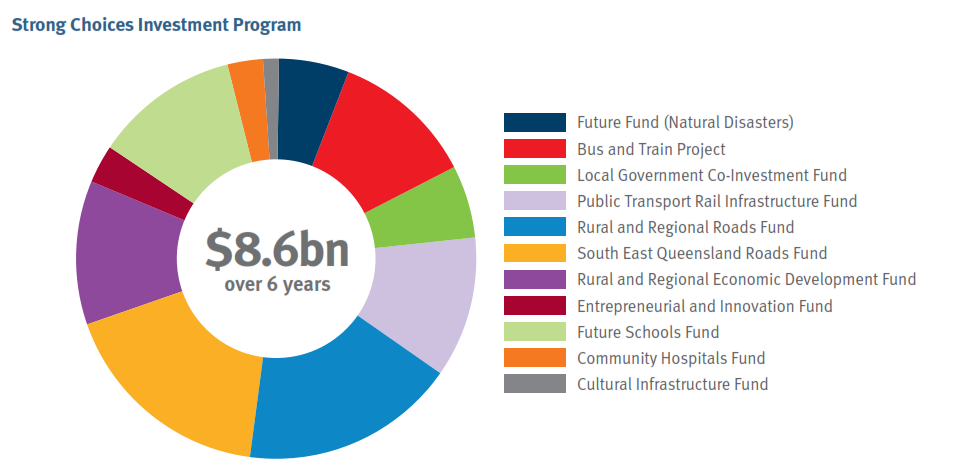
Next month, the Government is due to announce where it intends to spend the $9 billion of privatisation proceeds it isn’t using to pay down debt. While the Government has already provided an indicative, high-level carve up (see below), it still needs to identify specific projects. There is obviously a risk that proceeds could be used to fund popular projects with dubious economic merit in marginal seats. Hence there is a need for Queensland Treasury and the Premier’s Department to ensure a rigorous cost-benefit analysis has been done of all projects.

The proposed Townsville super-stadium certainly warrants close attention from bean counters on George St. It’s unclear why the Government should contribute millions of dollars to provide a venue for the NRL to improve its profitability (see NRL plan for 25,000 seat super-stadium). There doesn’t appear to be a strong public good case for public investment in the stadium, given Townsville already has 1300SMILES Stadium and the Sports Reserve, which can hold important public events as required.

Strong_choices

Posted in Budget, Queensland Government | Tagged , , , , | 4 Comments

US tax guru Dan Mitchell criticises federal debt levy

DanMitchell2Cato Institute economist and former George H.W. Bush adviser Dan Mitchell gave a fantastic presentation tonight to the Queensland branch of the Economic Society on tax avoidance and tax competition. Dan is highly critical of OECD efforts to discourage member countries from competing on tax rates to attract capital investment, which he believes guarantees the perpetuation of fiscal laxity by spendthrift governments. Dan observed that the OECD’s efforts have been encouraged by the drop in tax rates around the world that has occurred since the 1980s as capital has become more footloose in a better connected and more globalised world.

To stimulate economic growth, Dan noted that one of the best policy moves Australia could make would be to cut our highest marginal tax rate, which, with the 2% debt levy, is close to or above 50%, depending on whether the taxpayer has private health insurance or not (see this PwC note). He was highly critical of the debt levy, which is supposed to be temporary. Dan noted, however, how temporary taxes have a habit of becoming permanent. I was pleased to hear Dan’s view on this issue, as I have previously criticised the debt levy:

ABC radio interview on the debt tax and paid parental leave

Incidentally, Dan Mitchell was interviewed on ABC radio by Steve Austin this morning:

Cato Institute’s Dan Mitchell

Posted in Budget, Tax | Tagged , , , , , | 2 Comments

Costello right to support drop in $1,000 GST-free threshold for online purchases

I’m pleased to see former Federal Treasurer Peter Costello backs retailers’ call to lower online GST threshold. There is the obvious level playing field argument that Costello makes. Also, with Federal and State Governments facing big challenges in repairing their budgets, it’s important to defend current revenue sources, particularly relatively efficient taxes such as the GST. The strong growth in online purchases has meant that a large amount of GST revenue has been forgone, revenue that would have otherwise gone to State Governments. To reduce this forgone revenue, the Federal Government should lower the $1,000 GST-free threshold that applies to items coming into Australia, a threshold that means a lot of online purchases don’t have any GST applied.

Of course, the Government will need to consider the additional administration costs of applying GST to a larger number of items, and it’s possible that the optimal threshold may be several hundreds of dollars, but the Federal Government (Customs Service in conjunction with the Treasury) would be best placed to undertake the required analysis.

An earlier post of mine on this issue was:

Reaction against retailers’ call for GST on online sales is over the top

Posted in Tax | Tagged , , , | Leave a comment

Palmer plan for State split could make sense if part of wider Govt reform

The Palmer United Party’s plan to split Queensland by creating a new State of North Queensland (Palmer MP calls for State split) is worthy of further discussion, particularly if consideration is given to a potentially wider, more valuable reform: the abolition of local governments. There is widespread recognition in the Australian community that, with three levels of Government, we are over-governed. We could reduce costs and duplication and improve service delivery if we created regional governments which would perform current State and local government functions, but over larger areas than current local governments. For example, a regional government looking after South-East Queensland may make sense as SEQ is effectively becoming a 200km City (see Tradies know what it means to live in the 200km City). Of course, any such proposal would require detailed analysis to ensure the proposed entities are economically viable. 

Earlier relevant posts of mine include:

Great new ANZSOG paper recommends two tiers of Government

Not another referendum on local government

Posted in North Queensland | Tagged , , , , | 5 Comments

Speech to University of the Third Age Redlands on the Australian Economy

Australian_economy

This morning I addressed the University of the Third Age Redlands at the Donald Simpson Centre, Cleveland on the topic of The Australian Economy: Where we’ve come from, where we’re going. My prepared remarks are reproduced below. I varied the address in the delivery, but the main points are the same. Slides are available via SlideShare.

The Australian Economy: Where we’ve come from, where we’re going

Good morning. You may have seen it reported last week that Australia’s unemployment rate has increased to 6.4%, the highest rate we’ve seen in twelve years, and there is some concern over the short-term economic outlook. There’s certainly a risk that Australia’s dream economic run, of unbroken economic growth for more than two decades, may come to an end if housing construction doesn’t replace the economic boost provided by mining investment in recent years. But it’s too soon to tell how long the weakness in the labour market will continue, or whether it’s a sign of worse to come.

Over the last decade or so, Australians have typically been used to good economic news, or at least better economic news than in other countries. Since the financial crisis of 2008, the Australian economy has been a standout performer among the advanced industrialised economies that make up the OECD. Of course, this was not because our economy has been performing exceptionally, but because we avoided a recession unlike the US, UK and Europe.

Partly this may have been luck, partly good management. There have been arguments about the effectiveness of the short-term fiscal policy response – Keynesian pump-priming through the stimulus packages, incorporating the Rudd money, Pink batts, school halls, et cetera – but there is a lot of agreement that the Australian economy has been made much more resilient through reforms to our economy that have occurred, particularly since the 1980s.

Continue reading

Posted in Industry policy, IR, Labour market, Macroeconomy, Migration, Mining, Population, Tax, Uncategorized | Tagged , , , , , , , , | 1 Comment

Unemployment rate is partly a policy choice – cut regulation to create jobs

Upon the retirement of Treasury Secretary Ted Evans in 2001, then Prime Minister John Howard noted:

Ted…has been a leading contributor to public debate, particularly issues of structural reform, such as the functioning of the labour market. He highlighted the importance of labour market reform in improving economic growth and productivity, with flow on benefits to real wages and living standards.

Ted will be forever associated with that memorable phrase; in one sense, we can choose the level of unemployment which we are willing to bear; when discussing economic and social constraints on reducing unemployment. (from the transcript)

As unemployment continues to rise during this period of below-trend economic growth, it’s timely to remember Ted Evans’s observation that, in one sense, we choose the level of unemployment through the policy settings and regulations we impose on the economy. Since unemployment started rising again, I’ve been writing about the need to vigorously pursue reforms that will reduce the cost of hiring people and eliminate regulations that prevent people from pursuing economic opportunities:

Reduce youth unemployment through improved regulation – e.g. of penalty rates, taxis

Minimum wage reduces retail jobs available for young people

After yesterday’s disappointing employment data, it’s imperative that we refocus our efforts on reducing regulations that make it costly or difficult to hire people.

Posted in Labour market | Tagged , , , , , , | Leave a comment