Vehicle sales affected by weak consumer confidence & Gen Y habits

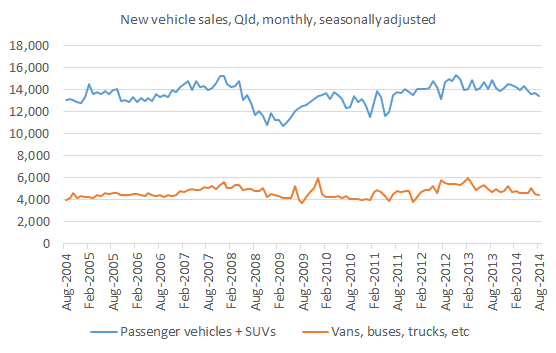
vehiclesales_Aug14New motor vehicle sales in Queensland in August were almost 9% lower than in August 2013, according to ABS data released yesterday. There are at least three contributing factors:

  • persistently weak consumer confidence (see Consumer sentiment slumps as budget worries weigh),
  • members of Generation Y having lower rates of car use and ownership than members of earlier generations at the same age (see the Urbanist on Why is Gen Y driving less?), partly because many of them live in the inner city, so they’re less likely to buy new cars as they start to earn money, and
  • baby boomers retiring and economising.

Given the importance of demographic factors, it’s possible new car sales won’t rebound strongly when the economy eventually improves. With lower rates of car ownership, I expect we’ll see increased demand for public transport and apartments in the inner city, so perhaps all those apartment towers being built in inner city Brisbane will be needed after all.

Posted in Brisbane, Housing, Transport | Tagged , , , , , , , | 4 Comments

If you want to understand the East Coast gas market, come to this presentation

With the first LNG exports from Curtis Island off Gladstone expected later this year, it is timely to consider what the linkage of our domestic gas market to the international market will mean for gas prices in Australia. A Grattan Institute study, Getting Gas Right, has found increases of more than 80% in wholesale gas prices may result. This will have significant impacts on industrial users of gas. For example, the anticipation of this gas price increase has led Stanwell to re-commission a coal-fired generator at Tarong, as the economics of coal-fired power production have improved relative to gas-fired power production (see Electricity providers return to coal-fired power as natural gas export revenue soars). Also, households will face significant increases in gas prices, although the proportionate price rise will be less than the wholesale price rise because the gas itself contributes only a fraction of the cost of supplying gas to households. The Grattan Institute study found that Queensland household gas bills may rise up to $60 per year.

Given these significant developments arising from imminent LNG exports, it seems appropriate that the Queensland Branch of the Economic Society of Australia, of which I’m Deputy Secretary, would schedule a presentation next month from a leading energy economist, Dr Liam Wagner, on the East Coast gas market:

Australia is in a key geographic and strategic position to supply a sizable proportion of the region’s LNG demand, and potentially be the world’s largest supplier. The impending entry of the Eastern States of Australia as exporters of LNG will also bring previously quite cheap domestic gas up to parity with international prices. Current trends in the development of the natural gas industry, particularly in Western Australia, have shown that the internationalisation of prices can have a significant impact on electricity prices and the availability of gas for industrial users. This seminar will outline the model ATESHGAH, purpose built for Australia’s natural gas markets to examine the effects that agent-based behaviour may have on Australia’s Energy Markets.

I hope you will be able to attend this lunchtime event, to be held at Morgans at the Riverside Centre, Brisbane on Wednesday 15 October 2014. Having worked with Liam in the past, I’m sure it will be very informative and insightful.

LiamInformation on the event including how to register is available on the ESA Qld website.

Posted in Energy, Gladstone, Mining | Tagged , , , , , , , , | 2 Comments

ABC radio interview on unemployment, the 4% target and the four pillars plan

I was interviewed this morning by Steve Austin on 612 ABC Brisbane regarding yesterday’s unemployment figures, particularly what they mean for the Government’s four pillars plan and its 4% unemployment rate target:

Jump in employment questioned

I reiterated the point I made in my blog post yesterday (4% unemployment rate target looking much less achievable now) about the difficulty of achieving and sustaining the Government’s 4% unemployment rate target. I also tried to make the points, not as lucidly as I would have wished, that:

  • the unemployment rate is determined by a lot of factors outside of the State Government’s control (e.g. monetary policy set by the RBA is obviously important, as is the growth of our major trading partners), and
  • the four pillars plan isn’t really a detailed economic strategy but more of a rhetorical device to show the Government’s commitment to what it sees as important sectors – the sectors that it expected (incorrectly, it now appears) to generate a large number of jobs. Hence, I don’t think it makes much sense to evaluate whether the four pillars plan is successful. It makes more sense instead to evaluate the Government’s budget strategy and red tape and green tape reduction strategies, for example, which are more specific than the high-level four pillars plan.
Posted in Budget, Labour market | Tagged , , , , , , | Leave a comment

4% unemployment rate target looking much less achievable now

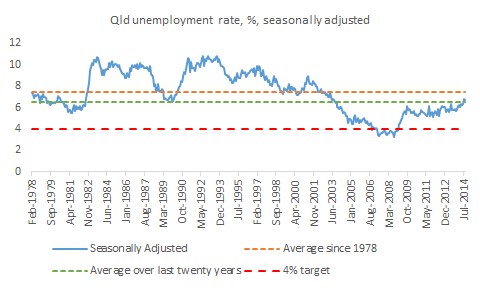
With Queensland’s unemployment rate at 6.7%, compared with 5.8% one year ago, debate has resumed over the Government’s pledge to reduce unemployment to 4% within two terms (see the Courier-Mail’s coverage). I’ve previously commented that, when the promise was made, it was technically achievable, but probably not sustainable for very long (see The 4% unemployment rate target – achievability vs sustainability). Now with the unemployment rate more than one percentage point higher than when the Government took office in March 2012, there are doubts about whether 4% would be achievable by the end of the Government’s next term (assuming it’s re-elected). As you can see from the historical data in the chart below, the unemployment rate can take a long time to fall from a peak.

unemployment_since_78The unemployment rate can take a long time to fall because there is a hard core of unemployed people who find it hard to get jobs even when conditions are good, and because, as the labour market improves, people marginally attached to the labour force (e.g. some stay-at-home mums) come back in looking for work. Unemployment goes up in an elevator, but comes down on an escalator – as I recall PM John Howard saying in an interview once.

The chart also shows just how far below the historical average of the unemployment rate the 4% target is. Even allowing for economic reforms that have improved the functioning of the labour market – by calculating the average over the last twenty years instead of since 1978 – a 4% unemployment rate looks very difficult to reach and sustain.

Commentary on today’s labour force data by other Queensland bloggers includes:

Aussie jobs surprise

The trend is your friend


Posted in Labour market | Tagged , , , , | 2 Comments

Qld tourism continues to under-perform

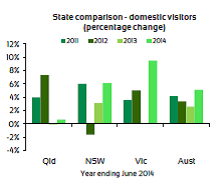
Evidence continues to mount on the failure of Queensland’ tourism promotion policies, which I’ve commented on before (TEQ deserved funding cut – no turnaround in share of international visitors). New Tourism Research Australia data shows that, while domestic tourism (Australians traveling in Australia) is growing nicely at a national level, it experienced negligible growth in Queensland in 2013-14 (see the chart I’ve taken from TEQ’s Domestic Tourism Snapshot below). The data also suggest a decline in total tourism expenditure in Queensland (p. 1 of the Snapshot).

Tourism_June_14 Pete Faulkner commented on the new data upon their release yesterday:

More bad tourism news for Queensland

The under-performance of tourism is a concern given it is one of the so-called four pillars of the Queensland economy, and is especially important in some regions, such as the Gold Coast and Far North. The under-performance also raises questions about whether the $100 million spent on Tourism and Events Queensland might be better spent. I’m therefore glad that the Productivity Commission’s new research project on tourism will consider “the role of government, including the rationale for government involvement in the tourism industry.” I expect the Commission will find very little rationale exists.


Posted in Tourism | Tagged , , , , | Leave a comment

High insurance costs likely to impede development of Northern Australia

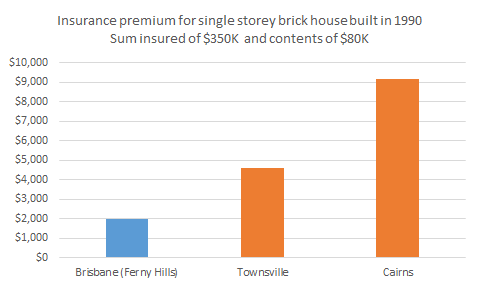
Since Cyclone Yasi, insurance premiums have soared in North Queensland as insurance companies have reassessed the risks of insuring properties in the region. Just how much premiums have increased is illustrated by some figures provided to the Joint Select Committee on Northern Australia by Townsville City Council (see chart below).

InsuranceThese figures were reported on page 133 of the Joint Select Committee’s Final Report Pivot North: Inquiry into the Development of Northern Australia, which was released last week. The figure for Cairns looks extremely high, so I’m unsure if it’s typical. That said, it’s pretty clear from media reports coming out of North and Far North Queensland that there has been a big spike in insurance premiums.

The Committee is right to see high insurance costs as a barrier to the economic development of the North, but I disagree with its recommendation that the Federal Government consider establishing an insurance office for Northern Australia that would provide subsidised insurance cover. That would be unfair to taxpayers in the rest of Australia, and it would ignore the possibility that insurers are right to be concerned about the risks from natural disasters in Northern Australia. Given these risks, the Government may want to reconsider promoting growth in the North beyond that which would occur naturally. Of course, it’s possible that insurance companies have over-reacted in the wake of Cyclone Yasi, but I think they’re in a better position to judge the risks than the Federal Government.

Thanks to Mark Beath of Loose Change for alerting me that the inquiry report has come out. Mark has commented extensively on strata insurance issues in Far North Queensland since Cyclone Yasi. For example, see Mark’s post:

Stop Press: Strata Whitewash!

Posted in Cairns, North Queensland, Townsville | Tagged , , , , , , | 5 Comments

Ipswich set for building boom

I wrote last year about how Ipswich will play an important role in the eventual recovery of the Queensland building industry. The outlook for the building industry in Ipswich now appears even better than it did then, with a huge surge in the approval of residential lots, as reported in the Government Statistician’s brief on residential land development in Ipswich released earlier this week:

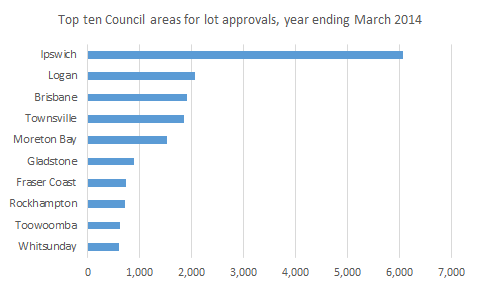
Before residential lots can be created, an applicant must first obtain a development permit approval for reconfiguring a lot (RaL) from the local government authority. In the year to March quarter 2014, council approved the development of 6,069 residential lots. This was an increase of 149 per cent compared with the same period last year when 2,434 lots were approved.

As a result, residential lot approvals in Ipswich now far exceed those in other local government areas (see chart below).

Lotapprovals_Mar14Many of the lots approved in Ipswich are obviously in housing estates in the early stages of development at Springfield and Ripley Valley. While Ipswich is far ahead of other Councils on lot approvals, it remains behind Moreton Bay, Brisbane and Gold Coast in terms of new lot sales. But, with recent lot approval numbers, Ipswich must be well placed to leap ahead of other local government areas in new lot sales. I expect builders will do very well out of growth in Ipswich in coming years.

Briefs on residential land development in a number of local government areas are available at the Government Statistician’s website.

For further information on expected growth in Ipswich, see my post:

Coles backs Ipswich – good investment given strong population growth

Posted in Housing, Ipswich | Tagged , , , , , , | Leave a comment

Big increase in Govt infrastructure spending in election lead up

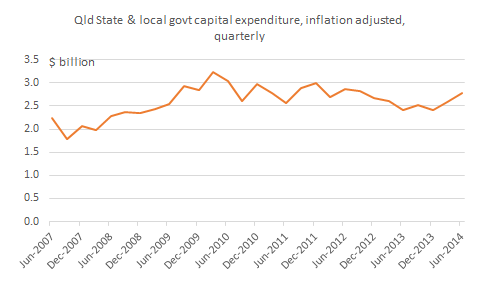
After a couple of years of spending cuts that have contributed to Queensland’s economic sluggishness, Queensland Government infrastructure spending appears to be on the rise in the lead up to the election (see chart below based on the June quarter National Accounts data from the ABS). I expect spending on the Bruce Highway was a significant part of the increase in the first half of 2014. The timing is fortunate, because the private sector remains sluggish, with the recovery in State Final Demand reported in June quarter solely due to public sector investment, including that by all levels of Government (see Pete Faulkner’s post at his Conus blog and the Government Statistician’s brief ABS State Details).

State_capex_Jun14

Posted in Infrastructure, Queensland Government | Tagged , , , | 3 Comments

$5 billion Bus and Train Tunnel has unimpressive benefit-cost ratio

BaTThe Environmental Impact Statement (EIS) for the Bus and Train (BaT) Tunnel from Dutton Park to Spring Hill is out for comment, and I’m rather unimpressed by the benefit-cost ratio, estimated by Deloitte at 1.16. That is, benefits are estimated to be only 16% higher than costs over the life of the project. That’s pretty concerning for a $5 billion project that is likely to be subject to the same risks of cost blowouts and demand shortfalls as other mega-projects.

Given the possibility of large forecast errors in costs and demand, you’d probably want a much higher benefit-cost ratio (i.e. definitely higher than, say, 1.5) to be confident it’s worth committing $5 billion – or over $1,000 for every Queenslander – to this project. Indeed, Deloitte’s own sensitivity analysis shows that, under some scenarios, the benefit-cost ratio is less than 1 and costs exceed benefits over the life of the project (see Table 14-16 in Chapter 14 of the EIS).

The risks of mega-projects are well known. As mega-projects expert Bent Flyvbjerg observed in his book Megaprojects and Risk:

At the same time as many more and much larger infrastructure projects are being proposed and built around the world, it is becoming clear that many such projects have strikingly poor performance records in terms of economy, environment and public support. Cost overruns and lower-than-predicted revenues frequently place project viability at risk and redefine projects that were initially promoted as effective vehicles to economic growth as possible obstacles to such growth.

There is a risk that the BaT project will turn out to be another poorly performing mega-project, and hence the EIS warrants close scrutiny over the six week consultation period that commenced today.

Posted in Transport | Tagged , , , , , , , , | 7 Comments

TransLink survey missing an option – reduce public transport subsidy

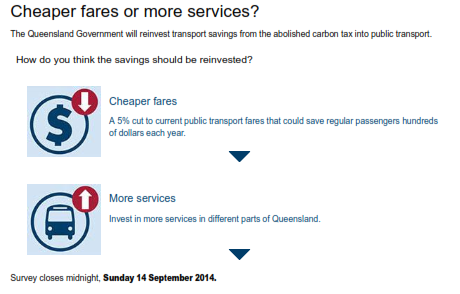
The TransLink survey on whether carbon tax savings of $30 million should be used to reduce fares or provide more services (see below) is missing an important option: keep fares and services the same, and reduce the massive subsidy to public transport. Regarding TransLink, which coordinates and funds public transport in South-East Queensland, the Commission of Audit observed last year (p. 2-105):

Services are heavily subsidised to encourage commuter trips on public transport rather than by private vehicle.  Passenger revenues account for approximately 24% of Translink’s
contract costs across all its contracted services.

According to the Service Delivery Statement for Transport and Main Roads, the average subsidy per public transport trip was $6.58 in SEQ in 2013-14 (see p. 15). I’ll try to work out what the aggregate subsidy amount to public transport is later, but it’s obviously huge. The Service Delivery Statement reports total State Government spending on passenger transport services of $2.3 billion (see p. 16), but I’ll need to determine exactly what this comprises.

I’m not denying there are economic and social justifications for subsidising public transport. I just think that the current level of subsidy, in SEQ especially, is very likely too high and we need to seriously examine the delivery of public transport (see my post SEQ’s extensive but costly public transport system requires thorough review).


Translink_survey

Posted in Transport | Tagged , , , , | 4 Comments