PC natural disaster funding recommendations could cost Qld over a billion

rescueThe Productivity Commission has injected a huge dose of economic rationalism into its recent draft report on natural disaster funding, which contains a recommendation to cut future Commonwealth support from 75% to 50% of the repair bill – a recommendation that could cost Queensland more than a billion dollars in assistance in the event of a natural disaster. It’s sure to have the Treasury bean counters in the Executive Building on George St terrified. While I applaud the Commission’s commitment to economic rigour, its recommendations are hugely inequitable. The Commission has forgotten that Australia is a Federation, that natural disasters can happen in all States, that they often have multi-billion dollar repair bills (e.g. around $7 billion for the natural disasters of the 2010-11 Summer), and there is a good case for the Commonwealth, with its superior funding capacity, to cover the largest share of the cost.

Far North econ-blogger Pete Faulkner has written a superb post criticising the Productivity Commission’s arguments: Productivity Commission report on Disaster Funding a real problem. I think the Treasury and Premier’s Department would be well served if they copied and pasted Pete’s post into the Queensland Government submission to the Commission regarding the draft report. Pete acknowledges the Commission is right it would be better to spend money preparing for natural disasters (i.e. mitigation measures) than spending money to clean up after disasters. However, it’s very harsh to require new mitigation spending at the same time as assistance for cleaning up after disasters is cut:

…where the real problem with the report exists is that the Commission is also recommending the Federal Government cut their disaster funding contribution from 75% to just 50% now. In the past 5 years this change would have required something in the order of $4bn additional funding coming from somewhere else. This, of course, simply means that the additional costs will be worn by State and Local authorities. Clearly, in the case of a major event the Local Authority (and in all likelihood the State) will be unable to meet the huge costs involved. Insurance is either impossible, or impossibly expensive, to obtain.

I recommend reading Pete’s post in full. It’s a very sharp piece of policy analysis.

Also, for some worrying statistics on the huge costs of natural disasters, see Rebuilding Queensland after the natural disasters of the summer of 2010-11.
Posted in Budget, Cyclones, Floods | Tagged , , , , , | Leave a comment

Economic weakness hits Qld retailers

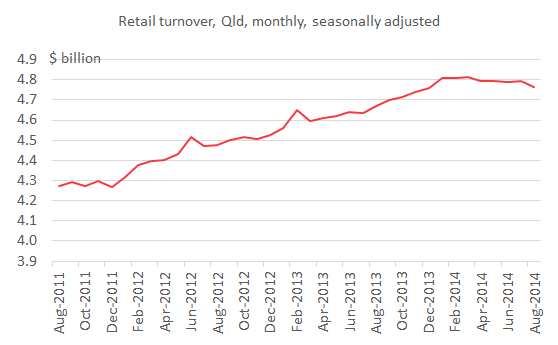
2014 has been a challenging year for Queensland retailers, with retail turnover not growing, and actually declining by around 1% from levels seen earlier in the year (see chart below). I suspect a large part of this is due to the mining downturn and the broader economic weakness that has seen unemployment increase from 6.1% to 6.7% over the year so far. Online purchases from overseas may play a role, although these would affect national turnover, too, and it has at least been growing at a modest rate, according to the ABS data (see Queensland Treasury information brief). Even if they can’t explain the recent poor retail turnover data, online purchases should have a lower threshold for GST, as I’ve posted on before (see Costello right to support drop in $1,000 GST-free threshold for online purchases).

retailturnover_Aug14On yesterday’s retail turnover figures, also see Pete Faulkner’s post Retail trade disappoints…particularly in Queensland. Pete makes the good point that, when you consider inflation, “retail sales in Queensland have fallen in real terms over the past year.”

Posted in Macroeconomy, Mining, Retail trade, Tax | Tagged , , , , , , , | 2 Comments

Victoria beating Qld in budget management and other policy areas

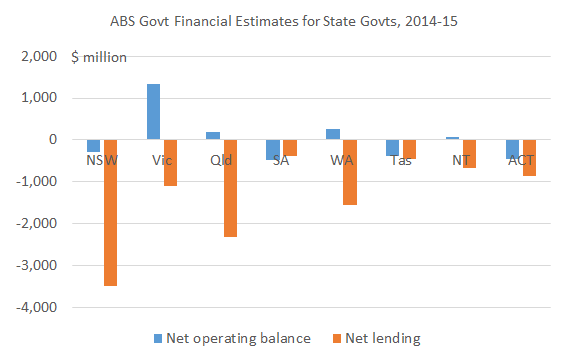
Many years ago, as a result of the economic failures of the Cain Government in the 1980s, Victoria had a poor reputation for economic management, while Queensland had an excellent reputation. A comparison of State Budget estimates for 2014-15 (see chart below), which the ABS published on a consistent National Accounts basis yesterday, shows just how different things are today, with Victoria leading Australia in terms of the net operating balance (i.e. the difference between revenues and recurrent expenses, not including capital expenditures, which push total net lending into deficit).

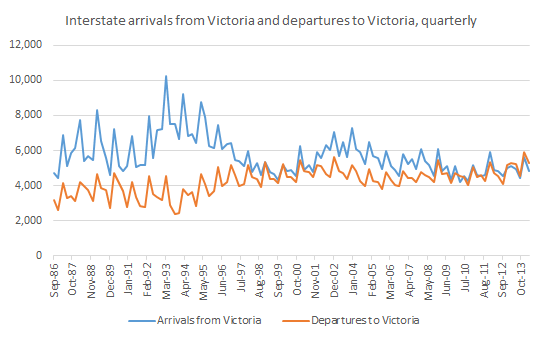
gfe_states_14_15It strikes me that Victoria’s policy settings are superior to other states in many areas, including in environmental management and planning, which has likely improved the livability of Melbourne and Victorian regions relative to the rest of Australia. That may explain, in part, why Victorians are staying put and no longer moving to Queensland (in net terms, as shown in the chart below). Indeed, as I’ve noted previously, Victoria is now actually gaining a small amount of people from Queensland (in net terms).

Vic_nim

Posted in Budget | Tagged , , , , , | 2 Comments

QCA finds nearly 150 ways Qld Govt assists industry – good hit list for Treasury

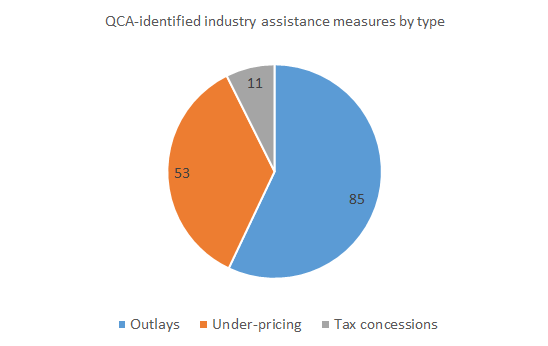
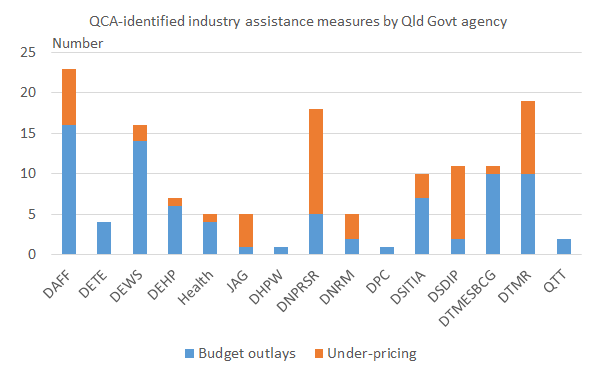
The QCA has released a Draft Catalogue of Industry Assistance Measures (available at this link), and it shows nearly 150 ways the Queensland Government assists industry, many of which I’ve no doubt have zero public policy rationale and are a total waste of taxpayers’ money. The charts below show splits by type of measure and by department (for budget outlays and under-pricing of services, as the relevant department wasn’t identified for tax concessions, although I’d assume it’s Queensland Treasury and Trade for most of them).

IAmeasures_by_typeIAmeasures_by_agencyWith so many cases in which Queensland Government services to industry are under-priced (e.g. leases of port land for bulk sugar storage sheds, leasing of railway corridors at peppercorn rates, benefits to tourism providers from the use of infrastructure in national parks), there is a huge opportunity to increase revenue and improve economic efficiency through better cost recovery. Unfortunately, we don’t know from the catalogue how much revenue is forgone through under-pricing, nor are estimates of the value of budgetary outlays or tax concessions provided. It seems obvious to me that these are important data items for an industry assistance review, and, if funding or cooperation from Government agencies is an issue, the QCA should seek intervention from the Treasurer. This industry assistance review is a big opportunity to identify some major budgetary savings, and the Government should give it a high priority.

The QCA is seeking public comment on the Draft Catalogue by 3 November.

My previous posts on the QCA’s current industry assistance review include:

Government should wait for QCA Report before committing to new industry assistance

QCA issues paper shows large potential savings in industry assistance

Posted in Industry policy | Tagged , , , , | Leave a comment

Qld less attractive to Southerners due to weak jobs market & growing pains

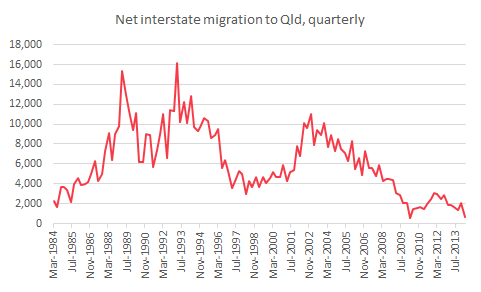
Yesterday’s new population data from the ABS were important because they showed Queensland’s population growth falling below the national average (see chart below). Partly this is due to a very low level of interstate migration (second chart below), which I’ve commented on before (When will interstate migration to Qld recover?). This will come as a surprise to many. For a long time, Queensland was known for being a fast growing State, attracting tens of thousands of migrants from Southern States each year. People were attracted by our climate, lifestyle, job opportunities and cheaper property prices. But property prices are no longer as attractive, population growth and congestion have compromised our lifestyle slightly, and the labour market has been weak. I’ve always been very optimistic about Queensland’s long-term prospects, but it’s difficult to see any turnaround in our population growth prospects in the near future, given the current state of the Queensland economy.

ttypopnetim

Also see:

Qld population growth falls below national average

Qld Treasury information brief

Posted in Migration, Population | Tagged , , , | Leave a comment

Coal contraction continues

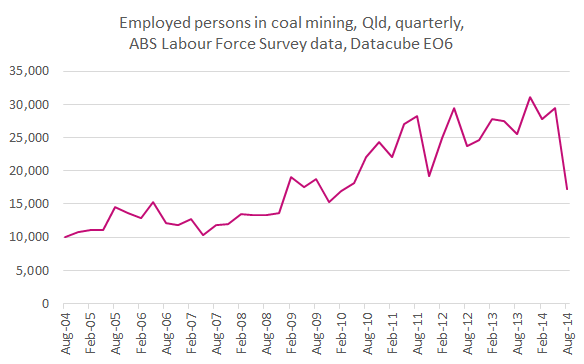
The big economic news for Queensland today was the announcement from BHP Billiton of a reduction in coal mining jobs of 700 in its Central Queensland operations, as the viability of some operations have been challenged by lower coal prices (see 700 Queensland coal mining jobs go at BHP’s BMA joint venture). This follows a series of coal mining job cuts this year, which appear to have been reflected in the August ABS employment by industry data released last week (see the chart below). While the plunge may be exaggerated due to sampling error in the Labour Force Survey, there is no doubt coal mining employment is falling significantly. The Premier is right to talk positively of the employment potential of Galilee Basin projects, but I think the time-frames for these projects means that any big employment boost is a few years away yet. In the meantime, there’s not much cause for optimism – MacroBusiness is particularly pessimistic (Coal mining job losses roll on) – and the Queensland Treasury might have to consider revising down its coal royalties forecast of $2.1 billion in 2014-15.

Coalminingemployment

Posted in Mining | Tagged , , , , , | 4 Comments

HIA wants debate on stamp duty, not negative gearing

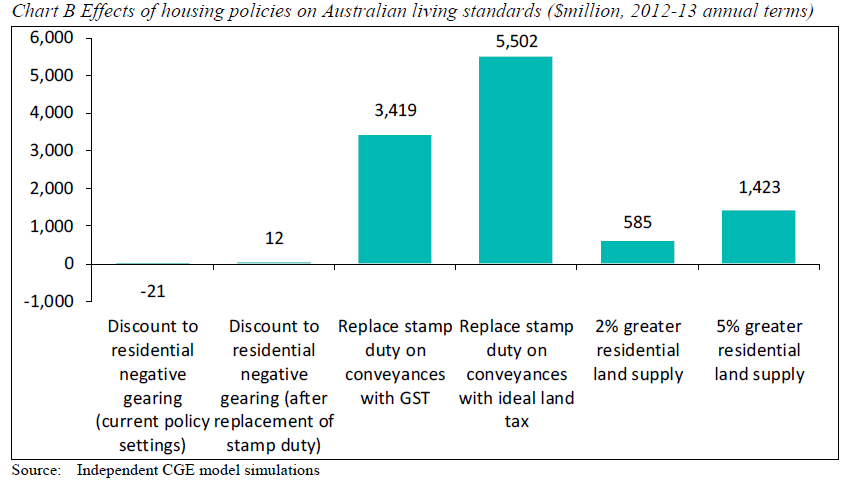
The Housing Industry Association (HIA) has released an excellent report from the consulting firm of top Australian economist Chris Murphy on The Economic Impacts of Negative Gearing of Residential Property (see the news report Don’t slash negative gearing, says HIA). The report makes the important point that any tightening of negative gearing rules (e.g. discounting the amount that can be deducted) would have an adverse impact on the supply of rental properties, leading to higher rents. It also argues attention should move from negative gearing to a bigger issue affecting the housing market: stamp duty. As I’ve noted before on this blog, stamp duty is a highly inefficient tax and should be abolished (see Grattan joins fight against stamp duty).

Independent Economics has estimated that stamp duty costs the economy 71 cents for every dollar of revenue it raises. This loss results from investment in housing being discouraged, and from families being discouraged from moving, which reduces the efficiency of the labour market. Very large economic benefits – of several billions of dollars – would be achieved if stamp duty were replaced with more efficient taxes such as the GST or ideally a land tax (see the chart I’ve copied and pasted from the report below).

stampdutyreform

Posted in Housing | Tagged , , , , , | 6 Comments

Private sector involvement should restrain growth in electricity prices

There was an excellent article in Saturday’s Courier-Mail, quoting me towards the end of it, by State Political Reporter, Steven Wardill, on the likely impacts of the proposed leasing out of Queensland’s electricity network assets:

Energy prices have risen rapidly in Australia regardless of who owns the infrastructure

This extract from the article contains some very interesting data:

Infrastructure Partnerships Australia chief Brendan Lyon believes privatisation in Queensland would herald lower prices.

“Queensland’s electricity grid is the least efficient in the country, with network costs increasing 140 per cent in the past 17 years,’’ he says.

“Over the same period, network costs in the privately operated Victorian market have fallen by 18 per cent.”

Predicting lower power prices seems a crazy brave call. But Lyon’s view is echoed in an Ernst and Young report commissioned by the New South Wales Government.

It found that since 1996, the average annual Queensland electricity bill had risen by $932 while in the privatised Victorian network the increase was $743.

I’m unsure if I’d bet that prices would fall, but I would expect that the growth rate of electricity prices would be lower under private management than under the status quo.

The article also includes some observations I made about leasing out government-owned assets on ABC radio last week (ABC radio interview on asset leases):

Economist Gene Tunny this week highlighted how regulation around investment levels and workplace relations will play a key role in what price the Newman Government gets for leasing power distribution assets.

“A lot will depend on what that lease looks like,’’ he said.

Posted in Budget, Energy | Tagged , , , , , , | 2 Comments

New ABS figures show two of the four pillars are crumbling – agriculture & mining

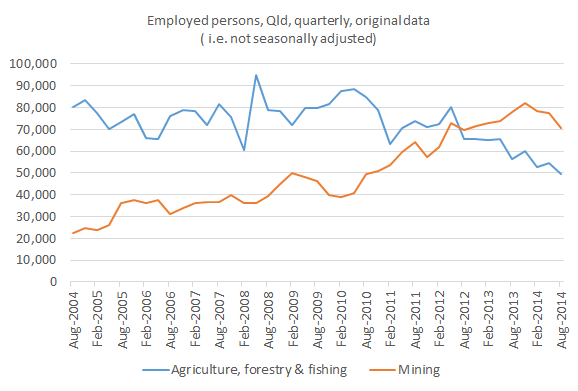
New quarterly employment by industry data confirm falling employment levels in two of the so-called four pillars of the Queensland economy: agriculture and mining (see chart below). Regarding the other two pillars, construction employment appears flat and the ABS does not report tourism employment figures quarterly, because, technically, tourism isn’t an industry, but a category of expenditure.

twopillarsIncidentally, regarding tourism employment numbers that have been generated in the past, the tourism minister has apparently been using incorrect data to talk up the sector, as reported in the Brisbane Times today. Well done to Far North bloggers Pete Faulkner and Mark Beath for having spotted the incorrect data in the first place (e.g. see Pete’s post at his Conus blog).

For more on the Government’s four pillars plan, see my post from last week:

ABC radio interview on unemployment, the 4% target and the four pillars plan

Posted in Agriculture, Mining | Tagged , , , , , , | Leave a comment

ABC radio interview on asset leases

At a BDO economic outlook breakfast I attended at the Brisbane Convention Centre this morning, Treasurer Tim Nicholls announced that the Government would consider asset leases as an alternative to the previously announced sale of the power generators and the (weird) non-share equity interests in Energex, Ergon and Powerlink (see my previous criticism of non-share equity interests in Government should just sell Energex, Ergon and Powerlink). I would prefer the originally proposed sale, rather than the long-term lease of the power generators, because I expect selling them would raise more money and would allow the operators to fully realise efficiency gains. However, leases of electricity distribution and transmission network assets currently on the books of the government-owned Energex, Ergon and Powerlink are probably a better option than the non-share equity interest alternative, which I thought was a weird, slightly tricky financial instrument.

As I’ve commented before, my feeling is that we’d be better off selling all of the assets. But leasing assets over a very long-term (e.g. 50 years) gets us a large part of the way toward private ownership, even if it isn’t perfect and there is always the risk of government interference down the track. The Government is still putting up a proposal that should yield significant efficiency gains (i.e. long-term leases), even though those gains may be lower than if the assets were sold. Unfortunately, Strong Choices was a weak, uninformative and unconvincing campaign (see my post Failure of Strong Choices now obvious), and the Government has had to accept political reality and find alternatives for politically toxic though economically desirable asset sales.

I more or less made these points in my interview with Rebecca Levingston on 612 ABC Brisbane this afternoon:

What to do with asset leases

Posted in Budget, Energy | Tagged , , , , , , , | 2 Comments