7.30 Qld interview on asset leases and power prices

I featured in Eric Tlozek’s excellent story on the proposed leasing out of electricity assets on 7.30 Queensland last night:

Government powers up to sell state asset leases

I come in at around 3 minutes, 20 seconds, after the Opposition Leader. The main points I made were:

  • if the assets are leased out, electricity prices are likely to be lower than they otherwise would, because privately operated assets would be run more efficiently, and
  • the Government needs to provide more information on the relative benefits and costs of asset leases to the public, given that it’s clear people are worried about adverse impacts (e.g. on jobs, power prices and service reliability).

Well done to Dr Liam Wagner from the UQ Economics School for his insightful analysis of the potential impact of asset leases on the cost of electricity supply. I particularly liked his discussion of how private operators would save money by spending on capital only where there is a “burning deck problem”.

Posted in Energy | Tagged , , , , , , | 5 Comments

Residential building activity recovering nicely, but still below levels of mid-2000s

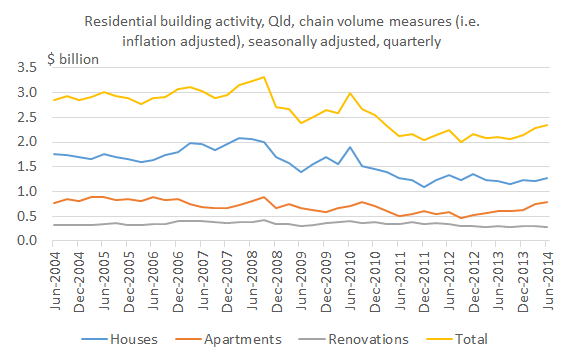
Builders across Queensland should have noticed higher levels of residential building activity lately, although they may still be disappointed activity remains below the levels of the mid-2000s (see chart based on ABS building activity data released yesterday below). The new data is generally encouraging, given residential building is an important part of the Queensland economy, and, if the trend continues, it should help the Queensland economy eventually get out of its current sluggishness. That said, population growth still remains relatively low (see my post Qld less attractive to Southerners due to weak jobs market & growing pains), so perhaps the building industry shouldn’t expect large additional gains. For the same reason, I’m a bit skeptical about the latest forecast from NAB that Queensland will top Australia in capital gains in property in the next two years, as reported this morning by the Courier-Mail.

Building_Jun14

Posted in Housing | Tagged , , , , , , , | Leave a comment

Time for Qld Govt to reconsider $5bn BaT Tunnel – my submission to the EIS process

BaTIt’s now time for the Queensland Government to consider public submissions on the underground Bus and Train (BaT) tunnel project, after the consultation period on the Environmental Impact Statement closed today. I took the opportunity to make a submission, extending an earlier post ($5bn BaT tunnel has unimpressive benefit-cost ratio) into a short letter to the Coordinator-General:

Adept Economics submission to BaT project EIS process

The main points I made were:

  • the cost-benefit analysis provides very little confidence the project will deliver positive net benefits to the Queensland community – benefits are estimated to be only 16% higher than costs over the life of the project, which is fairly concerning for a $5 billion project that is likely to be subject to the same risks of cost blowouts and demand shortfalls as other mega-projects (risks that if realised would lower the benefit-cost ratio); and
  • the EIS appears to assume that the approval of the BaT tunnel is a fait accompli, which is worrying both because of the unimpressive benefit-cost ratio and because all options to avoid inner city public transport capacity constraints weren’t fully considered – I would like to have seen a serious investigation of transport demand management options such as bigger differences between peak and off-peak public transport fares, TravelSmart programs, and staggered starting times for public servants working in Brisbane CBD (and I could have added tele-working).
Posted in Brisbane, Infrastructure, Transport | Tagged , , , , , , , , , , | Leave a comment

Reforming solar cross-subsidy is good policy, but unclear why $3.4 billion should be locked up in Cost of Living Fund

The Government’s apparent plan to end the cross-subsidy from households without solar cells to those with solar cells, and to fund the feed-in tariff through an explicit subsidy, is a sound one (see Brisbane Times coverage Power bills to come down: Newman). Effectively, it is spreading the cost of a poor decision by a previous Government across all Queensland taxpayers, rather than punishing those households which weren’t quick enough, informed enough, or which couldn’t afford to install solar cells at the time.

While I’m supportive of the policy, I’m unsure about the funding mechanism. It doesn’t seem sensible for the Government to lock up $3.4 billion so it can earn enough interest to pay the several hundred million dollars required for the subsidy each year. When I was a Manager in Commonwealth Treasury’s Budget Policy Division during the financial crisis, it became pretty obvious to me that earmarking government funds for specific uses over an extended period (e.g. the Nation Building Funds) was generally a dumb idea. You’re tying up, for a long time, a big chunk of money that might have a better, more urgent use (e.g. paying the Government’s bills).

Rather than having the $3.4 billion sit in a Cost of Living Fund, I would prefer the Government did the following:

  • it uses the $3.4 billion it would put in the Fund to pay off additional debt, reducing our interest bill further and increasing our chance of getting back our AAA credit rating, and
  • it finds the several hundred million dollars it needs for the subsidy each year through forcing further efficiencies on government agencies and through higher user charges where appropriate.

It should be possible to do this given the annual State Budget is around $50 billion. It appears unnecessary to lock up $3.4 billion in a Fund when it could be better used to pay off State debt and to maximise our chance of getting our AAA credit rating back.

Of course, the Government might find it politically unpalatable to make the full range of cuts and increases in charges that might be necessary to fund the subsidy if it doesn’t come out of a Cost of Living Fund. But the interest savings from paying off $3.4 billion in debt would cover a large part of the subsidy, meaning the savings it would need to find wouldn’t be as great. Of course, I would prefer that it fully fund the subsidy through offsetting cuts to programs or increases in user charges, as I’d like to see any interest savings fully reflected in an improved budget balance. We essentially need to use all the interest savings from debt reduction to offset forgone dividends when assets are leased out, so we shouldn’t be allocating interest savings to other uses.

Posted in Budget, Queensland Government | Tagged , , , , , , , , , | 3 Comments

New businesses need to hang tough for first year – big gains come in second year

New businesses experience their biggest productivity gains in their second year (see the chart below), after the hard work and investment of the first year have been realised, according to new research published by the ABS (see Firm Dynamics and Productivity Growth in Australian Manufacturing and Business Services). The data in the chart below are based on surviving businesses, so the big productivity gain in the second year isn’t simply a reflection of very inefficient businesses failing in their first year. The ABS research confirms what a lot of business people know: it’s hard starting up a new business and it can take a year or more to start achieving the success you’re targeting.

relativeproductivity

Posted in Productivity | Tagged , , , | Leave a comment

ABS funding cuts may have compromised macroeconomic management

Given the huge revisions to recent labour force data published by the ABS data yesterday, it’s now clear that the ABS is suffering from the impacts of funding cuts in recent years (see this ABC news report), and this has the potential to compromise macroeconomic management. The labour force data comprise timely, generally reliable estimates of the state of the Australian economy that the RBA considers in its deliberations over monetary policy. But how is the RBA supposed to interpret data where Australian employment growth in August is reported as 121,000 in the September publication, but revised to 32,000 in the October publication? Incidentally, the new data show employment having fallen by nearly 30,000 employed persons in September. A good summary of the most recent data is contained in Pete Faulkner’s post Confusion over the ABS jobs numbers.

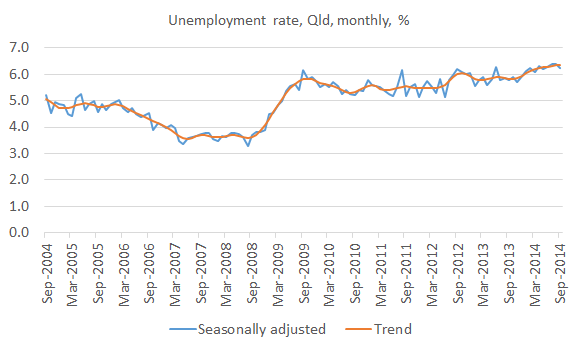
The revisions to recent data mean that Queensland’s unemployment rate (6.4% trend, 6.3% seasonally adjusted) is now at a lower level than we thought a month ago (6.7% in both trend and seasonally adjusted terms), but, in trend terms, it is still higher than anytime in the last decade.

urate_Sep_14

Regarding jobs growth in Queensland, in his post linked to above, Pete Faulkner makes the important but depressing point that:

Any jobs recovery which QLD had been enjoying this year would appear to have been comprehensively wiped out by today’s data.

The huge recent data revisions are due to the ABS no longer having confidence in its seasonal adjustment procedure and abandoning it for the most recent months. This is an extraordinary development. There is now an urgent need to restore funding to the ABS so we can get high quality data on the state of the economy.

Posted in Labour market | Tagged , , , , , , | 2 Comments

HIA appears worried RBA will move to rein in housing market

dwellingprices

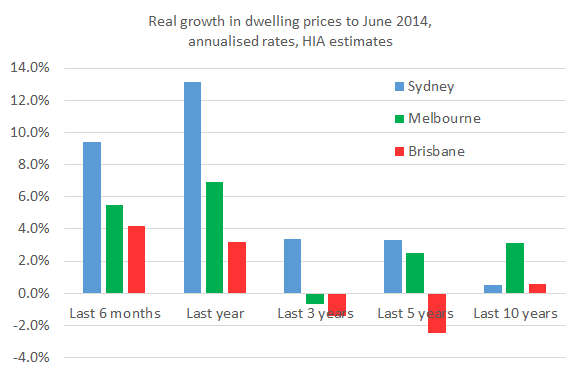
The Housing Industry Association (HIA) released an informative (though possibly naively optimistic) note yesterday titled A Portrait of Australian Home Prices, available at the HIA website, which is basically a message to the RBA that “There’s nothing to see here.” This follows concerns expressed by the RBA and some economic commentators about strong property price growth, particularly in Sydney. After analysing the true real growth rate of housing prices over the last ten years (i.e. controlling for inflation and it appears quality improvements), the HIA concluded:

In summing up the state of Australian home prices, it is important to remember that significant price growth is largely confined to the Sydney and Melbourne markets. In the case of Sydney, this follows a decade during which home prices were flat relative to inflation. The geographic reach of the current price upturn is markedly narrower than during 2002-03 and 2007. Apart from Sydney, price to income ratios are within normal ranges in the capital cities, although Melbourne is creeping towards the high end by this measure.

The HIA has done a good job in this note, but I doubt the RBA will be comforted by the fact that “significant price growth is largely confined to the Sydney and Melbourne markets”, given Sydney and Melbourne make up a large chunk of the Australian economy. Luckily, the figures for Brisbane look more reasonable than for Sydney and Melbourne, so there is less chance of a big correction here.

Posted in Brisbane, Housing | Tagged , , , , , , | Leave a comment

Strong Choices plan mostly good policy, but light on detail of budget impacts

finalplan

The final Strong Choices plan has arrived, and, as I commented yesterday, I’m mostly supportive of it. However, I would rather more of the lease proceeds be used for debt reduction rather than being allocated to infrastructure funds that could be used for popular – though economically dubious – infrastructure projects in marginal seats (e.g. the Townsville Super Stadium).

While the policy in the plan is mostly good, the plan itself is light on detail and I still doubt the Government has the evidence and arguments it needs to win the debate. For example, the Government has not released any forecasts and projections of the budgetary impact of the policy, claiming that the earnings of government businesses are uncertain so it can’t produce any reliable estimates of earnings forgone when the assets are leased out. When I mentioned this to 4BC’s Ben Davis yesterday afternoon on air, he thought that was pretty odd and surely Treasury must have some idea. I agreed with him, and I would be very surprised if the Treasury hadn’t produced estimates of the budgetary impacts of the plan. If it has, these estimates should be released to inform the public debate.

With around one-third of the lease proceeds not going to debt reduction but to other uses (e.g. infrastructure funds), it’s possible that the budgetary impact of the plan could be negative, because the Government wouldn’t save enough in interest to offset the loss of dividends from the Government-owned businesses. If so, it’s even more desirable that all of the lease proceeds should be allocated to debt reduction.

In addition to chatting with Ben Davis on 4BC yesterday, I also chatted with Pat Hession of ABC Townsville radio, and with Steve Austin and his other guest John Quiggin on Steve’s morning show on 612 ABC Brisbane:

Economists debate Government’s asset lease plan

Posted in Budget | Tagged , , , , , , | Leave a comment

Success of privatisation plan requires $12 billion spent wisely

As I’ve commented on previously, I’d prefer the Queensland Government to allocate all of the privatisation proceeds to debt reduction to maximise our chances of regaining our AAA credit rating. By allocating a sizable fraction – now $12 billion according to today’s Courier-Mail – to infrastructure projects, the Government runs the risk of not regaining AAA and, further, adversely affecting the State budget balance, given that it would lease out some assets but invest the proceeds in assets that are either:

  • non-income producing and costly to maintain, such as regional roads; or
  • unlikely to fully recover their costs such as the Townsville Super Stadium.

Many of the assets the Government invests in out of privatisation proceeds may cost the Government money over the long-term, and it will have forgone any gain from lower interest payments through debt reduction. Sure, the Government might argue that it would need to borrow money and pay interest to invest in many of these new assets anyway, so it’s not really forgoing the reduced interest payments, but it’s unclear if there is an urgent and unavoidable need for the new infrastructure in the first place. Given Queensland’s $80 billion debt and the need to regain our AAA credit rating, the Government should think carefully about the merits of its $12 billion infrastructure package. Some of the items, particularly the Townsville Super Stadium, appear to be of dubious merit and designed mainly to secure support for the Government in a community with marginal seats (see Privatisation proceeds should be spent wisely).

Finally, I’d note that the information provided to the Courier-Mail for its exclusive today shows just what a bad idea the original non-share equity injections proposed for Energex, Ergon and Powerlink were, with proceeds being boosted by over $3 billion by switching to leases instead. Incidentally, I still expect we’d get even more from the outright sale of the businesses (see ABC radio interview on asset leases).

Posted in Budget, Energy | Tagged , , , , , , , , , | 6 Comments

Don’t we have better things to spend $22 million on than Pirates of the Caribbean 5?

Government Ministers and officials who should know better have once again been seduced by the glamour of Hollywood, with the Australian Government offering around $22 million to Disney to secure production of Pirates of the Caribbean 5 in Australia (see Brisbane Times coverage). The Queensland Government also offered payroll tax exemptions so the film would partly be shot in Queensland. This is an example of the selective industry assistance most of us have come to accept is bad in other sectors (e.g. the car industry). It encourages the inefficient use of resources that could be better employed elsewhere. We don’t really face a choice of having people employed on an international film production or having them unemployed – and if that really is the choice we should make sure they get some re-training for a more reliable job.

Further, even if there were some benefit to the local economy of securing this production, the incentives provided, which are going to a highly-profitable, largely foreign-owned company, mean we’re most likely coming out behind on a cost-benefit analysis. Disney’s net profit was $2.25 billion in June quarter 2014 (see the Quarterly Earnings Reports). I have no idea why Australian taxpayers should be contributing to its future profits.

I’ve previously written about the folly of chasing after international film productions:

Moochers making movies: Government assistance to the film industry

Taxpayer money wasted chasing film productions

Posted in Industry policy | Tagged , , , , , | 4 Comments