International film productions such as Thor: Ragnarok unworthy of Qld taxpayer support

Thor: Ragnarok, now filming on the Gold Coast, and which is supposedly receiving Queensland taxpayer support of $3 million (see my post from October last year), is delivering much lower benefits to locals than may have been expected, as reported in the Brisbane Times earlier today:

“Australian crew members working on the big budget Hollywood movie Thor: Ragnarok on the Gold Coast are on the same casual rates as a decade ago, their union says.

Media Entertainment and Arts Alliance’s Queensland director Michelle Rae says the “market” rate, which is higher than the award rate, has not increased in 10 years and a workplace agreement with international productions needs to be struck.

She says many in the industry believe international producers are “double dipping” by accepting payroll tax concessions and then negotiating on wages and conditions after they’ve agreed to a government deal.”

I have long been critical of taxpayer assistance to international film productions. Any benefits to locals are usually temporary, and not that substantial once you take into account the fact many of the locals employed are simply taking time out from other income-earning jobs, such as jobs in hospitality or personal training. And, egregiously, Australian taxpayers end up boosting the profits of foreign equity investors. Movie studios have become very good at extracting as much money as they can from gullible governments around the world and maximising their own profits. So the latest revelation about the Ragnarok production should not come as a surprise.

Obviously, the lower the wages paid to Australian crew, the lower the net benefits of the production to the State and nation, meaning there is less justification for public support. It is a basic principle of cost-benefit analysis that you assess proposals from the point of view of your own population. A large share of the net benefits of international film productions end up overseas, and any net benefits that are delivered domestically would likely represent very poor returns on taxpayers’ contributions. There are many interesting project ideas across Queensland that would very likely represent better uses of taxpayers’ money than subsidising Hollywood blockbusters such as Ragnarok, which will make zero contribution to Australian culture.

Some of my previous posts on film industry assistance include:

Don’t we have better things to spend $22 million on than Pirates of the Caribbean 5?

NSW Govt risks annoying US conservatives by subsidising Redford-Blanchett film – my comments on Breitbart

Posted in Industry policy, Uncategorized | Tagged , , , , , , , | Leave a comment

After botched 2016 Census, let’s have it every ten years and properly resource and manage it

The compliance cost to the community of the upcoming Census has been magnified by the anxiety its botched implementation is causing Australians (see this Fairfax report on Census chaos). It appears many elderly Australians have been surprised by the letters they have received about the Census. Given many of them are not on the internet, they have tried to request paper copies, only to have had trouble getting through to the ABS which has not properly resourced its call centre. This has caused many elderly people to worry about the possibility of a $180/day fine.

Also, based on the intense conversation the Census generated yesterday in the office where I am based, it has had a productivity cost in workplaces across Australia. To make matters worse, due to privacy concerns through retention of identifying information and the linking of Census data to other data sets, it appears many Australians may boycott the Census, raising large concerns about the integrity of the data. The ABS has made a huge mistake here and should have avoided raising any doubts about the confidentiality and protection of Census data.

The ABS has clearly botched the implementation of the 2016 Census. It will be important for it and the Government, which is ultimately responsible for the Census, to learn some lessons. Obviously, dropping plans to retain personal information and linking Census data to other data sets would be a good start. Also, we should move away from having a Census every five years and have one every ten years, as is done in the US and UK. This would save significant amounts of taxpayers’ money, given the cost of the Census is estimated at around $400 million, and should allow for a better resourced and hopefully better managed Census, with the ABS able to take advantage of the longer lead time. Indeed, the ABS had previously proposed moving to a Census every ten years.

Last year, The Australian reported the ABS wanted to skip the 2016 Census so it could spend the money upgrading its old computer systems (see ABS wants Census every ten years). The ABS should have been listened to then. I agree with the ABS’s view that the Census is an inefficient and costly way of collecting the wide range of data that it is currently collecting. We could have a less frequent Census and use some of the money saved to boost sample sizes and the range of questions in household surveys, such as the Labour Force Survey which gives us the unemployment rate. We still need a Census from time-to-time, because its population data help the ABS target its surveys and develop population-level estimates, but we should be able to manage with one every ten years.

Posted in Population, Uncategorized | Tagged , , , , , | 6 Comments

SEQ should note growing realisation the Olympics is a waste of money

Forty years after the financially disastrous Montreal Olympics, cities around the world are finally realising that hosting the Olympics does not stack up. Brazilians, now experiencing a deep recession, have certainly lost much enthusiasm for the upcoming Rio Olympics (e.g. see this CNN report). So it should raise eyebrows that South-East Queensland Councils are considering a 2028 Olympics bid, as was reported last week.

Yesterday, the Financial Times published an excellent article (Rio 2016: The high price of Olympic glory, which I suspect is pay-walled, sorry) discussing the poor economic return from hosting the Olympics. It noted:

Researchers at the Saïd Business School, in Oxford, analysed 30 summer and winter games and released their findings last month. Though contested vigorously by the IOC, the study claims none of the games came in within their initial budget and nearly half exceeded targets by more than 100 per cent.

Andrew Zimbalist, an economics professor and author of Circus Maximus: The Economic Gamble Behind Hosting the Olympics and the World Cup estimates that the summer Olympics can lead to deficits of up to $15bn.

“It is sometimes argued that the deficit will be made up in the long run through increased tourism, trade and investment,” he says “The data doesn’t suggest that happens.”

An analysis of the 2000 Sydney Olympics by leading Australian economic modellers John Madden and James Giesecke found that the Games did not provide a net economic benefit to Australia. In a Conversation article (Hosting the Olympics: Cash cow or money pit?) they noted:

…rather than producing an economic benefit the Sydney Games actually reduced Australian household consumption by $2.1 billion.

As the author’s noted, this was very close to the estimated taxpayers’ contribution of $2.2 billion, as the Games provided no significant ongoing economic benefit to Australia, such as through higher tourism.

SEQ should be very wary of bidding for the Olympics.

Posted in Brisbane, Uncategorized | Tagged , , , , , , | 6 Comments

Being unpredictable helps guard against collusion: a lesson from the 2016 Colin Clark Lecture

Professor Leslie Marx of Duke University delivered the 2016 Colin Clark Lecture last Tuesday morning at Customs House in Brisbane on how to defend against potential collusion by suppliers. In industries with a small number of players who can readily form cartels, collusion by companies to fix prices occurs from time-to-time, unfortunately. As Adam Smith famously noted in the Wealth of Nations:

“People of the same trade seldom meet together, even for merriment and diversion, but the conversation ends in a conspiracy against the public, or in some contrivance to raise prices.”

Professor Marx gave examples of companies that have suffered price fixing on many of their inputs, particularly Coca-Cola and HP. And she mentioned some of the famous cartels we have seen in Australia, including the pre-mixed concrete cartel in South-East Queensland and the cardboard box cartel (see the ACCC’s website for these and other examples).

But, as Professor Marx explained, cartels tend to be unstable. Members have the incentive to cheat against the cartel, to increase outputs and cut prices to increase their own revenues and market shares. The classic example is OPEC. Despite agreements to restrict output and hence raise the oil price, over its history, production levels by OPEC members tended to exceed target levels. (More recently OPEC members have been flooding the market to try to wipe out US shale oil producers.)

The incentive to cheat means that cartels require monitoring and enforcement mechanisms (see the figure below, which Professor Marx attributed to George Stigler, showing the structures necessary to limit “secret deviations” or cheating). As Professor Marx noted, due to the complicated structures required to fix prices, enforce cartel agreements, and reallocate any profits (e.g. where a company accidentally wins a contract it should not have under the agreement), there tends to be a lot of evidence (e.g. contracts, recorded phone calls) that can eventually be used against cartel members in courts of law. In some cases, accounting firms have even been used to verify that cartel members have been maintaining agreed market shares!

Triangle

Professor Marx gave several excellent pieces of advice regarding how companies can guard against collusion. The two I found most memorable were:

  • Be unpredictable in your procurement (e.g. change purchase times, contract terms, etc), and
  • Closely monitor and analyse the market data and look for deviations from previously established trends.

Being unpredictable can undermine cartels because, as noted above, they require rather complicated agreements among members, and these agreements are based on the status quo. So, changing your behaviour can mean cartels need to reach new agreements, which they may not be able to do.

Monitoring and analysing the market data is clearly important. For instance, if you are in an industry which has seen stable or declining prices, and suddenly prices increase sharply, and there is no reason to suspect underlying supply conditions have worsened (or demand has suddenly surged), you should consider the possibility of a cartel. In fact, according to Professor Marx, evidence from economic modelling regarding unjustifiable price increases has been used to prosecute companies for collusion in the US. Economic students should think about that the next time they are reluctantly attending an econometrics lecture!

Finally, well done to the UQ Economics School for arranging a most excellent Colin Clark Lecture for 2016, and, of course, many thanks to Professor Marx for her fascinating and illuminating presentation.

Posted in Industry policy, Uncategorized | Tagged , , , , , , , , , , | Leave a comment

Were 80% of new Qld jobs in 2015-16 public service jobs?

The Courier-Mail is correct to highlight the large increase in public service employment that has occurred recently in Queensland, and it is on the right track in suggesting public service jobs are a large share of new jobs created, but it is misinterpreting the data when it claims that:

“THE State Government’s massive public servant hiring spree bankrolled 80 per cent of the additional jobs created in Queensland in the last financial year.”

That is not strictly correct. Because some sectors, such as mining, have had falls in employment, you cannot simply calculate the increase in public service numbers (8,500) as a percentage of new jobs in Queensland (10,400 in 2015-16 in trend terms), as the Courier-Mail has done. The decline in mining employment in 2015-16 was around 6,500 jobs (measured in four-quarter moving average terms, due to the data only being available in original un-adjusted form from the ABS). Now, if we take 8,500 new public service jobs, subtract 6,500 lost mining jobs, we are left with net jobs growth of 2,000, which is 8,400 short of the 10,400 increase overall. So 8,400 new jobs must have come from sectors other than the Queensland public service, such as hospitality, aged care and private health and education providers. In other words, Queensland public service jobs may be around half of new jobs created in 2015-16, but not 80%.

The Courier-Mail would be well advised to get a copy of math guru Jordan Ellenberg’s How Not to be Wrong which has a good section on the challenges of interpreting employment growth data and other data where component parts can be positive or negative. Ellenberg’s advice is (on p. 78 of the Penguin edition):

“Don’t talk about percentages of numbers when the numbers might be negative.”

Posted in Labour market, Uncategorized | Tagged , , , , | 4 Comments

Recommended reading: Matchmakers

It was reported in yesterday’s Sunday-Mail (24 July, p. 21) that “Baby boomers are increasingly turning to Uber, Airbnb and eBay to boost their retirement income because of stockmarket falls and minuscule bank interest rates.” That is, they are participating in the so-called sharing or collaborative economy, or more technically they have become participants in multisided platforms, the subject of a brilliant new book I read over the weekend: Matchmakers: The New Economics of Multisided platforms, written by leading US micro-economist David S. Evans and MIT Emeritus Professor Richard Schmalensee.

matchmakers

You can pick up a copy of Matchmakers at Dymocks, Albert St, Brisbane

The platforms are multisided, involving different groups of users, and value is created by connecting different types of users with each other, such as passengers and drivers who are connected by Uber, which is the matchmaker. Evans and Schmalensee demonstrate how highly successful multisided platform often have more than two sides, and connect a variety of types of users. For example, the authors identify that Facebook has a multisided platform bringing together friends, businesses, and app developers.

The book lucidly explains the fundamental economic concepts underpinning multisided platforms such as Uber and Airbnb, particularly the direct and indirect network effects. Positive network effects of both varieties mean that multisided platforms can end up with a huge scale, facilitated by the internet and smart phones, and end up dominating a market (at least temporarily).

A direct network effect is the type that has been taught in economics courses for decades: the impact on a user of a network of an additional user joining the network. Examples of positive network effects that were typically given related to telephones and fax machines. There was no point owning a fax machine if there was no one else to send a fax to, for example, so the value of owning a fax machine increased as more people owned one.

Two-sided and multisided platforms also involve an indirect network effect, which is the impact on a participant in a platform from a participant of a different type joining the platform. For example, a positive indirect network effect is the benefit to a rider of an additional Uber driver joining the Uber platform. Riders benefit when new drivers join Uber because the greater supply of drivers means lower waiting times and less likelihood of surge pricing.

Because of network effects, the demands of users, of the same type and of different types, are interdependent. For example, Facebook is more valuable to you when more of your friends are on it, and riders will not use Uber if there are no drivers (and drivers will not join Uber if there are no riders). Due to this interdependence, there is a massive chicken-and-egg problem, as there is a risk in the early days of a platform that not enough users of different types register and the platform never attains the critical mass it needs to generate rapid self-sustaining growth. As a result, it is very difficult for any particular platform to take off, and intense effort is needed in the early months and years to sign up enough users of different types. The authors give the terrific example of how difficult it was for Youtube to gain critical mass, and the massive efforts that the site founders took to attract uploaded videos and promote those videos to potential users. The authors’ analysis of what they call the ignition problem leads them to one of their great insights (on p. 199):

“Things will be both slower, and faster, than you might think.”

It is difficult for multisided platforms to reach the scale that is necessary for them to suddenly become attractive to a much larger number of users and to experience rapid growth. So successful platforms will come along infrequently, but the successful ones will grow rapidly in a very short time.

This book is a very important contribution to the economics of multisided platforms, which are profoundly transforming our economy and way of life. As such, it is obviously highly recommended reading.

Posted in Labour market, Macroeconomy, Transport, Uncategorized | Tagged , , , , , , , | Leave a comment

Townsville’s double digit unemployment rate signifies major downturn in region

Townsville_unemployment_rate

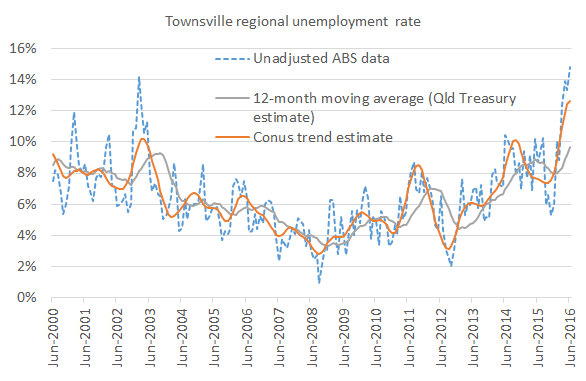
Yesterday afternoon I had a good chat with Pat Hession on Townsville ABC Radio about the latest discouraging unemployment data for my old home town of Townsville. Readers will be familiar with the vastly different economic conditions across Queensland (see my post on the June ABS labour force data), and the latest detailed regional labour force data from the ABS confirm just how bad economic conditions are in Townsville (see chart above), as the region struggles at the end of the mining boom, and after it has suffered large cuts to public service jobs in recent years. The Townsville Bulletin reports today that:

“TOWNSVILLE has recorded its worst unemployment rate in at least 20 years as the business community pleads for government investment in major projects to create jobs.

Australian Bureau of Statistics figures released yesterday revealed a 14.8 per cent unemployment rate for June.

The jobless rate is the worst in ABS records going back to 1998. The next worst was 14.2 per cent in February 2003.”

The Bulletin is reporting raw, seasonally un-adjusted data from the ABS and it is important to recognise that, due to the relatively small number of households sampled by the ABS in the Townsville region, there is a large degree of sampling error in the unemployment rate estimate. So a smoothed “trend” estimate is likely to give a better reading of the unemployment rate. Using a twelve-month moving average, the Queensland Treasury estimates the current Townsville unemployment rate at 9.7 percent (and rising), while Cairns region economist and former London investment banker Pete Faulkner from Conus estimates the trend rate at 12.6 percent using a more sophisticated statistical technique (see Pete’s latest post Regional jobs data; improving for Cairns, worsening for Townsville). I suspect Pete’s estimate is closer to where the real Townsville unemployment rate is, as it is not as backward-looking as the Treasury trend estimate.

I doubt that major projects can come quickly enough and absorb enough local unemployed workers to make a major impact on the regional unemployment rate, so I have not called for major projects as a solution to Townsville’s unemployment problem. (Also we need to consider whether major projects pass the cost-benefit analysis test and are good value for money, of course.)

A summary of my conversation on Townsville ABC Radio yesterday with Pat Hession by the Insentia media monitoring company which was forwarded to me by a contact gives a reasonably accurate summary of the points I made, including the need to cut taxes and charges on business that are holding back job creation (e.g. payroll tax):

Hession says there is plenty of interest in the employment market. He says there are not enough jobs to go around. He says Tunny is a former Treasury Economist. Tunny shares his thoughts regarding Townsville’s unemployment rate. He mentions the figures are from the ABS. Hession mentions there are significant job losses through the closure of Qld Nickel. Tunny mentions the Townsville Chamber of Commerce stated that they have had significant job losses. He says there must be a substantial flow on. He says it is not just Qld Nickel but the mining downturn itself. He says the drought is affecting the economy too. He mentions there are positive signs in the construction industry. He says the economy is not in a good state. He says the Townsville Bulletin has recently reported an increase in bankruptcies. He makes suggestions on what governments can do to improve the situation. He says he suggested the relocation of something like Work Cover in the Courier Mail a few months ago. He says it would be great if a significant government agency can be moved to Townsville. He says governments could look at cutting the cost to businesses hiring people. He says they could look at cutting stamp duty. He says there is a limit to what the government can do. He says people in Townsville need to accept that things will be tough for a while. He says it may take some time for things to get better. He mentions JCU has been doing great.

Posted in Labour market, Townsville, Uncategorized | Tagged , , , , , | 17 Comments

HILDA reveals very wealthy Canberra households, while Queenslanders much less wealthy

The relatively high salaries of Canberra public servants are allowing them to build up healthy asset portfolios, while average Queenslanders are much less wealthy, according to the University of Melbourne’s Household, Income and Labour Dynamics Australia Survey, the latest report from which was released earlier this week (see chart below based on Table 5.3 data on p. 60 in the report). According to the HILDA Survey, Median household wealth in Queensland is the second lowest in Australia, with only the median Tasmanian household being less wealthy. There is certainly scope in Queensland to improve our educational system and to remove unnecessary regulations with a view to boosting our economy and improving average incomes and wealth.

Median_household_wealth_HILDA_2014

You may recall that the HILDA Survey finding that the rate of home ownership in Australia is declining received some coverage in newspapers yesterday. The HILDA Survey is an outstanding resource and I highly recommend the latest report for its insights into Australian households and how they have fared over the last decade.

Posted in Education, Labour market, Macroeconomy, Uncategorized | Tagged , , , , , , , | 2 Comments

Judith Sloan right to criticise over-reliance on renewable energy

Judith Sloan, Contributing Economics Editor to the Australian, has a brilliant op-ed in the paper today (see Energy price reveals folly of renewables) criticising policies targeting renewable energy, following the wholesale electricity price spike that occurred in South Australia last week:

“What is clear is that overdevelopment of variable generation using renewable resources is a recipe for higher prices and lower than expected reductions in emissions because of the increasing costs of ensuring system stability and reliability.

Feasible storage options are down the track and, in any case, likely to be expensive.”

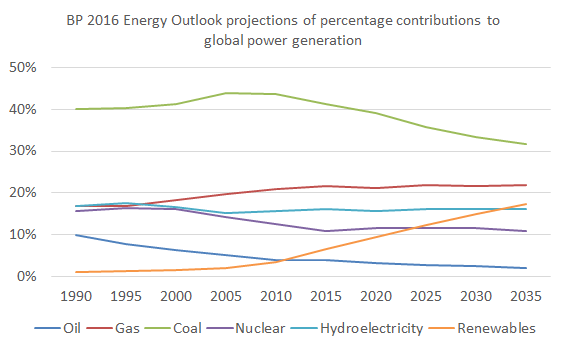
The high cost of renewable energy is likely to be one reason that energy giants such as BP are forecasting that, while renewable energy will grow strongly over the next two decades, it will not come to dominate power generation (see chart below based on BP Energy Outlook data).

BP_projections

I have previously questioned the wisdom of the Queensland Government’s 50% renewable energy target (Qld Renewable Energy Taskforce asked to achieve impossible 50% target), and last week’s electricity price spike in SA makes me even more confident that the policy should be reconsidered. Indeed, it probably will be reconsidered as the high cost of the policy becomes apparent.

Posted in Energy, Uncategorized | Tagged , , , , , , , , , , | 4 Comments

IR reforms could improve employment opportunities for young Australians

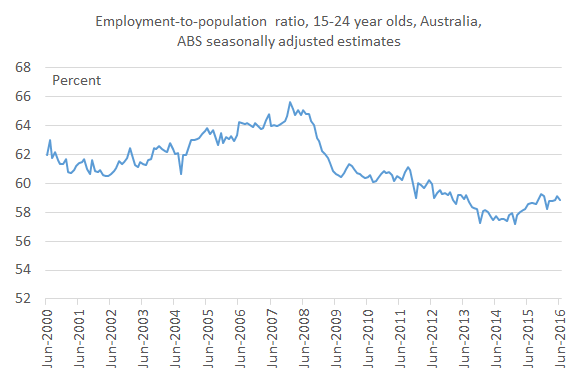
Almost eight years after the 2008 financial crisis, young Australians still face a significantly tougher job market than before the crisis. To illustrate, the employment-to-population ratio for young Australians aged 15 to 24 remains well below rates experienced prior to the crisis (see figure below based on the latest ABS Labour Force data released last Thursday). The crisis and resulting loss in business confidence saw a sharp fall in the employment-to-population ratio for young people over 2008-09, and after that it continued to decline (more gradually) before starting to recover over the last 1-2 years. It is arguable that industrial relations changes, particularly the introduction of the 2009 Fair Work Act, have constrained employment opportunities for young people to some extent in the post-financial crisis years.

empl_pop_ratio_15_24_Jun16

On 612 ABC Brisbane last Tuesday morning, in an excellent interview regarding Queensland’s high rates of youth unemployment in many regions, CCIQ’s Director of Advocacy Nick Behrens highlighted several ways that IR rules are constraining employment growth. For example, Nick noted that minimum engagement periods (e.g. an employee must be given a shift of three hours at least) are too long, and this rules out some employment opportunities, such as two hours of employment after-school for a young person. Hence, Nick recommends lowering the minimum engagement period. Also, Nick advocates reinstating junior rates of pay for twenty-year old retail workers and adopting the Productivity Commission’s recent recommendations regarding penalty rates. Finally, Nick is concerned about recent increases in first and second year apprentice pay rates that have made them unaffordable to some employers.

IR changes along the lines recommended by CCIQ would no doubt be unpopular with many, particularly with current workers who would lose out, but changes such as those recommended should be considered if we are genuine about improving employment opportunities for young Australians.

Posted in Labour market, Macroeconomy, Uncategorized | Tagged , , , , , , , , | 4 Comments