Brisbane unit values fell nearly 3% on average over 12 months to end of January

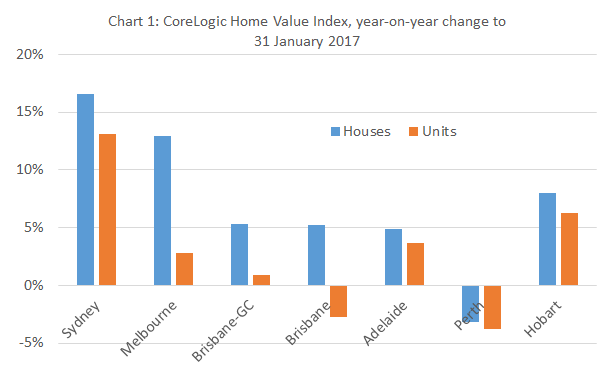
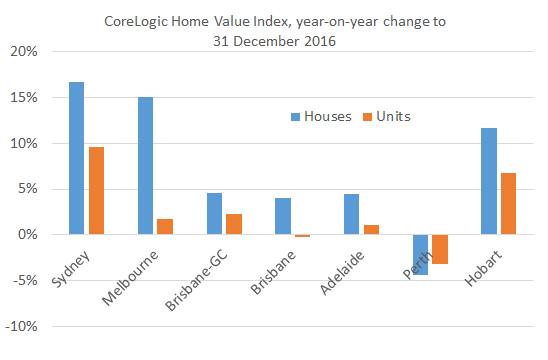
The huge supply increase in Brisbane apartments has resulted in a fall in unit values of 2.7% in the 12 months to 31 January, according to new CoreLogic estimates published yesterday (see Chart 1, based on data available in the CoreLogic report you can download at the link provided). Perth also saw a decline in unit values, no doubt due to ongoing weakness in WA’s economy after the end of the mining investment boom. At the same time, Sydney has experienced double-digit growth in unit values, approaching the growth rate for houses, as the property price bubble in that city continues to expand.

corelogic_jan17

It has been widely reported that the decline in unit values is raising issues at settlement time, with unit valuations coming in below contract values, and buyers hence having to provide larger deposits to secure loans (see Warning over unit values coming in under contract price). On the issues of the huge unit supply shock and settlement risk, Realestate.com.au economist Nerida Conisbee has made some interesting and insightful comments, as reported in the Courier-Mail article I linked to:

‘Realestate.com.au chief economist Nerida Conisbee said unit supply was at a very high level, with Brisbane seeing 10,000 come on-stream over 18 months while Melbourne was seeing 18,000 in the same period.

“That, in itself, isn’t a problem,” she said. “The problem is when people start defaulting on apartments and when that becomes a bit of a flood as multiple people decide to walk away from their units.”

Ms Conisbee said Brisbane was in a better position than Melbourne, given it had already turned the corner.

“One of the good things for Brisbane is that the pipeline of supply coming beyond this year is pretty low so that’s good news for Brisbane. My concern is for Melbourne which continues to see more units in the pipeline, that’s a worry.”’

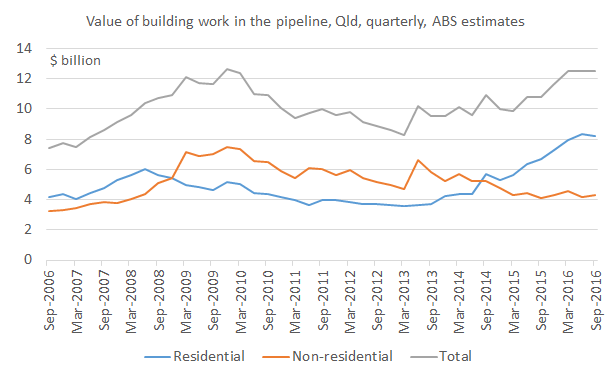
Ms Conisbee is right to highlight the smaller pipeline of unit supply beyond 2017 in Brisbane. While this will stabilise unit prices, it is a concern from a macroeconomic perspective, because residential apartment construction has been a major stimulus to growth in SEQ over the last couple of years. The sector will start dragging on economic growth, as it falls from its currently elevated levels, and it is unclear to what extent activity in other sectors, such as non-residential construction (e.g. on the new Queen’s Wharf development), will make up for it.

Posted in Brisbane, Housing, Macroeconomy, Uncategorized | Tagged , , , , , , , , | 2 Comments

Valley the victim of retail trends

A report in last Thursday’s Courier-Mail highlighted the decline of Fortitude Valley as a retail hub:

‘Boarded-up shops and “for lease” signs are regular sights in Brisbane’s Fortitude Valley as retailers abandon the once-bustling area…

…Chairman of the CBD’s Economic Development Board, coffee king Phillip Di Bella, said there was a problem and more retailers would go out of business unless there was a change.

“The biggest problem is that retailing is in big trouble,” Mr Di Bella said.

“Dick Smith, Howards Storage, Masters have all gone out of business and there will be many more.”’

Mr Di Bella identified a lack of parking in the Valley as an issue, which may well be the case, and Council should be receptive to any plans for new multi-storey car parks. Another possible intervention that would improve the attractiveness of the Valley, in my view, would be re-opening the Brunswick St Mall to traffic, as I have long considered the Mall was a huge mistake:

Brunswick St Mall should have been re-opened to traffic

Improvements such as these may help, but I would suggest fundamental economic trends are against the Valley re-emerging as a major retail destination. Those trends are:

  • online shopping, obviously, which will become even more important as same-day delivery by drone increases in prevalence; and
  • the trend toward highly-efficient big box stores in outer suburbs with huge floor areas and ample parking, such as Ikea at Logan and North Lakes.

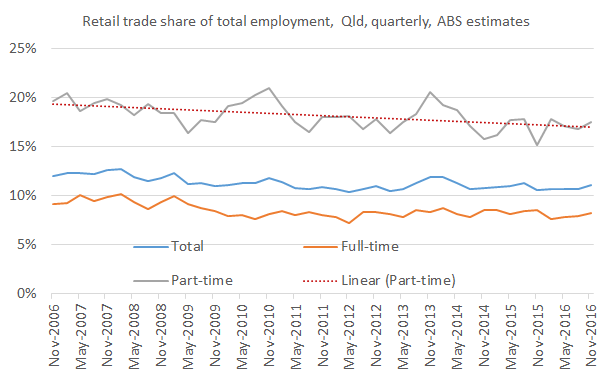
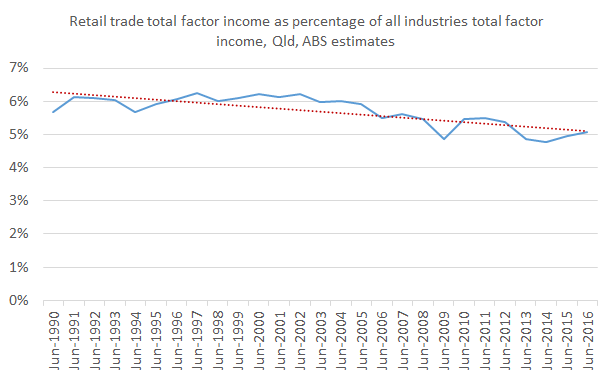
The impact of these trends on traditional retailers is possibly showing up in the recorded fall in retail trade’s share of the economy, measured in terms of employment and value added (see charts below). The noticeable decline in retail trade’s share of total part-time jobs has no doubt disproportionately affected young people.

retail_chart1

retail_chart2

So the decline of retail in the Valley is consistent with broader trends affecting the retail sector, although there may well be Valley-specific factors such as those identified by Mr Di Bella. Fortunately, other sectors appear to be doing just fine in the Valley. As the Courier-Mail article suggests, the Valley’s night-time economy is thriving, and the Valley nightclubs will be very pleased the Queensland Government backed down on its 1am lockout law. Also, being so close to the CBD, the Valley is highly suitable for office accommodation and residential apartments.

Finally, I should note deregulating retail trading hours would be highly desirable, and may provide a boost to remaining Valley retailers. The Queensland Government should have received John Mickel’s review of trading hours regulation by now, and I am keenly awaiting the Government’s response to his recommendations, which are widely expected to include a significant deregulation of trading hours.

Posted in Retail trade, Uncategorized | Tagged , , , , , , , | Leave a comment

The economics of President Trump – upcoming ESA Qld event

As Secretary of the Economic Society of Australia (QLD) I am pleased to announce our upcoming event on “The economics of President Trump”, on the evening of Wednesday 22 February at the Ship Inn, in its upstairs function room, at South Bank. The event will feature a timely panel discussion on the economics of President Trump, including an analysis of his trade and taxation policies, with a focus on what they might mean for Australia.

Panelists will include Professor Fabrizio Carmignani from Griffith University and Michael Knox, Chief Economist at Morgans, with a final panelist to be announced soon. Both Fabrizio and Michael have made excellent recent contributions on the economics of Trump, and I expect them to expand on these contributions in their presentations on the 22nd of February:

Fabrizio Carmignani’s article on Trumpnomics

Michael Knox’s note on Trump Trade

I especially liked Fabrizio’s reference to the historical failure of import substitution policies and the protection of manufacturing industries in his piece which was published in the Sydney Morning Herald and Brisbane Times. In Michael’s note, I liked his optimistic view that Australia could actually benefit from the Trump administration:

“Trump’s decision to favour bilateral free trade agreements, rather than multilateral agreements could wind up favouring allies in important strategic locations. One of those allies in an important strategic location is Australia.”

Please consider attending on the 22nd of February to hear more from Fabrizio and Michael, and to participate in the discussion.

donald_trump_official_portrait

Posted in Trade, Uncategorized | Tagged , , , , , , | 2 Comments

CommSec highlights importance of residential construction to Qld economy

The latest State of the States report from CommSec highlights the current importance of residential construction to the health of the Queensland economy. As reported by John McCarthy in today’s Courier-Mail:

QUEENSLAND’S economy is starting to emerge from the mining downturn and is creeping back up the national rankings, according to CommSec.

The state sits in fifth spot, behind Tasmania in fourth, but CommSec said people were starting to move to Queensland, driving up the population and creating housing demand…

…Population growth in Queensland was running at 1.3 per cent, its best for two years and that is helping the jump in home starts, which is 36 per cent above the decade average….

… “The strong level of home building will support the job market, as well as consumer and business spending,’’ the CommSec report said.

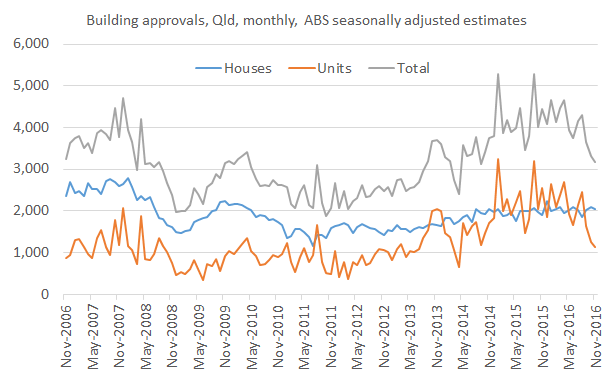
While the residential construction sector is currently performing strongly, I am concerned about how long this will last, particularly given the huge increases in supply, most notably of apartments, that we are seeing. The very large amount of residential construction work in the pipeline most likely peaked toward the end of last year (see first chart below) and building approvals, particularly for apartments, declined over 2016 (see second chart below). Peter Faulkner noted in a recent post that “we continue to see the dramatic impact of the decline in unit approvals being felt disproportionately in Greater Brisbane.”

pipeline

approvals_no16

I expect we will see residential construction activity fall toward the end of 2017, so it will no longer be making a positive contribution to economic growth. By this time, non-residential construction activity should start to pick up, with major projects such as Queen’s Wharf making a large contribution, but they may not be sufficient to make up for the expected decline in residential construction.

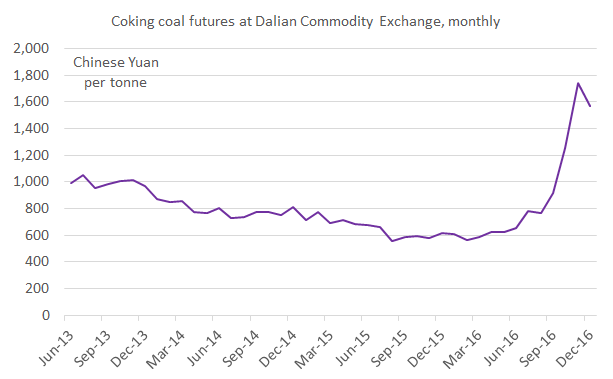
That said, the outlook for the Queensland economy in 2017 is generally positive, and I have previously commented on the increase in job vacancies we saw at the end of 2016 (see my recent post), solid growth in retail spending (related in part to a resurgence in tourism), and the rebound in commodity prices, particularly for coking coal (see chart below), which has improved the outlook for coal mining and led to the re-opening of the Glencore mine at Collinsville in North Queensland.

cokingcoalprice

How long the coal price rebound lasts is very difficult to forecast. The Office of the Chief Economist in the Australian Department of Industry, Innovation and Science is not getting its hopes up, noting in its latest Resources and Energy Quarterly that:

“…prices are forecast to decline over the outlook period, as China’s metallurgical coal import demand stabilizes. Global metallurgical coal producers have been increasing production in response to higher prices, and China has now eased domestic supply-side policy measures in order to bring prices down.”

So we should not expect the very high coal prices to be sustained, and to turbo-charge the Queensland economy and repair the State Budget, but we can enjoy the benefits of higher prices while they last.

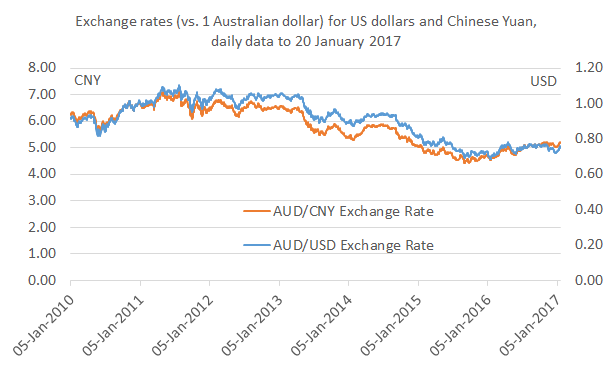
What I expect will provide a more enduring boost to the Queensland economy is tourism. The Australian dollar is in a range (chart below) that has greatly increased our attractiveness as a tourism destination, and the dollar may well fall further, given the possibility of a Trump-inspired economic boom in the US and higher US interest rates. In the 12 months to September 2016, international tourism visitor expenditure in Queensland increased nearly 11 percent to over $5 billion (see International Tourism Snapshot from TEQ). I expect tourism to also grow strongly in 2017, and, all going well, its growth should offset any contractionary forces arising at the end of 2017 from residential construction coming off its recent extremely high levels of activity.

exchange_rates_jan17

Posted in Housing, Macroeconomy, Mining, Tourism, Uncategorized | Tagged , , , , , , | Leave a comment

Disappointing 2016 for Qld labour market

Yesterday, on the same day the December jobs figures released by the ABS confirmed a disappointing 2016 for the Queensland labour market (see charts below), the Deputy Premier announced the State Government’s new regional jobs program. Coincidental or not, the timing highlighted to me the relatively limited impact that jobs programs typically have on the overall State economy. The Works for Queensland program may well bring benefits to some regions through upgraded infrastructure and temporary stimulus, but the expected State-wide impact of around 600 jobs quoted in the media release is relatively minor when compared with total unemployment in Queensland (around 155,000) and an estimated fall in employment over 2016 of over 30,000.

lfchart0_dec16

lfchart1_dec16

There is only so much the State Government can do to influence employment through jobs programs, as by far the largest influence on the jobs market is the state of the economy, which I should note did appear to be improving for Queensland at least in the second half of 2016, due in part to a resurgence in tourism associated with the lower Australian dollar (see my recent post on job vacancies). Retail trade data toward the end of last year were also encouraging for Queensland, so I am hopeful for the first half of 2017 at least. That said, it is undeniable some regional areas such as Townsville are still under-performing. In my view, the best thing for Government to do is to minimise taxes and regulations on the businesses that we are relying on to generate the bulk of the sustainable ongoing jobs in the economy.

Posted in Labour market, Uncategorized | Tagged , , , , , , | 1 Comment

Continuing rebound in Qld private sector job vacancies at end of 2016

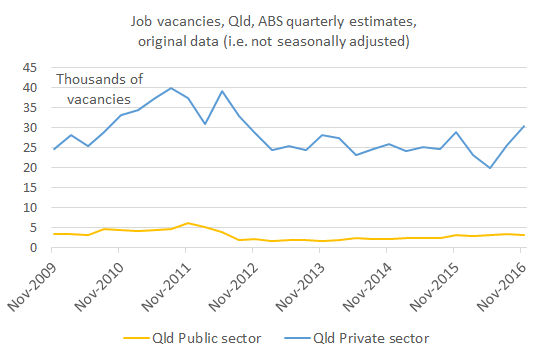
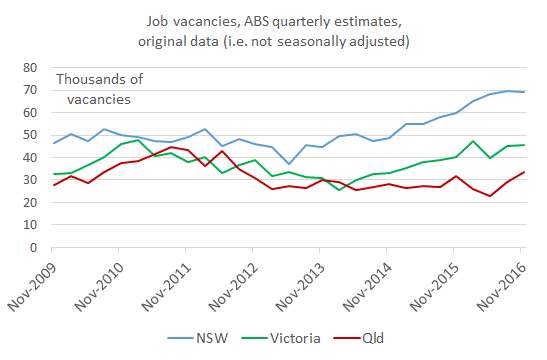
There was good news for the Queensland economy yesterday, with the ABS reporting a continuation of the rebound in private sector job vacancies in the final quarter of last year (see chart below). Private sector job vacancies have increased from a low of 19,900 in May to 30,500 in November 2016, bringing total vacancies to 33,600. Partly the strong performance in November would have been seasonal. As the Acting Treasurer Bill Byrne noted in a media release yesterday regarding the increase in vacancies:

“A significant proportion of this will be seasonal work in retail and also on farms with crops ripe for picking.”

I also suspect the strong performance of the Queensland tourism sector, largely related to the lower Australian dollar, made a major contribution to the private sector recovery in job vacancies over the second half of 2016.

vacancies_nov16_chart1

Queensland’s recovery in job vacancies stands in contrast to the performance of other States, in which vacancies were more-or-less stable (e.g. see chart comparing Queensland, NSW and Victoria below).

vacancies_nov16_chart2

Let us hope the good news for Queensland continues into 2017. As I have noted in a previous post, I have some concerns about whether the high level of activity in residential construction can continue, given the large dwelling supply increase that has occurred and is continuing to occur. Of course, there is certainly a significant amount of non-residential construction activity to come in future years (e.g. Queen’s Wharf), which, to an extent, will offset any cyclical decline in residential construction. I will continue to monitor developments in both residential and non-residential construction over 2017.

Posted in Agriculture, Housing, Labour market, Macroeconomy, Uncategorized | Tagged , , , , , , , , , | 2 Comments

Qld Treasury was right to be cautious on coal royalties windfall

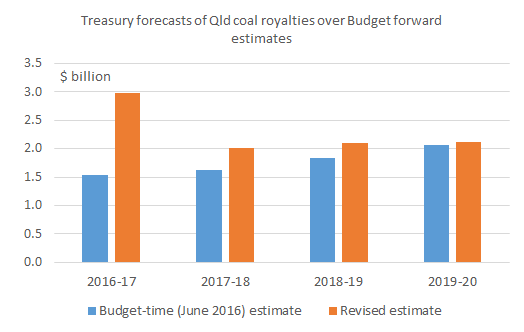
Queensland Treasury was right not to get too excited about the currently elevated coal prices and the surge in royalties when it updated its budget protections (chart below) last month.  As reported in today’s Australian, a report from the Chief Economist of the Federal Government’s Department of Industry, Innovation and Science hoses down expectations:

…the government’s projections in today’s release show that 2016’s 180 per cent price gains in coking coal and 80 per cent gains in iron ore and thermal coal have drawn nothing but a sober ­response from the industry so far.

“Investment decisions are taken with a long-term view of market conditions, and short-term price lifts are unlikely to have a significant effect on exploration activity and the progression of projects along the pipeline,” the report says…

…it predicts prices will slide this year as new global supply comes on and Chinese demand slows.

I made very similar comments to the Mackay Daily Mercury last week:

Adept Economics economist Gene Tunny believed it was likely the price surge would falter in 2017- on Tuesday coking coal come back to US$230.50/t- as mines reopened around the world to fill the supply shortfall.

However he noted the arrival of US president-elect Donald Trump could “give the global economy a kick along which would help coal prices”, through proposals to cut the corporate tax rate and focus on infrastructure.

He noted the longer term challenge would be if the US opted to increase trade barriers.

While he didn’t believe mining companies would be encouraged to make additional investments on the back of the higher coal price, he said state government would certainly benefit.

But he also noted signals from state government that it didn’t appear to be relying on the price climb maintaining.

A report from the state treasurer shows that in the 2016-2017 financial year it expected to reap $2.987b in coal royalties, up from $1.531b in 2015-2016.

However in 2017-2018 it expected this to fall to $2.022b and come in at $2.105b in 2018-2019.”

That said, Queensland is reaping some economic benefits from the elevated prices in addition to higher royalties, with the re-opening of the Collinsville mine in North Queensland at least, creating 200 jobs and additional business for local suppliers. Of course, the mining companies, and their largely foreign shareholders, will very much enjoy the temporary price surge, which has given Australia a positive trade balance for the first time in over two years (see the latest ABS data). Finally, the Commonwealth will extract some of the benefits through higher company taxes paid by the miners. So the higher prices are very good news, but we should not expect them to last.

coal_royalties_myfer_1617

Posted in Mining, Uncategorized | Tagged , , , , | 2 Comments

Should the Aquaman film production on the Gold Coast get a $22M tax break?

Last month, the Federal Treasurer and Queensland Premier argued over their respective roles in luring the Aquaman film production to the Gold Coast (see news.com.au article). In monetary terms, the Federal Government made the greatest contribution by far, with $22 million in tax breaks offered to the film production. The beneficiaries are the highly profitable US companies DC Comics and Warner Bros, which are the producers of Aquaman.

The tax break the production will receive is called the Location Tax offset, which for Aquaman the Commonwealth has bumped up to 30 percent from the usual 16.5 percent applied to production expenditure within Australia. The Commonwealth will pay the Aquaman producers $22 million, less whatever tax is owed by them for profits booked to the Australian operation.

The Queensland Government has not disclosed any financial contribution, but its media release notes:

“The Palaszczuk Government, through Screen Queensland, has invested an extra $30 million over four years to continue to attract large-scale film and high-end television productions to Queensland to increase jobs and expenditure into the State’s economy.”

So the Queensland Government may have provided a sweetener to attract the production, possibly as a rebate of payroll tax. The production will also benefit from the use of a large sound stage at Village Roadshow Studios on the Gold Coast that, oddly, the Queensland Government covered the bulk of the costs for: $11 million out of a total cost of
$15.5 million (see this media release for details). Sure, it will be used during the Commonwealth Games, but Village Roadshow will derive the bulk of the benefits from the sound stage over its life.

Given all this special assistance to the film industry, we should ask what justifies the industry getting such special treatment. Is it merely because of the glamour of Hollywood, the opportunity for politicians to appear on location or on the red carpet with movie stars? Or is there is a genuine benefit from an economic perspective?

Consider first that the Queensland Premier did make an important point in her attempt to claw back some of the credit from the Federal Treasurer for luring the production, noting in the Queensland Government media release:

“Australia doesn’t have a competitive tax system.”

I suspect the Premier was referring to the competitiveness of our tax system in relation to international film productions specifically, but her point is of broader applicability. Indeed, business groups and the Australian Treasury have been saying Australia’s tax system is internationally uncompetitive for years, and our uncompetitive tax system is the motivation for the Government’s proposed reduction in the company tax rate from 30 to 25 percent.

But why should the film industry, and particularly an international film production where the bulk of the profits will be repatriated overseas, get special treatment? Why not provide broader tax relief?

Let us consider the arguments typically advanced by film industry advocates. First, it is argued the film industry deserves special treatment because it creates jobs, directly and indirectly. Second, it is argued that government support is needed in the early stages to get the industry going, so it can reach a critical mass, an infant industry argument for public support.

The jobs argument is subject to a number of problems. It is typically very expensive for the government to create jobs. In this case, the $22 million tax break amounts to $22,000 to $37,000 for each of the 600 to 1,000 (temporary) jobs estimated to be supported by the production. And the Gold Coast does not appear to be suffering from an unemployment problem. The Queensland Government Statistician’s office estimates an average unemployment rate for the Gold Coast of 5.6 percent compared with the State average of 6.1 percent in the 12 months to November 2016. Other problems with the jobs argument are that, as noted above, the jobs are only temporary, many of the people getting the temporary jobs had other jobs anyway, and, based on the experience with Thor: Ragnarok, many of the jobs are typically not well paid and not as many jobs end up created as expected. CGI means that film productions need fewer people nowadays (see this Gold Coast Bulletin report).

Regarding the infant industry argument, that the industry just needs a hand up in its early days until it becomes self-supporting, we tried that over six decades with the car industry and it did not work, unnecessarily costing taxpayers billions of dollars in the failed attempt. Typically, infant industries do not reach adulthood.

While we have the occasional flurries of meaningful foreign film production expenditure in Australia, these are not long-lasting, as we typically only have a chance of attracting big budget international productions when the exchange rate is low, such as it was in the late 1990s and early 2000s (Chart 1). Even though the Australian dollar has fallen from around parity with the US dollar during the mining boom, currently our exchange rate at 73 US cents is still significantly higher than it was in the late 1990s and early 2000s, when it was in the 50 to 60 US cents range. Hence governments have had to dial up the incentives to attract Hollywood productions such as Aquaman, Thor: Ragnarok and Pirates of the Caribbean 5.

Chart 1: Foreign film production spend in Australia and exchange rate

foreignfilmspend_vs_xrate

Source: Foreign production spend data available from Screen Australia.

It does not make sense for our governments to pick winners and losers, but that is what they are doing when they extend special tax breaks to the film industry. Instead of having special tax breaks for the film industry, we should focus on getting our tax and regulatory policy settings right, so we can attract foreign productions without having to offer special rates for special mates.

My previous posts on the film industry include:

Ragnarok in Brissywood

International film productions such as Thor: Ragnarok unworthy of Qld taxpayer support

Also see my ABC Drum opinion piece:

Taxpayer money wasted chasing film productions

Posted in Uncategorized | 6 Comments

Sydney & Melbourne property prices defy rational explanation

At the Guardian, Gareth Hutchens criticises some market economists for their forecasts of a correction in house prices in 2016, while house prices in Sydney and Melbourne actually grew at double-digit rates. Market economists Saul Eslake and Stephen Koukoulas have attempted to explain the divergence between their forecasts and outcomes by referring to unexpected RBA cash rate cuts and higher than expected population growth, among other factors. I would suggest they should have simply said the market has stayed irrational longer than they expected.

What we are seeing in Sydney and Melbourne is a property price bubble, in which a mania has gripped property buyers. This type of mania afflicts markets from time-to-time, and we should not think we are immune to it in Australia. Famous historical examples of market manias are the Dutch tulip craze, the South Sea bubble, the US stockmarket before the 1929 Great Crash, Tokyo real estate in the 1980s, and the US housing market before 2007-08. In Sydney and Melbourne, we now have property markets dominated by a mixture of speculators and people gripped by a fear of missing out, people who want to buy a property before it becomes even more ridiculously over-priced.

The mania could continue so long as people can access cheap debt and can meet mortgage repayments, but eventually constraints will be reached (or possibly rationality will prevail) and price growth will stop. And we will see a re-evaluation by the market of property prices, particularly given price growth has been massively ahead of the growth in rents. The most recent CoreLogic Hedonic Home Value Index report (available for download from CoreLogic) notes:

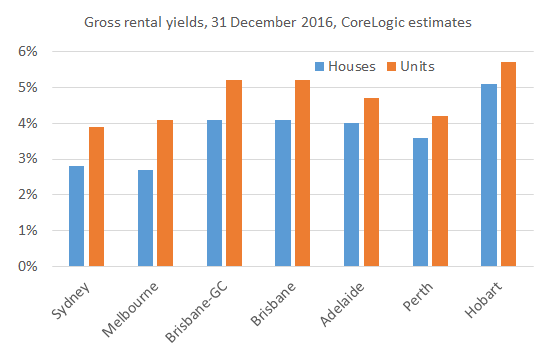
“Over the growth cycle to date, Sydney dwelling values are up 69% while rents have increased by approximately 10%; this has caused the gross dwelling yield to fall from 4.5% in June 2012 to the current record low of 3.0%. Similarly, in Melbourne, dwelling values are 51% higher over the cycle to date, while rents have risen by a much lower 9.6%. The divergence between dwelling value growth and rental growth has compressed Melbourne’s gross yield profile to a new record low of 2.9% from 3.8% in June 2012.”

Gross rental yields as low as this in Sydney and Melbourne are unsustainable (see figure below). Generally, they would only be tolerated by an investor who expects a large capital gain in the future. But the likelihood of that diminishes every time current property prices reach even more unsustainable levels.

rental_yields_dec16

In a rational market, there should be a close link between property prices and rents, as rent signals the market value of the services provided by a property. Of course, low interest rates are relevant, and perhaps investors are coming to accept lower returns generally, but why should Sydney and Melbourne property investors accept much lower yields than those in other markets?

The massive divergence between the growth of property prices and rents is a big clue that the Sydney and Melbourne property markets are very likely suffering from irrational exuberance.

Posted in Housing, Uncategorized | Tagged , , , , , , , , , , , | 4 Comments

Comments in Courier-Mail on residential construction & First Home Owners’ Grant

I am quoted extensively in John McCarthy’s Courier-Mail article this morning Brisbane house prices showing strong growth while regions are suffering (pay-walled), expressing similar views to those in my post from yesterday. In the Courier-Mail article, I sound more alarmist than I actually am, but nonetheless John has fairly reported my views. I am also quoted regarding the Real Estate Institute Queensland’s proposal to extend the First Home Owners’ Grant to existing dwellings in regional areas, which would be bad policy in my view:

Regional mayors have also petitioned the State Government to back a call from the Real Estate Institute to extend the First Home Owners Grant to all housing rather than new homes only.

But Mr Tunny said the grant was initiated to offset ­increased costs from the goods and services tax, “so this doesn’t make sense in terms of the original rationale for the grant’’.

We need to be concerned about the budgetary cost, noting Queensland is still running a fiscal deficit and accumulating debt.

“If the Government wants to stimulate regional areas, there may be better ways to do it,” Mr Tunny said.

Incidentally, yesterday CoreLogic published its latest Hedonic Home Value Index estimates, so below I have included an updated version of a chart using these data that I presented in yesterday morning’s post. The chart still shows a decline in Brisbane unit values over 2016 (-0.2%) compared with moderate house price growth of 4%, while the housing price bubble continues to expand in Sydney and Melbourne. Unit values are obviously growing strongly on the Gold Coast, as CoreLogic has estimated unit values in the Brisbane-Gold Coast region grew 2.3% over 2016, compared with a fall of 0.2% in Brisbane itself.

unit_prices_dec16

Posted in Brisbane, Gold Coast, Housing, Macroeconomy, Uncategorized | Tagged , , , , , , , , , , | 5 Comments