EV taxes, property taxes, and the need to reset federal financial relations in Australia

It’s good news that, according to the Brisbane Times, Queensland Transport Minister Mark Bailey has ruled out a special Electric Vehicle tax (at least for now). You may recall I reported on the Australia Institute’s campaign to stop state-levied EV taxes in my Wednesday post, which generated a wide range of thought provoking responses.

For instance, former state Treasury senior official Adrian Noon made a highly insightful comment regarding the context in which southern states are implementing tax policy changes, including EV taxes. Adrian has a lot of experience in Queensland public finance. In the first half of the 2000s, he was the chief economic adviser to Beattie Government Deputy Premier-Treasurer Terry Mackenroth. Here’s part of Adrian’s comment on my post on Linkedin:

This gets back to Commonwealth-State financial relations and the fact that the fuel excise at present is not hypothecated. The fuel excise in the next 20 years will be a dying tax as EVs & hydrogen vehicles (for heavy haul, longer distance uses) replace them.

The southern States are just being rat cunning – they are getting in & staking out the new tax base now before the Feds get in on the idea. I disagree with you – Qld should do exactly the same next week! 

Just like with NSW’s cheeky/dumb (depending on your view) play on stamp duty & land tax, this is just about setting the stage for the inevitable major reset of taxes in this country & Commonwealth-State financial relations that must happen sometime in the next few years, especially given the GST has turned out not to be the growth tax Howard sold it as due to its base destruction and changes in people’s spending preferences.

Adrian is correct that the GST has not lived up to the expectations of state and territory governments. For example, in early September, The Australian reported The GST is costing the government billions:

The declining share of GST revenue relative to the size of the economy over the past 20 years is costing the government $9bn in lost annual tax revenue – a shortfall which, absent reform, could blow out to $24bn by the end of the decade, the parliament’s independent budget watchdog has found.

A new analysis by the Parliamentary Budget Office found that despite being originally promoted as a “growth tax”, the 10 per cent GST has not kept up with economic growth over the last twenty years.

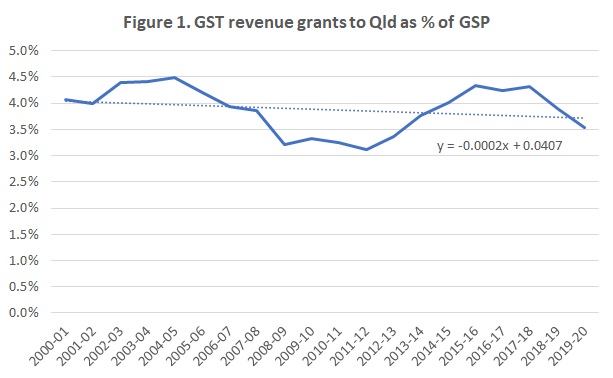
Instead, the GST tax take relative to total GDP has declined from 4 per cent in 2003-04, to 3.3 per cent in 2018-19.

We see this impact in the trend decline in GST revenue grants to the Queensland Government as a percentage of Gross State Product (Figure 1). Note the cyclical volatility in the time series is largely due to changes in the “relativity” calculated by the Commonwealth Grants Commission, which uses a complicated formula incorporating coal prices (a major influence on Queensland’s relativity) and dozens of other data inputs.
On the reset of federal-financial relations, I acknowledge this needs to occur. But I don’t think a special EV tax should be part of that reset, for the reasons I discussed in my Wednesday post. One possible solution would see the states and territories take a share of Commonwealth income tax, with the possibility of varying the state components of tax rates, along the lines of what then PM Malcolm Turnbull proposed in 2016, a proposal I supported in principle on ABC Brisbane radio at the time (see Premier’s 2016 Lodge dinner remark to Turnbull highlighted Vertical Fiscal Imbalance problem).

Finally, I should clarify that I would support a more rational system of road user charging, and possibly congestion charging, in preference to our current policy settings. That system would need to take into account:

  • the small amount of damage to roads caused by passenger vehicles compared with heavy vehicles, and
  • the reduction in greenhouse gas emissions from switching from petrol-powered vehicles to EVs.

On GHG emissions of EVs, it’s intuitive that EVs would have lower emissions, even if they rely on Queensland’s current electricity grid for charging, given the superior efficiency of electric motors. According to the Queensland Department of Transport and Main Roads (Benefits to Queenslander of EVs):

The average EV produces around 30% less greenhouse gas emissions compared to a conventional fossil fuel vehicle when using Queensland’s current electricity grid mix.

In my view, Minister Bailey is right not to slow down the take-up of EVs by levying a special tax on them.

Please feel free to comment below. Alternatively you can email comments, suggestions, or hot tips to contact@queenslandeconomywatch.com

Posted in Budget, Environment, Tax | Tagged , , , , , , | Leave a comment

Transcript of Megaprojects chat with Marion Terrill of Grattan

A couple of weeks ago I spoke with Marion Terrill of the Grattan Institute regarding her new report on The Rise of Megaprojects (check out Megaprojects chat with Marion Terrill from Grattan). Marion made so many excellent points in the discussion that I thought it would be worthwhile publishing the transcript (generated using the amazing AI tool otter.ai, and which required minimal editing by humans).

If you’re based in Queensland, you may be especially interested in the part of the conversation in which Building Queensland is mentioned (from 29:10). BQ is the state government’s infrastructure advisory body which is at risk of losing any independence it possessed following its absorption into Treasury. The transcript of our full conversation is below the fold.

Continue reading
Posted in Infrastructure | Tagged , , , , , , , , , , , | Leave a comment

Great Reset podcast chat with Darren Brady Nelson

Twenty years ago, the World Economic Forum came under heavy criticism from the left over its promotion of globalisation. The WEF runs the uber-exclusive Davos talkfest attended by billionaires, CEOs, and rock stars, so you’d expect it to support market-friendly policies. The WEF still supports globalisation, but it is now also advocating a Great Reset of global capitalism in this time of pandemic.

Now, ironically given its history, the WEF’s greatest critics are on the right. Critics worry that the Great Reset agenda to, among other things, reduce inequality and address climate change, will usher in an age of heavy-handed government intervention and the abolition of private property rights. On Sky Australia, Senator Matt Canavan called the Great Reset “crazy, kooky stuff”.

How worried should we be by the Great Reset? For thought-provoking views on the Great Reset, check out my interview with Darren Brady Nelson in Economics Explored EP63: The Great Reset. Darren is the Chief Economist of LibertyWorks, an Australian libertarian think tank, and he is also a Policy Advisor to the Heartland Institute, a well-known US pro-free-market think tank.

My view is that, given specific policy measures such as a wealth tax or an emissions trading scheme would have to be enacted by national governments, and in Australia either measure seems unlikely to be enacted by the current Government, the Great Reset agenda may not end up having much of an impact here, at least not for a few years.

For further info on the Great Reset, check out this article I co-authored with Adept Economics Research Assistant Taylor-Rose Hull:

What is the Great Reset agenda and is there need for concern?

Please feel free to comment below. Alternatively you can email comments, suggestions, or hot tips to contact@queenslandeconomywatch.com
Posted in Uncategorized | Tagged , , , , , , , | Leave a comment

Electric Vehicle Tax – Qld shouldn’t follow Victoria and SA in imposing one

The Australia Institute ran an excellent webinar (Stop the Electric Vehicles Tax) this morning opposing the Electric Vehicle Tax announced by Victoria and SA. An EV tax may end up being imposed by other state governments, including NSW’s and Queensland’s, and we may see one announced in the 2020-21 state budget when it’s handed down next Tuesday. Earlier this month, the Financial Review’s Queensland bureau chief Mark Ludlow wrote Electric vehicle taxes expected across Australia. That said, I haven’t heard any rumours about a Queensland EV tax, and I can’t find any commentary from the Treasurer regarding whether he’s considering one, so this could be a false alarm.

In the webinar, the Australia Institute’s Chief Economist Richard Denniss made some very compelling arguments for why an EV tax shouldn’t be imposed, including those he made in a Guardian Australia article published today (Instead of taxing electric vehicles, heavy vehicles should pay more for the damage they cause):

…while it’s true that as the number of electric vehicles rises in Australia fuel excise collections may fall, that doesn’t make it a good idea to tax the use of electric vehicles. The amount of money Australians spend on GST-free items such as private school fees and private health insurance has risen, but that doesn’t mean we have to increase the GST on books and clothes.

We tax cigarettes and alcohol because we want to discourage their use. We subsidise vaccinations and pharmaceuticals because we want to encourage their use. If we want to encourage more people to buy low-emission vehicles we should subsidise them and if we want to discourage people from buying them we should tax them.

In the webinar, Richard made the important point there’s no direct link between money raised by the Commonwealth through fuel excise and money spent on roads by either the Commonwealth or states and territories. It’s not earmarked for that purpose. It goes into the big pot of consolidated revenue and you can’t say any one dollar in that pot is spent on anything in particular.

An EV industry representative who spoke in the webinar, EV Council Chair Tim Washington, is worried the EV tax will seriously hamper the take-up of EVs in Australia. Apparently, there are fewer than 20,000 EVs in Australia at the moment, so EV taxes will raise very little revenue (i.e. only $1 million in its first year in SA), but they may slow the take-up rate of EVs. This would be unfortunate, given EVs could make a significant contribution to reducing Australia’s greenhouse gas emissions. Regarding what state Treasurers are saying about how an EV tax needs to be imposed to pay for road maintenance, Tim said “It’s an absolute lie”, making the same point Richard did about the non-existence of a direct link between fuel excise and spending on roads.

It’s highly likely we’ll all be driving or riding in EVs one day, and I’d prefer not to have to pay a tax on the kilometres travelled. Our governments extract plenty of tax revenue from us already. I’d prefer that the Queensland Government restrain the growth of its highly paid bureaucracy rather than impose a new tax. Let’s hope we don’t see one introduced in the budget next week.

Please feel free to comment below. Alternatively you can email comments, suggestions, or hot tips, especially regarding the upcoming Queensland state budget, to contact@queenslandeconomywatch.com

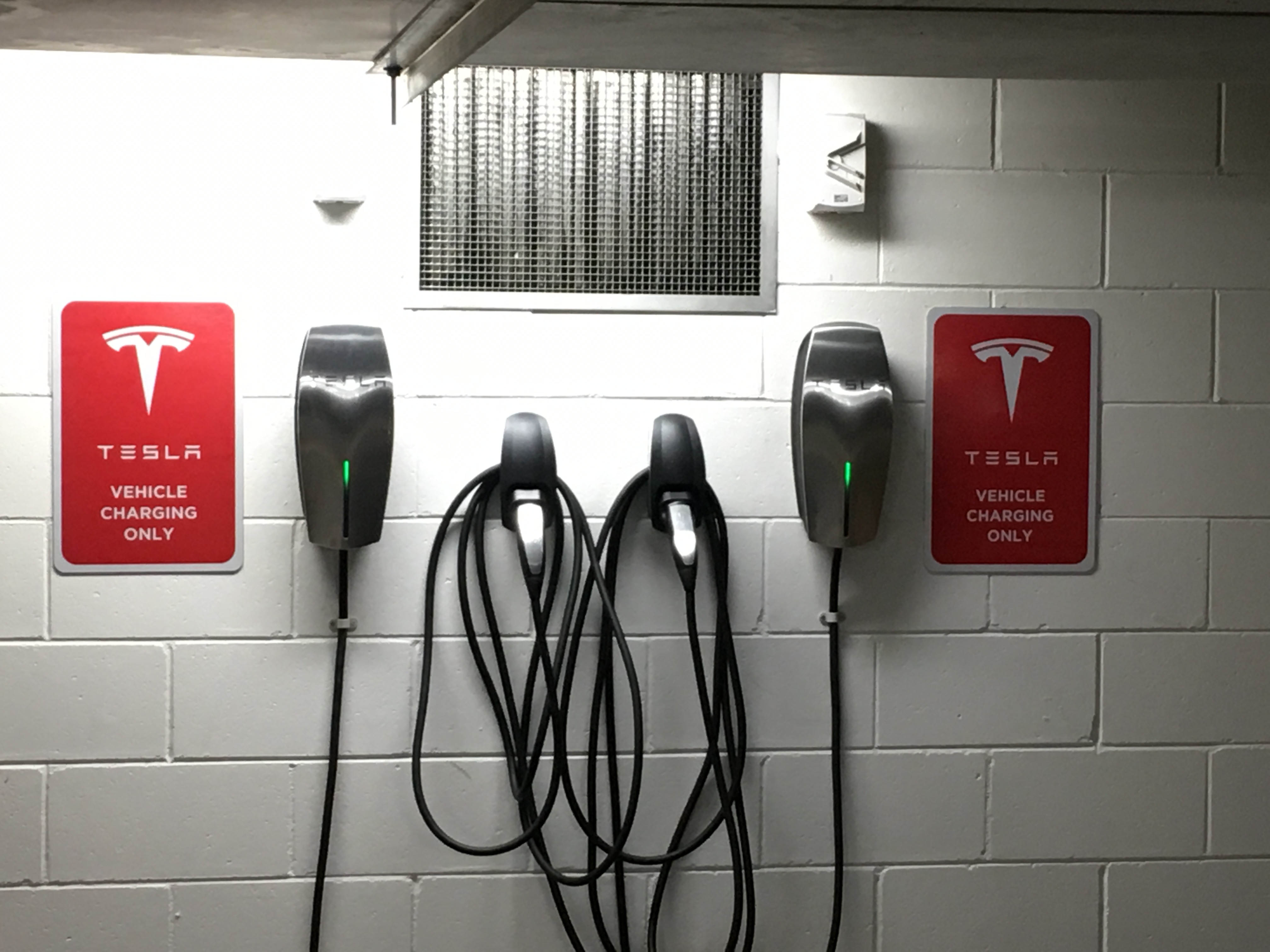
Tesla charging station in the car park of the Sofitel, Noosa
Posted in Budget, Transport | Tagged , , , , , , , , , , | 10 Comments

Thoughts on the border decision and QPC’s productivity reform livestream

First, better late than never I suppose, so I should be thankful the Queensland Government, on 1 December, will finally open up the state to Sydneysiders and let us travel to Sydney without having to endure hotel quarantine when we return. The Government still has big questions to answer, however, over the justification for its knee-jerk re-imposition of the hard border with NSW a few months ago. It won’t release any written advice from the Chief Health Officer justifying it, suggesting either there wasn’t any, or the case made for the border closure wasn’t particularly compelling.  

One organisation in Queensland that does care about evidence-based policy making is the Queensland Productivity Commission, and Commissioner Karen Hooper and her team deserve credit for an excellent livestream they ran today on Productivity Reform in Australia and NZ (see my 26 October QEW post). The forum featured eminent speakers from Australia and NZ, including national and state Productivity Commissioners. Apparently, the QPC will post the video recording in the future, but, in the meantime, I thought I should summarise the highlights.

  • Former Australian Productivity Commission Chair Gary Banks said workplace relations was a major priority for policy change in the interests of boosting productivity. He described our current workplace relations system as a “legacy of a bygone era”. Banks also raised doubts about elements of the federal government’s economic response to the COVID-recession. For instance, he questioned the Modern Manufacturing Strategy which identifies six sub-sectors (e.g. recycling, defence, space) to be prioritised without any legitimate rationale. He noted the problems Australia had in the past with the ‘picking winners’ strategy of assisting so-called infant industries. Unfortunately, infant industries subsidised by government may never ever grow up.
  • Victoria University Associate Professor Janine Dixon expertly demonstrated that the impacts of productivity improvements can be ambiguous regarding employment. This reminded me of Australia’s post-early-nineties recession experience. At the time, I recall, there was talk of a ‘jobless recovery’ and ‘five minutes of economic sunshine’, but years later we talked about the nineties productivity surge.
  • My former Australian Treasury colleague Jason McDonald, now at the Department of Prime Minister and Cabinet, nicely followed on from Janine Dixon and recommended a program of deregulation which would make it easier to do business and start new projects, meaning you could get both productivity and employment gains. It’s been announced that Jason will soon head up the federal government’s Deregulation Taskforce and I look forward to what he’s able to achieve in that role. It appears Jason is very annoyed by Australia’s overly restrictive occupational licencing laws and the lack of mutual recognition across states and territories in many cases. I hope Jason does some good work in this area and makes sure state and territory governments follow through properly on the National Cabinet’s agreement to have mutual recognition from 1 July 2021.
  • NZ Productivity Commission Chair Murray Sherwin stressed the importance of Productivity Commissions being independent agencies and being able to express their views freely. I should note this is something the Queensland Productivity Commission will probably lose when it’s merged into Treasury.
  • Australian Productivity Commission Chair Michael Brennan stressed the importance of having a flexible economy unhindered by burdensome regulation so that resources can be allocated to their most economically valuable uses as the economy recovers.

Finally, my only disappointment with the livestream (which I had to leave before the final session, unfortunately) was the panel discussion with the Productivity Commission Chairs, which was conducted at a very high-level and didn’t address what I thought was the big issue affecting the QPC: its probable loss of an independent voice once it’s absorbed into state Treasury, a plan which was announced by Treasurer Cameron Dick earlier this year. I submitted a question asking about whether it’s important for Productivity Commissions to be independent, but the panel discussion moderator didn’t ask the question of the Commissioners.

Overall, the livestream was well worth watching (and I’ll link to the recording once it’s available), so well done to the QPC. I very much hope it isn’t muzzled when it’s absorbed into Queensland Treasury.  

Finally, on 1 December, all NSW residents will be allowed into Qld without needing to endure hotel quarantine.

Posted in IR, Macroeconomy, Productivity | Tagged , , , , , , , , , , , , | Leave a comment

Coal price crash is bad news for the state budget and future capital investment

Last Friday, John McCarthy at In Queensland reported Budget impacts loom as coal prices plunge to four year lows. Yes, recent falls in the coking coal price to around $US100/t for coking coal must be causing anxiety in Queensland Treasury, which will be trying to wrap up the long overdue 2020-21 state budget that Treasurer Cameron Dick will hand down next Tuesday, 1 December. The fall in the Australian coking coal price since October appears partly related to alleged Chinese restrictions on Australian coal. Coal market analysts expect this can’t continue and indeed Australian coking coal futures prices show prices are expected to recover over the rest of the financial year (see chart below). Last Thursday, The Australian reported (Coal price slump finishes Carabella Resources):

In a client note on Thursday, RBC Capital Markets analyst noted that benchmark metallurgical coal prices had fallen below $US100/t this week for the first time in more than three years, but noted China’s bans on Australian coal were putting pressure on its own steel industry.

As reported by John McCarthy in In Queensland, “RBC Capital Markets has predicted the coal price would rebound to $US140 a tonne this year and $US150 long term.”  By this year, I think they mean this financial year, rather than by the end of 2020, which would be consistent with futures market pricing.

1st position refers to the 1-month ahead futures price, 3rd position to the 3-months ahead futures price, etc.

The (hopefully only temporary) fall in the coking coal price since October should see the Treasury adding a little bit extra to the already large write down ($1.1bn for 2020-21) in coal royalty revenue it revealed in its COVID-update in early September. We’ll see the additional damage the Treasury is expecting in the budget next Tuesday, and we’ll also see just how much debt the Treasury is projecting Queensland will end up with by 2023-24, something which should have been revealed in the COVID-19 Fiscal and Economic Review back in September. Of course, the state government was facing an election in late October and it didn’t want to reveal the obvious blow out in state debt. In a report commissioned by the Australian Institute for Progress, Joe Branigan and I projected general government debt of $72-77bn and total government debt of
$113-118bn by 2023-24. On Queensland’s budget outlook, see e.g. Gov’t claims police boost “fully funded”, but won’t release full budget forward estimates.  

Low coal prices (for coking and thermal coal) are raising doubts about future investment in coal mines. The Financial Review today, in an article on the latest Department of Industry forecasts of resources sector capital investment, referred to
$72 billion of projects unlikely to go ahead and noted:

The department did not name the projects it now deemed to be ”unlikely” to go ahead, but it did disclose that many of them were in the coal sector, which is currently struggling under very low prices and geopolitical uncertainty over China’s reluctance to accept Australian coal.

That said, the Carmichael coal mine is part of the resources sector investment rebound the department is forecasting for 2021, as is Arrow’s $10bn Surat basin gas project. While rebounding a bit, capital investment still won’t be anywhere near what it was in the first half of last decade, of course.

Posted in Budget, China | Tagged , , , , , , , , , , | Leave a comment

Women and the Budget – upcoming Griffith-WEN webinar on Thursday 26 November

This Thursday, Griffith Business School and the Women in Economics Network (WEN) are holding a webinar on Women and the Budget, and I’ve agreed to act as Moderator for the webinar. Here’s the event description from the organisers:

The economic impacts of the COVID-19 pandemic have been experienced by men and women in different ways, given the gender patterns in employment and household roles that prevail within Australian society. Despite women shouldering the bulk of jobs lost since the start of the pandemic, the Government’s Budget responses have been largely directed at male-concentrated industries.

This webinar examines the economic data to assess these gender patterns and explores the value of Gender Responsive Budgeting. Our speakers will discuss examples of how to cast a gender lens on economic policy formation, and consider where the barriers and resistance to adopting a gender lens approach stem from. The costs of overlooking a gender lensed approach to economic policy will be explored, not only in terms of costs to women, but in terms of the loss to the wider economy. Participants will have the opportunity to join the discussion through Q&A.

The presenters and panellists are RMIT’s Dr Leonora Risse, ANU’s Sally Moyle (former head of the federal Office for Women), and Griffith’s Dr Tracey West. I’m looking forward to the presentations and the Q&A and discussion following the presentations. If you’re interested and available this Thursday at 1pm (Brisbane time), please consider registering for the webinar via the link above. You can download the flyer with further information on the event and the panellists below.

Should the Treasury present further information on the gender-specific impacts of budget measures in federal budgets? This question and others will be considered in the upcoming Women and the Budget webinar on 26 November.

Posted in Uncategorized | Tagged , , , , , , , , | Leave a comment

Bold claim from Qld Treasurer: more Queenslanders working now than pre-COVID restrictions

Queensland Treasurer Cameron Dick has made a bold claim, which I disagree with, that more Queenslanders are working now than were working pre-COVID. The Treasurer’s claim is based on the October Labour Force data published by the ABS on Thursday, data which we should remember are based on a survey of households and are subject to sampling error. According to the Courier-Mail, Treasurer Cameron Dick has said:

“Queensland is the only state in Australia that has put back on every single job lost since the lockdowns started in March, plus 500 more,” he said.

“That means more people are working in Queensland now than before the start of restrictions.

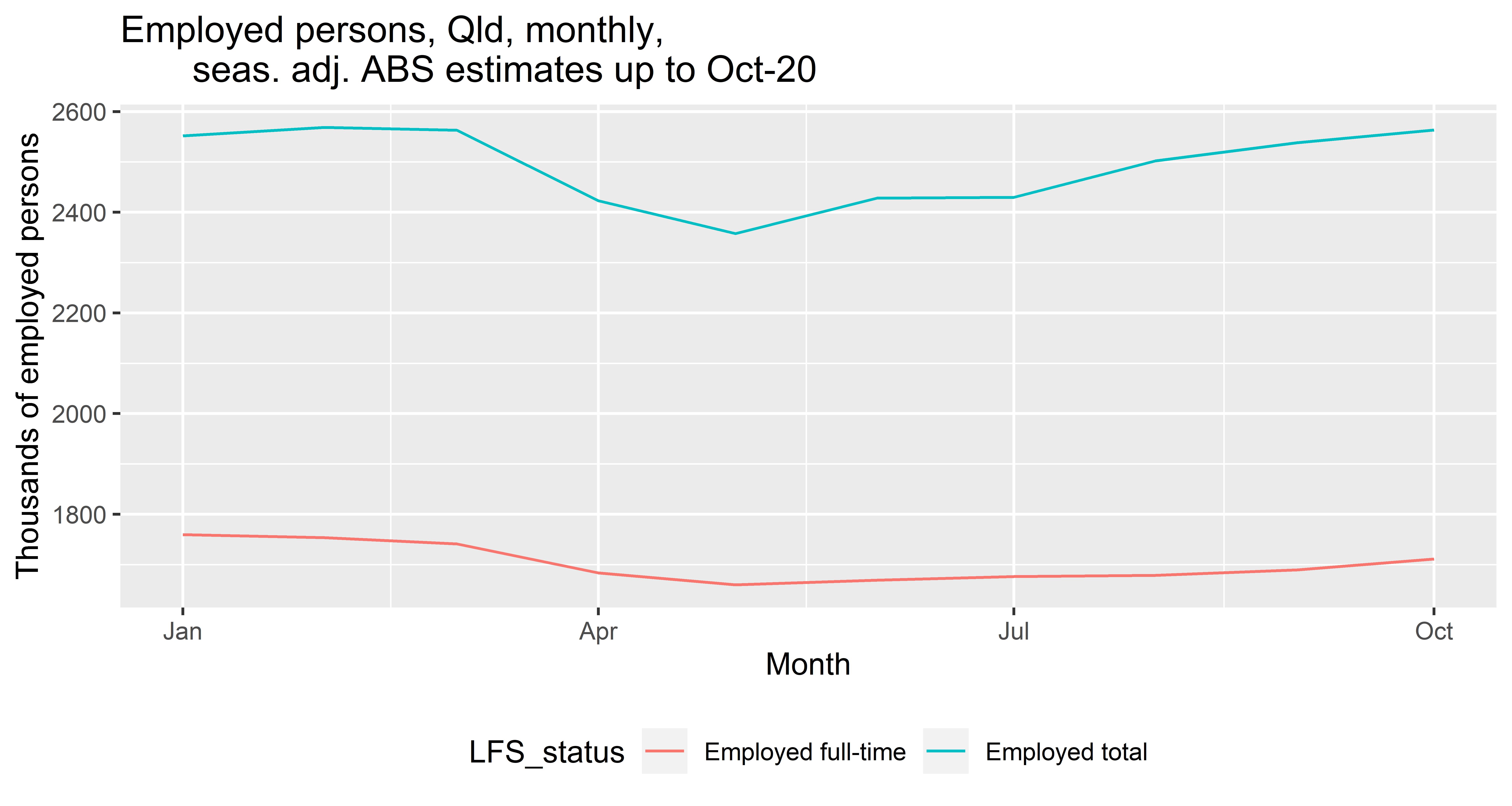
The Treasurer’s claim is based on the ABS estimate of employed persons (seasonally adjusted) in Queensland for October (2,563,493) being marginally higher than the estimate for March (2,562,979), although it was still lower than the estimate for February (2,568,470). Technically, Treasurer Dick is correct based on the ABS Labour Force Survey data, but they are almost guaranteed not to be perfectly reflecting reality.

Treasurer Dick should recognise the sampling error in the data and the high risk his statement that more Queenslanders are working now than pre-restrictions is incorrect. Consider that the statistical standard error for total employed persons in Queensland in October was 21,000 people, according to the ABS’s Labour Force Methodology publication. So making a strong statement based on employment being 500 people higher in October than in March, as the Treasurer has done, is pretty bold. Before we move on to the more accurate payroll data, I should point out that, in October, full-time employment in Queensland was over 30,000 people lower than in March, based on the ABS Labour Force data the Treasurer is relying on.

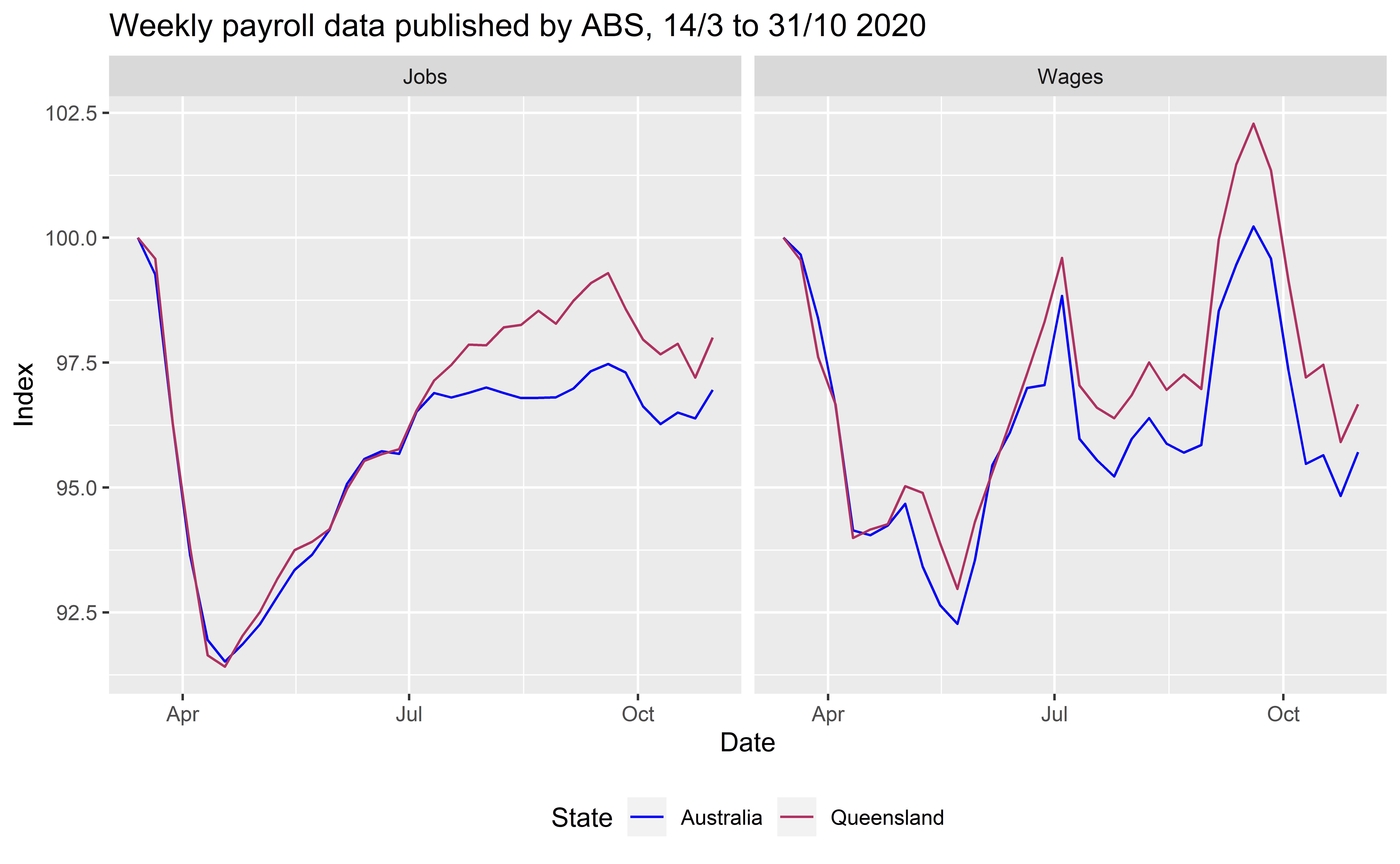
I think it’s way too soon for the Treasurer to claim more people are working now than were pre-COVID, particularly since the Treasurer’s statement isn’t supported by the payroll jobs data released by the ABS earlier in the week (see chart below), data which admittedly aren’t seasonally adjusted but which are based on Single Touch Payroll data provided to the ATO by the vast bulk of employers (i.e. a much bigger data set than the Labour Force Survey). According to the payroll data, at the end of October, there were around 2% fewer jobs in Queensland than in mid-March, just before social distancing restrictions were imposed. Total wages were 3.3% lower than in mid-March. Note the seasonality in the data whereby wages paid spiked in late September and early October during the school holiday period.

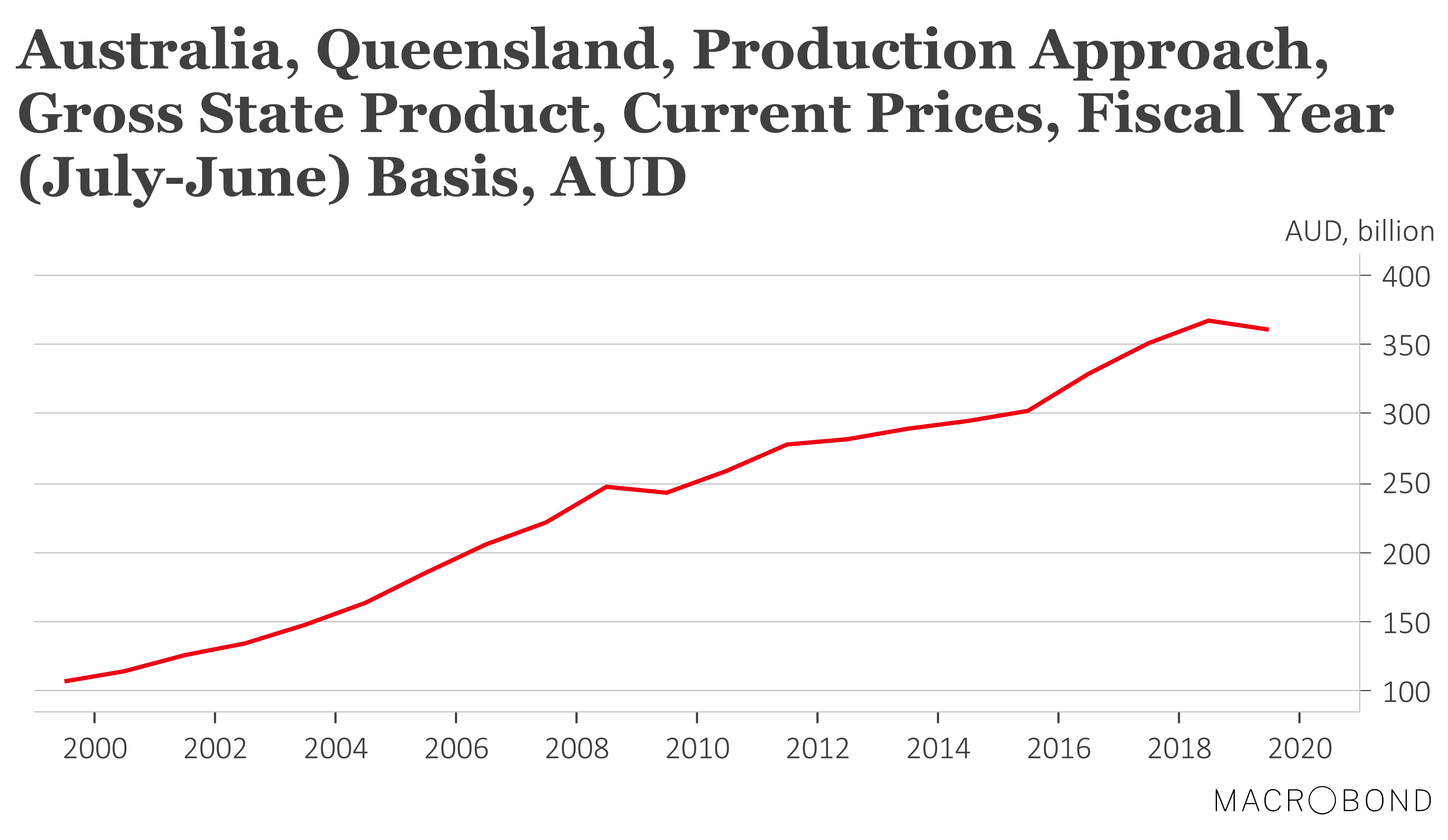
Finally, I should note the ABS State Accounts data were published yesterday and revealed a 1.8% fall in the nominal dollar value of Queensland’s Gross State Product in 2019-20 (see chart below). Queensland was the only state or territory to experience a nominal decline, which was a result of lower coal and LNG prices. Furthermore, as the ABS, reports, for nominal GSP, this was “the state’s first fall in recorded history” (i.e. since 1990, when the ABS started estimating state GSP).

Queensland also experienced a 1.1% decline in real GSP compared with a 0.3% decline nationwide. As the ABS notes:

Queensland recorded a larger contraction compared to the national result due to larger falls in private investment.

I’ll have a closer look at the State Accounts data in a future post.

Please feel free to comment below and let me know whether you agree or disagree with the Treasurer’s view that “more people are working in Queensland now than before the start of restrictions.” Alternatively you can email comments, suggestions, or hot tips to contact@queenslandeconomywatch.com

Posted in Uncategorized | Tagged , , , , , , , , , , | Leave a comment

Good news super guarantee hike could be scrapped

The long-awaited retirement income policy review report from former IMF Director and Treasury deputy secretary Mike Callaghan is looking good based on reporting by the Financial Review:

Increasing the compulsory superannuation rate could disadvantage low-income earners and cut workers’ lifetime income by 2 per cent, the much-anticipated retirement income review has concluded, opening the door for the Morrison government to delay or even scrap legislated rises.

This is great news because continuing with the scheduled increases in the super guarantee rate, progressively increasing it to 12% by mid-2025, would be really bad policy. Among other reasons, Grattan Institute modelling suggests it won’t actually provide much of a benefit to many workers, as they’ll just end up with lower age pensions (due to means testing), and it would also be very bad macroeconomic policy to increase savings while the economy remains well below its potential, which could be the case for the next few years at least.

I’ve previously supported scrapping the super hike, on QEW (Imperative to avoid bad policy measures like super increase which would set back recovery) and in an article co-authored with Adept Economics Research Officer Ben Scott (Super Guarantee hike should be scrapped or delayed).

It will be interesting to see what specifically the review says about how “Accessing home equity is an under-utilised opportunity.” It sure is, given all the asset-rich, cash-poor retirees living in Australia’s capital cities, but changing policy settings (e.g. pension assets/means test) would be politically toxic. Look at all the trouble the Opposition’s franking credits and negative gearing policies caused it in the 2019 election, for example. Perhaps the Government will provide some type of incentive to encourage reverse mortgages, although ASIC has previously cautioned against reverse mortgages according to this ABC report because they’re not well understood by people. It’s going to be interesting to see how the government responds to what is sure to be a very important report, one that could justify big changes to our retirement income policies.

Posted in Uncategorized | Tagged , , , , , , , | 2 Comments

Megaprojects chat with Marion Terrill from Grattan

The Queensland Government’s troubled Cross River Rail project is a good example of a multi-billion-dollar Megaproject at risk of cost blowouts and falling short of projected benefits, as I posted on last week (Cross River Rail scrutinised by Grattan and AiP) following the publication of a new report by the Grattan Institute. On Monday, I recorded a podcast interview with Marion Terrill, Transport & Cities Program Director at Grattan, who was lead author of The rise of megaprojects: counting the costs. The interview is now available as the latest episode of my Economics Explored podcast via iTunes, Spotify, etc. and you can even listen via the player below in this post (on the QEW website rather than in the email version of post).

Issues of discussion include:

  • Why megaproject costs blow out (5:20)
  • Optimism bias (12:00)
  • What Nassim Nicholas Taleb said about megaprojects in Antifragile (17:15)
  • How we can improve infrastructure project selection and management (22:50)

Here’s a sample of some of Marion’s great insights (from 12:45):

…there’s a couple of different stages at which optimism bias can kick in. So when a politician or an official makes the first cost announcement or cost promise, they probably don’t know all the possible complexities, but the margin that they might build in for that is generally nothing like enough. We see that time and time again, that the initial cost announcement is sort of assuming everything’s perfectly simple and goes perfectly smoothly. And the cost estimators are also very hamstrung, I think, in their ability to do good cost estimates, because we don’t collect data on finished projects in any useful format.

And what that means is, for example, in the report, one thing we’ve looked at is business cases that are in the public domain, we looked at the P-50, or the median cost system as compared to the P-90, or the worst case cost estimate if you like. And the typical differences are that a P-90 estimate is about 7% higher than a P-50 estimate. So that is not much more money between what you think is going to happen and the worst-case option. And when we looked in the data for 19 years, what we found is that should be more like 49% higher. That’s massively higher. So, you can see the lack of data supports a process of cost estimation, that makes insufficient provision for what history has told us is quite likely to happen.

And then there’s a final stage to this, which is when this goes to market. A lot of companies have been quite vocal this year and last year about them not making money. When I say to people, well, why is your company bidding for these jobs when you can’t make money? The feeling that comes out is essentially optimism bias. They want the job and they think, oh, we’ll find a way. They’re kind of inclined to see the advantages and to minimise all the things that could go wrong. And that’s perhaps what it takes to get the job. But it’s given rise to a lot of angst in industry.

I hope you enjoy our conversation.

Please feel free to comment below. Alternatively you can email comments, suggestions, or hot tips to contact@queenslandeconomywatch.com
Posted in Uncategorized | Tagged , , , , , , , , , , | 2 Comments