Christmas Eve post-6pm public holiday should have been repealed in this year of COVID

A prominent Brisbane man about town and long-time QEW reader has reminded me that last year I posted on the ridiculous Christmas Eve half-day public holiday, and he said that it was particularly costly in this year of COVID. Here’s a great note he sent me which I’m grateful he’s given me permission to publish:

Gene, this is an old post on Christmas Eve penalty rates, but worth revisiting.

In a Covid year when small business and marginalised workers (casuals, part timers, students, etc) have had it rough, it appears that a poor policy decision has kicked an own goal for Queenslanders.

2020 Christmas Eve activity in South East Queensland was DEAD, especially from mid afternoon onwards. Retailers, restaurants and hospitality venues all appeared very quiet. It looks like they closed early, rather than pay huge penalty rates on what used to be a big retail and hospitality evening. Imagine what activity and employment has been missed because of this poor policy decision?

This high wage structure pushes shoppers further into the arms of online retailers, making it harder for our students and part timers to find local work.

It is to be hoped that the retail peak bodies get this data and use it as evidence that the extra public holiday declaration has backfired on the Queensland community.

It would also be great for union leaders to hear from these marginal workers who missed out on work and much needed income. It might help arrest the decline in private sector union membership if their voice was heard.

Given Queensland’s parlous employment situation, we need every opportunity available to grow our economy and create jobs.

I fully agree with my long-time reader’s excellent remarks.

Please feel free to comment below. Alternatively, you can email comments, questions, suggestions, or hot tips to contact@queenslandeconomywatch.com

Retail has been very challenging in this year of COVID, so why make it more difficult with unnecessary public holidays and penalty rates?

Posted in Labour market, Macroeconomy, Retail trade | Tagged , , , , , , , , , , , | 4 Comments

Bulk of coal mining jobs in Central Qld, but Brisbane has 2-3K

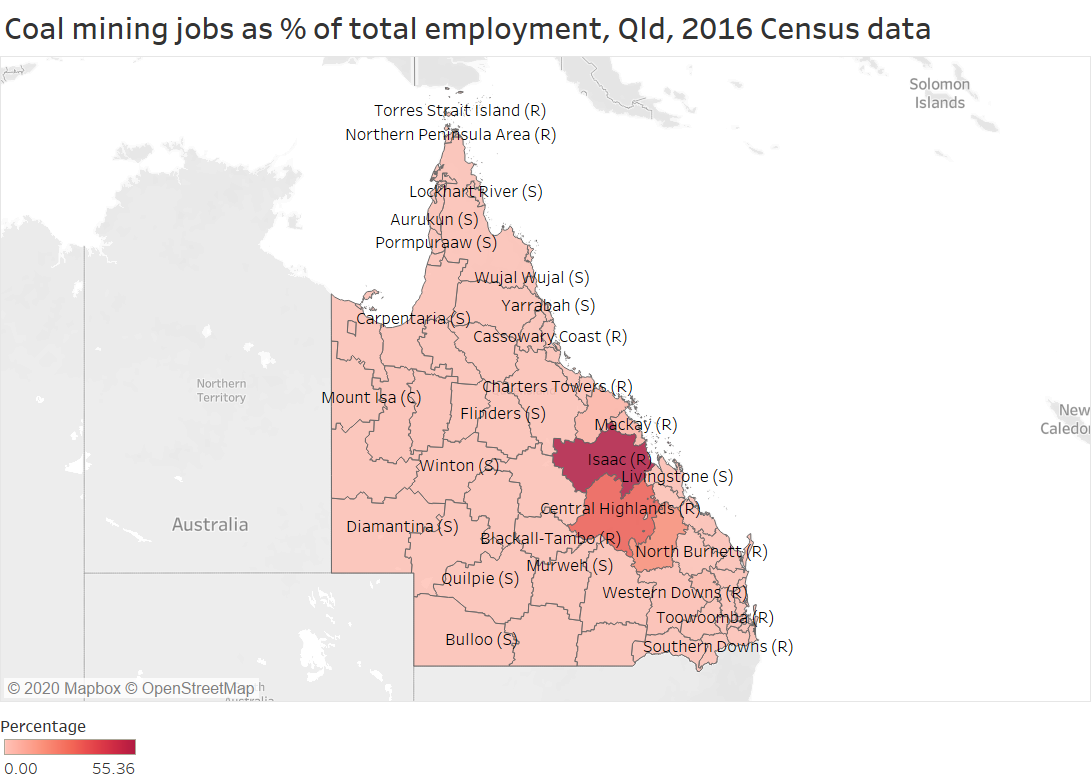
Last Wednesday, I was pleased to note that the Chinese ban on Australian thermal coal appears to have had little impact so far (check out Pick up in thermal coal prices over last month). This is good news especially for Central Queensland where coal mining is a very important contributor to the regional economy. For instance, it accounts for over half the jobs in the Isaac Local Government Area which hosts over two dozen coal mines (see map below, based on ABS 2016 Census data accessed via Queensland Treasury’s very useful Queensland Regional Database).

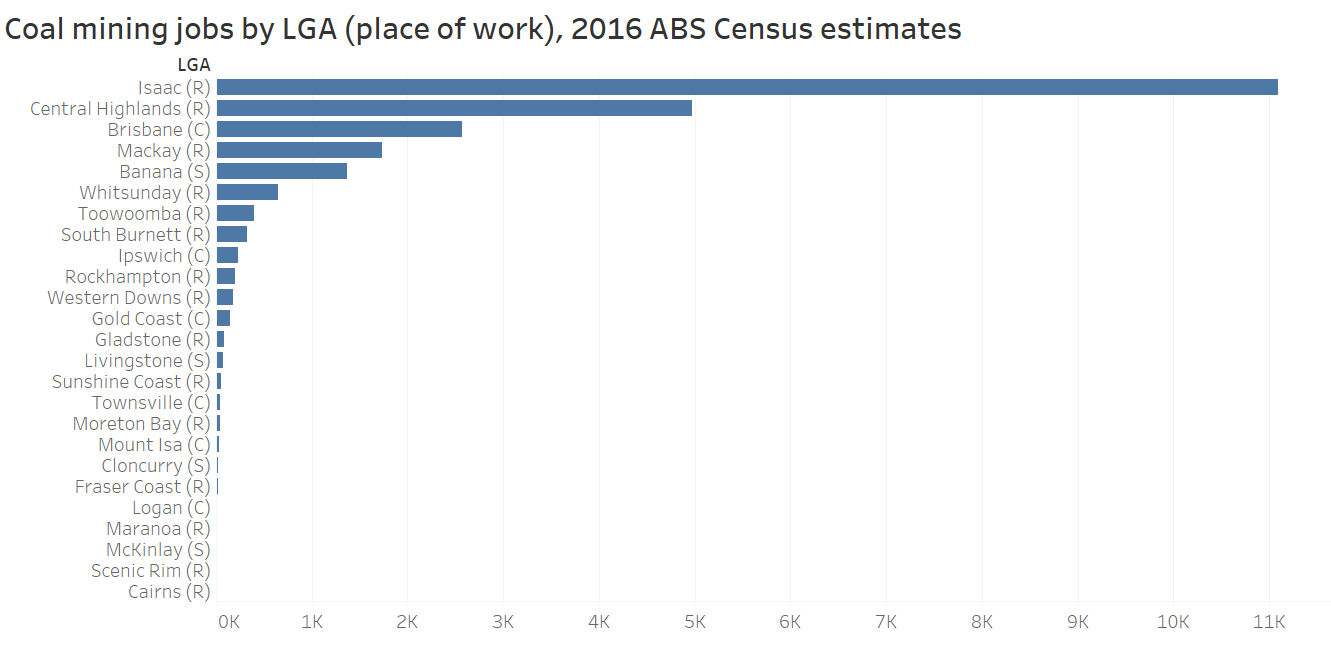
It turns out there are up to a few thousand coal mining jobs in Brisbane LGA (see chart below). These must be jobs in the corporate offices of coal miners, given the Census data I’m using are on a place-of-work basis. These figures do not include jobs indirectly supported by coal mining. For estimates of jobs both directly and indirectly supported by the resources sector in Queensland, check out the QRC’s economic contribution estimates, but do note the limitations of these estimates (e.g. see the Australia Institute’s recent commentary).

Please feel free to comment below. Alternatively, you can email comments, questions, suggestions, or hot tips to contact@queenslandeconomywatch.com
Posted in Brisbane, Mining | Tagged , , , , , , , , , | Leave a comment

Regulating Big Tech – my latest podcast episode

It’s been a challenging year 2020, but one positive development is that regulators in the US and Australia have started challenging the Big Tech companies Google and Facebook over alleged misuses of market power. The US Department of Justice is taking on Google over its search dominance and the Federal Trade Commission is taking on Facebook over allegedly restricting competition by buying up potential competitors such as Instagram and WhatsApp. In Australia, the Media Bargaining Code designed to assist traditional media companies negotiate for a share of ad revenue with Big Tech is currently being considered by a Senate committee. In my latest Economics Explored podcast episode Regulating Big Tech, I provide an update on moves by governments and regulators, and I discuss the relevant economic concepts and policy issues.

Links relevant to the conversation include:

Joseph Stiglitz on Regulating Big Tech

Don’t Be Evil: The case against big tech by Rana Foroohar

Australian Treasury Laws Amendment (News Media and Digital Platforms Mandatory Bargaining Code) Bill 2020

Economics Explored EP58: Tech Giants challenged by the Media and Governments

Economics Explored EP22: Antitrust with Danielle Wood from the Grattan Institute

Economics Explored EP21: Surveillance Capitalism with Darren Brady Nelson

Economics Explored EP16: Big Economic issues for the 2020s

Please feel free to comment below. Alternatively, you can email comments, questions, suggestions, or hot tips to contact@queenslandeconomywatch.com

Posted in Competition policy | Tagged , , , , , , , , , , , , , | Leave a comment

Mutual benefits of free trade recognised in UK-EU deal

UK Prime Minister Boris Johnson has had a big win with the just-in-time UK-EU trade deal, under which it appears the UK will retain access to the common market, with zero tariffs on “most goods” according to the Financial Times. While this can be seen as a huge win for Boris Johnson, partly it’s likely due to EU officials recognising the mutual benefits of free trade between nations.

When a country imposes a tariff, its own consumers and businesses end up paying it (although, in an impressive demonstration of his persuasive powers, President Trump was able to convince many Americans that tariffs on Chinese goods imported into the US would be paid by the Chinese). I should note that, if domestic substitutes to imported goods subject to tariffs are available, tariffs can boost domestic industries, but the protected industries can end up inefficient and unviable without ongoing tariff protection. Consumers and businesses pay higher prices than otherwise. That is what we ended up with in post-war Australia after decades of protection of our motor vehicle and textile, clothing, and footwear industries. Australian consumers are now much better off with cheaper cars and clothes in real terms as a result of successive governments since Bob Hawke’s (arguably, since Gough Whitlam’s) bringing down the once high tariff wall.

Probably the best recent description of the benefits of free trade was provided by federal MP Dr Andrew Leigh in his Lowy Institute paper Choosing Openness, which I attended the Brisbane launch of in 2017 and subsequently reviewed on QEW: Andrew Leigh’s Choosing Openness – highly recommended reading. In the paper, Andrew nicely summarises the benefits of lower tariffs for Australian consumers (on p. 40):

Looking at the prices of a standard basket of goods, the Australian Bureau of Statistics estimates that average prices have risen by 140 per cent since 1987. But the statistical boffins calculate that the average price of shoes has not risen at all, while the price of cars has risen by just 10 per cent. Sellers of shoes and cars could use price stickers from the 1980s and they would still be roughly right.

Andrew also notes the wider variety of products, especially cars, available to Australian consumers since we tore down the tariff wall. And, as Andrew reminds us, the benefits of free trade occur even if your trading partner doesn’t reciprocate:

As economist Joan Robinson once put it, even if your trading partner dumps rocks in their harbour, you do not become better off by dumping rocks in your own harbour.

EU officials appear to understand the mutual economic benefits of free trade, to the considerable political benefit of Boris Johnson, who now needs to devote his full attention to the current COVID crisis in the UK.

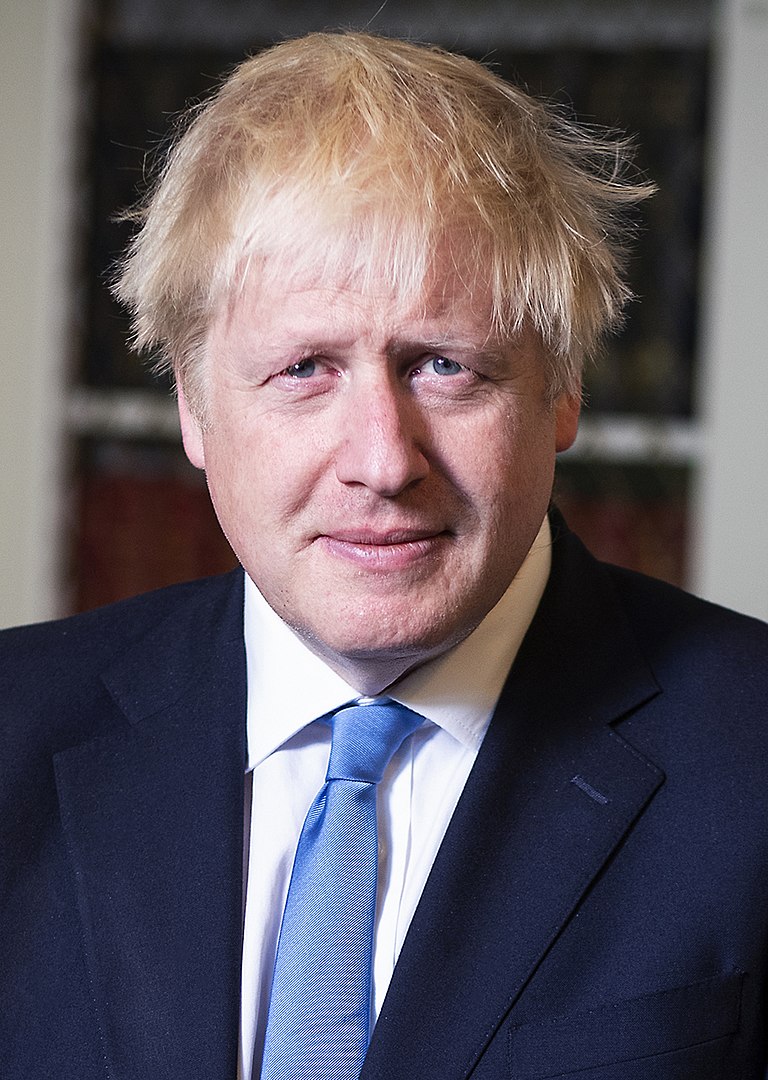
UK Prime Minister Boris Johnson. Official photo by Ben Shread / Cabinet Office, OGL 3, https://commons.wikimedia.org/w/index.php?curid=83764351

Please feel free to comment below. Alternatively, you can email comments, questions, suggestions, or hot tips to contact@queenslandeconomywatch.com
Posted in Trade | Tagged , , , | Leave a comment

Holiday reading – Qld Upper House discussion paper from the IPA

Obviously a lot has happened this year and it’s easy to miss things when they come out, so I’m glad I’ve finally learned about a paper published by the Institute of Public Affairs in October titled  A Voice for the Regions: Proposals for a Restored Upper House in Queensland. Regular readers will know I’ve been concerned about the quality of governance in Queensland for a long time, and, somewhat reluctantly, because it would mean more politicians, I think it would be worth restoring an upper house or at least installing some citizens’ oversight body, as I discussed in my post No Qld upper house means poorly thought through legislation.

The IPA paper by researchers Morgan Begg and Daniel Wild nicely explains the history of the abolition of Queensland’s upper house and its consequences:

Next year will mark the 100th anniversary of the Queensland Labor government’s successful campaign to abolish Queensland’s upper house in 1921.

Abolition was overwhelmingly against the will of the broader Queensland population, with some 61% of Queenslanders voting against abolition in a referendum held in 1917.

While periodic attempts have been made to revive an upper house, Queensland today remains the only state in Australia with a unicameral parliament—that is, without an upper house.

Queenslanders may be proud of this unique feature, but the absence of an upper house has led to three significant structural deficits in Queensland politics and public policy which present an existential threat to the Queensland way of life.

In the IPA’s view, those three deficits are the accountability deficit, democratic deficit, and regional representation deficit, which you can read more about on page 1 of the report. The IPA proposes a range of models for a Queensland upper house, one of which is designed to provide greater regional representation in Parliament. I’m less concerned about an alleged lack of regional representation in the Queensland Parliament than the IPA, so my preference would be for the population-based representation model with a proportional representation voting system (Model 1 on p. 8).

There would be both pros and cons (e.g. possibly some good legislation being held up or modified adversely) associated with restoring a Queensland upper house, so we’d want to have a comprehensive public discussion of it before settling on a model. I’m looking forward to engaging with the IPA on the Queensland upper house concept in the New Year and promoting a public conversation on it.

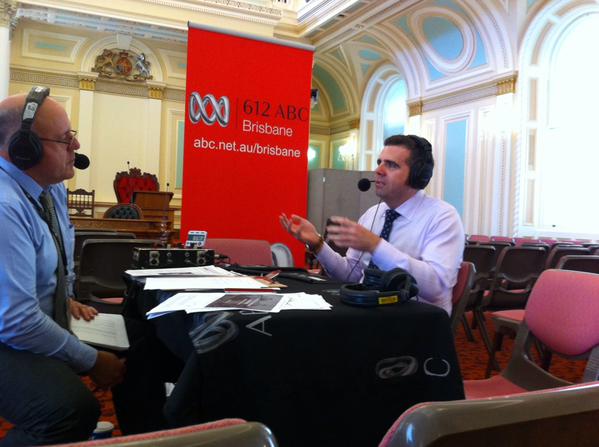
The chamber of Queensland’s defunct upper house, the Legislative Council, is now used for functions and the occasional radio broadcast. This photo is of me chatting with 612 ABC Brisbane’s Steve Austin on the first day of Parliament for the newly elected Palaszczuk Government in 2015.

Posted in Queensland Government | Tagged , , , , , , , | Leave a comment

Pick up in thermal coal prices over last month

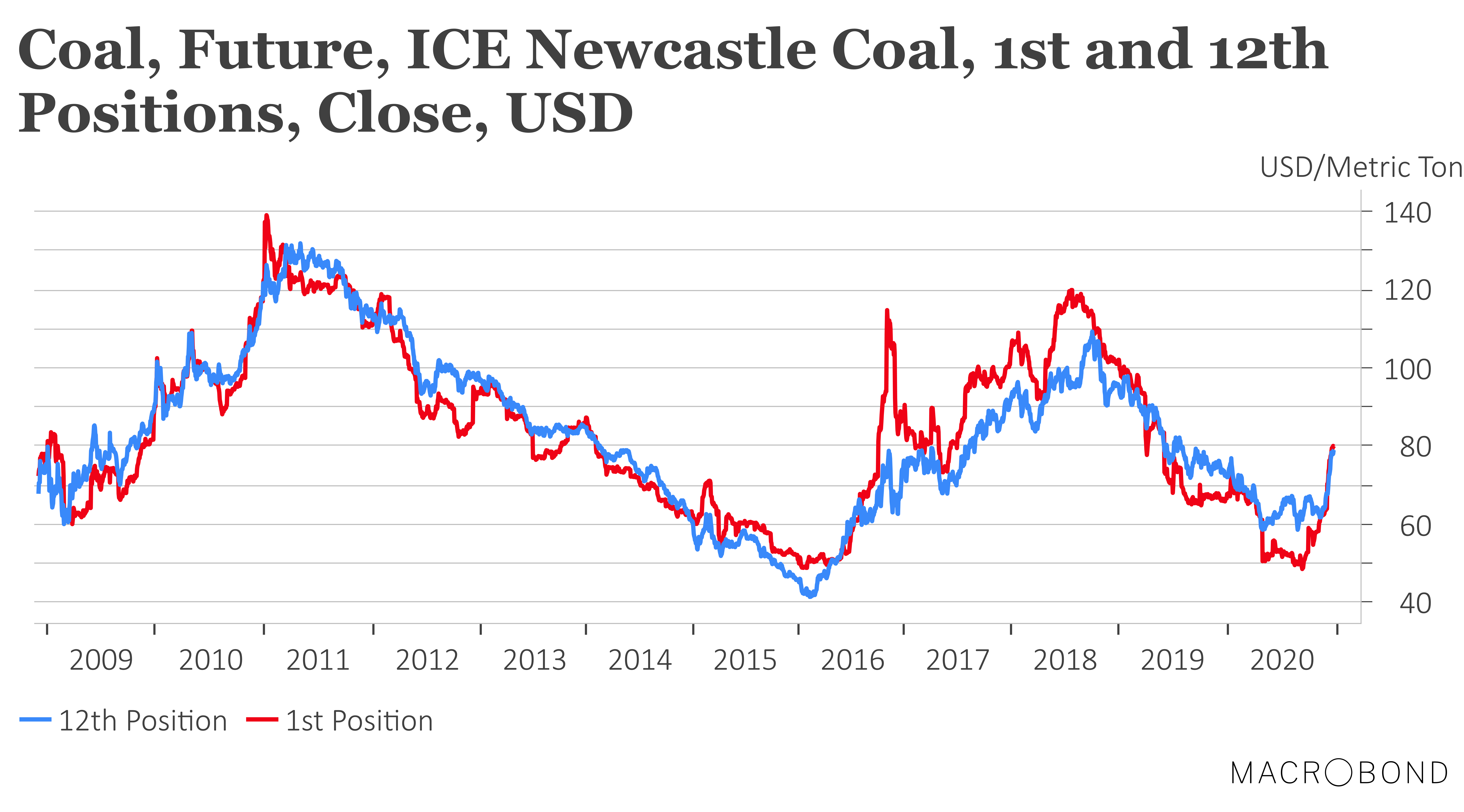
Unlike in WA where iron ore is the major commodity, in Queensland it’s coal that’s the big deal, and we should be thankful the Chinese ban on Aussie thermal coal doesn’t appear to have been that effective, as evidenced by Australian thermal coal prices increasing over the last few weeks (see chart below, noting 1st position refers to futures contracts for December 2020 and 12th position refers to contracts for November 2021). This is great news, as I’ve been very concerned about the implications for Queensland’s economy of Chinese trade restrictions.

The Financial Times, in an article published yesterday, Coal prices rally on strong Asian demand and tight global supplies, explains:

Despite the lack of Chinese buying, Australian thermal coal prices have also surged in recent weeks.

Higher China demand has pushed up the price of Indonesian, Russian and South African coal, allowing Australian producers to push material into less traditional markets of Bangladesh, Turkey and India.

While the increase in the thermal coal price is welcome, I think it needs to go higher still (to say US$100/tonne) to guarantee the ongoing viability of several thermal coal mining operations across Queensland.

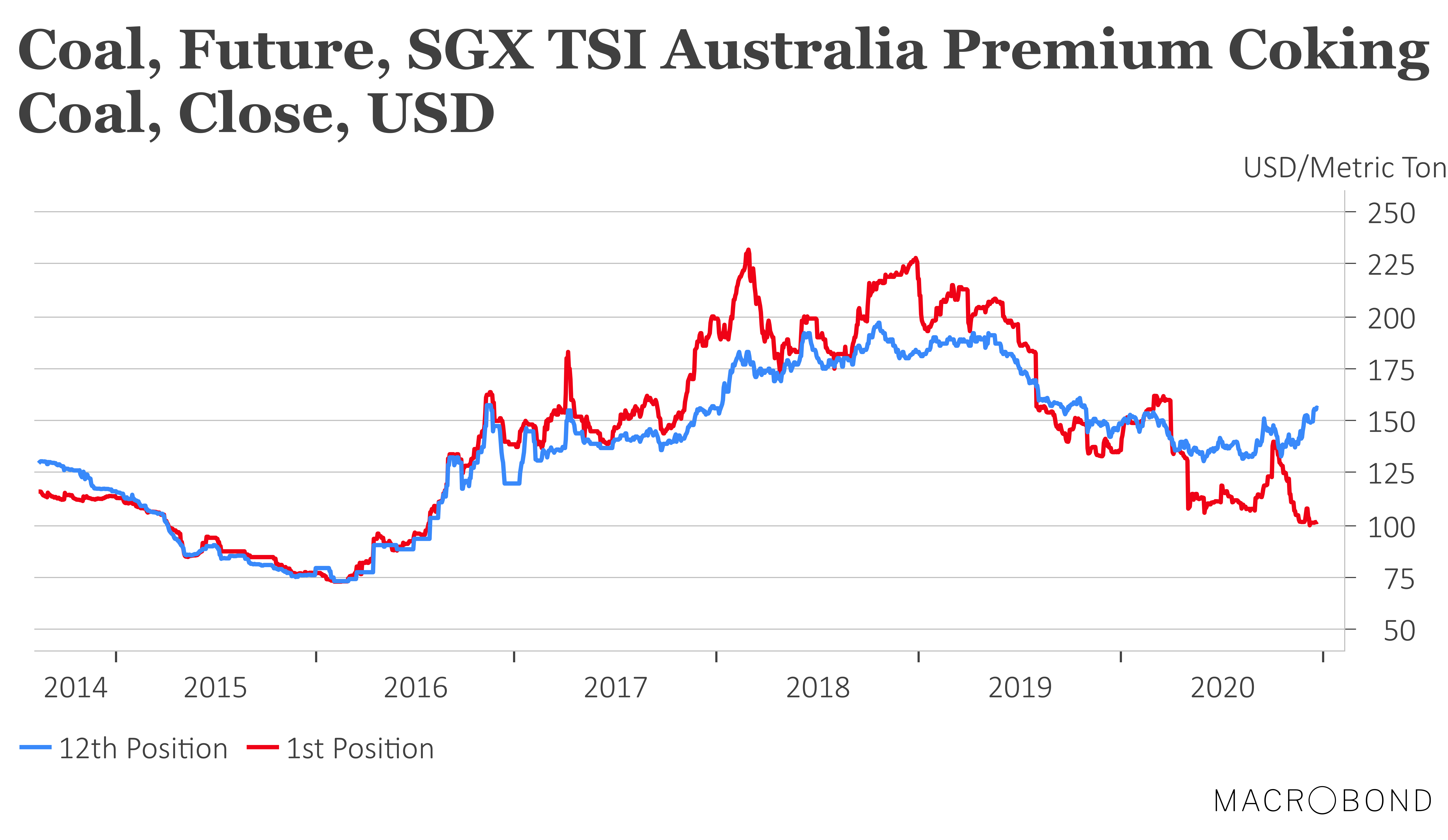
I should also note we’re yet to see a pick up in the more important (for Queensland) coking coal price, although it is expected to recover over the next twelve months (see chart below).

Please feel free to comment below. Alternatively, you can email comments, questions, suggestions, or hot tips to contact@queenslandeconomywatch.com
Posted in China, Mining | Tagged , , , , , , | Leave a comment

Brisbane Inner City still the biggest beneficiary of Qld Gov’t CAPEX

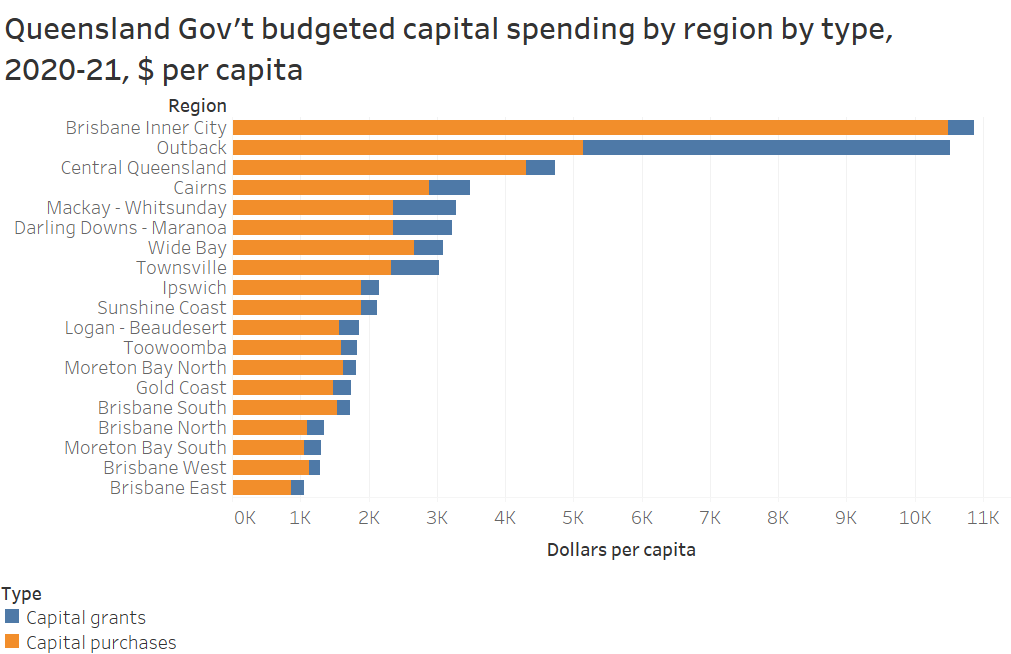
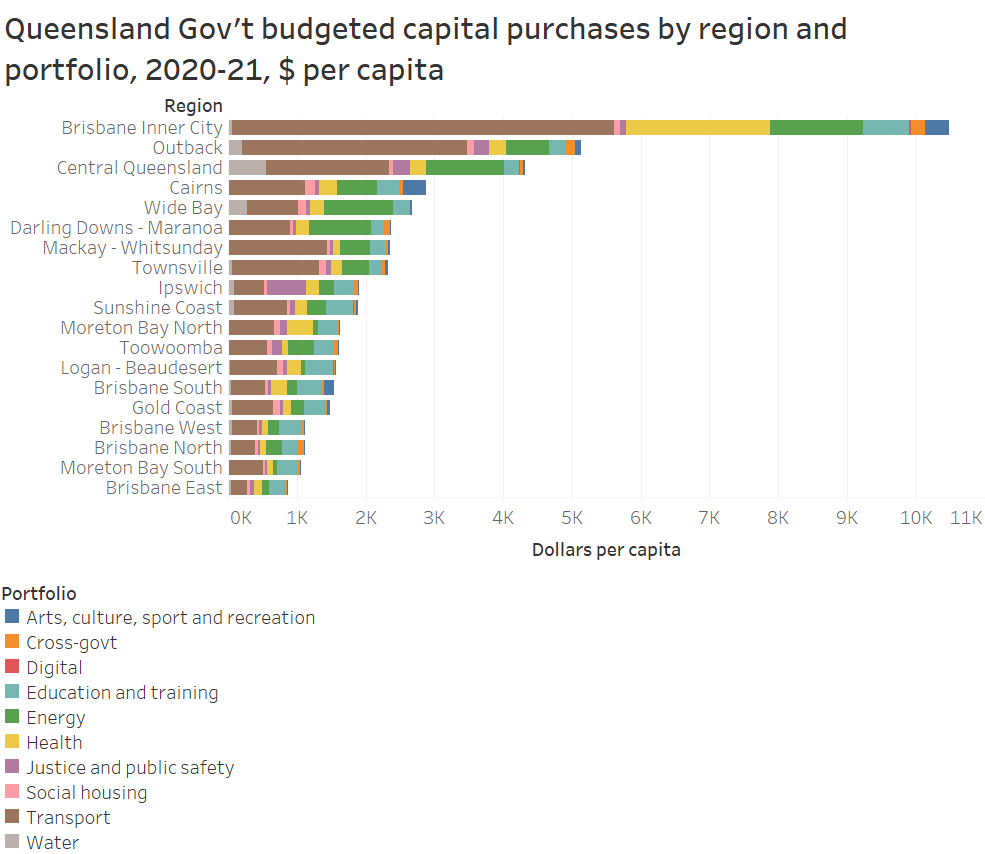
Following last year’s state budget, I posted on how Brisbane’s inner city was the big winner regarding state government capital spending. That continues in 2020-21 with the continuation of the huge Cross River Rail project (see chart below). Out of budgeted state government capital purchases of $12.6 billion in 2020-21, $3.1 billion is budgeted to be spent in inner Brisbane, with transport projects (largely Cross River Rail) accounting for $1.7 billion of that. Of course, people across the metro area can benefit from projects in inner Brisbane, but it still looks like a huge disparity to me. Arguably, the state government should be investing less in inner Brisbane and more in suburban activity centres, particularly post-COVID if many people continue working from home.

If we add in the $2.2 billion of capital grants the state government makes, state government capital spending in the outback jumps up a lot. This is probably due to Queensland’s numerous Outback councils getting grants for capital works projects from the state government (see chart below).

The capital spending data used in this post can be found in the state government’s Budget Paper 3-Capital Statement. The population estimates for 2020-21 were based on ABS estimates for 2018-19 and the state population growth estimates for 2019-20 and 2020-21 presented in Budget Paper 2-Budget Strategy and Outlook. Thanks to Adept Economics Research Assistant Taylor-Rose Hull for her assistance with gathering the data.

Please feel free to comment below. Alternatively, you can email comments, questions, suggestions, or hot tips to contact@queenslandeconomywatch.com
Posted in Brisbane, Budget, Infrastructure | Tagged , , , , , , , , | Leave a comment

South Bank theatre with $25M cost blow out shouldn’t have been funded by Qld Gov’t in first place

Yesterday, the Brisbane Times reported COVID-19, airconditioning blamed for South Bank theatre cost blowout. The new $150 million state-government-provided theatre attached to QPAC at South Bank will cost an extra $25 million. And the project is less than one quarter done, so there may be further cost blow outs. In my view, the theatre shouldn’t have been approved and funded in the first place, as it wouldn’t stack up. The cost blowout will substantially reduce what I always thought would be a pretty low benefit-cost ratio.

In my 2015 post New 1,500 seat theatre would likely be a waste of taxpayers’ money, I argued the new theatre was a bad idea on both efficiency and equity grounds. I then doubled down on my opposition to the theatre in response to a critique of my position by the Courier-Mail’s Paul Syvret, which you can read about in my post Courier-Mail’s Paul Syvret on my “coldly commercial prism”.

Finally, my opposition to the project was strengthened when I learned the government was actually crowding out the development of a private-sector-run theatre at the old State Library site on William St, as I discussed in my 2018 post Better to let the private sector risk money on a new Brisbane theatre.

The new South Bank theatre is a poor public project which should never have been approved and funded by the state government.

The Playhouse QPAC at South Bank Brisbane. Photo by Jennifer Tunny.

Please feel free to comment below. Alternatively, you can email comments, suggestions, or hot tips to contact@queenslandeconomywatch.com
Posted in Brisbane | Tagged , , , , , , , | Leave a comment

Where Queensland’s coal exports go

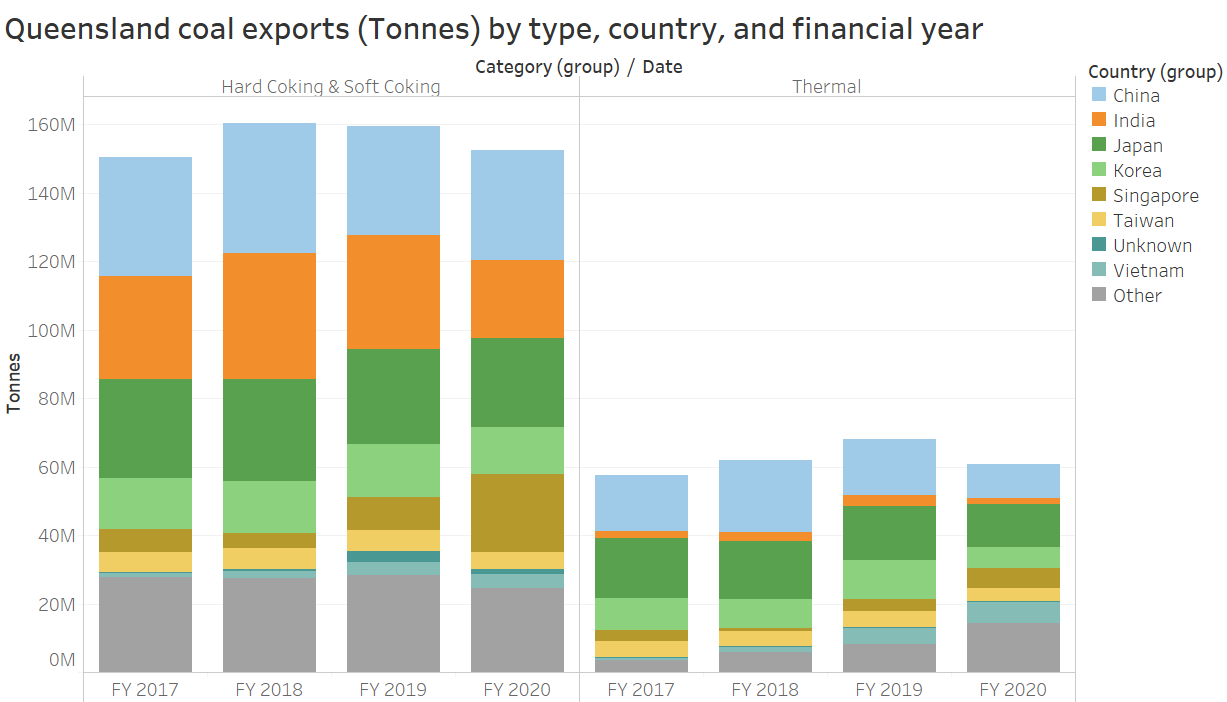
In my post last Tuesday, PM puts China’s Aussie thermal coal ban in perspective, I noted how China’s Aussie coal ban would be much more concerning if it also applied to coking coal, which is more valuable per tonne and which Queensland produces more of than thermal coal. The Queensland Government Department of Natural Resources, Mines and Energy publishes some great statistics on the state’s coal industry. The quarterly exports data provides a fascinating breakdown of exports by coal type by country. We see that Queensland exports coal to a diverse range of economies, with Japan and India very important export markets along with China (see chart below). The “Other” grouping in the chart below includes 36 countries, in Asia, the Middle East, Africa, Europe, and South America.

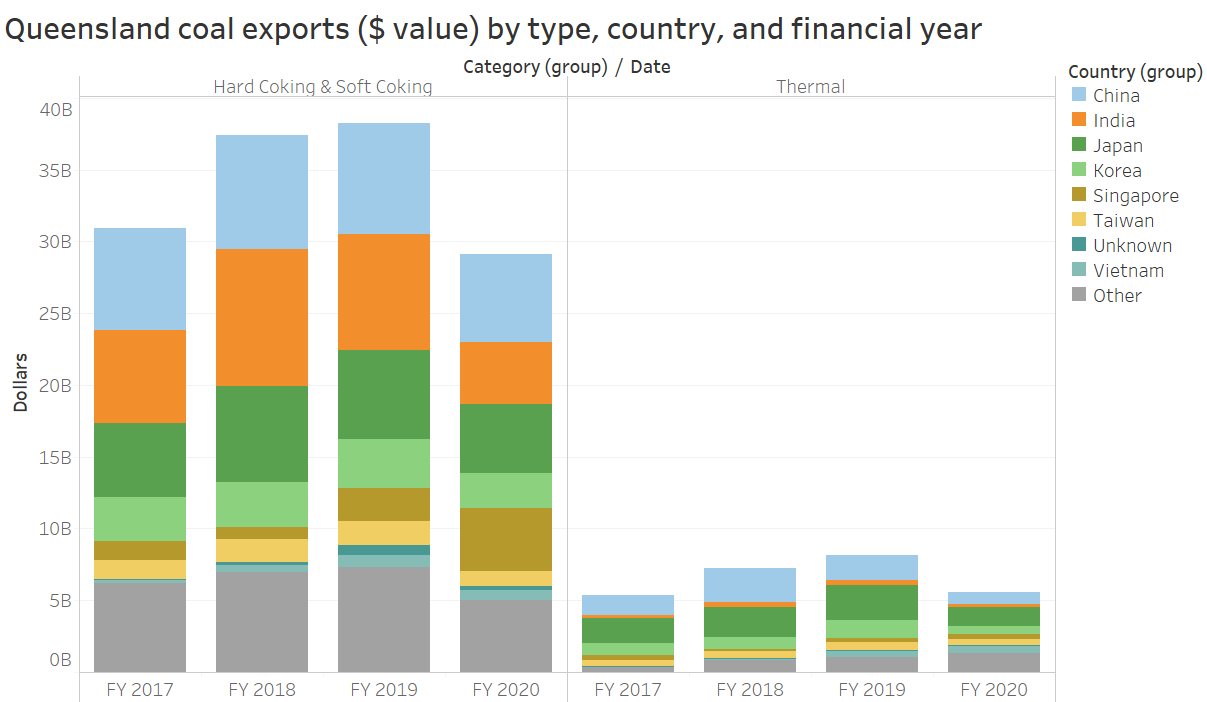
The dominance of coking (a.k.a. metallurgical) coal is even more pronounced if we look at the dollar values of exports (see chart below). Note how much the value of coal exports can fluctuate from year-to-year due to changes in coal prices, which can be substantial.

Overall, the data suggest China’s ban on our thermal coal will be costly, particularly if we can’t find alternative customers, but it shouldn’t be devastating.

Please feel free to comment below. Alternatively, you can email comments, suggestions, or hot tips to contact@queenslandeconomywatch.com
Posted in China, Mining | Tagged , , , , , , , , , , | 2 Comments

Bad news for Qld tourism as border restrictions being re-imposed

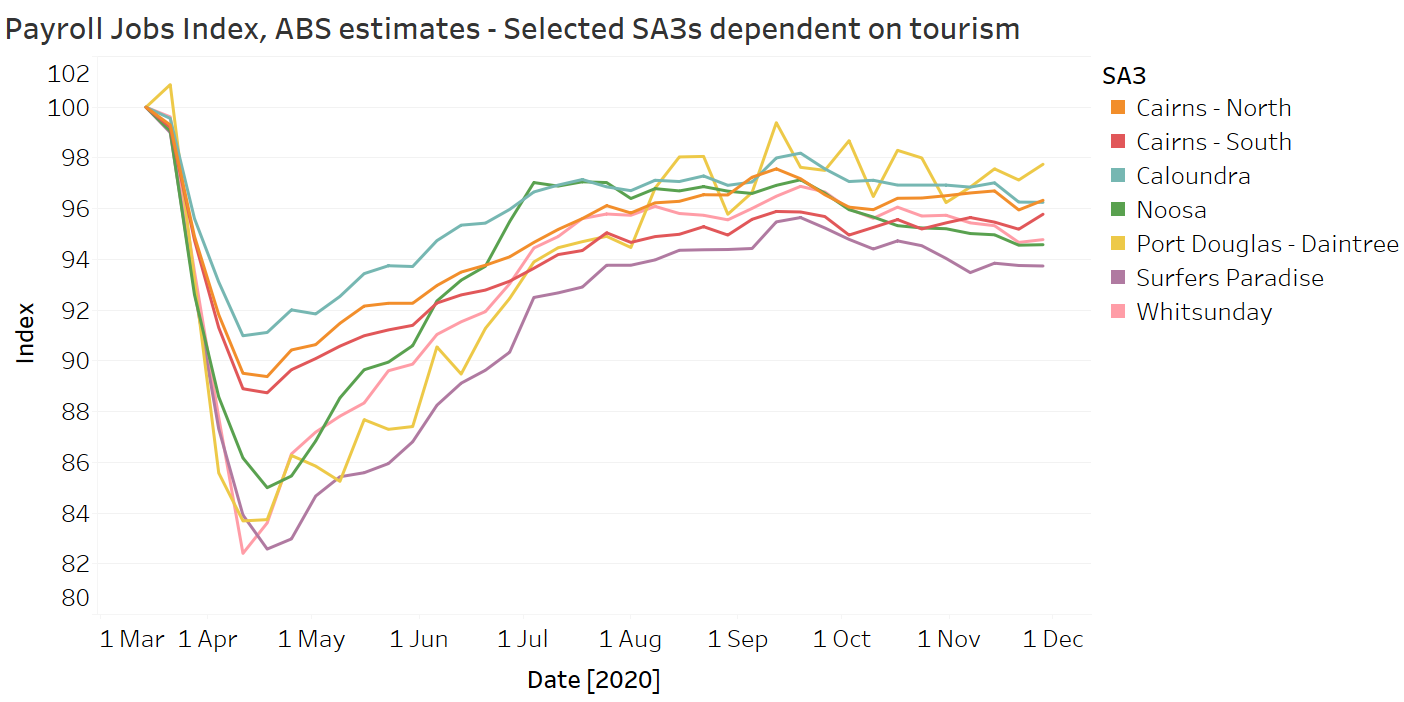
Just a few weeks ago, the Queensland Premier was telling Sydneysiders she wants them to come to Queensland, but now they need a COVID test on arrival and need to isolate until they’re cleared, as the state tightens the border restrictions in response to the Northern Beaches cluster. The Brisbane Times is reporting Qld slaps travel restrictions back on NSW, but no hard borders yet. While it’s not a hard border yet, there’s a non-trivial chance one will be re-imposed. Many Sydneysiders may decide not to come to Queensland for Christmas holidays after all, as it’s all too much trouble and there’s too much risk they’ll suffer due to a quarantine requirement being imposed suddenly. It’s all terrible news for our tourism sector, which still isn’t back to normal (e.g. see the chart below based on the ABS payroll jobs data) and is counting on a bumper Christmas holidays season to help make up for losses earlier in the year.

Let’s hope community transmission of COVID hasn’t spread beyond Sydney’s Northern Beaches, but, given the dozens of cases in the Northern Beaches already, it may easily have got out to the rest of the metro area and may have been spreading over the last few days. A hard border with NSW again is a serious possibility. 2020 still isn’t done with us.

Posted in Tourism | Tagged , , , , , | 2 Comments