Update on regional unemployment in Queensland

As I’ve commented on before (Good news for regional Qld if Carmichael mine goes ahead – jobs market weaker than in SEQ), over the last twelve months or so, there has been a large difference in employment growth between SEQ and the rest of Queensland. Mark Beath at Loose Change has produced a good chart based on Pete Faulkner’s trend labour force estimates showing this stark difference, which you can view at his post: Cairns employment disappoints in October. Weaker labour market conditions in the rest of Queensland have been reflected in relatively high unemployment rates in several regional areas, including Townsville, Cairns and Wide Bay (see map below based on Queensland Treasury’s 12 month moving average estimates of the original ABS data).
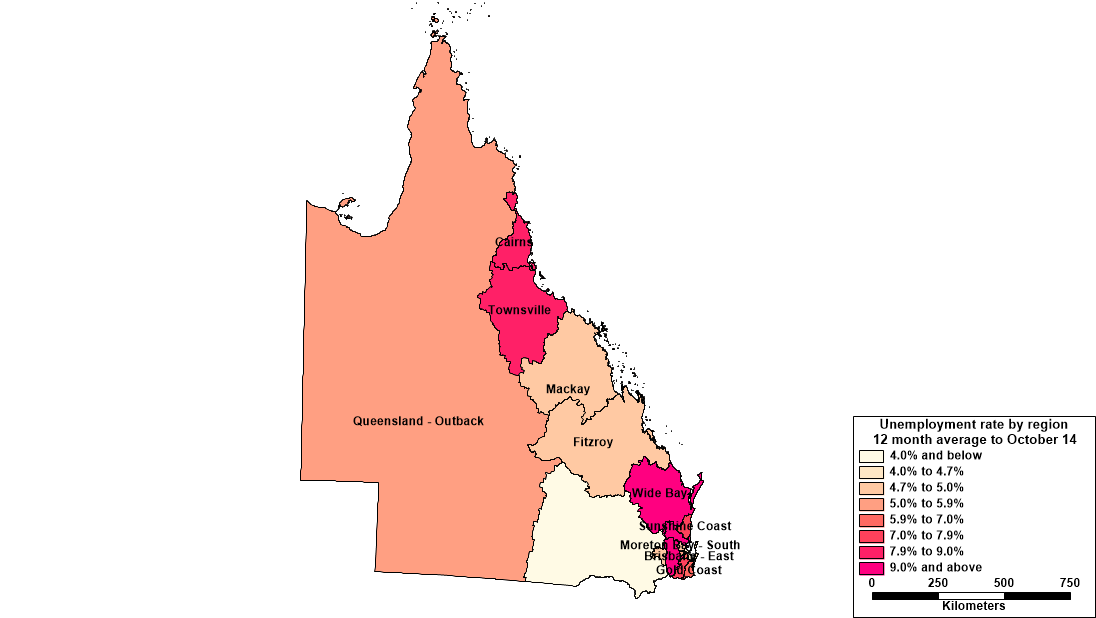
Unemployment_Oct 14_SA4_Qld

That said, any growth in employment in SEQ appears to be benefiting mostly people living in Brisbane’s Inner City, North and East, with relatively high unemployment rates in some other parts of SEQ, such as Ipswich and Moreton Bay – North (see map below).
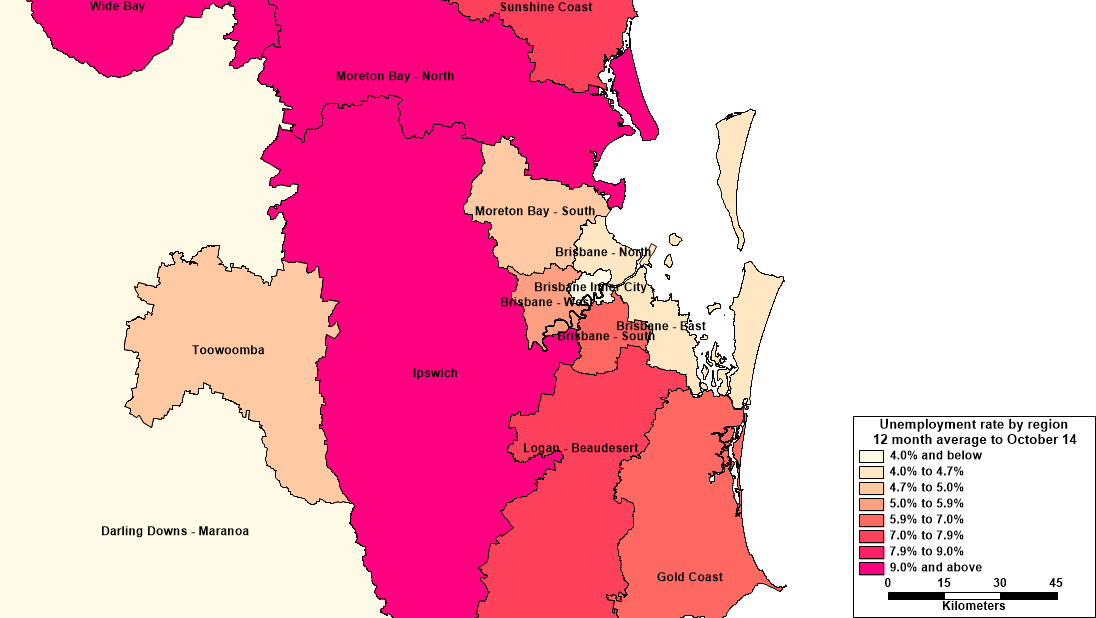
Unemployment_Oct 14_SA4_SEQFor more commentary on regional employment trends, see Pete Faulkner’s post:
Cairns jobs worsen while Townsville sees improvement

Posted in Labour market | Tagged , , , , , , , , | Leave a comment

Link to ABC radio interview on G20 and Expo 88

I expanded on the points I made in my post from early this morning (G20-Expo comparison is weird) in an interview on 612 ABC Brisbane by Steve Austin later in the morning, which you can listen to at this link:

Why the G20 doesn’t measure up to Expo 88

The important point I made about having to compare hotel occupancy rates during G20 with what they would otherwise have been at this time of year came from one of my loyal readers who commented on my post this morning. Thanks Jim!

Posted in Brisbane | Tagged , , , , , | 2 Comments

G20-Expo comparison is weird – Expo was a positive economic shock, G20 is a negative one for Brisbane

The Science and Technology Minister’s comparison of G20 to Expo is weird (see the Brisbane Times report G20 will give Brisbane an Expo 88 boost – Minister). I won’t deny there might be some long-term benefits from connections made and deals brokered at G20 side events, or that participating in the G20 is in Australia’s national interest, but it’s pretty obvious to me that the short-term impact of the G20 on Brisbane will be largely negative, while the impact of Expo was hugely positive.

Based on what many of my friends are up to, and on anecdotal reports from holiday destinations on the Gold and Sunshine Coasts and at Byron Bay, there will be an exodus from Brisbane over the G20 long weekend. I expect the negative economic impact of this exodus on Brisbane will more than offset any economic boost from visiting G20 leaders, their entourages and hangers-on. Contrast the expected impact of G20 with Expo 88, which had millions of visitors, and saw huge flows of people into Brisbane from elsewhere in Queensland, Australia and across the world. G20 is an event for a tiny global elite, while Expo was an event for the masses.

Furthermore, Expo has had huge, long-lasting impacts through the transformation of what was formerly a largely industrial area into a vibrant recreational precinct, South Bank.  I doubt the impact of G20 on Brisbane will be as long-lasting.

Posted in Brisbane | Tagged , , , , | 12 Comments

Goss Government was strong on economic management, possibly to its political detriment

It was sad news indeed today that Wayne Goss has died at what is now a relatively young age of 63. He certainly made a fine contribution to Queensland during his years as Premier. In addition to the electoral and social reforms that are being widely commented on, his Government made important economic reforms, such as the corporatisation of Queensland Rail. Furthermore, his Government was committed to maintaining Queensland’s AAA credit rating and low tax State status.

But the Goss Government’s strong economic management was unpopular with many in the Queensland community and ultimately cost it votes. Cuts to rail services were very unpopular in regional Queensland. And the Government’s commitment to a AAA rating and low tax status meant unpopular restraint in health and education spending.

Given the current fiscal situation Queensland finds itself in, the economic management of the Goss Government is something that should be remembered fondly. As a later Queensland Government showed, once fiscal discipline is abandoned, and the AAA credit rating is no longer seen as something to value, debt can grow quickly to levels not previously contemplated, as it has in Queensland to $80 billion.

Posted in Budget, Queensland Government, Queensland Rail | Tagged , , , , , , | Leave a comment

Liberty & Society weekend in Sydney for students and recent graduates

I wrote last week about the important contribution the Centre for Independent Studies has made to the Australian public policy debate (Don’t worry, Greg, the protectionists aren’t winning the real race), so I’m happy to recommend its Liberty & Society weekend for students and recent graduates in May 2015:

APPLY NOW FOR THE 8 -10 MAY 2015 L&S WEEKEND CONFERENCE TO BE HELD IN SYDNEY

Do you like to challenge yourself, question the way decisions are made and think seriously about the future of Australia and New Zealand? If you have started exploring the possibilities offered by classical liberal ideas then this conference is an opportunity not to be missed.

The Centre for Independent Studies recognises the importance of exposing, challenging and supporting young people who have an interest in exploring the foundations of a free society. The Liberty and Society student conferences are highly regarded with many participants saying the weekend was pivotal in building their personal philosophical framework.

You can find further details on the CIS website.

This weekend would be particularly valuable to anyone with an interest in economics and public policy. Over the years, a number of leading Queensland public policy thinkers have participated in the weekend, including (i.e. the ones I know about) Alex Robson of Griffith University, a current Deputy Director-General of a major Queensland Government department, and my fellow Economic Society Management Committee member John Humphreys.

I attended what I think was the second Liberty & Society weekend ever held, back in 1997. Queensland participation in these weekends is disproportionately low, so please consider applying if you’re interested, or passing this information on to someone who may be interested. Queensland certainly needs more people who can critically assess public policies put forward by our three levels of governments.

Posted in Uncategorized | Tagged , , | Leave a comment

Any Strong Choices jobs boost will come too late to do anything about current weakness

Unemployment_Oct14

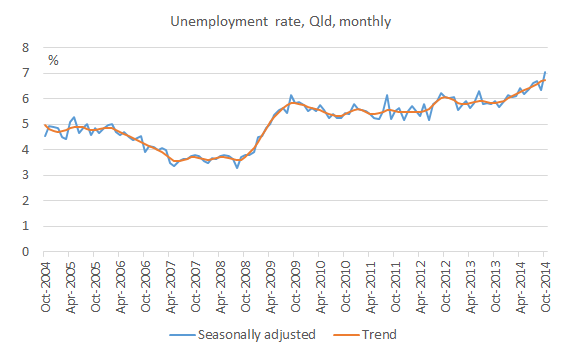
While there is more than the usual uncertainty about the reliability of recent jobs data from the ABS, yesterday’s awful data for Queensland, with unemployment now at 7% seasonally adjusted, can be read as confirming the economy is pretty weak at the moment.  This weakness was also apparent in the retail trade data released by the ABS earlier in the week (see Pete Faulkner’s post Retail trade jumps but QLD lags behind as we ditch print). I expect this weakness will continue for another 3-6 months at least.

The Queensland Treasurer is right to talk about the eventual economic boost to Queensland that will come from LNG exports (see Leases to help Qld jobless rate: Nicholls), but it, along with any projects associated with the Strong Choices infrastructure package, will ramp up over the next few years and won’t help the Queensland economy at the current time. Furthermore, any jobs boost from infrastructure projects would be partly offset by any job shedding as a result of leasing out assets.

Further commentary on yesterday’s labour force data is available at:

Unemployment steady at 6.2% but QLD tanks

Queensland Treasury information brief

Posted in Labour market | Tagged , , , , , , , | 2 Comments

Lease complications mean asset sales a better option

The Government may be having second thoughts about its decision to lease out rather than sell assets, as it’s facing a lot of tricky (and legitimate) questions on what the lease conditions would be from opponents such as the ETU (see Brisbane Times report Queenslanders may be forced into buyback after asset lease). The Government is exposed to criticism because it hasn’t fully thought through its asset leasing proposal and doesn’t yet have the evidence to convince the public of the merits of the proposal. Instead of running the uninformative Strong Choices campaign, the Government should have spent money on a comprehensive cost-benefit analysis of privatisation options and used this analysis to inform and influence the public debate.

That said, I’m in favour of the Government’s plan to lease out assets, because I expect privately managed assets will be better run and the prices of their services will ultimately be lower, but I think Queenslanders would be even better off selling the assets than leasing them out. I expect the proceeds of an asset sale would be greater than those from a lease, because a premium would be paid for actually owning the asset, as I mentioned to Rebecca Levingston on ABC 612 Brisbane in mid-September when the Government’s leasing plan was announced (see ABC radio interview on asset leases).

Posted in Budget, Energy | Tagged , , , , , | 2 Comments

Don’t worry, Greg, the protectionists aren’t winning the real race!

Never one to let a chance go by, Centre for Independent Studies founder Greg Lindsay sent out a great email to supporters of his think tank this afternoon following Protectionist’s Melbourne Cup win:

What a great day for racing! My mother won handsomely on Protectionist but as we know the Australian economy can only thrive by weeding the protectionists out and making sure they are beaten by better ideas for Australia.

We can’t all win the cup but we can all win with a dollar on CIS to deliver the great ideas Australia needs now.

Greg then provided a link to the donations page for the CIS, which is one of the few think tanks in Australia that is worth supporting, due to the consistent high quality of its output and its completely non-partisan stance.

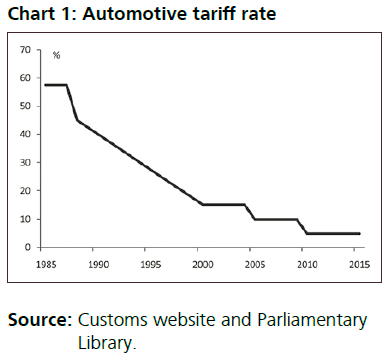
While I wouldn’t want to diminish Greg’s message in any way, I would say that the protectionists clearly aren’t winning the real race. Despite a lot of silly policy still existing, the Australian economy has been profoundly transformed over the last few decades. Microeconomic reform has affected large parts of our economy, and we no longer have a high tariff wall protecting inefficient industries (e.g. see the chart below I’ve copied from my article on car industry assistance published by the CIS in 2011). So, the protectionists aren’t winning, thankfully, and that owes a lot to the intellectual leadership shown by people like Greg and his colleagues at the CIS.

autotarrif

Posted in Industry policy | Tagged , , , , | Leave a comment

Croquet club blunder another reason to shut down Brisbane City Council’s future fund

Brisbane ratepayers are not well served by having their Council involved in property development through the City of Brisbane Investment Corporation (CBIC), with its latest proposed development at East Brisbane suggesting it isn’t meeting important economic or social objectives (see Croquet Club threatened by development).

I’d prefer the Council to simply sell off land it no longer requires rather than to become a property developer and to expose ratepayers to commercial risks, which are heightened due to the Council’s inexperience. So, from an economic perspective, simply selling off the land would be preferable.

While the CBIC appears to have a social as well as an economic mandate, by attempting to achieve self-funding community projects, the fund doesn’t appear to be doing well on its social mandate either. In this case, the community group that is supposed to benefit from the project, the local Croquet club, doesn’t want it because the development will be a huge disruption to members and will deny them a revenue stream from renting out club rooms that will lose their valuable river views when the apartment towers are built.

I’m not suggesting that a prime riverside site such as this one should remain undeveloped for the benefit of a Croquet club, but I think this example demonstrates a risk with trying to mix economic and social outcomes in the one development. You can end up with a development that does a poor job in meeting either economic or social objectives.

The Council should launch an independent review into the performance and future of the CBIC. The fund has previously received significant criticism for its performance (Brisbane City Council ‘future fund’ under fire despite multi-million dollar profit) and this latest blunder raises further concerns about the fund’s desirability.

Posted in Brisbane | Tagged , , , | Leave a comment

Ipswich & rest of Western Corridor suffering disproportionately from Qld’s weak labour market

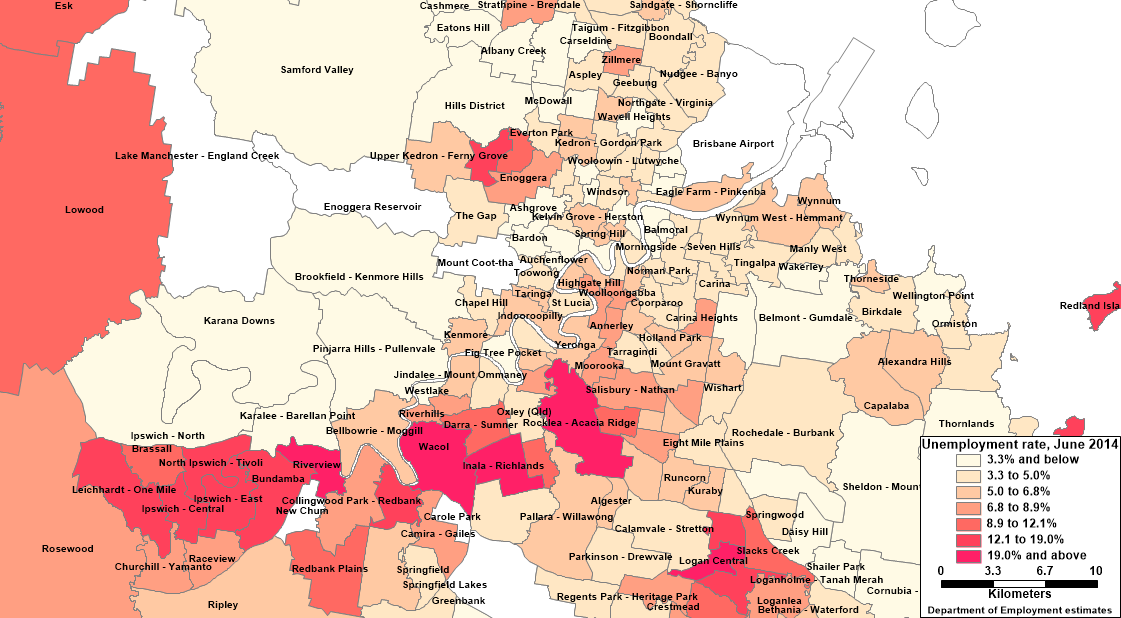
Ipswich and other parts of the Western Corridor are suffering disproportionately from Queensland’s weak labour market, according to the most recent estimates produced by the Department of Employment which combine Centrelink and ABS data (see map below, which can be seen more clearly if you right click on it and open it in another browser window). The Western Corridor includes some small areas with very high unemployment rates. For example, in June 2014, unemployment rates were 26.3% in Wacol, 23% in Riverview and 22.8% in Inala-Richlands. Commonwealth and State Governments should urgently review the factors underlying these high unemployment rates, and consider whether changes to housing, transport or welfare policies might be beneficial.

salm_jun14

Posted in Labour market | Tagged , , , , , | 2 Comments