COP26 chat with Grattan’s Tony Wood – climate change, renewables, nuclear, and coal

In Economics Explored Episode 108, leading Australian energy and climate change policy expert Tony Wood from the Grattan Institute explains what COP26, the 2021 climate change conference in Glasgow, is all about and why it’s important. Tony discusses what “Net Zero emissions” means exactly, the prospects for nuclear energy, and implications of climate change policy responses for fossil-fuel-dependent economies, such as Queensland’s.

Here’s what Tony had to say about an industry that is very important to Queensland, coal mining, after I asked him how many more decades we’ll be able to mine coal:

We haven’t got very long at all…because, despite what the current resources minister says about, well, Australia will decide what happens to our coal industry, the truth is we won’t. Someone else, our customers will decide what happens to our coal industry. And many of our customers have now signed up themselves to net zero. Whether they’re genuine or not, we will see and that’s the international side of this.

So I think the timing may not be as dramatic as BP would suggest. But you can, I think be very confident that the direction and destination is clear. It’s only a matter of how quickly, and this could accelerate quite quickly.

So what that means is the following. We have about 100,000 people employed in what we’ve described in our work as carbon intensive jobs. Those people, in some cases, at the last election I don’t think voted against action on climate change. They voted against losing their jobs. And the Labor Party, to be fair, did not do a very good job at giving those people a vision of what they would transition to…If you’re a relatively young family, man, most of them are men, often not tertiary educated, and you’re being told your job of $150,000, a year is going to go, and you’ll be paid to work in the tourist industry, you’re not very excited by that.

Right. So that’s the problem. Now, are there some alternatives? Yes, there are. And now’s the time, where we do have the economic benefit of all the coal industry right now in terms of the jobs, in terms of the economic prosperity we enjoy, to use that prosperity to fund the next generation of what’s to come…

It’s not about building more renewable energy farms, wind farms, or solar farms. It’s can we use the comparative advantage of Australia, which is a very big country, with a lot of wind and solar that we don’t need for ourselves, to use that to manufacture materials based upon our mineral resources?

You may recognise that Tony is suggesting what Ross Garnaut has referred to as Australia’s Super Power opportunity, and Tony thinks that’s a real possibility for Australia.

Incidentally, coal prices currently remain at high levels (see the thermal coal one-month and 12-month ahead futures prices in the chart below). There’s still plenty of demand for coal globally. Possibly that will change in future years, although so much depends on whether China, Japan, and other major trading partners follow through on their net zero emissions commitments. (Yes, believe it or not, China has a net zero commitment, but for 2060 rather than 2050.) The Queensland coal industry probably has many good years left, but it would be wise for our state government and local councils to be considering the possibility of what Tony has referred to as coal demand “falling off a cliff almost” in the future.

Thermal coal prices have been at very high levels.

By the way, the coking coal price chart is below. Coking coal, which is used to make steel, is even more important than thermal coal to the Queensland state budget, which is getting a multi-billion dollar boost from these elevated prices.
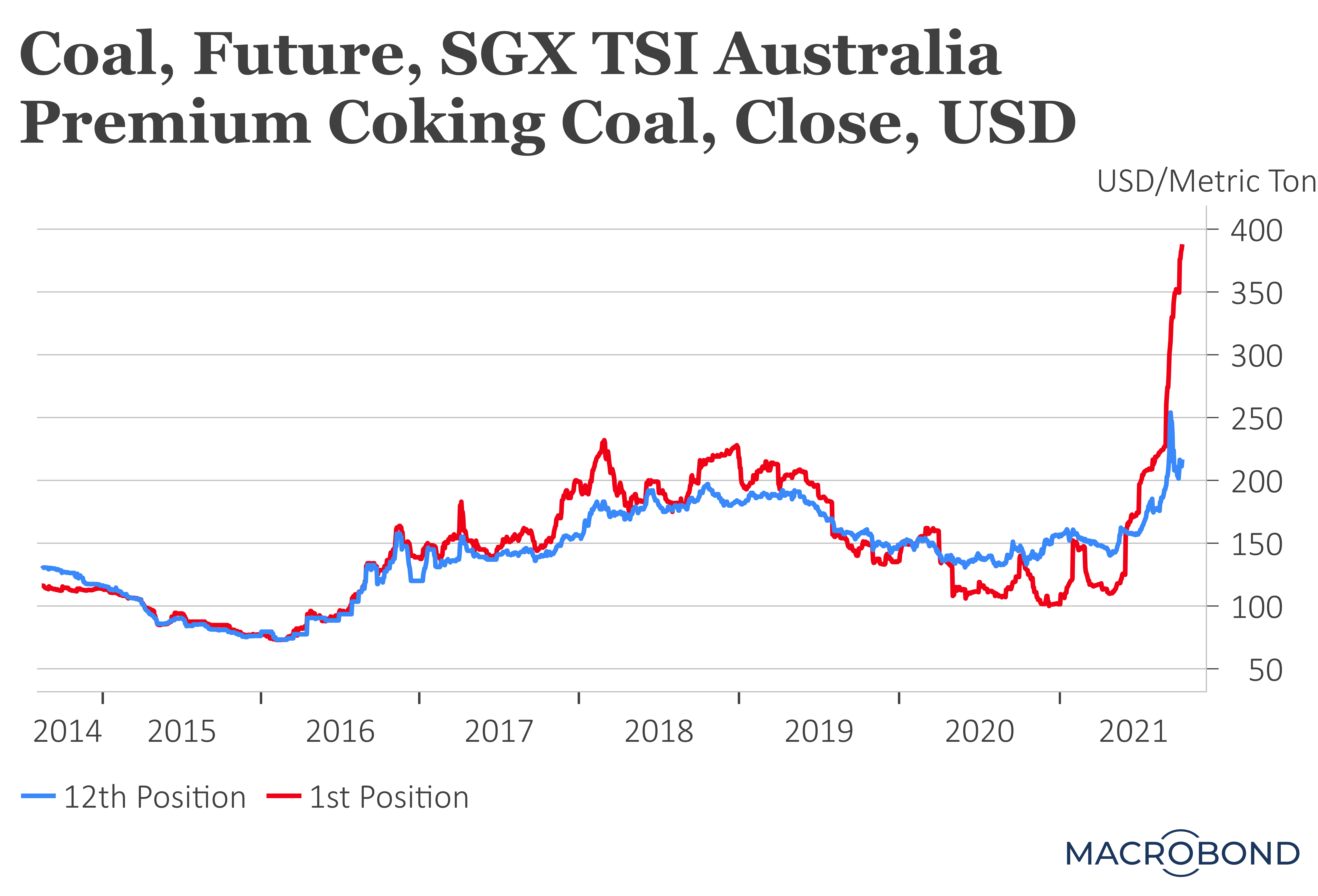
And so have coking/metallurgical coal prices.

Please check out my conversation with Tony, in which my Adept Economics crew member Ben Scott also appears, and let me know what you think about the issues discussed, including policy responses to climate change and the future of coal.

Please feel free to comment below. Alternatively, you can email comments, questions, suggestions, or hot tips to contact@queenslandeconomywatch.com. I also post from time-to-time on my business website adepteconomics.com.au, so please consider subscribing to updates there (Get in touch). Also please check out my Economics Explored podcast, which has a new episode each week.

Posted in Climate change, Energy, Mining | Tagged , , , , , , , , , | 4 Comments

Hospital funding fight the latest illustration of the big problem with vertical fiscal imbalance in our federation

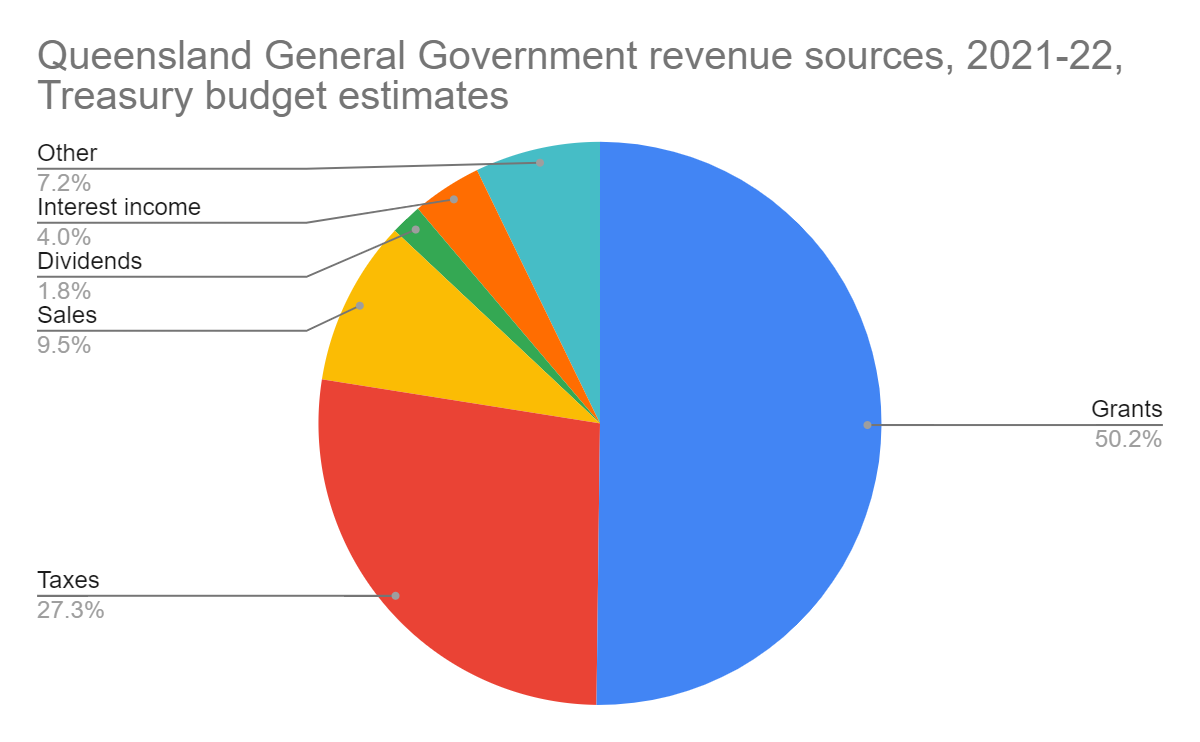
There is a deep structural problem underlying the current hospital funding fight between the Queensland Premier and the PM, the vertical fiscal imbalance (VFI) between the state’s spending responsibilities and the Commonwealth’s revenue raising powers. The states receive around half of their revenues from the Commonwealth (see the chart below based on Queensland Budget data) and naturally will blame the Commonwealth for their own failings in service delivery and planning. There is a blurring of accountability. Economists have been saying this for decades. 

While he was PM, Malcolm Turnbull tried to revive an idea from the Fraser Government which would have gone some way to resolving the VFI, handing part of the income tax power back to the states, a power which the Commonwealth seized during WWII and never relinquished. Unfortunately, PM Turnbull gave up on this proposal when faced with resistance from the states, a resistance which was led by Queensland Premier Palaszczuk (see Premier’s 2016 Lodge dinner remark to Turnbull highlighted Vertical Fiscal Imbalance problem).

The Queensland Premier should remember her own role in failing to resolve the VFI. She could have reduced the state’s dependence on the Commonwealth, which would have enhanced her flexibility to increase hospital funding if she chose to, but, of course, with more power comes more responsibility. The current VFI allows her to conveniently blame the Commonwealth for any problem which occurs on her watch. In her view, it’s the Commonwealth’s fault for not providing enough funding, rather than her Government’s failure to plan for COVID cases or its failure to redirect funding from other parts of the budget to Queensland Health.   

Other posts of mine on VFI include:

EV taxes, property taxes, and the need to reset federal financial relations in Australia

Qld-Commonwealth argy bargy over dam funding & vertical fiscal imbalance

Please feel free to comment below. Alternatively, you can email comments, questions, suggestions, or hot tips to contact@queenslandeconomywatch.com. I also post from time-to-time on my business website adepteconomics.com.au, so please consider subscribing to updates there (Get in touch). Also please check out my Economics Explored podcast, which has a new episode each week.
Posted in Budget | Tagged , , , , , , , , | 4 Comments

Pre and post-COVID population projections

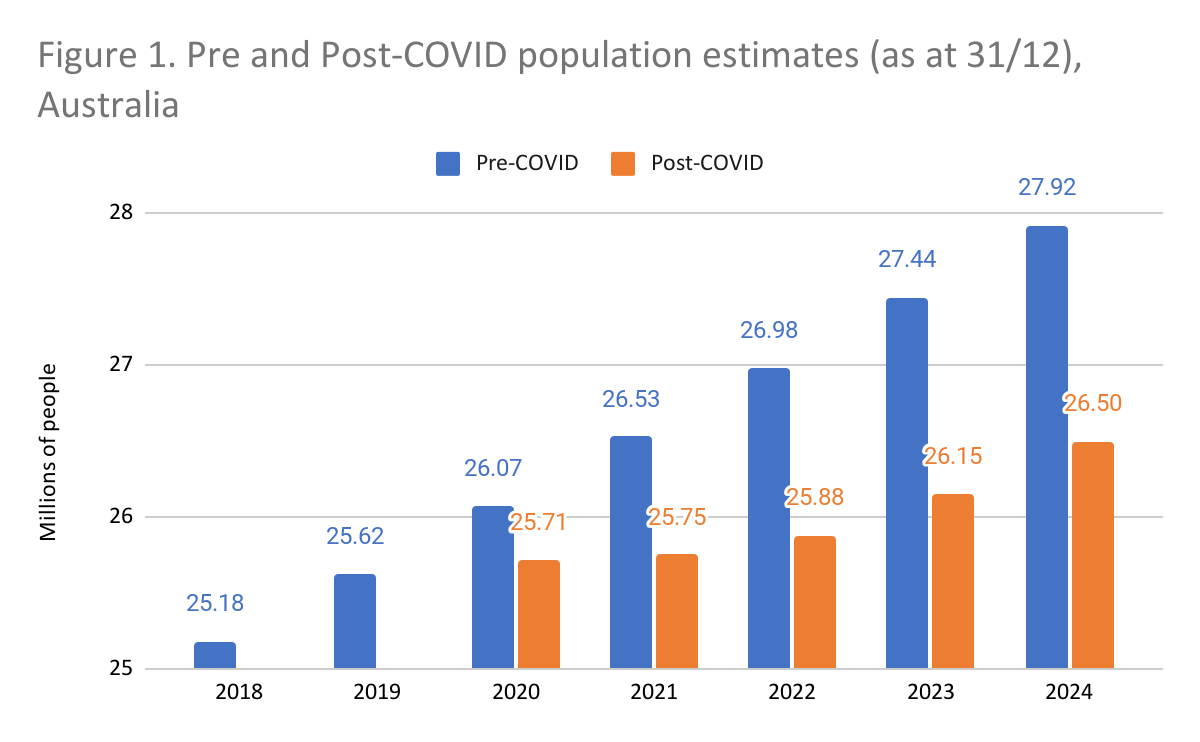
I’ve had some readers query the point made in Capricorn Enterprise’s blurb for the upcoming Major Projects Forum regarding the 600k reduction in Australia’s population (relative to the pre-pandemic trajectory) by 2024 (see my post Upcoming Major Projects Forum in Rockhampton on 28 October 2021). Thanks to Capricorn Enterprise for advising me that figure came from a report by Deloitte in the early days of the pandemic in May 2020. It turns out that the ultimate reduction in population relative to what was expected will be much greater than that, likely over one million people. This was pointed out in the Financial Review following the 2021-22 Budget handed down in May. 

We can illustrate the shortfall by comparing the pre-pandemic population trajectory, based on 2019-20 federal Budget estimates, with the projected trajectory in the 2021-22 Budget (Figure 1). That’s potentially 1.4 million fewer people in Australia at the end of 2024 than we would have expected pre-COVID. Note I extrapolated the 2019-20 Budget projections beyond 2022 based on the 2022 growth rate implied by the Treasury estimates.

The reason Australia’s population is expected to be much lower than previously projected is the big drop in net overseas migration, which was running at 250k per year but turned negative in the pandemic, and was nearly -100k in the twelve months to 31 March. The Treasury is projecting net overseas migration of -77k in 2021-22, 96k in 2022-23, 201k in 2023-24, and 235k in 2024-25 (see Table A.5 in Appendix A: Parameters and further information). That is, net overseas migration isn’t expected to return to pre-pandemic levels until the middle of the decade. 

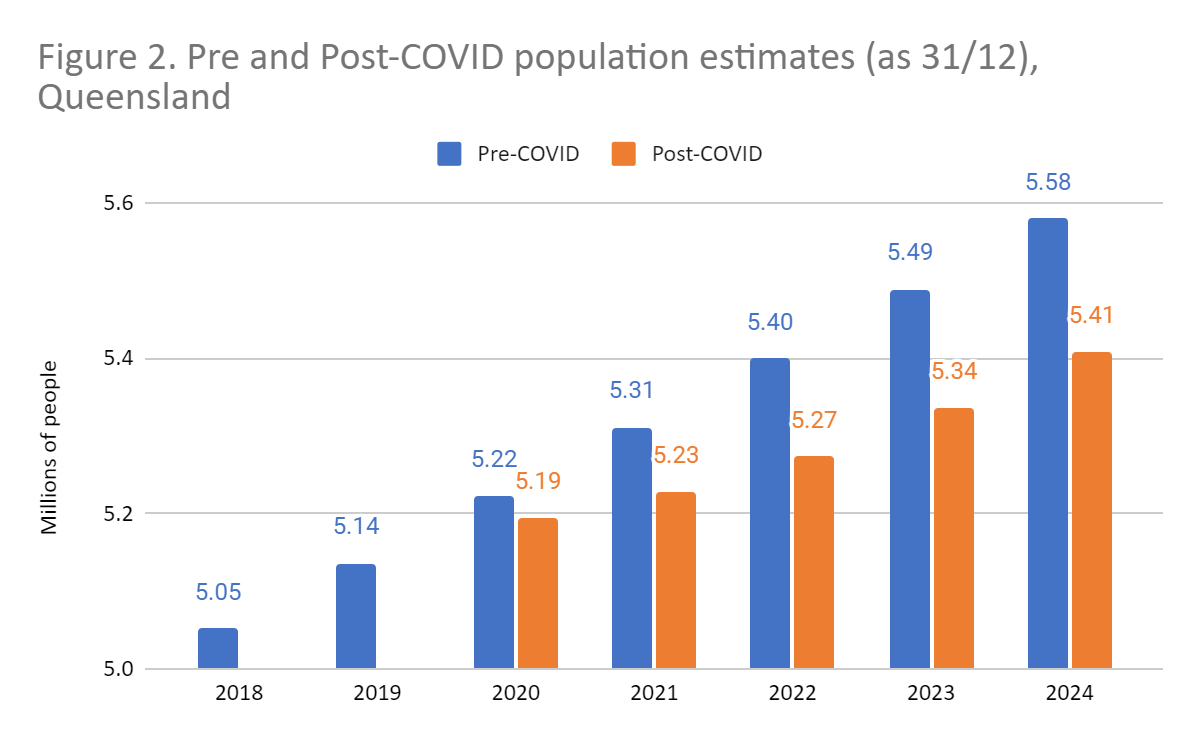
We can do the same exercise for Queensland. There will potentially be around 170k fewer Queenslanders than we would have previously estimated (Figure 2). I should note the federal Treasury forecasts of state populations in the 2021-22 Budget look like they’re assuming a lower level of net interstate migration to Queensland than we will likely experience based on what we’ve seen to date. For instance, net interstate migration in the twelve months to 31 March was around 31k compared with the 25k assumed in the budget for the 2020-21 financial year. The federal Treasury didn’t appear to anticipate Victoria experiencing negative net interstate migration and a reduction in population.* Queensland will certainly have fewer people than it would have had in the absence of COVID, but the gap may end up being 100-150k rather than 170k.  

*Regarding this population loss for Victoria, see my post Qld population growth and interstate migration gains in perspective).

Please feel free to comment below. Alternatively, you can email comments, questions, suggestions, or hot tips to contact@queenslandeconomywatch.com. I also post from time-to-time on my business website adepteconomics.com.au, so please consider subscribing to updates there (Get in touch). Also please check out my Economics Explored podcast, which has a new episode each week.
Posted in Population | Tagged , , , , , , | Leave a comment

Lockdowns reduce retail trade 14-17% in NSW and ACT compared with pre-lockdown levels

Thankfully, and better late than never, the upcoming NRL Grand Final has forced the Queensland Government to recognise the large economic costs associated with lockdowns, and it has decided not to panic this time, and surprisingly it has not yet implemented a snap lockdown in response to the latest COVID numbers. Of course, all that could change in coming days, or even later today, but for now the Government is acting sensibly. The retail trade estimates for the month of August published by the ABS yesterday remind us of the large adverse economic shock from lockdowns (see figure below). Compared with May levels, retail trade was down around 14% in NSW and 17% in ACT in August. Victoria was down nearly 6%, and this figure would have been much higher if Victoria had spent the whole month of August in lock down. Queensland retail trade was down 2.7% in August relative to May, which I expect was largely because SEQ was locked down in the first week of August.

Please feel free to comment below. Alternatively, you can email comments, questions, suggestions, or hot tips to contact@queenslandeconomywatch.com. Also please check out my Economics Explored podcast, which has a new episode each week.

Posted in Retail trade | Tagged , , , , , , , | 1 Comment

Upcoming Major Projects Forum in Rockhampton on 28 October 2021

I’m thrilled that I’ve been invited to return to present at Capricorn Enterprise’s Major Projects Forum in Rockhampton on Thursday 28 October. Here’s the blurb:

The Capricorn Enterprise Major Projects Forum is the premier project forum in the region, covering projects investing over $5bn in our region through to 2024/25.

By June 2024, Australia’s population will be 600k less than the pre-COVID projections. However, we expect that the Queensland economy will outpace the national economy over this period due to construction, mining and agriculture development.

Within our region, roads, energy, defence and water projects are expected to sustain elevated levels of project activity, the most significant being the $1bn Rockhampton Ring Road and the Defence Initiatives at Shoalwater Bay.

The forum will also look forward to the next generation of development, including opportunities in emerging industries such as renewable energy and hydrogen.

The potential for a Queensland hydrogen sector is huge. For instance, the Financial Times reported yesterday that Airbus gears up for hydrogen jet as fuel of future edges closer to reality. However, it’s still early days for Queensland hydrogen projects which appear to be still in their demonstration/feasibility testing stages.

I’m really hoping the Forum will go ahead and we won’t be in lockdown in late October. There’s no doubt that the Queensland Government would quickly lock us down again if we get even a few cases up here.

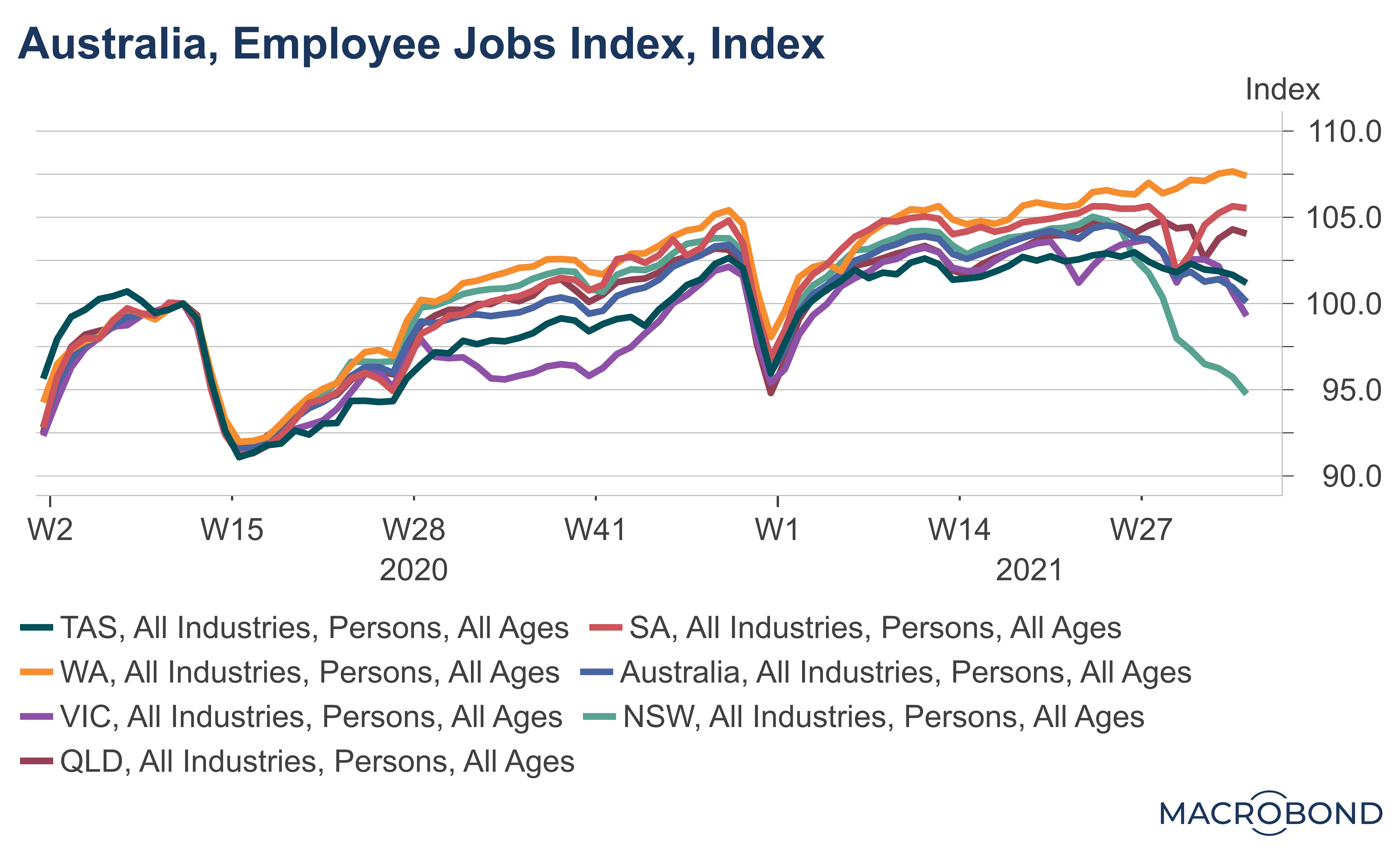
Queensland is fortunate we’ve avoided a COVID-Delta-variant outbreak so far. Obviously it’s good news we’ve avoided people getting infected and, in some cases, dying. Furthermore, the lockdowns in NSW and Victoria have come at a high cost to their state economies (e.g. see the payroll jobs data from the ABS below), and Queensland has avoided that massive adverse direct shock from a prolonged lockdown so far this year.

That said, the way Queensland has avoided an outbreak, i.e. a hard border regime, has imposed immense personal hardships on some people, including Queenslanders who have been shut out of the state, and has imposed large losses of trade on many businesses in tourism and hospitality, particularly those dependent on interstate visitors.

While his forecast is more apocalyptic than mine would be, I think that Peter Gleeson, in today’s Courier-Mail, has well summarised the problem with the Queensland Government’s zero-COVID strategy underpinned by its hard-border policy:

…to succeed, Queensland must effectively close itself off from the rest of the world until coronavirus is no more.

That could be years. We do have an Olympics to host in 2032.

Secondly, it means many, many businesses, reliant upon interstate and international input, will fold.

Hotels, restaurants and tourism operators will not sustain another Christmas without interstate visitors.

Let’s hope we’ve opened up before Christmas. I suspect that, once we’ve reached 80%+ double-vaxxed, the pressure on the state government to open up will be overwhelming.

Please feel free to comment below. Alternatively, you can email comments, questions, suggestions, or hot tips to contact@queenslandeconomywatch.com. Also please check out my Economics Explored podcast, which has a new episode each week.
Posted in Labour market, Macroeconomy | Tagged , , , , , , , , , , | 3 Comments

Super high coal prices will boost royalties and slow the increase in Qld state debt


Back in early August I observed that higher coal prices were helping the Qld economy and state budget in this time of rolling lockdowns. Amazingly, the all important metallurgical or coking coal price has surged even higher since then. There was speculation in the Financial Review on Monday that this could mean an additional six billion dollars for the Queensland Budget, depending on how long the higher prices last (see Coal price boom softens blow from iron ore slump).

Futures prices suggest prices will remain over 200 USD/tonne for another twelve months, which is great news (see the 12th position series in the chart below which currently relates to contracts settling in August 2022, while 1st position relates to contracts settling in the current month). Of course, these prices can move around a lot, depending on global economic conditions, so things could change, particularly if there is a financial crisis in China and contagion across the region due to the Evergrande failure. Note the most recent prices in the chart below were for Monday, but I haven’t seen any news since then that would suggest they have crashed between then and now.

We really need a strong mining sector at the moment to counteract the adverse impacts of COVID-related restrictions on Queensland’s tourism sector. The Gold Coast-Northern NSW border bubble has burst again, and tourism businesses are now worried interstate borders could remain closed over Christmas.

Finally, it is distressing that Australia is seeing its greatest internal turmoil since probably the dismissal of the Whitlam Government and the subsequent federal election period in 1975. In Victoria, we have just learned how far a government can restrict the liberties of its population before its people push back en masse. People were willing to go along with the restrictions so long as those restrictions appeared to be proportionate to the risk and fair, but in Victoria and arguably in other states, too, those restrictions have been disproportionate and unfair, even cruel.

The hard border policy enacted by the Queensland Government has caused immense suffering, and it is the policy that’s the problem, even though the Premier has tried to blame Queensland Health bureaucrats for actually enforcing the Government’s policy. There is a constraint on how many people we let into Queensland, i.e. available hotel quarantine rooms, and, if the bureaucrats show mercy on one individual, they will need to make another suffer.

In my view, the federal government needs to show some leadership to bring all our rogue state premiers into line before they do even further damage to the economy and people’s lives and wellbeing.

Please feel free to comment below. Alternatively, you can email comments, questions, suggestions, or hot tips to contact@queenslandeconomywatch.com. Also please check out my Economics Explored podcast, which has a new episode each week.
Posted in Mining | Tagged , , , , , , , , , | 2 Comments

Qld population growth and interstate migration gains in perspective

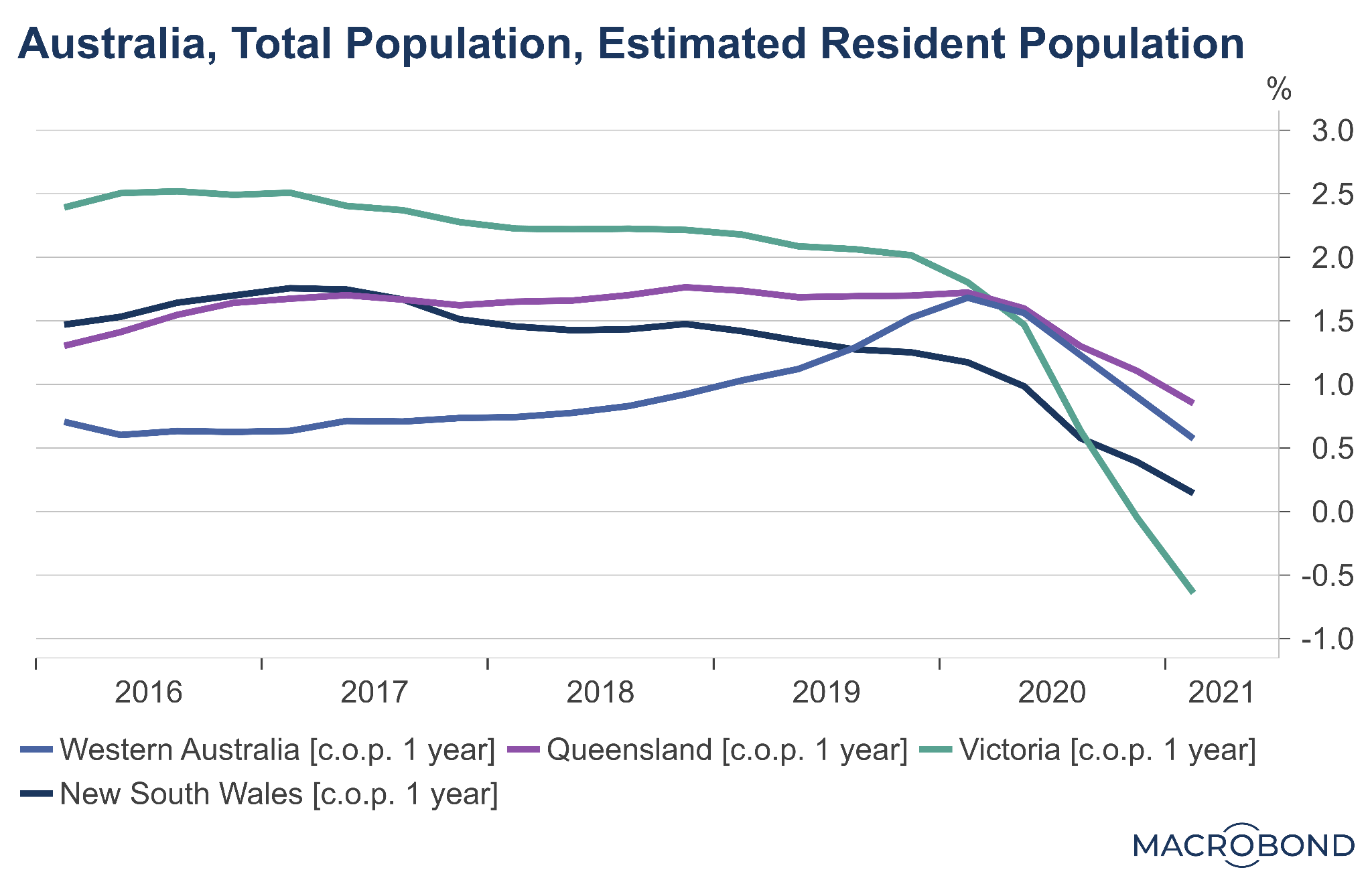
There is much excitement about Queensland having the highest population growth in Australia at the moment (e.g. see the Courier-Mail report ‘Once in a generation boom’ SEQ investment hits $60 billion), although, of course, population growth rates in Queensland and across Australia have fallen during the pandemic. The population growth rate just hasn’t fallen as much in Queensland as in other states. According to the ABS’s latest population estimates, Queensland recorded 0.9% population growth through-the-year to 31 March, compared with 0.1% growth nationwide and in NSW, and a fall of 0.6% in Victoria (see chart below). 

Note: c.o.p. stands for change over the period, in this case 12 months. 

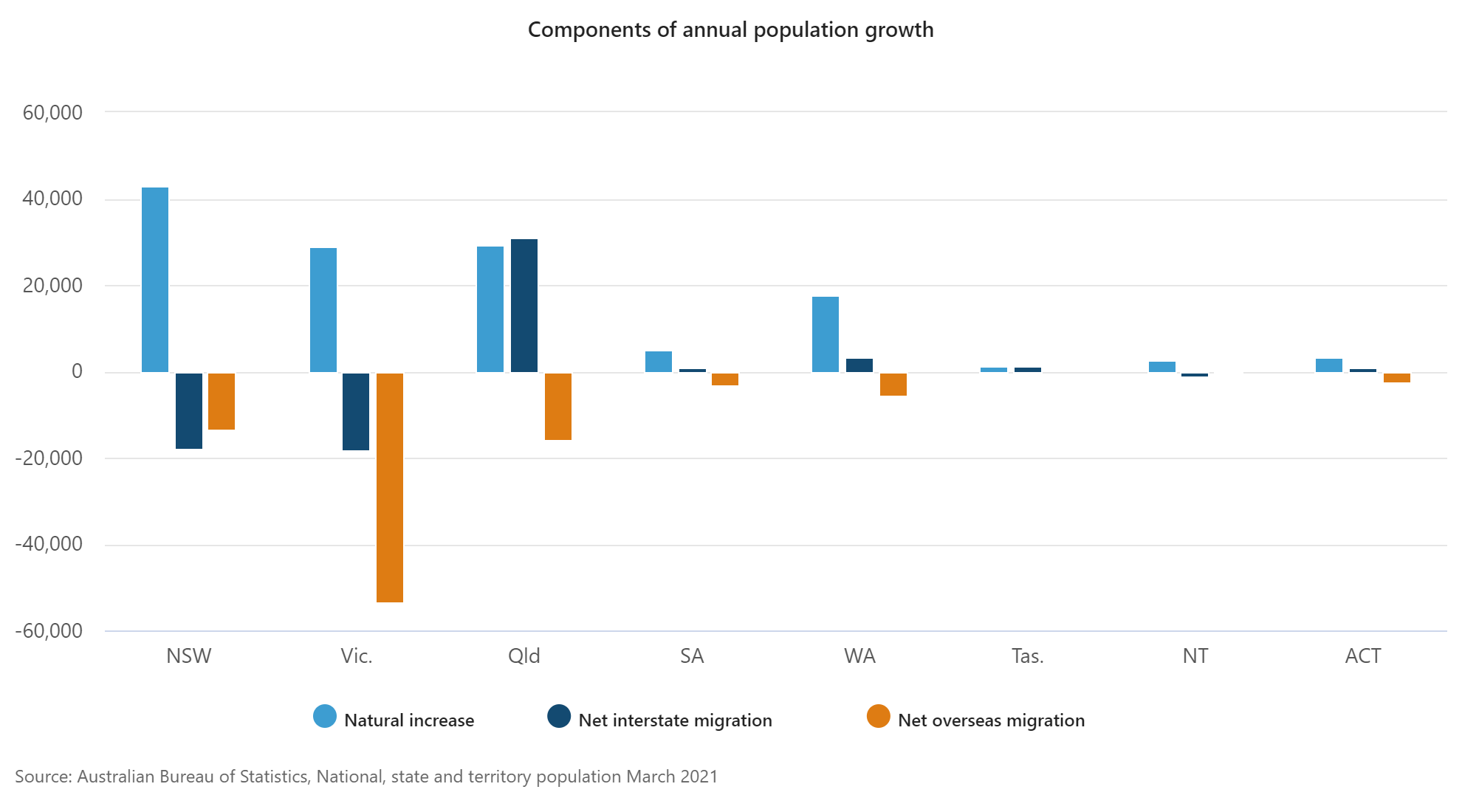
As expected, more people are leaving Victoria (aka Danistan) and fewer people are moving there. So large negative net overseas and net interstate migration flows have given it negative population growth (see the handy chart from the ABS below). Victoria probably had such a massive loss of people via net overseas migration because of all the time it spent in lockdown last year, during which time fewer Australians would have wanted to have returned there and many foreigners living in Victoria would have wanted to get out.   

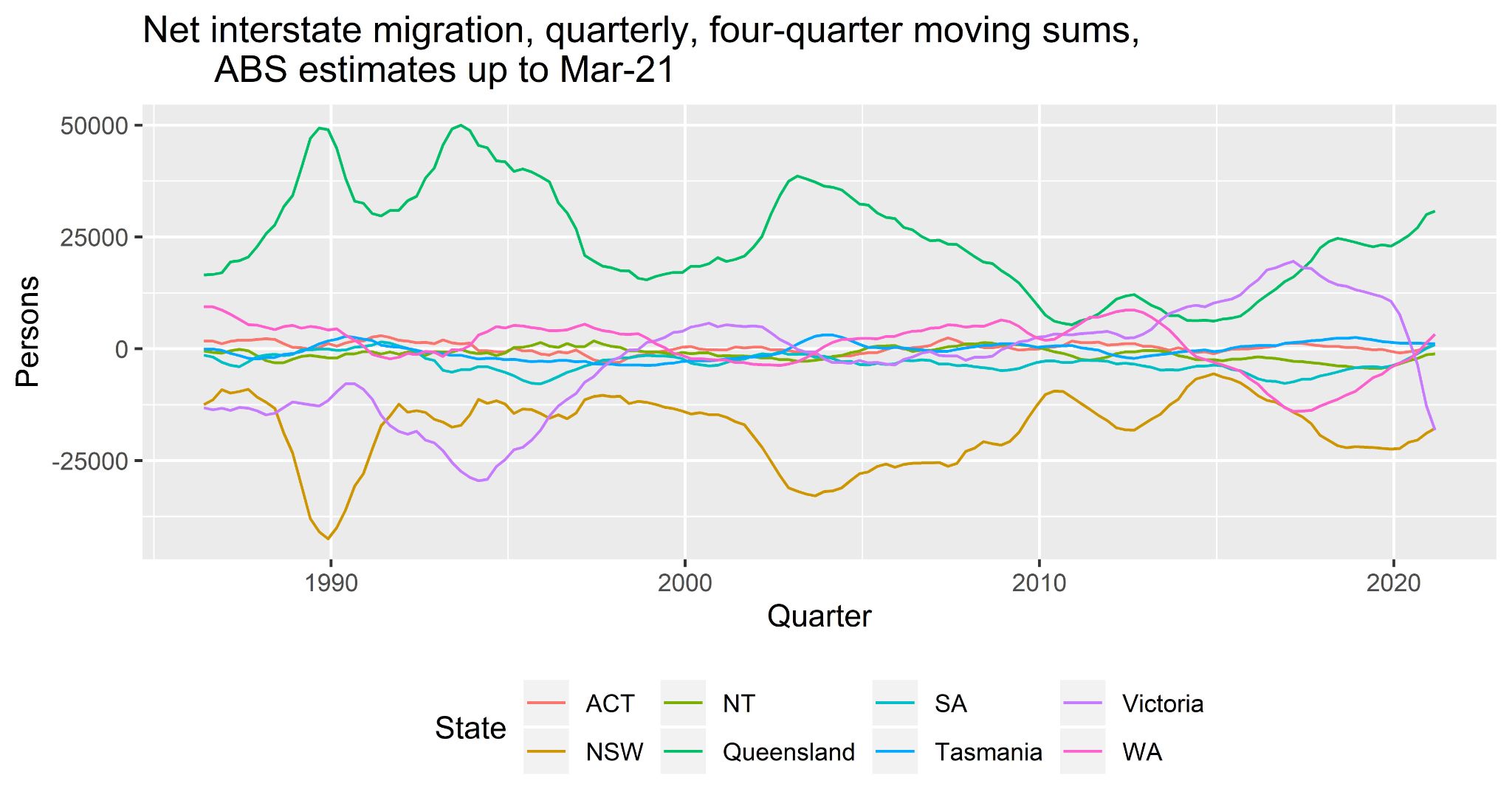
While it could be considered a good sign that Queensland recorded the highest population growth in Australia in the 12-months to 31 March, population growth was much lower than normal. Net interstate migration to Queensland was high compared with recent years, but not relative to historical peaks (see the chart below). Net interstate migration was around 31,000 people in the year to 31 March, with Queensland absorbing the vast majority of the 36,000 people lost by NSW and Victoria, but net interstate migration to Queensland got up to around 50,000 per year in the late eighties and early nineties. And that was back when the population was around 3 million rather than over 5 million people today. So we should keep recent interstate migration and population growth in perspective. 

Finally, regarding the investment boom the Courier-Mail is proclaiming, Brisbane Lord Mayor Adrian Schrinner may have reason to be excited as so many of the biggest current construction projects are in Brisbane (e.g. Queen’s Wharf and Cross River Rail), but from a state-wide perspective the investment pipeline is not that extraordinary as I’ve previously discussed (see How much momentum does business investment in Qld have? and Qld’s heavy CAPEX pipeline dominated by public sector projects). 

Please feel free to comment below. Alternatively, you can email comments, questions, suggestions, or hot tips to contact@queenslandeconomywatch.com. Also please check out my Economics Explored podcast, which has a new episode each week.
Posted in Infrastructure, Macroeconomy, Population | Tagged , , , , , , , , | Leave a comment

Lockdowns cause hours worked to fall below pre-pandemic levels

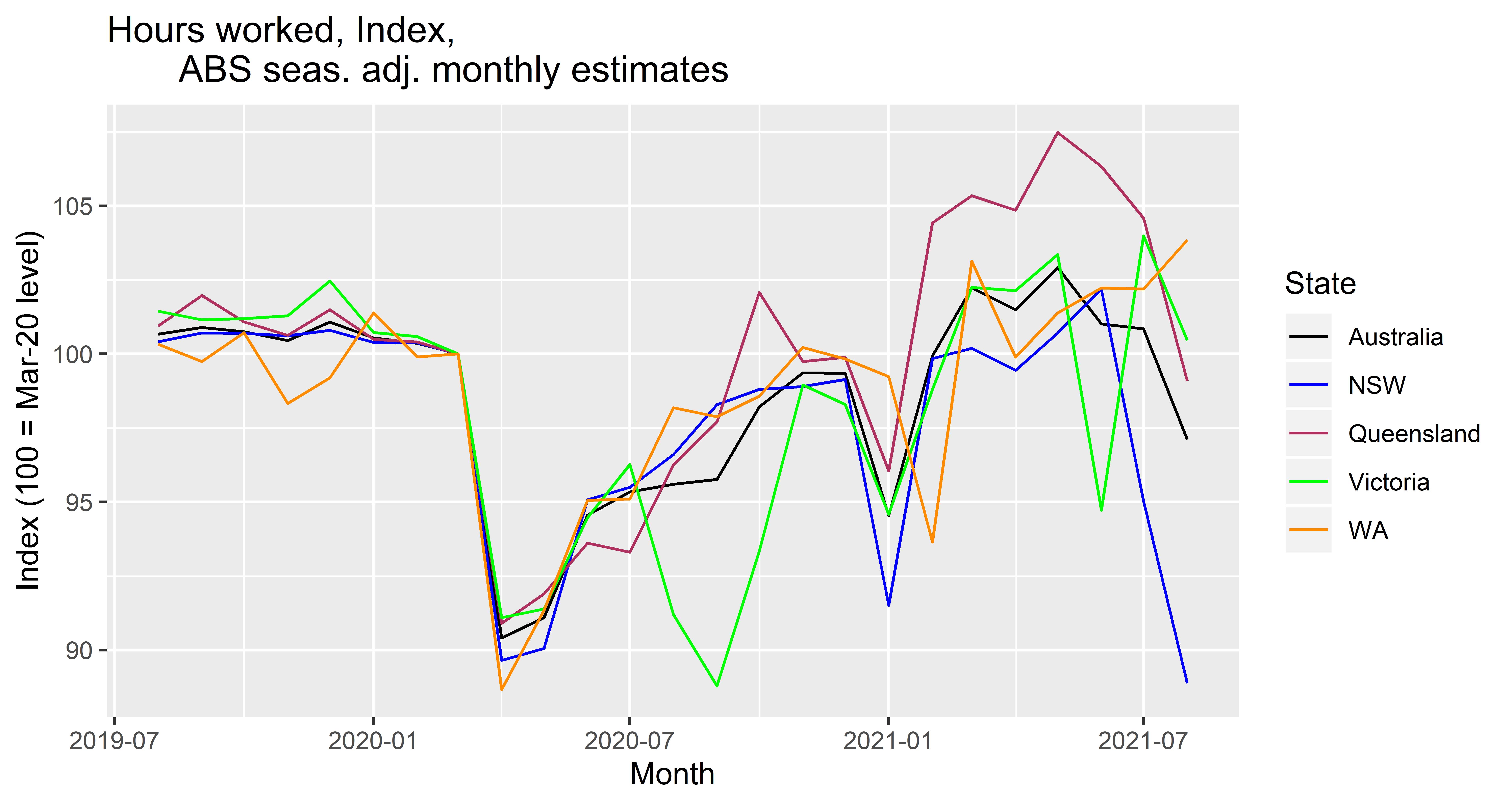
In August, according to the latest ABS Labour Force data, total hours worked were well below March 2020 levels in NSW (-11.1%), and they were 2.9% below nationally and 0.9% below in Queensland (see the chart below). Victoria was slightly above its March 2020 level of hours worked, but that could reflect sampling error. Overall, the data are showing what we’d expect, that lockdowns are restricting economic activity across the impacted states. While Queensland has been in lockdown less than other states, and only for around one week in August, we are still being impacted by the loss of interstate visitors from NSW and Victoria.

Hours worked in Australia, NSW, and Queensland have fallen to below March 2020 levels.

As others have commented, the unemployment rate has become a pretty useless indicator of the current state of the economy, given the falls in workforce participation (i.e. people are giving up looking for work) which are suppressing the official unemployment rate. Pete Faulkner has calculated that the effective unemployment rate for Australia is 7.3% (compared with a 4.5% headline rate) and the effective unemployment rate for Queensland is 6.0% (compared with a headline rate of 5.3%). Check out Pete’s post Zero hours and declining participation drive ‘effective unemployment rate’ higher for details.

Please feel free to comment below. Alternatively, you can email comments, questions, suggestions, or hot tips to contact@queenslandeconomywatch.com. Also please check out my Economics Explored podcast, which has a new episode each week.
Posted in Labour market, Macroeconomy | Tagged , , , , , , , , , | Leave a comment

Young Economists to debate housing affordability measures

There is an interesting upcoming online debate on measures designed to improve housing affordability among young economists on Thursday 16 September 2021, to be hosted by the Young Economists Network of the Economic Society of Australia (ESA). Here’s the blurb: 

‘Given the better than expected economic recovery within the Australia housing sector in recent months, should the Federal Government look to implement measures (including those of a policy, regulatory, etc. nature) to lower the volume of new investment housing loans/credit to help improve housing affordability and assist in the achievement of more equitable housing and overall economic outcomes?’

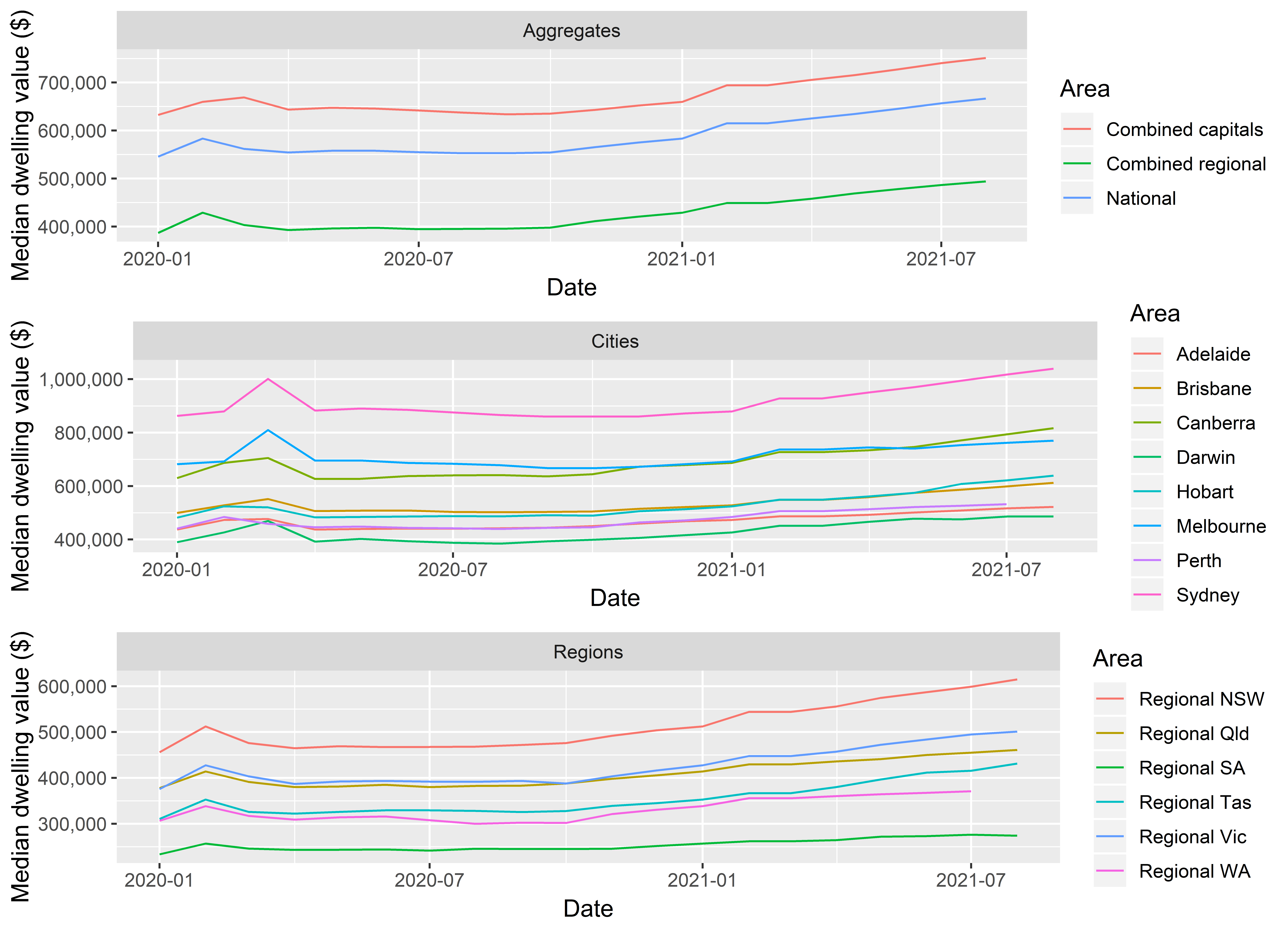
This is an important topic given the strong growth in house prices we’ve seen since the end of 2020, and which have defied early predictions of a big pandemic-related crash in property prices (see chart below prepared by Adept Economics Research Officer Ben Scott). This growth is occurring in both capital cities and regional areas, which are attracting new residents seeking a “sea change” or “tree change” or realising they can now work remotely and buy cheaper properties than in capital cities. 

Figure 1. Median property prices in Australian capital cities and regions, January 2020 – August 2021, CoreLogic estimates

The blurb for the event suggests the focus of debate will be on so-called macro-prudential measures to limit the growth of credit, particularly to property investors. Tim Lawless at CoreLogic has a recent post on the potential impact of such measures:

The impact of macro-prudential policies on the housing market

That we’d need to consider such an interventionist approach is a consequence of the RBA continuing to ignore the inflation of asset prices in its monetary policy decision making and its continuation of Quantitative Easing (QE) by which the RBA creates new money to buy bonds. There is a risk the RBA’s current monetary policy experiment ends badly eventually, in a repeat of the high inflation of the seventies and eighties, although the current downturn will probably prevent that happening anytime soon. The RBA seems unwilling to consider asset prices, including property prices, in its monetary policy decision making, and hence macro-prudential measures are once again under consideration.  

Finally, I should also note that any discussion of housing affordability should consider various restrictions on housing supply (e.g. heritage and zoning rules) that increase the cost of housing. In his CIS Policy Paper, Planning restrictions harm housing affordability, CIS Chief Economist Peter Tulip observes:

Planning restrictions are estimated to raise house prices 73 per cent above these costs in Sydney, 69 per cent in Melbourne, 42 per cent in Brisbane and 54 per cent in Perth.

Of course, as with many economic policy issues, there is extensive debate about the influence of planning restrictions (e.g. see Cameron Murray’s article Land Banking: red tape and a dearth of housing supply are a myth). Peter Tulip acknowledges this in his CIS paper, noting that relaxing planning restrictions wouldn’t have much of an impact in the short-run, although it would have a substantial impact in the long-run. Peter observes that:

A shortage that was created by decades of under-building will take decades to unwind.

If these issues interest you, then I expect the ESA young economists debate will be worthwhile to watch.  

Please feel free to comment below. Alternatively, you can email comments, questions, suggestions, or hot tips to contact@queenslandeconomywatch.com. Also please check out my Economics Explored podcast, which has a new episode each week.
Posted in Housing | Tagged , , , , , | Leave a comment

Not quite the Smart State

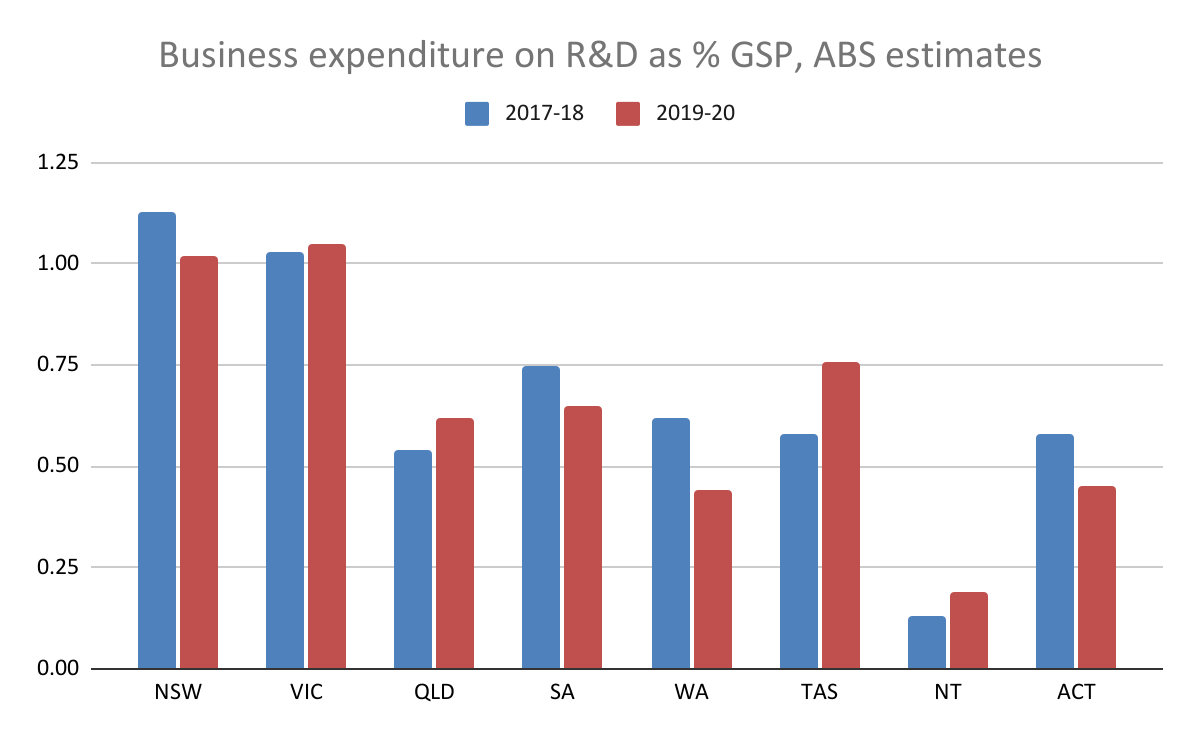
The business R&D estimates published by the ABS last Friday reminded me of the limited economic impact of successive Queensland Government initiatives such as the Smart State and Advance Queensland, although there have been some successes such as the Biosciences precinct at UQ and the Ecosciences precinct at Boggo Road. In 2019-20, Business R&D as a percentage of Gross State Product (GSP) was 0.62% in Queensland compared with over 1.0% in NSW and Victoria, and a national average of 0.9% of GDP (see the ABS estimates and the chart below). 

Business R&D is 0.62% of GSP in Queensland compared with over 1.0% in NSW and Victoria.

In Queensland’s defence, I should note:

  • mining exploration spending is not included in these figures, and arguably that could count as R&D broadly defined, and 
  • a major determinant of business R&D is an economy’s industry mix, as Graeme Davis and I demonstrated in some analysis we did of OECD data in the Treasury back in the mid-2000s (see International comparisons of research and development).

While business R&D has increased in Queensland over 2017-18 to 2019-20, that could just reflect the normal volatility and sampling error in the data. The ABS data set did not contain historical data, so I’ll need to track that down to analyse this more fully. I can say, however, that, since the early 2000s, the business R&D to GSP ratio does not appear to have budged. This Smart State Council working paper from 2006 reported business R&D was 0.60% of GSP in Queensland in 2003-04, which is roughly what it is today (see p. iii). 

This goes to show how challenging it is to transform an economy, to create a Smart State or to Advance Queensland. So much is determined by resource endowments, the local skills base, and tax and regulatory policy settings. Arguably we should focus our efforts on improving our education and training system and our tax policies and regulations, rather than on flashy initiatives to encourage business R&D and innovation.  

Please feel free to comment below. Alternatively, you can email comments, questions, suggestions, or hot tips to contact@queenslandeconomywatch.com. Also please check out my Economics Explored podcast, which has a new episode each week. 
Posted in Industry policy | Tagged , , , , , , , | 2 Comments