BOQ’s Peter Deans to give ESA Qld seminar on risk management in financial services

Banks play an important role in modern economies: looking after people’s money, facilitating transactions, and providing credit that gives economies momentum but which can also impart volatility—e.g. when too rapid credit growth inflates housing or commercial property bubbles. Banks are the major source of money creation in the economy, through the extension of credit (see the Bank of England article Money creation in the modern economy). Ultimately the central bank, e.g. the Reserve Bank of Australia, can influence the rate of money growth through monetary policy, but that is an imperfect instrument, and there is plenty of scope for short-run instability caused by any poor lending practices by banks. That is why sound risk management by banks and also prudential regulation by APRA are so important. In the first instance, it is the responsibility of banking executives to ensure their banks’ lending activities (and related borrowings to fund part of that lending) are sound and that banks are not taking on too much risk.

One banking executive who appears to be at the vanguard of managing risk in the banking sector is Peter Deans, Chief Risk Officer at the Bank of Queensland. On Thursday 11 February, Peter Deans will give a lunchtime presentation on Current Issues in Risk Management in Financial Services to the Economic Society of Australia (Qld), of which I am the current Secretary. There will be a small charge for attendance to help cover costs. If you are interested in attending, could you please register your interest with the ESA (Qld) Secretariat (admin@esaqld.org.au).

Peter_Deans

Peter Deans, Bank of Queensland

Update

I have learned that the issues Peter Deans will cover in his presentation include:

  • the evolution of risk management post-GFC,
  • the role of the Chief Risk Officer in non-financial risk management,
  • risk culture, and
  • the impact of new technologies, data analytics and disrupters.
Posted in Macroeconomy, Uncategorized | Tagged , , , , , , , , | Leave a comment

How the Qld economy performed over 2015

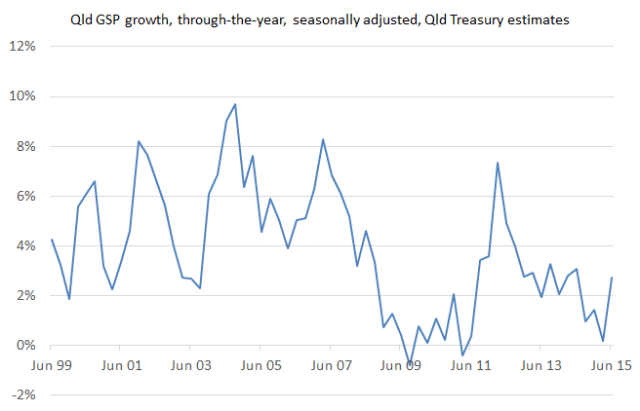
In 2015, the Queensland economy proved itself resilient to the end of the mining boom, and recovered from the apparent downturn, a so-called technical recession, at the end of 2014. Even though the economy is proving resilient, growth is at a much lower rate than Queensland has experienced in the past, at 2.7 per cent through the year to June, the most recent quarter for which gross state product (GSP) data are available (see chart below).

GSP_growth_Jun_15

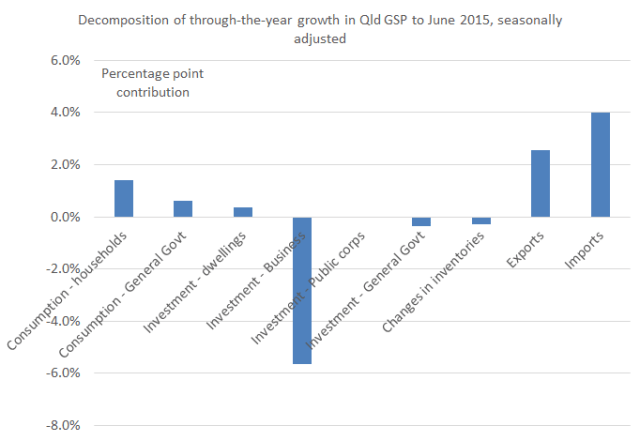
The recovery in GSP was due largely to a surge in exports, which was to be expected given the strong resources sector investment in recent years, and a large drop in imports, partly a large reduction in capital imports now that the construction phase of the mining boom is more-or-less over (see chart below). Modest growth in household consumption expenditure also made an important contribution to the recovery. As expected at the end of the mining boom, a decline in business investment had a large contractionary impact on the economy.

Decomposition_GSP_growth_Jun15

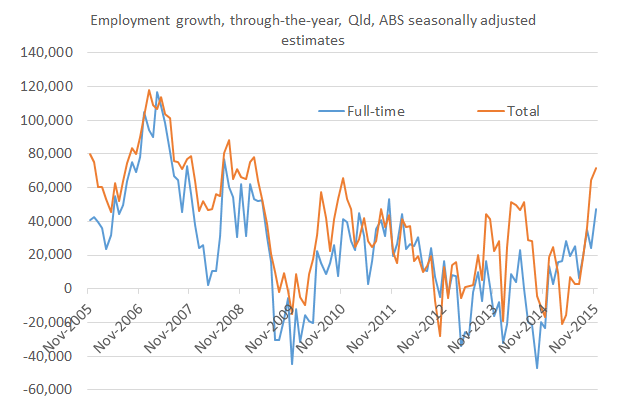
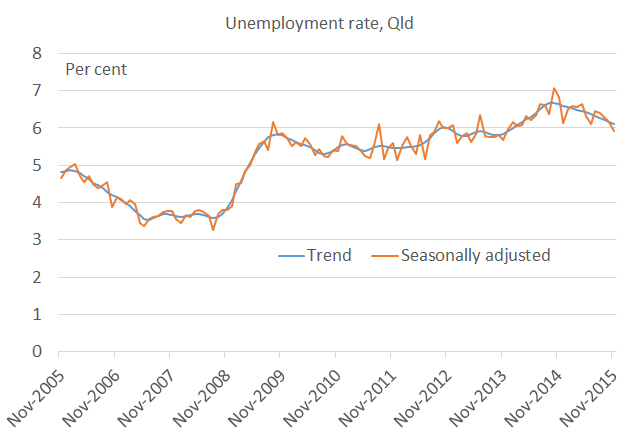
The economic recovery has seen reasonable, but unexceptional employment growth in Queensland (see chart below) and a reduction in the unemployment rate from over 6.5 per cent in late 2014 to around 6 per cent currently.

Employment_growth_Nov_15

While the Queensland Treasury has yet to prepare GSP figures for September quarter, relevant recent data (e.g. national accounts, labour force, and international trade data) suggest the pattern in the early half of 2015 is likely to continue. That is, the Queensland economy was likely growing through the second half of 2015, but at a moderate pace. While still suffering the impact of the resources sector downturn, the economy is being bolstered by resurgent tourism and international education sectors, benefiting from the lower Australian dollar, and the residential construction sector, as suggested by all the cranes over inner-city Brisbane building sites at the moment.

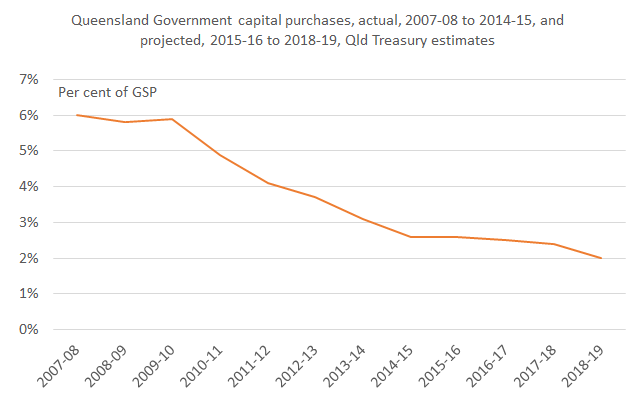
I will cover the economic outlook for 2016 and beyond in a future post, but I will quickly note I remain concerned about the outlook for both business and government capital expenditure. As I have noted before, the previous Queensland Government under-provisioned for infrastructure investment in the budget forward estimates because it was counting on asset lease proceeds to fund $8 billion plus of additional new infrastructure. The current Queensland Government cannot access this funding, due to its opposition to privatisation, meaning Queensland faces a concerning decline in State government capital expenditure over the forward estimates (see chart below based on data from Table 21 in the Mid Year Fiscal and Economic Review 2015-16). This should be of significant concern to construction and engineering companies which are heavily reliant on a flow of government-funded projects.

Capital_purchases_MYFER_2015_16

Posted in Budget, Macroeconomy, Uncategorized | Tagged , , , , , , , , , , , , | 2 Comments

Holiday reading

Recently I have been reading a variety of interesting books, including Digital Gold: The Untold Story of Bitcoin by New York Times reporter Nathaniel Popper, and the Edith trilogy by eminent Australian author Frank Moorhouse.

Digital_Gold

Digital Gold tells the story of Bitcoin, the digital crypto-currency, which began with the publication of the white paper by the mysterious Satoshi Nakamoto in November 2008. Viewed as dubious or a curiosity at first, Bitcoin has increasingly become accepted by the public. Bitcoin is no longer automatically linked to the online black market Silk Road in the public’s mind, and it is acknowledged by luminaries such as Bill Gates as having great potential to replace traditional payments systems (while having a number of drawbacks, particularly the volatility of its value). The book is a great read and the protagonists who feature in the book are fascinating, including a range of anarchist IT geniuses, entrepreneurs, hedge fudge managers, the Winklevoss twins made famous by The Social Network, and Ross Ulbricht, the founder of Silk Road, now serving a life sentence for nefarious dealings.

An excellent feature of the book is a technical appendix explaining the logic behind Bitcoin and how transactions are verified on the Bitcoin network without the need for intermediaries such as banks. As you would expect, given the book was published earlier this year, it does not include an important very recent development: the revelation that mysterious Bitcoin creator Satoshi Nakamoto could be the Australian technology entrepreneur Dr Craig Steven Wright (see Bitcoin: Sydney home of suspected founder Craig Steven Wright raided by AFP over ATO warrant).

Of course, Popper’s book is likely just one of the first of many histories of Bitcoin. Indeed, there is a lot of R&D occurring at the moment regarding the blockchain technology underpinning Bitcoin, with The Economist (see The trust machine) recently speculating it could “transform how the economy works”, particularly by lessening the need for financial intermediaries such as banks.

While Bitcoin’s shared public ledger is an incredible innovation, and may have substantial applications across financial markets, I doubt Bitcoin itself will come to replace our existing national currencies to any great extent. As Bank of England officials have pointed out, Bitcoin is more like a commodity than money, and its tendency to fluctuate substantially in value rules it out as a currency in widespread use (see the excellent article The Economics of Digital Currencies).

In addition to Digital Gold, as I noted above, I am also reading Frank Moorhouse’s Edith trilogy, which tells the story of (fictional) Australian woman Edith Campbell Berry, born around the turn of the 20th century, who goes to work for the League of Nations in Geneva in the mid-1920s. Edith is a great character: intelligent, ambitious, idealistic, and adventurous. Grand Days, the first volume of the trilogy covers her rise to prominence in the League secretariat (as well as her amorous exploits, which feature heavily throughout the trilogy). Dark Palace, the second volume, sees Edith experiencing the failures of the League in the 1930s, its lack of relevance during World War II, and its ultimate rejection by the great powers when they replaced it with the United Nations at the war’s end. Cold Light, the final volume which I have yet to read, sees Edith returning, deflated, to Australia and taking a job in Canberra, which was then, in the mid-forties, still largely under construction.

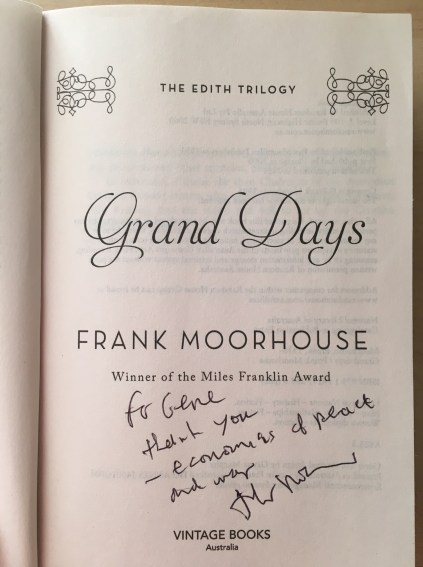
After he presented the inaugural Fryer Lecture in Australian Literature at the University of Queensland earlier this month, I mentioned to Frank Moorhouse that, as a former Commonwealth Treasury official, I was very pleased to see a novel set in the early days of Canberra, at the time our national capital was being established and so much important work in post-war reconstruction was being done. Recognising my interest in economics, Frank was nice enough to write the message below in my copy of Grand Days.

Grand_Days

At the lecture, Frank mentioned he gets a special pleasure knowing that a few people every day are finding and reading his novels for the first time. If you have not done so yet, I suggest you do the same. The Edith trilogy will no doubt be considered as an incredibly important contribution to Australian literature in the years to come.

Posted in Macroeconomy, Uncategorized | Tagged , , , , , , , , | Leave a comment

Qld currency was model for Australian currency

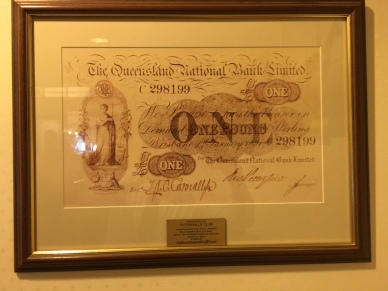
Last month, former UQ Economics lecturer Dr Jon Stanford published a very interesting paper in the Queensland History Journal titled Queensland’s Own Money, 1893-1910: Model for the Australian Note Issue (paywalled unfortunately). Jon discusses the financial crisis of the early 1890s and associated bank failures that prompted the Queensland Treasury to issue a Government-backed Queensland currency (e.g. first image below) which could replace notes issued by private banks (e.g. second image below). When the Commonwealth Government issued a national currency in 1910, the Queensland currency was used as a model. As Jon notes (p. 837):

The similarity between the inauguration of the new Commonwealth currency and Queensland’s own money in 1893 was no co-incidence. [PM Andrew] Fisher was elected to the Queensland Parliament in 1893 as member for Gympie and to the first House of Representatives in 1901 as member for Wide Bay…

…In the second reading speech on the Bank Notes Tax Bill, Fisher stated that the purpose of the Bill was to ‘give the Government a monopoly of the Australian note issue’ and, in reply to a comment ‘to force the existing bank notes out of use’. He further stated ‘Practically, it is exactly the same proposition as was adopted by the Queensland Parliament, when the Treasury note issue was initiated in that State.’

Well done to Jon for such an interesting article highlighting an important contribution by Queensland to the development of our national economy.

Qld_5pound_note

A Five Pound note issued by the Queensland Treasury. (From the RBA website).

QNB_note

A blown up copy of a Queensland National Bank One Pound note, which hangs on the wall of the business centre at Tattersall’s Club, Queen St Mall, Brisbane.

Posted in Queensland Government, Uncategorized | Tagged , , , , , , , , | 2 Comments

Merger savings good if they occur, but debt shuffle dubious

I am very flattered the Courier-Mail has a story about me this morning with the title on its website of The man who could clear Qld’s deficit:

THE forecast deficit of $1.5 billion could be overcome by courageous decisions made to cut funds propping up industry, according to former federal Treasury economist Gene Tunny.

Mr Tunny pointed to the Queensland Competition Authority (QCA), which found there were 112 instances where $17 billion in tax concessions had been given.

It also found there was $25.3 billion in assistance from 2013 to 2018, including $5.6 billion in budget outlays and $1.3 billion in underpriced assets and services.

Alas, the Queensland Government does not appear to have looked to the QCA report on industry assistance for savings. Instead, in its Mid-Year Fiscal and Economic Review to be released today, it appears to be relying on savings from an Energex-Ergon merger ($680 million over the rest of the decade, which seems very optimistic) and the same old accounting trick it used in the Budget.

That is, the Government is increasing debt in government-owned corporations and transferring the funds to the general government sector (via special dividend payments) so it can pay down general government debt (see Brisbane Times coverage). Obviously, this does not reduce total government debt. The debt shuffle is an illusion, a sleight of hand, and no substitute for true budget repair, which can only come from reducing the gap between revenues and expenditures, preferably by cutting expenditures. My previous comments on this blog on the Government’s dubious accounting trick include:

Qld Government opts for accounting tricks rather than true budget repair

Accounting trick wouldn’t improve Qld Government’s real financial position

I was quoted on this issue in the Courier-Mail earlier this year, too:

Today’s problems in Queensland bigger tomorrow after Budget, say economists

Posted in Budget, Uncategorized | Tagged , , , , , , , , , , , , , | 10 Comments

QCA and Premier’s Department have shown where Government can find budget savings

The need for difficult decisions to repair Queensland’s Budget is reinforced by news that, due to the drop in coal prices and a slower economy, revenue will be further written down by $1.5 billion over the next four years. The Government, however, does not have to look hard for budget savings—it only needs political courage—because potential savings measures have been identified by both the Queensland Competition Authority, in its recent Industry Assistance Inquiry, and the Department of Premier and Cabinet, in its controversial leaked Economic Action Plan.

Some of the identified savings measures include:

  • removing transport subsidies, particularly for agricultural freight ($1.4 billion over five years according to QCA estimates), a measure which was identified by both the QCA and Premier’s Department,
  • savings in Queensland Rail operations (e.g. cutting tilt train services),
  • scrapping the desalination and recycled water plants.

Unfortunately I am not expecting bold savings to be announced in the Government’s Mid-Year Fiscal and Economic Review which will be released later this week. Obviously, the Government’s precarious position in the Parliament means we will not see any tough decisions in this term.

Posted in Budget, Transport, Uncategorized | Tagged , , , , , , , , , , , | 4 Comments

Surprisingly good jobs data shows economy’s resilience

Unemployment_rate_November_15

I am quoted in today’s Courier-Mail regarding yesterday’s surprisingly good jobs data published by the ABS (e.g. see chart above):

In a sign the state is working through the mining downturn, there have been 50,800 jobs added since the Palaszczuk Government took office.

 Adept Economics’ Gene Tunny said there had been a long run of reasonable growth and Queensland was “obviously” benefiting from tourism.

This is all good news, but, as I have noted previously, I remain concerned about the 2016 outlook due to weakness in business investment (i.e. capital spending). That said, with strong growth in the services sector, which as Christopher Kent from the RBA noted earlier this year does not require as much capital per worker as say manufacturing, the economy should remain resilient. GFC Economics, a London-based economics consultancy, produced an excellent note on jobs growth in the services sector last month which you may be interested in:

GFC Economics note on services employment

Posted in Labour market, Macroeconomy, Tourism, Uncategorized | Tagged , , , , , , , | 4 Comments

Terminating KSD contract probably provides a better return for ratepayers than proceeding

Jim Binney returns to the topic of the controversial $650 million Kingsford Smith Drive upgrade in a new guest post.

From an economic point of view, avoiding costs is akin to a benefit. In fact this is the logic that underpins Council’s business case for the KSD upgrade in the first place (avoiding congestion and road safety costs are the main benefits). So, if the net cost of the project were $197 million (my estimate the other day), the ratepayers of Brisbane would actually be better off by that amount if the proposed KSD project didn’t proceed.

It was revealed at the Council meeting last night that contracts had already been signed. And the cost to ratepayers of stopping now would be a staggering $90.2 million according to the shopping list here: http://www.brisbanetimes.com.au/queensland/labor-could-bypass-tender-process-for-kingsford-smith-drive-plan-harding-20151202-gldxsu

But, of the $90.2 million of costs outlined, most costs relate to work that would be undertaken prior to the end of March 2016 if the project goes ahead (e.g. the $18.8 million in contract payments to Lend Lease, and the bulk of the $57.1 million direct Council expenditure). These costs can be avoided, and the resources could be channeled into projects that stack up. Costs such as reimbursement of bid costs to unsuccessful bidders ($6 million) are both sunk and irrelevant to the contract with Lend Lease. So the true cost to ratepayers of stopping the project is probably little more than the $8.3 million termination fee in the contract between Lend Lease and Council.

On this basis, my (free) advice to Council would be to:

  • Very quickly do a robust, transparent and peer reviewed cost-benefit analysis of the proposed KSD upgrade. If it stacks up, proceed with the project. Clearly I have my doubts, but I’m more than happy to be proved wrong.
  • If it doesn’t stack up, terminate the contract with Lend Lease immediately. Then find some congestion-busting projects that do stack up.

On the face of it, terminating the contract with Lend lease would appear to have a benefit-cost ratio for ratepayers of about 23.7 ($197 million / $8.3 million). That is a much better return than the implausible benefit-cost ratio of 1.13 in Council’s Business Case.

Jim Binney is Principal of Mainstream Economics and Policy.

Posted in Brisbane, Transport, Uncategorized | Tagged , , , , , , , | Leave a comment

Australia’s Christmas Gifts – Innovation and our Global Financial Standing

Thanks to Michael Willis from Effective Governance for today’s guest post.

The Prime Minister’s “Innovation Statement” may or may not prove to be gold, frankincense and myrrh, a Christmas gift for our nation. But like the shepherds arriving with a humbler offering, a research team has this week produced a gift our nation cannot overlook – a new research paper on how to build a world-class Australian financial centre.

This report has some important lessons for Australia’s policy makers and regulators, and reminds us that strong financial markets will be critical to the success of our nation’s innovation and the wider economy.

Running parallel to the Prime Minister’s innovation strategy, and underpinning it, is the need for Australia to build a globally competitive financial sector to support business innovation and scientific endeavours. And innovation must also be able to flourish in our financial sector, and among the sector’s regulators, so that we remain competitive in this key sector.

The paper from the Centre for International Finance and Regulation on “International Competitiveness of Australia’s Financial Services Sector” was written by Eric Knight of Sydney University and Dariusz Wójcik from Oxford… http://www.cifr.edu.au/project/International_Competitiveness_of_Aus_Financial_Services.aspx

What does the report tell us that will help us build a world-class Australian financial centre?

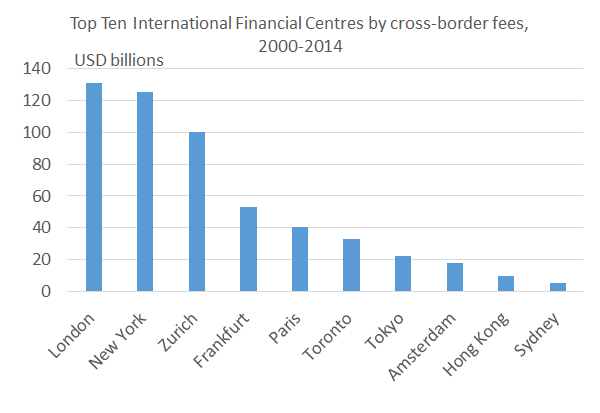
Firstly, while London and New York are the world’s top financial hubs, Sydney is still in the game, punching above its weight at number 10 position on the league table (see chart below).
International_financial_centres

Secondly, the report shows that corporate and financial tax regimes have less impact than might have been expected. Perhaps our policy makers are exerting too much energy on this issue.

In fact, the report identifies several indicators that are more critical to success for any global financial centre:

  • The strength of the rule of law and contractual enforcement, which appears to have a remarkably large impact on the performance of a financial hub
  • The centre’s population and its population growth capacity
  • The size and flexibility of its workforce (which may be concerning for Sydney)
  • The presence of a securities exchange and the concentration of financial services firms and investment banks
  • Proximity to quality universities

These are key factors, and our governments must ensure that Australia has the right policy settings for success in these areas.

Geography has a part to play as well. Membership of EU had been a major success driver for four cities in the top ten – Zurich (3), Frankfurt (4), Paris (5) and Amsterdam (8).

On our side of the globe, Asia’s economic growth will foster the growth of strong financial centres, but our region is still behind the game. The authors make clear that neither Shanghai nor Beijing will topple Hong Kong until they address issues of legal and regulatory reform. Those issues may well be barriers for other Asian cities, and an opportunity for Australia.

The purpose of the research paper was to identify areas for improved performance of Australia’s financial centres, Sydney and Melbourne. For Australia to maintain growth and create new jobs, we must maintain our global competitiveness in the financial sector, which has delivered much of our success in recent decades.

From a governance perspective, the importance of the rule of law and the enforceability of contracts are major positive for the Australian markets. But the research underscores the importance of constant review and reform, to reduce the costs of enforcement and to build global confidence in our financial markets and institutions.

Australia’s finance markets and regulators have some real strengths – such as our regulatory approach to the emergence of dark pools and the stability of our banking system through the GFC – but other centres are constantly watching, learning and improving.

The measure of success used in this research paper – the value of investment banking fees billed from cross-border deals from 2000-2014 – may generate some debate.

But as a guide for banks, innovators and regulators, this paper will contribute some excellent evidence to advance the policy debate and innovation in Australia’s financial services sector.

Prime Minister Turnbull’s mantra that “there has never been a more exciting time to be an Australian” may be true. But that also means we face constant competition on the global financial stage. Taking notice of this important paper might help ensure we are still in the top ten in another ten years.

Michael Willis is a Senior Advisor at Effective Governance Pty Ltd. He is also the Independent Chair of Boyce Chartered Accountants. The opinions expressed here are his own.

Posted in Industry policy, Productivity, Uncategorized | Tagged , , , | Leave a comment

Guest post on KSD upgrade features in Council debate

Last week’s excellent guest post from Jim Binney of Mainstream Economics on the Kingsford Smith Drive upgrade attracted a lot of attention, and now it has featured in the council debate on the merits of the upgrade. A Brisbane Times article (KSD contract is signed, despite opposition) reports Opposition Leader Councillor Milton Dick as saying:

“If this has been approved and the Lord Mayor has signed off a $650 million contract – and we know that last week independent economic analysis has found, quote, this looks like a ‘dud’ … this is the time for the Lord Mayor to put up or shut up.”

The independent economic analysis referred to is clearly Jim’s guest post from last week. The mayoral candidate Rod Harding has also referred to Jim’s analysis, noting an independent economist (i.e. Jim) found the project does not stack up.

Well done to Jim for injecting himself into an important policy debate. It is a pity the Council did not engage Jim to review the dubious business case for the $650 million project before it signed the contract.

Posted in Transport, Uncategorized | Tagged , , , | Leave a comment