Qld unemployment rate creeps up to 6.5 percent due to ongoing weakness in regions

NAB Chief Economist Alan Oster had a memorable quote regarding the latest NAB Business Survey results published in The Australian yesterday:

“West Australia is going backwards, South Australia is in no great shakes and Northern Queensland is just as bad, but the eastern seaboard, from southeast Queensland through NSW and Victoria, are shooting the lights out.”

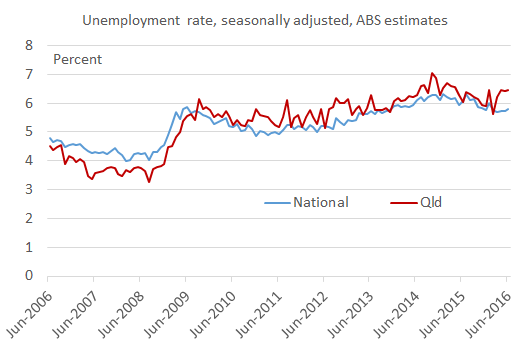
Oster has correctly identified the divergence in economic performance between SEQ and regional Queensland. This divergence means it is difficult to characterise how the total Queensland economy is performing. The ongoing economic weakness in regional Queensland has contributed to the Queensland unemployment rate increasing slightly to 6.5 percent in June, up from 6.4 percent in May (see chart below and Queensland Treasury’s Labour force brief). This is much higher than pre-financial crisis lows, but is much lower than historical double-digit highs, last seen in the early 1990s when the unemployment rate reached 10-11 percent. That said, the Queensland outback had a double-digit unemployment rate in May of nearly 12 percent and Townsville had an unemployment rate over 9 percent, according to Queensland Treasury’s smoothed estimates of the ABS original data (see Treasury’s Regional Labour Force brief).
unemployment_rate_Jun_16

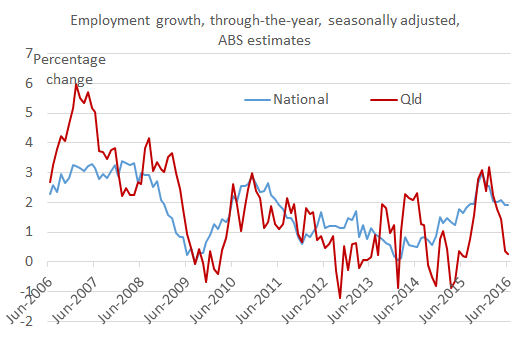
While SEQ appears to be performing reasonably well, it is obvious that jobs growth in SEQ is being offset to a large extent by job losses in regional Queensland, producing a relatively low rate of employment growth of only 0.3 percent over the year to June, compared with 1.9 percent nationally (see chart below).
employment_growth_tty_Jun_16

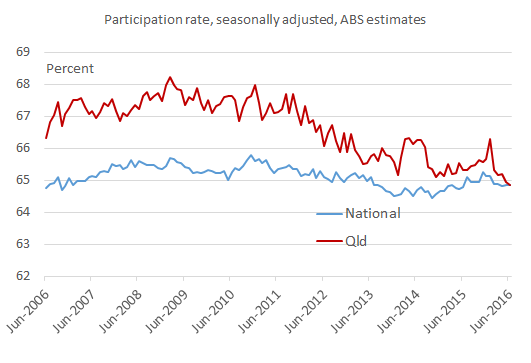
As I have commented previously, Queensland’s under-performing economy may have discouraged many people from looking for work, resulting in a reduction in the labour force participation rate (see chart below). Indeed, our participation rate has converged to the national rate (now 64.9 percent), while historically Queensland had a significantly higher participation rate.
participation_rate_Jun_16

On the June labour force data released by the ABS today, also see Pete Faulkner’s post:
Jobs data disappoints for QLD again

Posted in Labour market, Macroeconomy, Uncategorized | Tagged , , , , , , , , , | 2 Comments

ANU’s Ben Phillips quantifies the real per capita earnings declines in Qld and WA post-mining boom

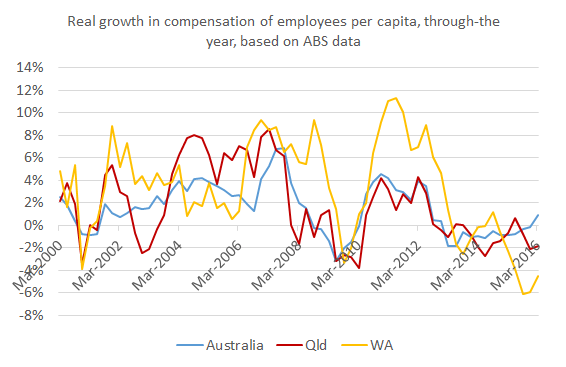
ANU Associate Professor Ben Phillips, who was in the same UQ Economics Honours class as me, has released an excellent note Trends in Household Living Standards in Australia: 1990 to 2016, which shows significant declines in real per capita earnings in Queensland and WA since the end of the mining boom (see my chart below based on figures I estimated consistent with Ben’s methodology). You may recall Ben’s analysis featured in an article by David Uren in yesterday’s Australian. Ben notes:

“Without the mining boom Queensland and WA wages are falling (in real, per capita terms). Over the past three years Queensland wages are down 4.4 per cent and WA wages are down 6.8 per cent.”

This is having a profoundly negative impact in the mining regions. And the associated decline in spending is having adverse flow-on impacts in a range of industries across Queensland. For example, the Gladstone Observer published this article yesterday:

Sex trade’s bottom line hit by mining downturn

The adjustment to the mining downturn continues to be a challenging one.

real_growth_compensation_employees

Posted in Macroeconomy, Mining, Uncategorized | Tagged , , , , , , , , | Leave a comment

Heat map of Brisbane metro property prices – big opportunities in the Western corridor?

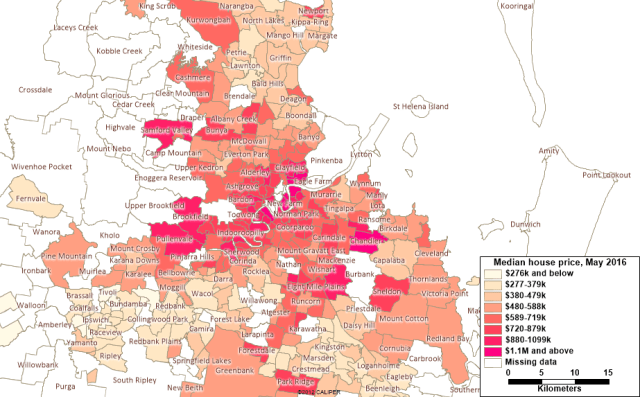
It is well appreciated that people are willing to pay more for properties that are closer to the CBD, have a greater range of services close by (e.g. transport, retail) and offer an attractive lifestyle (e.g. a cosmopolitan community, river views). Given the large variations which exist in these features across suburbs (as well as due to variations in property sizes) there is thus a great disparity in median house prices across the Brisbane metro area (see the map below based on the May 2016 CoreLogic data published in the August issue of Your Investment Property magazine). So New Farm and Teneriffe have median house prices around $1.5 million, while median house prices in many suburbs in Ipswich and Logan are in the $300-400k range. With recent improvements in services and amenities, particularly in Springfield (e.g. shopping centre expansion, rail line, Robelle Domain), and the large projected population growth in the Ipswich region, relatively low property prices could make the western corridor and Ipswich good places for investors to consider.

Median house prices_Brisbane metroSource: CoreLogic May 2016 median house price data published in the August issue of Your Investment Property magazine. N.B. data unavailable for some suburbs (coloured white on map).

I have previously discussed the long-term prospects for Ipswich:

Coles backs Ipswich – good investment given strong population growth

 N.B. The usual disclaimer applies, that this does not constitute investment advice.

Posted in Housing, Uncategorized | Tagged , , , , , , , | 3 Comments

Makin and Pearce confirm urgency of Budget repair in Conference of Economists paper

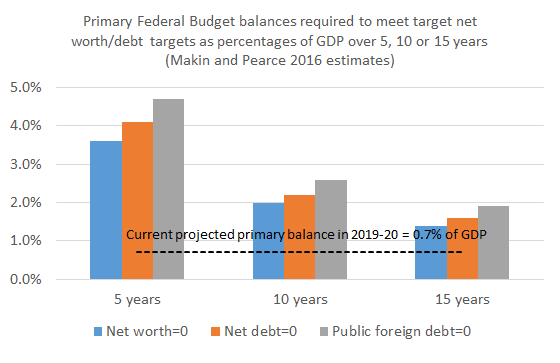
At the Australian Conference of Economists in Adelaide this week, Griffith University Economics Professor Tony Makin and ESA Qld Vice President Julian Pearce will present a very interesting paper titled Fiscal Consolidation and Australia’s Optimal Public Debt. Tony and Julian quantify the extent to which the Federal Government must improve its budget repair effort with a view to meeting different sustainability goals. The primary budget surplus (i.e. budget surplus excluding interest payments) that the Government returns to in 2019-20 and maintains from then on needs to be many times greater than the currently estimated 0.7% of GDP (see the chart below which I have reproduced from Tony and Julian’s paper). This will mean much greater expenditure restraint than the Government has envisaged or is likely to achieve in the next parliament. In other words, the budget repair challenge will be left to a future Government which may have to repair the Budget in a much shorter time frame and with much harsher measures.

Makin_Pearce_chart

Tony and Julian are right to highlight the urgency of the budget repair task and I am impressed at their efforts to quantify the true magnitude of the challenge. I would note, however, that the paper’s reference to the solvency of the public sector is a little imprecise. I would prefer the authors refer to the sustainability of the Federal Government’s current fiscal policy settings, which are clearly unsustainable, rather than questioning the solvency of the Government, which is not really in question at this time. As the authors note (on p. 10):

“…the financial strictures that negative net worth imposes on private firms do not fully translate to governments because governments uniquely possess the power to tax.”

This is an excellent paper which I highly recommend to readers of this blog and my former colleagues in Treasury’s Budget Policy Division who are constantly fighting the good fight for fiscal sustainability.

Incidentally, I appeared on Brisbane’s Ten Eyewitness News on Friday evening regarding a Queensland fiscal policy issue:

Super fund raid

Posted in Budget, Uncategorized | Tagged , , , , , , , , , , , , , | 1 Comment

To protect AAA, Federal Government needs to control age pension and manage the Force from the North

What an extraordinary week it has been! We began the week with no clear election winner and the prospect of a hung parliament, and now we end it with the strong likelihood the Government is back with a majority of one or two seats, or only having to rely upon the self-styled Force from the North, Bob Katter, for confidence and supply. So the Government will be returned, although with a greatly reduced ability to get its agenda implemented, which as others have noted makes the Budget repair task even more challenging and the threat to our AAA rating even greater. For example, Griffith University Economics Professor Ross Guest had an excellent piece published at the Conversation following the announcement there is now a negative outlook on our AAA credit rating from S&P:

Australia could be about to lose its AAA rating, and here’s why

Ross noted:

“In short, there is little or no prospect of achieving the budget repair that is a pre-requisite for maintaining Australia’s AAA credit rating. Both sides of politics need to spell out to all Australians what this means. The effect of a credit downgrade is like an income cut to households, businesses and government.”

This is a very pessimistic assessment from Ross and, alas, probably an accurate one. That said, the Government should continue to argue the case for Budget repair and, given the urgency, should start preparing the public for the even stronger expenditure control measures that will eventually be required to fix the Budget. I have long argued for courageous (i.e. politically unpopular) changes. For example, with a cost of more than $40 billion per year and strong growth due to the ageing of the population, I have previously noted the age pension is a prime candidate for reform:

PC calls for partial inclusion of family home in pension means test

At the same time as the Federal Government makes the case for expenditure restraint and implements whatever savings measures it can pass in the new parliament, it needs to maintain its discipline in the face of pressure from the Force from the North to immediately invest in new infrastructure in North Queensland. Mr Katter wants the proposed Hell’s Gate dam on the upper Burdekin built, and does not want to wait for another feasibility study report (see Katter names dam as his price). However, others in the region rightly do see the need for feasibility study work, including Townsville Mayor Jenny Hill (see this Townsville Bulletin report from March). The Government faces a tough challenge in managing the Force from the North, and it will be important to impress upon him the need for the necessary feasibility studies to ensure that high valued projects, rather than white elephants, are delivered to North Queensland.

Posted in Agriculture, Budget, Macroeconomy, Uncategorized | Tagged , , , , , , , , | 5 Comments

Qld has lowest annual growth in retail turnover among States and Territories

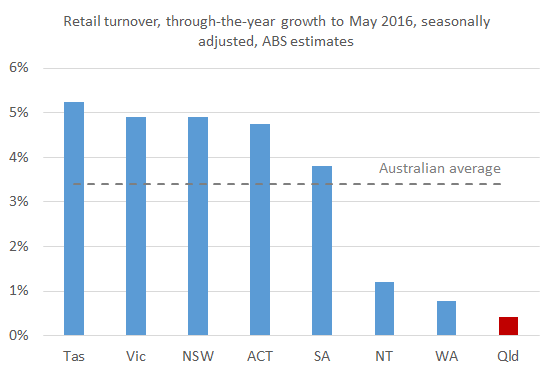
Weak economic conditions in parts of regional Queensland, particularly the Townsville, Central Queensland and outback regions, have no doubt contributed to Queensland having the lowest through-the-year growth in retail turnover among States and Territories, according to May retail turnover data released by the ABS yesterday (see chart below). I was alerted to Queensland’s poor performance on this indicator by Queensland Treasury’s handy information brief on retail trade. As I noted in Monday’s post, there is an urgent need to enact policy changes that promote economic development, and to streamline regulations and reject anti-development attitudes that are stopping many different types of projects.

Retail_tty_May16

Posted in Macroeconomy, Retail trade, Uncategorized | Tagged , , , , , , | 4 Comments

Recommended reading: The Industries of the Future by Alec Ross

Our embattled Prime Minister Malcolm Turnbull was at least right about the importance of innovation, even if that message did not resonate with voters in Western Sydney, Tasmania and other regions where the Coalition suffered heavy losses. One of the best places to learn about the profound innovations that are occurring is a book by a former adviser to Hillary Clinton, Alec Ross, titled The Industries of the Future. Mr Ross deftly illustrates his main points with interesting anecdotes from his exciting career, including meetings with tech industry titans and foreign officials, with one particularly interesting anecdote from the Russian White House.

The book surveys important innovations such as the platform technologies that underpin the sharing economy (e.g. Uber, Airbnb), big data analytics, the internet of things, and automation and robotics. These innovations will provide huge economic benefits and redefine our economies, but, at the same time, they will increase inequalities both within regions and between regions, as regions such as Silicon Valley will be major beneficiaries of winner-takes-all platform technologies. And these innovations will bring huge risks, particularly to privacy and security, as technology becomes an even more essential and integrated part of our lives.

In a terrifying passage in the book, Mr Ross alludes to the possibility of a future conflict being started by a private sector company retaliating against a cyber-attack by a foreign government. In fact, Google, among other US companies, has been subject to such an attack, by a Chinese Government operation. Mr Ross asks (on p. 143):

“…what would have happened if, when Google had identified the source of the hack, it had responded in kind with an attack designed to disable its attacker’s network and computers. The Google engineers are some of the best in the world. Would China have considered this an attack or some other form of invasion? It might have.”

Given the growing threat from cyber-attacks, Mr Ross suggests one of the best careers over the next few decades will be that of the cyber-security expert. His advice for young people is excellent, advising them that, if they want the best chance in today’s rapidly changing and interconnected world, they should study computer science, as well as a foreign language and a technical (i.e. programming) language such as Python.

This is a terrific book which I cannot recommend highly enough.

Industries_of_the_future

Posted in Labour market, Macroeconomy, Productivity, Uncategorized | Tagged , , , , , , , , , , , , | 3 Comments

Economic conditions partly responsible for return of Pauline Hanson and One Nation

Dennis Atkins had an excellent column in the Sunday Mail yesterday analysing the return of Pauline Hanson and One Nation, noting that One Nation voters had:

“…rejected the Turnbull mantra of embracing the future because of anxiety about the cost of living and high unemployment.

In the Townsville seat of Herbert, where One Nation came from nowhere to score more than one in 10 votes, the unemployment rate is 12 per cent.”

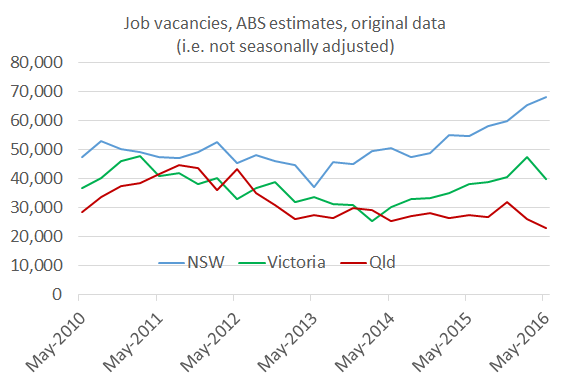
I have commented previously on the weak economic conditions in many Queensland regions, particularly in my old home town of Townsville, and have suggested that we need to urgently adopt policy settings (and attitudes) that promote economic development and job creation (see my Jobs Growth Summit post from April). As the State and regional economies in particular continue to suffer the after-effects of the mining downturn and drought, the short-term economic outlook is not encouraging. Certainly, job vacancy estimates released by the ABS last Thursday were disappointing for Queensland (see chart below).

Job vacancies May 16

Hence it is unsurprising that Queensland has been the source of several surprises in the federal election. We now wait patiently for the final outcome.

Posted in Labour market, Macroeconomy, Uncategorized | Tagged , , , , , , , , | 12 Comments

Heavy construction decline has been greater in Qld than in WA

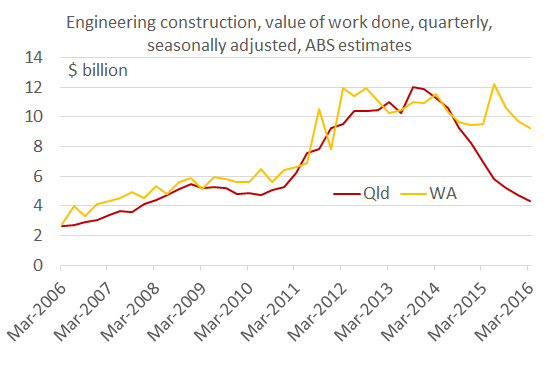
As I have discussed previously, relatively weak economic conditions in several Queensland regions, including Townsville and the outback, have been partly due to the mining downturn (see my post from last Saturday). At the same time as capital expenditure on the Curtis Island LNG plants has naturally wound down, the bust in commodity prices has meant that there has been a drop off in mining projects invested in. So we have seen a huge decline in the value of heavy or engineering construction work done in Queensland (see chart below based on ABS data released yesterday), a decline that is proportionately greater than that which has occurred in WA. Obviously, this has posed a big challenge to the Queensland economy and has been a major drag on economic growth in recent quarters.

Engineering_construction_Mar16

Posted in Macroeconomy, Mining, Uncategorized | Tagged , , , , , , , , , , , , , , | 3 Comments

XRR business case should be released in full to give public comfort it is value for money

Yesterday, the Queensland Government sent the Federal Government the business case for the $5 billion Cross River Rail (XRR) project, but alas it has only provided the public with an inadequate, opaque four-page (not counting the cover page) summary of the business case (available from the Building Qld website). This is not good enough and is terrible from a transparency perspective.

The reported XRR benefit-cost ratio of 1.12 to 1.21 (i.e. benefits likely only exceed costs by 12-21% over the project life-cycle) does not give us much comfort that the project stacks up, particularly when one considers the huge risks of cost blowouts and demand shortfalls common with mega-projects (see my post from May).

From the inadequate summary, it is unclear what sensitivity tests were conducted to generate the benefit-cost ratio range of 1.12-1.21. Did the analysts consider a truly pessimistic scenario? What about if the mysterious “other benefits”, representing 13% of benefits, do not materialise? Were there any scenarios in which XRR did not stack up? The business case summary is completely inadequate in allowing us to assess the robustness of these results.

XRR is a $5 billion project with a huge opportunity cost. How many schools and hospitals could that fund, for example? Independent experts and the public should be allowed to judge the merits of XRR by being allowed to review the full business case. At this feasibility assessment stage of XRR, I doubt there would be any genuinely commercially sensitive information in the business case, so even the weak defence of “commercial-in-confidence” would not really apply here.

While in opposition, the Government set a high standard for transparency in infrastructure decision making, noting in its Building Queensland policy document on p.7:

“The policy guidelines for Building Queensland will require that a cost-benefit analysis and assessment of value for money take place prior to any project approval and that this assessment be released for public consultation. Only infrastructure projects that can demonstrate a clear economic, fiscal or service delivery benefit, including regional significance, will be considered. If a project does not stack up, under Labor it will not proceed and the cost-benefit analysis will not be hidden from public scrutiny.”

The Government was right to include this statement in its policy document. It now needs to follow through and publish the full XRR business case.

XRR

Why just a summary? Economists are keen to read the full business case

Posted in Transport, Uncategorized | Tagged , , , , , , , | 3 Comments