Fantastic December quarter result for Qld economy

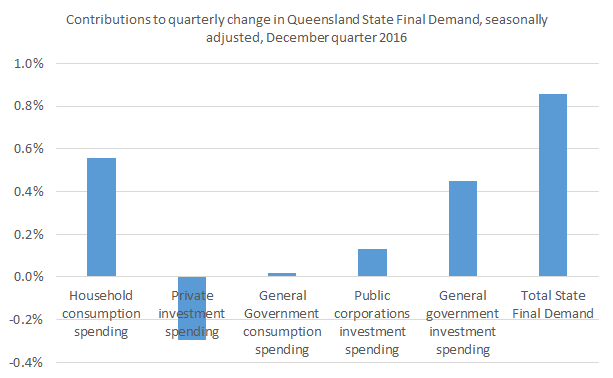
The December quarter National Accounts showed a strong rebound for the Australian economy, with economic growth at 1.1 percent for the quarter, while State Final Demand for Queensland grew at 0.9 percent over the quarter according to the ABS. (Note the GSP result for December quarter should be even better as it will include net exports which are not included in the State Final Demand estimates published today.) As the decomposition in the chart below shows, this was driven by growth in household consumption spending and general government investment spending (e.g. the State Government’s regional capital works programs, which appear to be having a strong economic impact, although the jobs impact is likely less than the Government is currently claiming, as I discussed in my previous post).

sfd_dec16


Posted in Macroeconomy, Uncategorized | Tagged , , , , , | 4 Comments

Qld Government & Treasury disagree over jobs created by capital works projects – Treasury right, of course

A recent media release from the Deputy Premier Jackie Trad (Jobs bonanza for regional Queensland) appears to have contained a huge typo. The media release from Tuesday last week states:

“$200 million will kick off 723 projects and support almost 6,000 jobs across regional Queensland on economy-boosting infrastructure projects as part of the Palaszczuk Government’s Works for Queensland program.”

Somehow an extra zero was added on to the correct estimate of 600 jobs, so the media release incorrectly states that 6,000 jobs would be supported by the new $200 million program, which is absurd.

As the Shadow Treasurer Scott Emerson pointed out in Parliament this morning (see p. 269 of the Hansard proof), there is a rule of thumb in Queensland that every $1 million of capital expenditure supports around three jobs. For example, the Queensland Government has previously noted, in a media release last November, that the Townsville Super Stadium (a $250 million project) will support 750 jobs in the construction phase, and the $450 million Logan Motorway Enhancement Program will support “more than 1,300 construction jobs”. Incidentally, both these projects involve higher levels of capital works than the latest $200 million program, but would deliver far fewer than the 6,000 jobs claimed for the new program. It is obvious the 6,000 jobs estimate is absurd.

Based on the three jobs per $1 million of capital works rule of thumb, you would estimate that the $200 million of capital expenditure in the Government’s latest program would support 600 jobs, not 6,000. The rule of thumb, though imperfect, at least provides a ballpark estimate of employment impacts. 600 jobs is in the ballpark. 6,000 jobs isn’t even in the surrounding car park; it’s over the other side of town.

The Government might possibly argue that the 6,000 figure includes jobs indirectly supported via the supply-chain and not just those directly employed on the projects. But that would imply a ridiculously high employment multiplier of 10: 6,000 total jobs (direct plus indirect) divided by 600 direct jobs. Multipliers of over 2 are usually suspicious; a multiplier of 10 is absurd. There is no defensible economic model that would estimate 6,000 jobs flowing from $200 million of capital works.

My guess is that whoever wrote the Deputy Premier’s media release, or the original briefing on which it was based, saw the 600 jobs figure in another document and misread it or mis-typed it as 6,000. They possibly saw the 600 figure in this earlier media release from January, a media release which appears to rely upon the rule of thumb mentioned above:

“Regional Queensland councils are being urged to submit their job-creating projects after being allocated a share of the new $200 million Works for Queensland program…

…“The Palaszczuk Government is absolutely committed to creating jobs for Queenslanders and this innovative program will deliver on this commitment,” Ms Trad said.

“It will serve a double duty – supporting more than 600 jobs and upgrading important regional infrastructure across the state.”

So the Government was originally using the right estimate of 600 jobs, but has subsequently incorrectly referred to 6,000 jobs, and, instead of correcting its mistake and moving on, it has unwisely stuck with the incorrect figure.

On ABC News Tuesday night last week, a Government spokeswoman was quoted as saying that the original 600 jobs estimate came from Treasury, and that Treasury was wrong. But it was the Government spokeswoman who was wrong. The Treasury’s estimate was sound, and the Government ought to find a face-saving way out of this regrettable situation, perhaps by claiming there was a miscommunication between ministerial staffers and officials.

The Treasury is too important an institution to have its reputation called in to question by a nameless Government spokesperson, who was obviously trying to manage what they viewed as a purely political issue, without understanding the full implications of their criticism of Treasury.

Posted in Infrastructure, Uncategorized | Tagged , , , , , , | 2 Comments

Zombie electricity utilities – upcoming presentation by Professor Manuel Pinho to ESA Qld

The latest issue of The Economist features an excellent article (Wind and solar power are disrupting electricity systems) describing the challenges of integrating renewable energy into electricity systems. It is a timely article, given there is an extensive debate in Australia at the moment regarding the impact of renewable energy sources on the reliability of electricity supply and its cost.

One of the world’s leading experts on the economics of renewable energy is Professor Manuel Pinho of Columbia University, a former Economy and Innovation Minister of Portugal. The Economic Society of Australia (Qld), of which I am the Secretary, is fortunate to be hosting a lunchtime seminar by Professor Pinho on renewable energy issues on Monday 13 March in Brisbane at Morgans, Riverside Centre.

As Portugal’s Minister for Economy and Innovation, Professor Pinho was instrumental in Portugal becoming an economy with a major reliance on renewable energy. The Guardian observed that one of the 12 key science moments of 2016 was Portugal being entirely powered by renewable energy for four days last May.

At the seminar on Monday 13 March, Professor Pinho will speak on the topic of:

Zombie Electricity Utilities: A world with falling demand for on-grid electricity consumption.

This is a very important topic, because as more people install solar PV cells and batteries, such as the Tesla Powerwall, the demand for electricity from the grid will fall. This could have major implications for the State Government Budget in the future, as dividends fall or subsidies need to be paid to ensure the ongoing viability of the State’s electricity distributor (i.e. Energy Queensland) and power generators (i.e. CS Energy and Stanwell).

If you are interested in attending this seminar, priced at $20 for members and $40 for non-members, please register soon (at the link above), as I expect this will be a very popular seminar.

220px-manuel_pinho

Professor Manuel Pinho

Posted in Energy, Uncategorized | Tagged , , , , , , , , | 3 Comments

Strong growth in plant & equipment capex is good news for Qld economy

Last Friday, in his opening statement to the House of Representatives Standing Committee on Economics, RBA Governor Phil Lowe observed:

“Nationally, measures of business conditions have picked up noticeably recently. For some time we have been waiting for a lift in non-mining business investment. It has been a long time coming. Encouragingly, in New South Wales and Victoria we have now seen a reasonable pick-up in investment. However, we are yet to see this in most other states, where the unwinding of the mining investment boom continues to affect the overall business climate. With the decline in mining investment coming to an end, we hope to see a broader pick-up over time.”

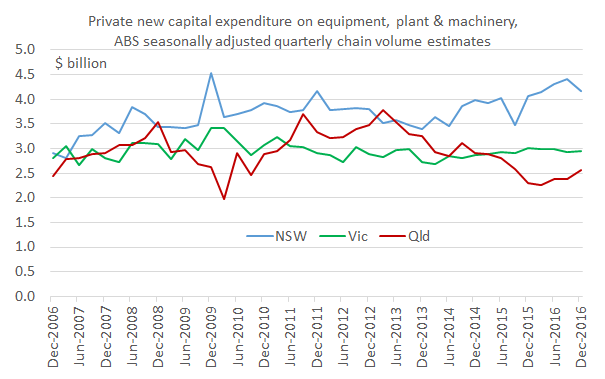
It is unfortunate the Governor did not refer to Queensland. Even though the unwinding of the mining investment boom continues to adversely impact on total real business investment (i.e. capital expenditure), as investment in buildings and structures continues to fall, capital expenditure by businesses in new equipment, plant and machinery is growing strongly (at 7.9% in December quarter and 12% over 2016). Indeed, recent data appear more encouraging in Queensland than in NSW, where a surge earlier in 2016 was partially unwound in the last quarter, and in Victoria, where business investment in equipment, plant and machinery has plateaued (see chart below).

capex_dec16_chart1

Queensland’s recent recovery in capital expenditure in equipment, plant and machinery would be related to improving business confidence over the second half of 2016, and supports the view that the economic outlook for Queensland is superior to other States in 2017. Certainly, Queensland is currently benefiting from a surge in tourism, new LNG exports, and a recovery in coal prices in the second half of 2016, among other positive factors. The Queensland Treasury must be feeling reasonably confident about its forecast in the 2016-17 Mid Year Fiscal and Economic Review that:

“Queensland’s economic growth is expected to be the strongest of all states in 2016-17 and 2017-18.”

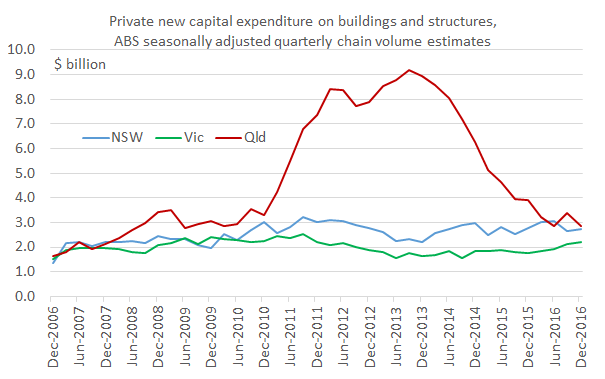
The latest capital expenditure data from the ABS also remind us about the huge shock the Queensland economy experienced from the construction of the LNG processing plants at Curtis Island off Gladstone, as well as other resources sector construction projects. Capital expenditure on buildings and structures in Queensland is still declining from the massively elevated levels of a few years ago (chart below).

capex_dec16_chart2

As I have noted in many previous posts, the end of the mining construction boom has been painful in parts of Central and Northern Queensland. Incidentally, I was briefly mentioned in today’s Courier-Mail regarding the paper’s #GoQld Action Plan to revive regional Queensland:

“Chamber of Commerce and Industry Queensland senior policy adviser Catherine Pham said lifting the payroll tax exemption threshold for businesses from the current $1.1 million was crucial. “The business community has consistently viewed payroll tax as a tax on employment and a penalty on giving someone a job,’’ she said.

Economist Gene Tunny agreed such a move would boost jobs. He also supported a push for relocating some public servants to regional cities.”

Posted in Macroeconomy, Uncategorized | Tagged , , , , , , , , , , , | Leave a comment

Health care business numbers up 17%, while retail, mining & farm business counts fall 8-9% over 2012 to 2016

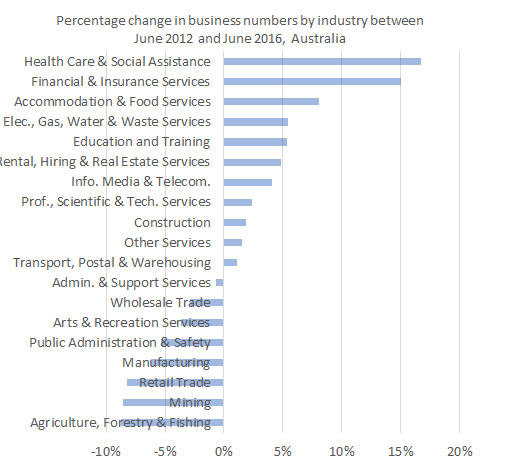
The structural change the Australian economy has experienced in recent years, including the decline in manufacturing and the decline of small retailers, at the same time as health care and other service sectors are booming, reveals itself in the latest business counts data based on ABNs released by the ABS today (see figure below). Between June 2012 and June 2016, across Australia, the number of health care and social assistance businesses increased from around 105,700 to 123,400, while, in contrast, the number of retail businesses fell from 142,900 to 131,200. The data also confirm Queensland’s relatively lacklustre economic performance over 2015-16, with business counts increasing 1.9% in Queensland compared with 3% in NSW and 2.8% in Victoria.

business_counts_2012_2016

Recent comments of mine on these trends can be found in the following posts:

Comments in Courier-Mail on Qld regional economies and structural change

Valley the victim of retail trends

Posted in Agriculture, Health, Mining, Retail trade, Uncategorized | Tagged , , , , , , , | 3 Comments

Qld sugar dispute highlights constraints on minority government

The current commercial dispute between Wilmar and Queensland Sugar Limited has highlighted the constraints on the Queensland Government’s ability to prosecute sound economic policy from its position as a minority government. Wilmar is the Singaporean-based company that bought CSR Sugar in 2010, mills 60 percent of Australia’s exported sugar, and now intends to market sugar as well. This has brought it into conflict with Queensland Sugar Limited, which has traditionally been the “single desk” marketer of sugar. Wilmar and QSL cannot agree on revenue-sharing arrangements between the miller and cane growers. An agreement is needed because cane growers, whose cane is milled by Wilmar, are expected to opt for QSL to market their sugar rather than Wilmar, a choice which is guaranteed by Queensland’s “Real Choice in Marketing” law.

The “Real Choice in Marketing” law was passed by the Queensland Parliament, but opposed by the Government, in late 2015. The Government lacked the numbers to defeat the Katter’s Australian Party bill which was supported by the LNP and Billy Gordon. The Government does not have the numbers in the Parliament to overturn the law, and instead the policy agenda is being set by the Opposition, which has announced it may legislate to intervene in the dispute and force arbitration:

Qld LNP calls for end to sugar dispute

Being part owners of QSL, cane growers will receive much higher revenue if QSL is the marketer of the sugar produced from their cane rather than Wilmar (see this ABC News report). The Opposition is getting the politics of the dispute right, as it is backing local cane growers against the foreign-owned Wilmar. However, its policy position is dubious from an economic perspective. While the sugar mills effectively have local monopsony power, the right way to deal with that is not to re-regulate the sugar industry, but to rely upon existing laws against the abuse of market power.

The “Real Choice in Marketing” law has been denounced as anti-competitive and as a deterrent to foreign investment and structural adjustment by both the Queensland Productivity Commission in a Regulatory Impact Assessment and the Australian Productivity Commission in a draft report on agricultural industry regulation. The Australian PC rejected the “Real Choice in Marketing Law” noting (on p. 420):

“The Commission agrees that reregulation of the sugar industry is an inappropriate means of achieving the underlying policy goal of ensuring an equitable allocation of risk and return between growers and millers. Australia has comprehensive laws governing the misuse of market power…and the concentrated nature of the industry provides sugarcane growers with an opportunity to take advantage of the collective bargaining provisions in the Competition and Consumer Act 2010 (Cwlth).”

The Queensland Government has the right policy position, but it lacks the power to enforce it. It can only resort to weak measures such as making Freedom Of Information requests for the Australian PC’s final report on agricultural industry regulations:

Palaszczuk Government to use FOI in bid to save Qld’s sugar industry

If the Government wants to re-establish its authority over economic policy, it really ought to call an early election.

For background on the sugar marketing dispute, see Anne Hyland’s AFR article from November last year.

Posted in Agriculture, Uncategorized | Tagged , , , , , | 4 Comments

Comments in Courier-Mail on Qld regional economies and structural change

Today, the Courier-Mail is re-launching its GoQld campaign, this time with a focus on regional economies. It has rightly identified the large divergence in employment growth between SEQ and the rest of Queensland, and it is reporting a loss of 43,000 full-time employed persons in regional Queensland in the last twelve months, based on Pete Faulkner’s trend estimates (see Queensland in shock as 43,000 jobs vanish).

Given the large sampling error in the ABS Labour Force Survey at the regional level, it is hard to be precise about regional employment estimates, but it is very likely the regions have lost jobs in net terms, particularly in the Townsville and Queensland outback regions. That said, there is a large variation in economic performance across regions, with the Gold Coast and Toowoomba regions performing strongly. Also, Central and Northern Queensland regions dependent on mining are now starting to feel the benefits of the recovery in coal prices in the second half of last year, as mines are increasing production and taking on new workers.

Partly, the divergence in employment outcomes between the regions is a result of long-term structural factors (e.g. automation, technological change, and rising labour costs making Australian manufacturers less competitive). Hence, we may not see a strong recovery in some regions, and government policy measures to revive these economies may prove ineffective. As I have noted before, I am concerned particularly about the Townsville economy, and I am also worried about the economic viability of many towns in western Queensland. I emphasised the importance of structural change in comments reported by Paul Syvret in today’s Courier-Mail (Voter sentiment reflects economic divide making change key to a bright future):

Economist Gene Tunny attributes the downturn in many regions to lower commodity prices (which he notes are recovering) and the end of the mining investment, but stresses longer term structural change is the most important factor.

“Quite simply, we don’t need as many people in mining, manufacturing and agriculture as we used to,” he said.

He stresses that as economies evolve over time, it is inevitable that there will be winners and losers.

Mr Tunny stresses that even though many in the regions think that “if we get more money for dams, roads, power stations and so on everything will be fine … there is no magic bullet”.

Ultimately, Mr Tunny says: “There may even be a case for regional government and re-examining state boundaries that reflect a very different era.”

Posted in Labour market, Macroeconomy, Mining, North Queensland, Townsville, Uncategorized | Tagged , , , , , , , , , , , | 3 Comments

HSBC’s Paul Bloxham on the economic outlook and President Trump

Last Thursday, Paul Bloxham, HSBC Chief Economist for Australia and NZ, gave an excellent briefing on the economic outlook at a lunchtime event organised by the French Australian Chamber of Commerce and Industry (FACCI), and hosted by Clayton Utz at their Brisbane CBD offices. Bloxham is highly optimistic about Australia’s (and Queensland’s) growth prospects due largely to:

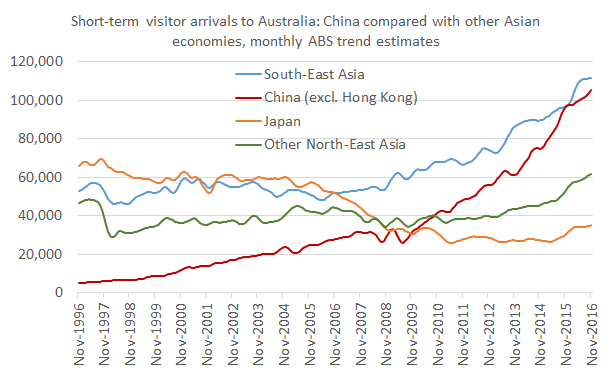
  • our close ties to China and other Asian economies, which will continue to grow and buy our resources and send us ever-increasing numbers of tourists (see chart below), and
  • the rebound in commodity prices, turning what was a headwind in recent years into a tailwind, encouraging the re-activation of mines and an expansion of output and employment in the resources sector, with positive flow-on impacts to the rest of the economy—and a large increase in State Government royalties revenue and Commonwealth company tax revenue which could avert a loss of Australia’s AAA credit rating.

starrivals

As you would expect, Bloxham qualified his observations by noting the huge amount of uncertainly arising from the US and possibly from elections in Europe later this year. Bloxham speculated on what Trump’s policies might mean for Australia, noting there could be one benefit from a US-China trade war, as we could then export more agricultural products to China. I would note that, of course, we may also suffer if the US buys fewer products from China and then this flows through to their demand for our resources. Also, Bloxham suggests, a higher US dollar caused by Trump’s policies and more restrictive immigration rules in the US might send foreign students who might otherwise go the US to Australia instead.

If you are interested in the economic implications of Trump, as Secretary of the Economic Society of Australia (Qld), I would encourage you to attend our upcoming event at the Ship Inn, South Bank on Wednesday evening 22 February:

The economics of President Trump

Posted in China, Mining, Uncategorized | Tagged , , , , , , , , , , , , | 1 Comment

Coal and LNG push Qld commodity exports up to $1 billion per week

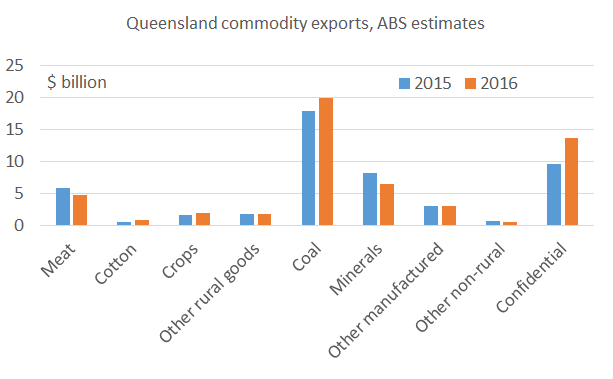
The surge in coal prices in the second half of 2016 and increased exports of LNG from Gladstone’s Curtis Island have pushed Queensland’s commodity exports to over $52 billion in 2016, or $1 billion per week, up from around $49 billion in 2015 (see chart below, based on the Qld Treasury briefing noting LNG exports are included in the confidential category, along with alumina and metallurgical coal from some exporters). The recovery in coal prices has led to production increases at several mine sites and hundreds of new jobs in the sector, but, as I have noted previously, it is unclear how long higher prices will be sustained. Along with Queensland’s strong tourism sector and increasing business confidence (see the recent CCIQ Pulse survey results), a revival in coal mining, even if temporary, should mean a positive economic outlook for Queensland in 2017. That said, I remain concerned about the contractionary impact that will come as residential construction falls from elevated levels, which will reduce the rate of economic growth to an extent.

exports-dec-16

Posted in Macroeconomy, Mining, Uncategorized | Tagged , , , , , , , , | 3 Comments

Property market shows parents are willing to pay for high-performing State Schools

There is a report from Domain today about the impact of school catchment areas on house prices (House prices in some Queensland state school zones rise by up to 40 per cent):

“With the new school year just underway, the Domain Group has released its annual school zones report, uncovering the primary and secondary government school catchment zones that have experienced the highest house price growth rates in 2016.

Despite a 3.5 per cent decrease in Brisbane city price growth last year, top performing primary and secondary catchment areas in southeast Queensland have seen between 19 and 40 per cent growth in prices…

…Some of Brisbane’s best performing schools made the top 10 list for catchment zone house price growth, including West End State School (up 21.7 per cent), Brisbane State High School (up 11.1 per cent) and Indooroopilly State High School (up 9.6 per cent).”

The study does not appear to have controlled for the wide range of factors that would affect property prices in any area, but there is no doubt that property prices are affected significantly by school catchment areas, and real estate agents have started using school catchment areas in their marketing of properties. The Brisbane State High and Milton Primary School catchments are particularly popular, for example.

Given the extent to which house prices are being bid up in the catchment areas of desirable schools, it is clear parents have the capacity to make a greater contribution to the costs of running state schools. Currently, existing property owners in desirable catchment areas are capturing a monetary benefit that could be captured by the State Government, through higher parental contribution charges at popular schools, to help it cover the costs of education provision. Of course, the State Government may need to make some concessions for poorer households living in desirable school catchment areas. Ideally, we would have a means-tested school voucher scheme across Australia.

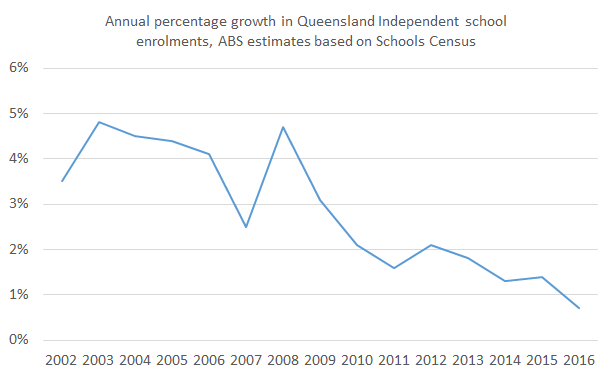
The increasing popularity of high-performing State Schools is partly a reflection of lacklustre economic conditions and large increases in private school fees, which have seen a large slowdown in the growth of private school enrolments (see chart below for the independent schools sector).

independent_schools_growth

For more commentary, see my earlier post on this issue:

St Lucia property owners capturing value from Ironside State School

Posted in Uncategorized | Tagged , , , , , , , , , , , | Leave a comment