Senator Canavan’s ambitious plan for a State of North Queensland

Senator Matt Canavan, a friend of mine from my Canberra days, is not wasting any time while he is temporarily out of the Cabinet. He is making plans for a new State of North Queensland. With his background as a Productivity Commission economist and as the former Minister for Northern Australia, Senator Canavan has the expertise and experience to come up with a credible and convincing plan for a new State of NQ. The Senator made some very interesting observations to the Townsville Bulletin last Friday:

“I’ve often said we’re big enough and strong enough and wealthy enough to represent ourselves,” he said.

“I reckon we’d get more things going if we didn’t have the handbrakes put on us by Brisbane and Canberra.”

Senator Canavan said Tasmania had 12 senators with 500,000 people but “North Queensland has only two and we have more than one million people”.

“I utterly reject any notion that we couldn’t stand on our own two feet,” he said. “Our average per-person economic output in North Queensland is 30 per cent higher than in southern Queensland. All the money seems to get spent in Brisbane.”

Senator Canavan is absolutely right about NQ’s higher economic output per capita (see chart below based on the most recent official estimates from Qld Treasury), although this is a result of the disproportionate contribution of mining to NQ’s economy. A lot of the income generated in NQ is earned by mining companies, and the bulk of it ends up leaving NQ, with a good proportion of it going overseas. The average NQ resident does not earn a higher income than the average SEQ resident. That said, the large economic contribution of mining (e.g. around two-thirds of North West Qld’s economy, half of Mackay’s, and one-third of Fitzroy’s) means that a new State of NQ would earn healthy royalty revenues. Of course, as currently happens with Queensland, this healthy royalty revenue would count against NQ in the distribution of GST revenue.

While I concur with the Senator that a State of NQ would be economically viable, I’d be careful about rushing into it. The set up costs would be large, and there may be trouble filling senior public service positions, given the vast majority of current Queensland public service SES positions are in Brisbane. Also, as I’ve posted on previously, I’m unsure NQ gets such a raw deal from Brisbane (see my post Is NQ under-funded relative to SEQ?). That said, I am very open to a debate about a new State of NQ, and I look forward to further contributions from Senator Canavan in advancing this interesting proposition.
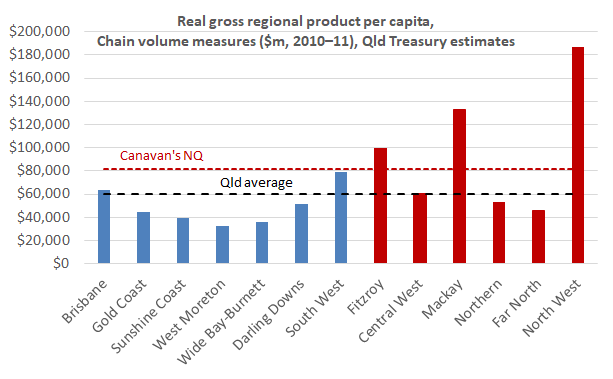
Canavan_NQ

*NB Senator Canavan is including Rockhampton, where his office is based, and the Fitzroy region in NQ.
Posted in North Queensland, Uncategorized | Tagged , , , , | 6 Comments

Qld Government wants electricity GOC dividends to do double duty

Yesterday’s media release from the Queensland Premier and Energy Minister on the $2 billion Affordable Energy Plan appears to have been prepared without Queensland Treasury input, as it is very loose in its discussion of the budget impact. The media release notes:

The Palaszczuk Government will ensure Queenslanders’ power bills are pegged to average inflation over the next two years and cut $50 a year from bills as part of a $2 billion Affordable Energy Plan to provide cost of living relief.

The move will see all the dividends from Queensland’s publicly-owned electricity assets reinvested in an all-out attack on affordability, while Queenslanders wait for the Prime Minister’s proposed National Energy Guarantee.

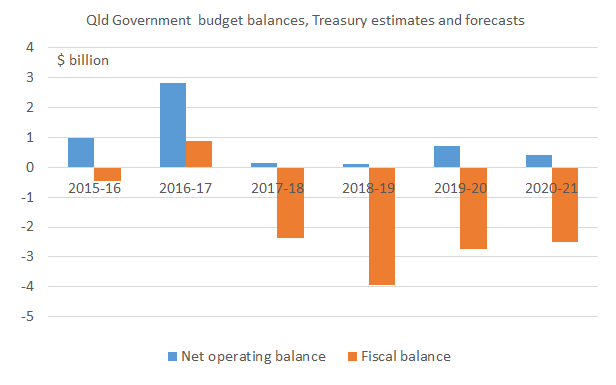
But the dividends from electricity sector government-owned corporations (GOCs) should already be included in the budget forward estimates so, everything else being equal, the new elements of the Affordable Energy Plan will increase the State Government’s projected fiscal deficits and hence increase debt (see the fiscal deficits Treasury projected in the State Budget released in June in the figure below). The dividends can’t do double duty. They already go into consolidated revenue to help pay for all the government’s bills, and they aren’t explicitly earmarked for subsidising electricity prices.

Unless GOC dividends or other revenues such as coal royalties are higher than previously expected, the Government does not have any new money to spend. The Government needs to explain exactly where the additional money for its new subsidies is coming from. An early mid-year Budget update would be useful in this regard.

I suspect the State Government does have some additional money from resource royalty revenue to play with. If it does, it should be transparent about this, rather than pretending it is funding its new energy affordability measures through GOC dividends already factored into its budget.

Finally, it is sloppy to talk about the dividends being “reinvested” in this package. The bulk of the Affordable Energy Plan is a subsidy to power bills which I expect will be treated as a recurrent operating expense in the budget, not as a capital investment.

On these issues, also see:

Graham Young’s post Retailers not the problem Premier—you are

Nick Behrens’ post from July Is Qld Government dividend policy forcing up electricity prices and taxation by stealth?

Budget_1718_Chart1

Posted in Energy, Uncategorized | Tagged , , , , , | Leave a comment

Qld Budget data visualisation from Truii

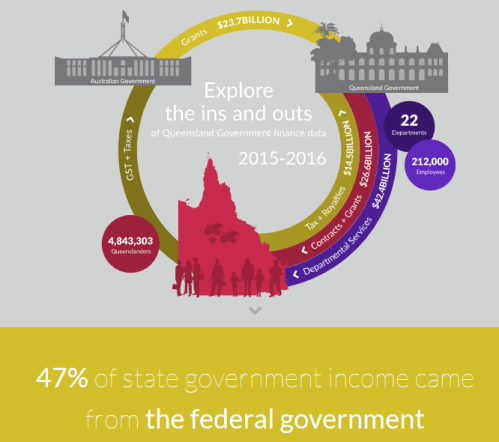
Brisbane-based data visualisation company Truii has produced an impressive data visualisation of the 2015-16 Queensland Budget:

Queensland Government finance data 2015-16

govspend

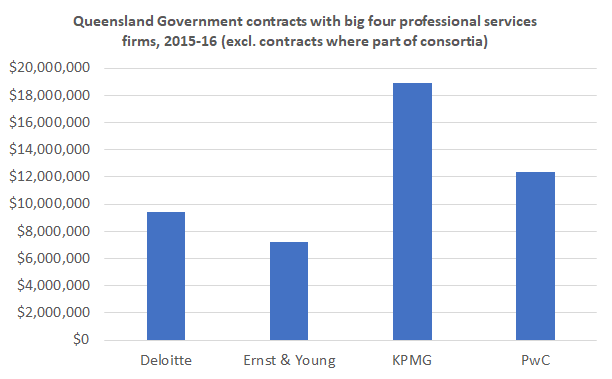
The data visualisation uses open data from the Queensland Government, including a comprehensive data set on contracts and grants. By linking to open data, the Truii site allows analysts to uncover an even greater range of insights than are available from Truii’s data visualisations alone. To illustrate, one can compare the performances of the big four professional services firms in winning Queensland Government work (see my chart below). It appears 2015-16 was a very good year for KPMG!

big_four_contracts

Truii’s data visualisation site was commissioned by the Department of Science, Information Technology and Innovation as part of its Testing Within Government program. Many thanks to Maree Adshead, CEO of Open Data Institute Australian Network, for alerting me to this excellent data visualisation.

Posted in Budget, Uncategorized | Tagged , , , , , , , , , , | Leave a comment

Nostalgia for the car industry won’t bring it back: domestic market too small, labour costs too high

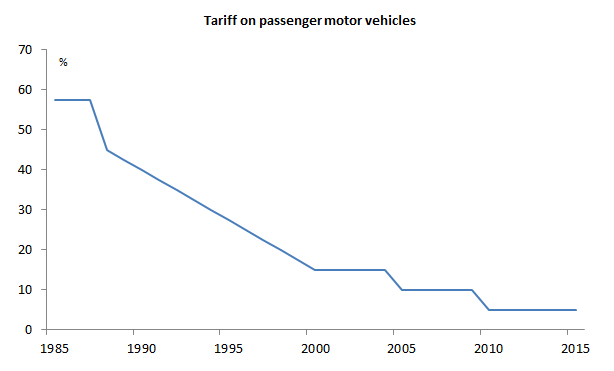
It is the last day of car manufacturing in Australia today, with the final Holden cars to be manufactured at the soon to be shut Elizabeth plant in SA, as reported in the Courier-Mail. It is awful that thousands of people have lost their jobs, but the industry was never viable without the very high tariffs we once had (see chart below), which cost Australian consumers thousands of dollars on every car imported. High tariffs had been replaced by direct industry assistance from taxpayers but, even though it had amounted to in the order of $10,000 per annum per job protected, it was insufficient to save the industry. PMVtariff

There was no legitimate economic case for protecting the car industry, and national defence arguments were spurious. Could we seriously expect a plant once producing Commodores to be rapidly converted to one producing modern fighter jets such as the Joint Strike Fighter? Alas, over the years automotive workers have been given false hope by government policies that had promised to transform and reinvigorate the car industry. Given the small scale of Australia’s domestic car market, which was too small to provide a base level of demand to domestic manufacturers that could support the large capital investments they needed to make, as well as our relatively high labour costs, the shut down of the Australian car industry was always inevitable.

Queenslanders are almost unambiguously better off from the reductions in car industry protection over the last few decades, given most of us benefit from cheaper cars and very few of us would be adversely affected by the plant closures down south.

My previous comments on the car industry include:

CIS Policy article on Carr’s car cash

Minimal threat to Qld economy from car industry shutdown

Posted in Industry policy, Labour market, Uncategorized | Tagged , , , , , | 8 Comments

Qld unemployment rate falls below 6% to 5.9% (in trend terms)

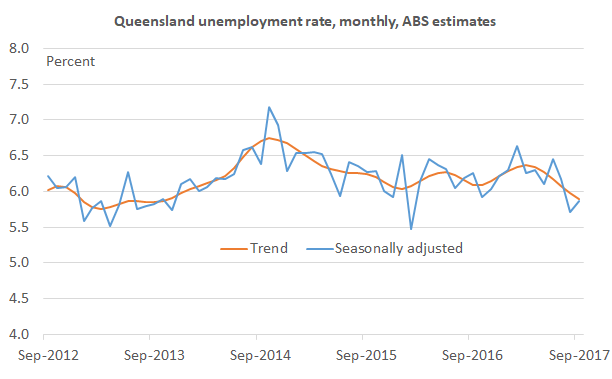
This is just a quick post to update you on the September labour force estimates released by the ABS today: the Queensland unemployment rate has fallen to below 6% in trend terms and is now at 5.9% (see chart below). This is the lowest rate in almost four years (since November 2013) and hopefully we’ll see further falls and convergence to the national unemployment rate, now at 5.5% (both trend and seasonally adjusted).

LF_Sep17_chart1

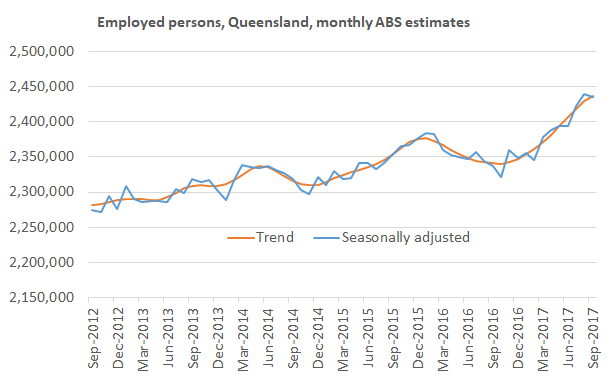
Over the last year or so, Queensland has seen a strong recovery in the jobs market, with employment growing at 4.1% through-the-year (see chart below). I should note that this was largely due to an increase in part-time employed persons (+64,700) rather than full-time employed persons (+31,100). And the public service has made a disproportionate contribution to employment growth, as discussed in previous posts.

LF_Sep17_chart2

Despite these qualifications, the jobs data are very positive for the Palaszczuk Government (see chart below), which will soon be fighting for its political life, as the rise of One Nation threatens its chances of forming government after the next election, widely expected to be held by the end of this year.

LF_Sep17_chart3

Posted in Labour market, Uncategorized | Tagged , , , , , | 3 Comments

Technological disruption & NQ business – JCU Townsville event on Thursday 26 October

On Thursday next week, I will travel up to Townsville to speak at a Business Professionals Networking Event at James Cook University, along with other professional association representatives, on the topic:

The impact of technological disruption and how it will change the future game plan for business in the North Queensland region

Technological disruption can be a blessing and a curse for regional economies. On the one hand, it can reduce the tyranny of distance and allow regional businesses to participate in a much larger market. But, on the other hand, it can reinforce the existing advantages of cities, which contain greater concentrations of technologically savvy and creative professionals who can take advantage of new technologies. One set of forces lead us to believe “the world is flat”, as Thomas Friedman suggests, while another set of forces lead us to believe “the world is spiky”, as Richard Florida argued in his 2008 book Who’s Your City.

Whether a region thrives in a world of technological disruption will depend a lot on its openness to the rest of the world and to new technologies, and on the skills and capabilities of its population. In this regard, I am very interested in seeing how Uber is operating in Townsville, as it only started in the city in March, and initial reports were that it was not making much of an impact on the local taxi industry.

If you live in the Townsville region, please consider attending the event. You can register at this link.

JCU_event.png

Posted in Townsville, Uncategorized | Tagged , , , , , , , | Leave a comment

Gutsy submission from Joe Branigan to regional decentralisation inquiry questioning inquiry’s rationale

The Australian Parliament is currently undertaking an inquiry into regional development and decentralisation, but the inquiry’s rationale has been brought into question by a brilliant submission from SMART Infrastructure Facility Senior Research Fellow (and occasional QEW contributor) Joe Branigan titled:

The Contribution of Australian Cities to Our Enduring Prosperity

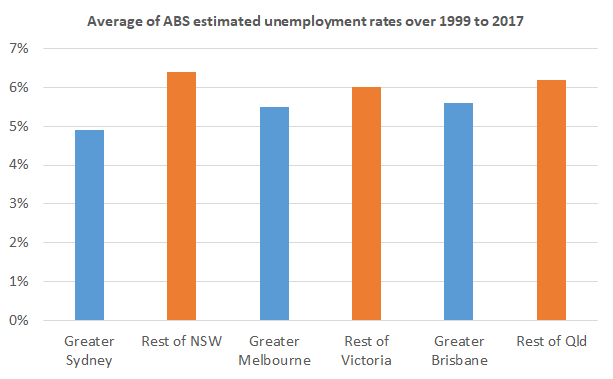
Joe argues that, instead of actively encouraging regional decentralisation, we should focus on making our major cities work better, by reducing traffic congestion and improving connections between our capitals and satellite cities (e.g. between Brisbane and the Gold Coast or Sydney and Wollongong). Typically, cities have higher levels of productivity than regional communities and also lower unemployment rates due to thicker labour markets (see chart below based on Joe’s calculations presented in his submission). Joe argues:

…regionalisation and decentralisation policies could lead to higher overall unemployment in Australia because regional areas do not work as efficiently in matching workers to jobs as do our large cities…

…a superior public policy approach to pursuing regionalisation and decentralisation would be to: (i) focus on addressing the major problems in our cities such as traffic congestion, housing costs and energy costs that negatively impact on productivity and liveability; and (ii) better connect the adjacent satellite cities and towns to our largest cities, such as the Sunshine Coast to Brisbane and Wollongong to Sydney via better road and rail connectivity. The integration of the Gold Coast and Ipswich into the Greater Brisbane region over the past two decades is worth studying.

Joe makes some excellent points here, and the integration of Ipswich and the Gold Coast into the Greater Brisbane region is definitely worth studying, although current levels of traffic congestion on the M1 are raising doubts about how successfully we have integrated the Gold Coast. With the Queensland Opposition currently pushing for an alternative route to the Gold Coast (although not yet committing funding to it, I should note) this will no doubt be an important issue in the upcoming State election campaign.

For anyone interested in regional economic development, I highly recommend you read Joe’s submission.

unemployment_averages

Posted in Brisbane, Gold Coast, Labour market, Productivity, Uncategorized | Tagged , , , , , , , | Leave a comment

Review of South Brisbane candidate Cameron Murray’s Game of Mates in CIS Policy magazine

Well known UQ economist Cameron Murray yesterday announced his candidacy for the Queensland State seat of South Brisbane, currently held by our formidable Deputy Premier Jackie Trad, who was already under threat from a strong challenge by the Greens’ Amy McMahon (see this Courier-Mail report). Cameron will be campaigning on the issue of corruption. As I have noted in a previous post, Clear evidence re-zoning decisions favour the politically connected, Cameron has undertaken some very interesting research on the topic. This research led him to being an expert witness at the recent CCC inquiry into local government corruption. In his view, the Government’s proposed ban on donations from developers to political candidates does not go far enough.

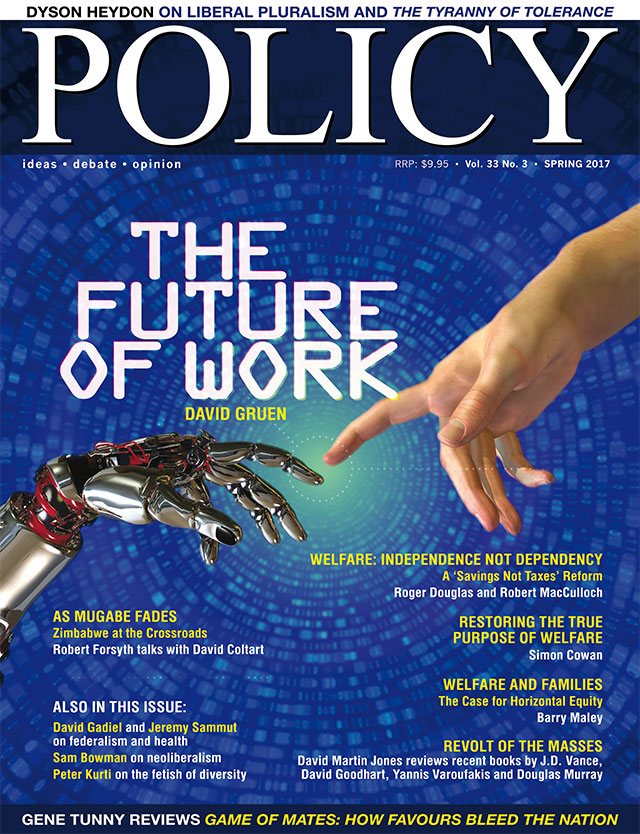
Earlier this year, Cameron and co-author Paul Frijters published a book, Game of Mates, expanding their work on alleged local government corruption to make the case that the whole Australian economy is a rigged game of mates. As I argue in a review of the book in the latest issue of the Centre for Independent Studies’ Policy magazine, Game of Mates makes some extraordinary claims that cannot be supported by the evidence, such as this one:

It is the story of how groups of ‘Mates’ have come to dominate our corporate and political sectors, and managed to rob us, the Australian majority, of over half our wealth.

As I argue in the review, this assertion is over the top and cannot be reconciled with Australia’s very high GDP per capita, moderate degree of inequality, and low level of perceived corruption. So I largely reject the book’s thesis, although I acknowledge the authors make many good points. There are obviously many real cases of corruption, rent seeking and abuse of market power out there. But the authors go much too far in arguing the whole economy is a game of mates and that this robs the average Australian of half of his or her wealth.

You can pick up a copy of the latest issue of Policy at many newsagents. Cameron’s book is available at good bookstores such as Folio Books on Mary St, Brisbane and Avid Reader on Boundary St, West End. Despite my comments above, Game of Mates is worth reading, as it does contain a lot of interesting conjectures and facts, particularly regarding the so-called revolving door between government agencies and resources companies that has existed in Queensland. Many prominent people are named, and there is a good chance that if you are a regular reader you will know some of them.

policy-spring17-cover

Posted in Uncategorized | Tagged , , , , , , | 2 Comments

AGL Chief Economist to address ESA Qld on National Electricity Market

As you are no doubt aware, one of the big economic challenges facing Australia at the moment is the high cost of energy. An important aspect of the debate around the cost of energy is the future of the National Electricity Market (NEM). This is highly contentious. For instance, UQ Professor John Quiggin has suggested the NEM has failed and we should consider re-nationalisation (see his post Electricity Re-nationalisation). Others are less pessimistic, but are concerned about the lack of a clear long-term policy framework, and the implications for reliability and financial viability of greater renewable energy capacity. At the same, there appears to be a huge opportunity to manage energy consumption and reduce power bills through demand side management or “behind the meter” measures. Finally, throw in allegations of price gouging in the east coast gas market, and we have a large number of weighty issues for economists to discuss.

So it is timely that the Economic Society of Australia (Qld), of which I am the Secretary, has arranged a lunchtime panel discussion for Thursday 9 November in Brisbane CBD on:

The National Electricity Market: Current Challenges and its Future

Panel members will include Tim Nelson, AGL Chief Economist, and UQ Professor Flavio Menezes, currently Deputy Chair of the Queensland Competition Authority. The Chair of proceedings on the day will be Euan Morton, Principal of Synergies Economic Consulting.

I am particularly looking forward to hearing from AGL’s Tim Nelson. You will recall AGL has been in the news a lot lately regarding the Liddell Power Station. In the lead up to the panel discussion, you may be interested in some of Tim’s recent output, including:

Presentation at the Liddell power station

Some thoughts about energy pricing

At $25 for ESA Qld members and $40 for non-members, this panel discussion is incredible value. The room at McCullough Robertson can accommodate 90 people only, so I encourage you to book early.

Tim_Nelson

Tim Nelson, AGL’s Chief Economist

Posted in Energy, Uncategorized | Tagged , , , , , , , , , , | Leave a comment

Andrew Leigh’s Choosing Openness – highly recommended reading

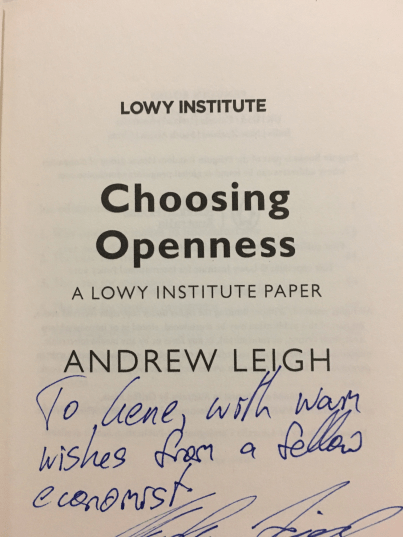
Choosing_Openness

On Wednesday evening, at the Queensland College of Art at South Brisbane, I attended the Brisbane launch of Australian Shadow Assistant Treasurer Andrew Leigh’s new book Choosing Openness: Why global engagement is best for Australia. It is a Lowy Institute Paper published by Penguin, and branded as one of its Penguin Specials, which are meant to be “concise, original and affordable.” At $9.99 Choosing Openness certainly is affordable (as well as being concise, at 143 pages, and original), and represents excellent value for money, being packed with interesting facts, data and arguments in favour of free trade and a liberal foreign investment policy.

One thing I really like about the book is that Andrew has gone back to old newspapers to find actual product prices from 1987 which illustrate just how much better off we are in real terms after bringing down the tariff wall, with much cheaper cars, clothes and shoes than thirty years ago. He is a strong believer in the benefits of unilateral trade liberalisation. That is, tariff cuts are in your own interest even if other countries do not cut their own tariffs. Andrew notes in his book:

As economist Joan Robinson once put it, even if your trading partner dumps rocks in their harbour, you do not become better off by dumping rocks in your own harbour.

At the book launch, I asked Andrew about his views on whether labour market reform was the great unfinished business of economic reform in Australia. Of course, as a member of the federal Opposition, which is advocating a reversal of sensible and modest reductions to penalty rates, Andrew was not supportive of labour market reform. He instead floated the idea that what we might actually need is more labour market regulation, particularly in the sharing economy, to deal with the concern that many Uber drivers are effectively earning below minimum wages. Andrew does not extend the same logic he applies to the analysis of international trade and investment to the labour market and sharing economy, but that is to be expected given his current political role. Should Labor win office at the next election, I expect Andrew will be a strong voice for sensible economic policy within the government.

Overall, Choosing Openness is an excellent book and I highly recommend it to all my readers (particularly to those who may have an influence on Queensland Government procurement policy, which regrettably has become protectionist). If you would like to read Choosing Openness this weekend, you could download the e-book for $6.99 from Booktopia among other sites. What a bargain!

IMG_1111

A nice note from Dr Andrew Leigh MP, who I first met in Treasury in 2008, when we were both working in the Fiscal Group.

Posted in Industry policy, IR, Trade, Uncategorized | Tagged , , , , , | Leave a comment