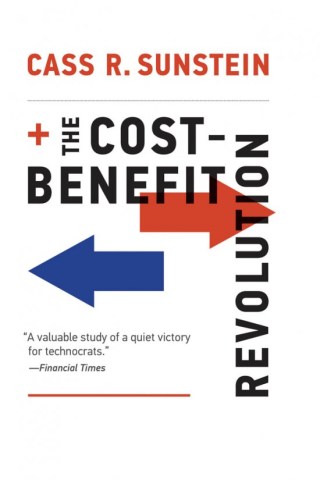
While economists often lament that governments don’t use cost-benefit analysis enough, Harvard Law Professor and former US regulatory czar Cass Sunstein offers a much more optimistic perspective in his excellent 2018 book The Cost-Benefit Revolution, which I’ve only just got around to reading. Sunstein’s first chapter is titled “The Triumph of the Technocrats”. Hurrah!
Sunstein notes that cost-benefit analysis has been increasingly applied to the assessment of regulations in the US since 1981 when the Reagan administration issued Executive Order 12291, making cost-benefit analysis of regulations compulsory. According to Sunstein, the requirement for cost-benefit analysis has been a great success. In chapter 1 (p. 10) he notes:
From 1981 to the present, cost-benefit analysis has often been a decisive decision rule in significant cases.
Unfortunately, as far as I can tell, the book doesn’t elaborate on what those significant cases were. It is very good on theoretical and philosophical issues regarding cost-benefit analysis, but it would have benefited from some detailed case studies, in my view. One of the practical examples the book does provide demonstrates the adverse impacts of failing to undertake a cost-benefit analysis. Sunstein argues that a cost-benefit analysis would have demonstrated that asthma puffers should have been exempt from the Montreal Protocol to ban CFCs. Sunstein is very good at demonstrating situations where cost-benefit analysis can be used, but the book would have been much better with case studies of its successful application.
As the co-author with Richard Thaler of Nudge, you’d expect Sunstein to include a lot of behavioural economics insights in The Cost-Benefit Revolution, and indeed he does. He notes people have a bias toward the present and can be overly optimistic and under-estimate risks. A cost-benefit analysis quantifying the impacts of a regulation, in terms of its costs, level of risk reduction, and the dollar benefits of that risk reduction, can help us avoid those biases.
Sunstein is no over-zealous advocate of cost-benefit analysis, though. He argues equity considerations may be relevant in policy decisions and, in some cases, you can’t adequately forecast what the outcomes of a policy measure may be. In some cases, rather than developing a detailed policy and deciding whether to proceed with it based on an ex ante cost-benefit analysis, policy experiments may be desirable instead. In chapter 5, “The Knowledge Problem”, Sunstein relates how he learned about the measure-and-react strategy from a Silicon Valley member of the US Defense Innovation Board, after he suggested Defense needed to apply cost-benefit analysis more. Sunstein gives clothing manufacturer Zara as an example of a company applying a measure-and-react strategy. As readers may know, Zara is the exemplar of “fast fashion” and has developed a highly efficient production and distribution system which allows it to quickly produce clothes according to what’s on-trend. Sunstein notes (on p. 98):
The measure-and-react strategy is not a randomized controlled trial, but it serves the same functions. It is increasingly used by private-sector actors, who know what they do not know and try to adjust to what people are doing on the fly. Can governments do the same thing? In many contexts, they certainly can.
There may well be benefits from greater policy experimentation by government. The measure-and-react strategy could usefully be applied to what Nicholas Gruen calls policy hacks (e.g. see his Mandarin article What is a ‘policy hack’?). Incidentally, Nicholas will be appearing soon in an upcoming episode of my Economics Explained podcast, which I expect to release this Thursday.
I should note The Reagan Executive Order mentioned above was hugely influential. Indeed, the perceived necessity for cost-benefit analysis spread throughout the world, including to Australia where the Commonwealth and state and territory governments all now typically require cost-benefit analysis of proposed regulations. Cost-benefit analysis studies are also usually required for infrastructure projects. In my first Economics Explained podcast interview, I talked about the importance of cost-benefit analysis in infrastructure decision making:
Economics Explained podcast interview with Craig Lawrence
Regrettably, unfavourable cost-benefit analysis studies are sometimes ignored for politically-driven infrastructure projects, such as the Rookwood Weir, a project which ought to feature in the next season of Utopia (see my post Rookwood Weir business case should be re-worked).
Finally, I’ve also recently read The Education of an Idealist by Sunstein’s wife Samantha Power, former UN ambassador to the UN in the Obama administration. Her book’s worth reading, too, particularly for its frank and revealing account of foreign policy decision making during the Obama years.




 Queensland Economy Watch