Queensland’s border restrictions with ACT (and arguably with NSW, too) were always a huge over-reaction and the events of yesterday revealed their tragic consequences, with a young woman prevented from attending her father’s funeral, even though the risk of her spreading coronavirus was negligible. On this blog, both myself and my good friend Joe Branigan have commented on the problem of the Premier and Health Minister deferring to an unelected bureaucrat, the Chief Health Officer (CHO), and evading responsibility for making the value judgments and policy decisions we elect them to make. They should be accountable in the Parliament for these judgments.
In the absence of political leadership in Queensland, we find the CHO making value judgements, but we are increasingly confused by her public statements and decisions. I suspect she’s under a huge amount of stress and isn’t being consistent in her decision making. Initially, I thought she was obsessed with eliminating any risk of coronavirus, but now we learn that she’s much more Benthamite and utilitarian. The Courier-Mail has reported:
…Chief Health Officer Jeannette Young made the astonishing admission that special treatment was given to Hollywood actor Tom Hanks because “entertainment and film bring a lot of money into this state”.
If the CHO is adopting such a utilitarian framework, then surely she could have let a young woman attend her father’s funeral, given the extremely low risk of any coronavirus transmission. The CHO’s decision has caused a lot of anguish and evoked a feeling of disgust in many Queenslanders and is difficult to justify. As I’ve written before, Chief Medical Officers should make their value judgements clear and Premiers shouldn’t just defer to them. Yesterday we learned the heartbreaking consequences of major failures of judgment and leadership.
For more on the importance of being explicit about value judgments in public policy decision making, check out my latest podcast recording on Economics and Public Policy.
Elected politicians accountable to the Parliament and the people should be making important value judgments, not bureaucrats.
I’ve long argued that the current approach to assisting the film industry, focused on luring international film productions, is wasteful, doesn’t achieve any important public policy goals, and is politically motivated, so drab politicians can benefit from some Hollywood glamour. I’ve also noted that Australian industry insiders, including legendary playwright David Williamson, have questioned the value for money of such assistance. Today via the Courier-Mail I was pleased to learn a Gold Coast industry participant Chris Boyd from Glass Media Group is also sceptical of the way our governments assist the film industry. Mr Boyd made a Right-to-Information (RTI) request regarding the amount of Screen Queensland’s assistance to Disney for Pirates of the Caribbean 5, a request which was ultimately rejected. Unsurprisingly, this rejection was celebrated by the bureaucrats concerned:
Mr Boyd has made some great observations, as reported by the Courier-Mail’s Kelmeny Fraser:
“At the time of the RTI application and ever since, I’ve thought that these incentives required much further examination and scrutiny, which we still aren’t seeing,” Boyd says.
“We are being told of the benefits of these projects without being told of the true cost, so the public, the industry and Government bodies such as the Queensland Competition Authority are unable to make accurate assessments.
“Large taxpayer funded investments on behalf of the industry, particularly when gifted to massive US corporations to make movies, should be subject to the highest levels of accountability.”
Absolutely. Unfortunately, Queensland’s RTI process is a huge joke. Years ago, it was alleged there was a trolley on which potentially embarrassing official documents were piled before a Cabinet meeting, and the trolley was wheeled into the Cabinet room to ensure the documents could all be considered Cabinet-in-Confidence, and hence exempt from RTI, even though they may not even have been discussed in the Cabinet meeting. The story may be apocryphal, but it’s close enough to the truth to be believable. This is not just a Queensland Government problem, of course. Governments around the world prefer to keep embarrassing information hidden. The public needs to continue to push for transparency.
For some of my previous commentary on the film industry, see:
Yesterday afternoon I had a great conversation with Steve Austin on his 612 ABC Brisbane Drive program regarding the state government’s budget update it published on Monday. We discussed the issues I covered in my post Woefully inadequate budget update, including the futility of the gimmicky Queensland Future Fund. You can listen to the audio below.
Also, I was mentioned yesterday by John McCarthy in a great article he wrote for the In Queensland news website:
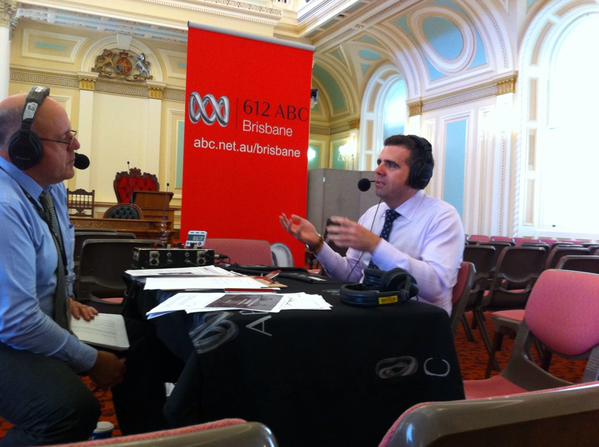
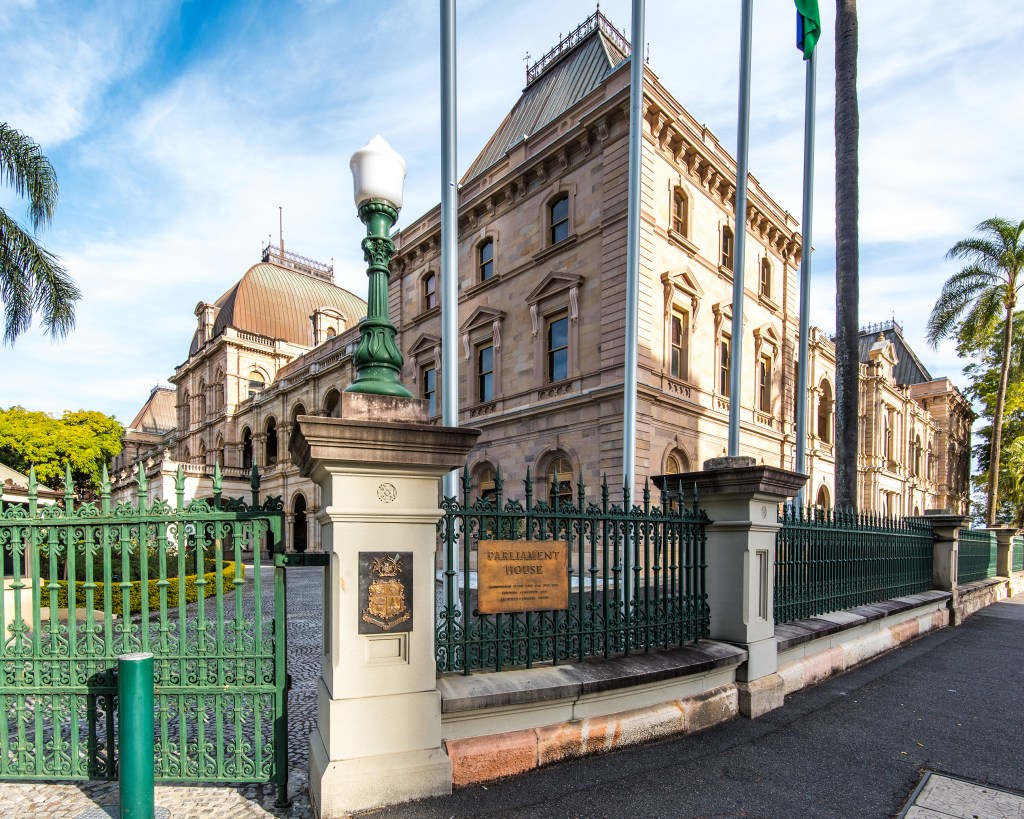
Chatting with Steve Austin on his radio show back in 2015, on the first day of Parliament for the Palaszczuk Government. Steve and I are sitting in the chamber of the abolished Legislative Council (i.e. upper house) of the Queensland Parliament.
We already knew the Queensland budget has deteriorated massively due to the COVID-crisis, so today’s state budget update was not surprising in terms of the huge fiscal deficits it announced, $9.3 billion in 2019-20 and $13.1 billion in 2020-21. Nor was it surprising that total debt would increase to $102 billion by the middle of next year, which is $18 billion higher than was forecast in the mid-year update last December.
What I did find surprising, however, was that the government released such a woefully inadequate budget update, not willing to provide any estimates of budget aggregates beyond the current financial year. It’s terrible for transparency and the public debate that the state government has only published a 40-page update to explain and discuss the biggest fiscal deterioration we’ve seen since the Great Depression.
Yes, I accept it’s difficult to forecast, but the Treasury should attempt to do so, and no doubt has the resources available to do so. The Budget is a major output of the state Treasury, and it must have been pretty quiet in the halls of state Treasury if they haven’t had to produce a comprehensive budget this year. The Treasury could say that the estimates are highly uncertain and put margins of error around them.
Not having the federal budget yet is no excuse, as State Treasury would have its own models by which it could estimate GST receipts. This is a point Opposition Treasury spokesman Tim Mander more-or-less made to Steve Austin on ABC radio this afternoon. The state government was actually originally planning on releasing its 2020-21 budget in April, in advance of the federal budget.
We’re heading toward a state election, and there should be public debate on how the state government will eventually stabilise the debt once the economy recovers. The Government hasn’t set out a plan. Instead it has ballyhooed its gimmicky Queensland Future Fund which doesn’t actually materially improve the state’s financial position.
We need to see just how much additional debt the state government could be getting into over the next few years. The state government has committed to billions of dollars of additional spending in the current financial year and beyond, but so far it has provided limited information on what that means for the budget aggregates into the future.
Finally, I should say that the Backing Queensland Business Investment Fund, by which QIC will invest $500 million in small and medium businesses, could set an unfortunate precedent. It raises the prospect of QIC becoming a State Bank. What could possibly go wrong? Can anyone remember Tricontinental?
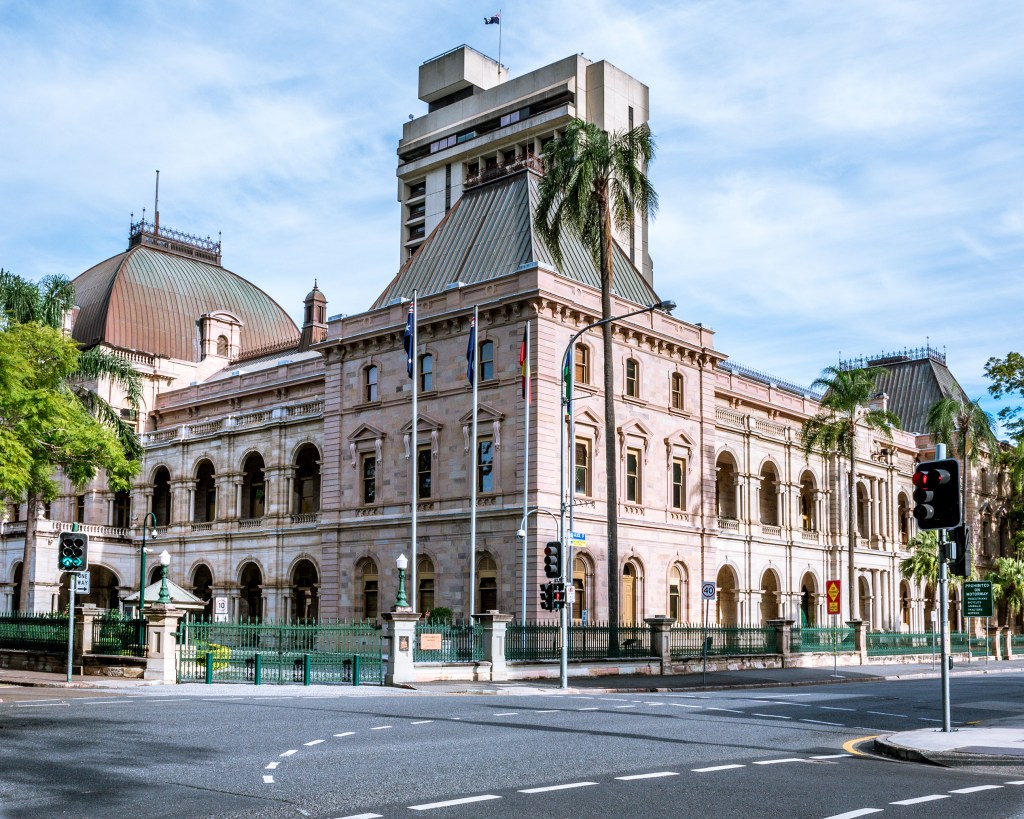
It must have been pretty quiet in Queensland Treasury in 1 William St this year, not having to prepare a full state budget.
On Friday 9 October, I’ll be facilitating a video conference for the French-Australian Chamber of Commerce and Industry (FACCI) on the 2020 federal budget, which looks to be in poorer shape as each day passes, with the ongoing stage 4 lock down in Melbourne and concerns over the looming default cliff and expected insolvencies tsunami. The federal budget will be delivered by Treasurer Josh Frydenberg on 6 October, the Tuesday of that week. Here’s the blurb from the FACCI website:
The French-Australian Chamber of Commerce & Industry is pleased to invite you to its next Business Briefing video conference dedicated to the 2020 Australian Federal Budget Update on Friday 9 October.
On this occasion, we will have the pleasure of welcoming Jamie Towers, Tax Partner at Mazars, for an analysis of the key changes impacting businesses and individuals in terms of Tax and Superannuation. To fuel the discussion and gain further insights on the budget update, we will also have the pleasure of welcoming Danielle Wood, CEO of the Grattan Institute, and Gene Tunny, Director at Adept Economics, as our panel facilitator.
We look forward to welcoming you on online on Friday 9 October from 11am in Perth, 1pm in Brisbane, 1:30pm in Adelaide and 2pm in Sydney and Melbourne.
Incidentally, the Queensland Government will release the state budget update today, and it’s expected to be sobering, as I discussed in my post last Wednesday Qld Gov’t going for broke in COVID response.
A February 2019 photo of me and other meeting participants, including Mark Bouris and Noel Whittaker, listening attentively to Treasurer Josh Frydenberg criticising Opposition tax policies at Parliament House in Canberra.
In my latest podcast episode, I explore what economists do and why the world needs them. I talk about the important roles that economists play in advising on government budget and economic policies and on the feasibility of specific projects, as well as the diverse roles they play in the private sector: in banks, hedge funds, professional services firms, and in industry more broadly. Hal Varian’s work at Google on its ad auctions gets a mention (see Wired article on Google Chief Economist Dr Hal Varian), and I also mention the work of behavioural economists, which I explored in my conversation with Dr Brendan Markey-Towler last year. Thanks to my good friend Tim Hughes for participating in the conversation.
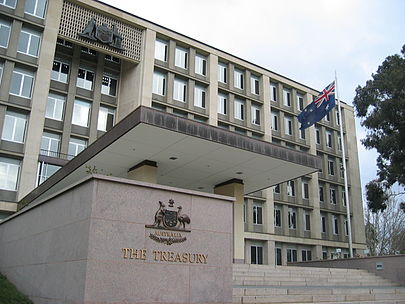
The Treasury in Canberra is a major employer of economists who get to advise on budget, tax, macro-economic, micro-economic, and financial markets policy settings.
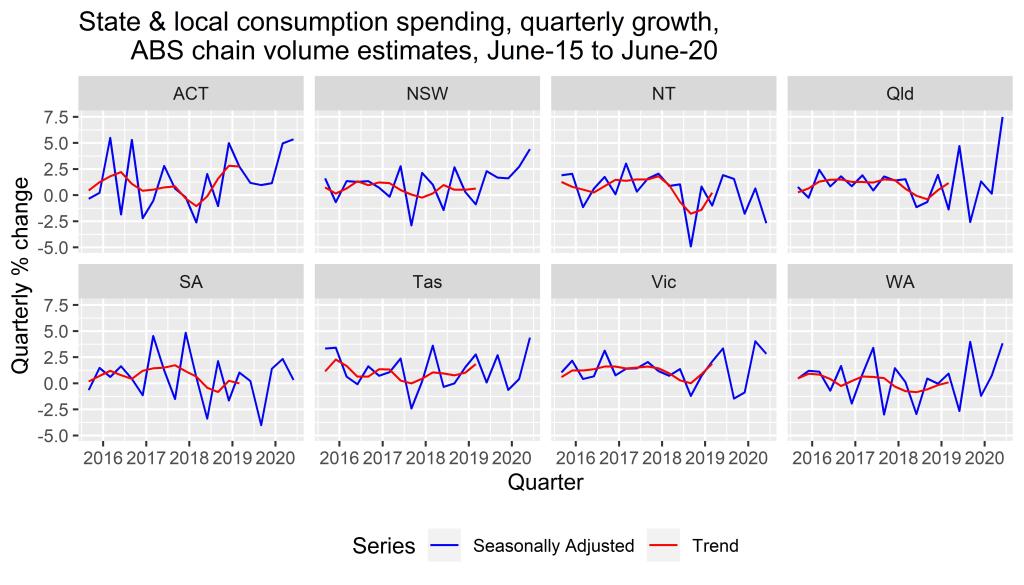
As well as confirming Australia is in a deep recession, with a 7% fall in GDP in June quarter, the National Accounts published by the ABS earlier today revealed Queensland state and local governments (mostly the state government) are spending big in their COVID responses. In the chart below, check out the 7.5% growth in Queensland state and local general government consumption spending, which includes employee expenses, in June quarter, the highest growth rate in Australia.
We’ll learn more about what’s been happening when the Queensland Government publishes its budget update next Monday. So far the Government has only disclosed part of the story, such as estimated net operating balances (see the Treasurer’s 23 July update and this briefing from Nick Behrens). Expect lots of red ink, with a deterioration of up to $20 billion in fiscal balances (the budget balance including net capital spending) over 2019-20 to 2023-24, as taxes, royalties, and GOC earnings have plunged and spending has surged, including $6 billion in stimulus/emergency measures. We will probably see fiscal deficits of around $10 billion in 2019-20 and $14-15 billion in 2020-21 with total state debt climbing to $105-110 billion by mid-2024. General government debt will approach $70 billion and the interest bill will climb toward $2 billion a year.
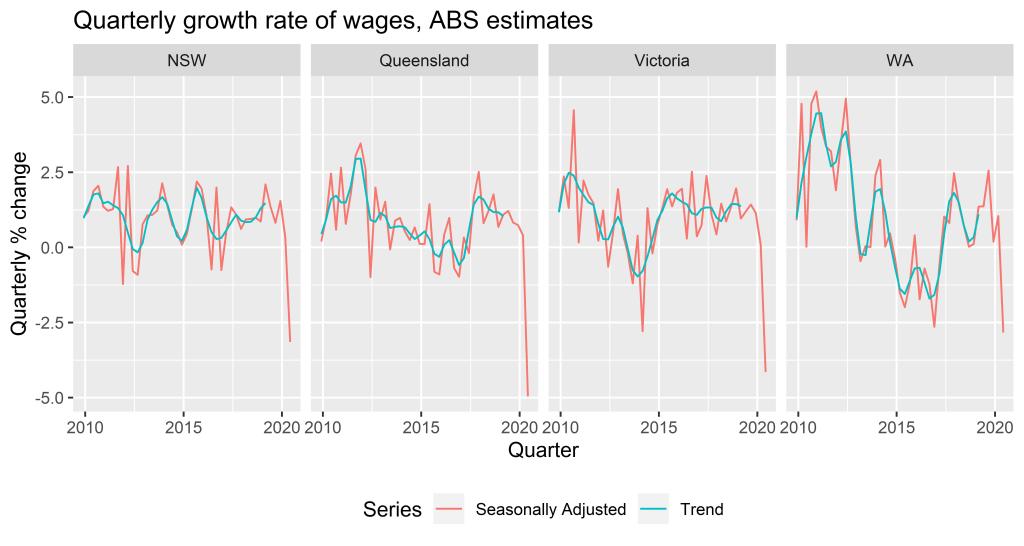
Age/SMH Senior Economics Correspondent Shane Wright has written a great summary of the business indicators data released yesterday by the ABS: An economy like 2016 as sales and wages collapse. The business indicators data are pieces of the jigsaw puzzle that is the National Accounts, which reports the nation’s GDP and its components. The June quarter National Accounts will be published by the ABS tomorrow. Perversely, company profits were up 15% in June quarter, largely due to JobKeeper and other subsidies, but income from sales and wages collapsed, as expected, in June quarter, according to the business indicators data (see chart below).
Queensland experienced the largest drop in total wages paid, although that’s not what we would have expected based on the single touch payroll data published by the ABS. It’s possible sampling error has led to Queensland having the worst result across Australia. In any case, the economic hit has been massive.
Overall, it’s expected that the Australian economy contracted by around 7% in June quarter, over three times the previous record for a quarterly contraction recorded in the mid-seventies. And, because of the Victorian outbreak, we shouldn’t expect a rebound in the September quarter we’re currently in. Check out this post from my colleague at Adept Economics Taylor-Rose Hull:
Unfortunately, we will likely be in the economic crisis for many months yet. I told Scott Emerson on 4BC yesterday afternoon that I’m very worried about the economic outlook, with the looming fiscal cliff, default cliff, and insolvency tsunami that will eventuate from the end of September.
Thanks to my old friend and former Treasury colleague Joe Branigan for this guest post on the Queensland Government’s response to COVID-19. Views expressed are Joe’s and should not necessarily be attributed to me. GT
The Triumvirate’s Stratagem cannot stand
by Joe Branigan
The Queensland Premier thinks she can’t lose. On the one hand, the enormous fiscal costs of lessening the catastrophic economic and social impacts of her COVID policy overreach are borne by the Federal Government (via JobSeeker and JobKeeper payments). On the other hand, the benefits of scaring the living daylights out of Queenslanders accrue solely to her government’s re-election chances.
The real trouble with Palaszczuk’s approach is that she’s relinquished her role as head of government and cabinet chair. The Premier, and her deputy, hide behind the political full-face shield that is the Chief Health Officer of Queensland Dr Jeanette Young. A Triumvirate, but effectively of one.
The Palaszczuk Government must be held accountable for the breathtakingly consequential decisions it says are based on Dr Young’s advice. From the ubiquitous use of the singular first-person pronoun by Dr Young in the Triumvirate’s daily press conferences, it appears as if the Government is uncritically and reflexively following Dr Young’s advice, giving her unprecedented power, by default.
But this is grossly inappropriate given that Dr Young is an unelected official. This is not to criticise Dr Young personally. She is doing her job and providing advice consistent with what she believes the very narrowly-based evidence on COVID19 tells her, although even here there are questions about the academic evidence she is relying on, much of it modelled rather than based on actual empirical experience – but that is a tale for another day. The point is that the Palaszczuk Government should not be solely deferring to the opinion of the CHO unreservedly.
Media outlets, including The Courier Mail, have thus far refused to be critical of the Government’s approach, preferring to be “united against COVID” no matter what the economic and social cost of the Government’s social distancing and other measures to Queensland. While the Queensland Media blindingly cheer on the Triumvirate, in the absence of critical journalistic scrutiny it will be up to Queenslanders themselves to seriously question the ‘official advice’. This scrutiny is even more important in Queensland, which unfortunately retains a powerful executive government aided and abetted by a unicameral parliament and now 4-year fixed terms between politician’s performance appraisals.
The CHO derives her authority from a newly written Section 362 of the Public Health Act 2005, which confers unchecked powers that exceed any other elected official, and more akin to the ancient royal prerogative than the delegated powers of a modern liberal democracy (see extract from the Public Health Act below).
Yet, the stated object of the Public Health Act is to “…protect and promote the health of the Queensland public.” Presumably Parliament was referring to the overall health and wellbeing of the entire citizenry, not just eliminating the risk of catching a single virus.
This unprecedented power bestowed upon a narrowly-focussed public health official, even in public emergencies, should be always curbed by deliberative cabinet processes that properly consider the multitude of factors involved in balancing society’s endless economic, health, social and cultural requirements with limited resources.
Cabinets and their subcommittees are often called on to make life and death decisions, whether explicitly or implicitly, when allocating scarce public resources between competing needs, especially in health. There are limits to how much we (the community) can sacrifice to save or extend a life, especially the lives of those very elderly and frail citizens who require significant resources to stay alive an extra day let alone live with some independence and dignity. Health departments allocate resources based on metrics that favour younger and healthier citizens with more tomorrows than yesterdays. And Australia’s Pharmaceutical Benefits Advisory Committee often rejects clinically effective cancer treatments based on cost.
As confronting as all that sounds, those decisions are rooted in a public policy goal that has served Queenslanders well for decades, which is essentially to achieve the greatest good for the greatest number and consequently to seek an efficient and fair allocation of public resources as determined (ultimately) by the Queensland Parliament.
But now we have moved to rule-by-diktat based on a new moral imperative. The 11th Commandment: ‘Thou Shalt have no other policy goal but me (being COVID)’. In effect, the whole of public policy in Queensland has been reduced to a single stratagem.
Given her powerful position, Dr Young should be completely transparent about the information she is relying on to make her decisions, what the objective of her decisions are, and the value judgements underlying those decisions. Is it really true that her sole focus is the complete elimination of community transmission in Queensland no matter what the economic and social cost? Why does she think that an extreme ‘corner solution’ objective is in the best interests of the Queensland community? We need to debate these issues and, preferably, the value judgments supporting those decisions should be determined by elected officials who are accountable to the public.
Meanwhile, the academic work is piling up against the complete elimination stratagem. Dozens of new studies in recent weeks have provided evidence of the short-run and long-term economic and social costs of the elimination stratagem relative to a counter-factual situation of managed suppression, from increased domestic violence, loneliness and despair to collapses in productivity and school learning, not to mention mass unemployment.
Importantly, it has long been established that the total welfare loss from catastrophic economic shocks is far greater than the contemporaneous loss in measured GDP. In other words, the policy reactions of governments to COVID will be felt for years, and possibly decades, to come.
And the latest epidemiological studies indicate that the true infection fatality rate is likely to be closer to 0.1-0.3% rather than the 1.0% originally feared, especially in a relatively young and healthy country with lower rates of morbidity and with an excellent health care system such as Australia, meaning the benefits of avoided deaths are a magnitude lower than first assumed.
This reckless form of government cannot go on for the next 12 months. Professor Whitty, the UK CMO, recently warned: “I think it is unlikely we will have a vaccine that is highly effective and ready to deploy at scale this (northern hemisphere) winter. I think there is a reasonable chance that we will have vaccines, not a certainty, in the period before the following northern hemisphere winter of 2021-22.”
Will public sentiment turn harshly against the Triumvirate before the 31 October election? Even with focus-group driven parochialism masquerading as mature political leadership it is hard to see their stratagem holding up for another 70 days.
The Queensland Parliament has granted “unprecedented power” to the Chief Health Officer during the COVID-crisis.
Extract from the Public Health Act 2005
Division 2 Chief health officer
362B Power to give directions
(1) This section applies if the chief health officer reasonably believes it is necessary to give a direction under this section (a public health direction) to assist in containing, or to respond to, the spread of COVID-19 within the community.
(2) The chief health officer may, by notice published on the department’s website or in the gazette, give any of the following public health directions—
(a) a direction restricting the movement of persons;
(b) a direction requiring persons to stay at or in a stated place;
(c) a direction requiring persons not to enter or stay at or in a stated place;
(d) a direction restricting contact between persons;
(e) any other direction the chief health officer considers necessary to protect public health.
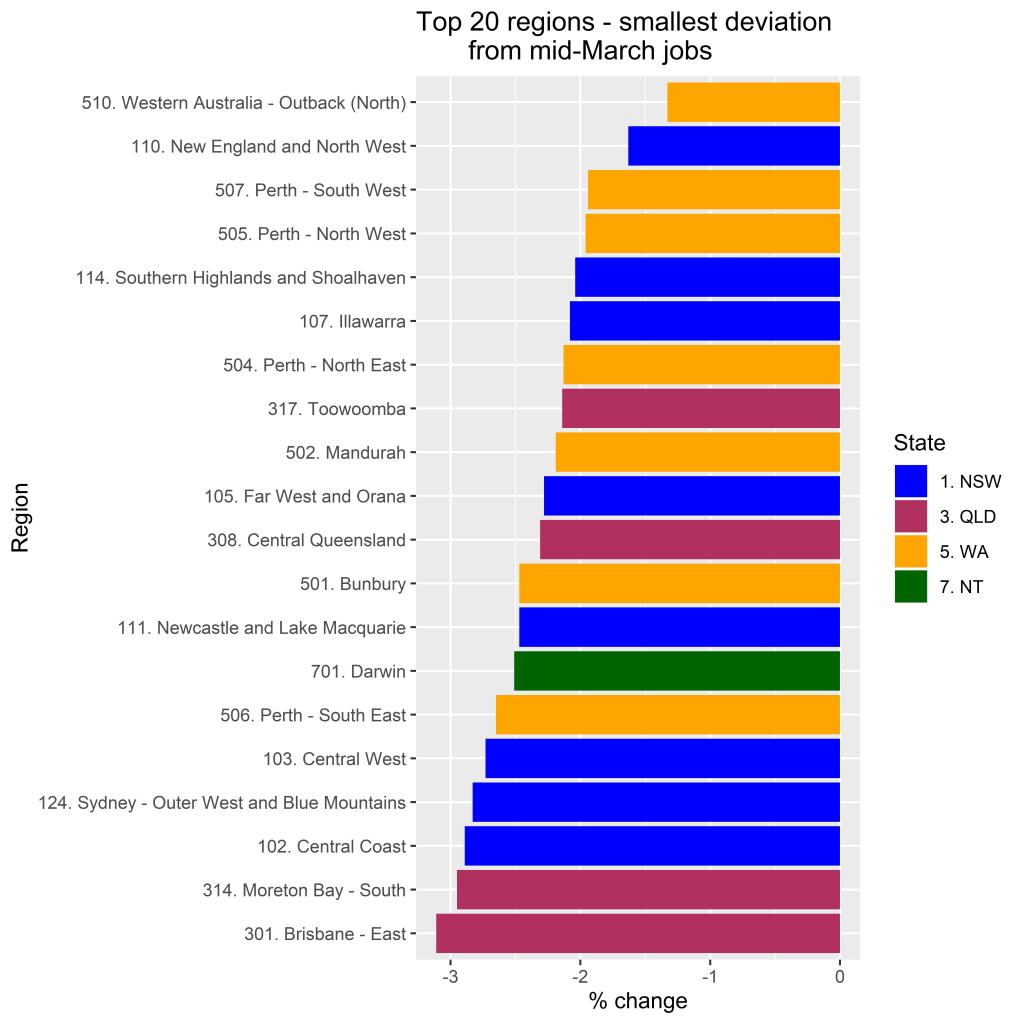
As shown in my post on the latest payroll jobs data from the ABS, the regions which have fared the best in Queensland since the COVID-related economic crisis began in March are Toowoomba and Central Queensland, likely due to the importance of the primary industries, agriculture and mining, and their supply chains to the economies of these regions (see chart below of top 20 out of 87 regions in Australia).
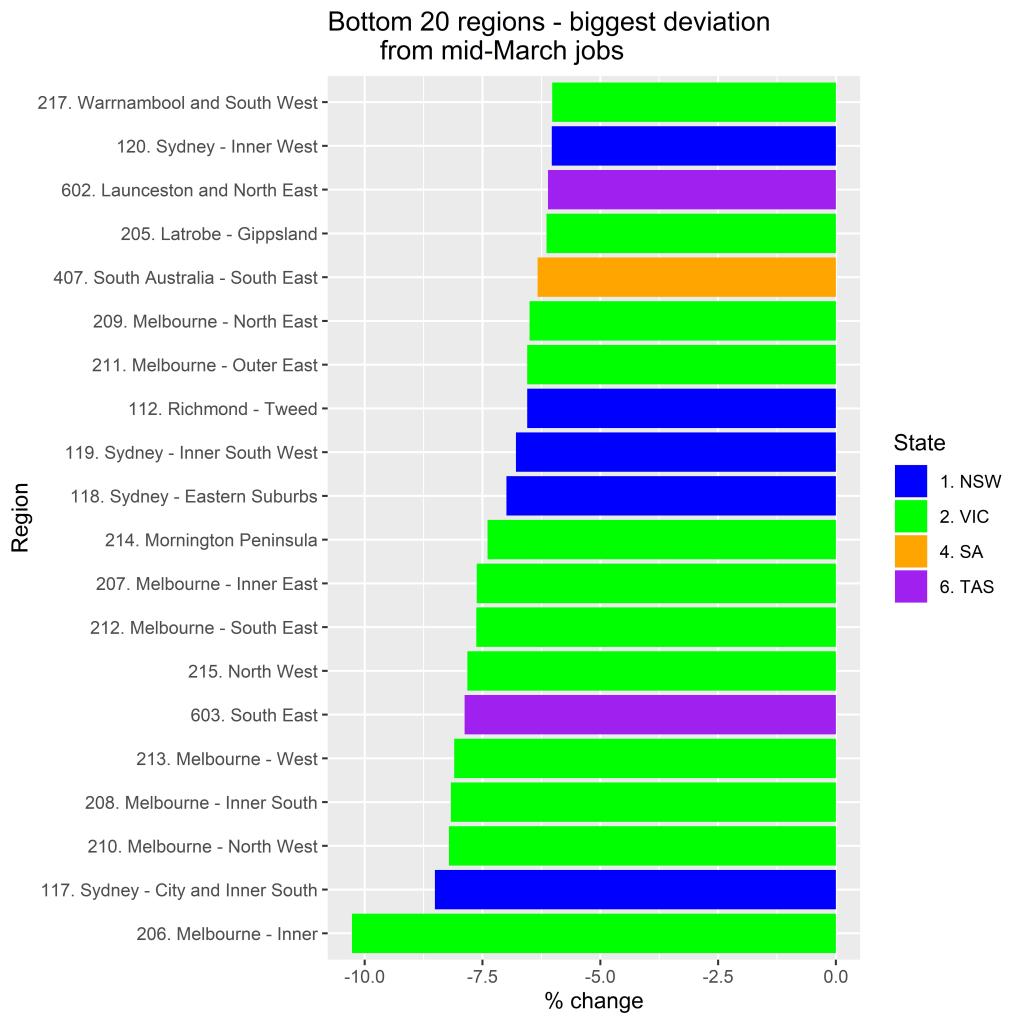
Queensland thankfully doesn’t have any regions in the bottom 20 across Australia, a sub-set which is dominated by Victorian regions for obvious reasons (see chart below).
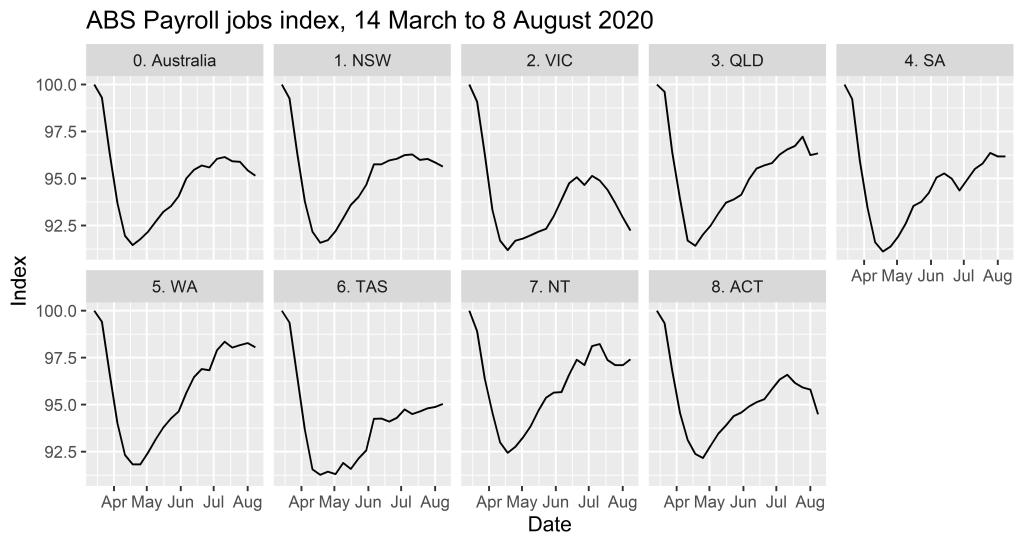
Overall, in terms of total employment, Queensland has been more resilient than most other states and territories (see chart below), which I suspect is partly related to primary industries making a larger contribution to our economy than they do in most other states and territories.
I should note that, despite Queensland’s apparent better performance regarding jobs than the rest of Australia, Queensland had the highest unemployment rate in Australia in July according to the ABS Labour Force Survey. This would be partly related to the fact we had an unemployment rate over half a percentage point higher than the national average pre-COVID, and it also probably reflects sampling error in the ABS Labour Force Survey. Right now, it’s pretty clear Victoria is the worst performing economy in Australia.



 Queensland Economy Watch