Michael Porter on Cairns’s tourism cluster

In a recent talk (Social Progress and Competitive Growth), Michael Porter illustrated the concept of an industry cluster using the Cairns tourism sector as an example (see figure below from Porter’s presentation). Basically I think it illustrates just how difficult it can be to develop new industries, because a whole range of supporting businesses and institutions are needed to support particular industries. To me, this means that governments shouldn’t try to pick winners but should instead try to get the basics right (e.g. education and training, law and order, efficient tax system, minimal regulation) and let the market sort out the rest. In the case of Cairns, the idea of a tourism cluster shows just how vulnerable somewhere like Cairns is to a downturn in tourists, because so many businesses are involved in servicing tourists. Luckily tourism to Cairns and the broader Far North is starting to recover, thanks in large part to Chinese tourists (e.g. see the recent discussion in Pete Faulkner’s Conus Quarterly).
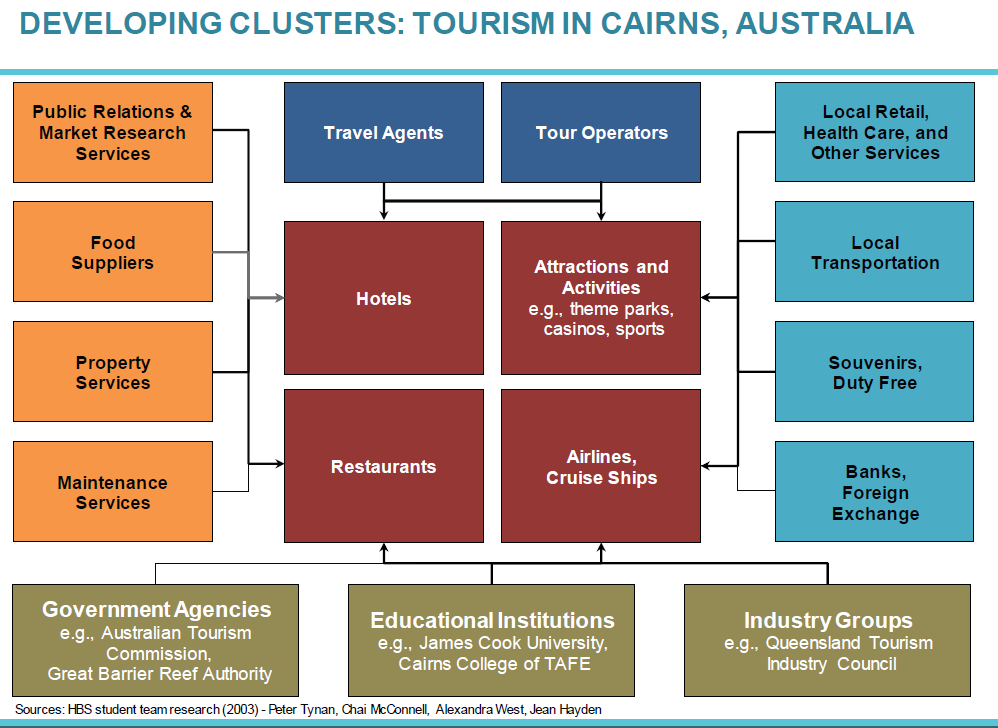
Cairns_cluster

Posted in Industry policy, Tourism | Tagged , , , | 4 Comments

Queensland doing relatively better than Southern States, but growth still subpar

It’s good that Premier Newman is upbeat about the economy, but I’m less excited about yesterday’s ABS National Accounts figures than he appears to be, based on this morning’s Courier-Mail report:

Campbell Newman seizes on ABS data showing Queensland growing over twice as fast as southern states

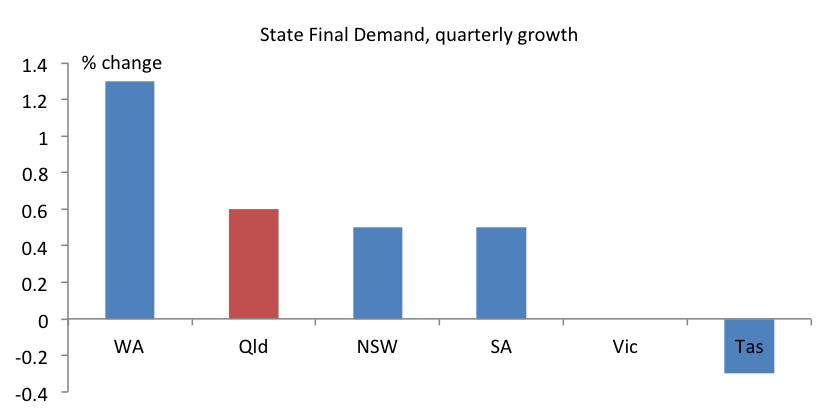
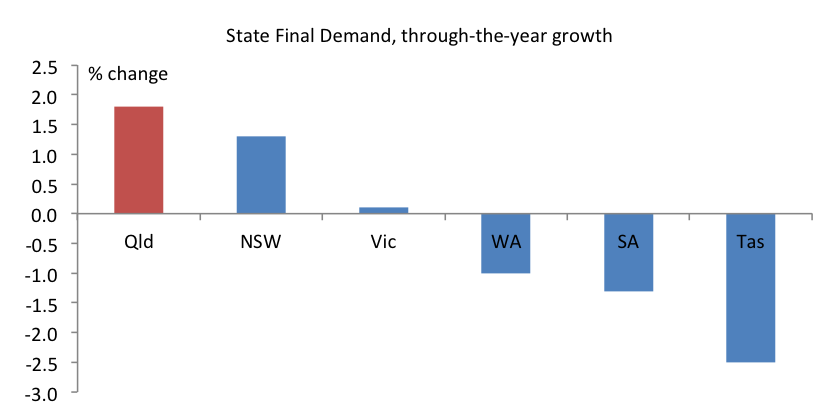
While Queensland is performing relatively better than NSW and Victoria, in particular, growth is only around half of what it really needs to be, and the data simply confirm the economy was sluggish over the June quarter, as consumers have been reluctant to spend and non-mining businesses reluctant to invest. To a very small extent, State Government cutbacks have had an impact, but appear to have shaved no more than 0.2 percentage points off the growth rate.

The Courier-Mail has focussed on the through-the-year growth numbers (i.e. between June quarter 2012 and June quarter 2013) which show Queensland leading Australia (first chart below), but the quarterly numbers comparing June quarter with March quarter, show that our relative performance is a bit less impressive and similar to that of NSW’s performance. While WA had negative through-the-year growth, as investment has come off significantly from extraordinarily high levels in the previous year, it has nonetheless recorded reasonable growth in the June quarter.

tty

qtrlyFor more on yesterday’s National Accounts data, see Queensland Treasury’s information brief.


Posted in Uncategorized | Leave a comment

Very little real growth in retail trade since financial crisis

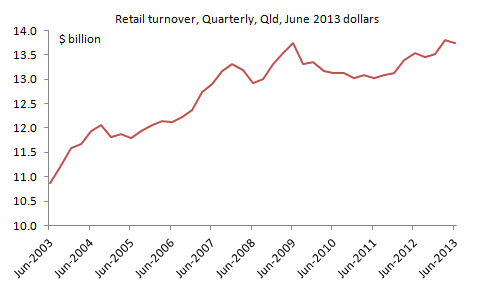
Yesterday’s retail trade data for July from the ABS were disappointing and continue to show consumers are reluctant to spend. Indeed, in real terms (i.e. adjusting for inflation), there has been practically no growth in retail turnover since the financial crisis (see chart below). This reflects a variety of trends, including a shift to online purchases from overseas, an increase in the household savings rate (see Retail trade restrained by stubbornly high saving rate), and, I suspect, education and health expenditures absorbing higher shares of households’ budgets.

Retailquarterly


Posted in Retail trade | Tagged , , , , , , , , | Leave a comment

Housing outlook improving

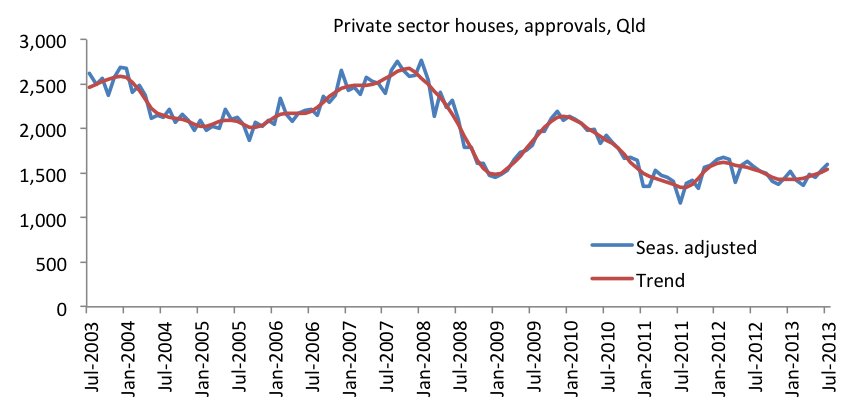
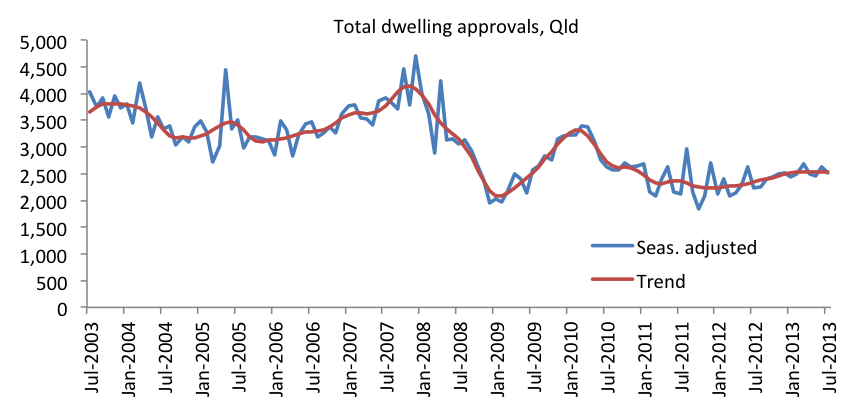
Yesterday’s building approvals data from the ABS should be encouraging for the Queensland building industry because they signal a recovery in housing construction, just as approvals of new apartment stock are declining. Approvals of private houses are trending upwards (first chart below), although the decline in approvals of apartments  – no doubt due to the big increase in supply expected in the next few years – means that total approvals remained flat in July (second chart below).

housestotal

I expect housing approvals will continue to rise, particularly in the Brisbane metro area’s western corridor out through Ipswich, as I’ve posted on before (Ipswich will play important role in eventual recovery of Qld building industry). With house prices starting to increase in Brisbane again, I expect many people will start to look for cheaper housing in outer suburbs (see today’s Brisbane Times article, Brisbane house prices jump due to limited supply).

Other commentary on yesterday’s building approvals data includes:

Dwelling approvals bounce back at MacroBusiness

Mixed bag building approvals from Pete Faulkner

Posted in Brisbane, Housing, Ipswich | Tagged , , , , , , , , , | Leave a comment

Resources sector investment hasn’t and won’t fall off cliff

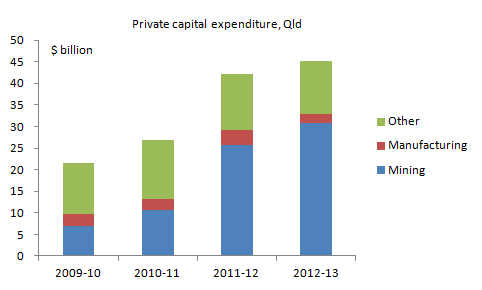
Yesterday’s ABS capital expenditure data show just how significant resources sector investment has been to the Queensland economy over the last few years, and how the manufacturing sector has been affected by the high exchange rate (see chart below).

capexJun13While the forward-looking expected investment data are not encouraging (as covered by MacroBusiness), I agree with Pete Faulkner’s conclusion that CAPEX data confirms the “soft-landing” scenario:

Data released this morning by the ABS shows that private sector capital expenditure (both actual and expected) are not falling off a cliff as the mining boom comes to its natural end. As we noted last quarter (see here), although the slow down in the mining sector is clear it is nowhere near as dramatic as some would have us believe.

Regarding the impact of the resources boom on manufacturing, see my earlier post:

Qld struck by Dutch Disease – manufacturing employment has plunged in last few years

Posted in Macroeconomy, Mining | Tagged , , , , , , , | Leave a comment

Townsville vs Cairns again

Having grown up in Townsville I’m very aware of the intense rivalry between Townsville and Cairns, which is partly a battle over which city should win the meaningless title of capital of North Queensland (see Is Townsville or Cairns the capital of North Qld?). The Townsville-Cairns rivalry was a feature of a report last week on new ABS data showing Cairns has more self-employed people than Townsville, with the report suggesting Townsville has it easier than Cairns because it has so many more public service jobs. The Cairns Post reported:

CAIRNS is the self-employed capital of northern Australia according to new figures from the Australian Bureau of Statistics.

Cairns economist Bill Cummings said ABS figures confirmed that Cairns led the way as a private enterprise city.

The greater city area, which also includes the Tableland, Cassowary Coast and the Douglas shire, had 24,363 businesses with 10,634 “unincorporated” or run by self-employed businesspeople.

By comparison Townsville has 18,175 and 7418, Darwin 10,986 and 5760 and Hobart 16,972 and 8362.

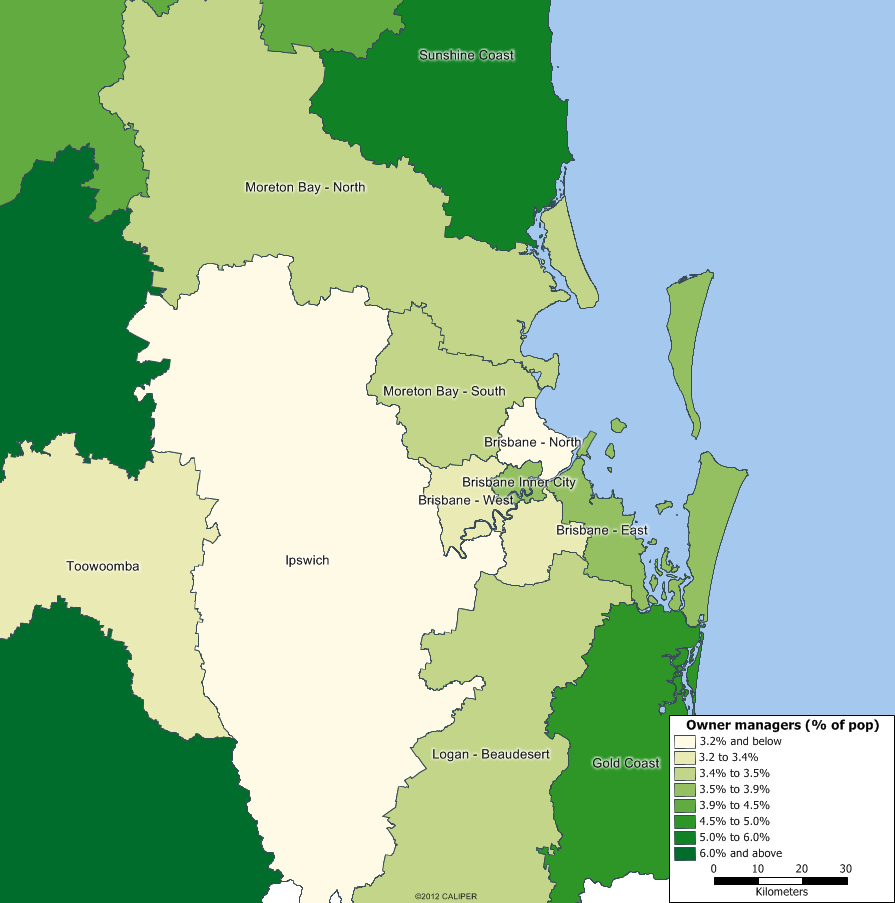
Of course, comparing absolute numbers could be misleading and it would be desirable to adjust for population differences, which I’ve done in the maps below by simply taking the number of owner-managers of unincorporated businesses (which a lot of tradies are) as a percentage of population. The claim regarding Cairns being ahead of Townsville in this regard checks out.

Here’s the Queensland map:

Statemap_OMAnd here’s the close up for SEQ:

SEQ_closeup_OMs

Posted in Cairns, Townsville | Tagged , , , , , , | 4 Comments

Good news on Qld coal exports and tourism

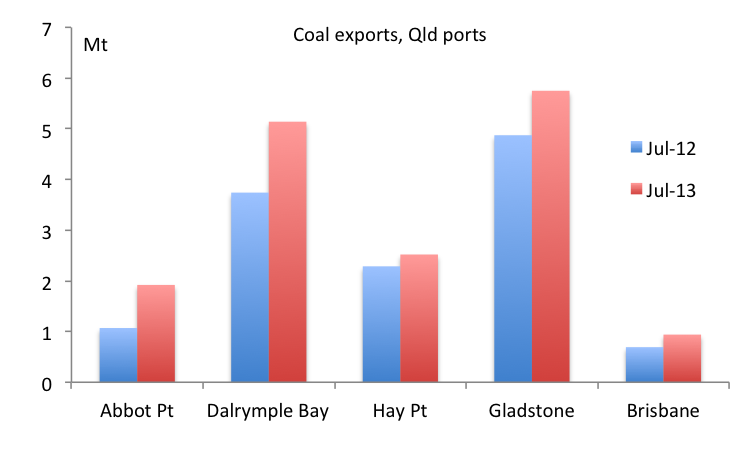
The Queensland Transport Minister Scott Emerson released some encouraging figures on coal exports yesterday, which I’ve charted below (Ports back to pre-GFC coal volumes):

CoalexportsIn part, the strong growth rates in the chart above reflect the coal industry recovering from the impacts of natural disasters. The media release notes:

Treasurer and Minister for Trade Tim Nicholls said the record July coal export totals were a further indicator that the Queensland economy was recovering from the effects of both the GFC and natural disasters.

“The consistent message that’s coming from the economic data is that Queensland is performing well and is the best place in Australia for businesses to invest and grow,” Mr Nicholls said.

“Our rural exports are also up, increasing 2.4 per cent in 2012-13 and more than a quarter of all business investment in Australia is happening in Queensland.”

I’ll be interested to hear what the QRC says about this latest data, after the reports we’ve had about the Queensland coal industry contracting recently.

There is also some positive news on tourism coming out of Cairns Airport, which Mark Beath has been monitoring:

Domestic flyers surge in July

Regarding Queensland’s economic outlook, while the overall economy will probably remain subdued over the next six months, data such as these suggest that it shouldn’t get any worse, and it may indeed get a bit better.

Posted in Mining, Tourism | Tagged , , , , , , | 2 Comments

Queensland’s dynamic labour market

labourmobilityToday’s new ABS data on labour mobility show Queensland has one of the most dynamic labour markets in Australia, with one of the highest proportions of workers having been with their current employer for under twelve months (chart above). I expect this is related to Queensland’s relatively younger population and our higher proportion of casual employment – related in part to the greater importance of tourism in our economy than in the economies of other States and Territories.

Posted in Labour market, Tourism | Tagged , , , , , , | Leave a comment

Are baby boomers ruining the careers of Gen Xers?

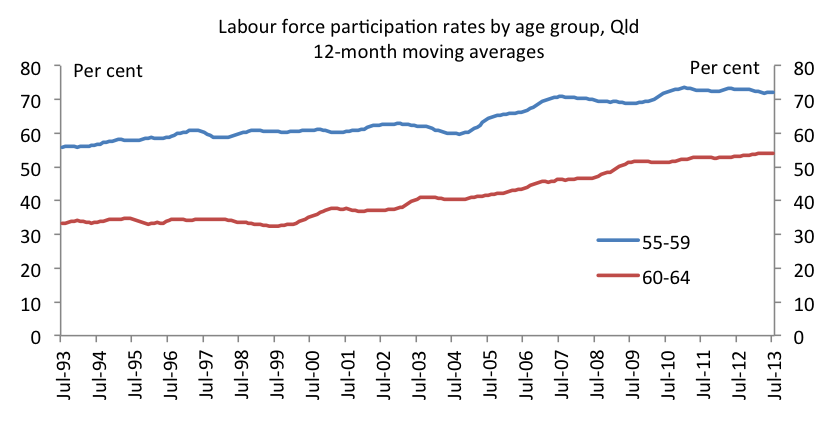
There was a story in News Ltd papers yesterday regarding how “job-hogging boomers don’t know when to quit” and how this potentially has adverse consequences for the businesses they work in and the next generation of employees. While it’s certainly true that people aged 55 and over today have higher workforce participation rates than people the same age a decade earlier (see chart below), I doubt this is a huge cause for concern.

partratesI’m sure many older workers are aware of the need to mentor younger staff and to progressively hand over responsibilities. Also, if younger workers feel they are held back because there are older people in senior positions blocking them from advancing, then they should leave that organisation and find one where merit and talent are rewarded.

Increasingly, leadership doesn’t depend on positions, but on individuals themselves, and you can organise people and achieve a lot without technically being in charge. It’s a new world of work out there, and the people who succeed are those people who make themselves indispensable – those people who make themselves linchpins, as Seth Godin calls them. (If you haven’t read Linchpin, you should; it’s brilliant.) Gen Xers and Gen Yers should focus on becoming indispensable, rather than worrying about who occupies the corner office.

Posted in Labour market | Tagged , , , , , , | Leave a comment

NQ worried about NT plan

Townsville Mayor Jenny Hill is rightly critical of the Prime Minister’s proposed special economic zone in the Northern Territory, in which a lower rate of company tax would apply. As reported in the Townsville Bulletin this morning (Economic zone plan to favour Darwin):

A PLAN by Prime Minister Kevin Rudd to create a special economic zone in the Northern Territory has drawn criticism from Townsville Mayor Jenny Hill, who said the policy could hurt North Queensland.

“The problem is it creates one area of preferred growth in Australia,” she said.

“It has the potential to suck businesses out of North Queensland,” said Cr Hill.

The idea of special economic zones comes up from time to time. One of the most recent proposals came from the Institute of Public Affairs, which would have included parts of North Queensland in the zone. I have previously commented on this plan (Government right in rejecting northern economic zone), and I still think governments are better off lowering tax rates across the whole of Australia rather than carving out special economic zones. Creating these zones is likely to lead to a large amount of tax avoidance with little public benefit, as identified by John Quiggin in his commentary on the NT plan yesterday, reported by ABC News:

University of Queensland economics professor John Quiggin agrees, and says tax havens often do not generate much broader economic benefit for an area.

“This is one of the dangers – Ireland is essentially a tax haven, not much productive activity has actually taken place in Ireland,” he said.

“You’ve got companies like Apple Computer working their profit through Ireland, but actually not doing very much in the way of production there.

Given the huge risks, I don’t expect we’ll see a special economic zone in the NT or anywhere else in Australia in the foreseeable future.


Posted in North Queensland, Tax, Uncategorized | Tagged , , , , , , | 2 Comments