Gold Coast should be good location for Rolls-Royce dealership

I noticed the Gold Coast Bulletin has today reported that Queensland’s only Rolls-Royce dealership will be located on the Gold Coast (Coast secures Rolls-Royce dealership). This is potentially a good move, as the Gold Coast certainly has a significant number of Queensland’s super rich, based on super luxury car ownership, as I posted on earlier in the year:

Where do Queensland’s super rich live?

While the Gold Coast’s economy has been struggling in recent years, there are positive signs for the tourism industry, and I expect the Gold Coast will recover strongly over the next few years, particularly as construction associated with the upcoming 2018 Commonwealth Games begins. Hence I think Rolls-Royce has probably made a sound decision.

My previous posts on the Gold Coast include:

Gold Coast should worry less about its over-reliance on property, tourism and retail

Strong growth in Gold Coast airport passenger numbers in 2012-13
Tourism recovering nicely on Gold Coast, not so elsewhere

Posted in Gold Coast | Tagged , , , , | 2 Comments

Low level of vacancies suggests sluggish labour market to continue in short-term

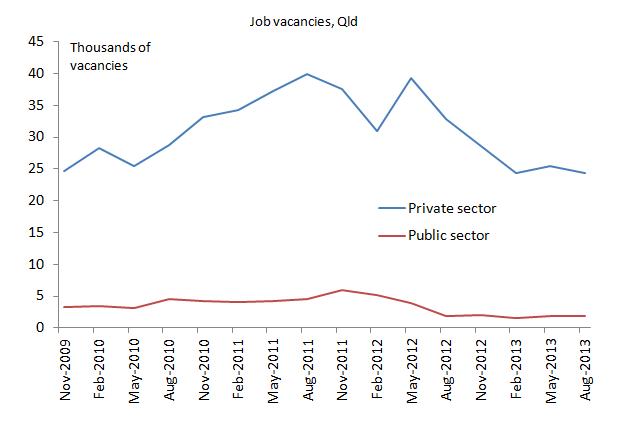
There doesn’t appear to be any recovery in Queensland’s jobs market coming in the next few months with job vacancies remaining at relatively low levels (see the chart below based on today’s new ABS job vacancies data).

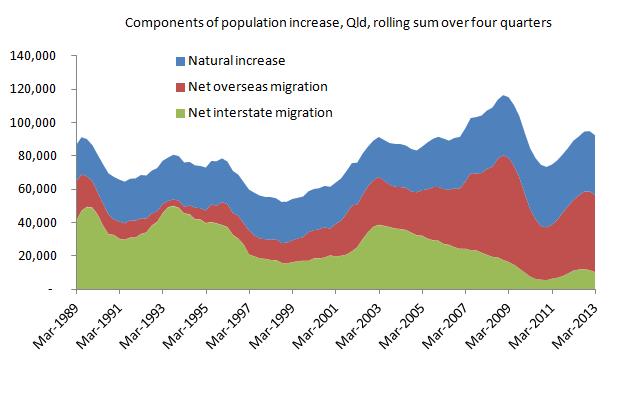
VacanciesGiven the relatively lacklustre labour market, I’d expect net interstate migration to Queensland to remain at recent low levels for a while yet (see chart below based on today’s new ABS demographic data).

populationchangeI’ve previously asked:

When will interstate migration to Queensland recover?

Also see Queensland Treasury’s briefing on today’s new demographic data.

Posted in Labour market, Population | Tagged , , , , , , , | Leave a comment

Higher education reform important in improving budget balance

I’m broadly pleased with the new Federal Government’s planned reforms of the higher education system (reported in the Brisbane Times article Christopher Pyne reveals university shake-up). Policy targets are generally useless, as they are rarely achieved and are often misguided, so it’s no loss the Government is scrapping the target to have 40% university attainment among 25-34 year olds by 2o25. Also I’d welcome any re-capping of university enrolments, because the current un-capped, demand-driven system is a big fiscal risk to the Government, given the high level of Commonwealth subsidies involved, as discussed in a previous post:

Commonwealth should give up student target – big savings possible from higher ed reform

I’m less excited by the removal of the student services fee, because removing it runs the risk of a decline in the quality of student facilities and services at universities. That said, universities could impose user charges for the use of specific facilities and services, rather than a general student services fee. While this appeals to me as an economist, I think it might have an adverse impact on the university experience for many students. It would certainly make it difficult for clubs and societies if, for example, they had to pay cost-reflective room hire fees to hold meetings or events.

Posted in Education | Tagged , , , , | Leave a comment

More on the mining slowdown

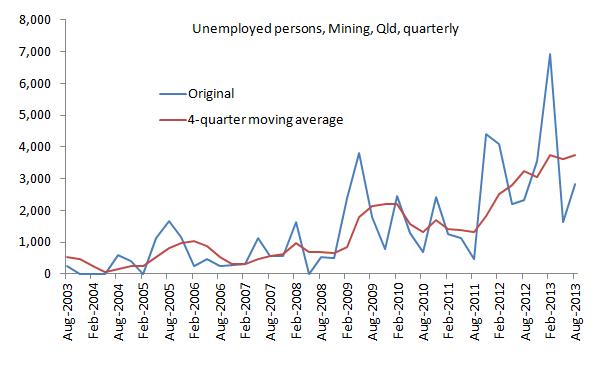
I posted last week on how the new ABS labour force data show a slowing in the growth rate of mining employment, but no decline in employment yet, as one might have expected based on reports of job losses at Central Queensland coal mines (Mining employment in Qld continues to grow, but at slower rate). Clearly there have been job losses in mining, as shown by the ABS unemployment by industry data (see chart below), but, so far, new mining jobs, most likely in the gasfields in the Surat Basin, have offset these job losses, meaning total mining employment hasn’t declined. That said, all those people who lost their jobs obviously didn’t get the new mining jobs that were created.

MiningunemploymentHat tip to a former colleague, who goes by the nickname “Toad”, for pointing out the unemployment by industry data to me. Regarding these data, the industry an unemployed person belongs to is based on their last job, full-time or part-time, in the last two years.

Posted in Labour market, Mining | Tagged , , , , , , , , | Leave a comment

Mining employment in Qld continues to grow, but at slower rate

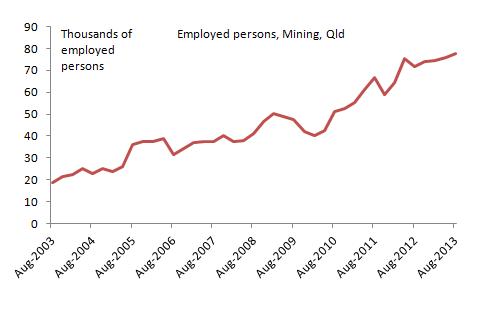
Employment in the Queensland mining sector still appears to be growing, although at a slower rate, according to the detailed quarterly data released today (see chart below). This suggests the concerns raised earlier in the year by some commentators over the possibility of large-scale job losses were misplaced.

MiningemploymentAlso on today’s data, particularly the regional numbers for Far North Queensland, see:

Soft employment in Far North

FNQ jobs data; headline fall disguises the reality

Posted in Labour market, Mining | Tagged , , , , , , , | 5 Comments

New Government should reject car industry begging

Since the late 1940s, Australia has bought itself a car industry, first through very high tariff protection that rose to around 57% by the 1980s, and then through financial assistance that, in part, replaced the benefits of tariff protection to the industry. Billions of dollars of taxpayers’ money have been wasted supporting an industry that isn’t viable in Australia due to our small domestic market which limits the economies of scale manufacturers can exploit.

Car industry assistance has been disproportionately costly to Queensland, because it mainly benefits businesses and workers located in Victoria and South Australia. Hence I hope the new federal Government sticks to its hard line on the car industry and refuses calls for it to commit to additional funding for Holden (see the AFR report, Car industry on brink as SA Premier seeks Abbott’s support).

I have a number of previous posts on car industry assistance, including:

Future of Australian car industry depends a lot on the exchange rate

Holden chief’s weird call for independent review of car industry

Farmers miss out when Govt gives $275M handout to Holden

I also had this article published in Policy in 2011:

Carr’s car cash and Australia’s reform malaise

Posted in Industry policy | Tagged , , , , , , , , , | 2 Comments

Effective population numbers much higher than usual residents in central and western Qld (and Cairns)

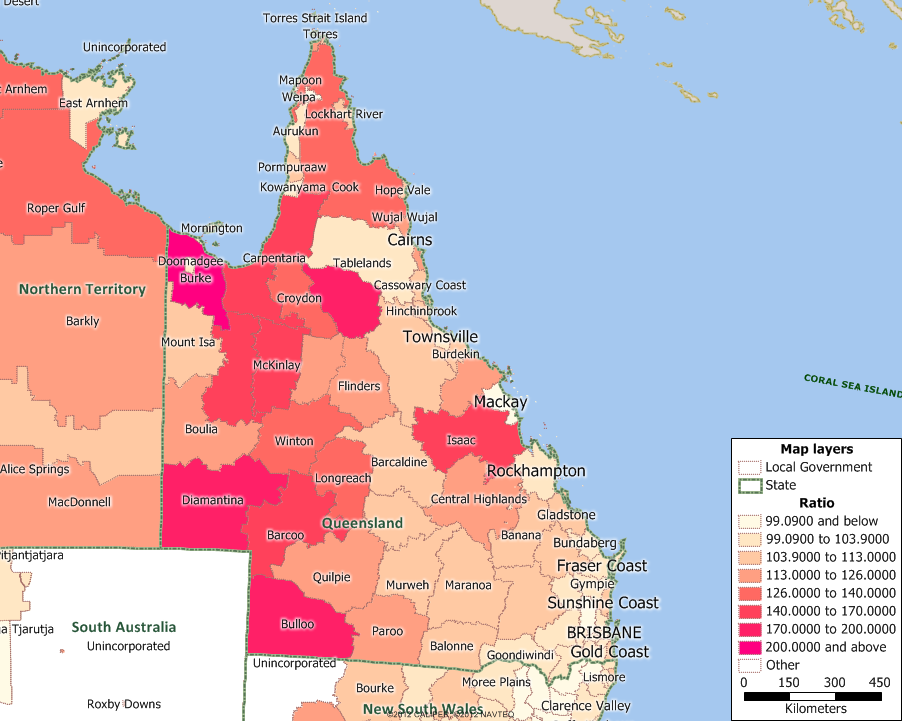
Some interesting data were released by the ABS today comparing the number of people counted in each local government area (LGA) on Census night compared with the number of usual residents (see chart below). The chart shows the ratio of the two population measures multiplied by 100 so it is expressed as a percentage. These data show the importance of FIFO workers in central Queensland, particularly Isaac Shire which includes Moranbah, and many parts of western Queensland. Also, the data show the importance of tourism to Cairns, with the LGA having quite a high ratio of Census night population to usual residents at 116% – much higher than the Gold Coast at 105%.

Census_night_ratiosThe underlying ABS data and commentary can be found at this link:

Perspectives on Regional Australia: Comparing Census Night and Usual Resident Populations in Local Government Areas, 2011

Posted in Population, Tourism | Tagged , , , , , , , , , , | Leave a comment

Qld labour market stable, not worsening

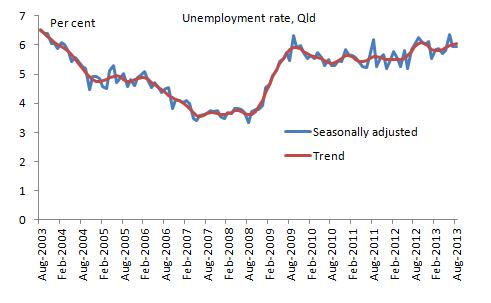
The Queensland labour market appears stable based on yesterday’s ABS labour force data (see chart below), confirming my skepticism about the bleak forecast for the Queensland economy reported by the Brisbane Times earlier in the week (Outlook for Qld economy bleak).

Unemployment Aug 13

Posted in Labour market | Tagged , , , , , | Leave a comment

Domestic tourism to Gold Coast recovering while other Qld regions struggle

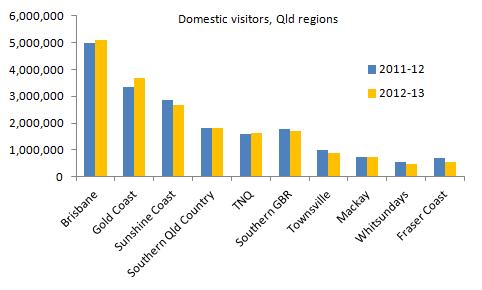
Domestic tourism figures for 2012-13 reported yesterday by Tourism and Events Queensland show that, while the Gold Coast, Brisbane and Tropical North Queensland (TNQ) are recovering, some other regions, such as the Sunshine Coast, Fraser Coast, Townsville and Whitsundays are not (see chart below).

TourismPete Faulkner has a good summary of the latest domestic tourism data at this link:

National Visitor Survey results

Posted in Tourism | Tagged , , , , | 2 Comments

Govt should explore transport demand management options before committing to costly infrastructure

While it’s good news the Government has found a much cheaper alternative to Cross-River Rail, before committing billions of dollars to an underground rail and bus network (see this morning’s Courier-Mail report), the Government should ensure it has fully considered transport demand management options to ease congestion. Some of these measures may well avoid or defer the need for new infrastructure in the short to medium-term. Such measures could include:

  • optimising train and bus fares so much higher fares are charged during peak times (e.g. 7-9am, 5-6pm) to encourage people to travel outside of these peak times;
  • congestion charging for travel in the CBD, as recommended by the Henry tax review, with higher rates during peak times to reduce congestion;
  • staggering the start and finish times of public servants (i.e. so not everyone comes in at 8-9am and leaves at 5-6pm), and encouraging private sector firms to do the same, as discussed by me in Increased train frequency unviable; and
  • pressuring Brisbane City Council to ease restrictions on development in the inner city to allow much higher population densities, which would result in more people cycling or walking to work (see my post Benefits of higher urban population density – more cycling and walking to work).

I’ve posted before on how we need a comprehensive review of transport policy in SEQ:

SEQ’s extensive but costly public transport system requires thorough review

Posted in Transport | Tagged , , , , , , , , , | 2 Comments