Making do with less – speech notes and slides

nonprofit

Tonight I spoke at the Pro Bono Econos Third Sector Talks at QUT’s Gardens Theatre on the challenges facing not-for-profit organisations in these fiscally lean times and how economists can help. My slides are available to download (Making do with less) and my speech notes are reproduced below. Many thanks to some generous colleagues and friends for comments and suggestions that I have incorporated into the speech notes. 

Making do with less

Good evening. Tonight I would like to make some remarks on how economists can assist not-for-profits (NFPs), particularly in these fiscally lean times. To begin, I would note that, in my view, economics is driving the growing importance of NFPs in our society.

The massive increase in living standards we have experienced since the end of the Second World War has meant that meeting our most basic needs is largely no longer a challenge for our economy, and hence we have more time, attention and resources to devote to other priorities.

In meeting these needs, we are faced with a choice. Milton Friedman observed (in Capitalism and Freedom) that:

“There are only two ways of coordinating the economic activities of millions. One is central direction involving the use of coercion—the technique of the army and of the modern totalitarian state. The other is voluntary co-operation of individuals—the technique of the market place.”

Friedman might have clarified that NFPs are covered in the second category, as NFPs exemplify the voluntary co-operation of individuals, and indeed that is one of the advantages they provide relative to government.

Given the NFP sector is a largely voluntary creature of the energy and innovation of a few, it might be worthwhile reflecting on why the NFP sector exists, and why NFPs “self selects” to do things in specific areas of society. I think there are some very strong economic reasons for this:

1) Either the market isn’t providing an outcome that some people think is appropriate (this could be outright market failure or perceived inappropriate priorities or approaches by the state). This is an allocative efficiency argument.

2) The NFP activities are generally consistent with state social policy and programs, but they can be delivered better by an NFP. This is probably more of a technical efficiency argument.

Since at least the 1970s, there has been widespread dissatisfaction with government-directed welfare-state solutions and government provision of social services and delivery of outcomes in other areas such as the environment.

So governments have turned to private providers, including NFPs, to provide community services. One example is the job network, which replaced the old Commonwealth Employment Service (CES), in which NFPs such as the Salvation Army now offer employment services alongside for-profit providers.

At the same time, NFPs are performing their traditional roles, as well as new ones are demanded by the community over time. For many services, governments have always recognised that NFPs deliver services that governments may otherwise have to—e.g. Guide Dogs or Meals on Wheels.

So clearly, the third sector is important, and being seen as more important, but funding for traditional activities from agencies such as Queensland Health and Housing and Communities has been cut back in recent years for many NFPs, or is appearing less reliable in the future. I would like to make some brief remarks tonight on how I think economists can help meet the challenges NFPs face.
Continue reading

Posted in Uncategorized | Leave a comment

Qld retail trade grows strongly in March quarter – good sign economy is re-balancing post-mining boom

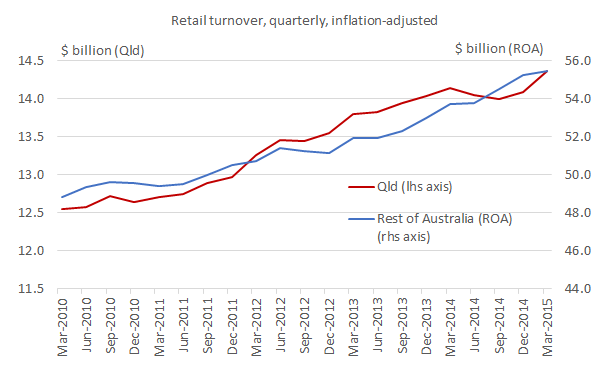
The latest retail turnover data released by the ABS today confirm my view that growing consumption spending will help offset the negative impacts of the end of the mining boom (see my speech on the end of the mining boom). The March quarter figures were very encouraging for Queensland, with a quarterly growth rate in real, seasonally adjusted retail turnover of 1.9 per cent (see chart below). Growth in the rest of Australia was less spectacular, but still a positive 0.3 per cent or around 1.4 per cent on an annualised basis, broadly in line with population growth.

Retail_Mar15

For additional information regarding the latest data, see Queensland Treasury’s information brief.

Posted in Retail trade | Tagged , , , , | 3 Comments

End of the mining boom – speech notes and slides

In Brisbane today, in the theatre of Morgans Financial Limited, along with Griffith’s Tony Makin and Morgans’ Michael Knox, I spoke on “The end of the mining boom”, at an event organised by Griffith’s APEC Study Centre. My slides are available for download (After the mining boom 4 May 15), and the speech notes I prepared, which I loosely stuck to, are reproduced below.  Note that my speech was given prior to the RBA’s interest rate decision being announced. 

After the mining boom

Introduction

Some of you may recall the economy as “rocking horse” analogy made by Swedish economist Knut Wicksell, referred to in Nobel Laureate Ragnar Frisch’s classic 1933 paper on the business cycle [SLIDE 2]. Say a rocking horse is constantly being hit by a club, at irregular times and with varying forces; it nonetheless exhibits a rocking motion although the amplitude and frequency of the rocking may change.

The shock or impulse needs to be distinguished from its propagation through the economy. The end of the mining boom is certainly a large shock to the Australian economy—and the Queensland economy, in particular—but the economy has endured other shocks before and may not result in a recession, as there are factors that tend to smooth out the impacts of shocks. For example, at the Treasury, one of Australia’s great economic achievements was seen as riding out the Asian financial crisis due to the depreciation of the Australian dollar. I’ll refrain from commenting on the 2008 financial crisis, due to the large debate on the efficacy of the fiscal policy response.

Further, there are a number of positive macroeconomic developments occurring at the same time. For example, the large level of investment in property by Chinese investors. Also, the US recovery is very positive news, and should eventually help drive global growth and compensate for slower growth in China.

It’s obvious there is a lot going on. Wicksell and Frisch have given us a useful framework to think about the end of the mining boom and the huge shock it is imparting to the economy, but it is now our challenging task to understand how that shock is propagating through the economy.

Continue reading

Posted in Macroeconomy, Mining | Tagged , , , , , , , , , , , , , , | Leave a comment

Residential building will help economy adjust to end of mining boom

Building approvals Mar 15

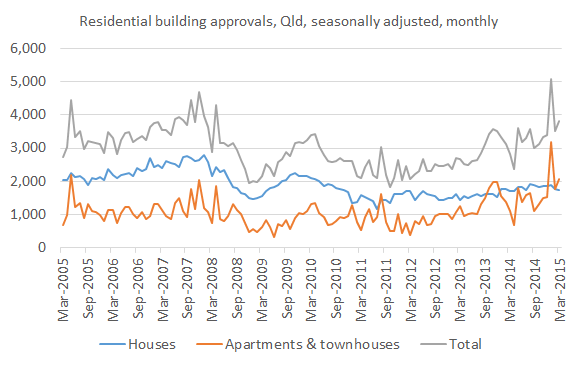
March quarter building approvals figures released by the ABS today show that the residential building industry, no doubt encouraged by very low interest rates,  will help the economy adjust to the end of the mining boom (see the Queensland data charted above). There appears to be a solid upward trend, due to strong recent approval numbers for apartments and townhouses. While I expect the Queensland economy will remain sluggish for the remainder of 2015, positive trends such as this mean that (hopefully) unemployment should not increase from where it is now.

For national coverage see the HIA’s media release Dwelling Approvals March to New Record.

Posted in Housing | Tagged , , , , , , | Leave a comment

Privatised electricity businesses would better achieve necessary efficiencies

It’s been clear for some time that the Australian Energy Regulator (AER) would make large cuts to future allowable revenues for Energex and Ergon, and that this would potentially impact Queensland Government dividend income. The preliminary determinations from the AER were released last week and they were as brutal for the businesses as expected, and Ergon in particular is facing some tricky questions about how it will cut its costs (see Ergon Energy has “no plans” to cut staff after nation’s energy regulator cuts revenue by 30 per cent).

With Ergon (and Energex) remaining in public ownership, it will be difficult to make the large job cuts required to achieve the necessary efficiencies, given that political considerations will inevitably intrude. Ergon appears heavily over-staffed, and the Government itself is being questioned about possible job losses that might result from the proposed Energex-Ergon merger (see Opposition calls to end power jobs uncertainty). With political considerations at play, it’s likely over-staffing won’t be reduced enough, and this will have significant budgetary implications, being reflected in lower dividend payments to Government.

Related previous posts include:

Risk to Qld Budget of lower dividends from Govt-owned businesses

Productivity Commission says no rationale for State ownership of Energex and Ergon

Posted in Budget, Energy | Tagged , , , | 5 Comments

RBA will almost certainly cut cash rate, but economy may be stronger than it thinks

Peter Martin, arguably the top economics journalist in Australia, appears to have been briefed by an RBA insider that the Bank will cut the cash rate next week to 2 per cent, a record low, and I’ve little doubt this will occur (see Reserve Bank to cut interest rates in May in face of weak economy). With inflation and expectations of future inflation very low, super low interest rates globally, a need to keep the exchange rate down, and concerns over the economic outlook, it makes sense to cut the cash rate.

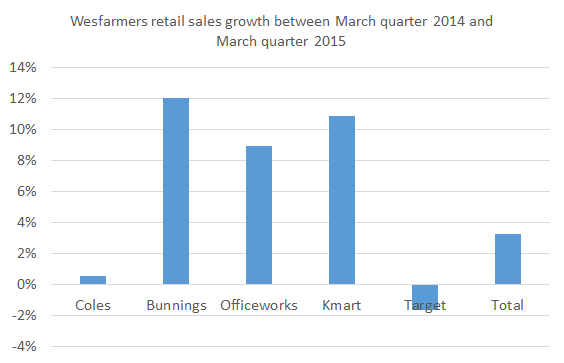
That said, the economy may well be stronger than the Bank thinks, as the wealth effect from strong property markets, particularly in Sydney and Melbourne, appears to be partly offsetting the negative shock from the end of the mining boom. This at least seems the case based on Wesfarmers’s encouraging (though not spectacular) recent retail sales report (see SMH coverage and the chart below). The miracle run of the Australian economy – 24 years since a recession – may continue for some time yet.

Wesfarmers

Posted in Macroeconomy, Retail trade | Tagged , , , , , , , , , , | 6 Comments

Bad day for developers in Queensland – risk to future investment and jobs

At a time when the Queensland economy is experiencing a huge negative shock from the downturn in the resources sector, and at a time when the health of our recovering building industry is very important, it is discouraging that some major proposed developments in Brisbane and the Sunshine Coast have been subject to adverse decisions today (see Cedar Woods approval to be reassessed and Emotions spill over after Sekisui proposal voted down).

I don’t object to community members having a say on development issues, but I’d implore decision makers to consider the need to promote economic development and jobs and to improve housing affordability by boosting supply. Also, decision makers should consider that the developments that have been subject to adverse decisions are in desirable locations that would be great places to live, and might help limit development in outer-lying areas, for which transport costs to and from business districts are much higher. Without a more encouraging attitude toward development, there is a risk that developers will put possible projects in the too hard basket, and the Queensland economy will miss out on important investment and jobs.

I’ve previously commented on the Cedar Woods development:

State & local govts need to allow development to boost housing supply – Gap mega-suburb would be a good start

Posted in Housing, Macroeconomy | Tagged , , , , , , | 10 Comments

On the End of Cheap China

Venetian_MacaoAt the Venetian Macao earlier this week

One of the best guides to the huge economic transformation that has taken place in China in recent decades is Shaun Rein’s The End of Cheap China. I’d agree with commentators who say it is compulsory reading for anyone wanting to do business in China or wanting to understand the contemporary Chinese economy. As I was exploring the Venetian Macao casino resort complex earlier this week, it was easy to see examples that would support one of Mr Rein’s main messages: that middle class Chinese consumers don’t see themselves as middle class, but rather as on the way to being rich, and their aspirations are reflected in their demands for luxury products – of which there is a dazzling array at the Venetian Macao.

The over-the-top brilliance in casino and resort operations that is the Venetian Macao – the world’s largest casino – also made me wonder about the business cases for the proposed new casino-resort complexes in Brisbane and Cairns. The project proponents must be incredibly confident in the quality of their proposed offerings, because I expect it will be hard to lure wealthy Chinese gamblers away from Macau, which offers a number of high quality casino resorts and is much closer for Chinese gamblers. The attraction of other destinations in Queensland, such as the Reef and beaches, must be an important factor in the business cases for the proposed Queensland casino resorts. The successful casino-resort proponents will need to work closely with regional tourism bodies to ensure the local product offering is at the quality required to help lure the wealthy guests they will need to make their casino resorts viable.

Posted in China | Tagged , , , , , , | 11 Comments

Health & aged care will drive jobs growth in coming years

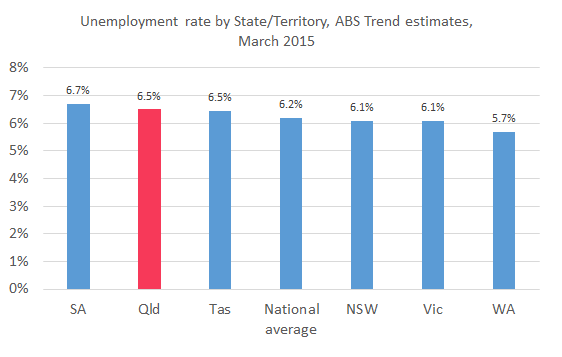
unemployment_rate_Mar15The March labour force data released yesterday by the ABS show the Queensland unemployment rate has stabilised at around 6.5%, which, while relatively high (see chart above), is not too bad from a historical perspective, as I’ve noted before (Don’t panic about unemployment just yet – still below long-run average). The Queensland economy is currently adjusting to the big shock caused by the end of the mining boom, but I expect the labour market will begin to strengthen later in the year and that, hopefully, the unemployment rate will fall to be closer to the national average.

I’m very optimistic about the prospects for jobs growth in the services sector, particularly in health and aged care, underpinned by the massive growth in the population of seniors (see the informative new Qld Treasury report Qld Seniors), and also in tourism, which is being aided by a lower exchange rate than in previous years. I’ll talk more about these factors in my upcoming presentation on the end of the mining boom.

Other commentary on the March labour force data is available from Queensland Treasury (Labour Force) and Pete Faulkner (Jobs data beats expectations).

Posted in Labour market, Population | Tagged , , , , , , , , , | 6 Comments

Risk to Qld Budget of lower dividends from Govt-owned businesses

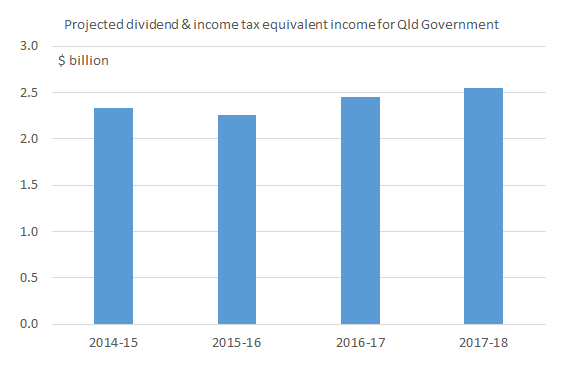
In addition to royalties revenue being lower than previously forecast, a major risk to the Queensland State Budget in coming years is lower than expected dividends from government-owned businesses. Currently government-owned businesses contribute over $2 billion to the Budget or 4-5 per cent of total revenue, and revenue of this broad magnitude is forecast by Treasury to continue over the forward estimates (see chart below). However, these forecasts may not eventuate due to the risk of unfavourable determinations from the Australian Energy Regulator (AER) regarding Energex and Ergon’s business plans for the next five years.

Dividend_incomeThe AER’s draft determination for NSW network businesses from late last year (see AFR coverage) suggests the AER might force Energex and Ergon to cut its proposed charges, and this could mean lower dividends (and income tax equivalent income) from the businesses to the Queensland Government. In a worst case scenario, this may result in a reduction in revenue to the Budget of several hundreds of millions of dollars per annum, compounding an already large fiscal challenge for the Government. The AER’s preliminary determination for Queensland network businesses is due this month, and I expect a number of George St econocrats are nervously awaiting its release.

N.B. Income tax equivalent income is income paid to the State Government by government-owned businesses that would be equivalent to company tax income they would have to pay to the Commonwealth Government, if they were not Government-owned. This is done for reasons of competitive neutrality – i.e. to create a level playing field between private and government-owned businesses.

Posted in Budget | Tagged , , , , , , , , | Leave a comment