Clear evidence re-zoning decisions favour politically connected – new paper by Murray and Frijters

Cameron Murray and Paul Frijters from the School of Economics at UQ have an excellent  paper out proving what we’ve all long suspected: that the politically well-connected do much better in the property development game than those less well-connected (see the Guardian write up). That said, the paper doesn’t prove any actual corruption, but it does show planning decisions often result in re-zoned areas that are clearly in the interests of well-connected developers (and that the re-zoned areas are occasionally of a suspiciously odd shape to favor those developers). Whether this results in inefficient economic outcomes is uncertain, as the authors acknowledge (p. 24 of the paper). It’s also uncertain what should be done about this research finding. The Murray-Frijters finding is consistent with the well-observed phenomenon that more persuasive and better-connected people are more successful and influential in most areas of business and society.

Perhaps the problem is that our planning regulations are so complex and restrictive that you need to be a well-connected, politically savvy operator to get anything done. In my view, the reform of planning regulations, to reduce their complexity and to take greater account of the benefits of economic development, should be a priority. As Brad Rogers has highlighted, for example, development restrictions relating to heritage are imposing a large cost on our community (Old Queenslanders in a New City). I’d note the Government is currently reviewing planning regulations (see Minister Trad’s media release from earlier this week), but I don’t expect that review will lead to the kind of profound changes that would excite me or Murray and Frijters.

Cameron Murray gives a good summary of the new research at his own blog Fresh Economic Thinking:

…How well-connected you are determines how successful you will be in getting your land rezoned for higher value uses. In Queensland $410million worth of additional development rights were given to mates in just our sample of decisions.

In the study we use sample of planning decisions and landowners involving a total area of 12,676Ha, made by one State authority, the Urban Land Development Authority (ULDA), which took planning powers away from local councils with the intention to increase the scale and speed of development in the rezoned areas. Throughout its time the ULDA was no stranger to accusations of bias, with the Local Government Association of Queensland arguing the government is “playing politics and favouring developers.”

In order to establish how well-connected both rezoned and non-rezoned landowners were, we trawled through a wide range of data on political donations, lobbyists and their clients, industry groups memberships, politicians and their former employers, relationships of ULDA board members, and landowner’s corporate records, in order to construct a relationship network.

We also compiled historical sales data to estimate that this series of rezoning decisions increased the value of the rezoned land by $710 million.

Our main finding however, is that well-connected landowners owned 75% of the rezoned land, but only 12% of comparable land immediately outside the rezoning boundaries, indicating that these decisions were primarily driven by the relationship networks of the landowners, rather than any technical assessment of efficient and appropriate locations for urban expansion.

Political favours in the property industry were found to be much more about being part of the entrenched well-connected political class, whose tight-knit mutual relationships support implicit favouritism, than about visible activities such as making political donations.

These well-connected landowners made $410 million in profit from the rezoning decision, at the expense of the public at large who had the option to instead sell those additional development rights. The data tells the story that connected property developers bought land unsuitable for development land on the urban fringe, then successfully lobbied State politicians and bureaucrats through their relationship networks to rezone areas where they had bought properties, wrong-footing both councils and other property developers. This process of influence took 7 years on average.

Well done to Murray and Frijters for this excellent new piece of work on a very important policy issue.
Posted in Housing | Tagged , , , , , | 2 Comments

Qld losing economic State of Origin at the moment

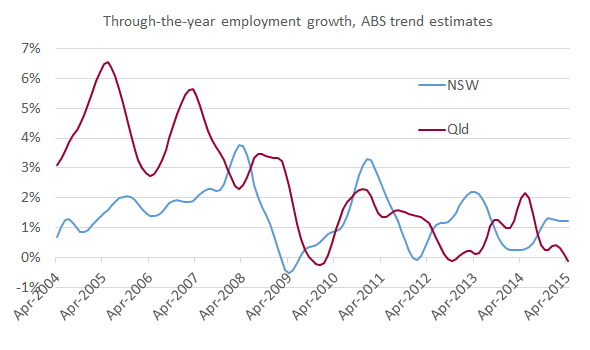
ttempl_Qld_NSW_Apr15

On the day of the first State of Origin game for 2015, it seems timely to reflect on Queensland’s recent economic performance relative to NSW. Alas, it has not been great, with Queensland actually recording a slight loss of jobs in the twelve months to April compared with positive (though not spectacular) growth in NSW (see chart above). Queensland’s unemployment rate is now 6.6% compared with NSW’s unemployment rate of 6.0% (see the Treasury information brief). The end of the mining boom undoubtedly caused a slowdown in the Queensland economy, the technical recession in the second half of 2014 that the Treasurer alerted us to last week (see More on Qld’s late-2014 technical recession). So it’s unsurprising that Queensland businesses are among the least confident in the nation, as reported in the Brisbane Times this morning.

N.B. after originally posting this, I’ve corrected the post to say Queensland businesses are among the least confident in the nation, as business confidence is worse in South Australia.

Posted in Labour market, Macroeconomy | Tagged , , , , , , | Leave a comment

Residential dwelling investment crucial to re-balancing of Qld economy

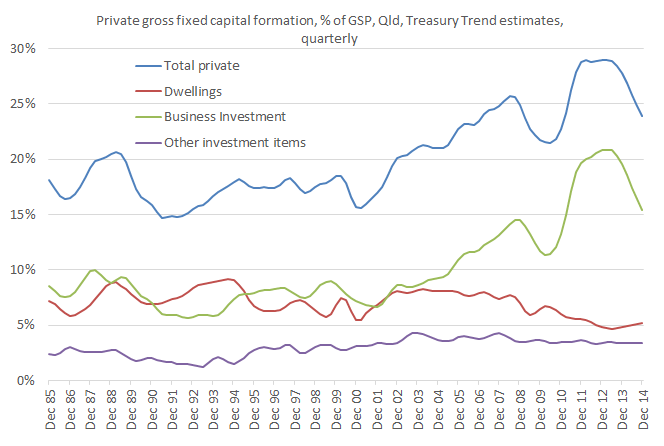
privateinvestment

Queensland Treasury’s latest set of State Accounts, which have created so much controversy (see my previous post on Qld’s technical recession), show just how extraordinary the private sector investment boom was in Queensland, with investment increasing as a share of gross state product (GSP) to nearly 30 per cent in 2012-13 (chart above). It was always inevitable that investment would fall from such high levels. The State Accounts also show how important a resurgence in dwelling investment will be to the re-balancing of the Queensland economy as private dwelling investment as a share of GSP is at relatively low levels. Luckily there are positive signs from residential building approvals, no doubt due to very low interest rates (see Residential building will help economy adjust to end of mining boom).

With other positive signs, such as the 18-month high in consumer confidence our Treasurer has referred to, I’m reasonably confident Queensland will avoid a proper recession, as opposed to the technical recession we recorded in late-2014 due to the inevitable fall in investment spending from extraordinarily high levels. A proper recession would entail a broader downturn than what we saw in late-2014, and would see unemployment increase well beyond the current level of 6.6 per cent.

On the definition of recession, it is well known that the commonly accepted definition of recession as two consecutive quarters of negative economic growth can be unreliable as a guide to the true state of the economy, as it possibly is for the case of Queensland in late-2014. Indeed, the US National Bureau of Economic Research doesn’t use the two-consecutive-quarters rule, as it looks at a range of indicators to determine the state of the economy as it moves through the business cycle (see NBER’s Business Cycle Dating Procedure). Regrettably, we don’t do the same thing in Australia, and the two-consecutive-quarters rule is well entrenched.  For that reason, when I was asked by ABC News last Thursday whether the Queensland Treasurer was correct to claim a recession in Queensland in late-2014, I had to agree.

Finally, notwithstanding the reasonably positive outlook for the Queensland economy, the shock coming from the decline in resources sector investment is a very large one, and it would be good to ensure we’re getting as much dwelling investment as we possibly can, which means not unnecessarily holding up or rejecting developments. I’ve previously commented that some recent decisions are concerning in this regard (see Bad day for developers in Qld – risk to future investment jobs). Our State Government and local councils need to be mindful of the economic importance of dwelling investment.

On the economic outlook for Queensland, also see my post from earlier this month:

Qld retail trade grows strongly in March quarter – good sign economy is re-balancing post-mining boom

Posted in Housing, Macroeconomy, Mining | Tagged , , , , , , , | Leave a comment

More on Qld’s late-2014 technical recession – Treasury should get out there and defend its figures

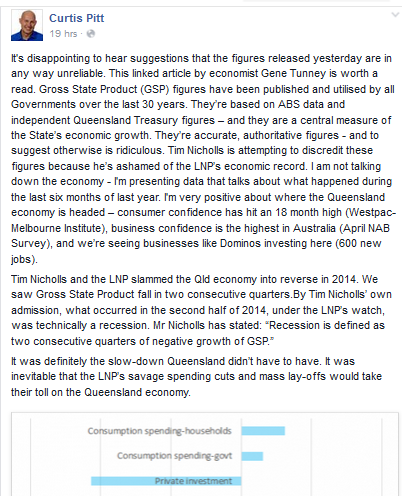
I was flattered that the Queensland Treasurer Curtis Pitt, or possibly one of his staffers, shared my previous post on his Facebook timeline yesterday (screenshot below). It’s regrettable that the integrity of the Queensland Treasury has been questioned in the debate over the reliability of its State Accounts figures, and I’d suggest the Treasury should urgently issue a discussion paper on its State Accounts, explaining why and how it produces them. I agree with the Treasurer about the reliability of the Treasury estimates and the reasonably good economic outlook we have at the moment. Unlike the Treasurer, however, I wouldn’t necessarily blame the former Government for the technical recession we had, as it was always a possibility given the mining investment boom coming to a natural end. In any case, whether the previous Government was to blame for the downturn is irrelevant to sorting out the Queensland Government’s current budgetary challenges, and I wish the Queensland Treasurer good luck in formulating the 2015-16 State Budget.

Qld_Treasurer

Posted in Budget, Macroeconomy | Tagged , , , , , , , | Leave a comment

Qld experiences technical recession as investment falls from elevated levels – no need to panic yet, though

Watching the ABC News tonight, I had to laugh when ABC State Political Reporter Chris O’Brien prefaced opinions given by Nick Behrens from CCIQ and me on whether Queensland is in recession with that classic journalistic device “Opinions differ…” Well they certainly do differ, but only one of the opinions was right, and it is undeniable that Queensland recorded a technical recession in the second half of 2014 – i.e. two consecutive quarters of negative economic growth.

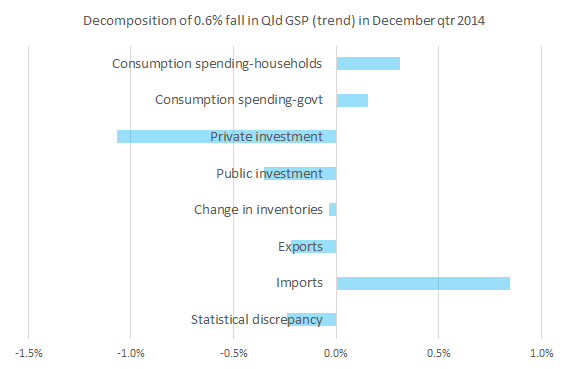
The Queensland Treasury figures showing a recession appear very reasonable to me and are what would have been expected given the drop off in capital investment spending by the resources sector and government from the elevated levels they have been at. The decline in private and public investment is the big driver of the drop in gross state product (GSP) in December quarter (see chart below). But the impact of the drop in investment was not as severe as it might have been, because a lot of capital equipment was obviously being imported, as imports fell in December quarter, offsetting part of the reduction in GSP caused by the fall in investment.  (Note that as imports subtract from GSP, a fall in imports adds to GSP.)

decomposition_Dec14

The positive contribution from consumption expenditure to the change in GSP is encouraging, and confirms my view that Queensland will endure the end of the mining boom without much more of an increase in unemployment (see my speech on the end of the mining boom). As I’m not surprised by today’s State Accounts figures from the Treasury, I have no reason yet to change my assessment.

I’d dismiss any allegations of political considerations influencing the Treasury figures. Treasury has been producing State Accounts figures on a quarterly basis for as long as I can remember, and indeed I recall using their estimates when I was an economics honours student in the mid-1990s. The ABS doesn’t produce quarterly State Accounts figures, so the Treasury has to produce them. In my experience, Queensland Treasury has always acted with integrity in the production of its economic data, and I’d challenge its critics to produce examples of where it hasn’t.

That said, Budget forecasts are another matter, as Budgets are technically the product of the Treasurer, and it is inevitable that the commendable levels of enthusiasm our Treasurers tend to have for our economic future will influence the forecasts to some extent. No doubt Queensland Treasury will be considering the need to revise down the GSP growth forecasts it will use in the upcoming Budget after today’s figures, and I’m sure it will be advising the Treasurer about the necessity to do so. In his excellent post Has Queensland been in recession?, Pete Faulkner notes:

We shall wait to see what the Budget in July now forecasts for GSP growth in 2014-15 but it would seem highly likely, given the falls in Q3 and Q4, that the previous 3% target will be downgraded.

Obviously, this will add to the already huge fiscal challenge the Government is facing.

Posted in Macroeconomy | Tagged , , , , , , , , , | 6 Comments

New evidence stimulus worsened our competitiveness from Makin & Ratnasiri

Griffith University Economics Professor Tony Makin and his co-author Shyama Ratnasiri have just published an interesting paper (Competitiveness and government expenditure: The Australian example) presenting new econometric evidence that suggests fiscal stimulus in response to the financial crisis worsened Australia’s international competitiveness. The decline in competitiveness occurred through the government bidding up wages and prices for resources to spend on stimulus initiatives, such as the Building the Education Revolution school halls. The decline in competitiveness, by adversely affecting our export performance, arguably offset the positive economic impact of the stimulus.

The new evidence presented in the paper is highly relevant to the recent debate over whether the Federal Budget should have done more to stimulate the economy (see my Budget briefing). Professor Makin has previously argued, correctly in my view, that fiscal stimulus would be unwise at the present time because it would add to upward pressure on the exchange rate, which the RBA is desperately trying to bring down using monetary policy.

My previous comments on fiscal stimulus have included:

Treasury’s dismissal of stimulus criticism is unconvincing

Stimulus was always going to be problematic in an open economy

Posted in Macroeconomy | Tagged , , , , , , , , , , , | Leave a comment

Recommended reading on Keynes as a Universal Man

jmk_bookOne of the best books of the year is Richard Davenport-Hines’s Universal Man: The Seven Lives of John Maynard Keynes. These seven lives are: altruist, boy prodigy, official, public man, lover, connoisseur and envoy. The book emphasises Keynes as a man of action, as well as an intellectual. While the economic content of the book is light, it contains fantastic vignettes from the life of Keynes—such as his ride in a motorcycle sidecar from Cambridge to London at the outbreak of the first world war—which make it a fascinating introduction to the huge breadth of the great economist’s life.

It is not as comprehensive as Robert Skidelsky’s incomparable three-volume biography, but the division of the book into chapters on his seven lives is a useful way to collect and emphasise his achievements in the different roles he had. Keynes provided a massive legacy, not just in economic policy, in which he remains influential today, but in the arts, through the establishment of the Arts Council and the revival of the Royal Opera House at Covent Garden.

With references to the vast array of luminaries Keynes knew in his life, such as Churchill and Virginia Woolf, the book is sure to be of wide interest outside economic circles, and I heartily recommend it.

Posted in Arts, Macroeconomy | Tagged , , , , , , , , | 2 Comments

Budget briefing – speech notes and slides

Last Friday afternoon I gave a presentation on the 2015-16 Budget at a private function I organised at the Tattersall’s Club in Brisbane. My slides are available for download (Budget briefing 15 May 15).

Budget briefing

Good afternoon. Today I’d like to share my views on the Federal Budget 2015-16, and particularly what it means for us in Queensland. The main conclusions I’ve reached so far are:

  • While there were a number of good savings measures, such as lower threshold of assets outside the family home in the pension assets test, the budget has deferred the hard decisions that are ultimately necessary—it has kicked the can down the road—particularly further tightening of the age pension and tax reform involving a broader GST, possibly with a higher rate; and
  • while there is much concern that the Budget isn’t supporting the economy at a time it needs fiscal stimulus—a view expressed by the Opposition leader last night—as Peter Switzer put it at the PwC Budget Breakfast Wednesday morning, this can be seen as a “Viagra budget”, with a well-targeted incentive to boost investment.
    The Government’s has been smart to rely on accelerated depreciation, a remarkably effective policy, and not instead on infrastructure spending, for example, to provide a boost to the economy. I’ll explain later why I don’t think a big fiscal stimulus is sensible at this time.

Continue reading

Posted in Budget | Tagged , , , , , , , , , , , , , , | Leave a comment

Trajectory to surplus not the same thing as budgeting for a surplus

As I mentioned to Pat Hession on Townsville ABC radio yesterday afternoon, the 2015-16 Federal Budget simply kicks the can down the road, as they say, leaving it for a future Government (or this one if it stays in power) to make the hard decisions necessary to truly repair the budget (see my post from yesterday). A trajectory back to surplus is not the same thing as budgeting for a surplus, and there is no surplus over the forward estimates, just a steady fall in the deficit – a fall which may not occur as projected, as new budget pressures emerge in coming years and the Government commits to new expenditures or renews old programs.

The budget estimates for 2017-18 and 2018-19 are not really forecasts, but what Treasury calls projections, in which critical variables such as nominal GDP grow at rates around long-run averages. The projections are not as reliable as forecasts, and, given how much budget forecasts for the same year can change within six months, the projections of the deficit declining to 0.4% of GDP by 2018-19 should be treated with some skepticism.

Regarding the impact of the Budget on Queensland, the Brisbane Times has good coverage, with the news of an increasing share of GST revenue welcome. The article also notes the establishment of the $5 billion Northern Australia Infrastructure Facility, which will provide concessional loans to nation building projects, but which seems to me to be a case of putting the cart before the horse. Is the Government sure that $5 billion of viable projects worthy of public subsidies are out there for Northern Australia right now? I’m doubtful there will be many projects with good business cases, and which would be likely to obtain the necessary environmental approvals, that the Facility could fund. The establishment of the Facility suggests the Government would expect to lend $5 billion, but to do so it might end up funding some dubious projects that turn out to be white elephants.

Finally, the best comment on the Budget I’ve seen this morning has come from BDO Tax Partner Mark Molesworth, who notes in an email introducing BDO’s Federal Budget update that:

The Abbott Government’s second Federal Budget was as predictable as the daily commute with many key measures released ahead of time.

While there is some relief for small business, the tokenistic concessions may in fact add to the tax compliance costs. Within the Budget there is very little for medium and large businesses, except for additional multinational anti-tax avoidance measures.

So, while it wasn’t a derailment in terms of tax reform and simplification, the ‘Reform’ train is stuck at the station while we wait for the delivery of the Tax White Paper.

Very true. The reform train is definitely stuck at the station. Unfortunately I doubt it will ever go anywhere. The Government no longer seems prepared to make the tough decisions that are truly necessary to repair the budget.

Posted in Budget | Tagged , , , , , , , , , | 7 Comments

Budget measures insufficient to avoid risk of permanent deficits

Tonight’s Federal Budget will be very disappointing, as the expected measures do not go anywhere near enough to reducing the risk that Australia will end up in a state of permanent deficit, as I’ve previously suggested it would if we do not make hard decisions (see Budget blowout highlights risk of permanent deficits without major spending cuts). Deloitte Access Economics forecasts suggest deficits in the order of $40-50 billion in the next couple of years (see ABC News report). While the end of the mining boom is no doubt responsible in part for recent revenue write-downs, it is undeniable that we have a huge structural deficit (see Guay Lim’s article in the Conversation), and tough, urgent measures are needed to remove it. Now is not the time to be spending an additional $3.5 billion on subsidising childcare, as reported by the Courier-Mail.

The best measure in the Budget appears to be the decision to tighten the assets test for the pension, saving $2.4 billion, but even that doesn’t go far enough. The assets test should, for reasons of both efficiency and equity, include the family home (see Adam Creighton’s excellent Australian article earlier in the year). The failure of our political class to deal with Australia’s long-term fiscal challenges is very disheartening.

Posted in Budget | Tagged , , , , , , , , , , , | 2 Comments