Paul Syvret’s Courier-Mail article on weak population growth spelling trouble for Qld economy

Thanks to Paul Syvret from the Courier-Mail for quoting me on migration and population trends in his opinion piece published in the paper today on Weak population growth could spell trouble for Queensland economy. For the record, here are some relevant extracts:

As economist Gene Tunny notes, one of the big drivers of Queensland growth in the 1990s through to the mid-2000s was strong population growth, particularly interstate migration…

Part of that initial wave was driven by the disparity between Queensland house prices and those of southern capitals, along with Queensland’s relatively strong economic performance post the 1990s recession.

Those comparative advantages are less marked today, putting aside what Tunny describes as a “mad” Sydney housing market.

Certainly the lure of employment, exacerbated by the end of the mining investment boom, is not what it once was, with Queensland’s growth lagging behind that of NSW and Victoria.

“It is hard to believe that the [Queensland economy] has been so lacklustre for such an extended period,” Tunny says.

“We are still a branch-office economy … and there are better opportunities, particularly in Victoria.”

Previous posts of mine on migration and population issues include:

Interstate migration to Qld remains low, and we’re still losing people to Victoria

Qld public service redundancies likely contributed to spike in migration to NSW & Victoria

Posted in Uncategorized | Tagged , , , , , , , , | 4 Comments

As many units as houses approved in Queensland in last 12 months – is a unit price crash coming?

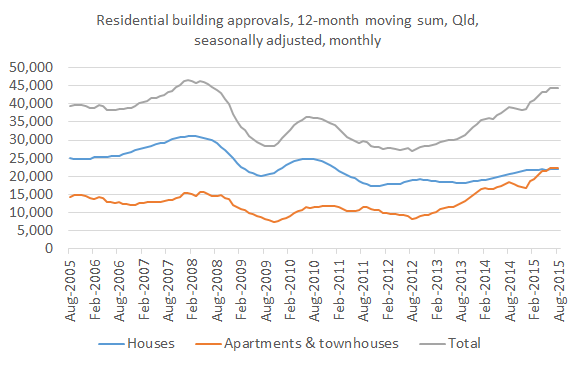
In March, QUT Media reported that, based on analysis by Professor Chris Eves, “Brisbane’s inner city apartment market will crash in 2016, due to oversupply driven by belief in inexhaustible international demand.” (See Collapse of Brisbane’s inner city apartment market imminent.) This is certainly possible, considering all the apartment building construction in Milton, Newstead, and West End, among other suburbs. And building approvals over the last twelve months suggest even more supply is expected to come (see chart below plotting the sum of building approvals over the previous 12 months on a monthly basis, based on the latest ABS data). It is extraordinary that unit approvals were at around the same level as approvals of houses over the twelve months to August 2015. This is definitely a market to keep a close eye on.

Building approvals_Aug 15

Posted in Housing | Tagged , , , , , , , | 4 Comments

The truth about cause and effect in Industry Super Fund governance – guest post from Michael Willis

Corporate governance expert and former Finsia President Michael Willis has written an article (reproduced below) on the debate over the Commonwealth Government’s push to get independent directors on to industry super fund boards that are now dominated by union and employer representatives (see this SMH article for background).  Mike originally published this piece on LinkedIn and I’m grateful he has given me permission to republish it.

The truth about cause and effect in Industry Super Fund governance

An early lesson in my philosophy studies was on the difference between cause and coincidence. The industry super fund lobby may need a refresher course in this principle.

The CEO of IFM Investors and lead advocate for the industry fund sector, Brett Himbury, recently linked the successful out-performance of some industry super funds, and their asset allocation decisions, to the control exercised by unions and employer delegates over these funds (Australian Financial Review, 22 September 2015).

It is one thing to crow, quite legitimately, about the strong performance of these funds, generated in large part from their decisions to overweight their funds in alternate assets. Subsequent events proved this to be a wise decision, and these funds can legitimately use this success in their promotion and marketing.

It is quite another matter to connect this decision with the peculiar governance structure of these funds, where the board seats are tightly held – typically 50% by trade union representatives and 50% by employer industrial associations, with the chair alternating between them.

Mr Himbury has expressed concern over the federal government’s planned legislative changes to ensure that at least a third of board posts, and the chair, are independent of the unions and industry associations. This change arose in part from revelations of inappropriately close relationships between super fund management and some unions.

Mr Himbury linked, at least implicitly, the severing of this tight control to the undermining of asset allocation decision making and to potentially poorer investment returns.

Trade unions are held in high regard in many parts of the workforce, and there is a case to be made for financially unskilled workers placing trust in their union to represent their interests and oversee the manager of their retirement nest eggs.

However, there is also a compelling argument that independent directors, not beholden to sectoral interests and able to act in the interests of members, take their fiduciary interests more seriously.

The presence of independent directors, with an independent chair, can ensure that the investment decisions are made in the interests of members rather than the employer’s industrial interests or the union’s political or commercial interests. For example: is it possible for an employer delegates to advocate that their industry be sufficiently weighted in an investment portfolio? Or on the other side, could a union delegate push to ensure a fund’s advertising is appropriately spent through the union’s network, or that members’ funds be invested according to a particular political agenda? In such cases, decisions may not be in the interests of fund members.

A more balanced board, with sufficient independent directors not aligned to unions or employers, can ensure that these sorts of conflicts are managed and avoided, and the members’ interests are protected.

The fear of Mr Himbury, that asset allocation may be constrained by these independent directors, appears to be groundless. An experienced independent director, acting in the interests of members, would be no more willing to reject the advice of asset consultants than union or employer delegates. There is no “causal” factor here, merely a coincidence between the peculiar governance of these funds and an unconnected performance success.

Sound corporate governance principles should apply to the superannuation industry, and these collaborations between unions and employer peaks should not be excluded from the transparency and accountability that board independence provides.

Michael Willis is a Senior Advisor at Effective Governance Pty Ltd. He is also the Honorary Treasurer of Independent Schools Queensland. The opinions expressed here are his own.

Michael Willis_4

Posted in Uncategorized | Tagged , , , , , | Leave a comment

Interstate migration to Qld remains low, and we’re still losing people to Victoria

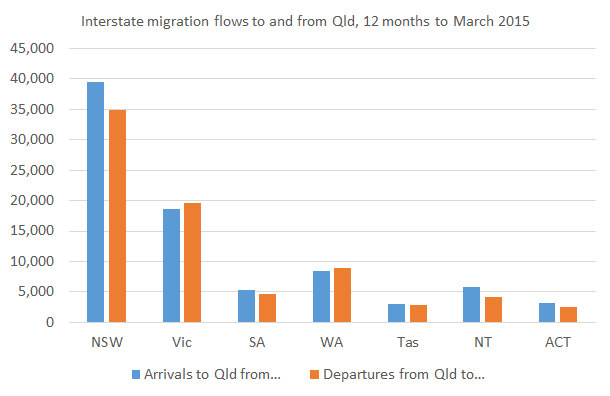
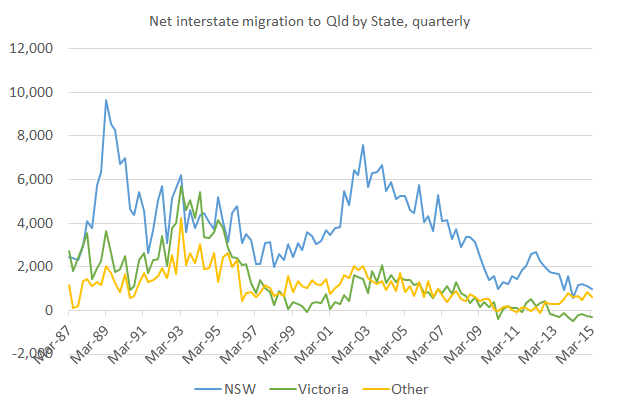
For over a year now, I’ve been commenting on the reversal of the long-term pattern of Queensland gaining people from Victoria through interstate migration (e.g. see this post from June). This reversal has contributed to a large decline in interstate migration to Queensland. While we continue to gain people from NSW, the net loss of people to Victoria persists, as revealed by the most recent population data released by the ABS on Thursday last week (see charts below). Thankfully, the net loss to Victoria is still relatively small, at fewer than 1,000 people per annum. As I’ve noted previously, the net loss to Victoria is likely due to better job opportunities, particularly for professionals, in Victoria. Given the current state of the Queensland economy, this will probably continue for some time.

IMchart1_Mar15

IMchart2_Mar15

Our very low rate of interstate migration is a major cause of Queensland’s population growth rate being lower than the national average (see the Queensland Treasury brief). Given our relatively low population growth, we shouldn’t expect to see a strong economic recovery in the near term being led by the residential construction sector.

Posted in Migration, Population | Tagged , , , , , , | 4 Comments

Interview on Turnbull Cabinet on 612 ABC Brisbane

Yesterday afternoon, Emma Griffiths from 612 ABC Brisbane interviewed me regarding PM Malcolm Turnbull’s Cabinet and what it means for the economy:

The future of business under Turnbull

I told Emma that it appears business is very optimistic about the new leadership team, but ultimately it will be actions that matter, particularly actions in major reform areas important to business such as taxation and industrial relations. On these issues, PM Turnbull and Treasurer Morrison will face the same political challenges as the previous team. Business will be hoping the new team is more persuasive about the merits of reform than the previous team, which so clearly failed in persuasion.

While the new Cabinet may contribute to a bounce in business confidence in the next NAB and CCIQ Pulse surveys, any bounce would likely be temporary, and confidence would eventually return to a level reflective of the true economic outlook. Commenting on the briefing the RBA Governor gave the new Cabinet on the economy, I suggested the Governor would have referred to Australia’s recent sub-trend economic growth, concerns over the expected level of business investment in the next twelve months, and the risks from overseas, particularly China. I expect the economy will remain sluggish, and I hope it will not slow down even more. The new Cabinet will not have an immediate impact on this economic outlook.

Finally, I noted to Emma that I have been impressed by the PM’s comments regarding creativity, innovation and disruptive technology. I suggested that it would be good if our State Government had a similarly enlightened attitude to disruptive technology such as Uber. If, instead of cracking down on Uber, the State Government embraced it, there would be huge gains for consumers (see my post from last week and also Graham Young’s opinion piece in the Courier-Mail last week, Taxi industry cannot brake Uber’s run in an old, overregulated market).

Posted in Budget, Macroeconomy, Tax | Tagged , , , , , , , , , | Leave a comment

Farm robots good for economy, but may mean downward trend in agricultural jobs continues

Agricultural employment

Queensland’s former Premier Campbell Newman is chairman of a company Swarm Farm that is developing robots for on-farm use, in tasks such as weeding (as reported in the Brisbane Times). This is fantastic technology and will be good for agricultural production and productivity. It is another application of technological improvements that boost on-farm productivity, with other recent applications including the remote operation of irrigation equipment by laptops (see this IT World story).

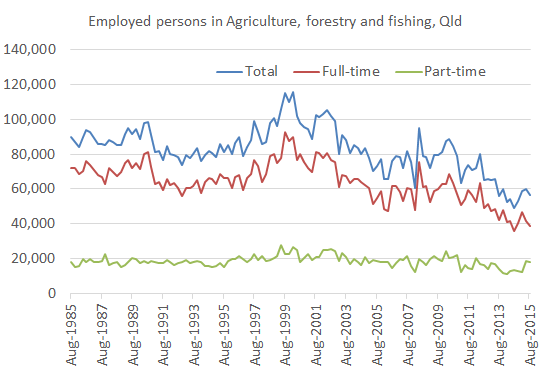
Of course, this productivity growth will be associated with labour savings, and I was reminded by the Swarm Farm story that productivity improvements in agriculture over the last few decades have been associated with a decline in the number of jobs in agriculture (see chart above). While the value of industry gross value added in agriculture, forestry and fishing has doubled since 1990, employment in the sector has fallen by around 40 per cent.

This productivity growth in agriculture is good for the economy because it frees up labour for more productive tasks, although possibly not for jobs in regional areas. The movement of people from less productive tasks on the land to more productive tasks in cities has long been associated with economic development. It explains in large part the strong economic growth China has experienced in recent decades, and it explains why the British Agricultural (or Agrarian) Revolution was a precursor to the Industrial Revolution.

That said, the productivity growth we are seeing on-farm should warn us not to expect an on-farm jobs bonanza from the agricultural export boom that is being forecast due to growing food demand from Asia.

Incidentally, the biography of Campbell Newman by Gavin King is being launched on October 7 in Brisbane:

‘can do’ book launch

This book should be a good read. Earlier this year, I was interviewed by the author regarding what recent Queensland political history means for the prospects for economic reform in Australia. I will certainly post a review of the book when it is released.

Posted in Agriculture | Tagged , , , , , | 4 Comments

Ethanol mandate to be introduced despite lack of evidence on net benefits to Qld

Earlier this week, the Queensland Government introduced into Parliament a bill for a 2 per cent ethanol mandate (see this Brisbane Times report). This measure appears designed to placate Katter’s Australian Party, which is looking out for cane growers who would benefit from an ethanol mandate. As I’ve posted on before, it is unclear this measure would benefit the community and most likely would not (see Ethanol mandate should not proceed without cost-benefit analysis). Ethanol is much less efficient as a fuel than petrol and it is not clear it is better for the environment once you consider the land and other resources needed to grow the feed stock (e.g. sugar cane or sorghum).

Because E10 gets fewer kilometres per litre, and the price differential between E10 and regular unleaded is insufficient to make up for this, E10 effectively costs around an extra 2 cents per litre. So a typical motorist might end up paying an extra $30 over the course of a year because they need to purchase slightly more fuel to make up for the lower efficiency of E10. While it is not a huge amount of money, it is an extra cost on consumers and one that does not appear justified.

The best way to determine whether this policy is desirable would be to conduct a comprehensive cost-benefit analysis, which has not been done in this case. I note the Government has set up a new Queensland Productivity Commission and I’m sure it could have undertaken the rigorous study required. Instead, we had a glossy discussion paper lacking the detailed analysis required and a consultation process that was useless because it was not informed by a decent analysis of what this policy would mean for the Queensland community.

I made a submission to the consultation process pointing out the risks of this policy and the need for a cost-benefit analysis – which I thought was a pretty obvious point that reasonable people would agree on – but this point was not noted in the consultation report. It is regrettable this policy is being rushed through with so little analysis of its impacts on the Queensland community. It is also regrettable the RACQ is acquiescing in the introduction of the ethanol mandate and is not pushing the Government to provide convincing evidence that this policy will benefit the community and will not impose unnecessary costs on motorists.

Posted in Agriculture, Retail trade | Tagged , , , , , , , , | 6 Comments

Cracking down on Uber would come at a high cost to the Qld community

Yesterday’s Sunday-Mail reported that Katter’s Australian Party (KAP) will introduce a bill into the Queensland Parliament to increase penalties for Uber drivers. Regarding the taxi industry that he is intending to defend, Robbie Katter notes: “They move a million wheelchairs per annum at no cost to the Government—it’s cross-subsidised from other routes.” Mr Katter considers this an argument for defending the taxi industry, but it actually illustrates the poor design of our current taxi industry policy. The cross-subsidy that Mr Katter is talking about comes at a cost to other consumers of taxi services, and it is not transparent, which is typically considered poor form in policy design.

From the community’s point of view, it may be better for the Government to deregulate the taxi industry and develop an explicit financial support program for Queenslanders with disabilities to help them meet any additional costs associated with their transport. They could use this support to help pay for a taxi or Uber ride. I cannot see any barriers to Uber drivers purchasing an appropriate vehicle and catering to this market segment. While there would be a cost to the Government budget from the explicit financial support, it is not a new cost to the community as a whole, because consumers are already paying for this support through the cross-subsidy that Mr Katter has referred to.

The benefits to the community that would come from a deregulation of the taxi industry and through allowing Uber to flourish are so large that we should resist attempts such as KAP’s to protect the taxi industry. As has been argued by commentators such as my friend Brad Rogers in the past, the current restriction on supply in the Queensland taxi industry imposes high costs on consumers (see Queensland taxi licences and drunken violence). This cost has been recently quantified by the Economic Policy Group in the Queensland Department of Premier and Cabinet at $40 million per year (see this ABC News report).

The Government must realise that the current protection of the taxi industry comes at a high cost to the community through higher fares than otherwise (and through a shortage of taxis at peak times) and this is what makes Uber so attractive in comparison. Consumers are highly supportive of Uber, and government regulation should change so that it is in line with community views.

Posted in Transport | Tagged , , , , , , | 9 Comments

Upcoming public lecture by Bob Gregory on the gender pay gap

The upcoming John Western Public Lecture at the University of Queensland (on Monday 21 September at 5pm) by eminent Australian economist Bob Gregory looks very interesting and no doubt will provoke much discussion on the causes of the gender pay gap:

Is this the end of the road: Will lifetime earnings for the average female ever lift to 66 cents in the average male dollar?

Professor Bob Gregory, one of Australia’s pre-eminent economist will present a wide-ranging lecture, which documents the extraordinary labour market gains that the average woman has made in Australia, relative to the average man, over the last half century discusses what has been learnt from this history,which factors have impacted most on changes in gender labour market outcomes, and why did they occur? The lecture also conjectures whether significant movement towards labour market equality for the average woman has more or less come to an end and, if so, what could significantly change this , from a macro perspective? Could it even be argued that the gender equality movement is losing its focus and effectiveness?

I expect Professor Gregory will provide up-to-date evidence regarding whether gender pay differences can be explained by differences in occupational choices, qualifications and experience, or whether some other factors must be at play.

Posted in Labour market | Tagged , , | Leave a comment

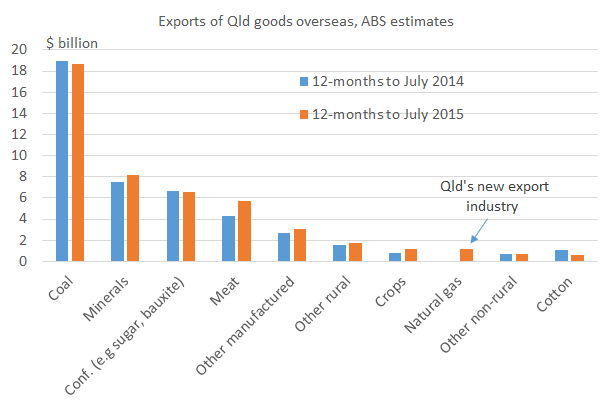
Exports to bolster Qld economy in difficult year ahead

Qld_exports

Queensland Treasurer Curtis Pitt is doing his best to talk up the Queensland economy, noting in recent media releases that Queensland exports are soaring and that Deloitte is forecasting 4.5 per cent economic growth in Queensland in 2015-16 and 4 per cent in 2016-17.  The strong exports growth (nearly 7 per cent in the 12 months to July) was due largely to very strong growth in meat exports (32 per cent over the twelve months) and the emergence of the new LNG export industry at Curtis Island off Gladstone (see chart above).  LNG is expected to provide a huge boost to exports over 2015-16 and 2016-17 as LNG production capacity progressively comes online. LNG could add an extra $5 billion to $7 billion  (around 2 per cent of Gross State Product) to exports in each financial year, as LNG exports ramp up to a projected $15 billion in 2016-17, which means Deloitte’s growth forecasts are not implausible. A boost to exports is much needed, as it is very possible that private sector capital expenditure will continue to fall over 2015-16.

In other positive news, the number of international visitors to Australia is growing very strongly, according to recent ABS data reported by Pete Faulkner:

International arrivals growth outstripping departures

Posted in Exports, Macroeconomy | Tagged , , , , , , , , | 2 Comments