Coronavirus update – next two weeks will be critical in determining impacts

It looks like political leaders are finally recognising the urgency of responding to coronavirus, with President Trump declaring a national emergency in the US and Australia cancelling mass gatherings. It’s about time. This is a huge public health threat with potentially large economic costs.

Markets have reacted positively to the recent displays of national leadership with both the Australian share market and the US share market rebounding yesterday. The S&P/ASX 200 was up 4.4% yesterday and Wall St was up more than 9%, its largest one-day gain since 2008, as reported in the Financial Times (see chart below).
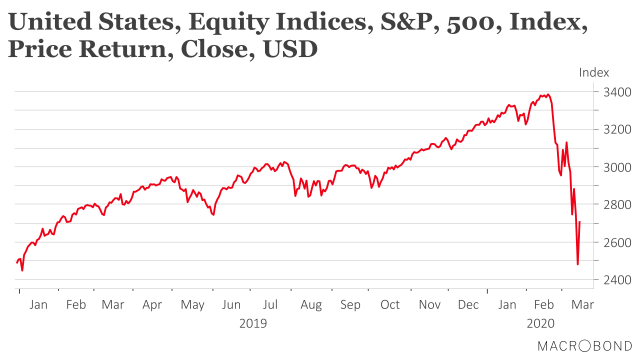
S&P500_13March

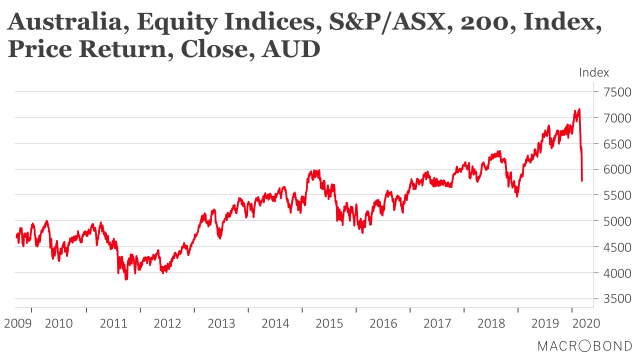
The Australian market is still 10% down from where it was this time last year and 23% down from the peak in February (see chart below).
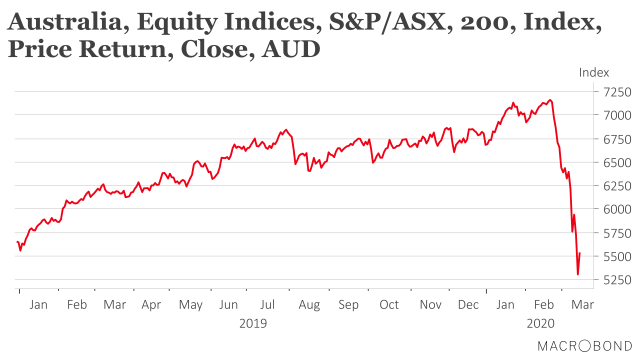
ASX200_13March

Given the analyses of the trajectories on coronavirus infections in other countries I’ve seen, the next two weeks will be critical for Australia (see this excellent Grattan Institute analysis from earlier this week). We will either contain the virus, and its impacts will be limited, or infections will grow exponentially and authorities will need to take radical steps similar to those seen in China, Italy, and New Rochelle, NY to stop it spreading further. That would bring massive economic disruption.

As an economist, I’m unable to forecast the growth of the virus and, hence, its likely economic impact. In my view, neither is any other economist at the moment, so I was very surprised at Chris Richardson’s mild forecast of the economic impact of coronavirus in his opinion piece in the AFR yesterday:

Deloitte doesn’t forecast the Australian economy to have shrunk in the March quarter, and the nation is now in with a fighting chance of avoiding it in the June quarter as well. Even more importantly, the effect on jobs is likely to be muted.

I think it’s far too early to tell whether we can be this confident.

Chris Richardson was happy about the Federal Government’s announced $17.6 billion stimulus package earlier this week, noting it helps employers keep apprentices, an at-risk group, in work. The stimulus package was probably necessary to bolster confidence, but it won’t be that effective if the virus shuts downs large swaths of the Australian economy for several weeks or months. Check out Stephen Long’s ABC News report for some excellent analysis.

Certainly, the Government will be actively considering additional stimulus measures in the 2020-21 Budget, as will our own Queensland Government. I expect the state government will need to present some cyclically-adjusted/structural budget balance estimates in its upcoming state budget to justify the debt blow out that will no doubt occur.
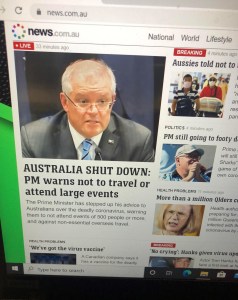
Australia_shut_down

Perfect headline from News Ltd soon after the PM’s COAG address on Friday.
Posted in Macroeconomy, Uncategorized | Tagged , , , , , , , , , | Leave a comment

City Infrastructure with Craig Lawrence – Economics Explained ep.26

At this stage, the official line is that Queensland’s local government elections will still go ahead on Saturday 28 March despite the coronavirus threat, although the Queensland Electoral Commissioner has told ABC Radio “Things could change…” (see this ABC News report). Last week, when I was more confident the council elections would proceed than I am now, I recorded an interview on the economics of city infrastructure with my colleague Craig Lawrence, Managing Director of Lytton Advisory, who I’ve worked with on a range of projects in Australia and the Middle East. I thought that a couple of the major projects being advanced by the incumbent Brisbane City Council such as the Brisbane CBD-Kangaroo Point pedestrian bridge and the conversion of Victoria Park Golf Course into a public park would provide conversation fodder. We also ended up discussing the economics of the state government’s troubled Cross River Rail project. So please consider checking out my latest Economics Explained episode on City Infrastructure with Craig Lawrence.

Use these (approximate) timestamps to jump right to the highlights:

  • 1:00 – conversation starts with me asking Craig about a recent post (A $7 Crossing) he wrote about the economic viability of Brisbane City Council’s proposed
    $190 million Kangaroo Point to Brisbane City pedestrian bridge
  • 12:00 – discussion of external benefits (including wider economic benefits) relevant in assessment of city infrastructure projects
  • 18:00 – discussion of agglomeration effects and benefits of active transport
  • 23:30 – Craig delivers his assessment of the economic viability of the Brisbane City to Kangaroo Point pedestrian bridge – “at the moment, there’s not enough evidence on the benefit side, to be able to justify the project “
  • 26:00 – further discussion of wider economic benefits – Craig notes a rule of thumb is that they should only be 15-20% on top of private benefits
  • 32:00 – I commence a conversation with Craig about Brisbane City Council’s un-costed redevelopment of Victoria Park Golf Course into a public park and how one might assess its economic viability
  • 43:20 – beginning of discussion on Cross River Rail, a controversial new subway system in Brisbane which was originally costed at $5 billion but may end up costing $12 billion, a mega project which Craig has previously been sceptical about (Cross River Rail Dice Roll?)

Economics Explained Logo

Posted in Infrastructure, Uncategorized | Tagged , , , , , , , , , , , , , , , , , , , | Leave a comment

Coronavirus, oil, and President Trump

Human psychology can influence financial markets in very weird ways, and such was the case on Monday, which was Wall Street’s worst day since December 2008. The sharp fall in equity markets around the world including here in Australia (see chart below) was arguably justified by a greater understanding of the huge adverse economic impact coronavirus is likely to cause, but it couldn’t be justified by what was the apparent proximate cause: the 30% oil price collapse following Saudi Arabia’s announced supply increase. US President Trump has shown more of an appreciation for economic facts and history than world financial markets in his latest remarks reported by the Financial Times (Trump tries to shift blame for market slide on to oil feud):

On Monday, Mr Trump said the collapse in oil prices would be “good for the consumer” by lowering petrol prices, as he played down the scope of the coronavirus epidemic.

Yes, you would actually expect a supply-induced collapse in oil prices to be good for economic growth because it would lower costs to consumers and businesses. We know that oil price changes in the opposite direction (i.e. oil price increases) have had adverse economic impacts in the past. For instance, the oil price hike of 1973 was a major contributor to the mid-seventies recession.

That said, the relationship between oil prices and the economy isn’t straightforward, as a 2005 note Oil and the Macroeconomy by eminent US econometrician James Hamilton explores. Oil price increases have much more of an economic impact (in absolute terms) than price decreases. And an important complicating factor in the US is now the impact of the oil price collapse on the viability of the US shale oil industry (e.g. see this Fox Business report). In Queensland, a lower oil price will eventually flow through to lower LNG export prices and lower gas royalties paid to the Queensland Government.

Even with the above qualifications, you’d still expect an oil price fall to have a positive macroeconomic impact. Equity markets around the world shouldn’t be plunging because of the oil price shock, although traders and investors are probably justified in being very concerned about coronavirus. They are rightly fearful of a global coronavirus-induced recession.

In Australia, we will learn details of the Morrison Government’s economic stimulus package, expected to be $5 billion or more, later this week. I applaud the federal government for recognising the urgency of this situation and reacting so promptly. However, I think governments at all levels still need to provide more information to the public about the current and planned public health response to coronavirus.

ASX200

Posted in Macroeconomy, Uncategorized | Tagged , , , , , | 2 Comments

Coronavirus conversation with former Qld Gov’t biologist & Treasury official Paul McFadyen

Yesterday I spoke with my good friend Paul McFadyen, a now-retired former Queensland Government biologist and Treasury official, about coronavirus and how governments should respond to it and crises more broadly. In our conversation, Paul recalled his experience during the SEQ water crisis in the mid-to-late 2000s while he was in Queensland Treasury. We spoke at his home in suburban Brisbane, which explains why you can hear some parrots chirping at times in the recording (below).

You can find a transcript of our conversation below. If you’re interested in the Queensland economy’s exposure to coronavirus, check out CCIQ Chief Economist Marcus Smith’s latest article The Question Is Not If, But How Much, Coronavirus Will Affect Queensland’s Economy.

Continue reading

Posted in Uncategorized | Tagged , , , , , , , , , | Leave a comment

Climate change with Nicki Hutley from Deloitte Access Economics – my latest podcast episode

In an Australian ABC News story in early February, Deloitte Access Economics Partner Nicki Hutley referred to the potential cost of climate change as “astronomical”. In my latest podcast episode,  I chat with Nicki about the cost of action compared with the cost of inaction on climate change.

Use these (approximate) timestamps to jump right to the highlights:

  • 1:10 – Nicki describes why the costs of unmitigated climate change would be “astronomical”
  • 4:40 – reference to Deloitte report for Australian Business Roundtable finding cost of extreme weather events in Australia will be $40 billion per year by 2050
  • 8:00 – further discussion of cost of inaction, including a reference to Deloitte’s report on the value of the Great Barrier Reef
  • 10:30 – what needs to be done to avert catastrophic climate change (i.e. need to transition away from using fossil fuels) and the distinction between mitigation and adaptation
  • 15:20 – current international agreements/measures won’t reduce emissions enough
  • 16:00 – discussion of the inadequacy of Australian state government aspirational targets for renewable energy in the absence of a carbon price/emissions trading scheme or carbon tax
  • 21:00 – Nicki argues that, due to the lack of a carbon price, we are not encouraging sufficient investment in renewables or in R&D – reference to blue and green hydrogen (check out Woodside’s website for information)
  • 22:50 – I mention Brian Fisher’s controversial estimate of the cost of the Australian Opposition’s climate change plan of $500 billion and ask Nicki about the cost of acting versus not acting, with Nicki noting the cost of inaction would be many multiples of the cost of action
  • 25:40 – discussion of implications of transition away from fossil fuels for coal miners, etc.
  • 27:40 – costs of renewable energy vs coal

Economics Explained Logo

Posted in Climate change, Uncategorized | Tagged , , , , , , , , , , , , , , | Leave a comment

Coronavirus catch up with CCIQ

I dropped into the head office of CCIQ on Wickham Terrace today for an update on coronavirus and for a briefing on the December quarter Pulse survey results. Once again, I spoke with CCIQ Senior Policy Officer Gus Mandigora and Chief Economist Marcus Smith (check out their profiles at the CCIQ website and listen to our first coronavirus interview if you haven’t yet). You can listen to our latest interview here:

Here are some timestamps so you can jump to the highlights:

  • 1:05 – update from Gus on what Certificates of Origin figures are telling us about the impact of coronavirus on exports
  • 5:10 – Marcus notes CCIQ’s latest Pulse Survey found Queensland business sentiment is at record low
  • 10:35 – Queensland Government response to coronavirus and what CCIQ thinks of it – “early days in terms of determining whether it’s enough”
  • 12:30 – discussion of temporary payroll tax relief just announced by state government (here is the state government’s media release and here is a webpage with details of payroll tax calculation)
  • 13:10 – Marcus asked about impact of coronavirus on state government budget
  • 15:00 – CCIQ wants government to stimulate economy via infrastructure projects
  • 17:00 – Gus updates us on the latest information from freight forwarders, noting there are lots of delays at ports in China, partly due to coronavirus-caused labour shortages, and there are still no live marine products being imported into China (as seafood markets and restaurants aren’t operating)
  • 20:00 – Marcus reiterates business activity “quite low at the moment” and “businesses are doing it tough”, and he notes the federal government has been saving money for a rainy day, but that rainy day is approaching quickly; its tax cuts haven’t stimulated the economy as it hoped
Posted in Budget, China, Macroeconomy, Uncategorized | Tagged , , , , , , , | Leave a comment

Coronavirus is massive shock to China with growing flow-on impacts on Qld economy

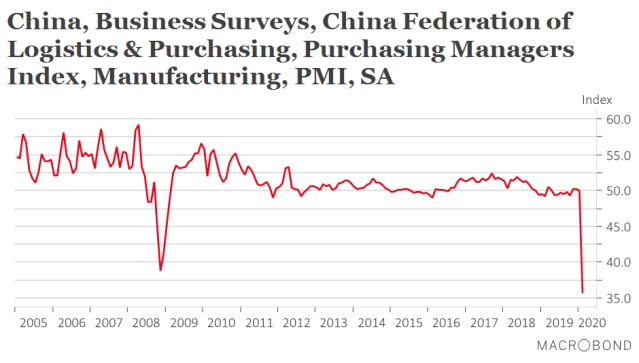
Modern-day stoics such as Tim Ferriss recommend you avoid regular news updates as they can distract your focus and increase your anxiety. There is much truth in this, particularly on days like this when you learn the latest news about how coronavirus is affecting the Chinese economy. The Financial Times has reported China factory index hits record low on coronavirus (pay-walled). The chart of the Chinese Purchasing Managers Index (PMI) shows a very steep drop to a level below that seen during the 2008 financial crisis (see chart below).

PMI chart

In Queensland, we may end up being affected by a wider range of indirect impacts as a potentially contracting Chinese economy could reduce its demand for our resource exports. So far, we’ve seen major impacts on international tourism and international education, as well as on seafood and agricultural produce exports to China, but we could end up experiencing impacts via lower resource exports if the virus isn’t contained soon.

In a highly-informative ABC interview last week, Queensland Deputy Premier-Treasurer Jackie Trad noted Queensland Treasury is estimating the adverse economic impact of coronavirus on Queensland at up to $1.7 billion in the 2019-20 financial year. That’s around 0.4-0.5% of Gross State Product (GSP).* With the latest news out of China, Treasury might need to consider increasing that estimated upper-bound impact of coronavirus. Obviously, coronavirus is a threat to the state government’s budget, an issue I’ll cover in a future post.

The latest Chinese PMI data will very likely add to the rising anxiety in global financial markets which sold off equities and retreated to government bonds last week.** The Australian share market fell nearly 10% last week and the ten-year Australian Government bond rate fell to around 0.75%, according to Trading Economics.

Central banks around the world, including our own RBA, will need to cut rates soon to try to restore confidence. The RBA board is meeting Tuesday and may well cut the cash rate. Check out Pete Wargent’s Plunge Protection Team post for useful information on how the financial markets are reacting to coronavirus and expectations regarding future interest rate reductions.

Finally, I’ll be recording an update of my discussion with CCIQ on the impact of coronavirus on the Queensland economy tomorrow, so check out QEW Monday night or Tuesday morning to get the latest news. For my previous interview, see:

CCIQ Coronavirus interview – Chief Economist “very concerned” about potential impacts

*Note that, at the time of the mid-year budget update last December, Queensland Treasury was forecasting 2.5% GSP growth in 2019-20.
**This post contains general information only and is not investment advice.

Posted in China, Uncategorized | Tagged , , , , , , | 2 Comments

The FIRE movement with Dr Di Johnson – Economics Explained ep. 24

My latest Economics Explained episode on the FIRE movement, in which I interview Griffith Business School lecturer Dr Di Johnson, is now available. FIRE stands for Financial Independence, Retire Early. By early, proponents typically mean retiring in your 30s or 40s. Popular FIRE blogs include  Mr Money Mustache and the Financial Samurai.

In addition to teaching and researching at Griffith, Di is a regular commentator on financial issues on ABC radio and TV. She is also a member of ASIC’s Financial Capability Research Network.

Use these timestamps to jump right to the highlights:

  • 1:40 – Dr Di provides an overview of the FIRE movement (also check out this Forbes article The 9 FIRE blogs you should read)
  • 3:45 – is the FIRE movement a millennial idea?
  • 7:35 – doing the math, you can see some big risks with the FIRE concept (Di mentions some information on average spending by singles and couples that was once on ASIC’s MoneySmart website: Weekly spend by life stage)
  • 11.20 – challenge of forecasting future living costs in decades to come – e.g. think about trying to forecast current Sydney cost of housing back in the 1970s
  • 16:40 – Di says some positives of the FIRE movement are it encourages people to save when they’re young and it promotes conscious consumerism
  • 23:05 – what is Barista FIRE?
  • 25:35 – discussion of digital nomads and vagabonding
  • 30:05 – Di notes it may be preferable just to find ways to make your current work more enjoyable – e.g. the slow work movement, taking longer holidays, etc.

The episode was recorded via Zoom video conferencing on the 25th of February 2020.

Economics Explained Logo

Posted in Uncategorized | Tagged , , , , , , , | Leave a comment

Cross River Rail cost blowout means project doesn’t stack up

Based on recent Courier-Mail reports of a huge cost blowout, the Cross River Rail project could deliver a net loss to the community of around $5 billion, or almost $1,000 for every Queenslander. 

The latest news about the troubled Cross River Rail project is unsurprising to those of us who have long been sceptical of the mega-project (e.g. see my Cross River Rail equals mega-project equals mega-risk from 2016). The Courier-Mail is reporting today that the Board overseeing Cross River Rail is being replaced, suggesting that rumours about a massive cost blowout of an additional $7 billion, as previously reported in the paper’s George St Beat column, are true.

It’s almost certain the project will not stack up from the Queensland community’s perspective. It may benefit some inner-city dwellers and workers, and to a small extent other SEQ rail travellers through a more efficient network, but the benefits to the whole state are insufficient to justify the potential $12 billion cost.

The Cross River Rail Business Case produced by Building Queensland reported net benefits for the project of $1.9 billion out to mid-century (p. E19). An additional $7 billion of costs (just to achieve the same level of gross benefits) would easily wipe out these net benefits. It’s easy to see that, in a worst-case scenario, the project could deliver a net loss to the community of around $5 billion, or $1,000 for every Queenslander.

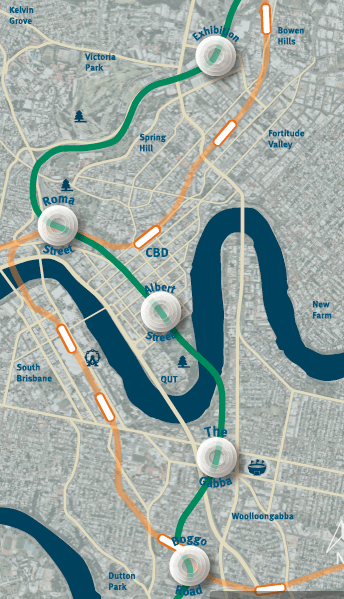
crr_map

The Cross River Rail route

Posted in Brisbane, Transport | Tagged , , , , , , | Leave a comment

Gig economy & side hustle business numbers growing strongly

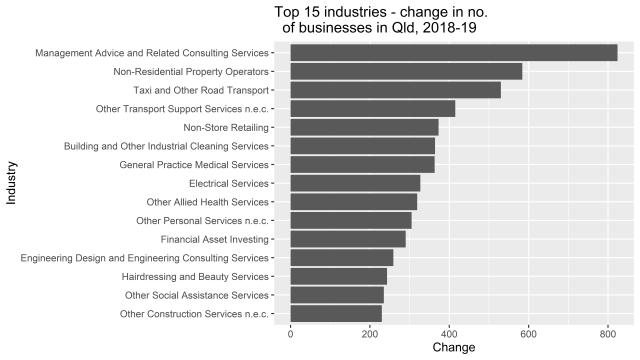
There has been strong growth in the number of gig economy and side hustle businesses in Queensland, according to ABS business counts data published last Thursday (see chart below). Topping the list of industries (at the 4-digit ANZSIC level) by the growth in business numbers in Queensland in 2018-19 was Management Advice and Related Consulting Services, which is the industry I expect my business is counted in, along with a wide variety of other consulting businesses. There were an additional 824 businesses in this industry by the end of 2018-19, a strong growth rate of 6.2%. The bulk of the growth that occurred in this industry was in non-employing businesses, i.e. sole traders, which increased by 520 businesses.

business_growth

In the ABS data, you can also see the impacts of Uber, on the growth in the number of Taxi and Other Road Transport businesses, and of e-commerce, on the growth in the number of Non-Store Retailing businesses. Far-North-Queensland-based economist Pete Faulkner has also noted the rise of the Uber driver in his latest post:

Business counts data shows the rise of the Uber driver

Of course, it’s pretty easy to get an Australian Business Number (ABN), so the data don’t necessarily tell us anything about the strength of the economy, which as I noted earlier this week isn’t running hot at the moment (see my Qld Hot or Not Update Presentation post). Moreover, in part, the growing number of gig economy businesses could reflect diminishing opportunities to pursue traditional careers as companies increasingly try to run lean-and-mean.

Regarding the pros and cons of the gig economy, check out my Economics Explained episode from last October The Gig Economy with Darren Brady Nelson.

If you’re contemplating becoming part of the gig economy or trying a side hustle, consider reading Seth Godin’s brilliant book This is Marketing, which I reviewed soon after it was published in late 2018:

Recommended reading: This is Marketing by Seth Godin

Posted in Labour market, Macroeconomy, Retail trade, Uncategorized | Tagged , , , , , , | 1 Comment